
Dad’s new romance leaves daughter fuming

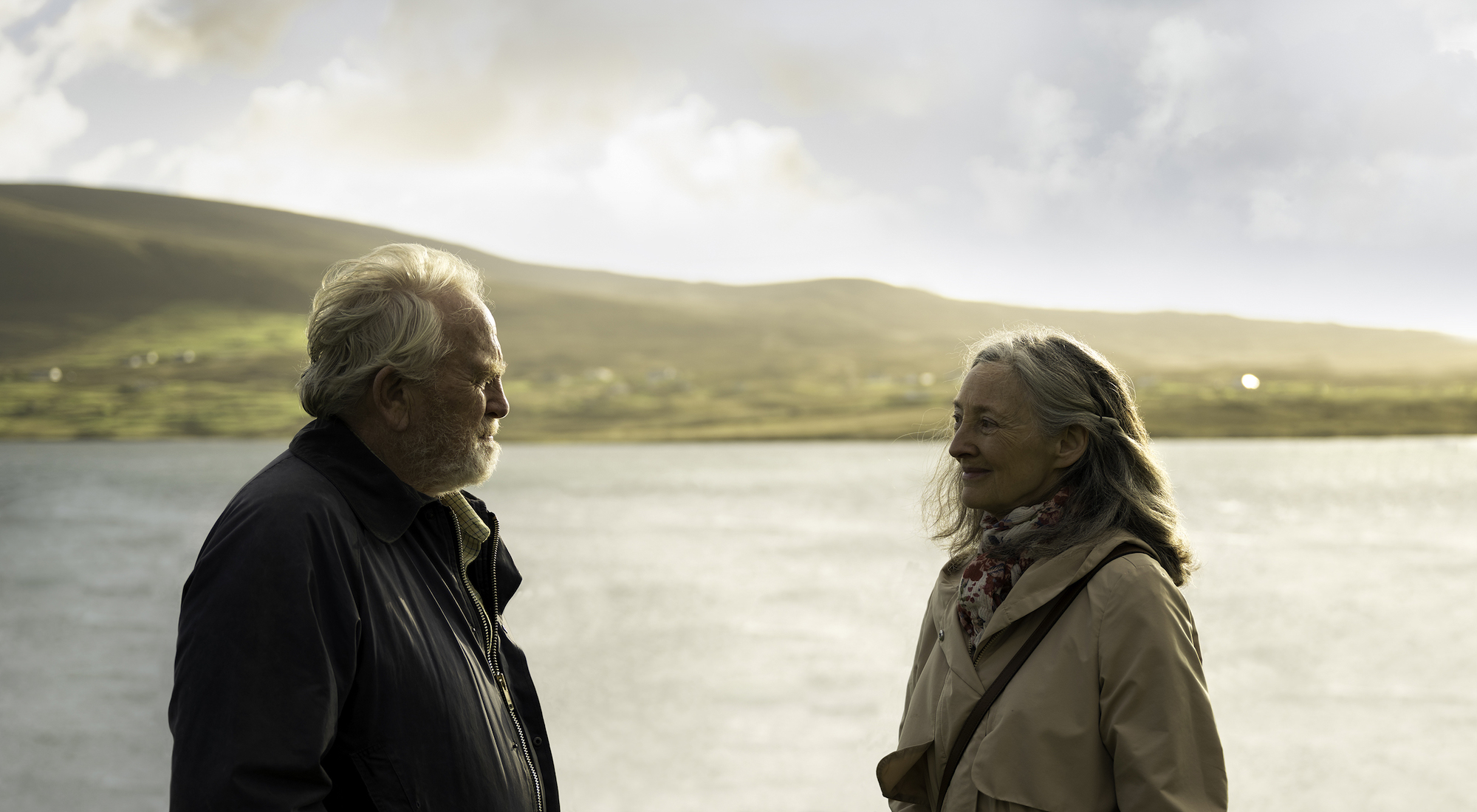
Howard (James Cosmo) enjoys the seaside scenery with housekeeper Annie (Brid Brennan) in My Sailor, My Love. (Photos courtesy of Music Box Films)

Senior citizens need love, too, as ABC hopes to prove with its upcoming debut of The Golden Bachelor. The same holds true across the pond, as Finnish director Klaus Haro demonstrates with his Ireland-set tale My Sailor, My Love.

The TV series, of course, is an extension of The Bachelor and The Bachelorette, “reality” shows that specialize in steamy encounters and dramatic histrionics. Don’t expect much of the former in Haro’s tale, but there are plenty of the latter. The only difference is, they don’t emanate from rejected suitors but from a daughter who’s unhappy about her father’s sudden interest in romance.

The daughter is Grace (Catherine Walker), a healthcare worker who spends most of her waking hours worrying about her aging dad, a retired sea captain named Howard (James Cosmos). When we first meet her, the situation has not only made her miserable, but it’s left her husband feeling so neglected that her marriage may be in jeopardy.

Realizing she can’t carry the burden of caring for Howard by herself, Grace hires a kindhearted widow named Annie (Brid Brennan) to serve as his parttime housekeeper. Howard, who’s accustomed to living on his own in his seaside home, soon sends Annie away, but a haphazard discovery convinces him he made a mistake. He then gathers a bouquet of flowers, starts up the car that’s been gathering dust in his garage and seeks her out.

Cue the heartfelt apology, courtesy of screenwriters Jimmy Karlsson and Kirsi Vikman. Also cue the gushing music, courtesy of composer Michelino Bisceglia. Set it all against gorgeous images of the Irish coastline, courtesy of cinematographer Robert Nordstrom.

In other words, love ensues, even though one wouldn’t expect a gruff hermit like Howard to jump into it so eagerly. But he does, resulting in a December-December romance that would be touching if it didn’t feel a bit contrived.
Then, just when we think the film is setting Howard and Annie up for happiness, Grace drops by with a sour attitude that looks a lot like jealousy. Rather than being grateful to Annie for making her father happy and taking care of his needs, she seems to resent her presence. Meanwhile, Howard displays a coldness toward his daughter that’s just as surprising, given the sacrifices she’s long made on his behalf.

What’s going on? Clues are doled out stingily over the course of the film, but an “aha” moment never arrives. The result is that despite assured performances by the major players, we don’t quite understand Grace and Howard’s motivations, and even Annie sometimes acts in a puzzling way.

With its combination of senior romance and family dysfunction, My Sailor, My Love is a tricky balancing act. Haro and company make a valiant effort, creating a handsome and sometimes appealing film in the process, but they don’t quite pull it off.

Rating: 3 stars (out of 5)

My Sailor, My Love (no MPAA rating) opens Sept. 22 in select theaters and will be available through VOD outlets beginning Oct. 24.

Indiana Jones has nothing on Ohio-based glacier explorer

Lonnie Thompson and his colleagues go to great trouble to extract ice cores like this from remote glaciers to learn the secrets they store about the earth’s past.

By Richard Ades

One admirer compares research scientist Lonnie Thompson to Indiana Jones. Another compares him to Clark Kent, the deceptively average-looking individual who is, in reality, Superman.

Both comparisons are apt, as we learn from Canary, a documentary directed by Danny O’Malley and Alex Rivest. The film details Thompson’s decades-long effort to uncover the history stored in glaciers found in some of the world’s highest and least-accessible locations. It also explains how the Ohio State professor became a major voice in the fight against climate change.

Even before the opening credits appear, we’re shown an incident in a war-torn area of Indonesia that encapsulates Thompson’s bravery and commitment to the environment.

After demanding to meet with him, members of a local tribe ask why he and his team are drilling into a mountaintop glacier that they consider the head of their god. Is he trying to steal the deity’s memory? Thompson tells them that’s exactly what he’s doing, because the glacier that stores the “memory” is in danger of melting away.

Serving as the film’s narrator along with other experts such as his wife, Ellen Mosley-Thompson—a glaciologist in her own right—Thompson explains that glaciers are like the canary in the coal mine. In the olden days, caged canaries were taken into mines to serve as early warning systems. If the air got too thin to keep the tiny birds alive, miners knew they had to leave quickly or suffer the same fate.

Thompson’s point is that glaciers have served the same function. By melting and shrinking, sometimes with shocking speed, they’ve offered some of the earliest evidence that the climate is changing and we’d better do something about it or suffer the consequences.

The analogy comes naturally to Thompson, as he was born and raised in a poor area of West Virginia that’s dominated by the coal industry. Ironically, considering the role fossil fuels have played in climate change, he originally enrolled at OSU to study coal geology. However, he eagerly switched fields when he was offered a job studying glaciers.

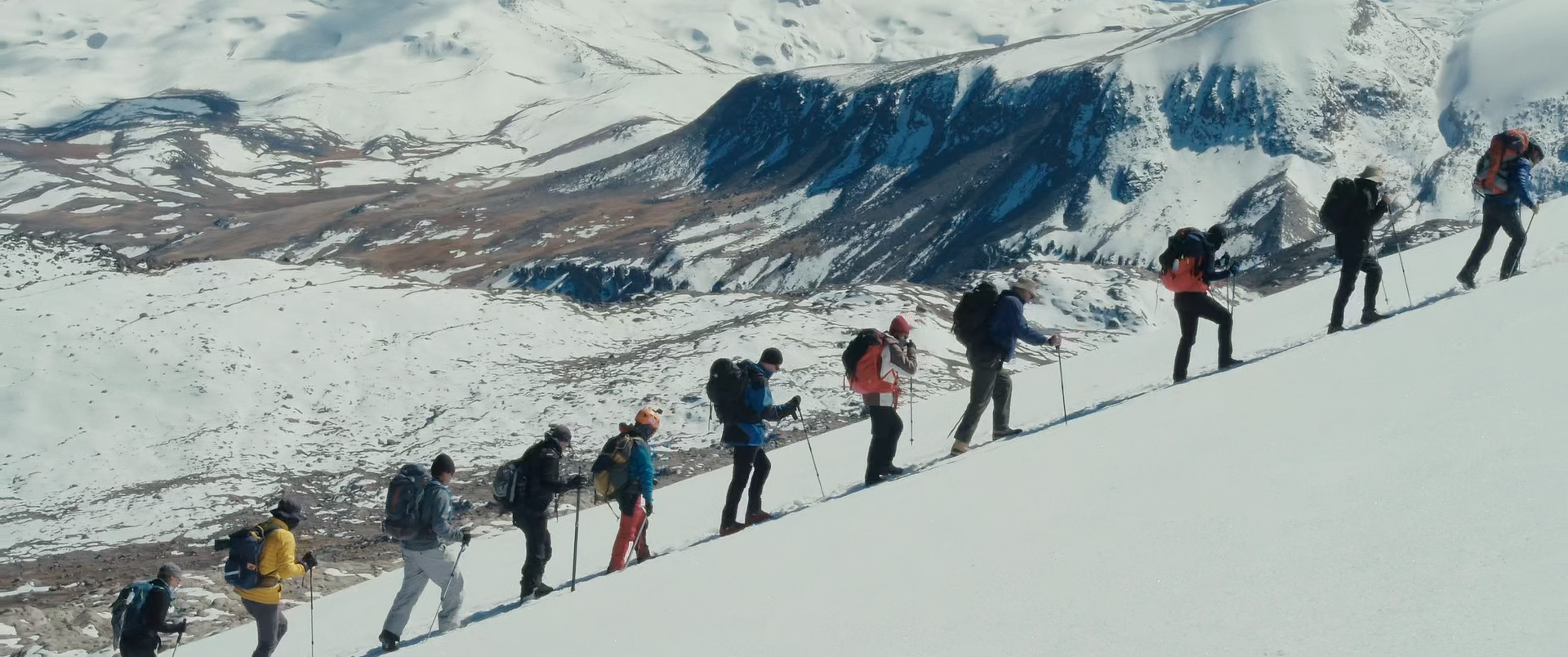
Thompson and his team climb to reach the next glacier.

With a combination of archival footage and contemporary interviews, the documentary explores Thompson’s career, which started with a years-long effort to access a mountaintop glacier located in a remote area of Peru. Though at first he was motivated solely by scientific curiosity, his discovery that glaciers around the world were shrinking eventually turned him into what he is today: a prominent cautionary voice in the fight against climate change.

Dramatic photography by cinematographer Devin Whetstone, accompanied by Paul Doucette and Jeff Russo’s equally dramatic score, set an appropriate tone for a film about a man engaged in a struggle for humanity’s survival. They help to make up for co-director O’Malley’s script, which sometimes fails to fill in salient details. Just what, for example, do Thompson and his colleagues do with the ice cores they work so hard to extract from glaciers? And what do these samples of ancient ice tell them about our planet?

But the film fills in just enough details when it reports on the rise of climate-change denial, a movement that caused politicians as diverse as Newt Gingrich, Sarah Palin and Mitt Romney to change from science supporters into science questioners. An eye-opening depiction of their transformation underscores the uphill battle Thompson and other activists face as they work to save humanity from its own excesses.   

Rating: 3½ stars (out of 5)

Canary opens Sept. 15 in select theaters in New York and Los Angeles, as well as the Gateway Film Center in Columbus. Subsequent one-night screenings are planned Sept. 20 in multiple markets. For details, visit canary.oscilliscope.net.