

A hidden Jean Kayak (Ryland Brickson Cole Tews, foreground) watches the industrious title characters at work in Hundreds of Beavers. (Photos courtesy of hundredsofbeavers.com)
By Richard Ades
What do you get when you take a drunk applejack salesman and strand him in a wintry wilderness filled with beavers?
If the beavers were real, you’d get a very strange nature documentary. But since they’re actually people dressed in animal costumes, you instead get Hundreds of Beavers, a comedy so bizarre that it’s probably on its way to achieving cult status.
Shot in black and white and with title cards rather than spoken dialogue, Beavers borrows some of its look and feel from the silent era. More often, though, it comes off as a (mostly) live-action version of early 20th-century cartoons, which sometimes had plots and visuals so surreal that you had to wonder just what the animaters were drinking and/or smoking.
You might end up wondering the same about director Mike Cheslik and his star, Ryland Brickson Cole Tews, who collaborated with him on the script. But however they got their inspiration, they brought it to life with skill, imagination and a taste for macabre humor.
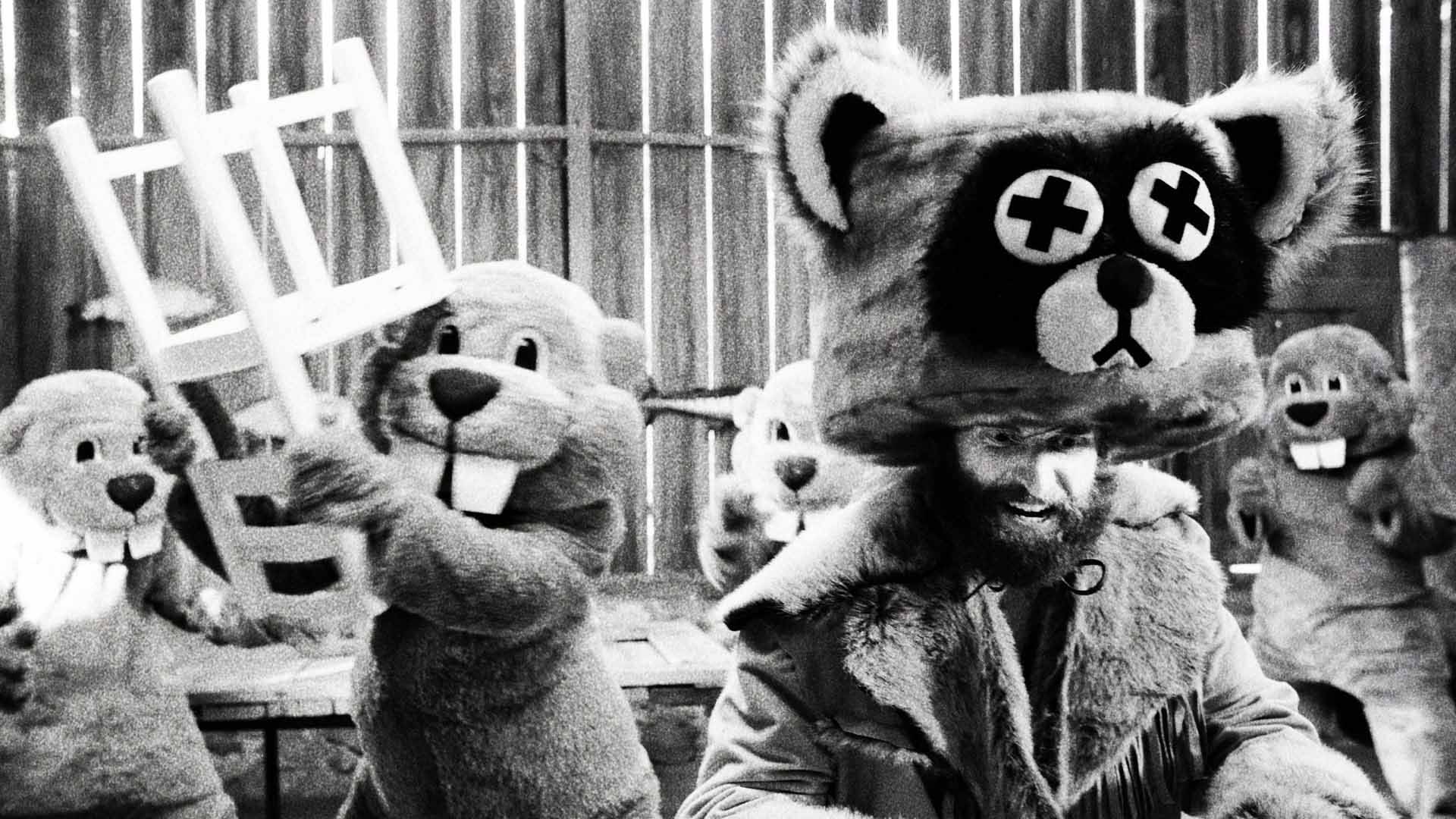
Angry beavers battle Jean Kayak, who’s wearing a hat made from one of their deceased comrades.
Tews plays Jean Kayak, who runs the Acme Applejack farm and seems determined to drink up the profits. Then a fiery explosion turns the farm into cinders and apparently leaves Kayak in a deep slumber. When he awakens months or years later, he finds himself alone in a world covered in deep snow.
At first, Kayak spends all of his time trying to stave off hunger by hunting giant rabbits (played, of course, by people in rabbit costumes). His efforts grow more and more elaborate, but like Wile E. Coyote in the old Road Runner cartoons, he always comes up empty. (The comparison is inescapable, as Kayak’s Acme Applejack farm is no doubt an homage to the Acme Co. from which Wile E. purchased his bird-trapping supplies.)
Things finally begin turning around for Kayak after he meets several new people, including a fur trader (Wes Tank) and a merchant (Doug Mancheski). The former helps him learn the trapping skills he needs to gain an advantage over the animals he’s been hunting, while the latter motivates him by offering rewards for their carcasses.
The biggest reward is the hand of the merchant’s furrier daughter (Olivia Graves) in marriage, but the price is steep: namely, “hundreds of beavers.”

The furrier (Olivia Graves) goes to work on a beaver carcass.
Director Cheslik turns the resulting battle royale between Kayak and the beavers into an inventive and sometimes comically gruesome treat with help from collaborators such as cinematographer Quinn Hester, composer Chris Ryan and special effects coordinator Brandon Kirkham.
Most viewers will be happy to accept all the clever mayhem at face value, but those looking for a deeper meaning may find it thanks to a final character: an Indian fur trader (Luis Rico) who befriends Kayak and sometimes helps him out.
The presence of a Native American, along with an early scene that’s reminiscent of the first Thanksgiving, may serve to remind us that Europeans’ “discovery” of the New World had a profound effect on its environment. Could it be that Kayak is meant to represent the early hunters and trappers who decimated animal populations to line their own pockets?
But if there is such a message, don’t worry. The flick never takes itself seriously enough to turn into an ecological lecture. Cheslik and his cohorts are having way too much fun for that.
Rating: 4 stars (out of 5)
Hundreds of Beavers can be seen in select theaters (including Central Ohio’s Drexel Theatre beginning April 5). It will be available online beginning April 15 via Prime Video and Apple TV, and beginning April 19 as an SVOD exclusive on Fandor.

 Reel Time With Richard Ades