Historic tale recounts pope’s abduction of Jewish boy

Edgardo (Enea Sala, left) receives a Catholic education after being abducted from his Jewish family in 1858. (Photos courtesy of Cohen Media Group)

By Richard Ades

Kidnapped: The Abduction of Edgardo Mortara relates the true story of a young Jewish boy who was taken from his parents so he could be converted to Christianity.

It’s a disturbing tale, but you may also find it a bit confusing unless you know something about Italian history. It also helps if you have a little patience.

Veteran director Marco Bellocchio takes his time unfolding the account of 6-year-old Edgardo Mortara, who is seized from his Bologna home in 1858 after Catholic officials learn he’d been secretly baptized as a baby. According to law, as the local “inquisitor” explains to the parents, he therefore must be raised as a Christian.

The boy’s father and mother, Salomone and Marianna (Fausto Russo Alesi and Barbara Ronchi), are shocked, as they know nothing about the baptism. They beg the official not to take their son, but their pleas only win them a 24-hour reprieve. After that, Edgardo (Enea Sala) is whisked away to Rome and enrolled in a school along with other boys who are training to become Catholic.
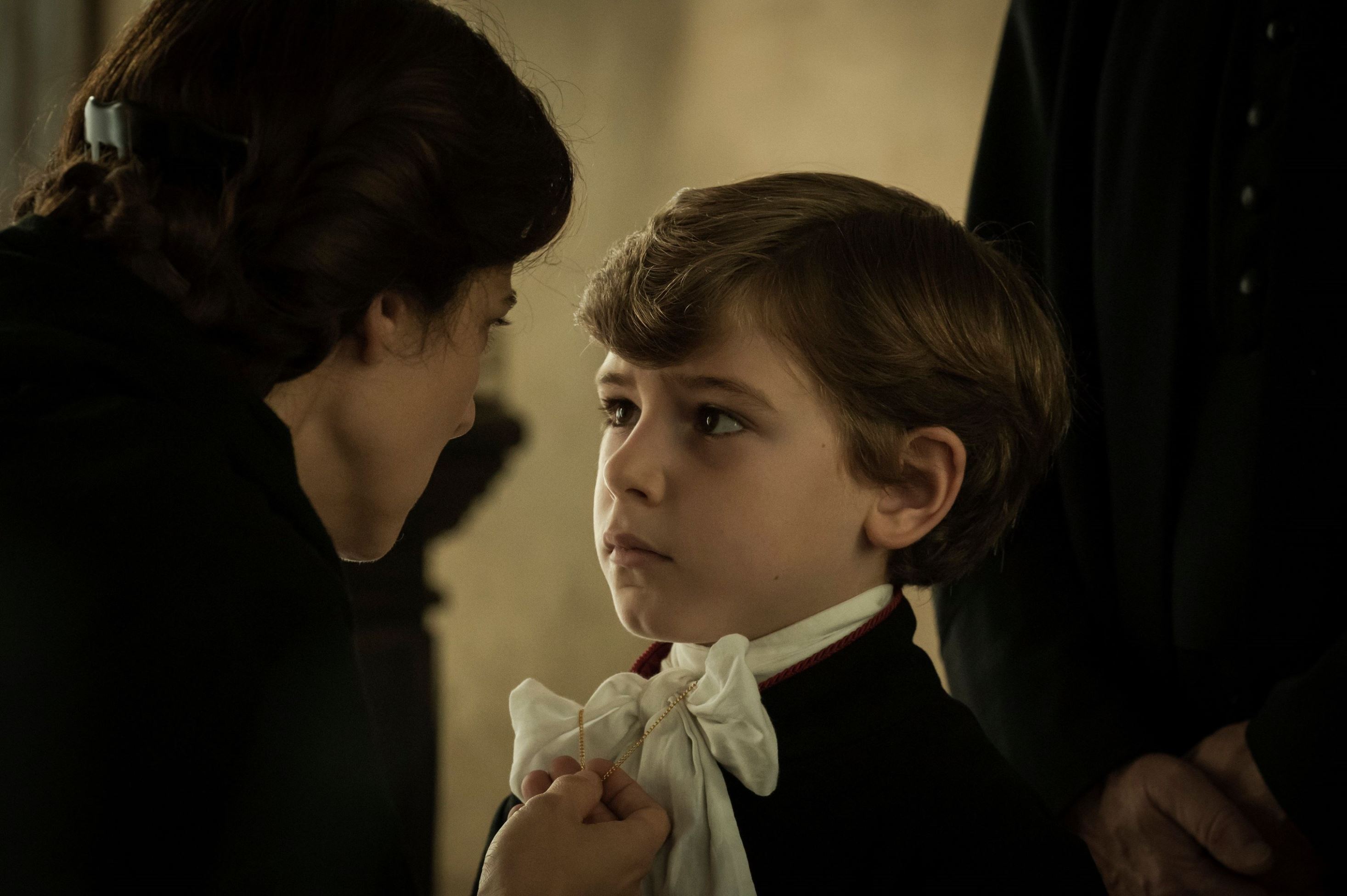
A distraught Marianna Mortara is allowed to visit her son (Enea Sala) months after he was abducted by Catholic officials.

In the months and years that follow, Salomone and Marianna do everything they can to reverse the church’s decision, including appealing their case to the press. But their efforts are stymied by Pope Pius IX (Paolo Pierobon), who takes a personal interest in the boy and refuses to give him up even after the abduction arouses international condemnation.

Director/co-scripter Bellocchio and most of his cast treat the tragic events with solemn restraint. Maybe a little too much restraint, as much of the film is weighed down by its own seriousness. There are effective scenes here and there, but the only actor who routinely shakes things up is Pierobon as the blustery and bullying Pius IX.

Another problem is that the script assumes the audience understands the complicated political atmosphere in which Edgardo’s ordeal is unfolding. In a much-simplified nutshell: Pius IX was in office at a time when Italians were rebelling against the pope’s power, which included controlling Rome and other parts of the country that were known as the Papal States. It all came to a head in 1871, when Italian troops captured Rome from the pope’s forces and unified Italy under one banner.  

Pope Pius IX (Paolo Pierobon) refuses to give up Edgardo (Enea Sala) even though the boy’s abduction has been greeted with international condemnation.

Unfortunately for those who aren’t knowledgeable about that history, Bellocchio skims over most of this in order to keep the focus on Edgardo, who by this time has grown into a young adult (played by Leonardo Maltese). It’s an understandable decision, but one that will leave many viewers confused about what’s really going on.

Kidnapped is about an act of official antisemitism that had an effect far beyond one Jewish individual and his family. As such, it has intrinsic interest, but the film would have had more impact if Bellocchio had imbued it with a bit more history and a bit less restraint.

Rating: 3 stars (out of 5)

Kidnapped: The Abduction of Edgardo Mortara opened May 24 in New York and Los Angeles and expands to additional cities beginning May 31. It will open in Columbus June 7 at the Gateway Film Center.

Holocaust escapee finds a home in pornography

Chelly Wilson does business out of her apartment in an old snapshot provided by the Wilson family. (Photos courtesy of Kory Miller/Obscured Pictures)

By Richard Ades

There have been many documentaries about Holocaust survivors. Queen of the Deuce is likely the only one about a survivor who went on to make her fortune in the porn industry.

Born into a family of Greek Jews in 1908, Chelly Wilson was quicker than most to recognize the rising threat Nazi Germany posed in the late 1930s. Temporarily leaving her son with her ex-husband and her daughter with a non-Jewish acquaintance, she hastily emigrated to New York, where she was soon making money selling hot dogs.

But Wilson’s real success came years later, when she began acquiring neighborhood movie theaters and devoting them to the increasingly popular genre of pornography. By the time soft porn began giving way to the hard variety, she was honchoing a business that ran a slew of theaters and even made its own features.

Directed and co-written by Valerie Kontakos, Queen of the Deuce tells Wilson’s story through interviews with her grown children and grandchildren, as well as people who worked with her over the years. Though she died in 1994, Wilson even makes an appearance herself thanks to home movies and interviews recorded by her family. In addition, an animated version of Wilson at various ages makes brief appearances to help us understand who she was and how she got that way.

An animated version of Chelly Wilson poses with some of her regular poker buddies in an image provided by Exile Films.

It all adds up to a portrait of an individual whose life was full of contradictions. For example:

⸱ She was a Jew who celebrated Christmas (which was also her birthday).

⸱ She was a lesbian but was married twice, including to a man she met in America.

⸱ She was a mother and grandmother who valued her family but sometimes kept them in the dark about her past.

A final contradiction is that, while many would label her a feminist thanks to her fierce independence, she made her living off a film genre that feminists of her era often considered misogynous.

In general, Wilson comes across as someone who proudly and unapologetically lived her life and was unafraid to thumb her nose at social norms. Director Kontakos does a good job of capturing her personality with major help from collaborators such as editor Rob Ruzic, composer Ken Myhr and lead animator Abhilasha Dewan.

As a bonus, Kontakos also captures the personality of New York in the 1960s and ’70s, before politicians such as Rudy Giuliani began working to reform its sex-, dirt- and crime-ridden image. Back then, the Big Apple might not have been as nice a place to visit as today’s cleaned-up version, but it obviously was the perfect home for a risk-taking entrepreneur named Chelly Wilson.

Rating: 4 stars (out of 5)

Queen of the Deuce previously made the rounds of several festivals, including the 2023 Columbus Jewish Film Festival. The film opens May 24 in select theaters and online through Amazon Prime Video and Apple TV.

He photographed folks the mainstream media ignored

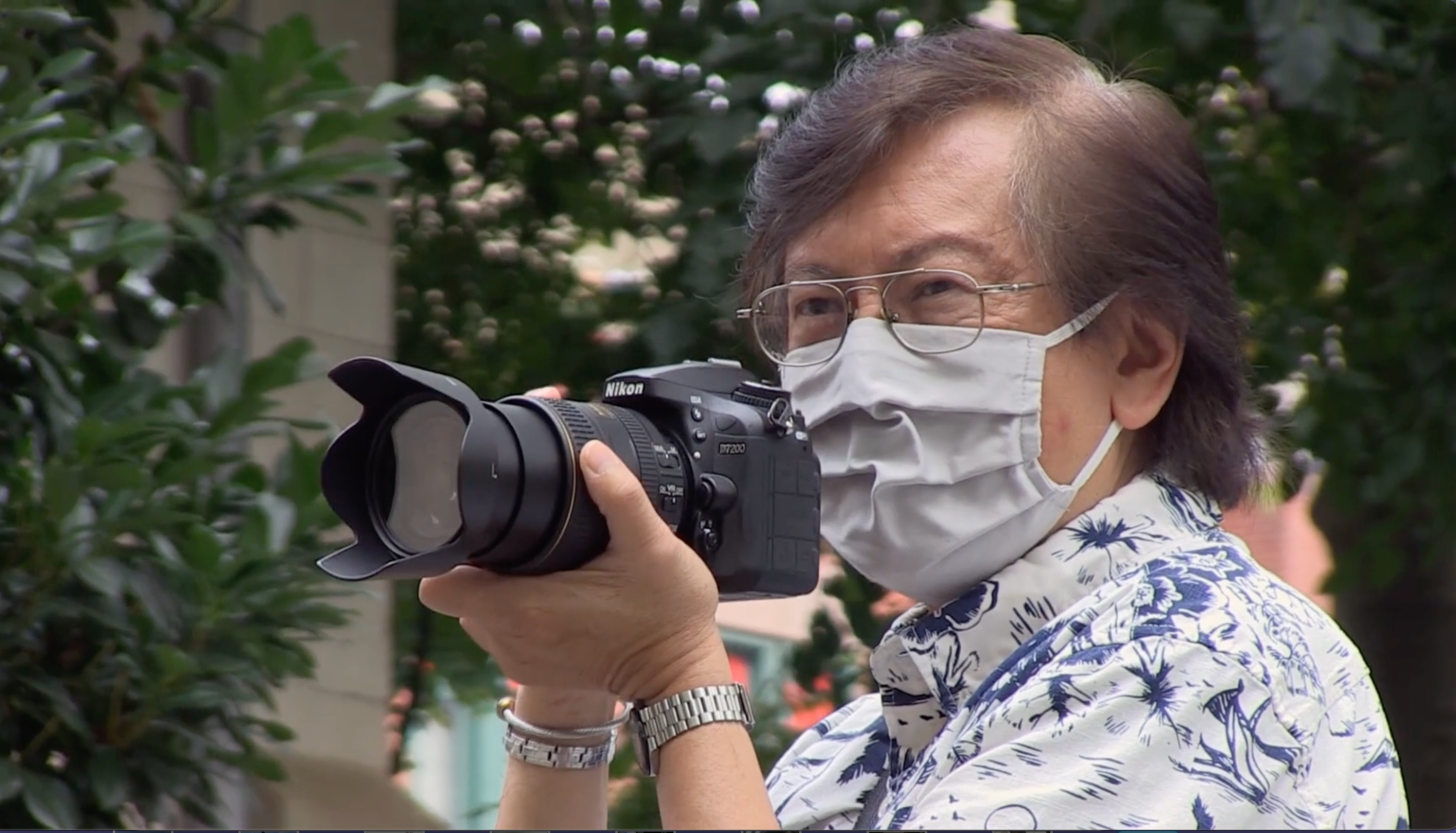
Wearing a mask during the COVID pandemic, Corky Lee gets ready to take his next photo. (Photos courtesy of All Is Well Pictures)

By Richard Ades

As a child, Corky Lee enjoyed comic books about superheroes, which he later credited with giving him a “moral compass.” As a Chinese American, however, he never saw any superheroes who looked like him.

Despite this fact (or maybe because of it), Lee grew up to be a kind of superhero himself—one whose “superpower” was simply taking the kind of pictures no one else was taking. Walking around New York City with a camera bag over his shoulder, he spent five decades chronicling the lives of Asian Americans and Pacific Islanders, people whose struggles and celebrations were often ignored by the mainstream media.

Lee and his lifelong crusade of inclusion are the subject of Photographic Justice: The Corky Lee Story, a documentary being shown on PBS in observance of Asian American and Pacific Islander Month.

Directed by Jennifer Takaki and featuring a combination of contemporary interviews and vintage footage, the film is a low-key but loving portrait of the man who became a fixture in New York’s Asian community. Whenever members of its many varied cultures and nationalities threw a parade, held a party or joined a picket line, Lee could be counted on to be there.

Love of country and love of New York are obvious in this photo Corky Lee took of a 2006 parade celebrating Budha’s birthday.

After decades of such coverage, the documentary tells us, Lee amassed so much knowledge about local AAPI-related events that kids jokingly referred to him as “Corkypedia.”

Besides showing up for Asian holidays such as the lunar new year and Budha’s birthday, Lee also covered national holidays, when he concentrated on providing an Asian American viewpoint. On Veterans Day, for example, he focused his lens on AAPI vets to show that Asians are as much a part of U.S. society as their European American counterparts.

According to the documentary, Lee felt this lesson became especially important when the country was hit with the 9/11 attacks in 2001 and with COVID in 2020. Muslim Americans and Chinese Americans, respectively, were scapegoated for these national and international tragedies, and he did what he could to counteract the resulting prejudice.

Sadly, the latter effort turned out to be his last. After viewing Takaki’s documentary, you’ll realize just how much of a loss that was.

Rating: 4 stars (out of 5)

Photographic Justice: The Corky Lee Story can be seen in select theaters and will air on PBS stations beginning May 13. Its Central Ohio airtime is 4 p.m. Sunday, May 19 on WOSU.

Celebrating the birth and rebirth of Tina Turner

Zurin Villanueva holds forth as Tina Turner in the North American Tour of Tina: The Tina Turner Musical. (Photo by Matthew Murphy for MurphyMade)

By Richard Ades

Tina: The Tina Turner Musical opens as the queen of rock psyches herself up for a concert that she hopes will relaunch her career.

The show eventually takes us to that concert, but not before it recaps Turner’s years’ worth of struggles with parents who abandoned her and a husband who abused her. It’s a long and painful journey that’s sometimes touching and other times, well, not. You may even be tempted to leave early, as a few audience members did toward the end of Tuesday’s opening night at the Ohio Theatre.

But don’t. I repeat, DO NOT LEAVE. Because when the show finally takes us to that concert, it may well be the best time you’ve had in ages.

With a book by Katori Hall, Frank Ketelaar and Kees Prins, Tina is a jukebox musical that revisits Turner’s classic hits while covering the highlights and (mostly) the lowlights of her life. After premiering in London in 2018, it opened the following year on Broadway, where it garnered a bevy of Tony nominations but won only for lead performer Adrienne Warren.

That suggests that the musical rises and falls on the strength of the performer who plays Tina, and how could it be otherwise? In the case of the touring production now visiting Columbus, it definitely rises, though not immediately. On Tuesday, Zurin Villanueva at first held forth with a voice that seemed too thin to do the role justice, but she gradually began adding elements of Tina’s iconic tones. By the time she launched into “River Deep—Mountain High,” she was Tina Turner.

Was Villanueva holding back in the beginning to dramatize the title character’s evolution into the powerhouse performer she would become? Likely. At any rate, she just kept getting better and better in a role that left her onstage and belting out tunes through most of the show. (Ari Groover takes over the demanding role in alternate performances.)

Anyone familiar with Tina Turner knows that she got her start (and her stage name) thanks to rock performer Ike Turner, who made her his lead singer and later married her, even though she was already pregnant with another musician’s child. It’s also well known that Ike was a physically abusive control freak. In the touring show, Deon Releford-Lee plays Ike as an all-out cad, though the script does give him a touch of humanity by revealing some of the Mississippi native’s disturbing brushes with Jim Crow racism.

When Tina at long last rebels against Ike’s brutality, it’s one of the show’s most moving moments, especially since it’s followed by the gorgeous “I Don’t Wanna Fight No More.” Tina’s struggles, however, have just begun, as she then spends years trying to reinvent herself as a solo performer.

Complicating her quest, the script suggests, is her understandable fear of submitting to another man’s control following her separation from Ike. This makes her cautious when an Australian music producer named Roger Davies (Dylan S. Wallach) appears out of nowhere and offers to help restart her career.  

Besides the talented folks already mentioned, top cast members include Carla R. Stewart as Tina’s supportive grandmother; Roz White as her mother; Gigi Lewis as her sister; Gerard M. Williams as Raymond, her first love; and Sarah Bockel as her manager, Rhonda. Worthy of special mention are Brianna Cameron and Symphony King, who alternate in the role of Anna-Mae, the girl who grows up to be Tina Turner.

Though the show sometimes drags things out a bit, especially during Act II, director Phyllida Lloyd mostly moves it along at a comfortable pace that escalates into pure exuberance during the spirited musical numbers. A dynamite band under Dani Lee Hutch’s direction accompanies the numbers, while choreographer Anthony Van Laast brings them to life by recreating Tina’s energetic dance moves.

Equally important are the behind-the-scenes technicians who back up the show’s dramatic and musical components with consistently compelling stage pictures, including lighting designer Bruno Poet and set/costume designer Mark Thompson. “Compelling,” by the way, turns into “gloriously over-the-top” once that final concert begins.

One final note: Don’t leave before the curtain call, and don’t leave after the curtain call, either, because that’s only the beginning of an extended “encore” that is the highlight of the entire evening.

Broadway in Columbus and CAPA will present Tina: The Tina Turner Musical through May 12 at the Ohio Theatre, 39 E. State St., Columbus. Showtimes are 7:30 p.m. through Thursday, 8 p.m. Friday, 2 and 8 p.m. Saturday, and 1 and 6:30 p.m. Sunday. Running time: 3 hours (including intermission and encore). For ticket information, visit columbus.broadway.com. For information about upcoming tour stops, visit tinaonbroadway.com/tickets/.