Dictator’s ploy traps migrants in deadly quagmire

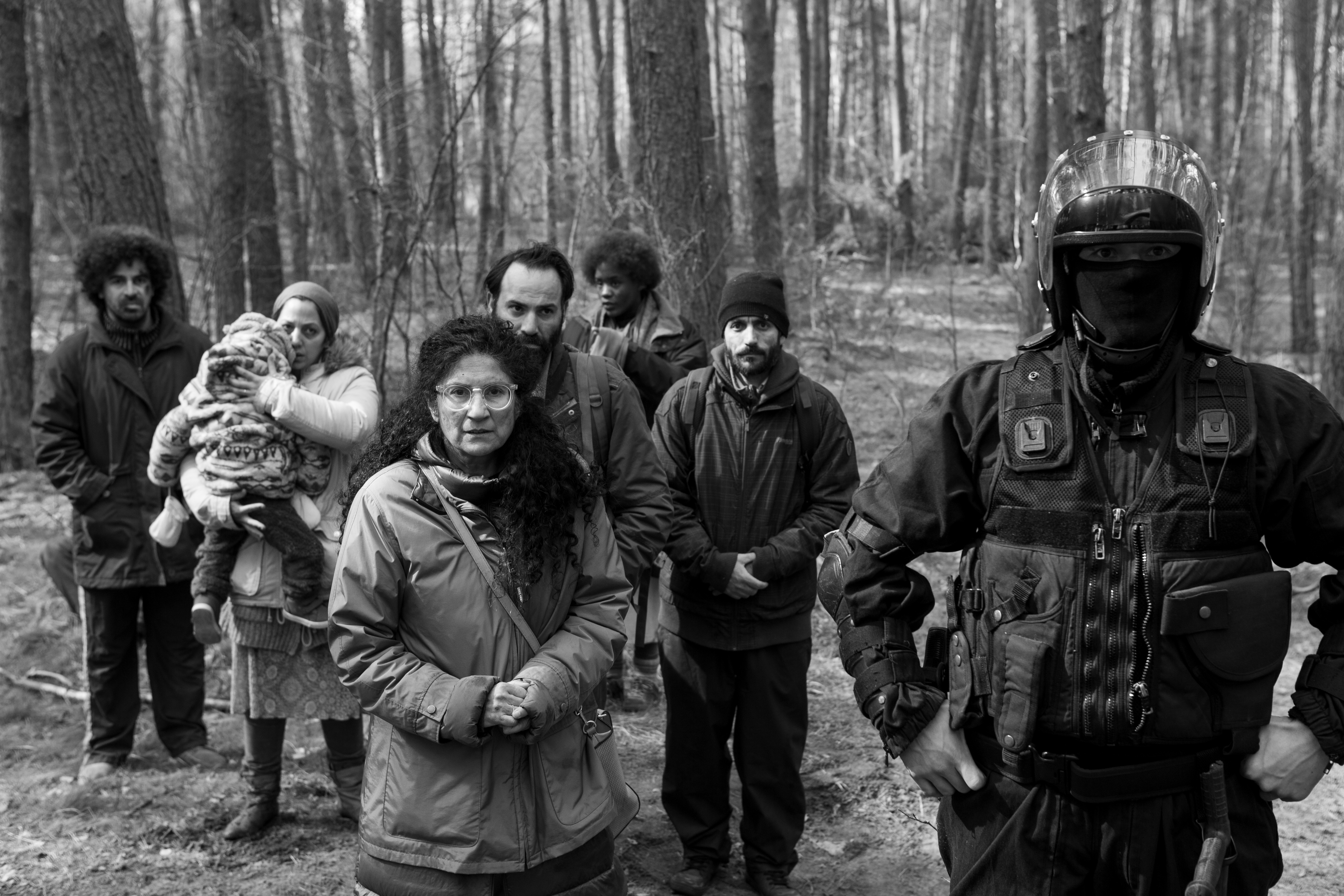
Leila (Behi Djanati Atai, glasses) and other migrants find themselves at the mercy of hostile border guards. (Photos courtesy of Kino Lorber)

By Richard Ades

The life of a migrant is an unending battle for survival.   

That was the message delivered by 2023’s Io Capitano, the story of two Senegalese teens’ perilous attempt to reach Europe. And it’s a message that comes across even more terrifyingly in Agnieszka Holland’s Green Border.

The acclaimed director sets her tale in a specific time and place: the border between Poland and Belarus in 2021. The year is significant because that’s when Belarusian dictator Alexander Lukashenko encouraged desperate people from around the world to travel to his communist country, where they supposedly would be guaranteed safe passage to Poland and the rest of the European Union.

As the film opens, we meet several people who’ve taken advantage of Lukashenko’s offer by catching a flight to Belarus. Among them are Bashir and Amina (Jalal Altawil and Dalia Naous), a Syrian couple who are traveling with an older relative and three young children. There’s also Leila (Behi Djanati Atai), an Afghan teacher fleeing Taliban persecution.  

Upon landing in Belarus, the Syrians allow Leila to share their prearranged ride to the Polish border. Once there, however, they realize that Lukashenko’s promise of safe passage was a hoax. After being forced to pay a bribe, they’re shoved through an opening in the barbed wire that separates the two hostile countries and left alone in a thick Polish forest with night coming on.

A young migrant girl peers through the barbed wire that separates Poland from Belarus.

But the real shock comes the next day, when they’re discovered by border guards who load them onto a truck and send them back to Belarus.

It soon becomes clear that neither country wants them and that they’re stuck in a kind of limbo, repeatedly being forced back and forth across the barbed-wire frontier. All the while, they’re cheated, derided and even brutalized by the guards and others they encounter.

Basically, this is a horror film, but one that replaces jump scares and gore with an unflinching look at the cruelty ordinary people can inflict on others whom they’ve dismissed as enemies and less than human. In such cases, not even children, elders or pregnant women are deemed worthy of compassion.

Working from a script she co-wrote with Maciej Pisuk and Gabriela Lazarkiewicz, Holland also looks at the migrants’ nightmarish situation from two additional viewpoints. One is through the eyes of Jan (Tomasz Wlosok), a young border guard who’s soon to be a father.

While attending a lecture given by his gung-ho superior, Jan is told that many of the migrants are pedophiles and other deviants, and that all amount to “live bullets” aimed at Poland by the dictator Lukashenko and his Russian buddy, Vladimir Putin. Despite this appeal to prejudice and patriotism, Jan is obviously torn as he goes about a job that frequently offends his sense of decency.
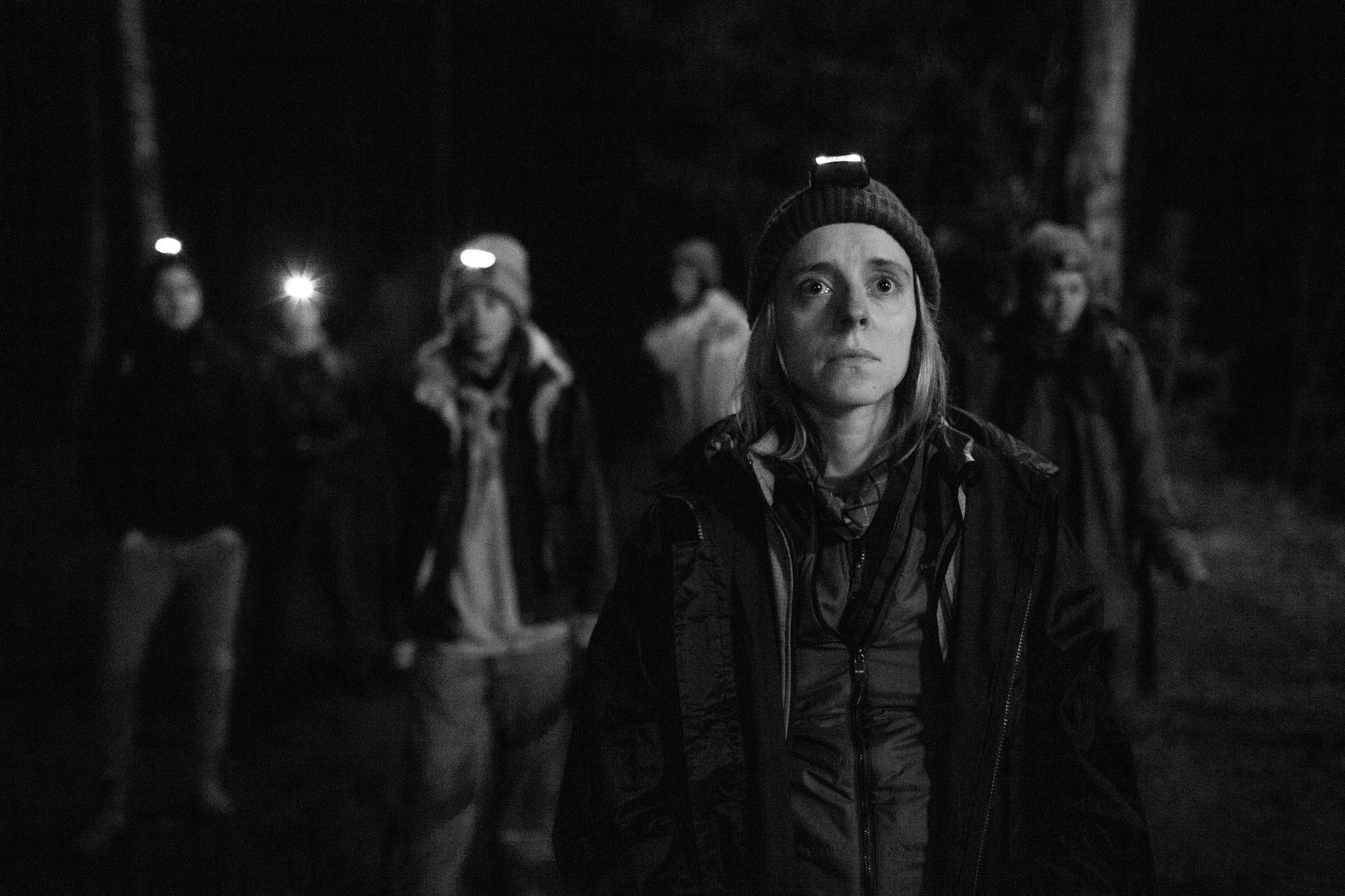
A group of Polish activists search for migrants caught in the no-man’s land between their country and Belarus.

The final viewpoint belongs to a group of activists who work undercover to aid the migrants. A widowed psychotherapist named Julia (Maja Ostaszewska) soon joins them, but she’s dismayed by their ineffectiveness and ultimately decides to take matters into her own hands.

All of the characters are portrayed with discipline and conviction by the cast, whose efforts are complemented by Tomasz Naumiuk’s black-and-white cinematography and Frederic Vercheval’s subtly expressive score.

Eventually, the stories of the migrants and others coalesce in ways that inject slivers of hope into the 2½-hour film. Otherwise, director/co-writer Holland offers few reasons for optimism about the plight of migrants in Europe or anywhere else.

Instead, she suggests that as long as governments can score political points by categorizing these desperate people as a subhuman threat, their suffering will continue.

Rating: 4½ stars (out of 5)

Green Border can be seen at select theaters, with more openings scheduled in the coming weeks. Columbus screenings are scheduled at 7 p.m. Friday, June 28 and 1 p.m. Saturday, June 29 at the Wexner Center for the Arts, and beginning July 5 at the Gateway Film Center. VOD screenings begin Aug. 20.

Decades later, ‘The Lion King’ still roars

The Lion King begins with “The Circle of Life,” which celebrates the birth of King Mufasa’s son, Simba. (Photo by Matthew Murphy; photos courtesy of Disney)  

By Richard Ades

It was almost exactly 20 years ago that I first saw the onstage version of The Lion King. After seeing it again last week, I looked up my review of that earlier production and realized it applies equally well to the current touring show.

That says a lot for the quality of the new production and for the timelessness of director Julie Taymor’s vision. The Lion King could have been just another Disney cartoon adapted for the stage, but Taymor employed African-inspired costumes, masks, puppetry and dance moves and turned it into a cultural phenomenon.

For her efforts, in 1998 Taymor became the first woman to win the Tony Award for best direction of a musical. In addition, the original Broadway production won well-deserved Tonys for scenic design (Richard Hudson), costume design (Taymor), lighting design (Donald Holder) and choreography (Garth Fagan) as well as the overall award for best musical.

Though the beautiful music and lyrics by Elton John and Tim Rice (and others) did not win a Tony, they contribute to the show’s groundbreaking character, starting with the fact that some of the key lyrics are in Swahili.

Maybe it’s less surprising that the book by Roger Allers and Irene Mecchi was Tony-less, as the story is simple and predictable: A majestic lion rules wisely over his kingdom until a jealous brother engineers his demise, after which the monarch’s young son must decide whether to fight for justice and his position as the rightful heir.  

It’s a tale as old as time—or at least as old as Hamlet. What makes it compelling is the show’s spirit and style, as delivered by a committed cast of fine actors, singers and dancers.

Cheetahs and giraffes are among the animals creatively portrayed with the help of life-size puppets. (Photo by Joan Marcus)

Major figures in the current touring show are Gerald Ramsey as the noble King Mufasa; Peter Hargrave as his villainous brother, Scar; Nick LaMedica as Mufasa’s hornbill steward, Zazu; Darian Sanders as the grownup version of the prince, Simba; and Khalifa White as Simba’s friend, Nala.

Appearing in alternate performances as the younger versions of the latter two characters are Bryce Christian Thompson and Julian Villela as Simba, and Ritisha Chakraborty and Leela Chopra as Nala.

Finally, special mention must be made of Mukelisiwe Goba as Rafiki, the all-seeing mandrill (or is she a baboon?) who serves as viewers’ guide and narrator. When she gets things started with her full-throated rendition of “The Circle of Life,” we know this iconic show is in good hands.

As it was from the beginning, thanks to Julie Taymor.

P.S. Danya Taymor followed in her aunt’s footsteps Sunday by winning the Tony Award for best direction of a musical (The Outsiders, which also won for best musical). Obviously, talent runs in the family.

CAPA and Broadway in Columbus will present The Lion King through July 7 at the Ohio Theatre, 39 E. State St., Columbus. Showtimes are 7:30 p.m. Tuesdays-Thursdays (except July 4), 8 p.m. Fridays, 2 and 8 p.m. Saturdays, 1 and 6:30 p.m. Sundays, plus 2 p.m. June 20, 7:30 p.m. July 1 and 1 p.m. July 4. Running time: 2 hours, 30 minutes (including intermission). For ticket information, visit columbus.broadway.com. For information on future tour stops, visit lionking.com/tour/.

Animated sequel explores teenage anxieties

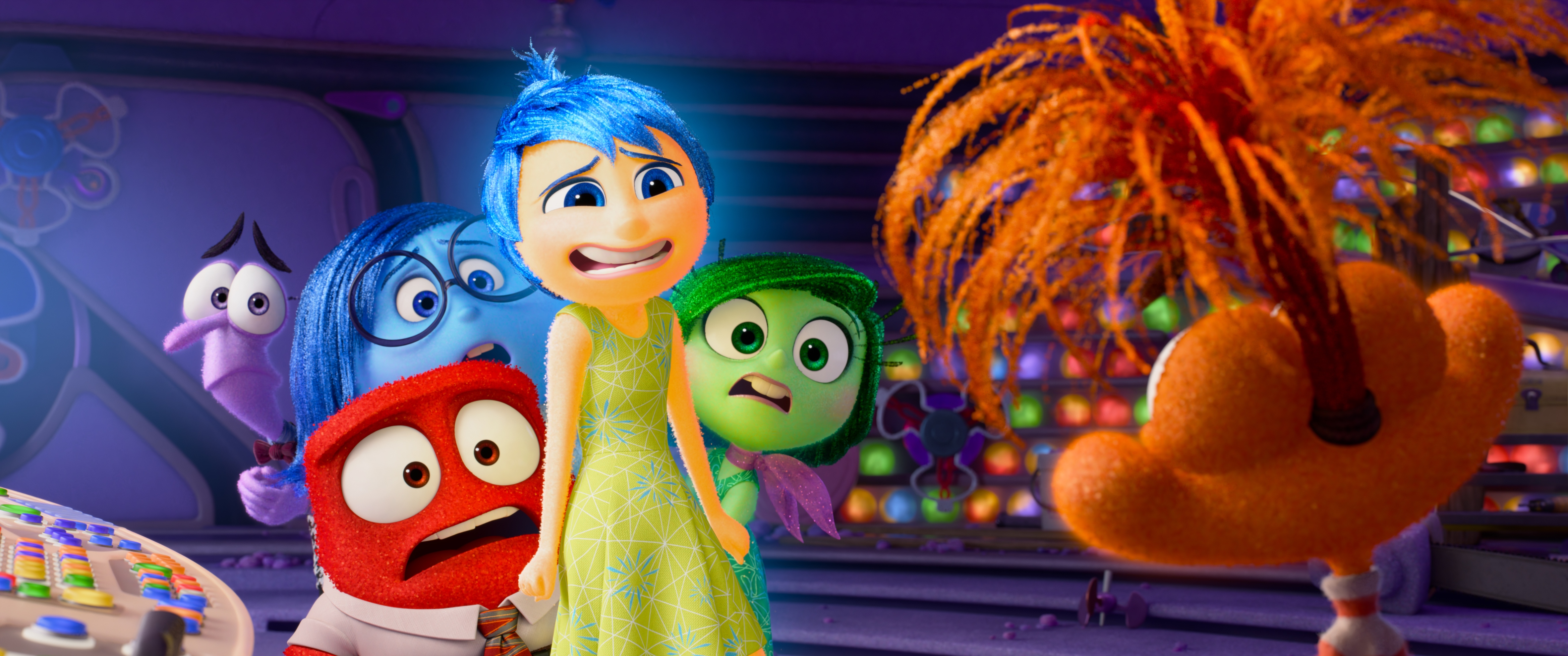
Joy (Amy Poehler, in green dress) and her fellow emotions encounter Anxiety (Maya Hawke), who suddenly appears when their host, Riley, becomes a teenager. (Photos courtesy of Disney/Pixar)

By Richard Ades

When we first met Riley in 2015’s Inside Out, she was a homesick 11-year-old whose family had just moved from Minnesota to San Francisco. True to its title, the Disney/Pixar pic mostly took place inside her head, where “Joy,” “Sadness” and other characters representing primary emotions struggled to help her deal with the seismic change.

It was an animated tour de force that brought psychological concepts such as personality, memory and sense of self to life with the help of endearing characters, imaginative landscapes and daredevil adventures.

Now we have Inside Out 2, which catches up with our hockey-playing heroine (voiced by Kensington Tallman) as a 13-year-old who seems to have settled into her new life. Once again, Joy (Amy Poehler), Sadness (Phyllis Smith) and their fellow emotions work tirelessly to keep Riley on an even keel.

All seems well until they come across a part of the growing girl’s psyche that they haven’t seen before: puberty. (Yes, the flick goes there.) Before they know it, they’re being evicted from the emotional “control room” and replaced by teen-appropriate newcomers such as Envy (Ayo Edebiri), Embarrassment (Paul Walter Hauser), Ennui (Adele Exarchopoulos) and their panic-prone leader, Anxiety (Maya Hawke).

Meanwhile, in the outside world, Riley is dealing with a series of disasters, starting with the realization that her changing body is suddenly in need of deodorant. What’s worse, she learns that her two best friends will be assigned to a different school next year.  

The upshot is that what originally seemed like good news—the hockey coach at her future high school invites her to take part in a “skills camp”—becomes a source of endless stress. Stuck in a “disgusting” body and soon to be separated from her BFFs, she pins all her happiness on making a good impression on the ice.

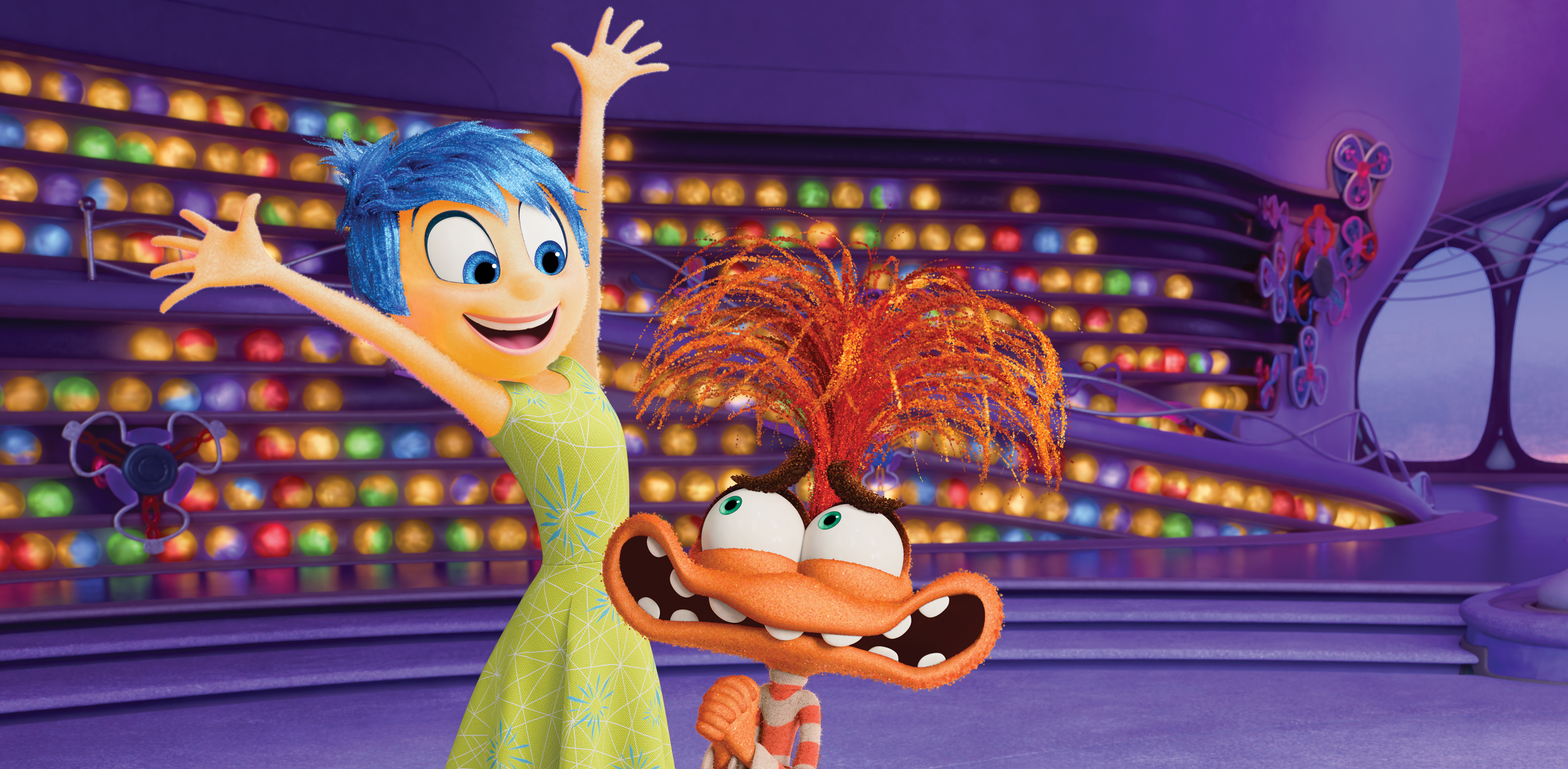
Joy (Amy Poehler, left) tries to make friends with Anxiety (Maya Hawke).

It’s obvious she’s headed for a meltdown, but Joy and the rest of her exiled emotional support group can only watch helplessly while Anxiety and the other newcomers fuel the girl’s misgivings.

Directed by Kelsey Mann from a funny, heartfelt and clever script by Dave Holstein and Meg LeFauve, Inside Out 2 is brilliant at depicting the fears and doubts swirling around the mind of a typical teenage girl. If there’s any disappointment at all, it’s that the Riley’s relationship with her friends hits a variation of a snag that we’ve seen countless times before.

On the other hand, we’ve never seen it depicted with such glorious visuals. In true Pixar fashion, the animation is beautiful, if sometimes a bit overwhelming. The same can be said for the sound design, especially if you see the film, as I did, in an IMAX theater.

Aided by an invested cast, it all leads to an engrossing and rewarding story that should appeal to teens and pre-teens, as well as anyone who remembers what it was like to go through that difficult time of life when everything was changing.

Rating: 4 stars (out of 5)

Inside Out 2 (rated PG) opens June 14 at theaters nationwide.