Staged film adaptation goes heavy on spectacle

Cast members show off some of the high-flying choreography that won Some Like It Hot one of its four Tony Awards on Broadway.

By Richard Ades

“Well, nobody’s perfect.” It’s ironic that one of the most famous last lines in the history of cinema belongs to a film that’s pretty much perfect.

Billy Wilder’s Some Like It Hot stars Tony Curtis and Jack Lemmon as Depression-era musicians Joe and Jerry, who are being chased by gangsters because they accidentally witnessed a mob execution. Disguising themselves as women, they join an “all-girl band,” where their attempts to fit in are complicated by Joe’s attraction to the lead singer and Jerry’s acquisition of an admirer who refuses to take “no” for an answer.

It’s always risky trying to adapt a work as universally loved and admired as Wilder’s 1959 comedy, so it’s not surprising that the stage version of Some Like It Hot fails to achieve the original’s perfection. What’s disappointing is that it could have been a lot better.

With a book by Matthew Lopez and Amber Ruffin, and songs by Marc Shaiman and Scott Wittman, the musical opened on Broadway in late 2022 and closed just over a year later. Despite the relatively short run, the show garnered a slew of Tony nominations and won four. Besides best actor in a musical, it took home awards for costume design, choreography and orchestrations.

These wins point to some of the show’s strong points, which are also evident in the touring production that opened Tuesday at Columbus’s Ohio Theatre.

Director/choreographer Casey Nicholaw imbues the many song-and-dance numbers with high kicks and precision tapping, all backed by Charlie Rosen and Bryan Carter’s brassy, jazzy orchestrations. Meanwhile, Gregg Barnes outfits the characters in imaginative period costumes. Combined with Scott Pask’s gorgeous set designs, it all adds up to a colorful spectacle.

In a way, that’s part of the reason the show falls short of the film that inspired it. Far from a spectacle, Wilder’s classic was the comic but heartfelt tale of two men who disguise themselves to stay alive and find their lives altered as a result. Not only do they learn what it’s like to be a woman in a man’s world, but one of them finds that living as a woman is strangely fulfilling.

In the touring show, Matt Loehr and Tavis Kordell star as buddies Joe and Jerry, respectively, who don dresses and disguise themselves as Josephine and Daphne. Both get plenty of opportunities to show off their dancing and singing skills, but they have fewer chances to define their evolving characters. And Jerry, in particular, evolves a lot, becoming increasingly comfortable in the guise of the invented Daphne. (Like the Tony-winning actor who played Jerry on Broadway, Kordell identifies as nonbinary.)

As Sugar, the band’s lead singer, Leandra Ellis-Gaston displays fairly decent pipes but was sometimes overpowered by the band on opening night. In fact, several singers faced the same problem, pointing to the possibility that the sound balance was in need of tweaking. A related problem is that the lyrics were often hard to make out, weakening songs that weren’t that memorable to begin with.

One singer who managed to come through loud and clear on Tuesday was DeQuina Moore, who gives a powerhouse performance as band leader Sweet Sue. Filling out the leading cast members, Edward Juvier is a hoot as Osgood, the millionaire who takes a liking to Daphne.

Of the two acts, the second comes closer to the spirit of the movie, slowing down enough to allow Loehr, Kordell and Ellis-Gaston to flesh out their characters. However, it ends with a seemingly endless slapstick number that involves chases and slamming doors and would have been more at home in a bedroom farce.

Moral: If you’re going to adapt a classic movie for the stage, it helps if you understand just what made the movie great.

Broadway in Columbus will present Some Like It Hot through Nov. 23 at the Ohio Theatre, 39 E. State St., Columbus. Showtimes are 7:30 p.m. through Friday, 2 and 7:30 p.m. Saturday, and 1 and 6:30 p.m. Sunday. Running time: 2 hours, 45 minutes (including intermission). For ticket information, visit columbus.broadway.com. For information on future tour stops, visit somelikeithotmusical.com.

Reimagining the making of a classic

Jean-Paul Belmondo and Jean Seberg (Aubry Dullin and Zoey Deutch) act out a scene from Breathless in Nouvelle Vague, a dramatization of the making of the 1960 film. (Photos by Jean-Louis Fernandez/courtesy of Netflix)

By Richard Ades

Nouvelle Vague may be the most affectionate love letter to moviemaking since Francois Truffaut’s Day for Night (1973).

Directed by Richard Linklater, the new film reimagines the making of Breathless, the 1960 classic that established critic-turned-director Jean-Luc Godard as a star of the influential movement known as the French New Wave.

If you’re a devoted cinephile, it’s likely you’re already salivating. And make no mistake: Linklater made this film with you in mind.

Not only is it shot in the style of Breathless, with a handheld camera and black-and-white photography, but it announces the name of each historic participant—from the director and stars to the lowliest of crew members—as soon as he or she appears on the screen. Linklater assumes you’ll want to know.

But what if you’re not a cinephile? In that case, chances are you’ll be a bit less enthralled, but the flick still has much to offer thanks to a charming cast and a witty script that both reveres and pokes fun at Godard and his eccentric approach to moviemaking.

We first meet Godard (Guillaume Marbeck) as a critic who wears shades even in darkened theaters and who complains that he hasn’t fulfilled his dream of making his first movie by the age of 25. Urged on by fellow critics, and encouraged by their belief that the only authentic way to make cinema is on the cheap, he takes on a film based on a real-life criminal who’s charged with killing a cop.

Jean-Luc Godard (Guillaume Marbeck, left) takes a break with his leading man, Jean-Paul Belmondo (Aubry Dullin).

Godard quickly hires the then-unknown Jean-Paul Belmondo (Aubry Dullin) to play the protagonist, but he has more trouble casting the crook’s American girlfriend. Aiming high because he thinks it will boost the film’s box office potential, he begins a campaign to land rising star Jean Seberg (Zoey Deutch).

Seberg is reluctant but eventually agrees because the film treatment was co-authored by Truffaut (Adrien Rouyard), another critic-turned-director who’s already made a name for himself. Once shooting starts, however, she begins to think she made a mistake.

For one thing, Godard has no script, preferring to rely on last-minute inspiration. For another, he’s not afraid to suspend shooting if that inspiration doesn’t show up on time.

Jean-Paul Belmondo (Aubry Dullin) takes to the street for a climactic scene while cinematographer Raoul Coutard (Matthieu Penchinat) and director Jean-Luc Godard (Guillaume Marbeck) follow in an open-top Citroen.

After Godard threatens the production’s bare-bones budget by repeatedly sending his cast and crew home early, not only Seberg but producer Georges de Beauregard (Bruno Dreyfurst) becomes worried. Beauregard repeatedly lowers the boom, but Godard refuses to change his unconventional ways.

There’s no suspense over the outcome, of course. We know going in that Breathless will become a groundbreaking success and Godard will go on to enjoy a decades-long career. The only question is just how he will accomplish this unlikely feat.

With a sense of history leavened by a sense of humor, Linklater answers that question in a way that should leave cinephiles fascinated and everyone else pleasantly entertained. 

Rating: 4½ stars (out of 5)

Nouvelle Vague (rated R) can be seen at select theaters and is available on Netflix beginning Nov. 14.

Painful memories of an eradicated past

An animated sequence depicts Pelagia Radecka, a young resident of Gniewoszów, Poland, searching for survivors of antisemitic violence in 1945.

By Richard Ades

My community is getting ready for the annual Columbus Jewish Film Festival, but a local theater is beating it to the punch with one of the most powerful Holocaust-related documentaries you’re likely to see this year.

Among Neighbors, directed by Yoav Potash (Crime After Crime), is about the tragic and lasting effects World War II had on the town of Gniewoszów, Poland. The film is at once a history lesson, a tale of survival and a portrait of humanity at its best and its absolute worst.

It’s also a mystery, one whose solution isn’t provided until the film’s final moments.

Because the documentary does so much, and because Potash waits so long to connect seemingly disparate parts, it sometimes comes off as disjointed. But the dramatic end justifies the director’s suspense-building means, and the film is never less than compelling along the way.  

Using a combination of contemporary interviews, archival footage and eloquent hand-drawn animation, Potash introduces us to Gniewoszów both past and present.

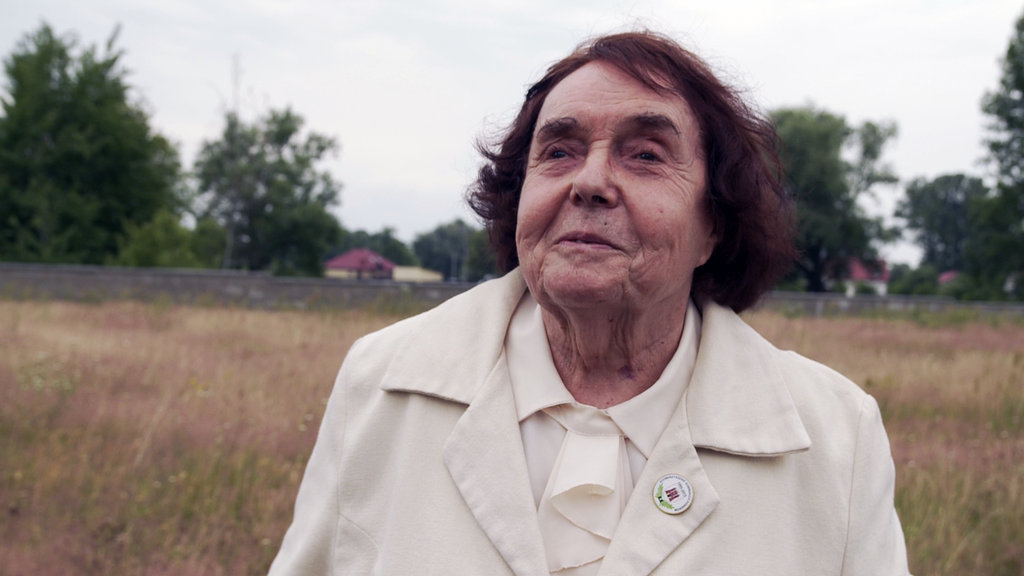
Pelagia Radecka, a Catholic resident of Gniewoszów, witnessed an act of antisemitic violence after the Nazis left her town.

In the past, Jews and Catholics lived together as neighbors and sometimes as friends, just as they had for centuries. But that all changed when Nazi Germany invaded Poland at the beginning of World War II and began instituting antisemitic restrictions that eventually evolved into roundups and death camps.

In response, a few Poles came to their Jewish neighbors’ defense, but more went along with the restrictions and even benefited from them. And some adopted the Nazis’ antisemitic and violent ways, even after the Germans had been driven out.  

As a result, Gniewoszów became a town whose Jewish residents have disappeared along with all traces of their former presence in the community. And most of its current residents are reluctant to talk about what happened to them, particularly since a 2018 law makes it illegal to suggest that Poles were in any way complicit in the Holocaust.

Yaacov Goldstein, a Jewish resident of Gniewoszów, survived the Holocaust and later moved to Israel.

Luckily for Potash, he’s able to find a few elderly residents who were alive during World War II and can be coaxed into telling what they remember. Two of them stand out:

˖ Yaacov Goldstein, a Jew who was a boy during World War II and later moved to Israel, tells the harrowing story of his parents’ efforts to survive and to protect him and his younger brother from the Nazis.

˖ Pelagia Radecka, a Catholic resident who was a teenager during the war, recalls being friends with the Jewish shopkeepers and their son who lived across the street. She also recalls witnessing a shocking act of antisemitic violence that occurred after the Germans had been driven out.

Bravely, Radecka is eager to talk about this act, even though she’s kept it to herself ever since, and even though talking about it amounts to a violation of Polish law.

Besides being a portrait of the highs and lows humans are capable of, Among Neighbors is a critique of societies that attempt to erase their sordid pasts. For Americans, living at a time when our own government is attempting to do the same, it could not be more timely.

Rating: 4½ stars (out of 5)  

Among Neighbors can be seen in select theaters, including Columbus’s Gateway Film Center, with screenings scheduled at 1:30 p.m. Oct. 25 and 26. For a list of other upcoming screenings, visit amongneighbors.com/screenings.

Tortured Iranian prisoners on a quest for justice

By Richard Ades

Two of the bravest movies I’ve seen in the past couple of years have taken aim at Iranian authoritarianism. In 2024, there was The Seed of the Sacred Fig, followed this year by the judo-centric Tatami.

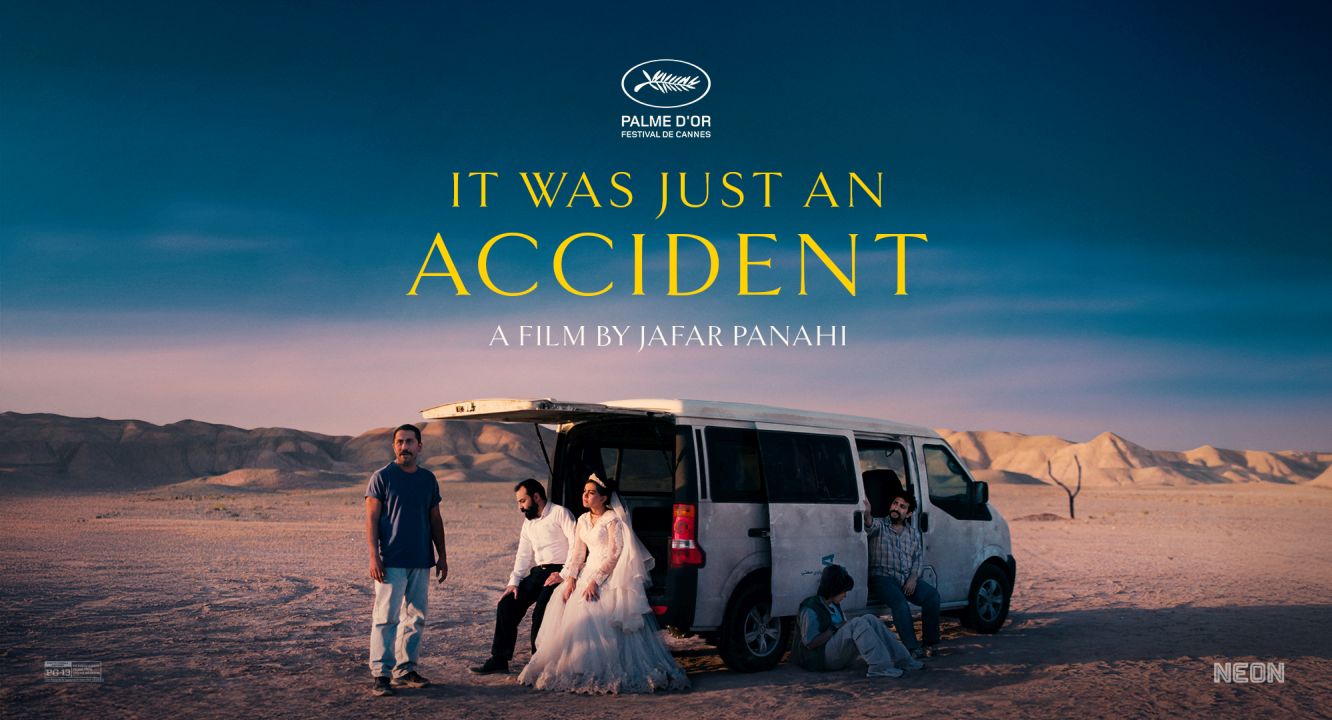
Now, add a third flick that raises a middle finger to Iran’s Islamic dictatorship: It Was Just an Accident, a ballsy effort written and directed by Jafar Panahi. The low-budget thriller deftly creates tension leavened with flashes of humor, all the while wading through moral quagmires and asking questions that defy easy answers.

The tale begins on a dark highway, where we meet a family man (Ebrahim Azizi) who’s driving home with his wife and young daughter when his car breaks down in front of a garage that’s closed for the night.

Luckily for him, the mechanic agrees to take a look at his vehicle anyway. Unluckily for him, the mechanic’s assistant thinks he recognizes this stranded motorist.

Vahid (Vahid Mobaserri) once spent years in prison after being charged with political “crimes” against the state. While there, he was interrogated and tortured by a guard whose face he never saw, but who was recognizable by the squeaking sounds made by his artificial leg.

Vahid thinks he hears the same sounds when this stranger enters his garage.

What follows is a quest for justice—or vengeance, depending on your point of view. Eventually finding a way to capture the motorist, Vahid prepares to bury him alive, only to be attacked by doubt when the stranger claims it’s a case of mistaken identity.

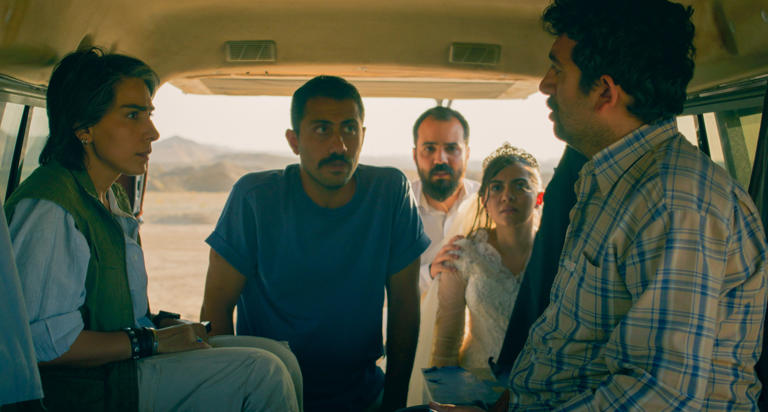
Discussing the fate of their prisoner, whom they suspect of being a sadistic former prison guard, are (from left) Shiva (Miriam Afshari), Hamid (Mohamad Ali Elyasmehr), Ali (Majid Panahi), Golrokh (Hadis Pakbaten) and Vahid (Vahid Mobaserri). (Photo courtesy of Neon)

Vahid then begins rounding up fellow victims of the guard variously known as “Eghbal the Pegleg” or “the Gimp” in hopes someone can make a positive identification. It’s a motley crew, ranging from a photographer (Miriam Afshari) and her tempestuous ex (Mohamad Ali Elyasmehr) to a bride (Hadis Pakbaten) who’s already decked out in her wedding gown.

Driving around in Vahid’s decrepit van, they vent about their prison experiences and argue about whether the drugged man in the back is really their former tormenter—and, if so, what to do with him. Should they make him pay with his life, or would that simply lower them to the government’s level?

These are heavy considerations, and yet writer/director Panahi manages to add bits of humor that often stem from cultural quirks. For example, it seems that not even kidnappers are immune from paying the tips, gifts and bribes that apparently are a part of Iranian daily life.

Beautifully acted by a committed cast, and beautifully photographed by cinematographer Amin Jafari, It Was Just an Accident is mesmerizing from its beginning to its cathartic and intriguingly nebulous ending. The fact that Panahi made this subversive film without the government’s permission—and thus, in secret—just makes his achievement all the more astounding.

Rating: 4½ stars (out of 5)

It Was Just an Accident (no MPA rating) opens theatrically Oct. 15 in New York City and expands to other markets Oct. 24 and 31.

Adapted fairy tale brings together hermit, runaway teen

Ivan Martin plays the character known only as the “Woodsman” in writer/director Kelsey Taylor’s adaptation of a familiar fairy tale. (Photos courtesy of To Kill a Wolf)

By Richard Ades

Most of us are familiar with Little Red Riding Hood, the story of a girl who ventures into the woods and has a disastrous encounter with a hungry wolf. The fairy tale is generally considered a symbolic warning to girls about the dangers they face from human “wolves” (i.e., lechers) as they approach womanhood.   

With To Kill a Wolf, writer/director Kelsey Taylor takes the tale’s basic characters and injects them into a modern yarn with an entirely different message. While the original story cautions listeners to avoid danger, Taylor’s adaptation is about dealing with danger’s aftermath: the guilt, shame and other reactions that remain after a catastrophe that was at least partly one’s own fault.

Switching the order of the original tale, Taylor starts out by introducing us to the “Woodsman” (Ivan Martin), a grizzled middle-aged man who lives on his own in a remote, wooded area of Oregon. We first meet the hermit when he’s prowling among the trees with a metal detector searching for—what?

The answer comes when the detector alerts him to an object buried under leaves on the forest floor. It’s an animal trap, the kind that’s designed to clamp onto its unsuspecting prey’s leg and hold it until the creature either starves to death or is dispatched by the trap’s owner.

The man sets off the trap, rendering it harmless, and moves on.

It’s in the midst of such a search that the Woodsman discovers a teenage girl lying on the snowy ground, unconscious and near death. After taking her home and nursing her back to health, he asks how she ended up in that situation, to which he receives the evasive reply, “I don’t know.”

Dani (Maddison Brown) refuses to explain how she ended up alone in the woods.

We later learn that this Red Riding Hood stand-in is a 17-year-old runaway named Dani (Maddison Brown), but the girl stubbornly refuses to answer the Woodsman’s questions about her past. She’s obviously been through some kind of trauma, and whatever it was seems to have rendered her incapable of trusting another human being.

Almost as obvious is the fact that the Woodsman has been through a trauma of his own, as evidenced not only by his lonely lifestyle but by the artificial limb that’s hidden under his pants leg.

The two traumas, the girl’s and the man’s, form a mystery that’s only gradually explained with the help of an extended flashback and other devices. Keeping us invested along the way are two intriguing performances: Martin’s as the gruff but well-meaning Woodsman and Brown’s as the girl who keeps her emotions inside until it’s no longer possible.

Ably filling out the main cast are David Knell as a local rancher, and Kaitlin Doubleday and Michael Esper as Dani’s estranged aunt and uncle. Behind the scenes, the film benefits from the artistry of cinematographer Adam Lee and composers Sara Barone and Forest Christenson.

Directing her first feature-length film, Taylor has created a layered gem that’s at once a mystery, a character study and a meditation on the difficulty of healing from one’s own past. It’s an impressive debut, to say the least.

Rating: 4½ stars (out of 5)

To Kill a Wolf is available through VOD outlets beginning Sept. 23 and will screen virtually Sept. 25-30 through the Popcorn List’s Pop-up Series.

Pioneer left her mark on 1950s cheesecake photography

Model-turned-photographer Bunny Yeager poses with a tool of her trade. (Photos courtesy of Music Box Films)

By Richard Ades

Lots of women posed for Playboy when it first hit newsstands in the 1950s. Bunny Yeager was attractive enough to be one of them, but she instead opted to make her mark on the other side of the camera lens.

The story of this celebrated cheesecake photographer is told in Naked Ambition, a documentary directed by Dennis Scholl and Kareem Tabsch.

Featuring vintage film footage and interviews with people who knew her, the flick depicts Yeager as someone who played a big role in shaking up America’s puritanical attitudes toward sex and nudity.

Yeager was introduced to the craft of taking naughty pictures by posing for a few herself when she worked as a model beginning in the ’40s. The experience proved to be helpful when she decided to switch roles, the doc tells us, as it allowed her make her own models feel more at ease.

As someone who’d spent time in front of the camera herself, Yeager knew the women were mainly concerned about looking their best. By demonstrating that she understood them and was on their side, she turned each photo session into a collaborative effort.

The result: images that were not only sexy but joyfully so, and which allowed the personality of each individual woman to come through.

Bunny Yeager helped to turn Bettie Page into a popular pinup model.

While helping her subjects achieve centerfold celebrity—and helping Hugh Hefner turn his cheeky magazine into a success—Yeager achieved a fair amount of fame herself. She even made an appearance on the TV game show What’s My Line, where the panelists were unable to guess that her “line” was “cheesecake photographer.”

Among her friends and admirers who appear in the documentary is the late talk show host Larry King, who shares a long anecdote that is amusing but has little to do with Yeager herself. Mostly, though, directors Scholl and Tabsch properly keep the focus on the woman who became known as “the world’s prettiest photographer.”

Sadly, Yeager’s life had its share of challenges and tragedies. Ironically, the doc points out, one of the biggest challenges was brought about by the changing attitudes she helped to foster.

As society became more and more open to sexually oriented images, the images themselves became increasingly hard-core. By the mid-1970s, especially after the launch of Hustler magazine, the emphasis was on (porno-)graphic nudity rather than the kind of subtle artistry that was Yeager’s stock in trade.

Suddenly out of work, the photographer was forced to reinvent herself—which she did, again and again.

Maria Stinger poses with a pair of cheetahs during one of Yeager’s typically elaborate photo shoots.

As a woman who found success in a field dominated by men, Yeager could be seen as a feminist icon. But since she found that success by taking sexy pictures of women for men’s enjoyment, she’s viewed by some feminists with mixed feelings. Indeed, we learn, her own daughters still disagree over the value of her legacy.

One thing that can’t be argued is that Yeager was a pioneer who left her mark on society. Naked Ambition remembers and honors her for that very reason.

Rating: 4 stars (out of 5)

Naked Ambition opens Sept. 12 in New York, Chicago, Los Angeles and Ottawa, Ontario, with additional openings scheduled in coming weeks. For a full list of engagements, visit musicboxfilms.com/film/naked-ambition/.

NYC-set flick inspired by romantic classic

Olivia (Mary Neely, left) and Amir (Kareem Rahma) are strangers who meet at the apartment of a man who owes each of them money. (Photos courtesy of Factory 25)

By Richard Ades

In 1995, director Richard Linklater came out with Before Sunrise, the tale of a man and a woman who meet on a train and decide to spend an eventful night exploring Vienna. Laced with philosophical discussions and flirtatious banter, the achingly romantic film explored possibilities that remained unfulfilled, as the two had commitments that forced them to go their separate ways in the morning.

Before Sunrise was such a success that Linklater reunited the characters in two sequels: Before Sunset (2004) and Before Midnight (2013). The former was even more romantic than its predecessor, but the final film was rather sour-natured, depicting the lovers in a stagnant relationship marked by constant bickering.

I bring all this up because Or Something, a film by first-time director Jeffrey Scotti Schroeder, is obviously inspired by the flick that launched Linklater’s lauded trilogy.

Like Before Sunrise, it brings together two strangers and forces them to spend a day wandering the streets of a big city—in this case, New York. At first, they struggle to get along, but soon they’re sharing opinions on subjects of increasing depth, even including religion and God. Finally, they begin revealing some of their darkest secrets.

The open-ended script is well suited to a low-budget production that reportedly was shot on location in only six days. It also gives the lead actors plenty of room to flesh out their characters—not surprisingly, since it was written by the actors themselves.

Mary Neely plays the tense and closed-off Olivia, whom we first meet when she’s trying to raise cash by selling some of her clothes to a thrift shop. Kareem Rahma plays the more outgoing Amir, who needs money for personal reasons that eventually come out.

The two first meet outside the apartment of a mutual acquaintance, Teddy (Brandon Wardell), who coincidentally owes each of them $1,200. The film is a bit vague on just why he owes them that exact amount, but it makes it clear that Teddy is either unable or unwilling to pay it.

Instead, he tells Olivia and Amir to get the money from someone named Uptown Mike, though he can’t tell them how to contact this mysterious figure other than directing them to a certain corner in Harlem. Thus begins a crosstown trek that will throw the two strangers together for the next several hours.

Much of the conversation that follows is entertaining and character-defining, such as the argument that arises when Olivia asserts that men are nice to women only when they want to have sex with them. On the other hand, some of the more cerebral topics arise less organically and less convincingly.

Still, Neely and Rahma play well off each other, keeping viewers vested in their characters’ fledgling relationship right up until the script makes two unfortunate detours.

The first leads Olivia and Amir into a karaoke bar at what seems like an unlikely moment. The second, and far more devastating, detour is a development that apparently is thrown in for shock value. It’s neither what we expected nor—especially for fans of Before Sunrise—what we wanted.

Look at it this way: Richard Linklater took 18 years to throw a sour note into his romantic “Before” saga, but Schroeder did it in only 82 minutes. If the director and his screenwriting stars want to redeem themselves, they need to bring Olivia and Amir back for a sequel.

Rating: 3 stars (out of 5)

Or Something (no MPA rating) opened Aug. 22 at the Quad Cinema in New York City and is scheduled for a special engagement Sept. 14 at Brain Dead Studios in Los Angeles. Additional screenings or VOD outlets have yet to be announced.

Fight for freedom is fueled by revolutionary art

A woman demonstrates against repression in the documentary Sudan, Remember Us.

By Richard Ades

While much of the world is rightfully concerned about what’s going on in Gaza, the northeast African country of Sudan may be the site of even greater misery, if only because its population is far larger. After years of dictatorships, military coups, rebellion and civil war, its people—those who haven’t fled—find life a daily struggle.

The documentary Sudan, Remember Us is a record of the ways young Sudanese rebels tried to head off the current situation by fighting repression and pushing for change. These protesters are remarkable for the courage they display, but also for their creativity, as they often use poetry and other forms of art to make their points.

Written and directed by French-Tunisian filmmaker Hind Meddeb, the doc begins with scenes of military strife in Khartoum in 2023, representing the beginning of the civil war that still engulfs the country. It then flashes back four years to the spring of 2019, when a rebellion has ended the long reign of dictator Omar Al-Bashir.

The victory leaves the rebels, all young and many of them female, filled with optimism and resolve. With signs, murals, chants, songs, poems and sit-ins, they push for the freedoms they were denied under Al-Bashir’s rule.

Unfortunately, Sudan’s window of opportunity for change is short-lived. On the last night of Ramadan, soldiers attack a sit-in demonstration, leaving many of the protesters dead and ushering in a military crackdown.

The main frustration of watching Meddeb’s documentary is that it’s so embedded in Sudan’s struggles that it makes little attempt to explain them to outsiders. We’re seldom told what the political situation is at any particular moment, though the film makes it clear just how the changes affect the gutsy rebels.

After the initial crackdown in 2019, they continue protesting via poetry, songs and other means, but at one point the atmosphere becomes even more ominous. We’re told that the internet has been shut down and that political arrests are now carried out in secret by unidentified men in plain clothes.

This development is guaranteed to send chills down the spines of Americans who’ve noticed the parallels in our own country: the attempts to silence and even defund critical media voices, as well as the expanding army of masked agents who seize people off the streets or at their jobs, often ignoring their rights or legal status.

An important difference is that Sudan doesn’t have America’s history of democracy, though so far it has failed to stop the executive branch’s adoption of an autocratic playbook. On the other hand, Sudan seems to have an unusual affinity for inspirational music, poetry and other art, which buoyed rebels’ spirits and determination when their quest seemed increasingly hopeless.

Any American who was alive back in the 1960s knows that we once had a similar appetite for revolutionary art. Maybe it’s time we got it back.

Rating: 4 stars (out of 5)

Sudan, Remember Us can be seen at select theaters and will open Aug. 15 at the Gateway Film Center in Columbus.

Landless refugees resort to desperate measures  

Reda (Aram Sabbah, left) and Chatila (Mahmood Bakri) see an escape to Germany as their only hope for a brighter future.

By Richard Ades

To a Land Unknown is a film shaped by its director’s dual allegiances.

As a man of Palestinian descent (though he now lives in Denmark), Mahdi Fleifel is devoted to telling the stories of his people. But as a cinephile, he seems equally devoted to recreating the magic of the American films he watched growing up in the 1980s.

The result is the story of two Palestinian refugees that combines the unvarnished realism of a documentary with the kind of alternately warm and testy relationship you might find in an American “buddy flick.”

The tale’s setting is Athens, Greece, where Chatila and his cousin Reda (Mahmood Bakri and Aram Sabbah, both excellent) are barely scraping by with the help of petty thefts and, in Reda’s case, paid sexual trysts. Their situation is desperate, but they see it as temporary.

If they can save up enough money, they plan to purchase fake passports and make their way to what they see as the greener pastures of Germany. Once there, they hope to open a café with the help of Chatila’s wife and son, who are now living in a refugee camp in Lebanon. 

From the beginning, it’s clear that Chatila is the more ruthless of the two, justifying their illegal activities as the products of dire necessity. Reda is both more soft-hearted and less self-disciplined, struggling to escape the drug addiction that threatens to control him.

Reda and Chatila meet Malik (Mohammad Alsurafa, left), a 13-year-old Palestinian orphan.

The men’s personality differences complicate what is already a difficult quest to escape Athens, but they forge ahead with the help of a 13-year-old Palestinian orphan named Malik (Mohammad Alsurafa) and a lonely Greek woman named Tatiana (Angeliki Papoulia). Later, others are involved as well, though not always by their own choice.

Indeed, the film eventually evolves into a kind of crime caper, though one that bears little resemblance to any caper flick you’ve ever seen. The emphasis is not so much on whether the men’s plot will succeed as it is on just how far they’ll go to achieve their goal.

If there’s one line that sums up To a Land Unknown, it’s one person’s assertion that people who’ve been treated like dogs are apt to attack each other. It helps to explain much of the characters’ behavior, as well as the film’s refusal to condemn them for it.

That thought alone would leave viewers with much to ponder, but then director/co-writer Fleifel adds a development that can only be seen as an homage—an unconscious homage, according to Fleifel—to an Oscar-winning classic from decades past.

Some will disagree, but for me it’s an unwelcome complication, upsetting the film’s delicate balance between stark reality and cinematic tropes. Up until then, however, Fleifel’s full-length debut is an engrossing examination of the lengths desperate people will go to in order to survive.

Rating: 3½ stars (out of 5)

To a Land Unknown (no MPA rating) can be seen in select theaters and is scheduled to open July 18 at Columbus’s Gateway Film Cen

Judo contender risks ayatollah’s wrath

Iranian martial artist Leila Hosseini (Adrienne Mandi) contemplates her next move after her government orders her to withdraw from an international judo competition.

By Richard Ades

One of my favorite movies of 2024 was The Seed of the Sacred Fig, about a family torn apart by Iran’s theocratic dictatorship. In the same year, one of my favorite guilty pleasures was Cobra Kai, the Karate Kid-inspired TV series that was wrapping up its six-season run.

So maybe it’s no surprise that one of my favorite films of 2025 is Tatami, which combines a jab at Iranian authoritarianism with youthful martial arts.

Before you let your imagination run wild, no, this is not the tale of two dojos that trade chops and kicks while arguing over Islamic principles. Instead, it centers on Leila Hosseini, an Iranian athlete who travels to Tbilisi, Georgia to take part in an international judo competition.

Portrayed with fierce determination by Adrienne Mandi, Leila psyches herself up for what she knows will be a grueling test of her skill and stamina. In one long day, a series of bouts will pit her against some of the world’s toughest competitors.

Providing advice and pep talks from the sidelines is her coach, Maryam Ghanbari (sensitively played by Zar Amir Ebrahimi). Between matches, Leila receives additional support via phone calls from her cheerleading husband, Nader (Ash Goldeh), who’s watching the proceedings on TV along with their young son and a houseful of relatives.

Leila (Adrienne Mandi, right) and her coach, Maryam Ghanbari (Zar Amir Ebrahimi), find themselves in an unexpected dilemma.

Then something happens that in most societies would be unthinkable. Coach Maryam receives orders from government officials that Leila must throw a match, fake an injury or simply withdraw from the competition. The reason: Leila’s early successes make it likely that she’ll end up vying for the championship with the top competitor from Iran’s mortal enemy, Israel.

The order reportedly comes from the “Supreme Leader” himself, the ayatollah, which means disobeying would spell big trouble for Leila, her coach and even her family. Realizing the danger, Maryam urges Leila to do as she’s told, even though it means giving up her lifelong dream.

Stubbornly, though, Leila refuses. Her decision immediately ostracizes her from her coach and teammates, leaving her on her own as she returns to the mat over and over to encounter increasingly tough competitors. All the while, the governmental threats continue.

Leila (Adrienne Mandi, in white) meets her latest competitor while competing for an international title.

Co-directed by Israeli filmmaker Guy Nattiv and Ebrahimi, the Iranian-born actor who plays Maryam, Tatami effectively combines sports action with political intrigue to create a tense viewing experience. Todd Martin’s stark black-and-white cinematography gives the film the look of a vintage documentary, lending it an air of veracity.

Indeed, the script by Nattiv and Elham Erfani is said to be inspired by actual athletes’ experiences. That doesn’t mean it all rings true, as one key development seems as contrived as it is predictable.

Even so, committed performances by Mandi, Ebrahimi and the rest of the cast keep viewers attentive and concerned, while composer Dascha Dauenhauer’s music underscores each scene’s emotions without ever overplaying its hand.

Coming out in the midst of the current confrontation among Iran, Israel and the U.S., Tatami’s timing is near perfect—just like the film itself.

Rating: 4½ stars (out of 5)

Tatami (no MPA rating) can be viewed in select theaters and is scheduled to open May 27 at the Gateway Film Center in Columbus.