Richard Ades was the arts editor of The Other Paper, a weekly news-and-entertainment publication, from 2008 until it was shut down on Jan. 31, 2013. He also served as TOP's theater critic throughout its 22-year existence.
The Columbus Film Critics Association (COFCA), consisting of critics from the Central Ohio area, recently released its picks for the best of 2021. The list is below:
Best Film
The Power of the Dog
Licorice Pizza
West Side Story
Belfast
Summer of Soul (…Or, When the Revolution Could Not Be Televised)
Pig
C’mon C’mon
The Tragedy of Macbeth
tick, tick…BOOM!
Dune
Best Director
Jane Campion, The Power of the Dog
Runner-up: Steven Spielberg, West Side Story
Benedict Cumberbatch in The Power of the Dog
Best Actor
Benedict Cumberbatch, The Power of the Dog
Runner-up: Nicolas Cage, Pig
Best Actress
Alana Haim, Licorice Pizza
Runner-up: Olivia Colman, The Lost Daughter
Best Supporting Actor
Kodi Smit-McPhee, The Power of the Dog
Runner-up: Troy Kotsur, CODA
Best Supporting Actress
Ruth Negga, Passing
Runner-up: Kirsten Dunst, The Power of the Dog
Best Ensemble
The Power of the Dog
Runner-up: The Harder They Fall
Actor of the Year (for an exemplary body of work)
Benedict Cumberbatch (The Electrical Life of Louis Wain, The Mauritanian, The Power of the Dog, and Spider-Man: No Way Home)
Runner-up: Andrew Garfield (The Eyes of Tammy Faye, Spider-Man: No Way Home, and tick, tick…BOOM!)
Breakthrough Film Artist
Alana Haim, Licorice Pizza – (for acting)
Runner-up: Jude Hill, Belfast – (for acting)
Best Cinematography
Bruno Delbonnel, The Tragedy of Macbeth
Runner-up: Ari Wegner, The Power of the Dog
Best Film Editing
Sarah Broshar and Michael Kahn, West Side Story
Runner-up: Peter Sciberras, The Power of the Dog
Best Adapted Screenplay
Jane Campion, The Power of the Dog
Runner-up: Tony Kushner, West Side Story
Best Original Screenplay
Paul Thomas Anderson, Licorice Pizza
Runner-up: Kenneth Branagh, Belfast
Best Score
Jonny Greenwood, The Power of the Dog
Runner-up: Jonny Greenwood, Spencer
Best Documentary
Summer of Soul (…Or, When the Revolution Could Not Be Televised)
Mikey (Simon Rex, right) has big plans for Strawberry (Suzanna Son) in Red Rocket. (A24 photo)
By Richard Ades
When Mikey Saber (Simon Rex) saunters into his Texas hometown at the beginning of Red Rocket, he passes a billboard advertising Donald Trump’s “Make America Great Again” campaign. This sets the time period as 2016, and it may also provide a clue that we’re about to see the tale of a master manipulator.
Here’s another clue about what’s ahead: Red Rocket is the latest film of Sean Baker (The Florida Project, Tangerine), which means it’s likely about folks scraping by in a hardscrabble and precisely detailed pocket of modern-day America.
Both clues are accurate, but they only partially prepare viewers for what’s ahead: a sex- and nudity-filled journey that will sometimes make them chuckle and other times leave them squirming in dread or discomfort.
At its center is Mikey, an ex-porn star who, when we first meet him, has $22 in his pocket and a face that shows signs of a recent beating. Upon returning to his oilfield-lined hometown for the first time in years, Mikey goes straight to the house of his estranged wife, Lexi (Bree Elrod), and mother-in-law, Lil (Brenda Deiss).
Far from being glad to see him, however, they greet Mikey with a mixture of hostility and suspicion that clearly is based on past experience. They agree to let him stay only after he agrees to contribute to the rent.
This, of course, means Mikey has to find a job, but that’s not so easy when your “resume” consists of X-rated videos. He eventually gives up on landing legit employment and wheedles a chance to sell weed for a friend of Lil named Leondria (Judy Hill). In no time, he’s raking in the big bucks.
Then, just as he seems to be getting his life in order and even reconciling with Lexi, he catches sight of a redheaded teenager named Strawberry (Suzanna Son) behind the counter of the local doughnut shop. He immediately sets out to win her over, but just what he wants to win her over to may send shivers down the average viewer’s spine.
The script, by director Baker and Chris Bergoch, never quite goes where you expect or, perhaps, want it to go, and the unsettled ending may leave some unsatisfied. The film also goes on a little longer than necessary. Still, its many quirky characters and indelible moments more than make up for such annoyances.
Rex skillfully anchors the tale as the glib and ruthless Mikey, and every member of the cast is equally effective, including Elrod as the tough yet vulnerable Lexi and Son as Strawberry, who’s not quite as innocent as she first seems. Other strong impressions are made by Ethan Darbone as Lonnie, a gullible neighbor who becomes Mikey’s biggest fan; and Brittney Rodriguez as June, Leondria’s sarcastic daughter.
Of the flick’s many indelible moments, one that particularly sticks out comes when Strawberry gives Mikey an impromptu rendition of NSYNC’s “Bye Bye Bye,” which is nicely performed by Son. Anyone else would have recognized this as a clear A Star Is Born moment, but Mikey is so limited in his outlook and experience that it fails to alter the questionable future he has in store for the teen.
The moment is illuminating, disturbing and heartbreaking. Add “darkly funny,” and you have a pretty good description of the film as a whole.
Rating: 4 stars (out of 5)
Red Rocket (rated R) can be seen at theaters nationwide, including (as of Dec. 24) Columbus’s Gateway Film Center.
Anita (Ariana DeBose), Bernardo (David Alvarez) and a host of others take to the street in a colorful dance number from West Side Story.
By Richard Ades
After a preview screening, critics usually clear the room as soon as the end credits start to roll. But after a recent screening of Steven Spielberg’s West Side Story, several critics (including this one) remained in their seats. Either they were too mesmerized to move or they couldn’t resist the opportunity to hear a few more minutes’ worth of those iconic tunes.
First presented as a stage musical in 1957, West Side Story transposes Shakespeare’s Romeo and Juliet to a New York neighborhood divided between two rival gangs: the Puerto Rican Sharks and the non-Latino Jets. Trouble brews and inevitably leads to tragedy when a former Jet named Tony falls in love with Maria, sister of the head Shark, Bernardo.
With a book by Arthur Laurents, a glorious score by Leonard Bernstein and lyrics by Stephen Sondheim, the musical caught fire and inspired a classic, multiple-Oscar-winning 1961 movie directed by Robert Wise and Jerome Robbins.
Full disclosure: As a fan of the stage play and particularly of the original flick, I approached this new Spielberg remake with a mixture of excitement and trepidation. Would it deviate from the Wise-Robbins version, thus marring perfection? Or, conversely, would it offer a slavish clone, thus raising the question “Why did they bother?”
Maria (Rachel Zegler) catches her first sight of Tony across the dance floor.
The welcome answer is that the new movie, with a script by the great Tony Kushner (Angels in America), stays true to the spirit of the original. When it deviates, it does so in ways that are tasteful and often necessary to bring the story up to date with modern mores even though the action remains in the 1950s.
On the surface, the most obvious change is that Maria and the rest of the Puerto Rican characters are now played by Latino/Latina actors rather than Gringos in tan makeup. In a more subtle innovation, it’s announced from the beginning that the neighborhood shared by both gangs is marked for demolition to make way for ritzier dwellings. The underlying message is that the Sharks and Jets are fighting each other in a battle that ultimately will be decided by forces beyond their control. (Its relevance to modern-day America is hard to miss.)
Still, at its core, this remains the story of the dangerous romance between Maria and Tony. And it’s still told by way of the most beautiful music ever written for a stage musical, and punctuated by deliriously spirited dance steps (adapted by Justin Peck from Robbins’s original choreography).
My only serious disappointment with the new film is that one of the leading actors seems miscast. Ansel Elgort was fine the title character in 2017’s Baby Driver, but he often makes an inexpressive Tony, and he sings with a voice that’s good but not great. In compensation, Rachel Zegler’s Maria has a vulnerable face and the voice of an angel, hitting those high notes with ease. It’s largely thanks to her that their duets, such as “Tonight” and “One Hand, One Heart,” are among the film’s many highlights.
Tony (Ansel Elgort) and Maria (Rachel Zegler) share their first dance.
The supporting cast is uniformly strong, starting with Ariana DeBose as Bernardo’s mind-of-her-own girlfriend, Anita. Though DeBose doesn’t create quite as many waves as Rita Moreno did in her Oscar-winning 1961 performance, she’s a powerful presence and dances up a hurricane in colorful numbers such as “America.” In other key roles, David Alvarez is mercurial but dignified as Shark leader Bernardo, while Mike Faist projects pride mixed with desperation as Jets leader Riff.
Best of all, Moreno herself (who turns 90 on Dec. 11) plays Valentina, a Puerto Rican shopkeeper who has helped Tony get his life back together after a brief stint in prison. In a surprising twist, she’s given the honor of singing “Somewhere,” the wistful lament sung by Tony and Maria in 1961. It turns out to be one of the new film’s most touching moments.
Though I originally worried about what Spielberg might change, one of my minor quibbles has to do with something he didn’t change: The Jets’ comic number “Gee, Officer Krupke” now seems dated, a blast from the past that’s turned into a dud amid the new film’s heightened sense of reality.
But that and other qualms fade away as the story heads into its final half-hour and the gears begin to turn toward its inescapable outcome. The feelings run as high as ever, and Bernstein’s music is as tender and majestic as always.
Thankfully, West Side Story endures.
Rating: 4½ stars (out of 5)
West Side Story (PG-13) opens Dec. 10 at theaters nationwide.
Desi Arnaz and Lucille Ball (Javier Bardem and Nicole Kidman) in a rare happy moment from Being the Ricardos (Amazon Studios photo)
By Richard Ades
Being the Ricardos, Aaron Sorkin’s behind-the-scenes look at the 1950s sitcom I Love Lucy, provides the answers to several burning questions.
Question No. 1: Can Aaron Sorkin do comedy? Answer: No. Sorkin has excelled at high-minded dramas such as 2020’s The Trial of the Chicago 7 and TV’s The West Wing. But as the writer and director of this film about a comedy classic, he takes a relentlessly dour approach that leaves room for only a handful of chuckles. Fans of I Love Lucy will be disappointed.
Question No. 2: Can Nicole Kidman do comedy? Answer: Yes—but she gets little opportunity here. As I Love Lucy star Lucille Ball, Kidman is both unconvincing and, worst of all, unfunny except during the brief moments when she’s allowed to act out iconic scenes from the sitcom.
Question No. 3: Did they have electric lighting in the 1950s? Answer: Yes, though you’d never know it from Being the Ricardos. Cinematographer Jeff Cronenweth lights nearly every scene so dimly that you’d think it was illuminated by oil lamps and took place during a total eclipse.
For the one or two people who aren’t familiar with the iconic sitcom, I Love Lucy was about a redheaded screwball named Lucy Ricardo and her bandleader husband, Ricky, who were played by Lucille Ball and her real-life husband, Desi Arnaz. The Ricardos lived in a New York apartment building run by their friends Fred and Ethel Mertz, played by William Frawley and Vivian Vance. Premiering in 1951, the comedy quickly became a smash hit and ran for six seasons.
Set during a single week of the show’s second season, Sorkin’s movie deals with the unexpected and potentially career-ending rumor that Ball once belonged to the Communist Party. Also during the week, Ball struggles with her suspicions that husband Arnaz (Javier Bardem) is being unfaithful. In addition, she and Arnaz must inform their sponsors that she’s pregnant, after which they hope to convince them to allow her TV character to also be pregnant despite fears that viewers will be shocked and repulsed.
There also are a few side issues that come up: Co-star Vance (Nina Arianda) chafes over the unglamorous image she’s forced to maintain as frumpy neighbor Ethel Mertz; fellow co-star Frawley (J.K. Simmons) tells Ball she’s not giving Arnaz enough on-set respect; comedy writer Madelyn Pugh (Alia Shawkat) complains about jokes that “infantilize” Lucy rather than treating her as a mature woman; and Ball engages in seemingly endless skirmishes with her director and writers over what’s funny and what’s not.
Also, in a flashback to the series’ creation, Ball fights with network bigwigs over her determination to cast her Cuban-born husband as her TV spouse despite their fears that viewers aren’t ready to accept an ethnically mixed marriage.
Whew! That’s a lot of issues. But the real problem is that Sorkin treats them all so seriously, emphasizing each melodramatic moment with overwrought music supplied by composer Daniel Pemberton. A lighter touch would have helped, as well as an occasional chance to remember what made I Love Lucy such a comedic treat. The players aren’t bad—Bardem and Simmons being especially on-target as Arnaz and Frawley, respectively—but their efforts are doomed by Sorkin’s somber approach.
If you think back, we actually had fair warning that Being the Ricardos would be a bad idea. In 2006, NBC coincidentally premiered two series that were set behind the scenes of a sketch-comedy show much like Saturday Night Live: Tina Fey’s 30 Rock and Sorkin’s Studio 60 on the Sunset Strip. Fey’s show, a comedy, ended up running for seven seasons, while Sorkin’s show, an ambitious and serious-minded drama, quickly lost viewers and was canceled after one.
The moral: If you set out to write about comedy, if helps if you do it with a sense of humor.
Rating: 2 stars (out of 5)
Being the Ricardos (rated R) opens Dec. 10 in select theaters and Dec. 21 on Amazon Prime Video.
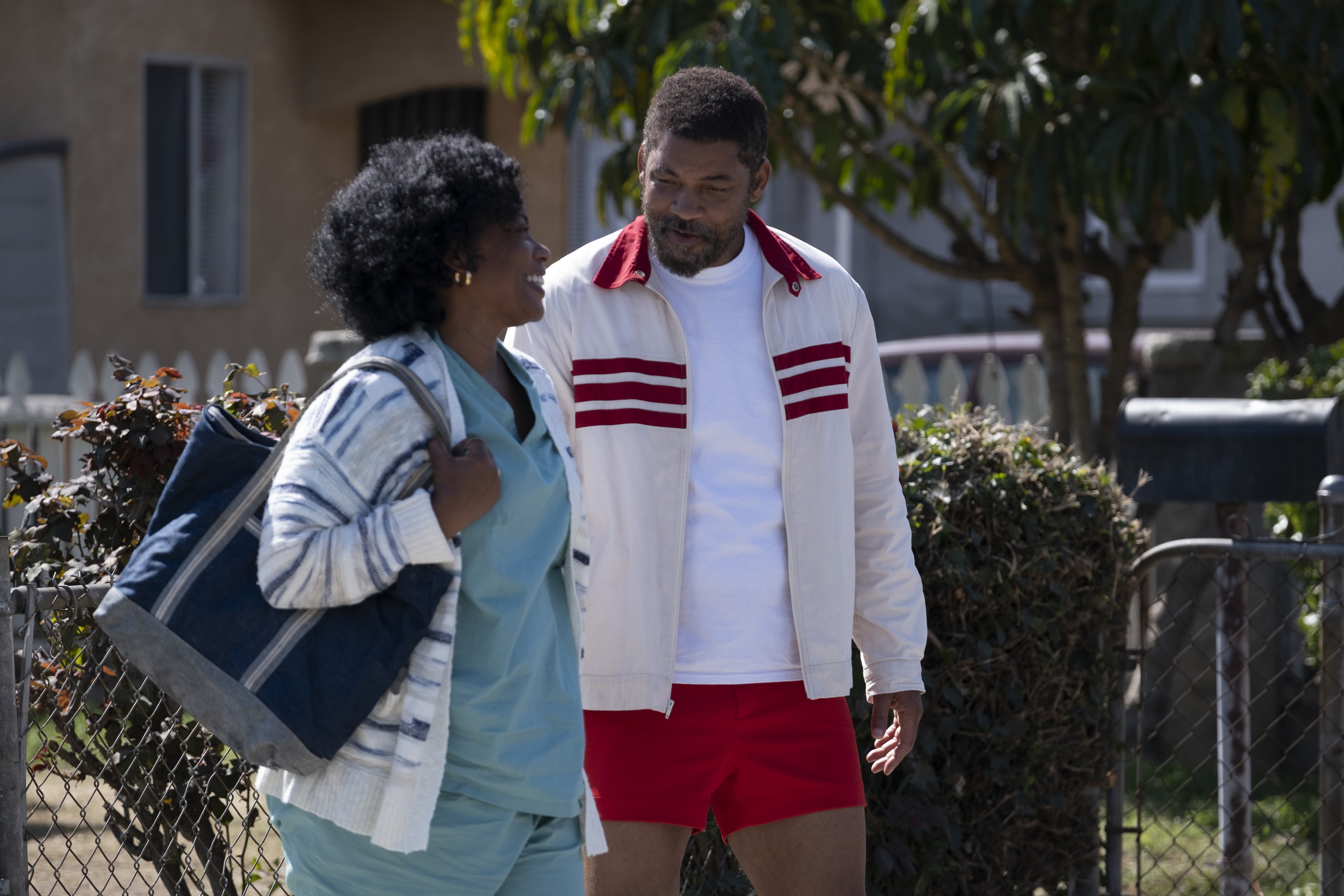
Richard Williams (Will Smith) has a talk with daughter Venus (Saniyya Sidney) in King Richard. (Photos courtesy of Warner Bros. Entertainment Inc.)
By Richard Ades
How did Venus and Serena Williams become two of the greatest tennis players of all time? According to the sports biopic King Richard, it’s because their father mapped out a long-term plan to make it happen and then saw it through.
The flick, directed by Reinaldo Marcus Green from a script by Zach Baylin, portrays Richard Williams (Will Smith) as someone who’s not easy to have as a father, a spouse or a business partner. Sometimes, in fact, he’s downright maddening. But, judging from his daughters’ eventual successes, he does gets results.
The story unfolds in the 1990s, when Venus and Serena (Saniyya Sidney and Demi Singleton) are entering their teen years while sharing a modest home with their parents and three sisters in Compton, California. Besides pushing all of his daughters to excel in their schoolwork, Richard frequently loads them into his VW bus in the evening and drives them to a scruffy public court to practice their tennis skills.
The exhausting regimen is hard on everyone, including Richard, who’s sometimes harassed and even beaten up by local thugs. But he refuses to ease up, even when wife Brandy (Aunjanue Ellis) tells him it’s too much. “We just got to stick to the plan,” he says.
The most difficult part of that plan is to find a professional coach who’s willing to work with Venus and Serena, the two most promising players, and to do it for free. Richard finally finds such a coach, whom he argues with and ends up firing, then finds an even more prestigious coach with whom he also locks horns. As the years go by, it becomes hard to tell if Richard is still aiding his daughters’ quest for success or standing in their way.
I’ve read one online commentator who makes the feminist complaint that King Richard focuses on a man rather than its rightful subjects, namely two of the world’s most prominent female athletes. That seems a little unfair since the story is set at the very beginning of Venus and Serena’s careers, before they’ve come into their own.
Brandy and Richard Williams (Aunjanue Ellis and Will Smith) are determined to turn their talented daughters into tennis superstars.
Perhaps a more valid criticism is that the script seldom acknowledges the important role played by their mother, Brandy, who knows a few things about tennis herself and sometimes has to bite her tongue when her husband makes unilateral decisions. The flick partially makes up for this in a late scene—one of the best—in which she finally lets go of years’ worth of frustration.
As one might expect, tennis matches are an intrinsic part of the sports film’s running time, including a climactic contest between one of the girls and an established competitor. These are well photographed and nicely handled by actors Sidney and Singleton and/or their on-court doubles.
Otherwise, the focus is on the members of the close-knit Williams family as Venus and Serena struggle to attain a goal never before reached by Black girls. A strong cast, beginning with Smith in the title role and including Jon Bernthal as enthusiastic coach Rick Macci, keeps things interesting.
At two hours and 26 minutes, the film does lag occasionally, and director Green (with help from composer Kris Bowers) does turn the emotional screws once or twice too often. Mostly, though, this is a fascinating origin story of tennis’s sibling superheroes.
Rating: 3½ stars (out of 5)
King Richard (PG-13) opens Nov. 19 at select theaters and online via HBO Max.
Pete Buttigieg takes a selfie that includes a crowd of supporters in a scene from Mayor Pete. (Photo courtesy of Amazon Studios)
By Richard Ades
Jesse Moss co-directed Boys State, which was probably the best 2020 documentary that wasn’t nominated for an Academy Award. Now he’s returned with Mayor Pete, another film that focuses on America’s political system. But while Boys State did so metaphorically, being set at a gathering of teenagers playing at being politicians, the new doc takes the direct approach.
Its subject is Pete Buttigieg, who, before becoming President Biden’s secretary of transportation, was the first openly gay person to run a major campaign for the presidency. Filmed in 2019 and early 2020, the documentary follows the then-mayor of South Bend, Indiana, as he takes his first plunge into the treacherous waters of the national political scene.
Though the result might not be quite as sublime as Moss’s earlier effort, it offers a behind-the-scenes look at a groundbreaking campaign that briefly seemed on the verge of upsetting a host of more-traditional candidates. The film makes it clear that Buttigieg accomplished this feat with help from advisers such as his communications director, Liz Smith, and even his husband, Chasten.
A graduate of Harvard and Oxford who speaks eight languages, as well as a former naval intelligence officer who saw active duty in Afghanistan, Buttigieg stood out from the field of candidates for reasons that went far beyond his sexual orientation. The film shows another difference: His calm and nuanced speeches were a far cry from the average politician’s promises and cliches. “I think you’re the real thing,” a middle-aged woman tells him after an early campaign appearance.
But the film also reveals that Buttigieg’s reluctance to divulge his emotions led some critics to paint him as cold and even robotic. As the first Democratic debate nears and Buttigieg prepares by taking part in practice debates, Smith can be seen pushing him to open up about his feelings. “He’s coming across as a f—ing tin man up there,” she complains, using an expletive that helps to earn the flick its “R” rating.
Then, right before the debate, news arrives that a South Bend cop has shot and killed a Black man. Buttigieg holds a town meeting and invites residents to air their concerns, but the effort only succeeds in revealing the gulf between him and many members of the Black community. Though he’s later praised for his response to this issue when it inevitably comes up on the debate stage, his lack of minority support continues to dog him throughout the campaign.
If there’s one element of Mayor Pete that may disappoint political junkies, it’s that it largely ignores the policy positions Buttigieg espoused and argued over with the other candidates. Instead, it focuses on the personal qualities that made him an unusual and historic candidate and will continue to set him apart if he ever decides to once again hit the campaign trail.
Rating: 4 stars (out of 5)
Mayor Pete (rated R) will premiere Nov. 12 on Amazon Prime Video.
Issa (Salim Daw) offers Siham (Hiam Abbass) his umbrella in a rainy scene from Gaza Mon Amour.
By Richard Ades
A 60-year-old fisherman in the Gaza Strip decides it’s finally time to get married. Then he pulls up his net and finds a statue of the Greek god Apollo. That’s the setup for Gaza Mon Amour.
Is there some connection between the man’s marital decision and his maritime discovery? If there is, writer-director-brothers Tarzan and Arab Nasser don’t spell it out, any more than they explain why the film’s title apparently pays homage to Alain Resnais’s 1959 French New Wave classic, Hiroshima Mon Amour.
The statue and the title are just two more quirky elements in a tale that combines romance with political commentary in such a droll, understated way that even its darker moments are leavened with a sly sense of humor.
Issa (Salim Daw, aka Salim Dau) fishes by night and runs a shop selling fish and other items during the day. Though he’s never been married and apparently hasn’t even expressed interest in matrimony since he was a teenager, he surprises sister Manal (Manal Awad) one day by announcing his desire to wed.
Despite Issa’s strict order that she not get involved, Manal takes the news as her cue to begin rounding up eligible women. And when she learns he already has his eye on widowed shop clerk Siham (Hiam Abbass), Manal argues that she’s not an appropriate choice for a devout Muslim because she has a divorced daughter (Maisa Abd Elhadi). Ignoring her, Issa sticks to his quest, but his own shyness proves to be a high hurdle.
Siham (Hiam Abbass, left) waits for a bus while Issa (Salim Daw) tries to find a way to break the ice.
Meanwhile, both Issa and Siham deal with the daily stresses and challenges that are part of life in the tiny Gaza Strip. Among them are poverty, power outages and occasional Israeli airstrikes, as well as local officials who wield their authority like petty dictators.
It’s all too much for a young friend of Issa’s, who has planned an illegal and potentially dangerous escape to Europe. Issa, though, is determined to stick it out, even after his mysterious discovery from the deep lands him in trouble with the gendarmes.
The Nasser brothers depict life in Gaza with a critical and satirical eye, especially when it comes to the strip’s authority figures. A police official throws his weight around in an arbitrary and self-serving way, and at one point the military proudly displays a new rocket in a scene hilariously loaded with phallic symbolism.
As for the looming relationship at the center of the tale, it’s portrayed with such charm by Daw’s determined but awkward Issa and Abbass’s secretly amused Siham that viewers won’t mind the glacial pace at which it develops. Anyway, despite its cheeky title, the film isn’t really about romance as much as it’s about standing up to society’s limitations and finding the space to live and enjoy one’s life.
Rating: 4½ stars (out of 5)
Gaza Mon Amour opens Nov. 5 at select theaters and through VOD outlets.
Jacques Cousteau wears his trademark red cap aboard the Calypso during the 1970s. (Photo courtesy of the Cousteau Society)
By Richard Ades
Becoming Cousteau, Liz Garbus’s biographical documentary about the late Jacques Cousteau, is aptly named.
Though Cousteau was one of the first luminaries to sound the alarm about mankind’s ongoing destruction of the environment—particularly the watery environment that covers most of our planet—he was not born with this level of enlightenment. He was not even that interested in the ocean, Garbus reveals, as he entered the French naval academy at the age of 20 only for the chance to become an aviator. But then fate sent his life in a new direction.
After being involved in a traffic accident that nearly killed him, we learn, Cousteau was forced to give up his previous plans and turn to the ocean for refuge. With a couple of companions, he began “free diving” (i.e., without auxiliary aids) as a way to recover his muscle strength. Even after Germany invaded France during World War II, his devotion to the sea kept growing, to the extent that he was soon planning to build a career around his new love.
At first, Cousteau hoped to earn money by conducting salvage operations on sunken ships and downed planes with the aid of diving equipment that he was working to perfect. Then, in 1951, he acquired the converted mine sweeper known as the Calypso and began his new life as an ocean-going explorer.
It was during these early years at sea, Garbus tells us, that Cousteau committed acts he later came to regret after becoming more environmentally sensitive. In order to catalog local fish populations, for example, he and his crew dynamited off-shore waters without regard for the damage it would cause to fragile habitats. Perhaps worst of all, they bankrolled their exploits by helping a British drilling company locate underwater oil deposits in the Persian Gulf.
Fortunately, Cousteau eventually found a safer meal ticket in the form of his long-running TV series The Underwater World of Jacques Cousteau. The series helped to pay for Cousteau’s worldwide explorations and, at the same time, gave him a bully pulpit to express his growing concerns about the damage being done to the sea by industrialized society and its waste products.
The documentary depicts all of this with the help of the miles and miles of film Cousteau shot throughout his career. At the same time, it doesn’t neglect his family life—such as it was.
Sons Jean-Michel and Philippe often were sent away to boarding school while Cousteau and his wife, Simone, roamed the seas on the Calypso. Even so, both sons took an interest in their father’s work, particularly the adventure-craving Philippe. As a result, Cousteau assumed he would one day be able to allow the younger generation to take it over, and he was devastated when tragedy disrupted his plans.
Producer-director Garbus has won awards and nominations in both documentary and scripted categories. With this National Geographic Documentary Films production, she succeeds in turning a 20th century icon into a human being who took a long, watery path to becoming an environmental prophet. It’s a compelling journey.
Rating: 4 stars (out of 5)
Becoming Cousteau (PG-13) can be seen at select theaters, including Central Ohio’s Marcus Crosswoods Cinema 17 and AMC Dine-In Easton Town Center 30.
Filmmaking couple Chris and Tony (Vicky Krieps and Tim Roth) take a working vacation in Bergman Island.
By Richard Ades
Bergman Island should appeal to devotees of the great Swedish director Ingmar Bergman—at least on the surface.
Written and directed by Mia Hansen-Love, the flick sends filmmaking couple Chris and Tony (Vicky Krieps and Tim Roth) to Faro, the island that often served as the auteur’s home and movie set. There they go to work on their separate writing projects while sleeping in a bed that reportedly was used in Scenes From a Marriage, Bergman’s painful account of a marriage’s disintegration.
The obvious implication is that we’re about to see a similar disintegration take place between Chris and Tony, whose relationship may not be that solid to begin with. Tony, who appears to be decades older, is so engrossed in his work that he sometimes seems distant and even ignores Chris’s romantic overtures. His career also is more established than hers, possibly creating the kind of power imbalance that played a destructive role in Scenes. This becomes obvious when a local screening of one of Tony’s films draws gushing fans while Chris disappears into the background.
It’s no surprise, then, that when a young man offers to give Chris a private tour of the island, she takes it, in the process skipping a group excursion she was supposed to take with Tony. Is this the beginning of the unraveling of their relationship?
But then director Hansen-Love takes things in a new and unexpected direction. After Chris begins telling Tony about a screenplay she’s struggling to finish, her script comes to life as we’re introduced to Amy (Mia Wasikowska), its lonely protagonist. We watch as Amy arrives at a Swedish island to attend a friend’s wedding and runs into Joe (Anders Danielsen Lie), an old love for whom she still carries a torch.
Will Amy and Joe reconnect despite the fact that each is now involved with someone else? The question is explored at length as the movie-within-a-movie goes on and on, to the extent that it nearly eclipses the original story of Chris and Tony. On the one hand, that’s OK, because Amy and Joe’s story is a pleasant diversion. On the other hand, it’s odd that the film’s core relationship is left so undeveloped.
After hearing about the complications Hansen-Love faced in making the movie, it’s hard not to wonder whether they contributed to this lapse. Owen Wilson was supposed to play Tony but bowed out weeks before filming started, forcing the director to begin shooting without a Tony in 2018. It wasn’t until 2019, after Roth had been cast in the part, that she was able to return to the island and fill in the gaps.
A few late twists do offer some insight into Chris’s relationship with Tony while raising questions about her connections with the supposedly fictitious Amy and Joe. These add intriguing ambiguities to the film, though they don’t quite make up for its failure to delve into interpersonal issues as richly as Bergman did in Scenes From a Marriage and other classics.
That’s a high standard, admittedly, but when you make a film called Bergman Island, it’s hard to avoid the comparison.
Rating: 3 stars (out of 5)
Bergman Island (rated R) opens in select theaters Oct. 15 and will be available from VOD outlets beginning Oct. 22.
Tim Harrison, a former Ohio police officer, has made it his mission to end the exploitation of exotic big cats.
By Richard Ades
One of my hometown’s most beloved celebrities—former Columbus Zoo director “Jungle Jack” Hanna—fares poorly in the documentary The Conservation Game. His reputation takes such a hit that one is tempted to feel sorry for him—except for the fact that many animals that supported his rise to fame allegedly fared much worse.
Produced and directed by Michael Webber, the muckraking film follows animal activist Tim Harrison around the country as he tries to track down the tigers and other big cats that often appeared on television in their younger years. Hanna and similar wildlife experts became familiar sights on talk shows by bringing out a variety of these adorable cubs, many of which represented endangered species.
Where were these animals from? When asked, the experts might hint that they were from an accredited zoo or refuge. But the truth, Harrison finds, is far murkier. By asking questions and following leads, he learns that many of them hailed from privately owned facilities, such as the squalid farm he discovers in rural Pennsylvania.
And what happened to the animals after their five minutes of TV fame? That’s the real tragedy. All too many have disappeared from view and are presumed dead, while Harrison finds others are forced to work for their living by appearing at functions such birthday parties or, in one case, being dragged onto a football field as a prominent high school team’s mascot.
None are treated in a way that’s appropriate for wild animals, especially animals whose species are in danger of dying out.
Attorney Carney Anne Nasser is an advocate for protecting exotic wildlife.
Several allies help Harrison in his crusade to end such abuse. They include Carney Anne Nasser, an attorney who played a role in a wildlife-trafficking case against now-imprisoned TV reality star Joe Exotic. Nasser and others are involved in an attempt to pass a federal law, known as the Big Cat Public Safety Act, that’s designed to curtail the exploitation of exotic animals.
But it’s Harrison who generally takes center stage in the film. A towering ex-cop who’s trained in the martial arts, he makes a formidable figure as he fearlessly walks up to strangers’ homes or businesses and asks what happened to this or that big cat. In an inevitable climactic scene, he does just that to Jack Hanna, a boyhood hero who has not lived up to his reputation as a champion of endangered wildlife.
In a postscript added following the documentary’s premiere last April, it’s noted that Hanna has retired from public life following what his family describes as a diagnosis of dementia. It’s also noted that his former employer, the Columbus Zoo, subsequently announced it will support passage of the Big Cat Public Safety Act.
Rating: 4½ stars
The Conservation Game (PG-13) can be seen at select theaters, including Columbus’s Gateway Film Center (through Sept. 22) and Marcus Cinema Crossroads (Sept. 20 and 22).