Show offers stripped-down, bloodied-up Sondheim

Susan Bunsold Wilson and Bill Hafner in Standing Room Only's production of Sweeney Todd (photo by Dale Bush)
Susan Bunsold Wilson and Bill Hafner in Standing Room Only’s production of Sweeney Todd (photo by Dale Bush)

By Richard Ades

If Columbus barbers have noticed a drop in business recently, it could be because the local theater scene is offering not one, but two productions of the bloodthirsty musical Sweeney Todd: The Demon Barber of Fleet Street.

Those whose taste tends toward the grandiose might want to check out the Ohio State version being presented this weekend at Mershon Auditorium. Those who favor more intimate productions might prefer the Standing Room Only production whose two-week run ends Sunday.

I’ve seen the latter, and I can recommend it with one caveat: The unamplified lyrics are sometimes hard to pick out over the accompaniment. That annoyance aside, the production does right by this darkest of musicals, which features a book by Hugh Wheeler and music and lyrics by Stephen Sondheim.

In fact, it does brilliantly by the musical, thanks to a well-chosen cast and Patrick McGregor II’s ingenious direction.

This is a “black box” production twice over. Not only is the scenery limited to a black backdrop and little more, but the main prop is a black, coffin-shaped box that is continually being moved and upended to serve a multitude of functions. This minimalistic approach might be distracting if McGregor’s cast weren’t so mesmerizing.

Following his starring role in Gallery Players’ 2015 production of Les Miserables, Bill Hafner again excels playing a 19th century man who’s suffered years of unjust imprisonment. But don’t expect to find much in common between the two portrayals.

Unlike the noble Jean Valjean, Sweeney Todd has vengeance on his mind—vengeance against the judge who sent him away in order to pursue his wife. The former barber’s fury intensifies when he returns to London only to learn that his wife is dead and his daughter has been adopted by that same judge. As portrayed by Hafner, Todd is so overcome by grief and anger that he stumbles around in a state of near catatonia.

In effective contrast, Susan Bunsold Wilson radiates manic energy as Mrs. Lovett, the widowed baker who ultimately becomes Todd’s partner in crime. As amoral as she is personable, Mrs. Lovett quickly finds a way to benefit when the deranged barber’s “shaves” start turning into homicides. It’s no coincidence that her meat pies soon become the talk of the neighborhood.

Both Hafner and Wilson display strong voices on numbers such as their duets By the Sea and the darkly humorous A Little Priest, in which Todd and Mrs. Lovett discuss the optimum ingredients for a tasty pie.

As the dastardly Judge Turpin, Todd Lemmon offers an understated version of villainy that disguises itself under a cloak of piety. Turpin and Hafner join their voices to great effect on Pretty Women, a beautiful song that incongruously arises during a moment of impending murder. A more blatant depiction of evil is offered by Colton Weiss as Turpin’s henchman, the nasal-voiced Beadle.

The musical’s second-most beautiful song, Not While I’m Around, is given a dramatic delivery by Layne Roate as the limping, dimwitted Tobias Ragg. Appearing in other important secondary roles are Ethan White as goodhearted seaman Anthony Hope; Taryn Huffman as Todd’s grown daughter, Johanna; and Laura Crone as a beggar woman and a rival barber.

An impressively large orchestra provides the accompaniment, though music director Josh Cutting ably replaced it with his keyboard at the matinee I attended. Curtis Brown’s lighting not only establishes mood but is used to shift viewers’ focus from one side of the room to the other during quick scene changes.

Filled with dark themes and bloody violence, Sweeney Todd is unsuitable for young children. But SRO’s inventive production makes it a treat for those who appreciate Sondheim’s lovely tunes and graceful lyrics even when they’re sung in the midst of a murder spree.

Standing Room Only Theatre will present Sweeney Todd through Sunday (April 10) at the Columbus Performing Arts Center, 549 Franklin Ave., Columbus. Remaining show times are 8 p.m. Saturday and 2 p.m. Sunday. Running time: 2 hours, 45 minutes (including intermission). Tickets are $12-$21 Saturday, $12-$16 Sunday. 614-258-9495 or srotheatre.org.

The Ohio State School of Music, Opera and Lyric Theatre will present Sweeney Todd through Sunday (April 10) at Mershon Auditorium, 1879 N. High St., Columbus. Remaining show times are 7:30 p.m. Saturday and 3 p.m. Sunday. Tickets are $20, $10 for senior citizens, students, children and OSU faculty, staff and alumni association members. Show isn’t suitable for ages 12 and under. 614-292-3535 or music.osu.edu.

Chekhovian angst mined for Durang-ian mirth

Vanya and Sonia and Masha and SpikeBy Richard Ades

There’s nothing quite as fun as watching Christopher Durang take on the Catholic Church, as he proved in his classic satire Sister Mary Ignatius Explains It All for You. But seeing him take on Anton Chekhov is also good for laughs.

He does so in Vanya and Sonia and Masha and Spike, a 2013 Tony Award winner that borrows names and themes from the dour Russian, along with a general air of depressed malaise. That is, the characters suffer from depression; the audience is in hysterics.

CATCO’s current production benefits from a director with a flair for comedy—David Hemsley Caldwell—and two lead players who are equally adept. Jonathan Putnam and Danielle Mann are quietly masterful as Vanya and Sonia, the 50-something siblings who share a miserable existence in the home once owned by their deceased parents.

The first scene establishes their flinty relationship. Sonia brings Vanya his morning coffee, only to learn he’s already poured himself a cup. She complains that he’s deprived her of one of her few daily pleasures, leading to an argument that eventually ends in broken china.

Sonia, we learn, was adopted. We also learn that she’s attracted to Vanya despite his protestations that he marches to a “different drummer”—i.e., he’s gay. Putnam and Mann inhabit the unhappy pair so thoroughly that their personalities come through even when they’re just sitting and glumly observing the world.

Meanwhile, Chekhov is referenced in multiple ways, including Sonia’s insistence that a nearby stand of 10 or 11 trees constitutes a “cherry orchard.” But don’t worry if you’re rusty on the playwright’s works—Durang throws in enough explanations to keep everyone in the loop.

In a nod to Greek mythology, he also makes sure we know why a character named Cassandra is doomed to making dire predictions that no one believes. Shanessa Sweeney is a live wire as the housekeeper, whose ability to see the future comes in handy following the sudden appearance of Sonia and Vania’s successful sister, Masha (Lori Cannon).

The movie star barges in with her younger lover, Spike (William Darby), and begins talking about a change that will upset her siblings’ boring but stable existence. Narcissistic and overbearing, Masha proved a difficult character to enjoy at Wednesday’s preview matinee, especially since Cannon at first had trouble playing her with more than one note. Cannon fared better after intermission, when Masha’s insecurities bubbled to the surface and made her recognizably—and hilariously—human.

As Spike, Darby has some nice comic moments but is mostly limited to stripping off his clothes and showing off his physique. In a more nuanced role, Kristen Krak is lovable as Nina, an aspiring actress who quickly forms a bond with the man she insists on calling “Uncle Vanya.”

Completing the near-perfect production, Eric Barker’s painterly set is expressively lit by Jarod Wilson to suggest the passage of time as the action wends its way from morning to night and back to morning. It’s an entertaining and surprisingly warm-hearted trip, and one that’s well worth taking.

CATCO will present Vanya and Sonia and Masha and Spike through April 24 in Studio One, Riffe Center, 77 S. High St., Columbus. A preview will be presented at 7:30 p.m. Thursday (April 7). Regular show times are 11 a.m. Wednesday, 8 p.m. Thursday-Saturday and 2 p.m. Sunday. Running time: 2 hours, 35 minutes (including intermission). Tickets are $17 Wednesday, $30 Thursday, $40 Friday-Saturday and $35 Sunday. 614-469-0939 or catco.org.

Buffalo pals prepare to let it all hang out

Unemployment turns factory workers into strippers in The Full Monty (photo by Heather Wack)

By Richard Ades

How desperate would you need to be to go onstage and bare it all before a few hundred friends and strangers?

The men in The Full Monty are plenty desperate, having lost their jobs when the local steel mill closed down. Some are afraid they’re going to lose even more if they don’t find work soon.

Adapted by Terrence McNally from the 1997 film, the musical version of The Full Monty relocates the action from Sheffield, England, to Buffalo, N.Y., and adds melodies and lyrics by David Yazbeck. But the basic situation remains the same.

For some of the characters, their very manhood feels threatened by the role reversals they’ve experienced since losing their jobs. After being the main breadwinners throughout their marriages, they now find themselves relying on their wives to bring home the paycheck.

The central protagonist, Jerry (David Bryant Johnson), has an even more basic worry. He’s separated from his wife (Jackie Comisar) and fears he’ll lose joint custody of his son (Kyle Klein II) if he doesn’t find a way to pay up on his child support.

For Jerry and the others, all of this adds up to more than enough reason to throw caution (and their clothes) to the wind by staging a striptease act that goes the Chippendales one better by climaxing in full frontal nudity.

Though the men’s emotional stress is well expressed in McNally’s script and Yazbeck’s catchy tunes, it doesn’t come across as well as it could in Short North Stage’s production. This is largely due to the central relationship between Jerry and his weight-obsessed friend, Dave (John McAvaney). Johnson’s Jerry is more laid back than one might expect for someone in his situation, while McAvaney plays Dave as a goofy sidekick.

Perhaps director/choreographer Edward Carignan decided to keep things light to find the laughs inherent in the characters’ situation, but “light” mostly comes off as simply “bland.” A bit more gritty reality is needed to sustain our interest in a tale that demands nearly three hours of our time.

On the other hand, little needs to be added in terms of music, movement or spectacle. Other than some songs and scenes that end in an awkwardly anticlimactic fashion, the production excels on all three fronts.

Johnson has a particularly nice voice, and the rest of the cast sings serviceably, at least, and often beautifully. Backing them up, music director Jeff Caldwell leads a band that is equally adept at the jazzy overture, the bluesy Big Black Man and the pretty You Rule My World.

Carignan’s choreography is fun and funny, particularly in a number (Michael Jordan’s Ball) that mimics basketball moves. Just as impressive is Dick Block’s set design, which features weathered interiors and exteriors that roll in and out of sight with dazzling efficiency.

Linda Kinnison  Roth as Jeanette Burmeister (photo by Heather Wack)
Linda Kinnison Roth as Jeanette Burmeister (photo by Heather Wack)

Along with all its other strengths, the production boasts two supporting players who are comedic standouts: Linda Kinnison Roth as veteran rehearsal pianist Jeanette Burmeister and R. Lawrence Jenkins as would-be stripper Noah “Horse” T. Simmons.

Two additional supporting players make indelible impressions playing spouses. Gina Handy combines a healthy libido with loving patience as Dave’s wife, Georgie. And as Vicki, wife of laid-off efficiency expert Harold (Ian Short), Danielle Grays kicks out all the stops on the Latin-flavored number Life With Harold.

Finally, something needs to be said for Adam Zeek’s lighting, which allows the show to live up to its name without becoming excessively graphic. Thanks to split-second timing, the inevitable male nudity is glimpsed just long enough to assure us that Jerry and his Buffalo pals do, indeed give us the “full monty.”

Short North Stage will present The Full Monty through April 24 at the Garden Theater, 1187 N. High St., Columbus. Show times are 8 p.m. Thursday-Saturday and 3 p.m. Sunday. Running time: 2 hours, 55 minutes (including intermission). Tickets are $25-$40. 614-725-4042 or shortnorthstage.org.

Federal snoops offer lusty help for the lovelorn

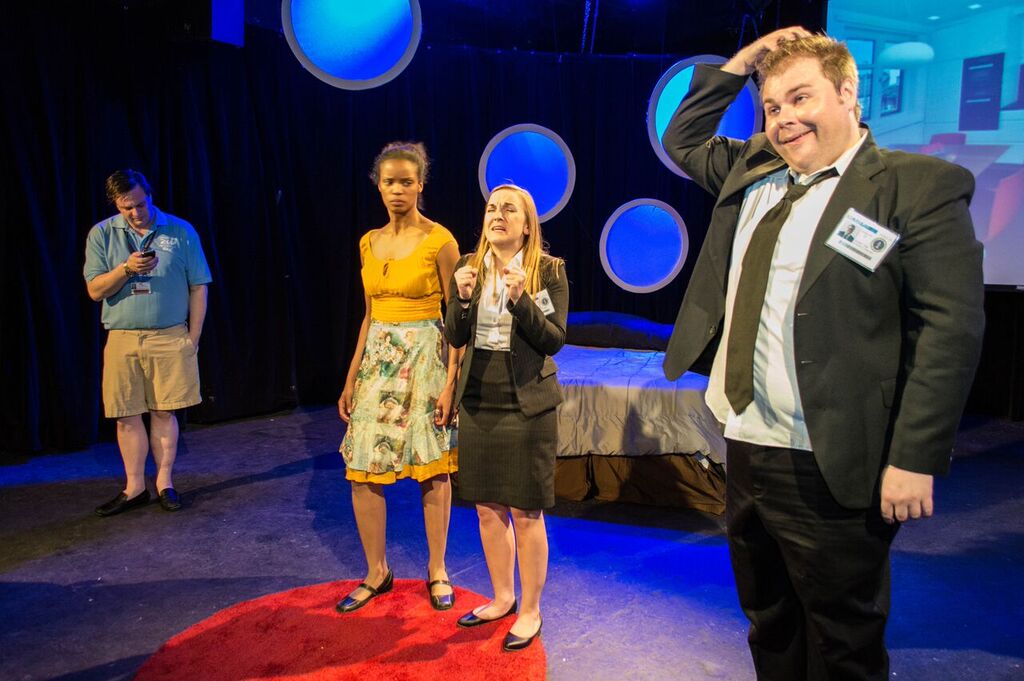
Appearing in The NSA’s Guide to Sex and Love are (from left): Scott Clay as Chuck, Alanna G. Rex as Daisy, Colleen Dunne as Gabrielle and Scott Douglas Wilson as Tom (photo by Michelle Diceglio)

By Richard Ades

The NSA’s Guide to Sex and Love has one big problem: the script. Don Zolidis’s would-be satire is a leaden flight of fancy that hops from one topic to the next with all the finesse of an oversized sledge hammer.

Partially making up for this weakness is the fact that it’s sexy as hell, particularly as it’s staged in MadLab’s world-premiere production. Working under Stephen Woosley’s direction, the seven-member cast eagerly throws itself into all manner of seductions, fantasies and other erotic situations.

The actors’ energy is particularly impressive considering what they have to work with. It’s easy to be committed to a quality script, but it takes guts to commit yourself to this hit-or-mostly-miss collection of jokes and set pieces.

Sometimes the punchlines come and go before we can figure out what their point was. When the National Security Agency proclaims that ferret owners tend to become suicide bombers, are we supposed to interpret this as a knock at ferret owners or at the government’s flawed methods of data analysis? Who knows?

Adding to the confusion is an overall framework that can only be described as “stream of consciousness”—or, more accurately, “stream of unconsciousness.” After introducing itself as a “TED Talk” led by NSA representatives Tom and Gabrielle (Scott Douglas Wilson and Colleen Dunne), the play jumps around among such topics as hooking up, marriage and gay sex.

The weird premise is that the NSA wants to use its data to improve citizens’ love lives. It then proceeds to help pair up two couples: Dan (Casey May) with Alana (Laura Spires), and Daisy (Alanna G. Rex) with Chuck (Scott Clay). Assistance is provided by the silent Agent Lance (Lance Atkinson).

Dunne and Wilson work the hardest as Gabrielle and Tom, who fiercely defend the importance of NSA espionage when they’re not sniping at each other over gender issues. May and Spires are more low-key as Dan, a man afflicted by awkward come-ons and premature ejaculation, and Alana, the woman he sets his sights on.

As the other lovebirds, Clay nicely underplays the frumpy Chuck while Rex effortlessly exudes class as Daisy—perhaps too effortlessly in terms of projection, as some of her lines were barely audible at Thursday’s preview performance. The odd couple is fun to watch during escapades such as their attempt to spice up their love life by playing characters from Game of Thrones.

Brendan Michna’s set design mostly consists of a bed, a sofa and several large, hanging discs that can be lit up at opportune moments. Jonathan Calig’s slide show augments the action by projecting information supposedly provided by the NSA.

Though political satire is obviously Zolidis’s main aim, the play delves nearly as much into the politics of gender. The latter subject is attacked with slightly more subtlety than the former, but with little more originality. In the playwright’s view, men are as simple-minded as they are single-minded, while women are devoted to two things: relationships (starting them) and chores (getting men to do them). Few laughs result from such musty observations.

On the other hand, viewers in the proper frame of mind may well get a libidinous lift from the couples’ more carnal interactions. That makes the play, for all its flaws, a nice choice for date night. Just remember to leave the kids at home.

The NSA’s Guide to Sex and Love continues through April 9 at MadLab Theatre and Gallery, 227 N. Third St., Columbus. Show times are 8 p.m. Friday-Saturday. Tickets are $15, $13 students/seniors, $10 members. 614-221-5418 or madlab.net.

Gamblers take a chance on romance in Loesser musical

Playing gamblers in Guys & Dolls are (from left): Bradley Davis Barbin, Kent Stuckey (Benny Southstreet), Todd Covert (Nathan Detroit), Derryck Menard and Ryan Kopycinski (Nicely Nicely) (photo by Jared Saltman)
Admiring a wad of cash in Guys & Dolls are (from left): Bradley Davis Barbin, Kent Stuckey, Todd Covert, Derryck Menard and Ryan Kopycinski (photo by Jared Saltman)

By Richard Ades

Guys & Dolls opened on Broadway in 1950 and subsequently won the Tony for best musical. I can only see that as a sign of how much society’s tastes have changed over the intervening decades.

Composer/lyricist Frank Loesser’s songs include the classic Luck Be a Lady and the infectious Sit Down, You’re Rocking the Boat. But they also include several unmemorable tunes and Sue Me, which combines a tender melody with the puzzling lyrics “So sue me, sue me, what can you do me?” Say what?

In short, Guys & Dolls is a mixed bag. And at 66 years of age, it’s a very dusty mixed bag. Adapted by Jo Swerling and Abe Burrows from short stories by Damon Runyon, it’s set in a quaintly old-fashioned version of New York’s underworld (dubbed “Runyonland”) where all the women are “dolls” and all the men are gamblers with hearts of gold.

Faced with the thankless task of resuscitating this chestnut for Gallery Players, director Mark Mann starts off by filling the four leading roles with likable and talented performers:
• Todd Covert as Nathan Detroit, a perpetually struggling gambler
• Amy Silver Judd as Miss Adelaide, a night club singer and Nathan’s longtime fiancée
• Kristin Yarger as Sarah Brown, head of a Salvation Army-like mission that tries to reform local “sinners”
• Christopher Storer as Sky Masterson, a traveling gambler and confirmed bachelor

The two women offer particularly distinct portrayals, Judd’s Adelaide coming off as a good-natured floozy while Yarger’s Sarah is sincere and grounded. Of the two men, Covert’s Nathan is slightly nicer, but both he and Storer’s Sky strike us as basically decent sorts.

As I said, all four of the leads are likable—maybe to a fault. If their characters had a bit more edge to them, their romantic intrigues might seem less blandly sweet.

Making up for the lack of dramatic tension, all four performers sing well and often beautifully under Bryan Babcock’s musical direction. An eight-piece band provides the big-sounding and mostly tuneful accompaniment.

Nathan Detroit (Todd Covert) and his longtime fiancee Miss Adelaide (Amy Silver Judd) in the Gallery Players production of Guys & Dolls (photo by Jared Saltman)
Nathan Detroit (Todd Covert) has an uncomfortable moment with his longtime fiancee, Miss Adelaide (Amy Silver Judd) in the Gallery Players production of Guys & Dolls (photo by Jared Saltman)

The plot centers on the illegal craps game Nathan is trying to set up for local and visiting gamblers. Short on the cash he needs to rent a space, he tricks Sky into betting he can lure the high-minded Sarah to accompany him to Havana. Sky leaps to the challenge by visiting Sarah’s mission and pretending he needs her help to repent from his evil ways.

Peripherally involved in the goings-on are Denae Sullivan as one of Sarah’s fellow missionaries; Ryan Kopycinski and Kent D. Stuckey as Nathan’s colleagues Nicely and Benny; Brad Barbin as police Lt. Brannigan; and Rick Cohen as Big Jule, a gat-packing gangster from Chicago.

Benny and various other gamblers are distinguished mainly by their colorful and era-appropriate suits, which were designed by Debbie Hamrick. The only one who gets a chance to stand out is Kopycinski’s Nicely, who helms the show’s most entertaining musical number, Sit Down, You’re Rocking the Boat.

Danielle Mann’s choreography is generally low-key except for a few acrobatic moves performed during the opening strains of Luck Be a Lady. Jon Baggs’s spare scenery is efficiently designed, keeping scene changes short.

Unfortunately, some of the scenes themselves tended to drag on opening night. A little tightening would help to keep things moving in between songs.

I’ve used terms such as “nice” and “likable” to describe the characters, and those are good descriptions of the production as a whole. If you’re in a mellow mood, that might be enough. But considering the show demands nearly three hours of your time, you may find yourself wishing for something more.

Gallery Players will present Guys & Dolls through March 13 at the Jewish Community Center, 1125 College Ave., Columbus. Show times are 7:30 p.m. Thursday, 8 p.m. Saturday and 2:30 p.m. Sunday. Running time: 2 hours, 50 minutes (including intermission). Tickets are $25 ($20 for JCC member), $23 for ages 60-plus ($18 for JCC members), $15 for students/children. 614-231-2731 or www.jccgalleryplayers.org.

Motown musical is like sunshine on a cloudy day

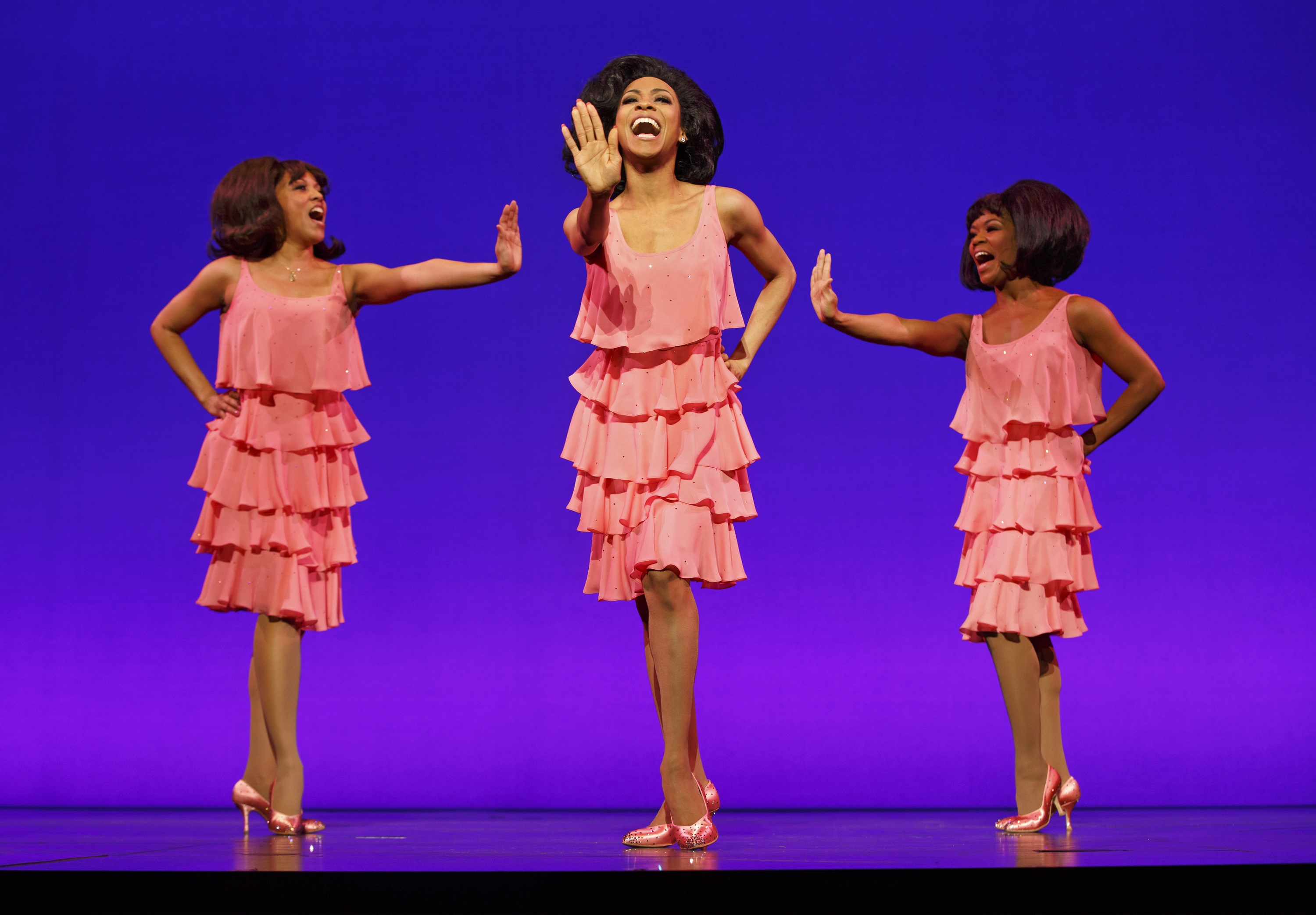
Playing the Supremes in Motown the Musical are (from left): Krisha Marcano (Florence Ballard), Allison Semmes (Diana Ross) and Trisha Jeffrey (Mary Wilson) (photo by Joan Marcus)

By Richard Ades

The curtain rises to reveal facsimiles of old Motown groups singing snippets of their hits. From the beginning, it’s clear that Motown the Musical is all about the music.

It’s only after we’ve been treated to several smartly choreographed numbers that the show introduces to the man around whom it revolves: Berry Gordy Jr. (Chester Gregory), who founded Motown and now is threatening to boycott a 1983 celebration of the record label’s 25th anniversary. Why? Because he holds a grudge against the many artists who abandoned it over the years.

Based on Gordy’s 1994 autobiography, the musical then backs up and begins recounting his long career.

First seen as a young boy growing up in Detroit, Gordy quickly develops into a brash young man who pushes his way into the music business by writing hits for singer Jackie Wilson (Rashad Naylor). But he soon becomes fed up with seeing his songs relegated to the B-sides of lesser efforts, so Gordy founds his own label.

This, however, introduces a whole new problem. Mainstream radio stations refuse to play black music—then known as “race music”—despite Gordy’s assurances that his soul/pop tunes appeal to everyone. His claim is borne out by a Southern concert that attracts a multiracial audience, which police officers struggle to keep segregated into “white” and “colored” sections of the auditorium.

Of the two acts, Act 1 is more interesting due to scenes like this that reflect the tenor of the times. It ends in the 1960s, a decade marked by hopeful activism and soul-rending violence: the Vietnam War, the assassination of a president and a King, and Detroit’s 1967 riot. On a more personal level, it also covers Gordy’s blossoming relationship with Diana Ross (Allison Semmes), lead singer of the Supremes.

Act 2 covers Motown’s move to Los Angeles and Gordy’s determination to turn Ross into a solo artist and a movie star. Inevitably, though, it becomes the story of Gordy and Motown’s gradual decline, which makes it much like every other musical biography.

Along the way, we get a few tidbits of information about Gordy’s relationships with Motown’s various stars. While these are sometimes interesting, the details are sketchy and sometimes are left out entirely—as when Gordy and an aggrieved musical group take each other to court. In such cases, it’s hard to forget that we’re hearing only Gordy’s side of the story.

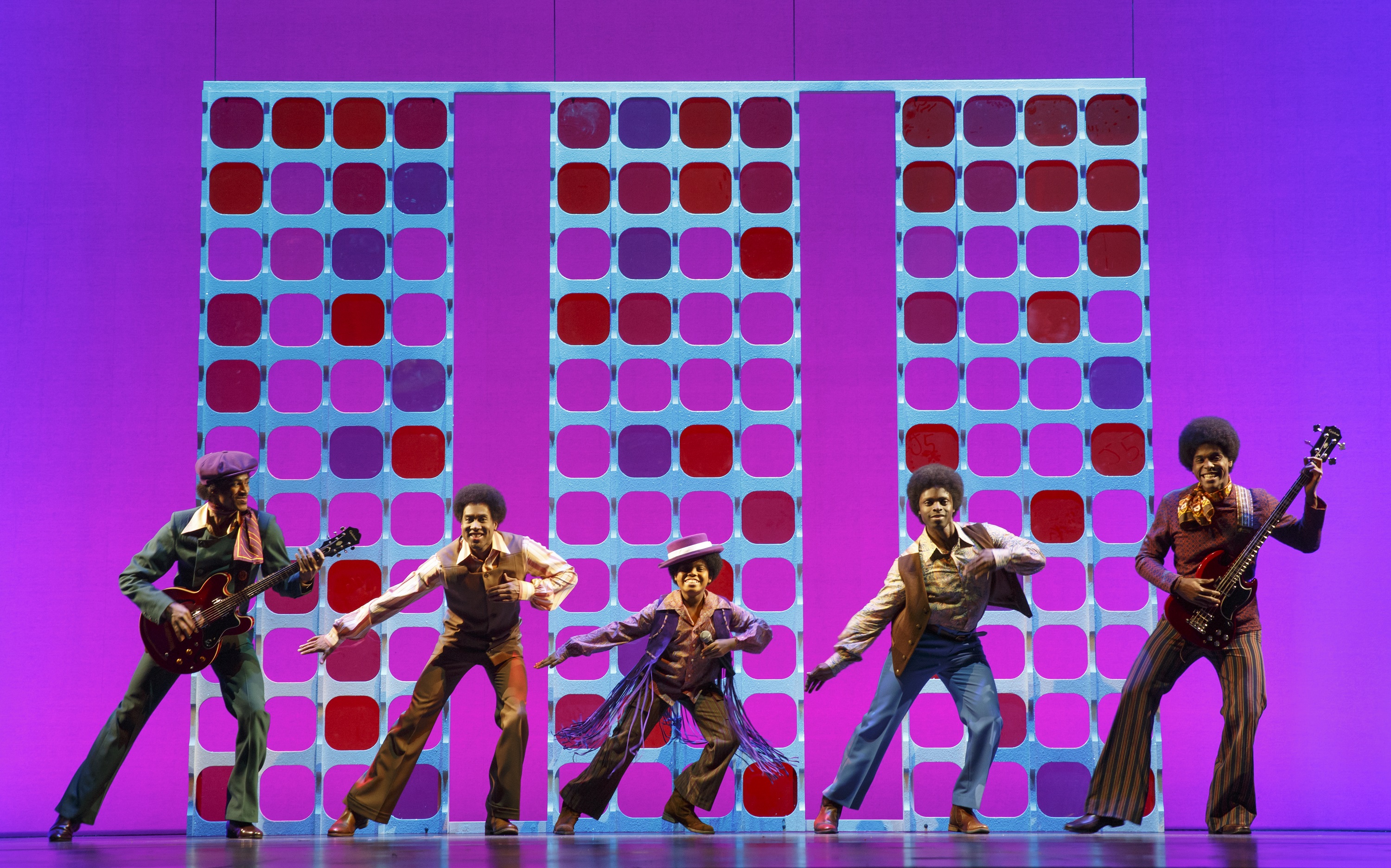
A young version of the Jackson 5 makes an appearance in Motown the Musical (photo by Joan Marcus)

But whatever the show lacks in narrative depth, it makes up for by allowing us to bask in one Motown hit after another. ABC, Ain’t No Mountain High Enough, Dancing in the Street: The nostalgic moments just keep on coming.

In the touring show, directed by Charles Randolph-Wright and accompanied by Darryl Archibald’s funky band, the songs are delivered with power and grace.

Semmes is great as Ross, seeming to gather strength as the night goes on. Though Gordy is known for promoting music rather than singing it, actor Gregory also comports himself well when he raises his voice in song. Semmes and Gregory’s duet You’re All I Need to Get By is one of the show’s sweetest numbers.

Also prominent are Jesse Nager as Smokey Robinson and the fleet-footed J.J. Batteast (alternating with Leon Outlaw Jr.) as a young Michael Jackson. On opening night, Nik Walker filled in for Jarran Muse as Marvin Gaye and displayed one of the most impressive voices of all.

David Korins’s scenery is spare, relying on Natasha Katz’s lighting to set the scene and mood. Esosa’s costume designs are period-appropriate and properly flashy.

Motown may not be a great musical, but it’s a musical with great music. Whether or not you’re old enough to remember the titular record label’s heyday, you’re sure to have fun.

Broadway in Columbus and CAPA will present Motown the Musical through Feb. 28 at the Ohio Theatre, 39 E. State St., Columbus. Show times are 7:30 p.m. through Thursday, 8 p.m. Friday, 2 and 8 p.m. Saturday, and 1 and 6:30 p.m. Sunday. Running time: 2 hours, 45 minutes (including intermission). Tickets are $33-$113. 614-469-0939, 1-800-745-3000 or ticketmaster.com.

Time traveler meets man who broke baseball’s color barrier

By Richard Ades

This Black History Month is proving to be particularly educational.

The same week that the Jesse Owens biopic Race opened nationwide, Columbus Children’s Theatre opened Jackie & Me. Written by Steven Dietz and Dan Gutman, the drama is about a boy who time-travels back to 1947 just in time to see the legendary Jackie Robinson integrate baseball’s Major Leagues.

This may sound like science fiction, but it doesn’t come off that way because the time travel is simply a means to an end—the end being a chance to teach young viewers about a key event in African-Americans’ struggle for equal rights. The play also functions as an inspirational tale about how a young boy learns to deal with his own struggles by observing how Robinson deals with his.

Joey (Collin Grubbs) is a 10-year-old with one big passion—baseball. Unfortunately, he also has a hot temper that often gets him in trouble, including when he’s playing his favorite sport. Though the script doesn’t spell it out, the implication is that his anger stems from the fact that his parents (Jenna Lee Shively and Morgan Thomas Mills) recently separated.

Marital splits are a pretty mature topic for a play aimed at youngsters, and it’s not the only one tackled by Jackie & Me. The Polish-American Joey is taunted with ethnic slurs on the baseball diamond, and he faces even worse slurs when he travels back to 1947 and discovers, much to his surprise, that he’s been transformed into an African-American.

For viewers old enough to deal with the subject matter (CCT suggests a minimum age of 7), the play offers an important history lesson. Joey arrives in the office of Brooklyn Dodgers manager Branch Rickey (Brent Alan Burington) just in time to hear him offer Robinson (Eric Qualls) a spot on the previously all-white team. He then hangs around while Robinson deals with problems ranging from racist taunts to his own self-doubts.

Working under William Goldsmith’s direction, pretty much everyone in the cast gives a strong performance, including several actors who play multiple roles. However, the bulk of the dramatic load falls on the shoulders of 11-year-old Collin Grubbs, who meets the challenge with assurance. On opening night, his only problem was a tendency to race through his lines so fast that they were sometimes hard to catch.

As a matter of fact, the entire production might benefit from slowing down and taking a breath a little more often to let the emotions percolate. Despite all the amazing and frightful adventures Joey undergoes, we’re given time to feel neither amazement nor fear.

Truthfully, the script doesn’t help, keeping the characters one-dimensional and treating time travel as nothing special. Even Joey’s parents, who know of his era-hopping ability, send him off to 1947 as if they were dropping him off at the bus stop.

Making matters worse, a video sequence meant to symbolize Joey’s trek through time looks more like a trip through a body’s digestive system. On the other hand, Ray Zupp’s semi-realistic scenery and Brendan Michna’s expressive lighting serve the production well.

Despite the play’s dramatic limitations, Jackie & Me does fulfill its prime function. Namely, it gives young viewers a valuable history lesson while teaching them the importance of self-control. That makes it worthwhile family viewing.

Columbus Children’s Theatre will present Jackie & Me through Feb. 28 at the Garden Theater, 1187 N. High St., Columbus. Show times are 7:30 p.m. Thursday, 10 a.m. and 7:30 p.m. Friday, 1 and 5 p.m. Saturday, 3 p.m. Sunday. Running time: 1 hour, 45 minutes (including intermission). Tickets are $20-$25, $15-$20 children, students and seniors; all tickets $12 on Thursday. 614-224-6672 or columbuschildrenstheatre.org.

Fading film star shares stage with oversized suppository

Doug Joseph (standing) and Ralph E. Scott in Die, Mommie, Die! (photo by Jerri Shafer)

By Richard Ades

I first saw Die, Mommie, Die! in its original off-Broadway production back in 2007. Strangely, I don’t remember much about it other than the fact that playwright Charles Busch played Angela Arden, a once-big Hollywood star whose career is as tattered as her marriage.

I think I got a few laughs out of the New York show, but I got many more from Short North Stage’s current revival of the campy comedy. Directed by Edward Carignan, the production boasts all sorts of strengths, starting with its cast.

Filling in for Busch as Angela, Doug Joseph proves once again that he’s the master (mistress?) at this kind of cross-dressing role. He plays the aging diva with just enough exaggeration to make it clear we’re watching a spoof. Specifically, we’re watching a spoof of “hag horror” flicks such as Hush…Hush, Sweet Charlotte and Die! Die! My Darling!

Equally on the mark is Ralph E. Scott’s portrayal of husband Sol Sussman, a producer who knows Angela has been fooling around while he’s been away raising money for his latest epic. But his wife’s infidelity is no higher than third on his list of problems, which include a business transaction with the mob and a killer case of constipation.

My main reservation about the production is Nick Lingnofski’s take on Angela’s not-so-secret lover, former TV star Tony Parker. Lingnofski can usually be counted on to improve whatever show he’s in, but here he spends so much time preening and posing that the character never comes alive. It’s like Lingnofski is playing a hack actor playing a hack actor, an approach that seems distractingly out of place.

Erin Mellon is fun as daughter Edith, who hates her mother nearly as much as she loves her father—and who expresses that love in ways that border on incest. Johnny Robison has his hands full playing her brother, Lance, a character marked by (1) mental challenges, (2) awakening sexual urges and (3) an out-of-control temper. On opening night, I didn’t always feel he combined all three in a coherent way, but he mostly succeeded.

Rounding out the cast, Josie Merkle does a fine job as longtime maid Bootsie Carp, whose loyalty to Sol makes her a liability to Angela.

In tune with the “hag horror” theme, the 1967-set tale includes murderous plotting on the part of Angela. In tune with the campy atmosphere, the story is spiced up with copious amounts of outrageousness, including an encounter with a painfully large suppository.

Bill Pierson’s set design perfectly captures 1960s decorating trends, right down to the planter and the star-shaped clock on the wall. Rob Kuhn’s lighting, along with well-placed sound effects and snippets of mood music, underline the faux-melodramatic atmosphere.

One reason this all plays so well is that it unfolds in the Garden Theater’s intimate Green Room, which allows viewers to catch the actors’ every glance, leer and frown. But of course, that’s an advantage only because nearly every glance, leer and frown is delivered so flawlessly.

Short North Stage will present Die, Mommie, Die! through Feb. 21 at Garden Theater, 1187 N. High St., Columbus. Show times are 8 p.m. Thursday-Saturday and 3 p.m. Sunday. Running time: 2 hours, 10 minutes (including intermission). Tickets are $25 general seating, $30 reserved. 614-725-4042 or shortnorthstage.org.

‘Best of Burlesque’ strips out the plot, leaves the stripping

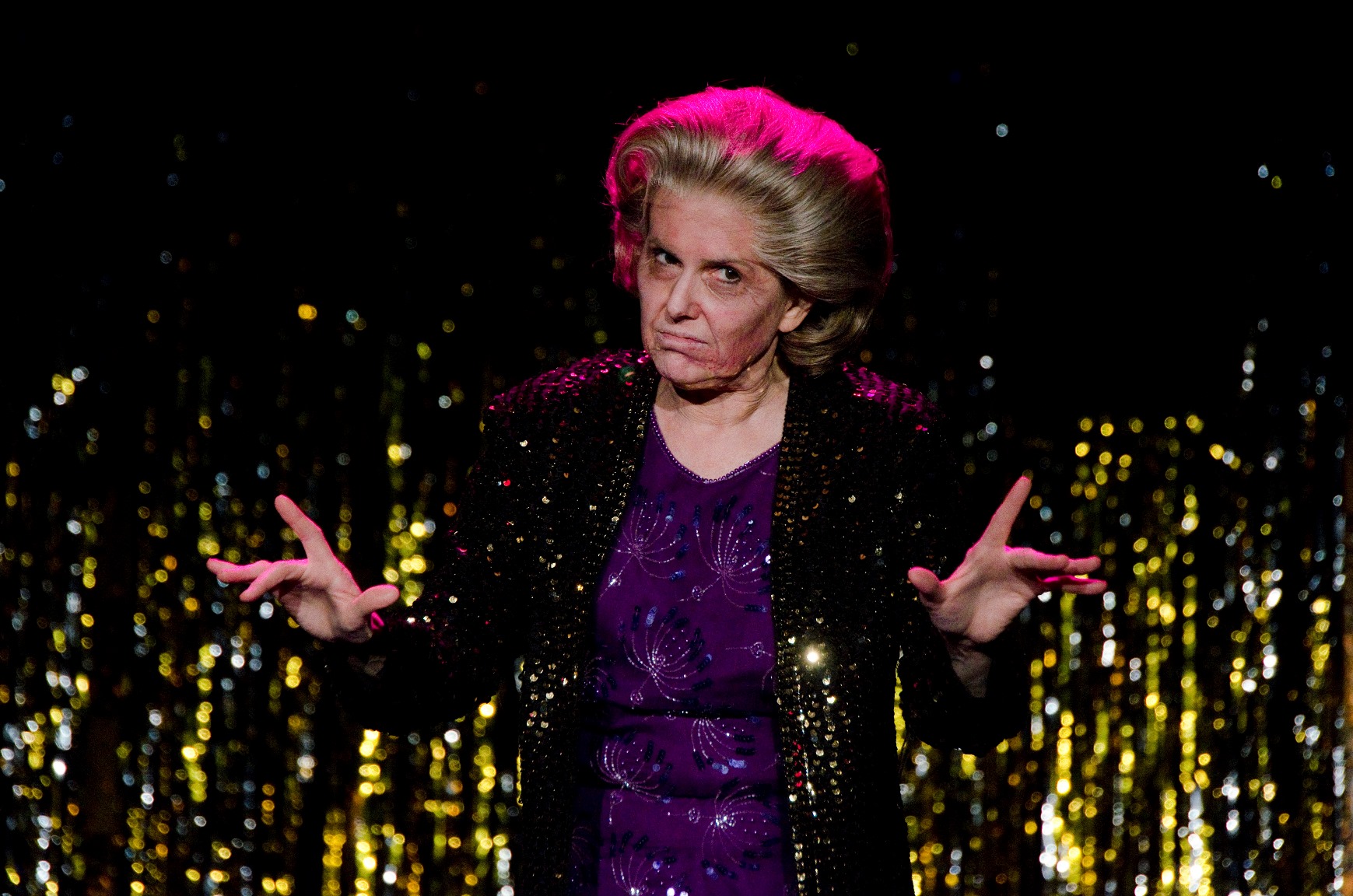
Leah Haviland, one of the featured performers in The Best of Shadowbox (Shadowbox Live photo)
Leah Haviland, one of the featured performers in The Best of Burlesque (Shadowbox Live photo)

By Richard Ades

Shadowbox Live’s annual Best of Shadowbox shows often benefit from honing—the honing that takes place once the players have enough performances under their belts to realize what does and doesn’t work.

You’d think the same would apply to the current Best of Burlesque show, which repeats the best skits and song/dance/striptease numbers from the three previous Burlesque shows. But it doesn’t, at least as far as the skits are concerned.

Since they’re based on actual routines that were performed in old vaudeville houses, director Stev Guyer and his cast probably don’t feel free to tweak the material. And since the acting is based on the over-the-top clowning that was practiced back in the day, Shadowbox doesn’t have much room to tweak that, either.

The result is that if you’ve seen these skits before, you won’t find much that’s fresh here. Of course, if you haven’t been to the previous Burlesque shows, you’ll likely enjoy the comedy, assuming you have a high tolerance for corny jokes about the kinds of things our grandparents or great-grandparents found amusing.

Fortunately, the rest of the show bases its appeal on something that’s more timeless: sex. Because The Best of Burlesque omits the loose storyline that tied its predecessors together, it can pack in more song-and-dance numbers that inevitably leave women stripped down to their pasties and/or men stripped down to their skivvies.

Not all of these numbers are equally inspired. But when the songs are strong, the costumes are colorful and the stripping is done with panache and attitude, you can’t help sitting up and taking notice.

One number that combines great singing and great stripping is Bang Bang, with lead vocals by a fearless Leah Haviland. Shadowbox wisely places it at the end of Act 1, which allows viewers to step outside and cool off during intermission.

Act 2 kicks back into high gear with The Mating Game, in which vocalist Amy Lay holds forth in an impossibly tall and feathery hat while fairy-like creatures cavort around her. That’s soon followed by a funny and sexy take on the Coasters song Little Red Riding Hood. Brandon Anderson handles the vocals while a raunchy version of the titular fairy tale is acted out by Nikki Fagin as Red, Stacie Boord as Grandma and Guillermo Jemmott as the lascivious Wolf.

A dark perversion of sexuality is represented by Sweet Dreams, sung by Fagin and Jemmott while Jack the Ripper (Andy Ankrom) saunters around in search of his next victim. It’s one of several numbers that owe much to Aaron Pelzek’s moody lighting.

Also memorable: You Look Like Rain, with lead vocals by Kevin Sweeney and tasty instrumentals by guitarist Matthew Hahn and his band.

As stated earlier, The Best of Burlesque dispenses with a storyline. Partially taking its place are video biographies of Gypsy Rose Lee and other iconic strippers of years past. These are scattered throughout and offer interesting tidbits of information, such as the fact that erotic dancers were sometimes featured at world’s fairs. I’d always assumed these were more family-friendly affairs.

The videos made me wonder whether Shadowbox might decide to re-create some of these ladies’ classic dances for future Burlesque shows. From a historic, nostalgic and, ahem, every other standpoint, they’d be a great addition.

The Best of Burlesque continues through April 17 at Shadowbox Live, 503 S. Front St., Columbus. Show times are 7:30 p.m. Wednesday-Thursday and 2 and 7 p.m. Sunday. Running time: 2 hours (including intermission). Tickets are $25, $20 student/senior/military. Special Valentine’s Day packages are available for Feb. 14 performances. 614-416-7625 or shadowboxlive.org.

Graczyk, Grossberg honored at Roundtable awards gala

The cast of Gallery Players' production of Les Miserables sings One Day More at the Theatre Roundtable's 2016 Awards Night (photos by Jerri Shafer
The Theatre Roundtable’s 2016 Awards Night featured performances from nominated musicals, including Gallery Players’ 2015 production of Les Miserables (photos by Jerri Shafer)

By Richard Ades

At one point during the Theatre Roundtable’s annual Awards Night on Sunday, a presenter joked that it was just like the Oscars because we’d been there two hours and were only halfway through. He was exaggerating a little, but the show did run quite a bit longer than usual.

At least the weather was cooperative—unlike last year, when an incoming winter storm darkened the usually festive atmosphere. Besides, there were enough high points that most people probably didn’t mind sticking around.

The Central Ohio Theatre Critics Circle provided one of the highest points: an appearance by Ed Graczyk. He received the circle’s Roy Bowen Lifetime Achievement Award for, among other things, leading Players Theatre Columbus for many years and writing the groundbreaking play Come Back to the 5 & Dime, Jimmy Dean, Jimmy Dean.

Taking part in the Theatre Roundtable’s 2016 Awards Night are critics (from left) Paul Batterson, Jay Weitz, Christina Mancuso, Michael Grossberg, Margaret Quamme, Richard Sanford and (at the podium) Richard Ades (photos by Jerri Shafer)
Taking part in the Theatre Roundtable’s 2016 Awards Night are critics (from left) Paul Batterson, Jay Weitz, Christina Mancuso, Michael Grossberg, Margaret Quamme, Richard Sanford and (at the podium) Richard Ades

Also honored by the critics were Evolution Theatre Company, Short North Stage, Shadowbox Live and MadLab’s former artistic director, Andy Batt. Before walking off with his citation, Batt delighted the audience by turning the tables on the critics, passing out both praise and pans to the people who’d long been judging his work as an actor and director.

Later—much later—in the evening, critic Michael Grossberg received an honor of his own: the Roundtable’s treasured Harold Award. The group probably chose to present it this year because Grossberg officially retired in 2015 when The Columbus Dispatch’s new owners made dozens of staff cuts. But fortunately for the local theater scene, the Dispatch is still counting on him to lead theater coverage, the only difference being that now he’s doing it as a freelancer.

The evening also included excerpts from 2015 musicals that were nominated for Roundtable awards. For me, the most exciting moment came when Gallery PlayersLes Miserables cast reassembled for a rendition of One Day More. It was a spectacular reminder of just how great that production really was.

For a list of Sunday’s nominees and winners, visit www.theatre-roundtable.org. It includes everything but the citations presented by the Central Ohio Theatre Critics Circle, which are listed below:

▪ To Evolution Theatre Company and managing artistic director Mark Schwamberger for a lineup of 2015 productions that entertained viewers while fulfilling the troupe’s refocused mission of advancing the understanding of gender issues and exploring gay and lesbian themes.

Andy Batt critiques the critics after accepting a citation for his longtime leadership of MadLab Theatre
Accepting a citation for his longtime leadership of MadLab Theatre, Andy Batt takes advantage of the opportunity to critique the critics

▪ To Andy Batt, who stepped down as MadLab’s artistic director at the end of 2015, for leading the troupe through 13 years of growth and development that included its 2012 launch of an annual festival for high school playwrights and its 2010 purchase and renovation of a performance space and gallery that has helped to nurture both the performing and visual arts in Downtown Columbus.

▪ To Short North Stage for making a major commitment to nurturing new musicals in 2015 with its successful world premieres of The Great One, The Last Night of Disco and Krampus: A Yuletide Fable.

▪ To Shadowbox Live for celebrating its 25th anniversary by stretching itself with inventive rock tribute shows and collaborations, both local and international.

Critic Michael Grossberg prepares to present a Roy Bowen Lifetime Achievement Award to Ed Graczyk

▪ A Roy Bowen Lifetime Achievement Award to Ed Graczyk, an accomplished director and nationally known playwright, who led Players Theatre Columbus from the 1970s into the early 1990s and wrote Come Back to the Five & Dime, Jimmy Dean, Jimmy Dean, a pioneering transgender comedy-drama that premiered at Players in 1976, ran on Broadway and became a Robert Altman film in 1982 and is celebrating its 40th anniversary in 2016.