Romeo, Romeo, wherefore art thou holding a whip and handcuffs?

Fifty ShadesBy Richard Ades

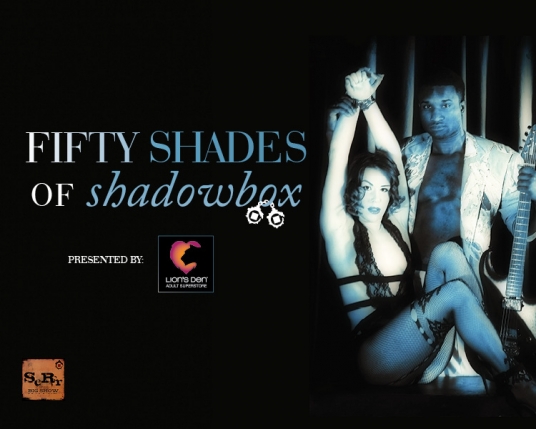
Given what they say about lightning striking twice, I had little reason to believe 50 Shades of Shadowbox would be as much fun as its 2015 predecessor.

That show, Sex at the Box, turned out to be my second-most-fun non-horizontal experience of the entire year. I knew it would be impossible to beat, but I hoped the new show would come close to matching its inspired lunacy.

Mostly, it doesn’t. But sometimes it does.

The skit that best reflects the show’s theme is 50 Shades of Romeo, in which star-crossed lovers Romeo (Robbie Nance) and Juliet (Amy Lay) find they share a penchant for kinky canoodling. Adding to the mock-Shakespearean atmosphere is the liberal use of Elizabethan suffixes (“musteth”).

Even funnier is The Ear Pod, featuring Tom Cardinal as a football fan who’s forced to miss the big game so he can attend couples counseling with his unhappy wife (Julie Klein). Miracle of miracles, it even has a punchline that’s both unexpected and amusing.

Maybe I’m being redundant there, as it’s hard for something to make us laugh if it isn’t unexpected. That’s the trouble with some of the evening’s weaker skits: They’re instantly predictable.

As soon as Kyle (JT Walker III) and his sexy girlfriend (Lay) walk into a room in The Jealous Boyfriend, it’s obvious she’s going to meet one ex-beau after another. It’s also obvious how Kyle will react, since the skit’s title gives it away.

Then there’s Spell Check, in which parents Katy Psenicka and Cardinal accuse their son of seeking out Internet porn. The punchline falls flat because it merely confirms what we knew all along.

The show gets off on the wrong foot with its first skit, Laid Off, about a boss (Klein) who decides to “fire” her lover (Cardinal) from the relationship. It’s disappointing because it tries to find laughs in heavy-handed double entendres rather than characterization or clever developments.

Thankfully, several of the other skits are more inventive, even if they aren’t absolute laugh riots. They include RiDickulous (about an app for girls deluged with photos of classmates’ not-so-private parts) and Sexy Nurse (about a hospital in which nurses dress just like they do in men’s lurid fantasies).

Also fairly amusing is Aw Fuk Me, about a 911 service for embarrassed victims of sexual shenanigans gone awry. However, at the performance I attended, it seemed to be cut short by a lighting miscue. It was a rare instance of imperfection for a troupe whose shows usually run like clockwork.

Shadowbox is such an expert at sketch humor that it’s likely director Stev Guyer and his cast will find ways to squeeze more humor out of the show as its run continues. But for now, the skits aren’t as reliably entertaining as the musical numbers.

The best cover songs include Bruno Mars’s Gorilla (sung by Noelle Grandison and Maurin Penn), Marvin Gaye’s Sexual Healing (sung by Grandison and Guillermo Jemmott) and Prince’s Little Red Corvette (sung by a very Prince-ly Walker).

Judiciously, Shadowbox saves the best for last: Meat Loaf’s Paradise by the Dashboard Light, with Kline and Lucas Tomasacci trading verses as the dueling leads. The show may not be epic, but it ends in a tunefully epic fashion.

50 Shades of Shadowbox continues through March 19 at Shadowbox Live, 503 S. Front St. Show times are 7:30 and 10:30 p.m. Friday-Saturday. Running time: 1 hour, 55 minutes (including intermission). Tickets are $20-$40. 614-716-7625 or www.shadowboxlive.org.

‘Spotlight’ shines in 14th annual Central Ohio Film Critics Association awards

Central Ohio’s film critics have voted on their favorite films and performances of 2015. I’m happy to report that my favorite 2015 release, Spotlight, won some of the top awards. The press release is below:

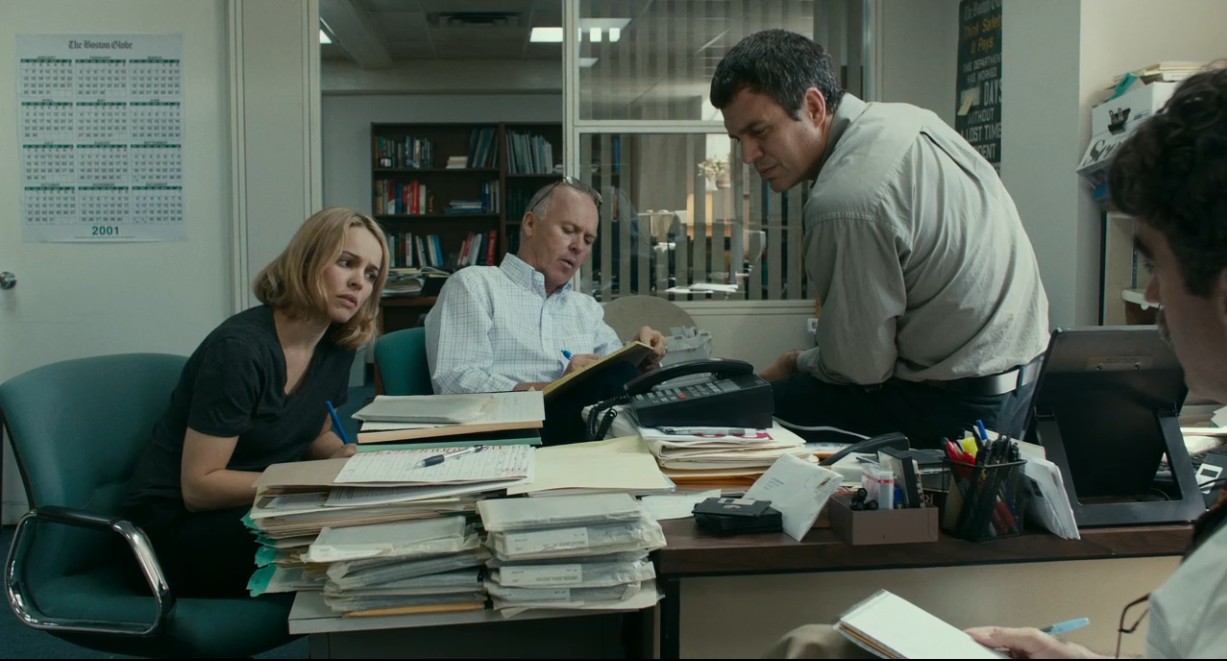
Rachel McAdams, Michael Keaton, Mark Ruffalo and Brian d’Arcy James (from left) play journalists investigating pedophile priests in Spotlight (Open Road Films)

(Columbus, Jan. 7, 2016) Tom McCarthy’s investigative drama Spotlight has been named Best Film in the Central Ohio Film Critics Association’s 14th annual awards, which recognize excellence in the film industry for 2015. The film also claimed three other awards. McCarthy was honored as Best Director. The cast, including Michael Keaton, Mark Ruffalo and Rachel McAdams, was named Best Ensemble. And Josh Singer and McCarthy won for Best Original Screenplay.

Columbus-area critics lauded Alicia Vikander with three awards: Best Supporting Actress (Ex Machina); Actor of the Year for her exemplary body of work in Burnt, The Danish Girl, Ex Machina, The Man from U.N.C.L.E., Seventh Son and Testament of Youth; and Breakthrough Film Artist. Other individual screen performers commended for their achievements include Best Actor Leonardo DiCaprio (The Revenant), who previously was named COFCA’s Best Actor in 2006 for The Departed; Best Actress Brie Larson (Room); and Best Supporting Actor Benicio Del Toro (Sicario).

The Revenant’s Emmanuel Lubezki won Best Cinematography. COFCA members also tabbed him for Best Cinematography in 2011 for The Tree of Life and in 2013 for Gravity. Other winners include: Mad Max: Fury Road’s Margaret Sixel for Best Film Editing; The Big Short’s Charles Randolph and Adam McKay for Best Adapted Screenplay; The Hateful Eight’s Ennio Morricone for Best Score; Best Documentary The Look of Silence; Best Foreign Language Film Phoenix; Best Animated Film Inside Out; and The Tribe (Plemya) as Best Overlooked Film.

Founded in 2002, the Central Ohio Film Critics Association is composed of film critics based in Columbus, Ohio, and the surrounding areas. Its membership consists of 21 print, radio, television and Internet critics. COFCA’s official website at www.cofca.org contains links to member reviews and past award winners.

Winners were announced at a private party on Jan. 7.

Complete list of awards:

Best Film
1. Spotlight
2. Inside Out
3. Room
4. Mad Max: Fury Road
5. Ex Machina
6. Sicario
7. Star Wars: Episode VII – The Force Awakens
8. The Revenant
9. The Big Short
10. The Martian

Best Director
-Tom McCarthy, Spotlight
-Runner-up: George Miller, Mad Max: Fury Road

Best Actor
-Leonardo DiCaprio, The Revenant
-Runner-up: Michael Fassbender, Steve Jobs

Best Actress
-Brie Larson, Room
-Runners-up: Saoirse Ronan, Brooklyn; and Alicia Vikander, The Danish Girl

Best Supporting Actor
-Benicio Del Toro, Sicario
-Runner-up: Oscar Isaac, Ex Machina

Best Supporting Actress
-Alicia Vikander, Ex Machina
-Runner-up: Jennifer Jason Leigh, The Hateful Eight

Best Ensemble
Spotlight
-Runner-up: The Hateful Eight

Alicia Vikander as an advanced robot named Ava in Ex Machina

Actor of the Year (for an exemplary body of work)
-Alicia Vikander, Burnt, The Danish Girl, Ex Machina, The Man from
U.N.C.L.E., Seventh Son and Testament of Youth
-Runner-up: Domhnall Gleeson, Brooklyn, Ex Machina, The Revenant and Star
Wars: Episode VII -The Force Awakens

Breakthrough Film Artist
-Alicia Vikander, Burnt, The Danish Girl, Ex Machina, The Man from
U.N.C.L.E., Seventh Son and Testament of Youth (for acting)
-Runner-up: Sean Baker, Tangerine (for producing, directing, screenwriting, film editing, cinematography, camera operation and casting)

Best Cinematography
-Emmanuel Lubezki, The Revenant
-Runner-up: John Seale, Mad Max: Fury Road

Best Film Editing
-Margaret Sixel, Mad Max: Fury Road
-Runner-up: Joe Walker, Sicario

Best Adapted Screenplay
-Charles Randolph and Adam McKay, The Big Short
-Runner-up: Emma Donoghue, Room

Best Original Screenplay
-Josh Singer and Tom McCarthy, Spotlight
-Runner-up: Pete Docter, Meg LeFauve, and Josh Cooley, Inside Out

Best Score
-Ennio Morricone, The Hateful Eight
-Runner-up: Junkie XL, Mad Max: Fury Road

Best Documentary
The Look of Silence
-Runner-up: Amy

Best Foreign Language Film
Phoenix
-Runner-up: Wild Tales (Relatos salvajes)

Best Animated Film
Inside Out
-Runner-up: Anomalisa

Best Overlooked Film
The Tribe (Plemya)
-Runner-up: The Gift

COFCA offers its congratulations to the winners.

Front Street troupe was particularly ambitious in 2015

One of the beautiful stage pictures offered by Short North Stage’s production of A Little Night Music (photo by Ray Zupp)

By Richard Ades

I try not to play favorites when I’m making out my annual “best of” list, but it’s hard to avoid the fact that one Columbus theater company was a dominant force in 2015. Shadowbox Live had so many great and unique shows that I could just about draw up a separate list devoted solely to the troupe on Front Street.

To some extent, this is no surprise. Shadowbox is by far the biggest and busiest company in town. At any given time, it divides its week up among multiple productions.

In 2015, though, Shadowbox seemed to be trying harder than ever. Not only were several of its variety shows particularly enjoyable, but it launched all-new productions that were like nothing we’d ever seen.

Shadowbox’s ambition didn’t always pay off. After putting everything else on hold for its fall production of The Tenshu, the kabuki-inspired tale turned out to be visually exhilarating but dramatically dull. But Joe Cocker: Mad Dog and Englishman was a joyful musical tribute, while the Pink Floyd retrospective Which One’s Pink? had moments of pure genius.

To top the year off, Shadowbox announced plans to purchase its expansive Brewery District venue. It’s a gutsy move, but if anyone can pull it off, it’s Stev Guyer and company.

Jean Valjean (Bill Hafner, left) risks being recognized by Javert (Scott Green, center) when he intercedes on behalf of Fantine (Melissa Muguruza), who’s being detained by two local constables (Derryck Menard and Emerson Elias) in this scene from Les Miserables (photo by Jerri Shafer)
Jean Valjean (Bill Hafner, left) risks being recognized by Javert (Scott Green, center) when he intercedes on behalf of Fantine (Melissa Muguruza) in this scene from Gallery Players’ production of Les Miserables (photo by Jerri Shafer)

Beyond Shadowbox, my 2015 was highlighted by two wonderful musical productions: Gallery Players’ Les Miserables and Short North Stage’s A Little Night Music. The former was the year’s biggest surprise. I’d previously seen four productions of Les Miz, including two touring shows and the 2012 film version, but I’d never found Jean Valjean’s saga as moving as it was on the Jewish Community Center stage.

On a more modest scale, several of the year’s biggest treats were provided by little Evolution Theatre Company, which staged gay-centered shows that were at once enjoyable and consciousness-raising. Especially rewarding were the WWII musical Yank!, the historical drama The Temperamentals and the Texas-based comedy Sordid Lives.

Also interesting: Wild Women Writing’s On the Edge and Over the Edge, collaborations with Short North Stage that featured short works by Samuel Beckett, Harold Pinter and contemporary American playwright Will Eno.

A few of the other shows were mixed successes for me: I had reservations about the works themselves, but I admired the way they were staged. Warehouse Theatre Company’s This Is Our Youth, Available Light Theatre’s The Christians, MadLab’s Clowntime Is Over and A&B Theatrical’s Devotion all fell into this category.

Outright disappointments? Of course there were some, but maybe the biggest was that I missed many shows that doubtlessly were worthwhile. Often I was too busy or out of town. In the case of one popular show staged in a relatively small space, I simply couldn’t get a ticket. At any rate, it should be remembered that any “best of” list is limited by what that particular critic has or hasn’t seen.

Obviously, 2015’s biggest shock was the unexpected death of Actors’ Theatre artistic director John S. Kuhn in late February. Though it was a great loss to the company and the theater community at large, Actors’ staff and supporters came together to ensure that the outdoor troupe’s summer season went forward as planned. Since then, Actors’ Theatre has named Philip J. Hickman as its new artistic director and announced a promising 2016 season, offering hope that the troupe will continue to build on the gains it made under Kuhn’s leadership.

On that somber but optimistic note, here’s my list of the best productions and performances of 2015:

Best play: Who’s Afraid of Virginia Woolf?, Adrenaline Theatre Company. Director Audrey Rush and her cast brought fire and commitment to Edward Albee’s tale of a monstrously dysfunctional relationship.

Best musical (tie): Les Miserables, Gallery Players; and A Little Night Music, Short North Stage. The former demonstrated that Les Miz still has the power to move us. The latter proved once again that Short North Stage has a way with Sondheim.

A sampling of the characters and costumes featured in Sex at the Box (Shadowbox Live photo)

Best variety show: Sex at the Box, Shadowbox Live. The show’s many highlights included Shadowbox’s funniest skit in years (Funk Daddy Love, starring Brandon Anderson) and perhaps its best cover song ever (Ball and Chain, with Julie Klein expertly channeling Janis Joplin).

Best touring show: Anything Goes, Broadway in Columbus/CAPA. Watching the seagoing musical was like crossing the Atlantic while time-traveling back to the 1930s.

Best new work: Krampus: A Yuletide Tale, Short North Stage. Created by Nils-Petter Ankarblom and Carrie Gilchrist, the musical was a delightfully menacing alternative to A Christmas Carol. Honorable mention: The Great One: A Hockey Musical, Short North Stage.

Best “far out!” moment: Act 2 of Which One’s Pink?, Shadowbox Live. Footage from The Wizard of Oz was combined with live re-enactments of scenes from the film, live performances of music from Pink Floyd’s The Dark Side of the Moon album and interpretive video by CCAD students. Bravo to director Stev Guyer and his talented collaborators.

Best direction (tie): David R. Bahgat, Les Miserables, Gallery Players; and Michael Licata, A Little Night Music, Short North Stage. Both directors performed miracles with the help of talented casts and crews. Bahgat made the familiar Les Miz as affecting as ever, while Licata brought out every tender, aching moment in Sondheim’s tale of longing and regret.

Best performance, female: Marya Spring, A Little Night Music, Short North Stage. Spring exuded both worldly confidence and vulnerability as glamorous actress Desiree.

Dr. Eve Bolinger (Ruth Sternberg) tries to “de-homosexualize” Earl “Brother Boy” Ingram (Mark Phillips Schwamberger) in Evolution Theatre Company’s production of Sordid Lives (photo by Jerri Shafer)

Best performance, male: Bill Hafner, Les Miserables, Gallery Players. Hafner sang beautifully while portraying Jean Valjean with just the right combination of nobility and humility.

Best cross-dressing performance: Mark Phillips Schwamberger, Sordid Lives, Evolution Theatre Company. The musical shifted into high gear only after Schwamberger appeared as the pitiable but hilarious “Brother Boy.”

Mythical ogre stalks kids in musical yuletide tale

A scene from Short North Stage's production of Krampus, a Yuletide Tale (photo courtesy of Short North Stage)
Krampus (JJ Parkey, center) terrorizes Flora (Emma Lou Andrews) and Bruno (William Gorgas) while St. Nicholas (Edward Carignan) watches on (photo courtesy of Short North Stage)

By Richard Ades

Christmas, at its essence, is a holiday devoted to hope and redemption.

Thus, it’s not surprising that redemption is at the heart of the granddaddy of all holiday yarns, Charles Dickens’s A Christmas Carol. And it’s also at the heart of Krampus: A Yuletide Tale, a musical that’s wrapping up its world-premiere run this weekend at Short North Stage’s Garden Theater.

Another similarity to A Christmas Carol: The road to redemption is a scary one indeed, probably too scary for small children. But for adults and mature youngsters, Krampus is a bracingly original journey.

With music by Nils-Petter Ankarblom (who also leads the three-piece band), and book and lyrics by Ankarblom and Carrie Gilchrist (who also directs), Krampus feels like an instant classic. The songs are beautiful and varied, and the story is thought-provoking and involving.

The title character (JJ Parkey) is a demon-like figure from Austro-Bavarian folklore who is said to kidnap and punish naughty children during the Christmas season. In this story, he sets his sights on siblings Flora (Emma Lou Andrews) and Bruno (William Gorgas), the offspring of penniless widow Anna Schlecht (Stephanie Prince).

Flora and Bruno aren’t really bad kids—they simply make a bad decision in order to help Anna avoid being evicted by their money-grubbing landlord, Herr Ulrich (Luke Stewart). But this momentary lapse is enough to remove them from the good graces of St. Nicholas (Edward Carignan), the forerunner of our modern Santa Claus.

Contributing to the tale’s charm is the intimate way it’s presented. Viewers sit on the stage of the Garden’s big auditorium, placing them a handful of feet away from Carignan’s storybook-like set. The imaginative costumes (also designed by Carignan) and the dramatic lighting add to the magical atmosphere.

The only production’s only technical shortcoming is that the band occasionally overpowers the vocals. This is mostly a matter of sound mixing, but Prince adds to the problem by singing some of her lines at a nearly inaudible level.

In the two showiest roles, Parkey and Carignan are spectacularly successful. Parkey makes a fearsome but somehow vulnerable Krampus, while Carignan is a surprisingly officious St. Nicholas. (Those of a spiritual bent may read religious significance into the implication that the mythic figures are but two sides of the same coin.) Both actors sing beautifully, but Carignan’s rich voice is put to particularly good use on St. Nick’s introductory solo, On This Night of December Fifth.

Among the human characters, Andrews’s Flora is the most engaging, but all of the cast members display heart and commitment.

Any new work can benefit from a tweak or two, and Krampus could stand to whittle down some of its sappier elements. Otherwise, this new work is just about perfect.

As I said, an instant classic.

Short North Stage will present Krampus, a Yuletide Tale through Dec. 20 at the Garden Theater, 1187 N. High St., Columbus. Show times are 8 p.m. Thursday-Saturday and 3 p.m. Sunday. Running time: 1 hour, 15 minutes. Tickets are $25, $15 for children. 614-725-4042 or shortnorthstage.org.

What’s a nice Jewish girl like you doing in a Christmas pageant like this?

Rose Clubok (right) as Shirley and Georgia Fried as her best friend, Evie, in the Gallery Players production of Coney Island Christmas (photo by Rebecca Barger-Amato)

By Richard Ades

I always wondered how Sandy Cohen felt about playing the Virgin Mary.

Sandy was one of the two Jewish girls who were in my class in elementary school. She played Mary in our annual Christmas pageant, this being back in the days when most people thought it was perfectly normal to hold a religious drama in a public school.

Then again, most people weren’t Jewish. I assume Sandy wanted to play the plum part or she wouldn’t have tried out for it, but how did she feel about our school hosting this seasonal Christian event while ignoring Hanukkah? For that matter, how did her parents feel?

Such questions occurred to me after seeing Gallery Players’ charming production of Coney Island Christmas. Written by Donald Margulies (The Loman Family Picnic), it’s about a Jewish girl who lands an even bigger role in her own school’s Christmas pageant: Jesus Christ.

Cursed with an obnoxiously loud voice and low self-esteem, Shirley Abromowitz (Rose Clubok) is thrilled when drama teacher Mr. Hilton (Rick Cohen) asks her to play the adult Jesus, who serves as the pageant’s narrator. Her supportive father (Brian A. Belair) also is thrilled for her, but her mother (Kate Willis), not so much. An immigrant who came to America to escape anti-Semitism, she sees the play as yet another form of persecution.

The family dispute develops in Brooklyn in the 1940s and is presented in the form of a memory that the adult Shirley (Laurie Alexander) relates to her young granddaughter, Clara (Nora Butter).

Nora Butter (left) as Clara, Laurie Alexander as adult Shirley and Rose Clubok as young Shirley (photo by Jared Saltman)

Co-directors April Olt and Sonda Staley make good use of the Jewish Community Center’s big stage, allowing the story to hop from place to place, and from the present to the past, without skipping a beat. More importantly, they make good use of their large cast, particularly its younger members.

Rose Clubok’s Shirley seldom sounds as loud as she’s described, but she’s a lovable and compelling heroine. Other youngsters give unforced performances as her fellow students, which makes it all the funnier when they overact their way through Mr. Hilton’s Thanksgiving and Christmas productions.

The adult cast members—including Laura Crone as music teacher Mrs. Glace—are equally on target. Mr. and Mrs. Abromowitz’s squabbling scenes do tend to drag a bit, but the eventual emotional payoff is worth the wait.

Alexander holds it all together as the adult Shirley, who both narrates and plays a supporting role in the extended flashback to her childhood. As the granddaughter to whom she tells the tale—a role that mostly consists of observing quietly—Nora Butter displays poise and confidence.

Jon Baggs’s scenery, Debbie Hamrick’s costumes and Jarod Wilson’s sound and lighting design are all unobtrusively effective.

My only real quibble with Margulies’s comedy is that it could be more sympathetic to Mrs. Abromowitz. She comes across as an unfeeling parent when she tries to keep Shirley out of the Christmas pageant, but she really is right that the school shouldn’t be favoring one religion over another.

As a memory play, though, Coney Island Christmas captures the spirit of a time when few questioned this lack of division between church and state. It also celebrates children like Shirley who were strong enough to survive the era with their identities intact.

Gallery Players will present Coney Island Christmas through Dec. 20 at the Jewish Community Center, 1125 College Ave., Columbus. Show times are 7:30 p.m. Thursday, 8 p.m. Saturday and 2:30 p.m. Sunday. Running time: 1 hour, 25 minutes. Tickets are $20 ($15 for JCC member), $18 for ages 60-plus ($13 for JCC members), $10 students/children. 614-231-2731 or www.jccgalleryplayers.org.

Welcome to the world where gay is the new straight

ZannaBy Richard Ades

Sean Felder seems a bit miscast as Steve, the football star in Zanna, Don’t! He sings and acts just fine, but the gridiron doesn’t usually attract guys with such a slight build.

Then again, there’s nothing usual about the world portrayed in Tim Acito’s “musical fairy tale.” It’s set at Heartsville High School, where being gay is the norm and being hetero is so unheard of that the head of the drama club is scandalized when a member suggests doing a musical about straight people.

Just as unconventional is the students’ attitude toward extracurricular activities. Though Steve is such a talented jock that he wins a game by actually passing the ball to himself, the school’s biggest celebrity is chess champion Mike (Ricky Locci). But the real key to popularity, as new student Steve recognizes, is joining the drama club.

Obviously, this is the school many a gay student has dreamed of attending. As written and scored by Acito (with help from Alexander Dinelaris), Zanna, Don’t! brings the dream to fizzy, tuneful life.

In Evolution Theatre’s production, director Brent Ries captures the piece’s mood with the help of Shane Cinal’s imaginative set, Danielle Mann’s playful choreography, music director Tim Sarsany’s well-heeled band and, most importantly, a lovable cast.

In the center of it all is William Macke as the title character, a wand-carrying, spell-casting student whose only desire is to hook up everyone with his or her same-sex soulmate. Indeed, Zanna devotes so much time to others’ happiness that he neglects his own. His sole friend is Cindy, an exotic bird portrayed by puppeteer Mike Writtenberry.

Even when trouble rears its head, Zanna does his best to keep romance alive. After Roberta (Tahrea Maynard) learns that girlfriend Karla (Alex Lanier) has been unfaithful, Zanna immediately points her toward Kate (Jordan Shafer). In general, everything is sweetness and light until a girl and boy come to the reluctant realization that they’re attracted to each other. The resulting controversy threatens the school’s loving atmosphere, forcing Zanna to respond with a spell that has unforeseen consequences.

Also in the cast are Laura Crone as the bossy Candi, Brian C. Gray as the put-upon Arvin and T. Johnpaul Adams as radio deejay Tank.

Everyone does a good or better-than-good job on the show’s songs, which represent vintage pop-rock and other lighthearted genres. Though the actors don’t appear to be miked, most put out enough volume to be heard over the carefully modulated band. That’s not to say the show wouldn’t benefit from more amplification, which would add to the fun quotient, but it functions just fine without it.

Despite its satirical, upside-down view of reality, Zanna, Don’t! mostly serves up frothy fantasy. As a theatrical work, it’s about as slight as the build of Heartsville High’s star football player, but its tunefulness and charm make it a modestly pleasant diversion.

Evolution Theatre Company will present Zanna, Don’t! through Nov. 21 at the Columbus Performing Arts Center, 549 Franklin Ave., Columbus. Show times are 8 p.m. Thursday-Saturday. Running time: 2 hours, 5 minutes (including intermission). Tickets are $25, $20 students/seniors, $30 for “generosity seating” (second or third row center). 1-800-838-3006 or evolutiontheatre.org.

Boyfriend and ex vie for woman’s affection

James Harper, Beth Josephsen and Danny Turek (from left) in Devotion (A&B Theatrical photo)
James Harper, Beth Josephsen and Danny Turek (from left) in Devotion (A&B Theatricals photo)

By Richard Ades

Local playwright Bill Cook has been known for plays about men in nightmarish situations.

In two of his previous works (Love in an Age of Clamor and The Promised Land), the nightmare was mainly financial in nature, but a woman also played a role. It seems that in Cook’s world, as in real life, romantic relationships can be both complicated and precarious.

In his new play, Devotion, those relationships move to center stage. Set in New York City, it’s about Tricia (Beth Josephsen), a struggling artist with two men in her life: current boyfriend James (James Harper), a video artist; and former boyfriend Alex (Danny Turek), an actor.

As the play begins, both James and Alex are sharing Tricia’s loft, but Alex keeps promising to move out as soon as he finds a new place. This irks James, who suspects Alex is biding his time while he looks for ways to con his way back into Tricia’s good graces. And his distrust seems justified, especially after Alex claims he’s met an art buyer who can help boost Tricia’s career.

Who will end up with Tricia? It’s hard to feel we have a horse in this race, as we don’t particularly like any of the characters. However, we may well recognize them, as Cook injects their interchanges with verbal slings and arrows that many will find wincingly familiar. Director Pamela Hill builds on the script’s strengths by encouraging the actors to dive headfirst into their characters.

On opening night, Harper gave the most understated performance as James—to the extent that, at times, it seemed he had yet to fully invest in the character. Turek started out with the opposite problem, overplaying his first scene. Overall, though, he gave a spirited and entertaining interpretation of the glib, conniving Alex.

Even more impressive is Josephsen’s performance, despite an occasional tendency to mumble her lines. Whether Tricia is keeping Alex’s advances in check or greeting James’s pronouncements with maternal disapproval, she creates a convincing portrayal of a woman who likes to be in control.

Though Devotion differs from Cook’s earlier works in some ways—for example, the tone is naturalistic rather than surreal—it retains the previous plays’ cinematically short scenes. This means the action has to stop every few minutes while stagehands adjust Peter Pauze’s appropriately realistic scenery. The pauses would be more of a distraction if the interludes weren’t accompanied by well-chosen mood music.

Another, more unfortunate, way in which Devotion resembles other Cook plays I’ve seen is that its ending doesn’t quite work. At least, it doesn’t quite work for me. At a certain point, two of the three characters begin acting in ways that make no psychological sense. I can hazard a guess as to why Cook has them behave this way, but sorry, I’m just not buying it.

Until the final scene, however, Devotion is a low-key but interesting take on the Battle Between the Sexes.

A&B Theatricals will present Devotion through Nov. 14 at MadLab Theatre, 227 N. Third St., Columbus. Show times are 8 p.m. Thursday-Saturday. Running time: 1 hour, 35 minutes (including intermission). Tickets are $15, $12 for students and seniors. 614-441-2929 or ab-theatrical.com.

Period piece favors outrageousness over logic

Kathryn Miller, Colleen Dunne and Melissa Bair (from left) in Skillet Tag (photo by Michelle DiCeglio)

By Richard Ades

Pete Bakely’s Skillet Tag is about a company team-building exercise that turns into a night of mayhem and menstruation. It’s just the kind of diversion we want and expect from MadLab for the Halloween season.

Well, with one exception: It would be nice if it came with a few more laughs.

Yes, there are chuckles and snickers, but they mostly come from Bakely’s willingness to push beyond the boundaries of good taste. For instance, characters come up with a myriad of terms for the menstrual cycle after it develops that every woman in the office is “entertaining the Red Army” simultaneously. And, oh yes, a used tampon makes a sudden appearance right before an act of onstage coitus.

Gross? Yes. Funny? Well…

One problem is that none of this makes much sense. From the beginning, it’s obvious that Bakely is more interested in setting up outrageous developments than he is in making them believable.

Why does host Jeff (Jason Sudy) insist that his underlings play “tag” by bonking each other over the heads with skillets? And when the hazardous game produces the first of the evening’s multiple fatalities, why is Neal (Chad Hewitt) nervous that the result will be a visit by murderous thugs? After all, this is a company that prints greeting cards, not a branch of the Mafia.

There’s a vague explanation that the staff long ago got bored and began venturing into dangerous sidelines, but logic clearly is not one of the playwright’s strengths.

Working under Michelle Batt’s direction on Brendan Michna’s handsome set, the actors dive gamely into the one-dimensional characters.

Gamest of all is Colleen Dunne as Becky, a secretary who seems to take a monthly trip to the edge of insanity. Others include Kathryn Miller as a recently hired attorney, Casey May as a dimwitted IT expert and Melissa Bair as the office lush. In her usual thoughtful fashion, Bair manages to suggest that her character actually has something going on beneath the surface, but she’s limited by a script that mostly confines her to swilling copious amounts of alcohol.

Also making brief appearances are Lance Atkinson and Chelsea Jordan as cops who are called (separately) to the scene after the corpses begin piling up. Incidentally, Atkinson’s cop may be unprofessional, but his female counterpart is totally incompetent. When you combine that fact with the evening’s liberal helpings of menstrually inspired mayhem, you might conclude that feminism falls somewhere under logic on Bakely’s list of attributes.

Then again, you probably won’t, because it’s hard to take any of this seriously. It’s simply an excuse to take a jokey, blood-spattered journey to the edge of propriety.

If you aren’t too squeamish about how you get there—or where that blood comes from—you might enjoy yourself.

Skillet Tag continues through Oct. 31 at MadLab Theatre and Gallery, 227 N. Third St., Columbus. Show times are 8 p.m. Friday-Saturday. Running time: 1 hour, 15 minutes. Tickets are $15, $13 students/seniors, $10 members. 614-221-5418 or madlab.net.

Waltzing through a tender tale of longing and infidelity

One of the beautiful stage pictures offered by Short North Stage’s production of A Little Night Music (photo by Ray Zupp)

By Richard Ades

To succeed, a musical production needs basic ingredients such as strong singing, a good band, pretty scenery, etc. If a show has all of these things, it’s probably worth seeing.

But it can be so much more if the director has a feel for the material’s subtleties (assuming there are any) and knows how to communicate them to the cast and crew. Then the musical becomes a transcendent experience.

At Short North Stage, I’ve seen two such productions, both written by Stephen Sondheim: 2013’s Sunday in the Park With George and, now, A Little Night Music. In the current show, a bittersweet reverie on love and regret, director Michael Licata and his cast bring out every knowing chuckle and every tender, aching moment.

Adapted by Hugh Wheeler from the Ingmar Bergman film Smiles of a Summer Night, the 1973 Tony winner centers on two Swedish households at the turn of the last century.

In one, middle-aged lawyer Fredrik Egerman (Mark A. Harmon) lives with young wife Anne (Jennifer Barnaba) and his son from a previous marriage, seminary student Henrik (JJ Parkey). In the other, Madame Armfeldt (Linda Dorff) cares for granddaughter Fredrika (Maria Delanno) while the girl’s mother, actress Desiree (Marya Spring), is off touring with her latest play.

From the start, it’s apparent that the Egerman household is emotionally unstable. Fredrik loves his girlish wife but is frustrated by her reluctance to take part in marital relations. When Desiree’s touring show arrives in town, he can’t resist going to see the woman with whom he had an affair some 14 years earlier.

This leads to a night of passion that arouses the suspicions of Desiree’s current lover, the pinheaded Count Carl-Magnus Malcolm (Nick Lingnofski). Being a first-class male chauvinist, he then complains about his mistress’s indiscretion to his long-suffering wife, Charlotte (Kate Lingnofski).

All the desires, suspicions and resentments that were fomented in Act 1 come to a delicious head in Act 2, when everyone converges at Madame Armfeldt’s estate for a country outing.

It’s hard to find fault with the large cast, except to note that Barnaba’s Anne sometimes fades into the woodwork and that her pretty soprano voice was occasionally overwhelmed by the band on opening night. Really, though, there are no weak links.

Spring exudes worldly confidence as Desiree, which makes her vulnerable rendition of the show’s most memorable tune, Send in the Clowns, all the more devastating. As former lover Fredrik, Harmon offers a deftly sketched portrait of a decent man tottering on a tightrope between obligation and desire.

Parkey, a familiar visitor on the Short North stage, gives one of his best performances yet as Henrik, a young man pulled in opposite directions by his religious ideals and his unspoken love for his 18-year-old stepmother. Another career-topping performance is given by Dorff as Madame Armfeldt, whether she’s tackling Sondheim’s tricky melodies or waxing philosophical about roads not taken.

Several hearty laughs are earned by Nick Lingnofski as the preening, adulterous count, while Kate Lingnofski communicates all of the conflicting emotions felt by his wronged but loving wife, Charlotte. In another important supporting role, Eli Brickey gives a saucy but warmhearted portrayal as Petra, Anne’s maid and confidante, and delivers a rousing rendition of The Miller’s Son, a Celtic-flavored statement of female self-sufficiency.

Meanwhile, young Maria Delanno shows remarkable poise as the wise-beyond-her-years Fredrika—to the extent that she didn’t even flinch when a piano bench collapsed under her on opening night.

Adding to the production’s texture are the varied voices who serve as a sort of musical Greek chorus, as well as the backstage musicians who perform under Lloyd Butler’s direction. Interestingly, nearly all of the songs are written in waltz time, which makes it fitting that the most prominent dance numbers (choreographed by Dionysia Williams) are actual waltzes.

Like the troupe’s 2013 staging of Sunday in the Park With George, the current show is a visual treat thanks to Ray Zupp’s gauze-strewn scenery, Adam Zeek’s ethereal lighting and a colorful array of costumes supervised by Stephanie Keller. But perhaps the most important of the backstage talents is sound designer Michael Mason, who succeeds in making nearly every syllable come through clearly—not an easy feat in the Garden Theater’s cavernous main auditorium.

With A Little Night Music, Short North Stage proves once again that it understands Sondheim. The show is tender, wise, witty and—for devoted fans of the composer/lyricist—completely unmissable.

Short North Stage will present A Little Night Music through Nov. 1 at the Garden Theater, 1187 N. High St., Columbus. Show times are 8 p.m. Thursday-Saturday, 3 p.m. Sunday. Running time: 3 hours (including intermission). Tickets are $25-$40. 614-725-4042 or shortnorthstage.org.

You say kabuki, I say ka-pokey…

Julie Klein, Nikki Fagin, Stacie Boord and Billy DePetro (from left) in The Tenshu (Shadowbox Live photo)

By Richard Ades

No one ventures outside its comfort zone more than Shadowbox Live.

The troupe could play it safe by sticking to its usual formula of skits and rock tunes, but it continually pushes beyond that SNL-like envelope by putting on ambitious, original shows. In recent years, those shows have largely been huge successes.

With The Tenshu, the kabuki-inspired tale that opened last week, Shadowbox pushes the envelope more than ever. Not only has it consulted with an international collaborator for the first time, but it’s completely redesigned its space—to the extent that its other current productions had to be placed on hold for the show’s three-week run.

What a shame that all of this effort has added up to a decidedly mixed success.

Visually, the show is striking, thanks to Britton Mauk’s Japanese-style scenery, Linda Mullin’s ornate costumes, David Mack’s macabre makeup and Aaron Pelzek’s lighting, along with puppets designed by Beth Kattelman and others.

Musically, the show is a bit less satisfying, though the original score is an interesting attempt to combine traditional Japanese sounds with rock beats.

But it’s in the drama department that the show really lags, suggesting that there’s a reason kabuki has never caught on in America. Adapted from a play written by Izumi Kyoka and translated from the Japanese by Hiromi Sakamoto, it lacks the unifying plot that Western viewers expect from a theatrical work.

Instead, it’s united by a single character and her mysterious home. All of the events occur in and around an ancient castle whose fifth floor is inhabited by a ghostly noblewoman named Tomihime (Stacie Boord) and her entourage.

Act 1 deals with Tomihime’s preparations for a visit from her friend Kamehime (Leah Haviland), as well as her use of supernatural powers to repel a band of samurai warriors led by the evil Lord Harima (Jimmy Mak). There are moments of enchantment and beauty, but much of the time is spent simply telling stories or exchanging gifts and pleasantries.

Act 2 finally gets to the meat of the tale: Tomihime’s potentially romantic encounter with a disgraced samurai named Zusho (JT Walker III). Unfortunately, the encounter proceeds so slowly that viewers’ patience may be put to the test.

Throughout, director Stev Guyer has the actors speak in a deliberate, declamatory manner. It’s probably meant to mimic the style of kabuki acting, but the approach makes it even harder for Western viewers to maintain interest in the slow-paced tale.

Shadowbox head writer Mak tries to make up for the script’s talkiness by adding action scenes reminiscent of Japanese samurai flicks or anime cartoons. Among them are two intricately choreographed swordfights and an attack by a huge, flying creature with glowing eyes.

Dancing also plays a role, courtesy of Katie Psenicka’s choreography. The most memorable dance represents a battle between a falcon (Nick Wilson) and a crane (Amy Lay).

The dance numbers are graceful, while the action sequences are thrilling. There just aren’t enough of them to make up for the show’s long stretches of lifeless dialogue.

The talent is all top-notch, both onstage and off-, but it’s not enough to sell the exotic story. Maybe what’s needed are subtitles—not to translate what happens but to explain why we’re supposed to find it compelling.

The Tenshu continues through Oct. 25 at Shadowbox Live, 503 S. Front St. Show times are 7:30 p.m. Wednesday-Thursday, 1 and 7:30 p.m. Friday, 2:30 and 7:30 p.m. Saturday, 2 and 7 p.m. Sunday. Running time: 2 hours, 20 minutes (including intermission). Tickets are $20-$40, $10 for ages 12 and under. An abridged version will be presented at 1 p.m. Friday (doors at noon). Running time: 45 minutes. Tickets are $10, $5 students/seniors/military. 614-416-7625 or shadowboxlive.org.