Anderson lets his eccentricities get the better of him

M. Gustave (Ralph Fiennes, left) and Zero (Tony Revolori) in The Grand Budapest Hotel (Fox Searchlight Pictures)

By Richard Ades

Some of my favorite filmmakers of all time are among the most distinctive filmmakers of all time.

Japan’s Yasujiro Ozu, with his camera calmly observing life from a stationary vantage point. Spain’s Luis Bunuel, with his surreal and wryly satirical take on society. France’s Eric Rohmer, with his chatty discussions of romance and philosophy.

I’m not quite ready to add Wes Anderson to my list of favorites, even though his style is as distinctive as anyone’s.

He can be charming, as he was in 2012’s Moonrise Kingdom. The flick had its share of Anderson’s usual eccentricities, but they didn’t overwhelm the central tale of two underage lovebirds who run away together.

Unfortunately, the same can’t be said for The Grand Budapest Hotel.

It starts out with an engaging setting, an Eastern European hotel that was once a fashionable haven for the well-to-do. It also features two engaging characters: M. Gustave (Ralph Fiennes), its refined and demanding concierge, and Zero Moustafa (Tony Revolori), the lobby boy who becomes his friend and disciple.

When an aging patron leaves the hotel and subsequently dies in 1932, Gustave is simultaneously named the heir to her most prized possession and a suspect in her murder. It seems likely that greedy family members are the real culprits, but Gustave is imprisoned before he can prove his innocence. Unless Zero and his girlfriend, Agatha (Saoirse Ronan), can come to the rescue, the truth may never be uncovered.

It’s a potentially engrossing tale, but it’s constantly upstaged by director/screenwriter Anderson’s playful shenanigans.

Start with the fact that the film is a story within a story within a story and that it all takes place in a fanciful and made-up place and era. Add frequent incongruities, such as coatless characters comfortably walking around in a wintry landscape, or dialogue that ricochets between stilted politeness and earthy cussing. Throw in landscapes that look like paintings and action scenes that were filmed with deliberately unconvincing miniatures.

It all adds up to a concoction much like the airy pastries that frequently turn up on characters’ plates: pretty and delectable, but not very filling. There are so many distractions that it’s impossible to take the characters or their travails the least bit seriously.

Anderson’s imaginative visuals and all-star cast—including F. Murray Abraham, Tilda Swinton, Adrien Brody, Willem Dafoe, Jeff Goldblum, Harvey Keitel, Bill Murray and host of others—do make the flick fun to watch. But it would have been so much more rewarding if Anderson had forced his signature style to serve the plot rather than overwhelming it.

The Grand Budapest Hotel opens Friday (March 21) at the Lennox 24, next Thursday (March 27) at the Drexel Theatre and March 28 at the Gateway Film Center.

Rating: 3½ stars (out of 5)

How do you spell ‘comedy’? C-R-I-N-G-E

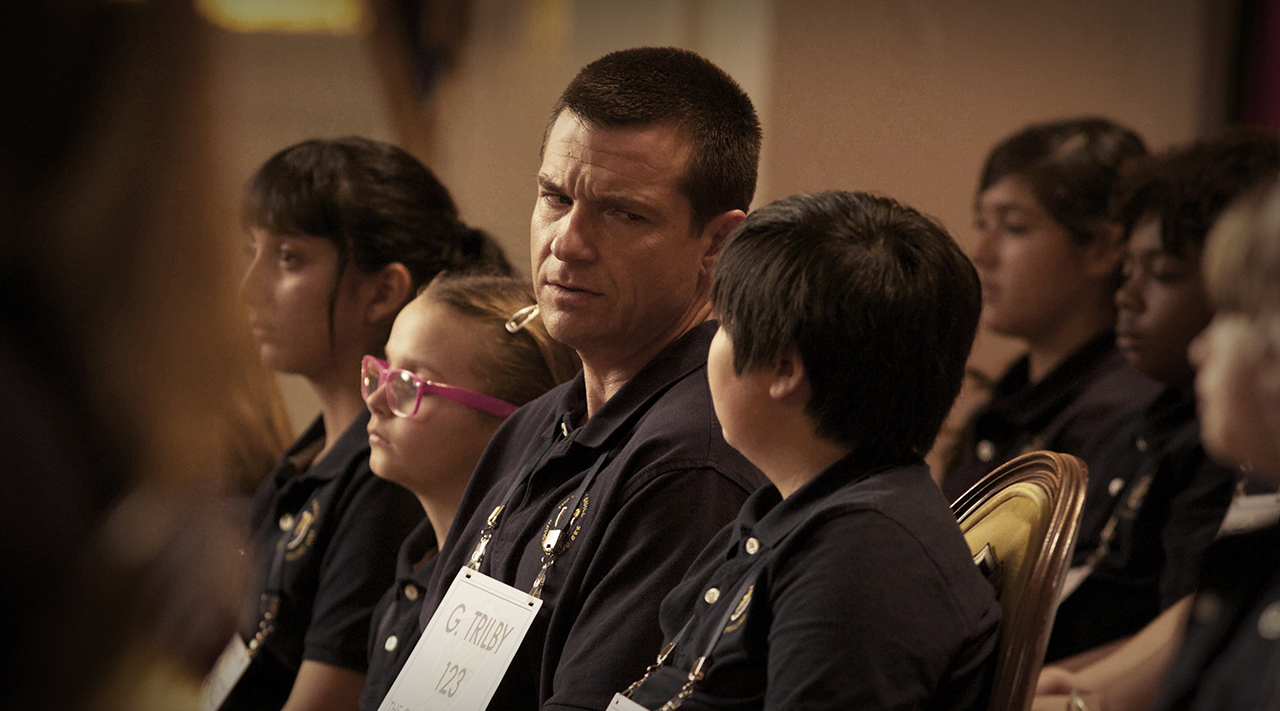
Guy (Jason Bateman) plays mind games with a young competitor in Bad Words (photo by Sam Urdank/Focus Features)

By Richard Ades

Back when I was arts editor for Columbus’s now-defunct The Other Paper, one of our ace critics turned in a review of a horror flick with a grisly scene: The heroes dispatched an attacker by sticking his head in a microwave oven and holding it there until it exploded.

Puzzled, I asked the critic how the filmmakers got around the fact that microwaves don’t work when the door is open. They didn’t care about such technicalities, he replied gleefully. “They just wanted to make someone’s head explode!”

It seems like an odd comparison, but a couple of scenes from Bad Words reminded me of that incident. Smart but antisocial 40-year-old Guy Trilby (Jason Bateman) has wormed his way into an adolescent spelling bee, and he proceeds to launch underhanded and exceedingly nasty psychological attacks on two of his competitors in an attempt to undermine their confidence.

Like the microwave offensive, the attacks make no logical sense. First, Guy’s spelling skills are so advanced that the kids pose no real threat to him, so why bother? And second, if his dirty tricks were exposed (and there’s no reason to think they wouldn’t be in the real world), he would be ejected from the competition faster than you can say “antidisestablishmentarianism.”

So why did the filmmakers include the attacks in their sordid comedy? Because, to paraphrase that wise critic, they just wanted to see Guy act mean to two defenseless kids.

Another comparison between the microwave scene and the spelling-bee attacks: You have to have a sadistic streak in order to enjoy them.

Well, maybe that’s too harsh. A cross between 2003’s Bad Santa and the stage musical The 25th Annual Putnam County Spelling Bee, Bad Words seeks the kind of laughs that grow out of shockingly inappropriate and irresponsible behavior. Now, I’m as susceptible to this kind of comedy as anyone—I loved Bad Santa, for example—but Bad Words inspires more cringes than guffaws.

A key weakness is that scriptwriter Andrew Dodge and first-time director Bateman don’t sufficiently explain Guy’s motivation for crashing a contest that’s meant for kids. We surmise that it has something to do with his own failure as a bee competitor when he was an eighth-grader, and possibly with the recent death of his mother. But when we learn his real reason for entering the contest, it’s hard not to think, “That’s it?” His ultimate goal doesn’t begin to explain his actions.

Another weakness is that, despite its hard-edged sense of humor, the film eventually gets stuck in a sappily predictable rut. As soon as a lonely 10-year-old spelling whiz named Chaitanya Chopra enters the scene and tries his best to befriend the eccentric adult, we know it’s only a matter of time before Guy’s icy heart begins to melt.

If Bad Words remains marginally palatable, it’s due solely to the strength of its able cast. Besides the understated Bateman, the players include Kathryn Hahn as the reporter who sometimes shares Guy’s bed, Allison Janney as an angry bee official and Philip Baker Hall (known to Seinfeld fans as no-nonsense library detective Mr. Bookman) as the bee’s founder. But no one contributes more to the film than young Rohan Chand, who is consistently adorable as the indomitable Chaitanya.

Without Chaitanya’s lovable presence, Bad Words would be simply an exercise in misanthropic excess.

Bad Words opens Friday (March 21) at the Lennox 24.

Rating: 2½ stars (out of 5)

Live, from Columbus! It’s the Beatles!

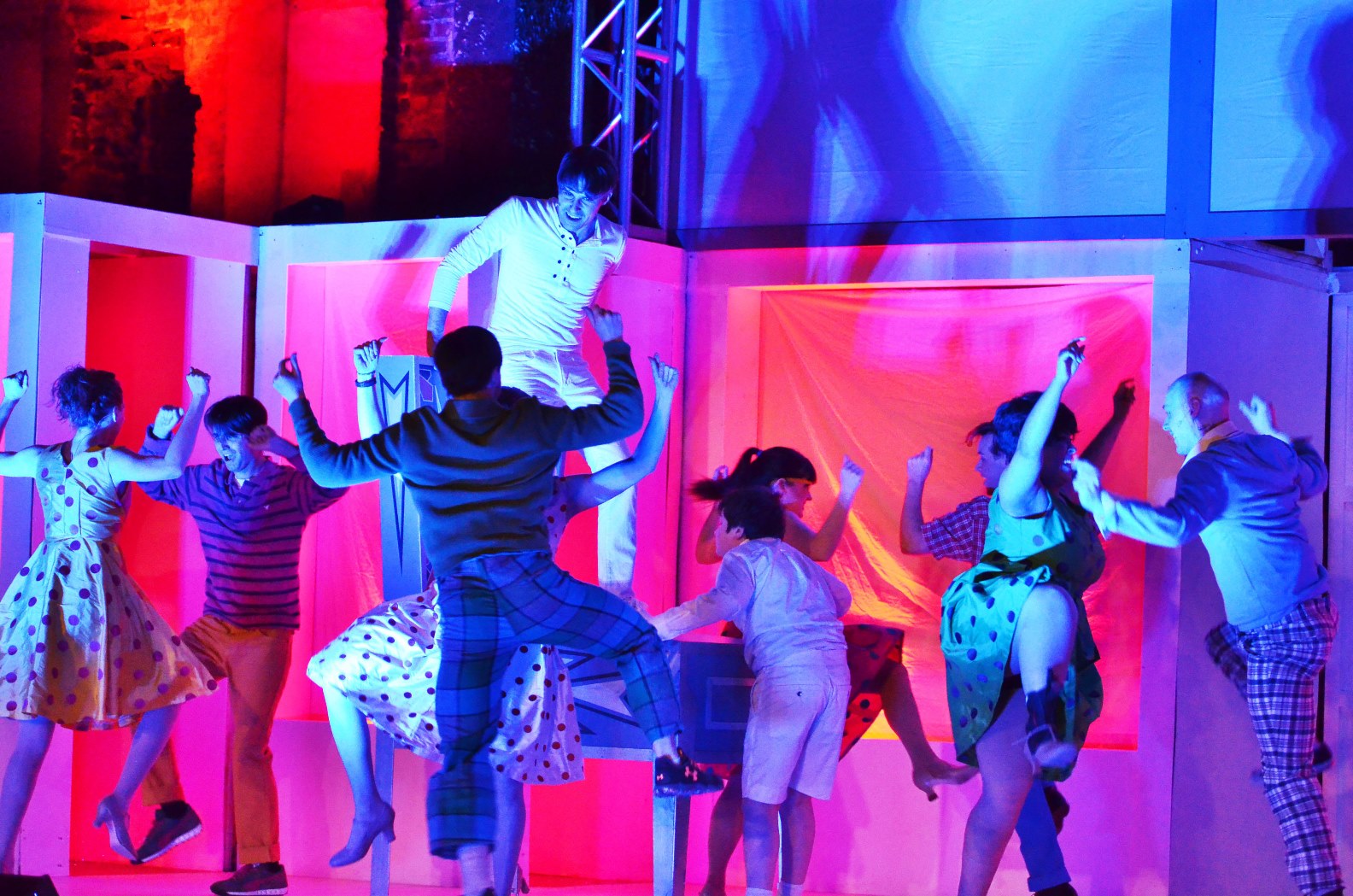
Andy Ankrom takes the helm in Yellow Submarine, one of 33 Beatles tunes featured in Bigger Than Jesus (photo by Will Shively)

By Richard Ades

Even if you’ve always idolized the Beatles, chances are you’ll learn something new from Bigger Than Jesus. Shadowbox Live’s “live rockumentary” intersperses songs from the Fab Four’s incredible canon with tidbits of information about the group.

For instance, did you know that in 1964 the Liverpudlian quartet refused to play the Gator Bowl until the Florida facility set aside its segregated ways? Or that Blackbird (whose title was mod slang for “black girl”) was a response to the civil rights movement?

And did you know that Eric Clapton had an uncredited guitar solo in While My Guitar Gently Weeps?

Well, maybe you knew that, but you won’t mind if the show’s narrators occasionally tell you stuff you’ve already heard. You’ll be too busy enjoying the music that makes up the bulk of its running time. Performed in roughly chronological order, the songs are some of the band’s biggest and best hits.

Given John, Paul, George and Ringo’s well-known expertise as musicians and recording innovators, a Beatles retrospective is a dangerous undertaking. Viewers won’t be satisfied unless the song renditions approximate the fun and excitement of the originals. For the vast majority of the show, Shadowbox succeeds.

After a few early numbers that are merely pleasant, things begin to heat up with Kevin Sweeney’s electrifying delivery of Help! JT Walker III then slows things down with the first of several numbers to benefit from his golden touch, the gorgeous Norwegian Wood.

Afterward, director Stev Guyer explains the John Lennon quote that gave the show its name. According to documentary footage projected on the room’s video screen, Lennon’s sardonic comment that the Beatles would surpass Jesus in popularity led to a boycott in at least one Southern city. The KKK also jumped on the anti-Beatles bandwagon, we learn.

Guyer begins the evening by jokingly apologizing to viewers whose favorite songs were inevitably left out. There were simply too many great ones to choose from, he says.

Indeed, it’s not hard to think of classics that didn’t make the cut: Yesterday, for one. Or She Loves You, the joyous anthem that helped to define the mopheads during their first appearance on The Ed Sullivan Show.

But there are so many other gems that are included. Some of the most memorable (and their featured vocalists): Sgt. Pepper’s Lonely Hearts Club Band (Leah Haviland), Magical Mystery Tour (Amy Lay and Walker), Penny Lane (Will Macke), Helter Skelter (Stephanie Shull), While My Guitar Gently Weeps (Jeff Simpson) and She Came in Through the Bathroom Window (Sweeney).

Many numbers are marked by fine harmonizing on the part of backup singers. In others, the Matthew Hahn-led band plays a leading role, as when surreal instrumental crescendos interrupt in A Day in the Life.

The psychedelic and colorful costumes (designed by Linda Mullin, Nick Wilson and Lyn Helenberger) help to recapture an era and a band that were increasingly influenced by mind-altering drugs. Katy Psenicka’s choreography is another important element of the proceedings. It’s especially enjoyable when the vocalists themselves bust a few moves, as they do in When I’m Sixty-Four (sung by Tom Cardinal, Haviland and Macke).

If you’re old enough to remember the Beatles, Bigger Than Jesus is nostalgic fun. If you’re not, it’s one hell of a history lesson.

Bigger Than Jesus: A Live Rockumentary About the Band That Changed the World continues through Aug. 7 at Shadowbox Live, 503 S. Front St. Show times are 7:30 p.m. select Wednesdays and Thursdays, 2 and 7 p.m. select Sundays. Running time: 2 hours, 20 minutes (including intermission). Tickets are $25, $20 for students and seniors. 614-416-7625 or shadowboxlive.org.

Stranded seafarer lives to tell his tale

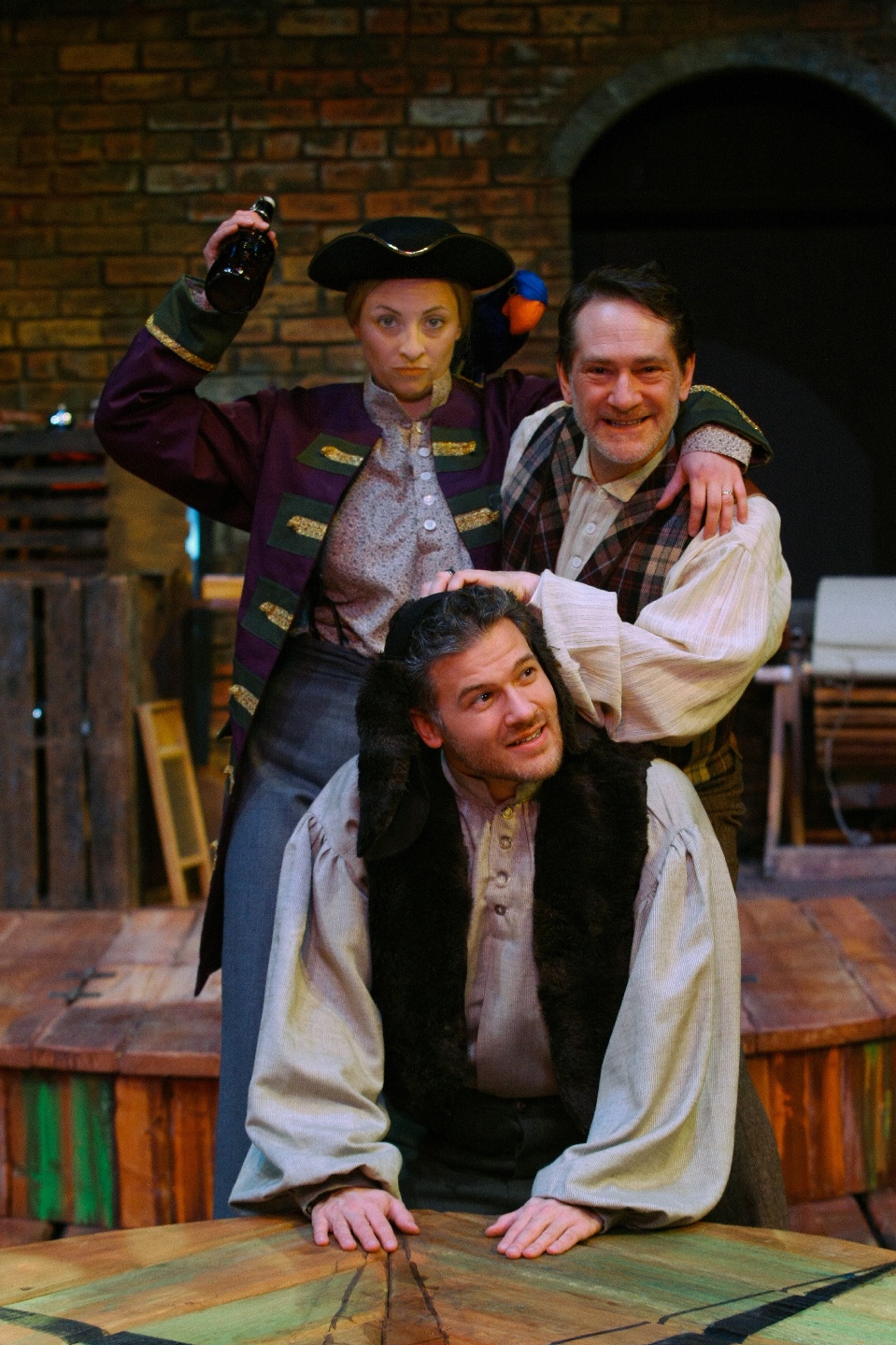
Lisa Thoma, Robert Behrens and Joe Dallacqua (clockwise from top) perform in CATCO’s production of Shipwrecked! An Entertainment – The Amazing Adventures of Louis de Rougemont (as Told by Himself) (photo by Dave Alkire)

By Richard Ades

Louis de Rougemont had quite an adventure, and he desperately wants to tell us about it. With a combination of narration, acting, shadow figures and sound effects, the 19th century Londoner explains how he left home as a youth and went to sea, only to be shipwrecked and stranded for years on a desert island.

A giant octopus, a rare black pearl and a tribe of Australian Aborigines also figure in his tale, which unfolds in Donald Margulies’s Shipwrecked! An Entertainment—The Amazing Adventures of Louis de Rougemont (as Told by Himself).

When I first saw the play in a 2010 Whistling in the Dark production, I thought it was a bit long-winded, but I enjoyed the way it captured the spirit of its real-life adventurer’s times. Because it was presented in a theater that was designed to be environmentally friendly, the production took a low-tech approach that added to the period feel. The live piano accompaniment was particularly effective.

CATCO’s current production, directed by Mark Seamon, is less low-tech and, thus, seems less authentic. Moreover, Seamon and company punctuate the story with goofy sound effects (a slide whistle and the like) that probably are designed to tickle younger viewers. Well, maybe they do, but they detract from the show’s credibility. De Rougemont clearly wants us to amaze us, not amuse us.

Beyond those quibbles, the show has much to recommend it. Shakespearean actor/director Robert Behrens makes a rare stage appearance as the title adventurer, and he gives an entertaining performance. Enthusiastic supporting actors Lisa Thoma and Joe Dallacqua play all the characters de Rougemont comes into contact with, especially a friendly Aborigine woman (Thoma) and an even friendlier dog (Dallacqua).

Even before the action starts, Michael S. Brewer’s handsome set is sure to elicit a few “oohs” and “aahs.” The broad-beamed stage floor is a good stand-in for the ship deck on which the young de Rougemont begins his adventures.

Yes, the play still seems a bit long-winded (I’ve heard of other productions that wrapped things up in less than 90 minutes, though I can’t imagine how). But the tale it tells is a fascinating one, made even more so by the fact that we’re not entirely sure we should believe it.

CATCO will present Shipwrecked! An Entertainment—The Amazing Adventures of Louis de Rougemont (as Told by Himself) through Feb. 23 in Studio Two, Riffe Center, 77 S. High St. Show times are 11 a.m. Wednesday, 8 p.m. Thursday-Saturday and 2 p.m. Sunday. Running time: 1 hour, 45 minutes. Tickets are $11.50 for Wednesday matinees, $45 on Fridays and Saturdays, $41 for other shows. Discount student tickets ($15) are offered two hours before show time. 614-469-0939 or catco.org.

Annual theater celebration features awards, speeches, songs

Matt Clemens (seen sharing a scene with Laura Griffith) received a Theatre Roundtable award for his leading role in Short North Stage's production of Sunday in the Park With George (photo by Megan Leigh)
Matt Clemens (seen sharing a scene with Laura Griffith) received a Theatre Roundtable award for his leading role in Short North Stage’s production of Sunday in the Park With George (photo by Megan Leigh)

By Richard Ades

It’s all over but the Facebook posts.

The Central Ohio Theatre Roundtable held its annual awards night Sunday at the Jewish Community Center. As in the past, the fast-paced show punctuated its presentations and speeches with songs from some of the past year’s musical productions.

The treats included Matt Clemens’s emotional rendition of Finishing the Hat from Stephen Sondheim’s Sunday in the Park With George. The number provided proof that Clemens richly deserved the award the Roundtable gave him for his leading role in the Short North Stage production.

One of the night’s most heartwarming moments came when the Central Ohio Theatre Critics Circle—representing local print, on-air and online critics—presented a citation to Short North Stage for that same production. When troupe co-founders Rich Gore and Peter Yockel came onstage to accept the award, Yockel found himself getting a little choked up. That prompted Gore to observe that he hadn’t seen his partner tear up like that since their recent wedding day.

In a conversation prior to the show, the two recalled that they were just one of many same-sex couples who’d headed to New York and queued up to get hitched in a civil ceremony on Halloween. But they stood out from the crowd, they noted, being one of the few pairs who hadn’t turned up in Halloween costumes.

Two troupes received the Roundtable’s Harold Awards for, essentially, persevering: Columbus Children’s Theatre for turning 50 and Shadowbox Live for turning 25 (as measured from the appearance of Stev Guyer and company’s earliest “rock operas”). Accepting his Harold, Guyer explained why he and his cohorts had stuck it out in a profession that kept them working longer-than-average hours for lower-than-average pay.

“It’s a calling,” he said. “It’s what you do.”

Guyer also praised Columbus theatergoers who were willing to take a chance on unknown productions—such as most of those presented by Shadowbox.

For a list of other Theatre Roundtable nominees and winners, visit www.theatre-roundtable.org/trnominations/. For a list of the Central Ohio Theatre Critics Circle’s 20th annual round of citations, which were presented at Sunday’s event, see below:

▪ To CATCO and the Columbus Museum of Art, for educating Central Ohio about the power of art and the creative challenges of artists by jointly scheduling CATCO’s area premiere of Red, John Logan’s 2010 Tony winner for best play about Rothko at a pivotal point in his career, and “Mark Rothko: The Decisive Decade,” the museum’s first major exhibit of works by the abstract master.

▪ To Short North Stage, for raising the standard in locally produced musicals with an ambitious 2013 season that culminated in the long-awaited Central Ohio premiere of Stephen Sondheim and James Lapine’s Sunday in the Park With George, a challenging 1985 Pulitzer Prize winner that was brought to vivid life by blending local talents with such New York experts as sound designer Leon Rothenberg, a 2013 Tony Award winner, and director Sarna Lapine, niece of James Lapine.

▪ A Roy Bowen Lifetime Achievement Award to William Goldsmith for nurturing the talents and imaginations of tens of thousands of children and for writing and directing many popular stage adaptations of classic tales as youth theater director at Players Theatre Columbus in the 1970s and ’80s and, for 25 years since 1989, as artistic director of Columbus Children’s Theatre, a troupe that celebrated its 50th anniversary in 2013.

‘Gravity’ named best of 2013 by Columbus critics


Sandra Bullock in Gravity, which Columbus critics named the year's best film (Warner Bros. Pictures)
Sandra Bullock in Gravity, which Columbus critics named the year’s best film (Warner Bros. Pictures)

Alfonso Cuarón’s Gravity has been named Best Film in the Central Ohio Film Critics Association’s 12th annual awards, which recognize excellence in the film industry for 2013. The film also claimed two other awards. Cuarón was honored as Best Director, and Director of Photography Emmanuel Lubezki won for Best Cinematography.

Columbus-area critics recognized these screen performers: Best Actor Chiwetel Ejiofor (12 Years a Slave); Best Actress and Breakthrough Film Artist Adèle Exarchopolous [Blue Is the Warmest Color (La vie d’Adèle)]; Best Supporting Actor James Franco (Spring Breakers); Best Supporting Actress Jennifer Lawrence (American Hustle); and Actor of the Year Matthew McConaughey for his exemplary body of work in Dallas Buyers Club, Mud and The Wolf of Wall Street.

Other winners include: American Hustle for Best Ensemble; The Wolf of Wall Street‘s Terence Winter for Best Adapted Screenplay; Her’s Spike Jonze for Best Original Screenplay and Arcade Fire for Best Score; Best Documentary The Act of Killing; Best Foreign Language Film and Best Animated Film The Wind Rises (Kaze tachinu); and Short Term 12 as Best Overlooked Film.

Repeat COFCA winners include: Jennifer Lawrence (2012 Best Actress for Silver Linings Playbook); Matthrew McConaughey (2012 Actor of the Year for Bernie, Killer Joe, Magic Mike and The Paperboy); James Franco (2010 Best Actor for 127 Hours); and Emmanuel Lubezki (2011 Best Cinematography for The Tree of Life).

Founded in 2002, the Central Ohio Film Critics Association is composed of film critics based in Columbus, Ohio, and the surrounding areas. Its membership consists of 20 print, radio, television and Internet critics. COFCA’s official website at http://www.cofca.org/contains links to member reviews and past award winners.

Winners were announced at a private party on Thursday, Jan. 2.

Complete list of awards:

Best Film
1. Gravity
2. Her
3. American Hustle
4. Frances Ha
5. The Wolf of Wall Street
6. 12 Years a Slave
7. Inside Llewyn Davis
8. Before Midnight
9. Upstream Color
10. Nebraska

Best Director
-Alfonso Cuarón, Gravity
-Runner-up: Spike Jonze, Her

Best Actor
-Chiwetel Ejiofor, 12 Years a Slave
-Runner-up: Matthew McConaughey, Dallas Buyers Club

Best Actress
-Adèle Exarchopolous, Blue Is the Warmest Color (La vie d’Adèle)
-Runner-up: Brie Larson, Short Term 12

Best Supporting Actor
-James Franco, Spring Breakers
-Runner-up: Jared Leto, Dallas Buyers Club

Best Supporting Actress
-Jennifer Lawrence, American Hustle
-Runner-up: Lupita Nyong’o, 12 Years a Slave

Best Ensemble
American Hustle
-Runner-up: The Wolf of Wall Street

Actor of the Year (for an exemplary body of work)
-Matthew McConaughey, Dallas Buyers Club, Mud and The Wolf of Wall Street
-Runner-up: Jennifer Lawrence, American Hustle and The Hunger Games: Catching Fire

Breakthrough Film Artist
-Adèle Exarchopolous, Blue Is the Warmest Color (La vie d’Adèle) (for acting)
-Runner-up: Brie Larson, Don Jon, Short Term 12 and The Spectacular Now (for acting)

Best Cinematography
-Emmanuel Lubezki, Gravity
-Runner-up: Hoyte Van Hoytema, Her

Best Adapted Screenplay
-Terence Winter, The Wolf of Wall Street
-Runner-up: John Ridley, 12 Years a Slave

Best Original Screenplay
-Spike Jonze, Her
-Runner-up: Destin Daniel Cretton, Short Term 12

Best Score
-Arcade Fire, Her
-Runner-up: Steven Price, Gravity

Best Documentary
The Act of Killing
-Runner-up: Stories We Tell

Best Foreign Language Film
The Wind Rises (Kaze tachinu)
-Runner-up: Blue Is the Warmest Color (La vie d’Adèle)

Best Animated Film
The Wind Rises (Kaze tachinu)
-Runner-up: Frozen

Best Overlooked Film
Short Term 12
-Runner-up: Mud

COFCA offers its congratulations to the winners.

Previous Best Film winners:

2002: Punch-Drunk Love
2003: Lost in Translation
2004: Million Dollar Baby
2005: A History of Violence
2006: Children of Men
2007: No Country for Old Men
2008: WALL•E
2009: Up in the Air
2010: Inception
2011: Drive
2012: Moonrise Kingdom

For more information about the Central Ohio Film Critics Association, please visit http://www.cofca.org/or e-mail info@cofca.org.

A look back at ‘2013: The Musical’

Japheal Bondurant as competitor William Barfee in CATCO's production of The 25th Annual Putnam County Spelling Bee (Red Generation Photography)
Japheal Bondurant as competitor William Barfee in CATCO’s production of The 25th Annual Putnam County Spelling Bee (Red Generation Photography)

By Richard Ades

2013 may be remembered as The Year of the Musical in Central Ohio. Or, more likely, as The First Year of the Musical.

In the more than two decades I’ve been reviewing local theater, musicals have always represented a small percentage of the shows I saw each year. But that’s likely to change.

A prime reason is that CATCO dropped its long aversion to the genre when Steven Anderson took over as producing director in 2010. Another reason is the ascendance of Short North Stage, a 2-year-old troupe that specializes in Sondheim’s art form.

Add to that the musicals staged by Otterbein University Theatre and the growing number staged by Shadowbox Live, including its recent collaborations with Opera Columbus. Then figure in the musicals bravely tackled by troupes that normally stick to standard fare.

The end result is a year that was teeming with musicals. And not just musicals: great musicals.

There were so many worthwhile musicals, in fact, that I’ve been forced to abandon the format I always followed at The Other Paper, which divided the nominees into categories such as Best Drama or Best Comedy. Limiting myself to one Best Musical would have forced me to ignore many of the year’s best shows. Instead, I’ve settled for naming the year’s Top 10 shows.

A couple of caveats: First, no one has time to see everything, so I’m sure I missed some award-worthy gems. And second, this is a subjective list based not only on what was done well but on what I found particularly interesting and memorable.

With that said, congratulations to the winners, and thanks to everyone who made this an exceptional year for theater in Central Ohio.

Top 10 Shows of 2013:

The 25th Annual Putnam County Spelling Bee, CATCO. Though the Top 10 list is mostly arranged haphazardly, this was my favorite show of the year. Director Steven Anderson found both the heart and the laughs in this familiar musical, with help from a consistently wonderful cast led by Japheal Bondurant, Elisabeth Zimmerman and Ralph E. Scott.

Sunday in the Park With George, Short North Stage. The Garden Theater-based troupe sometimes imports its directors from New York, and it paid off handsomely here. Sarna Lapine (niece of James Lapine, who wrote the book and directed the Broadway premiere) gave us a Sondheim revival that was both pitch-perfect and picture-perfect. As a bonus, sound designer Leon Rothenberg found a way to tame the theater’s echo-y acoustics, which bodes well for future productions.

Passing Strange, Short North Stage. Green Day fans undoubtedly enjoyed the punk-rock anger of American Idiot, which came through town in March. But those of a thoughtful bent were more likely to enjoy this satirical take on youthful angst, which was beautifully realized by director Mark Clayton Southers and his committed cast.

Duck Variations, A Portable Theatre. The best news was that the fledgling troupe is the new home of Geoffrey Nelson, former artistic director of CATCO. The second-best news was that its premiere show paired Nelson with fellow CATCO alum Jonathan Putnam. These two sly and seasoned pros made the David Mamet comedy one of the year’s funniest shows.

Assassins, Red Herring Productions. Michael Herring’s solo springtime performance of Krapp’s Last Tape launched the rebirth of his long-dormant troupe. But nothing could have prepared us for Red Herring’s next show, a polished production of Sondheim’s most controversial musical. John Dranschak directed an A-list cast led by Ian Short and Nick Lingnofski.

Mercy Killers, On the Verge Productions. 2013’s crop of touring musicals supplied a fair amount of flashy entertainment, but none of them were as impressive or thought-provoking as this one-man touring show. Writer/actor Michael Milligan told a tragic tale that movingly dramatized the shortcomings of the U.S. health-care system.

The Whipping Man, Gallery Players/New Players Theater. If you thought there was no way to come up with a new take on the Civil War, this show proved you wrong. Matthew Lopez’s postwar drama reunited two former slaves with the wounded son of their Jewish master. The fascinating, if imperfect, tale was exquisitely directed by Tim Browning.

The Air Loom, MadLab. Local actor Jim Azelvandre has tried his hand at writing in the past, but this surreal tale is his best work to date. Azelvandre also supplied the canny direction, which ensured that the ingenious storyline and eccentric characters remained entertaining throughout.

Henry IV, Part One, New Players Theater. Besides staging The Taming of the Shrew on its outdoor stage, New Players was brave enough to tackle one of Shakespeare’s seldom-seen historical dramas. Bard-literate director Robert Behrens made 15th-century Britain come to life with the help of a lively cast led by David Tull as the hard-partying Prince Hal and John Tener as the irrepressible Falstaff.

Burlesque Behind the Curtain, Shadowbox Live. Shadowbox’s production of Spamalot was a blast, too, but Behind the Curtain deserves credit for improving on last year’s Burlesque de Voyage. Writer Jimmy Mak, director Stev Guyer and the talented players created a show that was sometimes very sexy and other times very, very funny.

New York-bound ‘Flashdance’ faces an uphill battle

Steelworker/dancer Alex Owens (Jillian Mueller) re-creates an iconic moment from the original movie in Flashdance: The Musical (photo by Jeremy Daniel)

By Richard Ades

“She’s a maniac, maniac on the floor/And she’s dancing like she never danced before…”

Read those lyrics the wrong way, and the fantasy at the heart of Flashdance becomes apparent. Steelworker-by-day/dancer-by-night Alex longs to be accepted into a prestigious ballet academy, but she has no formal training. So how can she hope to win out against dancers who’ve been hitting the barre since they were kids?

The 1983 movie distracted attention from that glaring question by overwhelming us with montages of toned bodies dancing to a rocking soundtrack. It also captured the tenor of the times by setting Alex’s quest against the backdrop of a dying industry: We could relate to her struggle to redefine herself because so many of us were trying to find a way to survive in a changing economy.

Then, of course, there was cinematic newcomer Jennifer Beals and her portrayal of Alex as a tough Pittsburgh girl who could switch from wistful dreamer to sexual predator at the drop of a leg warmer.

So the movie became a hit, and Alex and her wardrobe became cultural icons. Can the new Tom Hedley/Robert Cary/Robbie Roth stage version repeat the magic?

After seeing the touring show Tuesday night at the Palace, I suspect it has a long way to go.

Director/choreographer Trujillo and his cast reimagine some of the movie’s best moments and add some of their own. Overall, though, it fails to make us care about Alex’s journey.

Part of the problem is the role of Alex, which must be almost impossible to cast. Besides acting and singing, the leading lady must be able to dance well enough to convince us she has a shot at a career in ballet. In the touring production, it’s apparent that Jillian Mueller was cast primarily for her dancing skills. Her moves are fine, but her singing voice lacks power and she has little stage presence.

It’s admirable that the producers didn’t follow the movie’s tack and have Alex’s dance moves performed by a body double (though it appears they do just that in one scene, for no apparent reason). But because they failed to find the rare individual who can act, sing and dance like a maniac, Alex mostly disappears into Klara Zieglerova’s serviceable but generic scenery. As a result, few sparks are generated by the central romance between Alex and her smitten boss, Nick, even though Corey Mach gives the latter a likable personality and sonorous voice.

Filling some of that void, Ginna Claire Mason and David R. Gordon do make us care about the rocky relationship between Alex’s dancer friend Gloria and would-be comedian Jimmy. We particularly care about Gloria, whose naïve search for fame makes her susceptible to the advances of C.C. (Christian Whelan), proprietor of the disreputable dance club down the street. Her crestfallen rendition of Gloria is one of the more effective holdovers from the movie.

Back at the raunchy but relatively wholesome club run by the fatherly Harry (Matthew Henerson), Alex spends her nights sharing the stage with Tess and Kiki, seasoned hoofers well played by Alison Ewing and DeQuina Moore. Moore is especially fiery in the energetically choreographed Manhunt, another movie holdover.

Not all of the show’s songs are inherited from the movie, by the way. Of the new tunes, some are pretty, and some are even catchy, but none matches the toe-tapping power of the originals.

Will Flashdance make it to New York? If it does, it will accomplish a major miracle, as it’s not easy to construct a conventional stage musical out of a movie that was basically an extended music video. The show reportedly has been tweaked quite a bit to get this far, and it likely will need a lot more tweaking to get to Broadway.

Broadway in Columbus and CAPA will present Flashdance: The Musical through Dec. 22 at the Palace Theatre, 34 W. Broad St. Show times are 7:30 p.m. Tuesday-Thursday, 8 p.m. Friday, 2 and 8 p.m. Saturday, and 1 and 6:30 p.m. Sunday. Tickets are $28-$78. 614-469-0939, 1-800-745-3000 or ticketmaster.com.

If only the script were as profound as the photography


Bruce Dern (left) and Will Forte play a father and son who hit the road in Nebraska

By Richard Ades

Director Alexander Payne fills Nebraska with black-and-white images of desolate landscapes and all-but-deserted small towns. Above them, the skies appear bleak, even on the rare occasions when the sun is shining.

The photography is beautiful and evocative, but it’s a mixed blessing. It can’t help reminding film buffs of that devastating portrait of small-town America, 1971’s The Last Picture Show. And Nebraska is hardly The Last Picture Show.

Payne’s very name is another mixed blessing, as it leads us to expect more than we get. He’s the director behind such memorable films as The Descendants and (my personal favorite) Sideways. And Nebraska falls well short of both of these predecessors.

Indeed, it’s a tale that fails to live up to either its photography or its potential.

Bruce Dern plays Woody Grant, a semi-senile old man who thinks he’s won $1 million and is determined to journey from Billings, Mont., to Lincoln, Neb., to collect it. Since he has long since lost his driver’s license, he’s willing to walk there if necessary.

SNL alum Will Forte plays David, one of Woody’s two sons, who tries to explain to him that the “prize” is merely a gimmick to sell magazines. He finally agrees to drive his dad to Lincoln, if only because there seems to be no other way to convince him. Besides, David’s girlfriend has finally tired of their stagnant relationship and moved out, leaving him eager to get away from his suddenly lonely apartment.

Will Woody and David arrive at a better understanding of each other during the long road trip? Will they come to terms with Woody’s lifelong addiction to alcohol and the problems it created for his wife and sons? One expects such issues to be addressed, and to some extent they are, but not nearly as effectively as they might have been. One explanation is that director Payne has uncharacteristically relegated screenwriting chores to someone else—namely TV veteran Bob Nelson.

What are the script’s shortcomings? For starters, it’s not clear that the Grants’ dysfunctional household was all that destructive. Yes, David seems to be drifting a bit, but his brother (Bob Odenkirk) has a family and a modestly promising career as a TV newsman.

The real hindrance to profundity, though, is the script’s devotion to superficial humor and characterizations. Woody’s wife, Kate (June Squibb), is the main culprit, as she quickly turns into a shrewish caricature who doles out malicious insults and TMI revelations with equal abandon.

Later, after Woody and David stop to visit relatives in their Nebraska hometown, male communication is depicted as a ritual revolving around two subjects: cars and sports. A few humorous moments ensue, particularly when David’s cousins (Tim Driscoll and Devin Ratray) razz him about his conservative driving habits, but this is hardly groundbreaking material.

Perhaps the ultimate barrier to meaningful character development is the fact that Woody is so far gone. The former mechanic shuffles around in an age- and alcohol-fueled stupor, seldom giving any indication that he understands what’s going on. Dern’s portrayal is physically convincing and may give the 77-year-old actor a shot at winning a major award (he’s already been nominated for a Golden Globe), but the character has almost zero depth.

As for Forte, he handles the pivotal role of David well, particularly considering his background is in comedy. Also making a good impression is Stacy Keach as a family “friend” with a mean streak and a long-held grudge.

Haunting photography, good acting: Nebraska has most of the makings of a great Alexander Payne film. All it lacks is a great Alexander Payne script.

Nebraska opens today (Dec. 13) at Columbus’s AMC Lennox Town Center 24.

Rating: 2½ stars (out of 5)

Mark, we hardly knew ye

By Richard Ades

Available Light has always pushed boundaries. Shows that incorporate multimedia, song, dance, movement and improvisation are all par for the course.

All that’s well and good. What’s not so well and good is the troupe’s occasional tendency to confuse plays with lectures, sermons or, worst of all, consciousness-raising sessions. That’s the wrong turn Available Light takes with its latest self-written work, Glue.

It starts out with the appearance of four people who introduce themselves as longtime friends of Mark, a man who recently died. They inform us that they put this show together in response to their loss.

“It’s about friendship,” we’re told.

In an attempt to bond with the audience, they then have specific viewers read statements about friendship that apparently were passed out in advance. Each of these—including the comment that our best friends sometimes have four legs—is met with uniform smiles of support from the people onstage.

“Maybe by the end of the show, we’ll all be best buddies,” one declares brightly.

If all of this smiling supportiveness is meant to be taken with a cynical grain of salt, it’s not apparent in the production director Matt Slaybaugh has put together with actors Acacia Leigh Duncan, Jordan Fehr, Elena M. Perantoni and Michelle G. Schroeder. Instead, all four characters seem to be unvaryingly nice.

They’re too nice, in fact, to tell us anything less than positive about their lost friend. As a result, we never really get to know Mark, any more than we would get to know a real-life stranger whom we “met” only through to his eulogy.

We learn that Anna (Duncan) and Rebecca (Perantoni) dated Mark at various times; that Brian (Fehr) created comic books with him; and that Julie (Schroeder) was once his roommate. Schroeder’s description of Julie’s close but oddly chaste friendship with Mark does strike an emotional chord, but otherwise he remains only a slightly clingy but wonderfully empathetic person.

The problem is not only that Anna, Rebecca, Brian and Julie are too nice to say anything negative about Mark—sometimes they’re too busy sharing general aphorisms about friendship to talk about him at all: “To connect, you’ve got to make yourself vulnerable.” “Love is an act of will.” And so on.

A little of this goes a long way.

Watching Glue is sort of like scrolling through Facebook for 90 minutes, except that this is a version of Facebook without the jokes, topical comments or political harangues. Instead, you get only the friends who ply you with sentimental advice while other friends tell them how wonderful they are for sharing it.

Another difference: You can’t log off.

As in its most-creative shows, Available Light concocts Glue out of a variety of ingredients, including projected images, recorded voices, music and movement. If you’re into adventurous theater and performance art, this is a plus.

But unless you also have a high tolerance for being lectured to, Glue’s 90 minutes will go by very, very slowly.

Available Light Theatre will present Glue through Nov. 23 at MadLab Theatre & Gallery, 227 N. Third St. Show times are 8 p.m. Thursday-Saturday. Running time: 90 minutes. Tickets are $20 in advance, “pay what you want” at the door. 614-558-7408 or avltheatre.com.