Like a less curmudgeonly, more Scandinavian version of Doc Martin

Rolf Lassgard as the gruff title character in A Man Called Ove

By Richard Ades

Fans of the British TV series Doc Martin know grumpy heroes can be both endearing and entertaining. Now we have a Swedish movie, A Man Called Ove, that aims to prove they can be just as endearing and entertaining in a country that drives on the opposite side of the road.

If the flick doesn’t succeed quite as brilliantly, it’s because director/screenwriter Hannes Holm doesn’t have the series’ knack for tickling us with quirky comedy before surprising us with heart-stopping suspense or heartwarming drama. The film, adapted from Fredrik Backman’s bestselling novel, takes a more direct route to our emotions.

We first meet Ove (Rolf Lassgard) when he’s haggling with a store clerk over the price of a bouquet of flowers. He comes off as an unreasonable, disagreeable curmudgeon. Then, in the next scene, we realize he bought the flowers to take to his late wife’s grave. Oops. I guess we should give the old guy a break.

Another reason for pitying him arrives when his young bosses call him into their office and pretend they’re doing him a favor by laying him off from the company where he’s worked for 43 years. Little wonder that Ove—wifeless, friendless and now jobless—is soon attempting suicide. The only thing that stops him is the arrival of a new family of neighbors led by Parvanah (Bahar Pars), a pregnant Iranian immigrant who immediately begins inserting herself into Ove’s lonely existence.

From this point on, the film revolves on the question of whether the friendly Parvanah will succeed in renewing Ove’s interest in the world and those who share it. Though he continues trying to join his wife in the great beyond, the film gives us little reason for pessimism. For one thing, Parvanah is such a bubbly force of nature that it’s impossible to believe he can resist her for long. For another, numerous episodes reveal that Ove is far less misanthropic than he pretends to be.

One such incident involves another Doc Martin parallel: Just as Martin is bedeviled by a homeless dog that refuses to leave him alone, Ove is bedeviled by a fluffy homeless cat. Yet as soon as the cat is threatened, he comes to its rescue.

Other scenes depict Ove as downright heroic. At times, when he alone steps forward to prevent a tragedy, he appears to be the only heroic person in Sweden.

Through much of the film, incidents from Ove’s current life are interspersed with flashbacks to his childhood and young adulthood. The most charming of these depict how he met Sonja (Ida Engvoll), the outgoing woman who became his wife. The most puzzling involves an encounter with one of the dictatorial officials he refers to as “whiteshirts.”

The flashbacks show the developments that helped to turn Ove into the sad individual he’s become, but in the process they give the film an episodic structure. They also reinforce the flick’s tendency toward heavy-handed melodrama.

Though flawed, A Man Called Ove paints a warm portrait of an aging individual who’s given a well-deserved second chance at life. As a popular example of modern Swedish cinema—it’s the country’s nominee for a Foreign Language Film Oscar—it may come as a pleasant surprise to those more familiar with the dour works of Ingmar Bergman.

As for fans of Doc Martin who are looking for an emergency dose of curmudgeonhood, they’ll probably be less satisfied. Fortunately for them, an eighth (and supposedly last) season is set to air next year.

Rating: 3 stars (out of 5)

A Man Called Ove, rated PG-13, opens Friday (Oct. 21) at the Drexel Theatre, 2254 E. Main St., Bexley.

Love of cartoons opens door to boy’s closed mind

Owen Suskind, whose struggle to reconnect with the world is the subject of Life, Animated.
Owen Suskind’s struggle to reconnect with the world is the subject of Life, Animated.

By Richard Ades

The first time we meet Owen Suskind, it’s in home movies that show him as a young boy playing with his father and brother and watching Mickey Mouse on TV. The second time we meet him, he’s a 20-something man muttering to himself in cartoon-like voices.

The connection between the child and the man is explained in Life, Animated, a documentary that is both uplifting and heartbreaking. Directed by 2010 Oscar winner Roger Ross Williams (Music by Prudence), it’s about a family’s struggle to connect with a son afflicted by severe autism.

According to Owen’s father, former Wall Street Journal reporter Ron Suskind, the first signs of trouble arose after his son turned 3. Though Owen had been developing as expected until then, he suddenly stopped communicating or learning new language, and he regularly had trouble sleeping.

Ron said he and his wife, Cornelia, tried to find out why, but it was like “looking for clues to a kidnapping.” The Owen they knew seemed to have disappeared.

The only bright spot in young Owen’s life was that he appeared to love watching the family’s VHS collection of Disney animated films. But it wasn’t until Ron made an astonishing discovery that this proved to be the key that would unlock the door to his son’s private world.

One day, in a desperate attempt to reopen communications with Owen, Ron greeted him with a squawking impersonation of Iago, the parrot from Aladdin. To his surprise, Owen responded with lines from the movie. The father soon realized that Owen had memorized not just Aladdin but all the Disney flicks, a fact he used to open up more channels of communication.

Though Life, Animated is about a man mesmerized by Disney tales, don’t expect it to follow a simple path to a Disney-like happy ending. The documentary frankly shows the ups and downs Owen encounters as his family tries to push him toward leading a full, independent adult life.

Romance is a particularly difficult problem. Even though Owen begins hanging out with a young woman he considers his girlfriend, he has no idea what a romantic relationship entails. “Disney doesn’t help with sex,” notes his concerned brother, ironically named Walt.

The film uses original animation to bring to life the characters Owen has imagined on his own.

Helping director Williams tell this fascinating story are animators Mathieu Batard and Olivier Lescot and animation producer Philippe Sonrier, who bring to life the cartoon characters and dramas Owen imagines on his own. A couple of celebrity voice actors also show up in a surprise visit to a class Owen organizes for people who share his challenges.

If the movie has one element that may rub some the wrong way, it’s that the background music is occasionally on the manipulative side. Mostly, though, it’s as on target as the rest of this unique and heartwarming film.

Rating: 4½ stars (out of 5)

Life, Animated (rated PG) opens Friday (July 29) at the Gateway Film Center, 1550 N. High St., Columbus. For tickets and show times, visit gatewayfilmcenter.org.

Reopened theater hosts revisited sitcom characters

Patsy (Joanna Lumley, left) and Eddy (Jennifer Saunders) toast what they hope is their good fortune in Absolutely Fabulous: The Movie

By Richard Ades

Absolutely fabulous. That’s the only way to describe Bexley’s renovated Drexel Theatre.

New décor. New seats. Best of all, new restrooms that are finally worthy of the well-heeled suburb where the landmark cinema sits. Their rundown predecessors were scarier than the average horror flick, but the new ones are so gorgeous that patrons will be tempted to gulp down a super-sized soda just so they’ll have an excuse to visit them.

Overall, the recently reopened Drexel is so posh that Edina Monsoon and Patsy Stone would feel right at home there.

Wait. Who?

For those who don’t recognize those names, Edina “Eddy” Monsoon (Jennifer Saunders) and Patsy Stone (Joanna Lumley) are the anti-heroines of both a film that opens at the Drexel this weekend and the classic British sitcom that spawned it. Both the series and the film are called Absolutely Fabulous.

Whether you think the film lives up to that name may depend on whether you were a fan of the series. Directed by Mandie Fletcher and written (like the TV show) by Saunders, the comedy jumps into Eddy and Patsy’s gaudy, glitzy world so abruptly that “Ab Fab” neophytes will have trouble getting their bearings.

In case you fit into this category, here’s a head start:

Officially, Eddy is in public relations and Patsy is a fashion editor, but they actually spend most of their time partying, getting high and trying desperately to hang onto their youth. Among the many people who share their world are:

▪ Eddy’s mother (June Whitfield)
▪ Eddy’s divorced daughter, Saffron (Julia Sawalha)
▪ Saffron’s teenage daughter, Lola (Indeyarna Donaldson-Holness)
▪ Eddy’s bizarrely dressed personal assistant, Bubble (Jane Horrocks)

The far-fetched plot involves real-life model Kate Moss, whom Eddy desperately wants as a client. Eddy enlists Patsy and Lola in a scheme to meet Moss at a party, but all goes tragically wrong when the model falls off a balcony and into the Thames, where she’s lost and presumably drowned.

Suspected of pushing Moss to her death, Eddy ends up fleeing to the south of France with her lifelong friend. There they face the sobering fact that they’ll soon be destitute unless one of them finds a meal ticket, and fast. The result is a subterfuge that involves a fake mustache and a lonely, gullible billionaire.

Along its way to a finale that intentionally calls to mind Some Like It Hot, Absolutely Fabulous hopscotches its way through lots of beautiful scenery, lots of colorfully grotesque characters, and lots and lots of cameos (though few of them involve celebs familiar to Americans). Through it all, Eddy and Patsy remain as self-centered and immature as they’ve been since the series debuted in 1992.

Ab Fab newbies may get a few chuckles out of this meandering comedy, once they’re gotten past the unfamiliar accents and characters. As for longtime fans, they may get a few more—heck, they started laughing as soon as Eddy and Patsy made their first appearance at the screening I attended. But I suspect even they will admit the film’s real draw is the chance to see their favorite scamps one more time.

Rating: 2½ stars (out of 5) for Ab Fab newbies, 3½ for Ab Fab fans

Absolutely Fabulous: The Movie (rated R) opens Friday (July 22) at the Drexel Theatre and AMC Lennox Town Center 24.

‘Spotlight’ shines in 14th annual Central Ohio Film Critics Association awards

Central Ohio’s film critics have voted on their favorite films and performances of 2015. I’m happy to report that my favorite 2015 release, Spotlight, won some of the top awards. The press release is below:

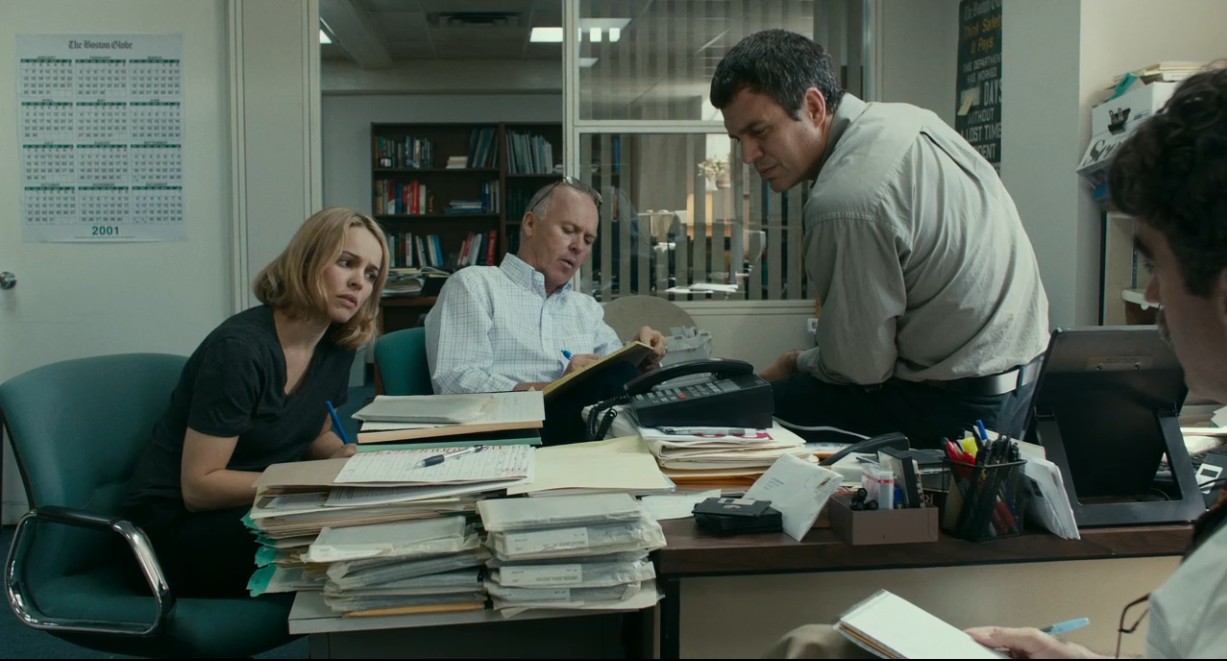
Rachel McAdams, Michael Keaton, Mark Ruffalo and Brian d’Arcy James (from left) play journalists investigating pedophile priests in Spotlight (Open Road Films)

(Columbus, Jan. 7, 2016) Tom McCarthy’s investigative drama Spotlight has been named Best Film in the Central Ohio Film Critics Association’s 14th annual awards, which recognize excellence in the film industry for 2015. The film also claimed three other awards. McCarthy was honored as Best Director. The cast, including Michael Keaton, Mark Ruffalo and Rachel McAdams, was named Best Ensemble. And Josh Singer and McCarthy won for Best Original Screenplay.

Columbus-area critics lauded Alicia Vikander with three awards: Best Supporting Actress (Ex Machina); Actor of the Year for her exemplary body of work in Burnt, The Danish Girl, Ex Machina, The Man from U.N.C.L.E., Seventh Son and Testament of Youth; and Breakthrough Film Artist. Other individual screen performers commended for their achievements include Best Actor Leonardo DiCaprio (The Revenant), who previously was named COFCA’s Best Actor in 2006 for The Departed; Best Actress Brie Larson (Room); and Best Supporting Actor Benicio Del Toro (Sicario).

The Revenant’s Emmanuel Lubezki won Best Cinematography. COFCA members also tabbed him for Best Cinematography in 2011 for The Tree of Life and in 2013 for Gravity. Other winners include: Mad Max: Fury Road’s Margaret Sixel for Best Film Editing; The Big Short’s Charles Randolph and Adam McKay for Best Adapted Screenplay; The Hateful Eight’s Ennio Morricone for Best Score; Best Documentary The Look of Silence; Best Foreign Language Film Phoenix; Best Animated Film Inside Out; and The Tribe (Plemya) as Best Overlooked Film.

Founded in 2002, the Central Ohio Film Critics Association is composed of film critics based in Columbus, Ohio, and the surrounding areas. Its membership consists of 21 print, radio, television and Internet critics. COFCA’s official website at www.cofca.org contains links to member reviews and past award winners.

Winners were announced at a private party on Jan. 7.

Complete list of awards:

Best Film
1. Spotlight
2. Inside Out
3. Room
4. Mad Max: Fury Road
5. Ex Machina
6. Sicario
7. Star Wars: Episode VII – The Force Awakens
8. The Revenant
9. The Big Short
10. The Martian

Best Director
-Tom McCarthy, Spotlight
-Runner-up: George Miller, Mad Max: Fury Road

Best Actor
-Leonardo DiCaprio, The Revenant
-Runner-up: Michael Fassbender, Steve Jobs

Best Actress
-Brie Larson, Room
-Runners-up: Saoirse Ronan, Brooklyn; and Alicia Vikander, The Danish Girl

Best Supporting Actor
-Benicio Del Toro, Sicario
-Runner-up: Oscar Isaac, Ex Machina

Best Supporting Actress
-Alicia Vikander, Ex Machina
-Runner-up: Jennifer Jason Leigh, The Hateful Eight

Best Ensemble
Spotlight
-Runner-up: The Hateful Eight

Alicia Vikander as an advanced robot named Ava in Ex Machina

Actor of the Year (for an exemplary body of work)
-Alicia Vikander, Burnt, The Danish Girl, Ex Machina, The Man from
U.N.C.L.E., Seventh Son and Testament of Youth
-Runner-up: Domhnall Gleeson, Brooklyn, Ex Machina, The Revenant and Star
Wars: Episode VII -The Force Awakens

Breakthrough Film Artist
-Alicia Vikander, Burnt, The Danish Girl, Ex Machina, The Man from
U.N.C.L.E., Seventh Son and Testament of Youth (for acting)
-Runner-up: Sean Baker, Tangerine (for producing, directing, screenwriting, film editing, cinematography, camera operation and casting)

Best Cinematography
-Emmanuel Lubezki, The Revenant
-Runner-up: John Seale, Mad Max: Fury Road

Best Film Editing
-Margaret Sixel, Mad Max: Fury Road
-Runner-up: Joe Walker, Sicario

Best Adapted Screenplay
-Charles Randolph and Adam McKay, The Big Short
-Runner-up: Emma Donoghue, Room

Best Original Screenplay
-Josh Singer and Tom McCarthy, Spotlight
-Runner-up: Pete Docter, Meg LeFauve, and Josh Cooley, Inside Out

Best Score
-Ennio Morricone, The Hateful Eight
-Runner-up: Junkie XL, Mad Max: Fury Road

Best Documentary
The Look of Silence
-Runner-up: Amy

Best Foreign Language Film
Phoenix
-Runner-up: Wild Tales (Relatos salvajes)

Best Animated Film
Inside Out
-Runner-up: Anomalisa

Best Overlooked Film
The Tribe (Plemya)
-Runner-up: The Gift

COFCA offers its congratulations to the winners.

One man’s quest to fly under the gaydar

Director David Thorpe (center) and friends in Do I Sound Gay?

By Richard Ades

David Thorpe likes being gay. He just doesn’t like broadcasting his sexual orientation every time he opens his mouth.

Thorpe’s attempt to avoid that is the subject of his new documentary, Do I Sound Gay?

The flick’s theme is bound to raise questions right off the bat. For starters: Why would an openly gay man want to disguise his gayness, especially in an era when society finally seems to be becoming more open-minded about homosexuality?

Thorpe has trouble answering this question, noting only that he’s in his 40s, still single and lacks confidence—all of which “might be why I’m obsessed with sounding gay,” the first-time director says.

But if Thorpe has trouble explaining why he wants to get rid of his gay voice, at least he does a good job of explaining what a stereotypical gay voice is. While careful to note that not all gay men sound gay—and, conversely, not all men who sound gay really are gay—he has a speech therapist lay out its components. They include nasality, high pitch, careful enunciation and a tendency to prolong vowels and “s’s.”

With the therapist’s help, Thorpe works to expunge any such qualities from his speech patterns. At the same time, he talks to friends about their own attitudes toward “sounding gay.”

Also interviewed on the subject are gay celebs such as sex columnist David Savage, Project Runway’s Tim Gunn and Star Trek alum George Takei. Most say it really doesn’t matter what one sounds like, but David Sedaris reveals mixed feelings about his own high-pitched voice. The writer admits that he sometimes worries it will turn off other gay men and the world in general.

Other gay men? The film points out that gay porn invariably features actors with deep, manly voices. Sounding gay is fine in the living room, it suggests, but a no-no in the bedroom. Hmm, maybe we’re getting to the root of Thorpe’s motivation.

The film covers lots of other territory, including the long history of stereotypically gay characters in Hollywood movies.

In one of the more serious segments, it also acknowledges that sounding and acting gay can be dangerous, even in our supposedly enlightened era. The proof is Zach, a flamboyant teen who proudly labels himself a diva but is secretly traumatized by the backlash he receives from classmates.

Thorpe is familiar with such backlash, recalling that, as a youngster, he toned down his own flamboyant tendencies to avoid being bullied by classmates. It wasn’t until much later, he learns from a cousin, that he reclaimed his gay mannerisms.

Given the director’s closeness to the topic, it’s not surprising that Do I Sound Gay falls short of being a great documentary. After more or less stumbling into the controversial subject and attacking it from every possible angle, Thorpe walks a tightrope at the end, trying to wrap things up in a way that placates anyone he might have offended.

Even so, give him credit for tackling the prickly topic in the first place and for examining it in a way that’s entertaining and sometimes even enlightening.

Rating: 3 stars (out of 5)

Do I Sound Gay? (unrated) opened Aug. 7 at the Gateway Film Center, 1550 N. High St. For information, visit gatewayfilmcenter.org.

Beware of ex-classmates bearing fish

Joel Edgerton, Jason Bateman and Rebecca Hall (from left) in The Gift (photo by Matt Kennedy/STX Productions LLC)

By Richard Ades

Joel Edgerton is determined to set our nerves on edge with The Gift, and he succeeds pretty well. The writer/director/co-star knows just how to push the audience’s collective buttons.

The tale revolves around Simon and Robyn (Jason Bateman and Rebecca Hall), who no sooner move into their new California home than they run into one of the husband’s old classmates: Gordo. Thanks to Edgerton’s subtly creepy portrayal, we instantly distrust this guy—to the extent that our stomachs tighten a little when Gordo overhears the couple’s new address.

Sure enough, he’s soon showing up unannounced, invariably when Robyn is home alone. Annoyed, Simon recalls that Gordo was always a “weirdo” and suggests that he has the hots for the pretty Robyn. She, on the other hand, thinks he’s just trying to be helpful.

Robyn, as we eventually learn, is not an accomplished judge of character.

As Gordo’s behavior grows more and more erratic, director Edgerton builds tension by supplying a series of shocks constructed in the time-honored fashion: He primes us with scenes of quiet dread followed by a sudden sight or sound. These are fun, especially when experienced with a vulnerable audience.

But Edgerton’s goal ultimately extends beyond eliciting Pavlovian responses. We learn that Simon has more history with Gordo than he’s willing to admit. It’s an ugly history that Simon would like to forget and that Gordo is unable to let go.

Frankly, there’s a bit of a disconnect between the early scenes, with their stock shocks, and the third act, with its unexpected complexity. That’s one of the few signs that this first-time director has more to learn.

A bigger disappointment is that the tale’s female lead is less interesting than her male counterparts.

Edgerton’s Gordo, as stated, is wonderfully creepy, while Bateman’s Simon has a tendency toward ruthlessness that becomes increasingly obvious as the story unfolds. As for Hall’s Robyn, we never quite get a handle on her.

We know she’s an accomplished interior designer, mostly because her husband tells us she is. We also know she has a history of pregnancy-related trauma and addiction. But she mainly comes across as simply a woman in danger—more of a plot device than a flesh-and-blood character.

Hall makes her watchable, but Edgerton’s script fails to make her knowable. The result: Even though The Gift continually scares us and surprises us, it never quite moves us.

Rating: 3½ stars (out of 5)

The Gift, rated R, opens Friday (Aug. 7) at theaters nationwide.

Schumer leaves her mark on raunchy rom-com

Bill Hader and Amy Schumer in Trainwreck (Universal Pictures)

By Richard Ades

We knew Amy Schumer was funny. Likewise, SNL alum Bill Hader.

But who knew LeBron James could slam-dunk a joke almost as easily as he does a basketball? That’s just one of the revelations crammed into Trainwreck, a raunchy rom-com that’s awash in hilarious surprises.

Written by and starring Schumer and directed by Judd Apatow (Bridesmaids), Trainwreck is tailor-made for the current queen of provocative comedy. Schumer even plays a New Yorker named Amy who, like her stage persona, indulges in a life of bed-hopping abandon.

That is, she does until she meets Aaron Conner (Hader), a sports physician who volunteers for Doctors Without Borders when he’s not keeping James and other athletes in competition-worthy shape. Assigned to interview Aaron for the aggressively hip magazine that employs her, Amy soon finds herself questioning the prejudice against monogamy that she learned from her cynical father (Colin Quinn).

Incidentally, the scene in which Dad imparts that advice to an adolescent Amy and her little sister is the first of the flick’s hilarious surprises. But since comedy is always better when it catches you unawares, I’ll say nothing more about that moment except to advise you to get to the theater on time.

Throughout the movie, Schumer is a delight, whether Amy is having her way with a one-night stand or trying to convince Aaron she really does know something about sports. Schumer even handles the rare detours into pathos with aplomb. Maybe she’s not quite as versatile as Bridesmaids star Kristen Wiig, but she’s no one-trick pony, either.

Even more surprising is screenwriter Schumer’s ability to make the most out of the film’s innumerable supporting players, including prominent sports figures.

Appearing as himself, James generates laughs whether he’s arguing over a check or talking up the hometown that welcomed him back after his sojourn in Miami. Fellow NBA star Amar’e Stoudemire also is effective, playing himself during one of his bouts with knee injuries.

Funniest of all is the WWE’s John Cena, who plays the pre-Aaron Amy’s closest thing to a steady guy. A particularly funny bedroom scene even finds a way to utilize Cena’s fluency in Mandarin Chinese.

Non-sports-related players include familiar Saturday Night Live faces such as alum Quinn and current cast member Vanessa Bayer. Also prominent are Tilda Swinton as Amy’s blithely nasty boss and Brie Larson as her happily married sister.

Is there anything wrong with Trainwreck? Well, some of the transitions seem a bit abrupt, if you want to be picky. I also could have done without the “homage” to Woody Allen’s Manhattan. Not only does it remind us of an even better film (never a good idea), but it includes a humorless dig at Allen himself.

A more welcome detour consists of scenes from a fictitious avant-garde movie about a dog walker played by Harry Potter’s Daniel Radcliffe. Trainwreck is so full of such throwaway moments that it’s one of the few flicks that would benefit from a second viewing, just so you can catch the subtle jokes you missed the first time.

In recent weeks, Schumer has been criticized for making supposedly misguided jokes about racial and ethnic matters. After initially explaining that the comments were made in the guise of the clueless chick she used to play in standup routines, she vowed to do better.

Let’s hope Schumer doesn’t censor herself too much. Her first big-screen vehicle demonstrates that we’re all the winners when Amy is free to be Amy.

Rating: 4 stars (out of 5)

Trainwreck, rated R, opens Friday (July 16) at theaters nationwide.

‘Sex Tape’ is a case of comedius interruptus

Cameron Diaz and Jason Segel in Sex Tape

By Richard Ades

Sex Tape actually isn’t terrible until they decide to do it doggie-style. Comedy, I mean.

It all starts promisingly enough. Like many longtime couples, Jay and Annie (Jason Segel and Cameron Diaz) have seen their sex life whittled away by familiarity and the demands of parenthood.

The solution they come up with is to record their lovemaking on Jay’s iPad. The resulting three-hour marathon has its desired effect on their libido, after which Annie feels it’s served its purpose and orders Jay to erase the evidence.

Unfortunately, Jay doesn’t. Instead, he accidentally shares the video with previous iPads that he’s given to family members and acquaintances. They include Annie’s mom and Hank (Rob Lowe), a corporate executive who could become Annie’s new boss. Panicked, the couple set out to recover the devices.

The real trouble—for them and for us, the viewers—begins when they arrive unannounced at Hank’s mansion. Rather than thinking of a logical excuse for getting their hands on the iPad, they come up with the most absurd plan imaginable: Hank asks to use the bathroom so he can search the house while Annie keeps their host engaged in conversation.

That’s when the canine antics get under way. A vicious guard dog begins chasing Jay from room to room, taking a bite out of him whenever he catches up. Meanwhile, Annie reluctantly accepts Hank’s invitation to indulge in a little cocaine.

The concurrent chasing and snorting do result in a few laughs. In the process, though, they completely derail the flick’s original premise. What had been a lighthearted look at a racy anecdote to marital boredom becomes a scattershot affair that misses its target because it can’t decide just what that target is.

Director Jake Kasdan (Bad Teacher) has a game cast, especially in his butt-baring leads. But they’re all stymied by the three-person writing team, which consists of Kate Angelo (The Back-up Plan), Segel and Nicholas Stoller (co-writers of The Muppets).

Like a stereotypical committee, they’ve concocted a mess that lacks a unifying structure. Rather than building on the theme of marital ennui, they’ve thrown together a hodgepodge of unlikely and unfunny developments.

They can’t even decide on a proper tone, ricocheting from The Hangover-style raunchiness to pure mush. At its mushiest, Sex Tape actually has the head of a porn website preaching to Jay and Annie on the importance of remembering the love that drew them together in the first place. Good grief.

Great title, great premise, likable cast and enough nudity and sexual shenanigans to justify its “R” rating. It’s just too bad the script didn’t rise to the occasion.

Rating: 2 stars (out of 5)

‘Jersey Boys’ fails to recapture stage show’s magic

Playing the Four Seasons in a scene from Jersey Boys are (from left): John Lloyd Young (Frankie Valli), Erich Bergen (Bob Guadio), Vincent Piazza (Tommy DeVito) and Michael Lomenda (Nick Massi) (Warner Bros. Entertainment Inc.)

By Richard Ades

Chicago was a great movie. So were Cabaret, West Side Story and The Sound of Music.

But for every stage musical that made a successful transition to the multiplex, you can probably think of four or five that didn’t. So it’s not really surprising that the movie version of Jersey Boys isn’t half as much fun as its live predecessor.

Director Clint Eastwood made some good choices and some bad choices when he went about adapting Marshall Brickman and Rick Elice’s biographical tribute to the Four Seasons. One of the good choices was casting people who’d already proved themselves in the stage version, rather than following the usual practice of hiring film stars. That guaranteed that the actors playing the 1960s rock group could actually sing (unlike, say, Russell Crowe in the big-screen version of Les Miz).

One of Eastwood’s questionable choices was hiring Brickman and Elice to adapt their own hit musical. You’d think that would be a plus, as it would encourage the movie to stay true to the original, but staying true to the original isn’t necessarily a good thing.

Not to belabor the obvious, but a movie and a stage musical are two entirely different animals. On the stage, we can put up with dramatic developments being delivered in a kind of shorthand, as their main purpose is to propel us toward the next tune. In a movie, we generally need more realism.

We don’t get that in Eastwood’s Jersey Boys. Not only do many of the characters come off as Italian-American stereotypes, but the dramatic developments often hit us without warning, depriving them of their potential power. That’s especially true of lead singer Frankie Valli (John Lloyd Young), who’s faced with one emotional setback after another involving the women in his life—none of whom we’ve really gotten to know.

Compounding the problem, Young gives a rather unemotional performance in the role he originated on Broadway, though he makes up for it every time he launches into his dead-on impersonation of Valli’s falsetto warbling.

The actors playing the other members of the group—Vincent Piazza as unscrupulous control freak Tommy DiVito, Erich Bergen as songwriter Bob Guadio and Michael Lomenda as bass-voiced Nick Massi—are all fine. Even so, the movie seldom gives us a feel for what drives them other than their egos. And economic necessity: In an early voice-over, Tommy says the only ways to escape from their blue-collar New Jersey neighborhood are the Army, the mob and fame.

Speaking of the mob, it’s well represented by Christopher Walken as “Gyp” DeCarlo, a paternal gangster with a soft spot for the group’s music.

The film does manage to open the story up a bit in the first act, as when Frankie is roped into an attempt to rob a jewelry store. The heist goes humorously wrong when the would-be crooks attempt to load a huge safe into the trunk of an old Studebaker, with disastrous results.

Mostly, though, Eastwood sticks to the stage musical’s arc, which allows the members of the group to take turns narrating the Four Seasons’ rise from obscurity to Top 40 success, even as the quartet is wracked by jealousies and financial problems.

Like the original, the movie is at its best when it re-creates the band’s big hits, like Sherry, Walk Like a Man and, best of all, the Valli solo Can’t Take My Eyes Off You. Unfortunately, there aren’t nearly enough moments when the musicians are allowed to set aside their problems and just rock out.

As if to make up for this dearth, the closing credits are projected over a Bollywood-style song-and-dance number involving the whole cast, belatedly capturing the kind of energy that made the stage production a Broadway hit.

Rating: 3 stars (out of 5)

Anderson lets his eccentricities get the better of him

M. Gustave (Ralph Fiennes, left) and Zero (Tony Revolori) in The Grand Budapest Hotel (Fox Searchlight Pictures)

By Richard Ades

Some of my favorite filmmakers of all time are among the most distinctive filmmakers of all time.

Japan’s Yasujiro Ozu, with his camera calmly observing life from a stationary vantage point. Spain’s Luis Bunuel, with his surreal and wryly satirical take on society. France’s Eric Rohmer, with his chatty discussions of romance and philosophy.

I’m not quite ready to add Wes Anderson to my list of favorites, even though his style is as distinctive as anyone’s.

He can be charming, as he was in 2012’s Moonrise Kingdom. The flick had its share of Anderson’s usual eccentricities, but they didn’t overwhelm the central tale of two underage lovebirds who run away together.

Unfortunately, the same can’t be said for The Grand Budapest Hotel.

It starts out with an engaging setting, an Eastern European hotel that was once a fashionable haven for the well-to-do. It also features two engaging characters: M. Gustave (Ralph Fiennes), its refined and demanding concierge, and Zero Moustafa (Tony Revolori), the lobby boy who becomes his friend and disciple.

When an aging patron leaves the hotel and subsequently dies in 1932, Gustave is simultaneously named the heir to her most prized possession and a suspect in her murder. It seems likely that greedy family members are the real culprits, but Gustave is imprisoned before he can prove his innocence. Unless Zero and his girlfriend, Agatha (Saoirse Ronan), can come to the rescue, the truth may never be uncovered.

It’s a potentially engrossing tale, but it’s constantly upstaged by director/screenwriter Anderson’s playful shenanigans.

Start with the fact that the film is a story within a story within a story and that it all takes place in a fanciful and made-up place and era. Add frequent incongruities, such as coatless characters comfortably walking around in a wintry landscape, or dialogue that ricochets between stilted politeness and earthy cussing. Throw in landscapes that look like paintings and action scenes that were filmed with deliberately unconvincing miniatures.

It all adds up to a concoction much like the airy pastries that frequently turn up on characters’ plates: pretty and delectable, but not very filling. There are so many distractions that it’s impossible to take the characters or their travails the least bit seriously.

Anderson’s imaginative visuals and all-star cast—including F. Murray Abraham, Tilda Swinton, Adrien Brody, Willem Dafoe, Jeff Goldblum, Harvey Keitel, Bill Murray and host of others—do make the flick fun to watch. But it would have been so much more rewarding if Anderson had forced his signature style to serve the plot rather than overwhelming it.

The Grand Budapest Hotel opens Friday (March 21) at the Lennox 24, next Thursday (March 27) at the Drexel Theatre and March 28 at the Gateway Film Center.

Rating: 3½ stars (out of 5)