Mobility-impaired Norwegian discovers life, love through gaming

As a boy dealing with a debilitating medical condition, Mats Steen often escaped into the virtual world of gaming. (Photo by Bjorg Engdahl Medieop/Netflix)

By Richard Ades

Growing up with a degenerative muscular disease, Mats Steen found it harder and harder to take part in everyday life. As a result, the young Norwegian spent most of his time playing video games.

“His world seemed so limited,” said his father, Robert.

Finally, at the age of 25, Mats succumbed to his condition. That’s when Robert and his wife, Trude, realized that their son’s world hadn’t been so limited after all.

The reason is revealed in Benjamin Ree’s unconventional documentary The Remarkable Life of Ibelin.

The film explains that Robert, after losing Mats in 2014, announced the sad news to followers of his son’s blog, “Musings of Life.” The grieving father expected that to be the end of it, but he soon was inundated with condolences from people around the world who had come to know Mats through their shared love of the video game World of Warcraft.

In the real world, the adult Mats had spent his days in a wheelchair, unable to take care of his most basic needs by himself. That much, his parents knew.

What they didn’t know was that once his wheelchair was pushed up to the computer, Mats had entered the virtual world and become Ibelin, a muscle-bound hero who busied himself sprinting through verdant landscapes, fighting monsters and forming bonds with his fellow avatars—bonds that eventually evolved into real-life friendships.

Ibelin (right), Mats Steen’s virtual alter ego, spends time with Rumour, the avatar of a Dutch girl named Lisette.

As in Ree’s 2020 documentary, The Painter and the Thief, the director tells this fascinating story in a way that surpasses genre conventions.

In the early moments, Mats’s boyhood and young adulthood are captured through a combination of home movies and interviews with his parents and sister, Mia. Nothing out of the ordinary here. Later, though, the film immerses itself in images and characters derived from Mats’s favorite video game.

With the help of material gleaned from World of Warcraft archives, Rees uses animation and voice actors to recreate scenes from Mats’s online life.

In some cases, they’re tender, as when he first meets the flirtatious Rumour, the avatar of a Dutch girl named Lisette. In other cases, they’re painful, as when Ibelin lashes out against other avatars. Determined to keep his health problems to himself, Mats hides the fact that his character’s flintiness stems from his own frustration over his worsening condition.

In his better moments, though, Mats’s virtual alter ego could be kind and thoughtful. Interspersed with the animated segments are interviews with Lysette and others that reveal the ways in which Mats affected their lives for the better. The result was that their make-believe relationships grew into actual friendships—friendships that became all the more passionate once Mats finally revealed his real-world challenges.

The Remarkable Life of Ibelin benefits greatly from Rasmus Tukia and Ada Wikdahl’s expressive animation and Tore Vollan’s subtle score. Combined with Ree’s innovative approach to documentary-making, they turn a unique story into a rewarding and moving experience.  

Rating: 4½ stars (out of 5)

The Remarkable Life of Ibelin (PG-13) will be available through Netflix beginning Oct. 25.

Former Mr. Maisel again makes jerkiness palatable

Andy Singer (Michael Zegen, right) is forced to spend a hectic day with his daughter, Anna (Kasey Bella Suarez), in Notice to Quit.

By Richard Ades

As the cheating husband who drove his wife to a life of comedy in The Marvelous Mrs. Maisel, Michael Zegen proved he can play a cad without losing the audience’s sympathy. By the end of the series, in fact, we were rooting for him almost as much as we were for his joke-telling ex.

In the comedy-drama Notice to Quit, as actor-turned-real estate agent Andy Singer, Zegen again relies on his natural likability. So, it seems, does first-time writer/director Simon Hacker.

Perhaps more than he should.

To be blunt, Hacker gives us almost no reason to cheer for Andy, an ethics-challenged New Yorker who’s down on his luck. To name just one of his vices, he regularly makes extra bucks by stealing appliances out of vacant properties and selling them to a ragtag gang of thugs.

Then, just as Andy is being evicted from his apartment because he’s behind on the rent, 10-year-old daughter Anna (a relatable Kasey Bella Suarez) shows up and wants to spend the day with him. She’s mad because her mom (Andy’s ex) is moving to Florida, and she doesn’t want to go.  

So how does Andy react to the presence of the daughter he hasn’t seen in months? Not well. In fact, he doesn’t want to be bothered and unsuccessfully tries to palm her off on his retired father (Robert Klein).

To some extent, it’s understandable that Andy can’t deal with Anna on this day, as he’s desperate to scrape together enough bucks to avoid ending up on the street. Mainly, though, his lack of filial devotion just makes it that much harder to care about him.

That is, it makes it harder for us to care about him. For her part, Anna seems to love her dad and enjoys this rare opportunity to spend time with him. Why? Did they have a close relationship in the past, when her parents were still together?

Hacker’s script never explains, any more than it clarifies just why we’re supposed to see Andy as anything other than a self-centered scumbag. And yet we are, because it quickly becomes obvious that the film has something warm and fuzzy in its long-range sights.

When that something arrives, it lands with all the impact of a wet noodle, both because it was telegraphed well in advance and because it wasn’t earned. It’s clear that Hacker wants us to care about what happens, but it’s equally clear that he doesn’t know how to make us care.

Well, with one exception: He lucked out by casting Zegen as Andy, who retains at least a portion of our sympathy even though he doesn’t deserve it, and Suarez as Anna, the daughter who loves him for no apparent reason. The chemistry these two create is the flick’s main selling point.

Rating: 3 stars (out of 5)

Notice to Quit (PG-13) opens Sept. 27 in theaters nationwide.

Teen’s hike with dad is subtly—and sadly—enlightening  

Sam (Lily Collias) explores the Adirondacks with her father and his best friend. (Photos courtesy of Metrograph Pictures)

By Richard Ades

When you’re hiking through nature, you miss a lot if you’re not paying attention. The same holds true when you’re viewing Good One, the story of a teenage girl’s hike through the Adirondacks with her dad and his best friend.

Seen mostly through the eyes of 17-year-old Sam (Lily Collias), the flick is full of telling moments, but few of them hit you over the head. Instead, writer/director India Donaldson expects you to watch and listen for clues about what Sam is going through.

Fortunately, Collias’s face registers the girl’s most fleeting thoughts, and cinematographer Wilson Cameron’s lens is right there to capture them.  

Taking place over three days, the film follows along as Sam goes on what seems to be a family tradition: an extended hike with her dad, Chris (James Le Gros). They were supposed to be accompanied by both Chris’s friend Matt (Danny McCarthy) and his teenage son, but the son bails out following a last-minute family argument.

This leaves Sam alone with two divorced, middle-aged men whose egos and life experiences sometimes make them difficult traveling companions.

They not only trade insults with each other, but they force her into a second-class status by, for example, relegating her to the back seat in the car or the floor in their shared hotel room. They also rely on her to take the lead on such stereotypically female tasks as cooking and cleaning.

Sam’s hiking companions are her father, Chris (James Le Gros, right), and his friend Matt (Danny McCarthy).

Sexual roles and outright sexism are understated themes here, but they’re not the only ones. An uncomfortable incident far into the journey forces Sam to question whether she can count on her father to be in her corner, or even to recognize what her corner is. It’s a sad, life-changing moment that filmmaker Donaldson delivers with her usual restraint.

Though the film is only 90 minutes long, its leisurely tempo might test some viewers’ patience. On the other hand, the pace allows us to enjoy the pristine Adirondak scenery, which is complemented by composer Celia Hollander’s evocative score.

More importantly, it allows us to appreciate Le Gros and McCarthy’s portrayals of two flawed but vulnerably human men, along with Collias’s portrayal of a young woman who is still on the cusp of adulthood and yet more mature than either of them.

Rating: 4 stars (out of 5)

Good One (rated R) can be seen in select markets and expands to theaters nationwide on Aug. 23.

Rapping their way toward Irish solidarity

Members of the Kneecap hip-hop band are (from left): Liam Og O’Hannaidh (stage name Mo Chara), JJ O’Dochartaigh (DJ Provai) and Naoise O’Carrolean (Moglai Bap). All play themselves in the new film Kneecap. (Photos courtesy of Sony Pictures)

By Richard Ades

Kneecap is a movie about Irish rappers who deliver their rhymes in their native Irish. As such, it can be a lot for American viewers to absorb, especially since it unfolds at a take-no-prisoners pace.

Once you get your bearings, though, writer/director Rich Peppiatt’s debut flick is a blast and a hoot.

The title refers to an actual Northern Ireland hip-hop band that took its name from the painful punishment often meted out by republican enforcers during the period of upheaval known as “The Troubles.” Set in 2019 or so, long after relative peace has arrived, the film purports to be the band’s origin story.

I say “purports” because Peppiatt’s clever script no doubt takes massive liberties with reality. If the story still has an air of authenticity, it’s partly because the band members all play themselves, and they do so with panache and conviction.

The trio’s founding members are Naoise O’Carrolean and Liam Og O’Hannaidh, lifelong friends who rap in their spare time but make their living selling drugs. The final member is JJ O’Dochartaigh, a bored music teacher who becomes involved with Naoise and Liam by pure chance.

But before that happens, a whirlwind prologue efficiently defines the characters and the divided society in which they live.

While Naoise is still a baby, his Catholic parents take him into the woods for a secret baptism ceremony, only to see it interrupted by a hovering military helicopter. Angry at the English- and Protestant-dominated government that he blames for curtailing his rights, the father, Arlo (Michael Fassbinder), becomes a republican activist and eventually fakes his own death to avoid being captured. This leaves Naoise virtually fatherless and forces his mother (Simone Kirby) to play the role of a grieving widow.

Liam is also affected, since Arlo has been a father figure to him. Like Naoise, he grows up into an angry young man who champions the Irish language as an act of rebellion.

Naoise O’Carrolean (left) has a rare meeting with his fugitive father, Arlo (Michael Fassbinder).

Meanwhile, JJ is plodding along, teaching students who don’t seem to be all that interested. When fate brings him into contact with two rappers who share his passion for music and the Irish language—and, it must be said, for drugs—he doesn’t need much prodding to join their band.

It’s a fascinating story, and writer/director Peppiatt tells it in an anarchic, wildly creative style that fits its subject. Watch for “sound waves” to be represented by squiggly lines, or for Irish rhymes to be translated in ever-changing fonts of lettering. And in one of several scenes of drug use, watch as the three hallucinating musicians suddenly morph into Claymation figures.

Raunchiness—in terms of language, nudity and sex—is another of the film’s defining elements. The sex scenes generally involve Liam and Georgia (Jessica Reynolds), the latest in a string of Protestant girlfriends. In an amusing twist, Liam always dates Protestant women because only they can stimulate the anger that apparently is needed to awaken his sex drive.

Though Kneecap takes on serious subjects, including the desire for Irish solidarity and the fight to make their native tongue an official language, the film seldom takes itself seriously. More often, it’s laugh-out-loud funny.

For a debut feature film—or any film, really—it’s quite an achievement.

Rating: 4 stars (out of 5)

Kneecap (rated R) opens Aug. 2 in theaters nationwide.

Survivors of conversion therapy tell their stories

Filmmaker Zach Meiners (right, in T-shirt) and former Mormon Elena Joy Thurston both underwent conversion therapy in an attempt to “cure” them of homosexuality. (Photos courtesy of Gravitas Ventures)

By Richard Ades

At the beginning of Conversion, a man tells the story of his first love—and first loss.

At 15, he had a boyfriend whose parents had put him through a doctor’s treatment program in an attempt to convert him to heterosexuality. After classmates discovered the two youths holding hands behind the school, the boyfriend said he was terrified that he’d be sent back into the program.

Later that night, he took his own life.

“Our love killed him,” the man remembers thinking at the time. But, of course, what really killed the boy was society’s problem with homosexuality, as well as the doctor’s attempt to “cure” him through what’s often called “conversion therapy.”

Though this practice is now widely condemned and even illegal in nearly half of U.S. states, thousands of LGBTQ people have been subjected to it down through the years. Three of them tell their stories in Zach Meiners’s new documentary.

One of them, in fact, is Meiners himself, who recalls that he first realized he was different from his male friends when puberty hit and they suddenly became interested in girls. Worried that others might discover he didn’t share their feelings, he started looking for ways to change himself.

Among his stranger experiences with conversion therapy were sessions with a therapist who demanded detailed accounts of his gay fantasies. Meiners eventually began to suspect the therapist was doing this for his own benefit rather than his client’s, as the man often became visibly aroused during their time together.

Dustin Rayburn is a conversion therapy survivor.

Other memories are shared by Dustin Rayburn, whose religious family blamed their child’s sexuality on a “gay demon”; and Elena Joy Thurston, who was a Mormon wife and mother when she realized she had lesbian longings. Though Rayburn and Thurston’s experiences with conversion therapy were very different, in each case someone wrongly tried to blame their gayness on sexual assaults they’d suffered as youths.

Conversion is a heartfelt effort to spread the word about a pseudoscience that has made life exponentially harder for thousands of young people and that has no doubt driven many to attempt suicide. If the film doesn’t have as much impact as it might, it’s partly because similar messages have been delivered by earlier efforts such as Gregory Caruso’s 2022 documentary of the same name and Joel Edgarton’s 2018 drama Boy Erased.

In addition, Meiner’s apparently limited budget shows at times, as when the same still images keep cropping up over and over. The film also weakens itself by occasionally lapsing into sappiness and by spending an inordinate amount of screen time interviewing a former advocate of conversion therapy.

The documentary regains its sense of purpose, however, when it warns that conversion therapy remains a threat. The phony science may disguise itself by using different names and terminology, we’re told, and it may hide in back channels of the internet, but it has never really gone away.

Rating: 3 stars (out of 5)

Conversion was released July 2 through VOD and cable outlets.

Dictator’s ploy traps migrants in deadly quagmire

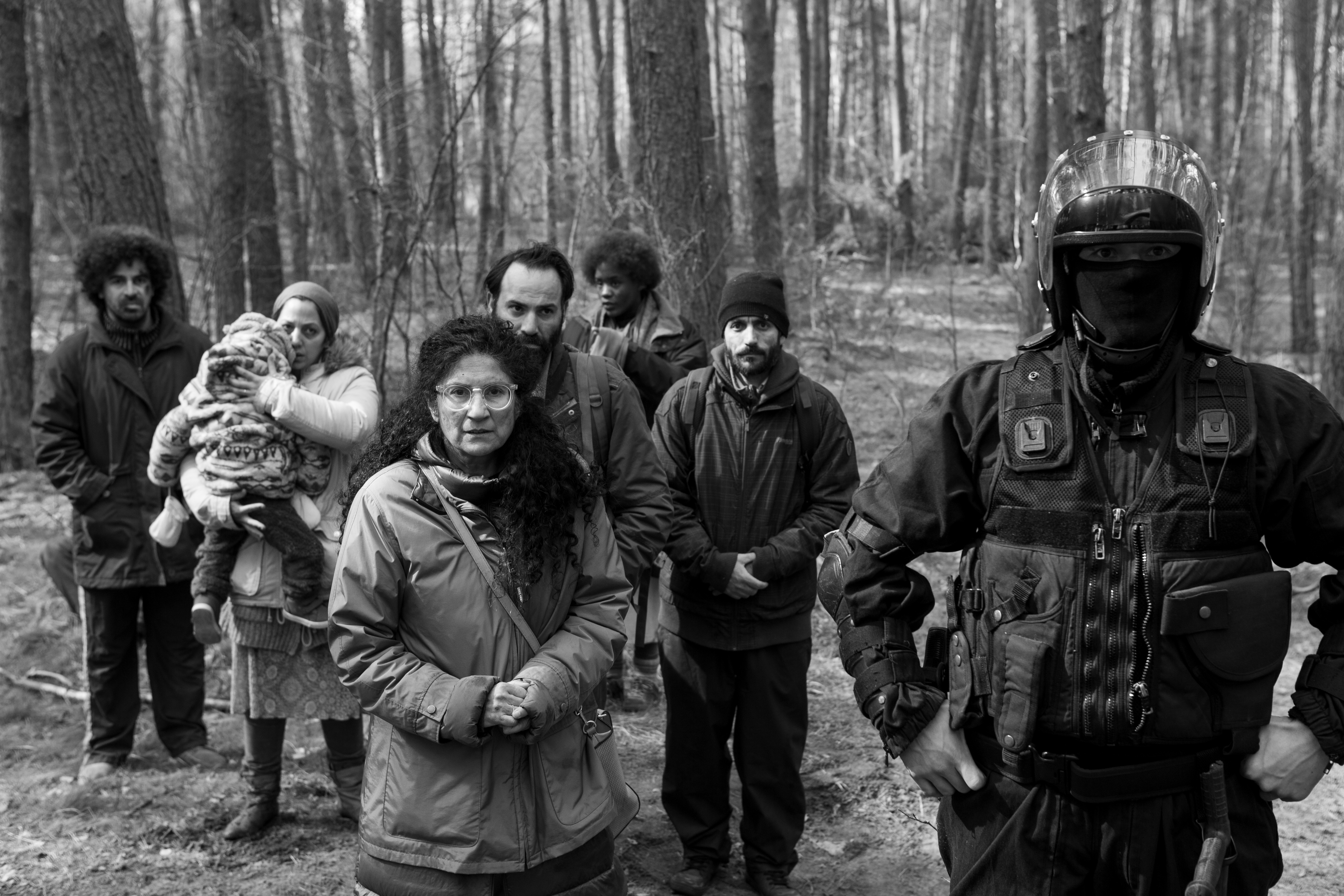
Leila (Behi Djanati Atai, glasses) and other migrants find themselves at the mercy of hostile border guards. (Photos courtesy of Kino Lorber)

By Richard Ades

The life of a migrant is an unending battle for survival.   

That was the message delivered by 2023’s Io Capitano, the story of two Senegalese teens’ perilous attempt to reach Europe. And it’s a message that comes across even more terrifyingly in Agnieszka Holland’s Green Border.

The acclaimed director sets her tale in a specific time and place: the border between Poland and Belarus in 2021. The year is significant because that’s when Belarusian dictator Alexander Lukashenko encouraged desperate people from around the world to travel to his communist country, where they supposedly would be guaranteed safe passage to Poland and the rest of the European Union.

As the film opens, we meet several people who’ve taken advantage of Lukashenko’s offer by catching a flight to Belarus. Among them are Bashir and Amina (Jalal Altawil and Dalia Naous), a Syrian couple who are traveling with an older relative and three young children. There’s also Leila (Behi Djanati Atai), an Afghan teacher fleeing Taliban persecution.  

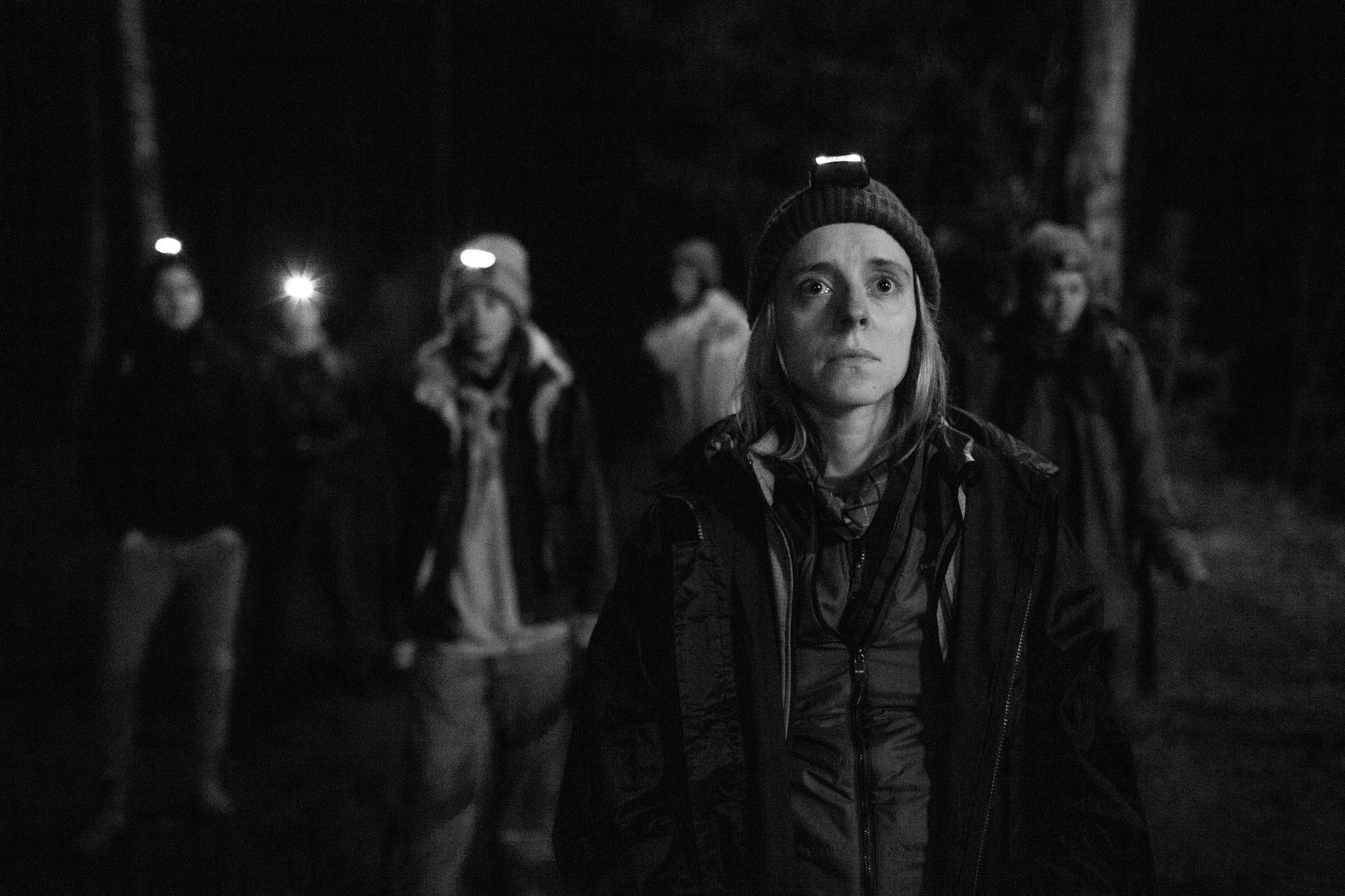
Upon landing in Belarus, the Syrians allow Leila to share their prearranged ride to the Polish border. Once there, however, they realize that Lukashenko’s promise of safe passage was a hoax. After being forced to pay a bribe, they’re shoved through an opening in the barbed wire that separates the two hostile countries and left alone in a thick Polish forest with night coming on.

A young migrant girl peers through the barbed wire that separates Poland from Belarus.

But the real shock comes the next day, when they’re discovered by border guards who load them onto a truck and send them back to Belarus.

It soon becomes clear that neither country wants them and that they’re stuck in a kind of limbo, repeatedly being forced back and forth across the barbed-wire frontier. All the while, they’re cheated, derided and even brutalized by the guards and others they encounter.

Basically, this is a horror film, but one that replaces jump scares and gore with an unflinching look at the cruelty ordinary people can inflict on others whom they’ve dismissed as enemies and less than human. In such cases, not even children, elders or pregnant women are deemed worthy of compassion.

Working from a script she co-wrote with Maciej Pisuk and Gabriela Lazarkiewicz, Holland also looks at the migrants’ nightmarish situation from two additional viewpoints. One is through the eyes of Jan (Tomasz Wlosok), a young border guard who’s soon to be a father.

While attending a lecture given by his gung-ho superior, Jan is told that many of the migrants are pedophiles and other deviants, and that all amount to “live bullets” aimed at Poland by the dictator Lukashenko and his Russian buddy, Vladimir Putin. Despite this appeal to prejudice and patriotism, Jan is obviously torn as he goes about a job that frequently offends his sense of decency.

A group of Polish activists search for migrants caught in the no-man’s land between their country and Belarus.

The final viewpoint belongs to a group of activists who work undercover to aid the migrants. A widowed psychotherapist named Julia (Maja Ostaszewska) soon joins them, but she’s dismayed by their ineffectiveness and ultimately decides to take matters into her own hands.

All of the characters are portrayed with discipline and conviction by the cast, whose efforts are complemented by Tomasz Naumiuk’s black-and-white cinematography and Frederic Vercheval’s subtly expressive score.

Eventually, the stories of the migrants and others coalesce in ways that inject slivers of hope into the 2½-hour film. Otherwise, director/co-writer Holland offers few reasons for optimism about the plight of migrants in Europe or anywhere else.

Instead, she suggests that as long as governments can score political points by categorizing these desperate people as a subhuman threat, their suffering will continue.

Rating: 4½ stars (out of 5)

Green Border can be seen at select theaters, with more openings scheduled in the coming weeks. Columbus screenings are scheduled at 7 p.m. Friday, June 28 and 1 p.m. Saturday, June 29 at the Wexner Center for the Arts, and beginning July 5 at the Gateway Film Center. VOD screenings begin Aug. 20.

Animated sequel explores teenage anxieties

Joy (Amy Poehler, in green dress) and her fellow emotions encounter Anxiety (Maya Hawke), who suddenly appears when their host, Riley, becomes a teenager. (Photos courtesy of Disney/Pixar)

By Richard Ades

When we first met Riley in 2015’s Inside Out, she was a homesick 11-year-old whose family had just moved from Minnesota to San Francisco. True to its title, the Disney/Pixar pic mostly took place inside her head, where “Joy,” “Sadness” and other characters representing primary emotions struggled to help her deal with the seismic change.

It was an animated tour de force that brought psychological concepts such as personality, memory and sense of self to life with the help of endearing characters, imaginative landscapes and daredevil adventures.

Now we have Inside Out 2, which catches up with our hockey-playing heroine (voiced by Kensington Tallman) as a 13-year-old who seems to have settled into her new life. Once again, Joy (Amy Poehler), Sadness (Phyllis Smith) and their fellow emotions work tirelessly to keep Riley on an even keel.

All seems well until they come across a part of the growing girl’s psyche that they haven’t seen before: puberty. (Yes, the flick goes there.) Before they know it, they’re being evicted from the emotional “control room” and replaced by teen-appropriate newcomers such as Envy (Ayo Edebiri), Embarrassment (Paul Walter Hauser), Ennui (Adele Exarchopoulos) and their panic-prone leader, Anxiety (Maya Hawke).

Meanwhile, in the outside world, Riley is dealing with a series of disasters, starting with the realization that her changing body is suddenly in need of deodorant. What’s worse, she learns that her two best friends will be assigned to a different school next year.  

The upshot is that what originally seemed like good news—the hockey coach at her future high school invites her to take part in a “skills camp”—becomes a source of endless stress. Stuck in a “disgusting” body and soon to be separated from her BFFs, she pins all her happiness on making a good impression on the ice.

Joy (Amy Poehler, left) tries to make friends with Anxiety (Maya Hawke).

It’s obvious she’s headed for a meltdown, but Joy and the rest of her exiled emotional support group can only watch helplessly while Anxiety and the other newcomers fuel the girl’s misgivings.

Directed by Kelsey Mann from a funny, heartfelt and clever script by Dave Holstein and Meg LeFauve, Inside Out 2 is brilliant at depicting the fears and doubts swirling around the mind of a typical teenage girl. If there’s any disappointment at all, it’s that the Riley’s relationship with her friends hits a variation of a snag that we’ve seen countless times before.

On the other hand, we’ve never seen it depicted with such glorious visuals. In true Pixar fashion, the animation is beautiful, if sometimes a bit overwhelming. The same can be said for the sound design, especially if you see the film, as I did, in an IMAX theater.

Aided by an invested cast, it all leads to an engrossing and rewarding story that should appeal to teens and pre-teens, as well as anyone who remembers what it was like to go through that difficult time of life when everything was changing.

Rating: 4 stars (out of 5)

Inside Out 2 (rated PG) opens June 14 at theaters nationwide.

Historic tale recounts pope’s abduction of Jewish boy

Edgardo (Enea Sala, left) receives a Catholic education after being abducted from his Jewish family in 1858. (Photos courtesy of Cohen Media Group)

By Richard Ades

Kidnapped: The Abduction of Edgardo Mortara relates the true story of a young Jewish boy who was taken from his parents so he could be converted to Christianity.

It’s a disturbing tale, but you may also find it a bit confusing unless you know something about Italian history. It also helps if you have a little patience.

Veteran director Marco Bellocchio takes his time unfolding the account of 6-year-old Edgardo Mortara, who is seized from his Bologna home in 1858 after Catholic officials learn he’d been secretly baptized as a baby. According to law, as the local “inquisitor” explains to the parents, he therefore must be raised as a Christian.

The boy’s father and mother, Salomone and Marianna (Fausto Russo Alesi and Barbara Ronchi), are shocked, as they know nothing about the baptism. They beg the official not to take their son, but their pleas only win them a 24-hour reprieve. After that, Edgardo (Enea Sala) is whisked away to Rome and enrolled in a school along with other boys who are training to become Catholic.

A distraught Marianna Mortara is allowed to visit her son (Enea Sala) months after he was abducted by Catholic officials.

In the months and years that follow, Salomone and Marianna do everything they can to reverse the church’s decision, including appealing their case to the press. But their efforts are stymied by Pope Pius IX (Paolo Pierobon), who takes a personal interest in the boy and refuses to give him up even after the abduction arouses international condemnation.

Director/co-scripter Bellocchio and most of his cast treat the tragic events with solemn restraint. Maybe a little too much restraint, as much of the film is weighed down by its own seriousness. There are effective scenes here and there, but the only actor who routinely shakes things up is Pierobon as the blustery and bullying Pius IX.

Another problem is that the script assumes the audience understands the complicated political atmosphere in which Edgardo’s ordeal is unfolding. In a much-simplified nutshell: Pius IX was in office at a time when Italians were rebelling against the pope’s power, which included controlling Rome and other parts of the country that were known as the Papal States. It all came to a head in 1871, when Italian troops captured Rome from the pope’s forces and unified Italy under one banner.  

Pope Pius IX (Paolo Pierobon) refuses to give up Edgardo (Enea Sala) even though the boy’s abduction has been greeted with international condemnation.

Unfortunately for those who aren’t knowledgeable about that history, Bellocchio skims over most of this in order to keep the focus on Edgardo, who by this time has grown into a young adult (played by Leonardo Maltese). It’s an understandable decision, but one that will leave many viewers confused about what’s really going on.

Kidnapped is about an act of official antisemitism that had an effect far beyond one Jewish individual and his family. As such, it has intrinsic interest, but the film would have had more impact if Bellocchio had imbued it with a bit more history and a bit less restraint.

Rating: 3 stars (out of 5)

Kidnapped: The Abduction of Edgardo Mortara opened May 24 in New York and Los Angeles and expands to additional cities beginning May 31. It will open in Columbus June 7 at the Gateway Film Center.

Holocaust escapee finds a home in pornography

Chelly Wilson does business out of her apartment in an old snapshot provided by the Wilson family. (Photos courtesy of Kory Miller/Obscured Pictures)

By Richard Ades

There have been many documentaries about Holocaust survivors. Queen of the Deuce is likely the only one about a survivor who went on to make her fortune in the porn industry.

Born into a family of Greek Jews in 1908, Chelly Wilson was quicker than most to recognize the rising threat Nazi Germany posed in the late 1930s. Temporarily leaving her son with her ex-husband and her daughter with a non-Jewish acquaintance, she hastily emigrated to New York, where she was soon making money selling hot dogs.

But Wilson’s real success came years later, when she began acquiring neighborhood movie theaters and devoting them to the increasingly popular genre of pornography. By the time soft porn began giving way to the hard variety, she was honchoing a business that ran a slew of theaters and even made its own features.

Directed and co-written by Valerie Kontakos, Queen of the Deuce tells Wilson’s story through interviews with her grown children and grandchildren, as well as people who worked with her over the years. Though she died in 1994, Wilson even makes an appearance herself thanks to home movies and interviews recorded by her family. In addition, an animated version of Wilson at various ages makes brief appearances to help us understand who she was and how she got that way.

An animated version of Chelly Wilson poses with some of her regular poker buddies in an image provided by Exile Films.

It all adds up to a portrait of an individual whose life was full of contradictions. For example:

⸱ She was a Jew who celebrated Christmas (which was also her birthday).

⸱ She was a lesbian but was married twice, including to a man she met in America.

⸱ She was a mother and grandmother who valued her family but sometimes kept them in the dark about her past.

A final contradiction is that, while many would label her a feminist thanks to her fierce independence, she made her living off a film genre that feminists of her era often considered misogynous.

In general, Wilson comes across as someone who proudly and unapologetically lived her life and was unafraid to thumb her nose at social norms. Director Kontakos does a good job of capturing her personality with major help from collaborators such as editor Rob Ruzic, composer Ken Myhr and lead animator Abhilasha Dewan.

As a bonus, Kontakos also captures the personality of New York in the 1960s and ’70s, before politicians such as Rudy Giuliani began working to reform its sex-, dirt- and crime-ridden image. Back then, the Big Apple might not have been as nice a place to visit as today’s cleaned-up version, but it obviously was the perfect home for a risk-taking entrepreneur named Chelly Wilson.

Rating: 4 stars (out of 5)

Queen of the Deuce previously made the rounds of several festivals, including the 2023 Columbus Jewish Film Festival. The film opens May 24 in select theaters and online through Amazon Prime Video and Apple TV.

He photographed folks the mainstream media ignored

Wearing a mask during the COVID pandemic, Corky Lee gets ready to take his next photo. (Photos courtesy of All Is Well Pictures)

By Richard Ades

As a child, Corky Lee enjoyed comic books about superheroes, which he later credited with giving him a “moral compass.” As a Chinese American, however, he never saw any superheroes who looked like him.

Despite this fact (or maybe because of it), Lee grew up to be a kind of superhero himself—one whose “superpower” was simply taking the kind of pictures no one else was taking. Walking around New York City with a camera bag over his shoulder, he spent five decades chronicling the lives of Asian Americans and Pacific Islanders, people whose struggles and celebrations were often ignored by the mainstream media.

Lee and his lifelong crusade of inclusion are the subject of Photographic Justice: The Corky Lee Story, a documentary being shown on PBS in observance of Asian American and Pacific Islander Month.

Directed by Jennifer Takaki and featuring a combination of contemporary interviews and vintage footage, the film is a low-key but loving portrait of the man who became a fixture in New York’s Asian community. Whenever members of its many varied cultures and nationalities threw a parade, held a party or joined a picket line, Lee could be counted on to be there.

Love of country and love of New York are obvious in this photo Corky Lee took of a 2006 parade celebrating Budha’s birthday.

After decades of such coverage, the documentary tells us, Lee amassed so much knowledge about local AAPI-related events that kids jokingly referred to him as “Corkypedia.”

Besides showing up for Asian holidays such as the lunar new year and Budha’s birthday, Lee also covered national holidays, when he concentrated on providing an Asian American viewpoint. On Veterans Day, for example, he focused his lens on AAPI vets to show that Asians are as much a part of U.S. society as their European American counterparts.

According to the documentary, Lee felt this lesson became especially important when the country was hit with the 9/11 attacks in 2001 and with COVID in 2020. Muslim Americans and Chinese Americans, respectively, were scapegoated for these national and international tragedies, and he did what he could to counteract the resulting prejudice.

Sadly, the latter effort turned out to be his last. After viewing Takaki’s documentary, you’ll realize just how much of a loss that was.

Rating: 4 stars (out of 5)

Photographic Justice: The Corky Lee Story can be seen in select theaters and will air on PBS stations beginning May 13. Its Central Ohio airtime is 4 p.m. Sunday, May 19 on WOSU.