Bernstein biopic plagued by hamminess on both sides of the camera

Maestro stars Bradley Cooper and Carey Mulligan as conductor/composer Leonard Bernstein and his wife, Felicia Montealegre.

By Richard Ades

While waiting to see Maestro—Bradley Cooper’s take on the life of Leonard Berstein and his wife, Felicia Montealegre—I had a scary thought: What if it turned out to be another Being the Ricardos?

In that 2021 film, writer/director Aaron Sorkin focused so much on the marital woes of Lucille Ball and her husband, Desi Arnaz, that he all but ignored the comedic joy she brought to the world. So I worried: Would Cooper pull a Sorkin by focusing so much on Bernstein’s marital challenges that he’d ignore all the musical joy the composer/conductor created?

The good news is that Cooper, as the biopic’s director and co-writer (with Josh Singer), does leave ample room for Bernstein’s beautiful music. The bad news is that he leaves little room for the joy that should have accompanied the music. Instead, the musical interludes appear like oases amid a chilly atmosphere of marital tension and discord.

Perhaps even worse, even though Leonard is played by Cooper himself and Felicia by the great Carey Mulligan (Promising Young Woman), we only sporadically feel like we understand them as either individuals or marital partners.

A big problem is Cooper’s portrayal of Leonard as a nasal-voiced caricature who seems to be consumed by frantic energy. Mulligan’s Felicia is more restrained, but it’s not really clear why the Costa Rican-born thespian decided to spend her life with this flighty musical genius.

As the movie’s first scene points out, Leonard is attracted to men and eager to act on that attraction. Felicia is apparently aware of this and seems OK with it, but you don’t have to be clairvoyant to suspect it eventually will cause tension in the marriage.

Felicia Montealegre and Leonard Bernstein (Carey Mulligan and Bradley Cooper) enjoy one of their first outings. The couple’s early years are depicted in black and white.

Another reason we have trouble understanding the characters is the self-consciously artsy way in which director Cooper and cinematographer Matthew Libbatique tell their story.

The black-and-white photography of the early scenes, the transitions that allow characters to magically walk through a doorway into another location altogether, the heated conversations that are seen from a fixed viewpoint on the other side of the room: All may be impressive in and of themselves, but they cumulatively have a “look at me” quality that detracts attention from the central characters.

Maybe it would have helped us get to know the two if the film had spent less time on their challenging marriage and more on their respective careers. But we see little of Felicia’s acting or of Leonard’s musical collaborations. Even his best-known work, the great Broadway musical West Side Story, gets only a brief mention as an adaptation of Romeo and Juliet.

The film eventually does allow Leonard and Felicia and their relationship to come warmly alive, but only after a serious health problem threatens to separate them forever. The change is welcome, but it comes very late in the two-plus-hour running time.

As a conductor, Bernstein said his goal was, in effect, to become the composer so that he and the orchestra could do justice to the artist’s work. As a writer, director and actor, Cooper no doubt wanted to do equal justice to Bernstein and Montealegre, but he was too busy showing off to accomplish the task.

Rating: 2½ stars (out of 5)

Maestro (rated R) opens Nov. 22 in select theaters and Dec. 8 at Columbus’s Drexel Theatre and Gateway Film Center. It will be available through Netflix beginning Dec. 20.

The hills are alive with the sound of sexual revolution

Novice nun Elisabeth (Lilith Grasmug) is forced to return home to her family following the mysterious death of her older sister. (Photos courtesy of Dekanalog)

By Richard Ades

Switzerland’s nominee for 2023’s international Oscar is Thunder, the quietly striking debut feature of writer-director Carmen Jaquier.

Critics have compared the French-language film to various acclaimed predecessors, and Jaquier herself has said its style was inspired by Pier Paolo Pasolini’s The Gospel According to St. Matthew and Carlos Reygadas’s Silent Light.

Given that its heroine is a novice nun who’s forced to leave an Alpine nunnery and rejoin secular life, the most obvious comparison is to The Sound of Music, but the similarities are only on the surface. While that blockbuster musical’s Maria discovers love, family and marriage, Thunder’s Elisabeth (Lilith Grasmug) discovers something decidedly earthier.

Set in a conservative village around the turn of the last century, the tale begins with a series of images showing the difficult lives of its inhabitants, particularly its girls and women. The montage ends with a disturbing shot of a young woman chained to the kitchen where she’s working.

The scene then switches to a distant nunnery, where 17-year-old Elisabeth is told she must return to her family because Innocente, her older sister and best friend, has died. The girl has to be carried out forcefully, apparently because she has no desire to leave the safety of religious life. Even as she trudges through mountainous terrain toward home, Elisabeth asks God to hide the secrets of the world from her because she wants no part of it.

Yet as soon as she returns to the family she hasn’t seen in years, Elisabeth begins trying to uncover the secret that’s been haunting her: What happened to Innocente? Her curiosity only grows when her mother (Sabine Timoteo) refuses to discuss the matter, and when a passing villager charges that her late sibling was a deviate who would have sex with anyone, including the devil.

Answers finally begin to appear when Elisabeth finds a diary in which Innocente describes in graphic detail her discovery of a part of life that is repressed in their rigidly religious society—sex. Intriguingly for the spiritually minded Elisabeth, Innocente writes that the discovery makes her feel closer, not farther, from God.

Will Elisabeth follow in her late sister’s dangerous path? Her parents fear that she will, especially after she befriends three young men who fell under the sexually adventurous Innocente’s influence.

Despite dealing with physical passion and such serious subjects as repression and misogyny, Thunder’s style is quiet and meditative. Cinematographer Marine Atlan’s images of the Alpine landscape and composer Nicolas Rabacus’s score complement each other in their calm beauty.

Leading the cast, Grasmug projects understated strength and determination as Elisabeth. Behind her, the supporting cast is uniformly convincing.

Despite the film’s strengths, some viewers may have reservations, feeling that writer-director Jaquier stacks the deck in her depiction of a mini-sexual rebellion in turn-of-the-century Switzerland.

Would teenagers really be able to handle the type of shared intimacy being shown without jealousy or hurt ever arising? And while the adults’ disapproval seems to be motivated solely by their religion, wouldn’t any modern parent be just as concerned, if for different reasons?

But Jaquier doesn’t address such questions, being focused solely on the age-old battle between repression and freedom, particularly as it relates to girls and women. And she depicts that struggle beautifully in a film whose subdued style in no way diminishes the strength of its convictions.

Rating: 3½ stars (out of 5)

Thunder (no MPAA rating) opened Oct. 25 in New York City, with a national rollout set to follow.

A Scottish woman’s struggle to survive

Kirsty (Hermione Corfield, in white dress) attends a village celebration in The Road Dance. (Photos courtesy of Music Box Films)

By Richard Ades

In 1904, on a beach in Scotland’s Outer Hebrides, a man and his young daughter have just finished a swimming lesson. When the father asks the girl what she’s learned, she names the three most important lessons: paddle with your arms, kick with your feet and, perhaps most importantly, breathe.

Thus begins The Road Dance, setting the stage for the survival struggle that faces Kirsty (Hermione Corfield), the grownup version of the girl, 12 years later. Her problems stem from a farewell celebration held for her beau, Murdo (Will Fletcher), and other local men who’ve been called up to fight in World War I.

Despite the circumstances—and despite the obvious jealousy of Kirsty’s rejected suitor (Tom Byrne)—it’s a joyous occasion. But then Kirsty goes off by herself to answer the call of nature and is subjected to an attack that leaves her dazed and irrevocably changed. The encounter sends her on a dark journey that she attempts to hide even from her loving mother and sister (Morven Christie and Ali Fumiko Whitney).

Directed and written by Richie Adams, who based his script on a novel by John Mackay, The Road Movie is steeped in atmosphere.

Petra Korner’s cinematography immerses us in the rustic island community, with its stone fences and houses, windswept hills and lonely beaches. Composer Carlos Jose Alvarez’s mournful score is as distinctly Scottish as the inhabitants’ dialects.

Further clarifying the time and place are bits of dialogue that define the community’s religious core—for example, when a minister sermonizes about a village girl’s fateful surrender to temptation, or when an old woman demands to know if Kirsty is carrying her Bible. (She is.)

Murdo and Kirsty (Will Fletcher and Hermione Corfield) take a walk.

One result of the focus on atmosphere is that following Kisty’s attack, we assume what happens next will be as predictable as the sunset over the Atlantic. How could it be otherwise, given who she is and when and where she lives? And for a long section of the story, that appears to be the case.

Eventually, though, things change. Rather than being predictable, The Road Dance proves to be full of unexpected developments. Some of them, truthfully, are a bit contrived, but fine, naturalistic acting by Corfield and the rest of the cast help to keep the tale centered.  

Though not perfect, The Road Dance is worthwhile not only for the tragic story it tells but for the beautiful and richly atmospheric way in which it tells it.

Rating: 4 stars (out of 5)

The Road Dance (no MPAA rating) will be available through select theaters and VOD outlets beginning Oct. 13. It will be screened at Columbus’s Gateway Film Center beginning Nov. 3.

Giving their all to protect reproductive freedom

Francine Coeytaux (left) is a co-founder of Plan C, an organization devoted to making the abortion pill available and affordable even in conservative states such as Texas.

By Richard Ades

Recent developments in the battle over abortion rights have mostly favored the forced-birth side of the argument. In particular, there’s the Supreme Court’s 2022 decision to overturn Roe v. Wade, emboldening conservative state legislatures that had already been working to restrict access to abortion.

Such developments are disheartening to those who care about reproductive freedom and women’s health care. For them, the documentary Plan C offers a reason to hope. Directed by Tracy Droz Tragos, it introduces us to a group of intrepid women who have been working behind the scenes to keep abortion available and affordable.

The doc is named after Plan C, an organization devoted to spreading information about the “abortion pill” drugs mifepristone and misoprostol. In interviews, co-founders Francine Coeytaux and Elisa Wells talk about the group’s efforts to adapt to the changing political landscape.

The COVID pandemic made their work more important than ever because (1) people seeking a surgical abortion were often prohibited from visiting a clinic, and (2) a mid-pandemic court ruling made the abortion pill available without an in-person medical appointment.

The documentary also introduces us to Just the Pill, as represented by medical director Julie Amaon and clinic director Frances Morales. The group works to deliver the abortion pill to those who need it—when they need it. Its distributors have been forced to shift into hyperdrive to keep clients on the right side of new state laws that prohibit abortion after as little as six weeks.

Supporters of the abortion pill hold a strategy meeting in a scene from Plan C.

Plan C also interviews several medical personnel and patients who prefer to keep their faces and names hidden due to their fear of legal repercussions and even physical attacks from abortion opponents.

Thanks to political rhetoric, abortion has long been a polarizing issue, and it’s becoming even more so as Republican-led legislatures pass increasingly extreme laws. The documentary devotes much of its attention to Texas, where one such law encourages citizens to spy on each other and to sue anyone they suspect of helping someone obtain an abortion. One day, predicts lawyer and journalist Carrie Baker, the Lone Star State will turn to surveillance to ferret out even those who perform their own abortions.

Much of the documentary presents a similarly cautionary viewpoint, as underscored by composer Nathan Halpern’s ominous score. In fact, it may strike some viewers as overly pessimistic, since it fails to note that all the restrictive laws may be sparking a backlash in the form of Republican election losses and statewide votes to protect abortion access—for instance, Kansas’s August 2022 rejection of an attempt to remove constitutional protections for the procedure.  

On the other hand, the film offers one big reason for optimism in its portraits of brave women who have devoted their lives to fighting for reproductive freedom. Their efforts leave even the most jaded observer feeling uplifted and inspired.

Rating: 3½ stars (out of 5)

Plan C opens Oct. 6 in select theaters, including Columbus’s AMC Dublin Village 18, AMC Easton Town Center 28 and the Gateway Film Center.

Dad’s new romance leaves daughter fuming

Howard (James Cosmo) enjoys the seaside scenery with housekeeper Annie (Brid Brennan) in My Sailor, My Love. (Photos courtesy of Music Box Films)

Senior citizens need love, too, as ABC hopes to prove with its upcoming debut of The Golden Bachelor. The same holds true across the pond, as Finnish director Klaus Haro demonstrates with his Ireland-set tale My Sailor, My Love.

The TV series, of course, is an extension of The Bachelor and The Bachelorette, “reality” shows that specialize in steamy encounters and dramatic histrionics. Don’t expect much of the former in Haro’s tale, but there are plenty of the latter. The only difference is, they don’t emanate from rejected suitors but from a daughter who’s unhappy about her father’s sudden interest in romance.

The daughter is Grace (Catherine Walker), a healthcare worker who spends most of her waking hours worrying about her aging dad, a retired sea captain named Howard (James Cosmos). When we first meet her, the situation has not only made her miserable, but it’s left her husband feeling so neglected that her marriage may be in jeopardy.

Realizing she can’t carry the burden of caring for Howard by herself, Grace hires a kindhearted widow named Annie (Brid Brennan) to serve as his parttime housekeeper. Howard, who’s accustomed to living on his own in his seaside home, soon sends Annie away, but a haphazard discovery convinces him he made a mistake. He then gathers a bouquet of flowers, starts up the car that’s been gathering dust in his garage and seeks her out.

Cue the heartfelt apology, courtesy of screenwriters Jimmy Karlsson and Kirsi Vikman. Also cue the gushing music, courtesy of composer Michelino Bisceglia. Set it all against gorgeous images of the Irish coastline, courtesy of cinematographer Robert Nordstrom.

In other words, love ensues, even though one wouldn’t expect a gruff hermit like Howard to jump into it so eagerly. But he does, resulting in a December-December romance that would be touching if it didn’t feel a bit contrived.

Then, just when we think the film is setting Howard and Annie up for happiness, Grace drops by with a sour attitude that looks a lot like jealousy. Rather than being grateful to Annie for making her father happy and taking care of his needs, she seems to resent her presence. Meanwhile, Howard displays a coldness toward his daughter that’s just as surprising, given the sacrifices she’s long made on his behalf.

What’s going on? Clues are doled out stingily over the course of the film, but an “aha” moment never arrives. The result is that despite assured performances by the major players, we don’t quite understand Grace and Howard’s motivations, and even Annie sometimes acts in a puzzling way.

With its combination of senior romance and family dysfunction, My Sailor, My Love is a tricky balancing act. Haro and company make a valiant effort, creating a handsome and sometimes appealing film in the process, but they don’t quite pull it off.

Rating: 3 stars (out of 5)

My Sailor, My Love (no MPAA rating) opens Sept. 22 in select theaters and will be available through VOD outlets beginning Oct. 24.

Indiana Jones has nothing on Ohio-based glacier explorer

Lonnie Thompson and his colleagues go to great trouble to extract ice cores like this from remote glaciers to learn the secrets they store about the earth’s past.

By Richard Ades

One admirer compares research scientist Lonnie Thompson to Indiana Jones. Another compares him to Clark Kent, the deceptively average-looking individual who is, in reality, Superman.

Both comparisons are apt, as we learn from Canary, a documentary directed by Danny O’Malley and Alex Rivest. The film details Thompson’s decades-long effort to uncover the history stored in glaciers found in some of the world’s highest and least-accessible locations. It also explains how the Ohio State professor became a major voice in the fight against climate change.

Even before the opening credits appear, we’re shown an incident in a war-torn area of Indonesia that encapsulates Thompson’s bravery and commitment to the environment.

After demanding to meet with him, members of a local tribe ask why he and his team are drilling into a mountaintop glacier that they consider the head of their god. Is he trying to steal the deity’s memory? Thompson tells them that’s exactly what he’s doing, because the glacier that stores the “memory” is in danger of melting away.

Serving as the film’s narrator along with other experts such as his wife, Ellen Mosley-Thompson—a glaciologist in her own right—Thompson explains that glaciers are like the canary in the coal mine. In the olden days, caged canaries were taken into mines to serve as early warning systems. If the air got too thin to keep the tiny birds alive, miners knew they had to leave quickly or suffer the same fate.

Thompson’s point is that glaciers have served the same function. By melting and shrinking, sometimes with shocking speed, they’ve offered some of the earliest evidence that the climate is changing and we’d better do something about it or suffer the consequences.

The analogy comes naturally to Thompson, as he was born and raised in a poor area of West Virginia that’s dominated by the coal industry. Ironically, considering the role fossil fuels have played in climate change, he originally enrolled at OSU to study coal geology. However, he eagerly switched fields when he was offered a job studying glaciers.

Thompson and his team climb to reach the next glacier.

With a combination of archival footage and contemporary interviews, the documentary explores Thompson’s career, which started with a years-long effort to access a mountaintop glacier located in a remote area of Peru. Though at first he was motivated solely by scientific curiosity, his discovery that glaciers around the world were shrinking eventually turned him into what he is today: a prominent cautionary voice in the fight against climate change.

Dramatic photography by cinematographer Devin Whetstone, accompanied by Paul Doucette and Jeff Russo’s equally dramatic score, set an appropriate tone for a film about a man engaged in a struggle for humanity’s survival. They help to make up for co-director O’Malley’s script, which sometimes fails to fill in salient details. Just what, for example, do Thompson and his colleagues do with the ice cores they work so hard to extract from glaciers? And what do these samples of ancient ice tell them about our planet?

But the film fills in just enough details when it reports on the rise of climate-change denial, a movement that caused politicians as diverse as Newt Gingrich, Sarah Palin and Mitt Romney to change from science supporters into science questioners. An eye-opening depiction of their transformation underscores the uphill battle Thompson and other activists face as they work to save humanity from its own excesses.   

Rating: 3½ stars (out of 5)

Canary opens Sept. 15 in select theaters in New York and Los Angeles, as well as the Gateway Film Center in Columbus. Subsequent one-night screenings are planned Sept. 20 in multiple markets. For details, visit canary.oscilliscope.net.

Motherless girl shocked by dad’s sudden reappearance

Georgie (Lola Campbell) turns to petty crime with the help of her friend, Ali (Alin Uzun). (Photos courtesy of Kino Lorber)

By Richard Ades

Scrapper’s title is the perfect description of Georgie (Lola Campbell), a 12-year-old struggling to survive in a working-class suburb of London.

Having recently lost her mother and with no father in sight, the girl scrounges for money by stealing bikes with the help of her friend, Ali (Alin Uzun). She then tries to fence them to a local shop owner by arguing that soon everyone will want one because the Tour de France is imminent.

Even when Georgie and Ali are caught stealing by a bike’s owner, she manages to talk her way out of trouble by pretending they were just making sure it was mechanically sound. She also succeeds in keeping concerned social workers at bay by convincing them she’s living with an uncle rather than on her own.

As depicted by first-time actor Campbell and first-time writer-director Charlotte Regan, Georgie seems unfazed by anything that comes her way. That is, until a man named Jason (Harris Dickinson) shows up and claims to be her long-lost father. That sets off a wave of paranoid suspicions (Is he a vampire? Is he a gangster?), along with recriminations toward the parent she accuses of deserting her.

“At least he’s here now,” Ali argues, leading to a fallout with his mercurial friend.  

Jason (Harris Dickinson) tries to mend fences with Georgie (Lola Campbell), the daughter he never knew.

Will Jason stay around long enough to accept the parenting role he abandoned as a young man? Will the resentful and independent Georgie let her guard down long enough to let him try?

A situation like this seems guaranteed to generate pathos and sentimentality, but filmmaker Regan relies on quirky humor to avoid the former and to head off the latter as long as possible. Reportedly, she also relied heavily on improvisation, which explains why some scenes have a freewheeling quality.

Though the resulting film is a bit uneven, a winning cast keeps the story interesting. Uzun and Dickinson are fine as Georgie’s faithful friend and belatedly concerned father, while Campbell is irresistible as the girl who falls back on her ample wits to survive one of the worst losses a child can face.

Rating: 3½ stars (out of 5)

Scrapper (no MPAA rating) can be seen in select theaters and is scheduled to run Sept. 8-14 at Columbus’s Gateway Film Center.

Character studies dominate Irish doc, U.S. road flick

Tana (Lily Gladstone) takes a cross-country trip in her late grandmother’s Cadillac in The Unknown Country. (Photo courtesy of Music Box Films)

By Richard Ades

Opening this weekend are two indie films that have more in common than you might think.

The Unknown Country, a drama by first-time director Morrisa Maltz, is about a cross-country trip taken by a grieving Native American woman. North Circular, an Irish documentary written and directed by Luke McManus, is described as “a musical trip through Dublin’s inner city.”

What unites the flicks is their willingness to digress in the presence of strong personalities. In each case, this is a mixed blessing.

The Unknown Country ostensibly focuses on Tana (Lily Gladstone), who takes time to travel to a family wedding in South Dakota even though she just lost her beloved grandmother. She then drives her granny’s Cadillac to Texas in a trek that ends at a landmark once visited by the dearly departed.

Co-written by director Maltz and cast members Gladstone and Lainey Bearkiller Shangreaux, the film is primarily about Tana’s attempt to come to terms with her loss. However, Tana herself ends up being overshadowed by a series of strong peripheral characters she meets along the road. Among others, there’s a waitress who lives for her cats, a bride and groom who feel they were destined to be together, and an elderly woman who comes to life on the dance floor.

Most of these characters are real people simply playing themselves, making the flick an adventurous blend of fiction and fact. Each of them is interesting, as are several sights Tana sees along the way, including a Native American wedding, a small-town winter festival and a brightly lit Dallas dance club.

The only problem is that we don’t get to know protagonist Tana as well as the people she meets, making the film a bit less than the sum of its very worthwhile parts.

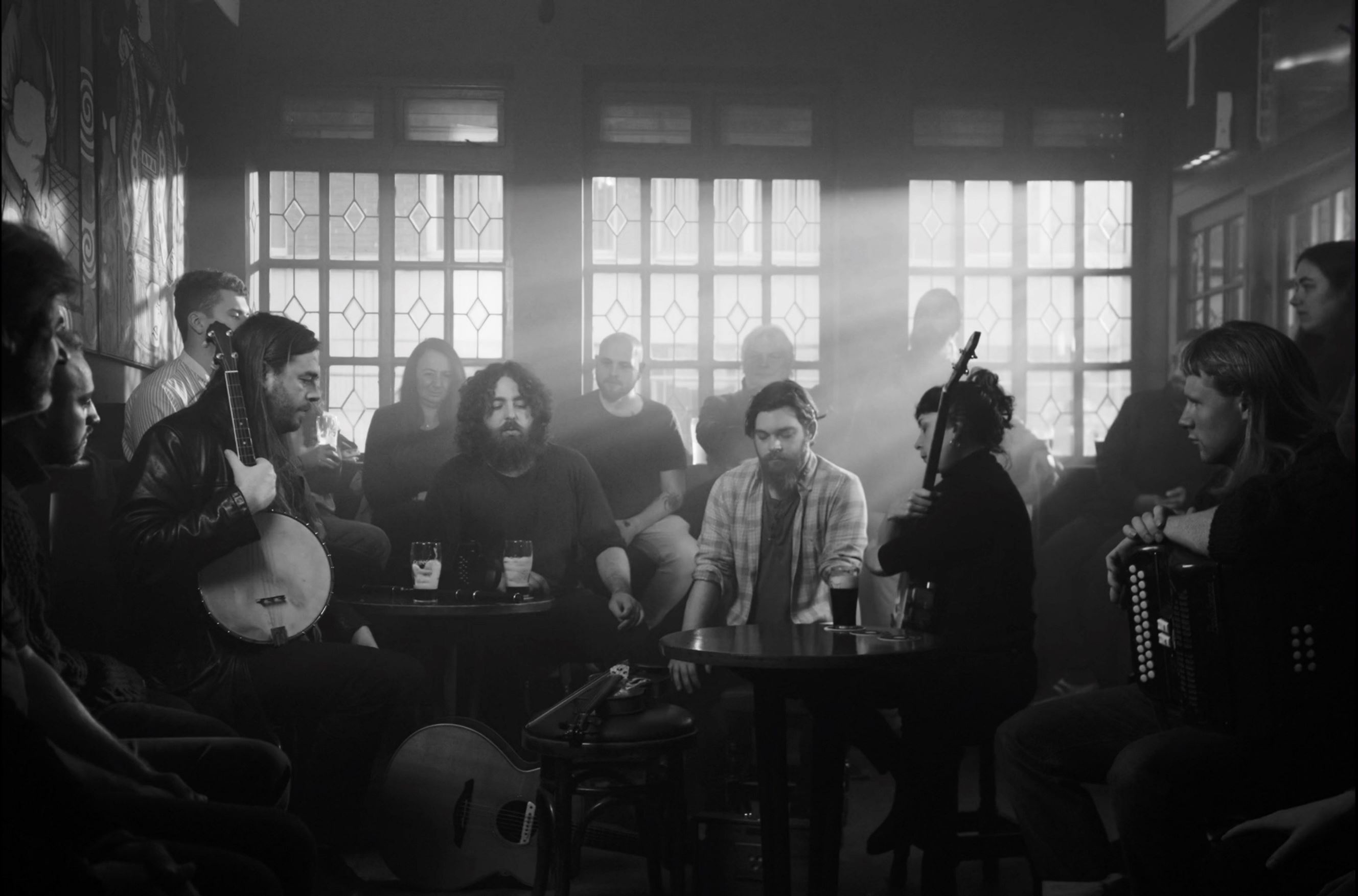
Holding forth at Dublin’s Cobblestone Pub in a scene from North Circular are (from left): folk singers John Francis Flynn, Eoghan Ó Ceannabháin, Killian O’Donnell and Lisa O’Neill. (Photo courtesy of Lightdox)

In a similar way, North Circular spends much of its time introducing us to people who live near the titular roadway, which winds around some of the poorer sections of Dublin. One of the first is an army veteran who plays the bagpipes for military ceremonies and complains that the younger generation shows little interest in learning the traditional instrument. Yes, it’s a shame, but his story comes across as unnecessary digression.

Fortunately, most of the other interviewees can speak more directly to the film’s subject, which is the neighborhood’s struggles with poverty and encroaching gentrification. And several of them do more than speak—they sing about their losses and grievances, often delivering a cappella laments to a silent audience. The sum total is a memorable trip to a side of Ireland’s capital that is never experienced by the average tourist.

Besides their plethora of minor characters, the two films have one other thing in common: striking cinematography. Andrew Jajek’s images in The Unknown Country are engrossing whether they’re showing quiet human interactions or majestic landscapes such as South Dakota’s Badlands and Texas’s Big Bend National Park. And North Circular’s black-and-white images combine with its somber folk tunes to create what at times amounts to cinematic poetry.  

Rating for each film: 3½ stars (out of 5)

The Unknown Country opens July 28 at the Quad Cinema in New York City and the Nuart in Los Angeles, and will open at additional theaters across the country in the following weeks. North Circular opens July 28 at DCTV’s Firehouse Cinema in New York City.

Reality intrudes on sheltered life in ‘Chile ’76’

Carmen (Aline Kuppenheim) is asked to put her life on the line by helping a political dissident. (Photos courtesy of Kino Lorber Team)

By Richard Ades

After being blown away by last year’s Argentina, 1985, I wondered if Chile ’76 would turn out to be an equally instructive look at its titular country’s painful history.

But it’s not, mostly because it doesn’t try to be. Manuela Martelli’s debut film is more of a psychological thriller than a historical drama.

Though it’s set three years after the military coup that brought President Augusto Pinochet to power, the right-wing dictator’s name never even comes up. Instead, the focus is on Carmen (Aline Kuppenheim), an upper-middle-class woman whose privileged life has allowed her to ignore the brutal suppression Pinochet unleashed on her country.

That begins to change, however, in an early scene. Carmen is picking out paint to renovate her family’s vacation home when the sounds of one of the country’s many political kidnappings are heard outside the store.

Quiet soon returns, but we’re left with the impression that Carmen’s life is about to be complicated by the upheaval going on around her. Director/co-scripter Martelli signals this with some rather blatant symbolism: A store employee mixes blood-red paint with a neutral shade, after which a couple of drops spill onto Carmen’s immaculate shoes.

Sure enough, once Carmen reaches her vacation home, a priest friend named Father Sanchez (Hugo Medina) involves her in a matter with political overtones. He asks her to provide medical care for Elias (Nicolas Sepulveda), a young man who he claims was shot while trying to steal food.

Elias (Nicolas Sepulveda), a wounded fugitive, is nursed back to health by Carmen (Aline Kuppenheim).

Being a doctor’s wife who once worked for the Red Cross, Carmen agrees to help, and she keeps helping after she learns Elias is in reality a political dissident hiding from the government. Eventually, she even offers to deliver messages to the fugitive’s left-wing cohorts, involving her in political intrigue for which she’s dangerously unprepared.

Remember the unseen kidnapping that first reminded us we were in Pinochet’s Chile? Most of Martelli’s film is similarly understated, concentrating on Carmen’s fears rather than on the real perils that inspire them. The only un-understated element is Maria Portugal’s musical score, composed of dissonant sounds designed to keep our nerves on edge.

Otherwise, Chile ’76 is a uniformly low-key effort thanks to Kuppenheim’s muted portrayal and Martelli’s restrained script and direction. The result is a film that may not excite viewers but is sure to leave them impressed by its subtle workmanship.  

Rating: 3 stars (out of 5)

Chile ’76 can be seen in select theaters and opens June 30 at the Gateway Film Center in Columbus.

Overheard honesty threatens marital bliss

Beth (Julia Louis-Dreyfus) tries to drown her sorrows in You Hurt My Feelings. (Photos by Jeong Park)

By Richard Ades

When a couple exchanges wedding vows, they promise to love and cherish each other, among other things. What they generally don’t promise is to be honest with each other.

Whether or not that’s a good thing is a topic writer-director Nicole Holofcener takes up in her entertaining and chuckle-worthy new film, You Hurt My Feelings.

Long-married New Yorkers Beth and Don (Julia Louis-Dreyfus and Tobias Menzies) love and support each other to a fault—the fault being that they occasionally express that support by telling little white lies.

When Don gives Beth earrings as an anniversary present, she greets them with such forced enthusiasm that it’s obvious she doesn’t like them. And when Beth reciprocates by giving Don a V-neck sweater, his disappointment is equally clear because his first comment is, “Oh, a V-neck.” (As all fans of Louis-Dreyfus’s former series, Seinfeld, know, saying the name of a gift after you open it is a sure sign you didn’t want it.)

All this is no big deal, right? When you’re in a relationship, telling the occasional little white lie can help you avoid hurt feelings or unnecessary friction.

But then Beth catches Don in a lie that doesn’t seem so little: She overhears him admitting to his brother-in-law that, even though he’s told Beth he loves the novel she’s been working on for the past two years, he actually hates it.

Beth is hurt and humiliated, telling sister and fellow eavesdropper Sarah (Michaela Watkins), “I can’t look him in the face ever again.” Sarah tries to soften the blow by admitting she tells actor-husband Mark (Arian Moayed) that he’s more talented than he actually is, but it seems the damage is done.

This unfortunate incident comes to dominate the flick, as well as supplying its title, but it’s actually just one of several examples of the fragile egos and self-doubts that afflict all the major characters.

Aspiring novelist Beth worries she won’t be able to duplicate the success of her previous work, a memoir about growing up with an abusive father. (Not that the memoir was as successful as it might have been if her father hadn’t been just verbally abusive, she muses ruefully.)

Therapist Don (Tobias Menzies) has trouble keeping his clients’ backstories straight.

Don, a therapist who seems to be chronically tired, has trouble keeping his clients straight, and he worries that he’s not helping them get any better. Sarah, an interior designer, has similar fears about pleasing her clients, while Mark suspects he’s really not such a great actor.

Finally, there’s Beth and Don’s 23-year-old son, Eliot (Owen Teague), who’s working on a play that he fears is no good, while dating a woman who he worries will break up with him.

My one quibble with the way all this trauma is acted out is that Louis-Dreyfus falls back on her old Elaine Benes mannerisms at one or two inopportune moments. Otherwise, everyone’s great, including the several supporting actors who play Mark’s eccentric and generally dissatisfied clients.

With its New York setting, sardonic wit and neurotic characters, You Hurt My Feelings may strike some as a lighter, gentler version of early Woody Allen. But Holofcener is really doing her own thing with this portrait of everyday worries and squabbles, giving viewers a breezily pleasant hour and a half in the process.

Rating; 4 stars (out of 5)

You Hurt My Feelings (rated R) opens May 26 in select theaters.