Saga of Lucy and Desi is a Baba-loser

Desi Arnaz and Lucille Ball (Javier Bardem and Nicole Kidman) in a rare happy moment from Being the Ricardos (Amazon Studios photo)

By Richard Ades

Being the Ricardos, Aaron Sorkin’s behind-the-scenes look at the 1950s sitcom I Love Lucy, provides the answers to several burning questions.

Question No. 1: Can Aaron Sorkin do comedy? Answer: No. Sorkin has excelled at high-minded dramas such as 2020’s The Trial of the Chicago 7 and TV’s The West Wing. But as the writer and director of this film about a comedy classic, he takes a relentlessly dour approach that leaves room for only a handful of chuckles. Fans of I Love Lucy will be disappointed.

Question No. 2: Can Nicole Kidman do comedy? Answer: Yes—but she gets little opportunity here. As I Love Lucy star Lucille Ball, Kidman is both unconvincing and, worst of all, unfunny except during the brief moments when she’s allowed to act out iconic scenes from the sitcom.

Question No. 3: Did they have electric lighting in the 1950s? Answer: Yes, though you’d never know it from Being the Ricardos. Cinematographer Jeff Cronenweth lights nearly every scene so dimly that you’d think it was illuminated by oil lamps and took place during a total eclipse.

For the one or two people who aren’t familiar with the iconic sitcom, I Love Lucy was about a redheaded screwball named Lucy Ricardo and her bandleader husband, Ricky, who were played by Lucille Ball and her real-life husband, Desi Arnaz. The Ricardos lived in a New York apartment building run by their friends Fred and Ethel Mertz, played by William Frawley and Vivian Vance. Premiering in 1951, the comedy quickly became a smash hit and ran for six seasons.

Set during a single week of the show’s second season, Sorkin’s movie deals with the unexpected and potentially career-ending rumor that Ball once belonged to the Communist Party. Also during the week, Ball struggles with her suspicions that husband Arnaz (Javier Bardem) is being unfaithful. In addition, she and Arnaz must inform their sponsors that she’s pregnant, after which they hope to convince them to allow her TV character to also be pregnant despite fears that viewers will be shocked and repulsed.

There also are a few side issues that come up: Co-star Vance (Nina Arianda) chafes over the unglamorous image she’s forced to maintain as frumpy neighbor Ethel Mertz; fellow co-star Frawley (J.K. Simmons) tells Ball she’s not giving Arnaz enough on-set respect; comedy writer Madelyn Pugh (Alia Shawkat) complains about jokes that “infantilize” Lucy rather than treating her as a mature woman; and Ball engages in seemingly endless skirmishes with her director and writers over what’s funny and what’s not.

Also, in a flashback to the series’ creation, Ball fights with network bigwigs over her determination to cast her Cuban-born husband as her TV spouse despite their fears that viewers aren’t ready to accept an ethnically mixed marriage.

Whew! That’s a lot of issues. But the real problem is that Sorkin treats them all so seriously, emphasizing each melodramatic moment with overwrought music supplied by composer Daniel Pemberton. A lighter touch would have helped, as well as an occasional chance to remember what made I Love Lucy such a comedic treat. The players aren’t bad—Bardem and Simmons being especially on-target as Arnaz and Frawley, respectively—but their efforts are doomed by Sorkin’s somber approach.   

If you think back, we actually had fair warning that Being the Ricardos would be a bad idea. In 2006, NBC coincidentally premiered two series that were set behind the scenes of a sketch-comedy show much like Saturday Night Live: Tina Fey’s 30 Rock and Sorkin’s Studio 60 on the Sunset Strip. Fey’s show, a comedy, ended up running for seven seasons, while Sorkin’s show, an ambitious and serious-minded drama, quickly lost viewers and was canceled after one.

The moral: If you set out to write about comedy, if helps if you do it with a sense of humor.

Rating: 2 stars (out of 5)

Being the Ricardos (rated R) opens Dec. 10 in select theaters and Dec. 21 on Amazon Prime Video.

Venus, Serena and the man with the plan

Richard Williams (Will Smith) has a talk with daughter Venus (Saniyya Sidney) in King Richard. (Photos courtesy of Warner Bros. Entertainment Inc.)

By Richard Ades

How did Venus and Serena Williams become two of the greatest tennis players of all time? According to the sports biopic King Richard, it’s because their father mapped out a long-term plan to make it happen and then saw it through.

The flick, directed by Reinaldo Marcus Green from a script by Zach Baylin, portrays Richard Williams (Will Smith) as someone who’s not easy to have as a father, a spouse or a business partner. Sometimes, in fact, he’s downright maddening. But, judging from his daughters’ eventual successes, he does gets results.

The story unfolds in the 1990s, when Venus and Serena (Saniyya Sidney and Demi Singleton) are entering their teen years while sharing a modest home with their parents and three sisters in Compton, California. Besides pushing all of his daughters to excel in their schoolwork, Richard frequently loads them into his VW bus in the evening and drives them to a scruffy public court to practice their tennis skills.

The exhausting regimen is hard on everyone, including Richard, who’s sometimes harassed and even beaten up by local thugs. But he refuses to ease up, even when wife Brandy (Aunjanue Ellis) tells him it’s too much. “We just got to stick to the plan,” he says.

The most difficult part of that plan is to find a professional coach who’s willing to work with Venus and Serena, the two most promising players, and to do it for free. Richard finally finds such a coach, whom he argues with and ends up firing, then finds an even more prestigious coach with whom he also locks horns. As the years go by, it becomes hard to tell if Richard is still aiding his daughters’ quest for success or standing in their way.

I’ve read one online commentator who makes the feminist complaint that King Richard focuses on a man rather than its rightful subjects, namely two of the world’s most prominent female athletes. That seems a little unfair since the story is set at the very beginning of Venus and Serena’s careers, before they’ve come into their own.

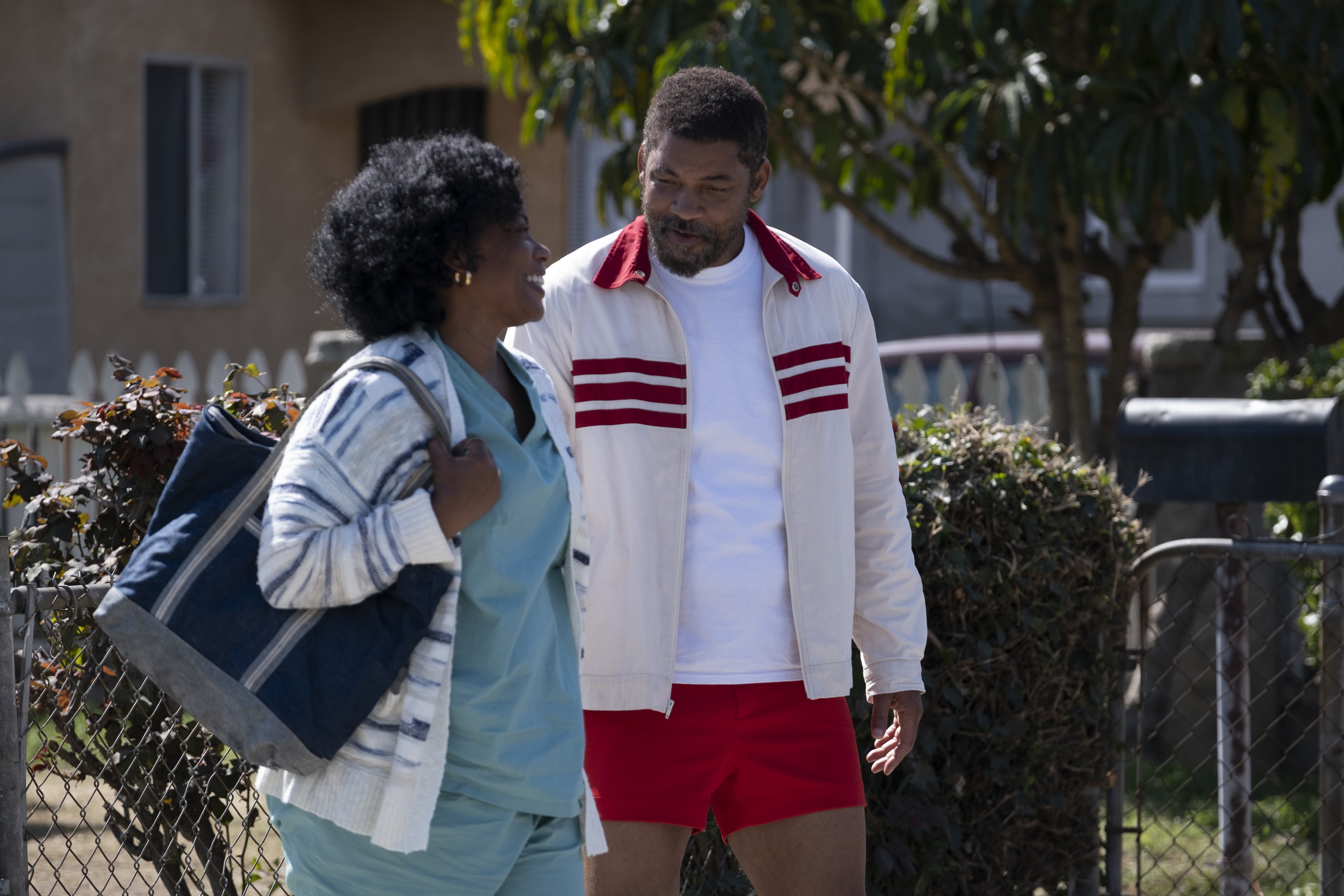
Brandy and Richard Williams (Aunjanue Ellis and Will Smith) are determined to turn their talented daughters into tennis superstars.

Perhaps a more valid criticism is that the script seldom acknowledges the important role played by their mother, Brandy, who knows a few things about tennis herself and sometimes has to bite her tongue when her husband makes unilateral decisions. The flick partially makes up for this in a late scene—one of the best—in which she finally lets go of years’ worth of frustration.

As one might expect, tennis matches are an intrinsic part of the sports film’s running time, including a climactic contest between one of the girls and an established competitor. These are well photographed and nicely handled by actors Sidney and Singleton and/or their on-court doubles.

Otherwise, the focus is on the members of the close-knit Williams family as Venus and Serena struggle to attain a goal never before reached by Black girls. A strong cast, beginning with Smith in the title role and including Jon Bernthal as enthusiastic coach Rick Macci, keeps things interesting.

At two hours and 26 minutes, the film does lag occasionally, and director Green (with help from composer Kris Bowers) does turn the emotional screws once or twice too often. Mostly, though, this is a fascinating origin story of tennis’s sibling superheroes.

Rating: 3½ stars (out of 5)

King Richard (PG-13) opens Nov. 19 at select theaters and online via HBO Max.

Documentary dissects Mayor Pete’s historic campaign

Pete Buttigieg takes a selfie that includes a crowd of supporters in a scene from Mayor Pete. (Photo courtesy of Amazon Studios)

By Richard Ades

Jesse Moss co-directed Boys State, which was probably the best 2020 documentary that wasn’t nominated for an Academy Award. Now he’s returned with Mayor Pete, another film that focuses on America’s political system. But while Boys State did so metaphorically, being set at a gathering of teenagers playing at being politicians, the new doc takes the direct approach.

Its subject is Pete Buttigieg, who, before becoming President Biden’s secretary of transportation, was the first openly gay person to run a major campaign for the presidency. Filmed in 2019 and early 2020, the documentary follows the then-mayor of South Bend, Indiana, as he takes his first plunge into the treacherous waters of the national political scene.

Though the result might not be quite as sublime as Moss’s earlier effort, it offers a behind-the-scenes look at a groundbreaking campaign that briefly seemed on the verge of upsetting a host of more-traditional candidates. The film makes it clear that Buttigieg accomplished this feat with help from advisers such as his communications director, Liz Smith, and even his husband, Chasten.

A graduate of Harvard and Oxford who speaks eight languages, as well as a former naval intelligence officer who saw active duty in Afghanistan, Buttigieg stood out from the field of candidates for reasons that went far beyond his sexual orientation. The film shows another difference: His calm and nuanced speeches were a far cry from the average politician’s promises and cliches. “I think you’re the real thing,” a middle-aged woman tells him after an early campaign appearance.

But the film also reveals that Buttigieg’s reluctance to divulge his emotions led some critics to paint him as cold and even robotic. As the first Democratic debate nears and Buttigieg prepares by taking part in practice debates, Smith can be seen pushing him to open up about his feelings. “He’s coming across as a f—ing tin man up there,” she complains, using an expletive that helps to earn the flick its “R” rating.  

Then, right before the debate, news arrives that a South Bend cop has shot and killed a Black man. Buttigieg holds a town meeting and invites residents to air their concerns, but the effort only succeeds in revealing the gulf between him and many members of the Black community. Though he’s later praised for his response to this issue when it inevitably comes up on the debate stage, his lack of minority support continues to dog him throughout the campaign.  

If there’s one element of Mayor Pete that may disappoint political junkies, it’s that it largely ignores the policy positions Buttigieg espoused and argued over with the other candidates. Instead, it focuses on the personal qualities that made him an unusual and historic candidate and will continue to set him apart if he ever decides to once again hit the campaign trail.    

Rating: 4 stars (out of 5)

Mayor Pete (rated R) will premiere Nov. 12 on Amazon Prime Video.

Aging fisherman looks for love, finds god

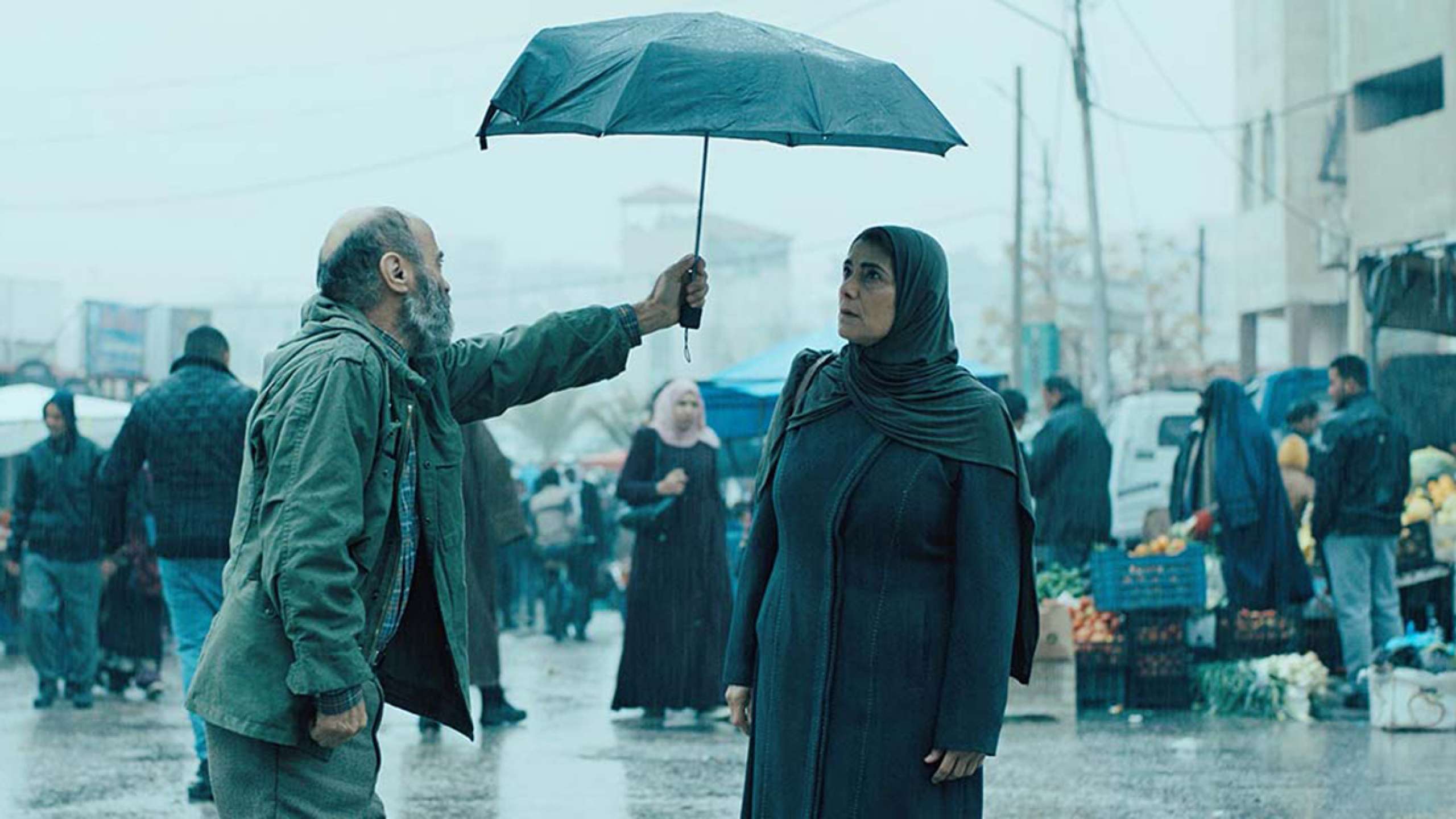
Issa (Salim Daw) offers Siham (Hiam Abbass) his umbrella in a rainy scene from Gaza Mon Amour.

By Richard Ades

A 60-year-old fisherman in the Gaza Strip decides it’s finally time to get married. Then he pulls up his net and finds a statue of the Greek god Apollo. That’s the setup for Gaza Mon Amour.

Is there some connection between the man’s marital decision and his maritime discovery? If there is, writer-director-brothers Tarzan and Arab Nasser don’t spell it out, any more than they explain why the film’s title apparently pays homage to Alain Resnais’s 1959 French New Wave classic, Hiroshima Mon Amour.

The statue and the title are just two more quirky elements in a tale that combines romance with political commentary in such a droll, understated way that even its darker moments are leavened with a sly sense of humor.

Issa (Salim Daw, aka Salim Dau) fishes by night and runs a shop selling fish and other items during the day. Though he’s never been married and apparently hasn’t even expressed interest in matrimony since he was a teenager, he surprises sister Manal (Manal Awad) one day by announcing his desire to wed.

Despite Issa’s strict order that she not get involved, Manal takes the news as her cue to begin rounding up eligible women. And when she learns he already has his eye on widowed shop clerk Siham (Hiam Abbass), Manal argues that she’s not an appropriate choice for a devout Muslim because she has a divorced daughter (Maisa Abd Elhadi). Ignoring her, Issa sticks to his quest, but his own shyness proves to be a high hurdle.

Siham (Hiam Abbass, left) waits for a bus while Issa (Salim Daw) tries to find a way to break the ice.

Meanwhile, both Issa and Siham deal with the daily stresses and challenges that are part of life in the tiny Gaza Strip. Among them are poverty, power outages and occasional Israeli airstrikes, as well as local officials who wield their authority like petty dictators.

It’s all too much for a young friend of Issa’s, who has planned an illegal and potentially dangerous escape to Europe. Issa, though, is determined to stick it out, even after his mysterious discovery from the deep lands him in trouble with the gendarmes.

The Nasser brothers depict life in Gaza with a critical and satirical eye, especially when it comes to the strip’s authority figures. A police official throws his weight around in an arbitrary and self-serving way, and at one point the military proudly displays a new rocket in a scene hilariously loaded with phallic symbolism.

As for the looming relationship at the center of the tale, it’s portrayed with such charm by Daw’s determined but awkward Issa and Abbass’s secretly amused Siham that viewers won’t mind the glacial pace at which it develops. Anyway, despite its cheeky title, the film isn’t really about romance as much as it’s about standing up to society’s limitations and finding the space to live and enjoy one’s life.

Rating: 4½ stars (out of 5)

Gaza Mon Amour opens Nov. 5 at select theaters and through VOD outlets.

Luck and learning turned diver into environmental hero

Jacques Cousteau wears his trademark red cap aboard the Calypso during the 1970s. (Photo courtesy of the Cousteau Society)

By Richard Ades

Becoming Cousteau, Liz Garbus’s biographical documentary about the late Jacques Cousteau, is aptly named.

Though Cousteau was one of the first luminaries to sound the alarm about mankind’s ongoing destruction of the environment—particularly the watery environment that covers most of our planet—he was not born with this level of enlightenment. He was not even that interested in the ocean, Garbus reveals, as he entered the French naval academy at the age of 20 only for the chance to become an aviator. But then fate sent his life in a new direction.

After being involved in a traffic accident that nearly killed him, we learn, Cousteau was forced to give up his previous plans and turn to the ocean for refuge. With a couple of companions, he began “free diving” (i.e., without auxiliary aids) as a way to recover his muscle strength. Even after Germany invaded France during World War II, his devotion to the sea kept growing, to the extent that he was soon planning to build a career around his new love.  

At first, Cousteau hoped to earn money by conducting salvage operations on sunken ships and downed planes with the aid of diving equipment that he was working to perfect. Then, in 1951, he acquired the converted mine sweeper known as the Calypso and began his new life as an ocean-going explorer.

It was during these early years at sea, Garbus tells us, that Cousteau committed acts he later came to regret after becoming more environmentally sensitive. In order to catalog local fish populations, for example, he and his crew dynamited off-shore waters without regard for the damage it would cause to fragile habitats. Perhaps worst of all, they bankrolled their exploits by helping a British drilling company locate underwater oil deposits in the Persian Gulf.

Fortunately, Cousteau eventually found a safer meal ticket in the form of his long-running TV series The Underwater World of Jacques Cousteau. The series helped to pay for Cousteau’s worldwide explorations and, at the same time, gave him a bully pulpit to express his growing concerns about the damage being done to the sea by industrialized society and its waste products.

The documentary depicts all of this with the help of the miles and miles of film Cousteau shot throughout his career. At the same time, it doesn’t neglect his family life—such as it was.

Sons Jean-Michel and Philippe often were sent away to boarding school while Cousteau and his wife, Simone, roamed the seas on the Calypso. Even so, both sons took an interest in their father’s work, particularly the adventure-craving Philippe. As a result, Cousteau assumed he would one day be able to allow the younger generation to take it over, and he was devastated when tragedy disrupted his plans.

Producer-director Garbus has won awards and nominations in both documentary and scripted categories. With this National Geographic Documentary Films production, she succeeds in turning a 20th century icon into a human being who took a long, watery path to becoming an environmental prophet. It’s a compelling journey.

Rating: 4 stars (out of 5)

Becoming Cousteau (PG-13) can be seen at select theaters, including Central Ohio’s Marcus Crosswoods Cinema 17 and AMC Dine-In Easton Town Center 30.

Tale unfolds on Bergman’s old stomping grounds

Filmmaking couple Chris and Tony (Vicky Krieps and Tim Roth) take a working vacation in Bergman Island.

By Richard Ades

Bergman Island should appeal to devotees of the great Swedish director Ingmar Bergman—at least on the surface.  

Written and directed by Mia Hansen-Love, the flick sends filmmaking couple Chris and Tony (Vicky Krieps and Tim Roth) to Faro, the island that often served as the auteur’s home and movie set. There they go to work on their separate writing projects while sleeping in a bed that reportedly was used in Scenes From a Marriage, Bergman’s painful account of a marriage’s disintegration.

The obvious implication is that we’re about to see a similar disintegration take place between Chris and Tony, whose relationship may not be that solid to begin with. Tony, who appears to be decades older, is so engrossed in his work that he sometimes seems distant and even ignores Chris’s romantic overtures. His career also is more established than hers, possibly creating the kind of power imbalance that played a destructive role in Scenes. This becomes obvious when a local screening of one of Tony’s films draws gushing fans while Chris disappears into the background.  

It’s no surprise, then, that when a young man offers to give Chris a private tour of the island, she takes it, in the process skipping a group excursion she was supposed to take with Tony. Is this the beginning of the unraveling of their relationship?

But then director Hansen-Love takes things in a new and unexpected direction. After Chris begins telling Tony about a screenplay she’s struggling to finish, her script comes to life as we’re introduced to Amy (Mia Wasikowska), its lonely protagonist. We watch as Amy arrives at a Swedish island to attend a friend’s wedding and runs into Joe (Anders Danielsen Lie), an old love for whom she still carries a torch.

Will Amy and Joe reconnect despite the fact that each is now involved with someone else? The question is explored at length as the movie-within-a-movie goes on and on, to the extent that it nearly eclipses the original story of Chris and Tony. On the one hand, that’s OK, because Amy and Joe’s story is a pleasant diversion. On the other hand, it’s odd that the film’s core relationship is left so undeveloped.

After hearing about the complications Hansen-Love faced in making the movie, it’s hard not to wonder whether they contributed to this lapse. Owen Wilson was supposed to play Tony but bowed out weeks before filming started, forcing the director to begin shooting without a Tony in 2018. It wasn’t until 2019, after Roth had been cast in the part, that she was able to return to the island and fill in the gaps.

A few late twists do offer some insight into Chris’s relationship with Tony while raising questions about her connections with the supposedly fictitious Amy and Joe. These add intriguing ambiguities to the film, though they don’t quite make up for its failure to delve into interpersonal issues as richly as Bergman did in Scenes From a Marriage and other classics.

That’s a high standard, admittedly, but when you make a film called Bergman Island, it’s hard to avoid the comparison.

Rating: 3 stars (out of 5)

Bergman Island (rated R) opens in select theaters Oct. 15 and will be available from VOD outlets beginning Oct. 22.

Whatever happened to that adorable tiger cub?

Tim Harrison, a former Ohio police officer, has made it his mission to end the exploitation of exotic big cats.

By Richard Ades

One of my hometown’s most beloved celebrities—former Columbus Zoo director “Jungle Jack” Hanna—fares poorly in the documentary The Conservation Game. His reputation takes such a hit that one is tempted to feel sorry for him—except for the fact that many animals that supported his rise to fame allegedly fared much worse.

Produced and directed by Michael Webber, the muckraking film follows animal activist Tim Harrison around the country as he tries to track down the tigers and other big cats that often appeared on television in their younger years. Hanna and similar wildlife experts became familiar sights on talk shows by bringing out a variety of these adorable cubs, many of which represented endangered species.

Where were these animals from? When asked, the experts might hint that they were from an accredited zoo or refuge. But the truth, Harrison finds, is far murkier. By asking questions and following leads, he learns that many of them hailed from privately owned facilities, such as the squalid farm he discovers in rural Pennsylvania.

And what happened to the animals after their five minutes of TV fame? That’s the real tragedy. All too many have disappeared from view and are presumed dead, while Harrison finds others are forced to work for their living by appearing at functions such birthday parties or, in one case, being dragged onto a football field as a prominent high school team’s mascot.

None are treated in a way that’s appropriate for wild animals, especially animals whose species are in danger of dying out.

Attorney Carney Anne Nasser is an advocate for protecting exotic wildlife.

Several allies help Harrison in his crusade to end such abuse. They include Carney Anne Nasser, an attorney who played a role in a wildlife-trafficking case against now-imprisoned TV reality star Joe Exotic. Nasser and others are involved in an attempt to pass a federal law, known as the Big Cat Public Safety Act, that’s designed to curtail the exploitation of exotic animals.

But it’s Harrison who generally takes center stage in the film. A towering ex-cop who’s trained in the martial arts, he makes a formidable figure as he fearlessly walks up to strangers’ homes or businesses and asks what happened to this or that big cat. In an inevitable climactic scene, he does just that to Jack Hanna, a boyhood hero who has not lived up to his reputation as a champion of endangered wildlife.

In a postscript added following the documentary’s premiere last April, it’s noted that Hanna has retired from public life following what his family describes as a diagnosis of dementia. It’s also noted that his former employer, the Columbus Zoo, subsequently announced it will support passage of the Big Cat Public Safety Act.

Rating: 4½ stars

The Conservation Game (PG-13) can be seen at select theaters, including Columbus’s Gateway Film Center (through Sept. 22) and Marcus Cinema Crossroads (Sept. 20 and 22).

Virtual lessons lead to long-distance caring

Poster for Language Lessons

By Richard Ades

When a Costa Rican woman unexpectedly appears on Adam’s computer screen one morning, she’s there to give the Oakland resident a Spanish lesson. Before long, however, she’s called on to throw him a lifeline.

That’s the setup for Language Lessons, a warm-hearted film directed by Natalie Morales from a story she co-wrote and stars in with Mark Duplass.

As it turns out, Adam’s wealthy husband has hired Carino (Morales) to help Adam (Duplass) brush up on the Spanish he learned as a child. The two agree to meet each Monday morning via Zoom, but tragedy disrupts their plans. Logging in for the second lesson, Carino finds Adam lying in bed and barely able to communicate. It’s only after a minute or two of dazed confusion that he reveals his husband was killed in an overnight traffic accident.

Since Adam is obviously suffering from shock and a lack of sleep, Carino does what she can to calm him down. Then, because he seems to be alone with his grief, she leaves several messages over the next few days in an attempt to be supportive. Thus begins a long-distance relationship—perhaps even a friendship—that is put to the test when Carino becomes the one in need of support.

Mark Duplass as the grieving Adam in Language Lessons

Up until that point, Language Lessons sometimes verges on treacly, especially when Gaby Moreno’s soundtrack needlessly underscores the characters’ emotions. But when Carino undergoes a concerning change and Adam attempts to find out what’s wrong and offer assistance, things get more interesting. Sexual, economic and ethnic differences all play a role in complicating the situation.

Photographed entirely as a series of computer screen images, the film easily tells its story without violating any COVID protocols. Perhaps writers Morales and Duplass could have done a better job of fleshing out the characters, but as actors they make up for it with soulful performances. Morales is especially interesting as the enigmatic Carino, while Duplass plays Adam as someone who wears his heart permanently attached to his sleeve.

Like Together Together, which came out in the spring, Language Lessons shows that platonic love between a man and a woman can be just as challenging as the romantic kind. And, as a cinematic subject, just as interesting.

Rating: 3½ stars (out of 5)

Language Lessons opens Sept. 10 at select theaters nationwide, including Central Ohio’s Gateway Film Center.

Eclectic shorts share quarantine protocols

A young Chinese man (Zhang Yu, right) and his son (Zhang Yanbo) struggle to cope with quarantine restrictions in “The Break Away,” part of the anthology The Year of the Everlasting Storm. (Photo courtesy of Neon)

By Richard Ades

The Year of the Everlasting Storm is a collection of seven shorts that are united not so much by theme as by process. Since the titular year is 2020, the seven directors (from five different countries) were instructed to create works without violating COVID-19 quarantine restrictions. The apparent purpose was to show it was still possible to make films during a pandemic.

The result: a group of flicks that are mostly made in cramped quarters, though a couple also branch out into the virtual world. Other than that, they have little in common, which means each one stands alone rather than contributing to a cohesive whole.

Well, with one caveat: A few of the films focus on what life was like during the early days of the pandemic, which allows us to compare them to each other and to our own real-life experiences.

Leading off the collection is a work by Jafar Panahi, the Iranian director who actually inspired the entire project by making previous films under similar restrictions—though they were imposed by his country’s censorship rather than a pandemic. “Life” features the filmmaker and members of his family, including his beloved pet iguana, Iggy. Little happens except that his mother violates a stay-at-home mandate in order to pay a visit, though only after armoring herself with a hazmat suit and a spray bottle of disinfectant. The gently comic vignette is a reminder of the fears and deprivations much of the world experienced while first coming to terms with a once-in-a-century plague.

Even more deprivations are suffered by the young Chinese couple featured in the second film, “The Break Away,” directed by Singapore-born Anthony Chen. Stuck in their apartment and worried about money because the pandemic has sapped much of their income, the frazzled wife (Zhou Dongyu) gradually loses patience with her laid-back husband (Zhang Yu). Meanwhile, their young son is irritable because he can’t understand why he isn’t allowed to go outside. Like “Life,” the mini-drama contains reminders of the early misconceptions we all had about COVID-19 and how it’s spread.

The COVID theme shows up only briefly in the next short, Malik Vitthal’s “Little Measures,” which is the first of the collection’s three U.S. offerings. It focuses on Bobby Yay Yay Jones, whose attempt to regain custody of his three children has been delayed by the pandemic. Meanwhile, he keeps in touch with them electronically, their conversations being shown via small Facetime-style images. The piece is punctuated by Jonathan Djob Nkondo’s animation, which comes off as a superfluous addition.

COVID disappears almost entirely in “Terror Contagion,” directed by American filmmaker/journalist Laura Poitras (Citizenfour). Consisting largely of computer images taken from virtual meetings, it follows Poitras as she joins the group Forensic Architecture’s investigation into the Israeli spyware manufacturer NSO. Accompanied by Brian Eno’s creepy music, it evokes a feeling of paranoia as it talks of global surveillance and its potential dangers to individual freedoms. Both an impressive addition and a distraction from the rest of the collection since it’s such a change in tone, “Terror Contagion” probably would benefit from being expanded into a stand-alone documentary.  

Next, the anthology returns to COVID concerns with Dominga Sotomayor’s “Sin Titulo,” which is about a Chilean woman (Francisca Castillo) who’s affected by the pandemic in two ways: Her vocal ensemble isn’t allowed to sing together in person, forcing her to record her part over the phone so that it can be joined with the others electronically. And, more painfully, she’s unable to see her newborn grandchild except at a distance. A difficult relationship with a rebellious daughter adds a bit more tension to this modest but beautifully filmed flick.

“Dig Up My Darling,” the show’s penultimate and spookiest piece, also deals with a pandemic—though it’s not clear just which one. David Lowery (Pete’s Dragon) directs a silent Catherine Machovsky in the tale of a woman who hits the highway to take care of some long-unfinished business. It’s a mystery that’s more interested in creating an eerie atmosphere than in answering questions, several of which are deliberately left hanging at the end.

In fact, viewers may still be trying to answer those questions when new ones pop up during the final short, “Night Colonies.” Directed by Thailand’s Apichatpong Weerasethakul, it focuses on three things: a mattress, fluorescent lights and lots and lots of bugs that are buzzing around said lights. Viewers might wonder whether all this is an oblique reference to the pandemic or its aftermath, especially when faded photos of people make a brief appearance. Generally, though, the film just comes off as an exercise in carefully composed sights and sounds, which will leave some mesmerized while others may wish Iggy the iguana would reappear and treat himself to a few flying treats.  

It’s a polarizing finale to a collection of inventive films that would work better as a whole if they were connected by more than just as set of production rules.

Rating: 3½ stars (out of 5)

The Year of the Everlasting Storm opens Sept. 3 at select theaters.

Ex-adoptive mom refuses to take ‘no’ for an answer

Ema (Mariana Di Girolamo, center) and her dancer friends in Ema (Photos courtesy of Music Box Films)
 

By Richard Ades

“Whatever Lola wants…Lola gets.” Substitute the title character’s name for “Lola,” and that could be the theme song for Ema, the dance-fueled tale of a Chilean woman who has a knack for getting her way.

Well, not always. When the film begins, Ema (Mariana Di Girolamo) and choreographer-husband Gaston (Mozart in the Jungle’s Gael Garcia Bernal) have lost their adopted son following a shocking incident. Young Polo (Cristian Suarez) had developed the bad habit of starting fires and had launched an attack on Ema’s sister that left her partially disfigured.

Now that Polo has been given up and adopted by a new set of parents, Gaston blames Ema for their loss by saying she encouraged the boy’s destructive habits. But Ema fights back with charges and insults of her own, such as calling her husband a “human condom” due to his biological inability to father a child of his own.

The resulting marital squabbles spill over into Gaston’s reggaeton dance troupe, threatening Ema’s position as a leading performer. Meanwhile, Ema loses her job teaching dance at Polo’s former school. The upshot is that she’s left with nothing—nothing, that is, except fierce determination and her uncanny ability to bend others to her will with the help of flirtation and, frankly, sex.

In other words, watch out.

The loss of their adopted child drives a wedge between Ema (Mariana Di Girolamo) and husband Gaston (Gael Garcia Bernal).

Ema is directed and co-written by Pablo Larrain, who helmed 2016’s Jackie, a psychological study of Jacqueline Kennedy that I found cold and uninvolving. Whatever else you can say about Ema, it’s anything but cold. Indeed, its most indelible image, which appears in the first scene and reappears at key moments, is of the title dancer wielding a flame thrower that sends spectacular bursts of fire and destruction far into the distance.

As for uninvolving, maybe it is, at first. The frequent dance segments, as well as our uncertainty over whom we should be rooting for in the Ema-Gaston battle, make it hard to buy into the tale. But once Ema has nothing left to lose, Di Girolamo’s measured but smoldering portrayal makes it impossible to sit this one out.

You still may not know whether you should be rooting for Ema, but don’t worry. You’ll have plenty of time for that discussion after Larrain presents us with his provocative final image.

Rating: 4 stars (out of 5)

Ema (rated R for language and sexual content) opens Aug. 20 at select theaters, including Columbus’s Gateway Film Center, and will be available through VOD outlets beginning Sept. 14.