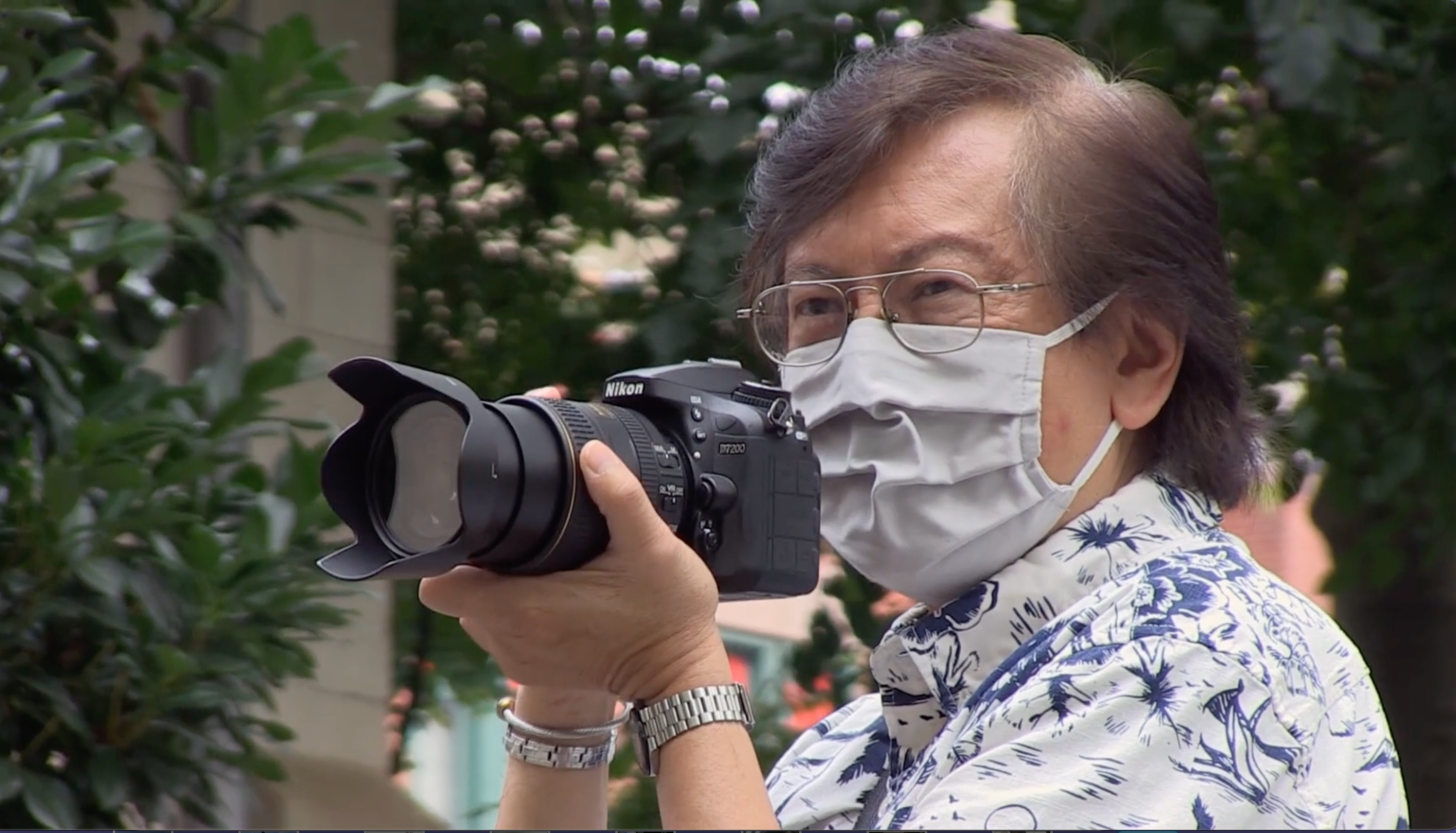
He photographed folks the mainstream media ignored

Wearing a mask during the COVID pandemic, Corky Lee gets ready to take his next photo. (Photos courtesy of All Is Well Pictures)

By Richard Ades

As a child, Corky Lee enjoyed comic books about superheroes, which he later credited with giving him a “moral compass.” As a Chinese American, however, he never saw any superheroes who looked like him.

Despite this fact (or maybe because of it), Lee grew up to be a kind of superhero himself—one whose “superpower” was simply taking the kind of pictures no one else was taking. Walking around New York City with a camera bag over his shoulder, he spent five decades chronicling the lives of Asian Americans and Pacific Islanders, people whose struggles and celebrations were often ignored by the mainstream media.

Lee and his lifelong crusade of inclusion are the subject of Photographic Justice: The Corky Lee Story, a documentary being shown on PBS in observance of Asian American and Pacific Islander Month.

Directed by Jennifer Takaki and featuring a combination of contemporary interviews and vintage footage, the film is a low-key but loving portrait of the man who became a fixture in New York’s Asian community. Whenever members of its many varied cultures and nationalities threw a parade, held a party or joined a picket line, Lee could be counted on to be there.

Love of country and love of New York are obvious in this photo Corky Lee took of a 2006 parade celebrating Budha’s birthday.

After decades of such coverage, the documentary tells us, Lee amassed so much knowledge about local AAPI-related events that kids jokingly referred to him as “Corkypedia.”

Besides showing up for Asian holidays such as the lunar new year and Budha’s birthday, Lee also covered national holidays, when he concentrated on providing an Asian American viewpoint. On Veterans Day, for example, he focused his lens on AAPI vets to show that Asians are as much a part of U.S. society as their European American counterparts.

According to the documentary, Lee felt this lesson became especially important when the country was hit with the 9/11 attacks in 2001 and with COVID in 2020. Muslim Americans and Chinese Americans, respectively, were scapegoated for these national and international tragedies, and he did what he could to counteract the resulting prejudice.

Sadly, the latter effort turned out to be his last. After viewing Takaki’s documentary, you’ll realize just how much of a loss that was.

Rating: 4 stars (out of 5)

Photographic Justice: The Corky Lee Story can be seen in select theaters and will air on PBS stations beginning May 13. Its Central Ohio airtime is 4 p.m. Sunday, May 19 on WOSU.

‘Marvelous’ series’ finale lives up to its name

Rachel Brosnahan as the titular aspiring comedian in The Marvelous Mrs. Maisel

By Richard Ades

The Marvelous Mrs. Maisel is coming to an end, and it’s doing it as stylishly as ever.

The tale of a divorced Jewish housewife who seeks success as a standup comedian will be wrapped up over the course of nine episodes during the series’ fifth and final season.

Will Miriam “Midge” Maisel (Rachel Brosnahan) achieve her goal by breaking through the comedic glass ceiling of mid-20th century America? It’s not giving too much away to say she will, as that’s revealed in an early-season flash-forward. What’s not revealed right away is just how she’ll hit the big time, and how her success will affect her family and friends.

It comes out in the second episode that at some point she’ll part ways with the mannishly attired Susie Myerson (Alex Borstein), who became the fledgling comedian’s first cheerleader and, soon after, her devoted manager. How do they break up, and will they ever reconcile? Viewers will have to wait and see.

Her relationship with ex-husband Joel (Michael Zegen), whose infidelity ended their marriage in the first season, also continues to evolve. And it does so in surprising ways, as seen in another flash-forward or two.

In fact, series creator and writer Amy Sherman-Palladino does a good deal of time-traveling from the show’s principal era of the late 1950s and early ’60s. Thus, we get to peek into the futures of several characters, including Midge’s parents (Marin Hinkle and Tony Shalhoub). We even get to see grownup versions of her children, Esther and Ethan, though they played relatively minor roles during most of the series.

Through it all, Maisel continues to impress with its amazing production values, one episode opening with a dance number worthy of Broadway. The show is also frequently funny, with, as usual, much of the humor coming from its supporting characters rather than its titular comedian. And by “supporting characters,” I primarily mean Borstein’s always-hilarious Susie, followed by Shalhoub’s rendition of Midge’s curmudgeonly and neurotic dad.

(For those who want to see if Borstein is as funny in her own skin as she is in Susie’s, a new Prime comedy special allows her to tell jokes, sing and even make a few political and philosophical points. Viewers may conclude that she isn’t quite as funny in her own skin, but they’re likely to be impressed by her versatility. As indelible a character as Susie is, she’s clearly not Borstein.)

All in all, season five is one of the series’ best, maybe even as good as season one. Fans of the show’s scrappy heroine should go away happy.

Rating: 4 stars (out of 5)

Episodes 1-3 of the final season of The Marvelous Mrs. Maisel can be seen on Amazon Prime Video beginning April 14. One subsequent episode will be released each Friday through May 26. Alex Borstein: Corsets & Clown Suits will air on Prime Video beginning April 18.