A look back at ‘2013: The Musical’

Japheal Bondurant as competitor William Barfee in CATCO's production of The 25th Annual Putnam County Spelling Bee (Red Generation Photography)
Japheal Bondurant as competitor William Barfee in CATCO’s production of The 25th Annual Putnam County Spelling Bee (Red Generation Photography)

By Richard Ades

2013 may be remembered as The Year of the Musical in Central Ohio. Or, more likely, as The First Year of the Musical.

In the more than two decades I’ve been reviewing local theater, musicals have always represented a small percentage of the shows I saw each year. But that’s likely to change.

A prime reason is that CATCO dropped its long aversion to the genre when Steven Anderson took over as producing director in 2010. Another reason is the ascendance of Short North Stage, a 2-year-old troupe that specializes in Sondheim’s art form.

Add to that the musicals staged by Otterbein University Theatre and the growing number staged by Shadowbox Live, including its recent collaborations with Opera Columbus. Then figure in the musicals bravely tackled by troupes that normally stick to standard fare.

The end result is a year that was teeming with musicals. And not just musicals: great musicals.

There were so many worthwhile musicals, in fact, that I’ve been forced to abandon the format I always followed at The Other Paper, which divided the nominees into categories such as Best Drama or Best Comedy. Limiting myself to one Best Musical would have forced me to ignore many of the year’s best shows. Instead, I’ve settled for naming the year’s Top 10 shows.

A couple of caveats: First, no one has time to see everything, so I’m sure I missed some award-worthy gems. And second, this is a subjective list based not only on what was done well but on what I found particularly interesting and memorable.

With that said, congratulations to the winners, and thanks to everyone who made this an exceptional year for theater in Central Ohio.

Top 10 Shows of 2013:

The 25th Annual Putnam County Spelling Bee, CATCO. Though the Top 10 list is mostly arranged haphazardly, this was my favorite show of the year. Director Steven Anderson found both the heart and the laughs in this familiar musical, with help from a consistently wonderful cast led by Japheal Bondurant, Elisabeth Zimmerman and Ralph E. Scott.

Sunday in the Park With George, Short North Stage. The Garden Theater-based troupe sometimes imports its directors from New York, and it paid off handsomely here. Sarna Lapine (niece of James Lapine, who wrote the book and directed the Broadway premiere) gave us a Sondheim revival that was both pitch-perfect and picture-perfect. As a bonus, sound designer Leon Rothenberg found a way to tame the theater’s echo-y acoustics, which bodes well for future productions.

Passing Strange, Short North Stage. Green Day fans undoubtedly enjoyed the punk-rock anger of American Idiot, which came through town in March. But those of a thoughtful bent were more likely to enjoy this satirical take on youthful angst, which was beautifully realized by director Mark Clayton Southers and his committed cast.

Duck Variations, A Portable Theatre. The best news was that the fledgling troupe is the new home of Geoffrey Nelson, former artistic director of CATCO. The second-best news was that its premiere show paired Nelson with fellow CATCO alum Jonathan Putnam. These two sly and seasoned pros made the David Mamet comedy one of the year’s funniest shows.

Assassins, Red Herring Productions. Michael Herring’s solo springtime performance of Krapp’s Last Tape launched the rebirth of his long-dormant troupe. But nothing could have prepared us for Red Herring’s next show, a polished production of Sondheim’s most controversial musical. John Dranschak directed an A-list cast led by Ian Short and Nick Lingnofski.

Mercy Killers, On the Verge Productions. 2013’s crop of touring musicals supplied a fair amount of flashy entertainment, but none of them were as impressive or thought-provoking as this one-man touring show. Writer/actor Michael Milligan told a tragic tale that movingly dramatized the shortcomings of the U.S. health-care system.

The Whipping Man, Gallery Players/New Players Theater. If you thought there was no way to come up with a new take on the Civil War, this show proved you wrong. Matthew Lopez’s postwar drama reunited two former slaves with the wounded son of their Jewish master. The fascinating, if imperfect, tale was exquisitely directed by Tim Browning.

The Air Loom, MadLab. Local actor Jim Azelvandre has tried his hand at writing in the past, but this surreal tale is his best work to date. Azelvandre also supplied the canny direction, which ensured that the ingenious storyline and eccentric characters remained entertaining throughout.

Henry IV, Part One, New Players Theater. Besides staging The Taming of the Shrew on its outdoor stage, New Players was brave enough to tackle one of Shakespeare’s seldom-seen historical dramas. Bard-literate director Robert Behrens made 15th-century Britain come to life with the help of a lively cast led by David Tull as the hard-partying Prince Hal and John Tener as the irrepressible Falstaff.

Burlesque Behind the Curtain, Shadowbox Live. Shadowbox’s production of Spamalot was a blast, too, but Behind the Curtain deserves credit for improving on last year’s Burlesque de Voyage. Writer Jimmy Mak, director Stev Guyer and the talented players created a show that was sometimes very sexy and other times very, very funny.

New York-bound ‘Flashdance’ faces an uphill battle

Steelworker/dancer Alex Owens (Jillian Mueller) re-creates an iconic moment from the original movie in Flashdance: The Musical (photo by Jeremy Daniel)

By Richard Ades

“She’s a maniac, maniac on the floor/And she’s dancing like she never danced before…”

Read those lyrics the wrong way, and the fantasy at the heart of Flashdance becomes apparent. Steelworker-by-day/dancer-by-night Alex longs to be accepted into a prestigious ballet academy, but she has no formal training. So how can she hope to win out against dancers who’ve been hitting the barre since they were kids?

The 1983 movie distracted attention from that glaring question by overwhelming us with montages of toned bodies dancing to a rocking soundtrack. It also captured the tenor of the times by setting Alex’s quest against the backdrop of a dying industry: We could relate to her struggle to redefine herself because so many of us were trying to find a way to survive in a changing economy.

Then, of course, there was cinematic newcomer Jennifer Beals and her portrayal of Alex as a tough Pittsburgh girl who could switch from wistful dreamer to sexual predator at the drop of a leg warmer.

So the movie became a hit, and Alex and her wardrobe became cultural icons. Can the new Tom Hedley/Robert Cary/Robbie Roth stage version repeat the magic?

After seeing the touring show Tuesday night at the Palace, I suspect it has a long way to go.

Director/choreographer Trujillo and his cast reimagine some of the movie’s best moments and add some of their own. Overall, though, it fails to make us care about Alex’s journey.

Part of the problem is the role of Alex, which must be almost impossible to cast. Besides acting and singing, the leading lady must be able to dance well enough to convince us she has a shot at a career in ballet. In the touring production, it’s apparent that Jillian Mueller was cast primarily for her dancing skills. Her moves are fine, but her singing voice lacks power and she has little stage presence.

It’s admirable that the producers didn’t follow the movie’s tack and have Alex’s dance moves performed by a body double (though it appears they do just that in one scene, for no apparent reason). But because they failed to find the rare individual who can act, sing and dance like a maniac, Alex mostly disappears into Klara Zieglerova’s serviceable but generic scenery. As a result, few sparks are generated by the central romance between Alex and her smitten boss, Nick, even though Corey Mach gives the latter a likable personality and sonorous voice.

Filling some of that void, Ginna Claire Mason and David R. Gordon do make us care about the rocky relationship between Alex’s dancer friend Gloria and would-be comedian Jimmy. We particularly care about Gloria, whose naïve search for fame makes her susceptible to the advances of C.C. (Christian Whelan), proprietor of the disreputable dance club down the street. Her crestfallen rendition of Gloria is one of the more effective holdovers from the movie.

Back at the raunchy but relatively wholesome club run by the fatherly Harry (Matthew Henerson), Alex spends her nights sharing the stage with Tess and Kiki, seasoned hoofers well played by Alison Ewing and DeQuina Moore. Moore is especially fiery in the energetically choreographed Manhunt, another movie holdover.

Not all of the show’s songs are inherited from the movie, by the way. Of the new tunes, some are pretty, and some are even catchy, but none matches the toe-tapping power of the originals.

Will Flashdance make it to New York? If it does, it will accomplish a major miracle, as it’s not easy to construct a conventional stage musical out of a movie that was basically an extended music video. The show reportedly has been tweaked quite a bit to get this far, and it likely will need a lot more tweaking to get to Broadway.

Broadway in Columbus and CAPA will present Flashdance: The Musical through Dec. 22 at the Palace Theatre, 34 W. Broad St. Show times are 7:30 p.m. Tuesday-Thursday, 8 p.m. Friday, 2 and 8 p.m. Saturday, and 1 and 6:30 p.m. Sunday. Tickets are $28-$78. 614-469-0939, 1-800-745-3000 or ticketmaster.com.

Mark, we hardly knew ye

By Richard Ades

Available Light has always pushed boundaries. Shows that incorporate multimedia, song, dance, movement and improvisation are all par for the course.

All that’s well and good. What’s not so well and good is the troupe’s occasional tendency to confuse plays with lectures, sermons or, worst of all, consciousness-raising sessions. That’s the wrong turn Available Light takes with its latest self-written work, Glue.

It starts out with the appearance of four people who introduce themselves as longtime friends of Mark, a man who recently died. They inform us that they put this show together in response to their loss.

“It’s about friendship,” we’re told.

In an attempt to bond with the audience, they then have specific viewers read statements about friendship that apparently were passed out in advance. Each of these—including the comment that our best friends sometimes have four legs—is met with uniform smiles of support from the people onstage.

“Maybe by the end of the show, we’ll all be best buddies,” one declares brightly.

If all of this smiling supportiveness is meant to be taken with a cynical grain of salt, it’s not apparent in the production director Matt Slaybaugh has put together with actors Acacia Leigh Duncan, Jordan Fehr, Elena M. Perantoni and Michelle G. Schroeder. Instead, all four characters seem to be unvaryingly nice.

They’re too nice, in fact, to tell us anything less than positive about their lost friend. As a result, we never really get to know Mark, any more than we would get to know a real-life stranger whom we “met” only through to his eulogy.

We learn that Anna (Duncan) and Rebecca (Perantoni) dated Mark at various times; that Brian (Fehr) created comic books with him; and that Julie (Schroeder) was once his roommate. Schroeder’s description of Julie’s close but oddly chaste friendship with Mark does strike an emotional chord, but otherwise he remains only a slightly clingy but wonderfully empathetic person.

The problem is not only that Anna, Rebecca, Brian and Julie are too nice to say anything negative about Mark—sometimes they’re too busy sharing general aphorisms about friendship to talk about him at all: “To connect, you’ve got to make yourself vulnerable.” “Love is an act of will.” And so on.

A little of this goes a long way.

Watching Glue is sort of like scrolling through Facebook for 90 minutes, except that this is a version of Facebook without the jokes, topical comments or political harangues. Instead, you get only the friends who ply you with sentimental advice while other friends tell them how wonderful they are for sharing it.

Another difference: You can’t log off.

As in its most-creative shows, Available Light concocts Glue out of a variety of ingredients, including projected images, recorded voices, music and movement. If you’re into adventurous theater and performance art, this is a plus.

But unless you also have a high tolerance for being lectured to, Glue’s 90 minutes will go by very, very slowly.

Available Light Theatre will present Glue through Nov. 23 at MadLab Theatre & Gallery, 227 N. Third St. Show times are 8 p.m. Thursday-Saturday. Running time: 90 minutes. Tickets are $20 in advance, “pay what you want” at the door. 614-558-7408 or avltheatre.com.

I want a table, and I want it now

Jeff Horst plays 40 different characters in CATCO’s one-man show Fully Committed (Red Generation Photography)

By Richard Ades

And I thought I had it bad.

During the two years I waited tables, my worst experience came when our cook fell off the wagon and showed up drunk. When the lunchtime crowd arrived, I had to keep dropping off orders in the kitchen even though I knew it was like dropping them down a well. I then had to make excuses to our customers about why their burgers and Reubens never seemed to materialize.

But all that was a walk in the park compared what Sam goes through in Fully Committed. Working the reservation desk at an exclusive New York restaurant, the would-be actor regularly has to put up with an egotistical chef, an uncooperative maître d’ and self-important customers who make impossible demands.

Written by Becky Mode, the one-man play follows Sam on a particularly difficult day. A co-worker has failed to show up, leaving Sam to deal with all the crazies on his own. Adding to the pressure, his father keeps calling and asking if he’s coming home for Christmas. Plus, another actor makes frequent calls whose apparent purpose is to rub his own success in Sam’s face.

One of my quibbles with a show like this—in which one person plays a plethora of roles—is that many of the characters invariably come off as stereotypes. It’s hard not to fall back on ethnic clichés in such a situation, especially if your aim is to provoke laughs.

In CATCO’s production, however, actor Jeff Horst and director Steven Anderson avoid taking that easy route. Sure, the chef is a haughty Brit and the maître d’ is a snooty Frenchman, but the 40 or so characters seldom fit into overused pigeonholes. They may not be as grittily believable as Michael S. Brewer’s messy set, but they’re far from one-note creations.

“Fully committed,” by the way, means a restaurant is completed booked, but it also describes an actor who invests himself totally in his characters. That’s something Horst does many times over.

Particularly memorable are the AWOL co-worker, who exudes an oily Jack Nicholson-like aura; the gangster who caresses himself while speaking in a voice filled with menace and power; and Sam’s folksy father, who is too self-effacing to admit how desperately he wants his son to come home for the holidays.

And then there’s Sam himself, who seems to have inherited his dad’s decency. Or maybe he’s decided that being calm and diplomatic is the only way to survive in a job that regularly requires him to walk through a minefield filled with explosive egos.

Whatever his motivation, he manages to keep himself together through most of his hectic day, but he eventually starts to lose his equilibrium. And that’s when things start to get interesting.

Until then, truthfully, this supposed comedy is more annoying than funny, with characters who are as unpleasant as the constantly ringing phones. For much of its running time, the show’s main draw is the opportunity to see Horst earn his keep in what reportedly is his first role as a member of Actors’ Equity.

But that should be enough for many viewers. After all, Horst’s performance, even more than his union card, proves that he’s a full-fledged professional.

CATCO will present Fully Committed through Nov. 24 in Studio Two, Riffe Center, 77 S. High St. Show times are 11 a.m. Wednesday, 8 p.m. Thursday-Saturday and 2 p.m. Sunday. Running time: 1 hour, 40 minutes. Tickets are $45, $11.50 for Wednesday matinees. 614-469-0939 or catco.org.

Gangsters hold forth in second operatic update

One of the dancers from Danny’s nightclub in The Merry Widow (photo courtesy of CAPA)

By Richard Ades

Shadowbox Live and Opera Columbus had so much success with last year’s update of La Boheme that they decided to do it again. This time, the collaborators’ target is the 1905 operetta The Merry Widow.

As before, the lyrics have been translated to English while the action has been truncated and relocated to Columbus. Donathin Frye adapted the Franz Lehar/Victor Leon/Leo Stein work and directed the production, which again unfolds amid the tables of Shadowbox’s Backstage Bistro.

The verdict: It’s a pleasant way to spend a Saturday or Sunday afternoon, especially if you combine it with one of the bistro’s tasty appetizers. Though not as involving or moving as La Boheme (not surprisingly, given the original’s comic nature), it features strong voices singing pretty solos and duets. Like the updated La Boheme, it amounts to a good introduction to opera for the uninitiated.

Whether opera buffs like it probably depends on their tolerance for deviations from the source material. And Frye does do a lot of deviating.

In place of the original work’s European nobles, Frye fills his tale with Columbus mobsters who are terrified of upsetting their Chicago-based boss, Don Mondo. The problem is that Hanna (Kristen Kurivial) has inherited $20 million from her late husband, and the unseen Mondo wants to ensure that she remarries someone who will keep the money in the family.

Mondo’s preferred husband-to-be is his nephew, Danny (Daniel Scofield), owner of a nightclub of slightly ill repute. Unfortunately, Danny and Hanna have a troubled history that has left them with a love-hate relationship.

Now, you, I and the bedpost know Danny and Hanna will eventually transcend the “hate” part, but in the meantime local crime boss Don Zeta (David Weaver) is worried Hanna will end up with someone who’s not only unrelated but a cop to boot: Detective Cameron (Robert Bux). Little does he know that Cameron is actually in love with Zeta’s own semi-faithful wife, Valerie (Katherine Petersen).

Frye plays up the adaptation’s mobster element with stereotypical jokes and characters that would become tiresome if the tale weren’t so breezy and good-natured. Besides, the point of all this is to hear good music, and on that score, the show delivers.

Performing under Jason Hiester’s musical direction and to pianist James R. Jenkins’s sprightly accompaniment, the cast raises voices that range from good to great. Scofield’s baritone is especially aria-worthy, but other leading players hold their own.

Petersen displays fine pipes as the teasing Valerie, and her duets with her panting admirer, Bux’s Cameron, are both tuneful and sexy. Kurivial’s solos as Hanna benefit from her own sweet voice, though it’s a little odd that she suddenly develops an Appalachian-like accent when she’s not singing.

As for Frye’s lyrics, they’re fun, if occasionally silly. “You may think that it’s a joke,” Valerie sings to the seductive Cameron, “but it will end with guns and smoke.” And that sounds like Shakespeare compared to “Tippy dippy,” a line from a later song performed by the raunchy dancers who headline Danny’s club.

Then again, if you were worried about rampant silliness, you probably wouldn’t be attending this updated, gangster-filled operetta. In fact, you probably wouldn’t be attracted to opera in the first place.

Opera on the Edge (a collaboration Shadowbox Life and Opera Columbus) will present The Merry Widow through Nov. 17 and Jan. 11 through Feb. 2 at the Backstage Bistro, 503 S. Front St. Show times are 4 p.m. Saturday and 5 p.m. Sunday. Running time: 1 hour, 20 minutes. Tickets are free (selected seats are $10); reservations are recommended. 614-416-7625 or shadowboxlive.org.

Play, movie depict challenges of being female in a male-dominated society

Waad Mohammed as a Saudi girl in search of a bicycle in Wadjda

By Richard Ades

Patriarchy is in the crosshairs at two Bexley area venues. A groundbreaking Saudi Arabian film is launching a sneak attack at the Drexel Theatre while, a few blocks to the south, a familiar tale is walking the boards at the Jewish Community Center.

The play is Yentl, best known as the source material of a 1983 movie musical starring Barbra Streisand. Written by Leah Napolin and Isaac Bashevis Singer, the stage version differs significantly from the Streisand vehicle but still focuses on a young Jewish Pole who changes her identity in order to study scripture.

Yentl (Adelaide Feibel) learns the joys of scholarship thanks to her rabbi-father (Frederick M. Luper), who teaches her the Torah in secret because such knowledge is meant only for boys. After his death, she disguises herself as a young man named Anshel and joins a yeshiva to continue her studies.

From this point, the play largely sets aside the underlying issue of gender inequality and focuses on gender identity. Yentl/Anshel becomes study partners with Avigdor (Daniel Shtivelberg) and stumbles into a relationship with his ex-fiancée, Hadass (Rachel Gaunce). This sets up complicated questions whose answers are hard to sort out in the current Gallery Players production.

One problem is that talented high-schooler Feibel seems overwhelmed by the challenging title role. Not only is she onstage almost constantly, but she has to play a girl who masquerades as a boy and is faced with conflicting and confusing emotions. Though Feibel gives a gutsy performance, it’s hard to read her character’s true feelings, as the portrayal mainly comes off as angry and defensive.

In general, director Steve Black’s production suffers from a lack of coherence. There are good performances in both large and small roles—Shtivelberg and Gaunce are both admirable—but there are also scenes in which actors stumble over lines or chew the scenery.

At the performance I attended, the audience unwittingly added to the problem by applauding every scene, no matter how short. Though the applause was meant to be supportive, it added to the feeling that the play was a collection of disparate parts rather than a coherent whole.

Meanwhile, at the Drexel, an unusual film is taking aim at the patriarchal elements of another religion. Set in Saudi Arabia, where a conservative interpretation of Islam prevents women from even obtaining driver’s licenses, Wadjda focuses on another girl who masquerades as someone she’s not.

Wadjda (an irresistible Waad Mohammed) is easy to spot in her all-girl school—she’s the one wearing worn sneakers under her ankle-length uniform. Though she would be a typical preteen in most parts of the world, Wadjda’s love of pop music and her tomboyish adventures with boy pal Abdullah (Abdullrahman Al Gohani) mark her as a rebel in the school’s repressive atmosphere.

Then two things happen that change her life: (1) She spots a beautiful bicycle that she decides she must have, even though cycling is considered hazardous to a girl’s virtue. And (2) the school announces a Quran competition whose prize money is almost identical to the bike’s cost. The enterprising girl immediately undertakes a study of Islam’s holy book, fooling the school’s staff into thinking she’s suddenly found religion.

Directed by Haifaa Al Mansour, the film also focuses on Wadjda’s mother (Reem Abdullah), a woman with her own set of problems. She attempts to live by her society’s strict rules, which mean covering up from head to toe and hiring a foreign-born driver when she wants to venture outside the home. But she’s increasingly feeling the sting of patriarchy, particularly because her loving but largely absent husband (Sultan Al Asaaf) is planning to take a second wife who can give him the son he needs to carry on his bloodline.

The mother’s emotional conflicts are shown in subtle ways, as in the primping she engages in before putting on a garment that hides her handiwork from the public. Similarly, Wadjda’s feelings toward her situation—her father’s imminent remarriage and the increasing strictures she’s expected to follow—must be gleaned from her expressive eyes.

Wadjda carries two distinctions: It’s the first full-length film made entirely in Saudi Arabia, and it’s the first feature directed by a Saudi woman. But its most important distinction is the disarming and subtly powerful way in which it depicts the ordeal of growing up female in a patriarchal society.

Gallery Players (in conjunction with Fort Hayes Black Box Theatre Company) will present Yentl through Nov. 3 at the Jewish Community Center, 1125 College Ave. Show times are 7:30 p.m. Thursday, 8 p.m. Saturday and 2:30 p.m. Sunday. Running time: 2 hours, 20 minutes (including intermission). Tickets are $20 ($15 JCC members), $18 seniors ($13 JCC members), $10 students and children. 614-231-2731 or http://columbusjcc.org/programs/cultural-arts/gallery-players/.

Wadjda will be screened through Oct. 31 at the Drexel Theatre, 2254 E. Main St. Show times: 4:30, 7:30 and 9:45 p.m., plus 11 a.m. and 1:45 p.m. Wednesday. Running time: 1 hour, 37 minutes. Tickets: $5-$9. Rating: 5 stars (out of 5). Drexel.net.

Tale of New Jersey songsters improves with age

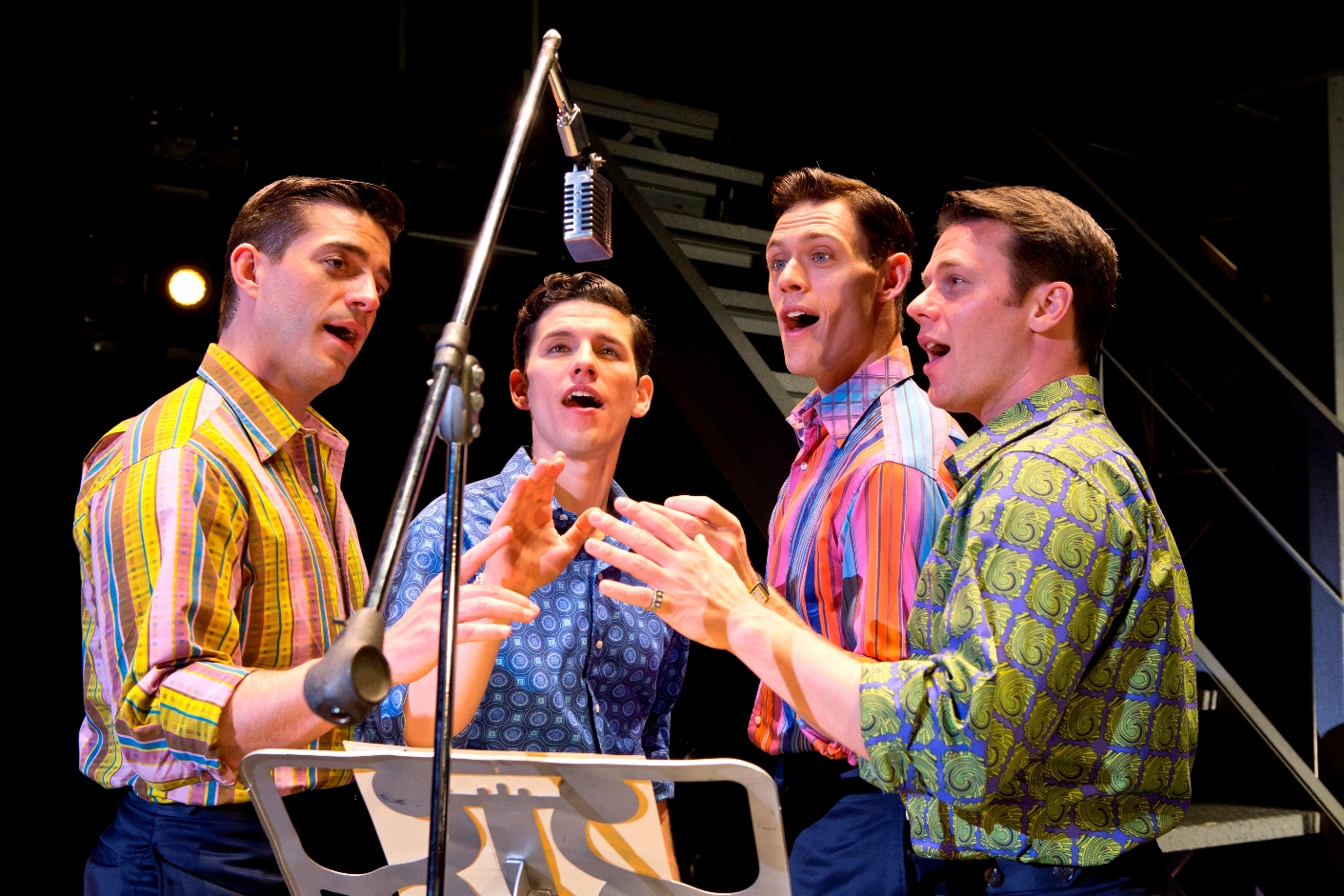
Brandon Andrus, Nick Cosgrove, Jason Kappus and Nicolas Dromard (from left) play the Four Seasons in Jersey Boys (photo by Jeremy Daniel)

By Richard Ades

Why is Jersey Boys so much more fun the second time around?

Part of it may be due to lowered expectations. Prior to the touring show’s Columbus debut in 2011, the press attended a preview during which we were told to expect a spectacle that would put every other musical to shame. We also were informed that male viewers, in particular, would be reduced to manly tears by this trip down the Four Seasons’ Memory Lane.

Well, it didn’t happen. Not to me, at least. The show’s historically correct harmonizing was great, but the dramatic portions left my eyes dry.

Fast forward to earlier this week, when the latest version of the touring show returned to the Ohio Theatre. I went, expecting little, and got a lot. In fact, I had a ball.

But the difference can’t be attributed entirely to my new lack of optimism. I think the production is noticeably better this time around.

That’s particularly true in regards to the key role of lead singer Frankie Valli. Two years ago, the featured actor hit the falsetto notes with aplomb, but he couldn’t carry off some of the tale’s most touching moments. Now, though, Nick Cosgrove does it all without a hitch—singing, acting and even a few athletic dance moves.

Actors playing the rest of the New Jersey-bred quartet are equally fine: Nicolas Dromard as the out-for-himself Tommy DeVito, Jason Kappus as songwriter Bob Gaudio and a comically laconic Brandon Andrus as Nick Massi.

With a book by Marshall Brickman and Rick Elice, this 2006 Tony Award winner relates the history of the Four Seasons by allowing each member of the 1960s rock group to tell his side of the tale in turn. It’s a clever tack and probably a necessary one, given that three of the four original members are still alive and don’t necessarily agree on the details.

A bevy of talented supporting cast members play the many people who wander in and out of the musicians’ lives. Key actors include Barry Anderson as record producer Bob Crewe, Marlana Dunn as Mary Delgado and Thomas Fiscella as sentimental gangster Gyp DeCarlo.

Under Des McAnuff’s direction, the cast and crew work as a unit while the action flows fluidly from one scene to the next, sometimes even in the midst of song. Meanwhile, Klara Zieglerova’s set design and Howell Binkley’s lighting design fill the stage with images that are subtly handsome and perfectly complementary. As a piece of stagecraft, Jersey Boys is a wonder.

But the show’s real highlight is the music—the just-right re-creations of hits such as Big Girls Don’t Cry, Walk Like a Man and Can’t Take My Eyes Off You. And that’s due not only to the actors’ vocal prowess but to conductor Ben Hartman and his onstage band. Special kudos to Mark Papazian, without whose emphatic drumming the night would be far less joyful.

Were my eyes still dry when I left the show this time around? Yes, but I didn’t care. The rest of my face was smiling.

Broadway in Columbus and CAPA will present Jersey Boys through Sept. 29 at the Ohio Theatre, 39 E. State St. Show times are 7:30 p.m. Tuesday-Thursday, 8 p.m. Friday, 2 and 8 p.m. Saturday and 1 and 6:30 p.m. Sunday. Running time: 2 hours, 35 minutes (including intermission). Tickets are $28-$128. 614-469-0939, 1-800-745-3000 or ticketmaster.com.

King Arthur and friends hit the road in ‘Spamalot’

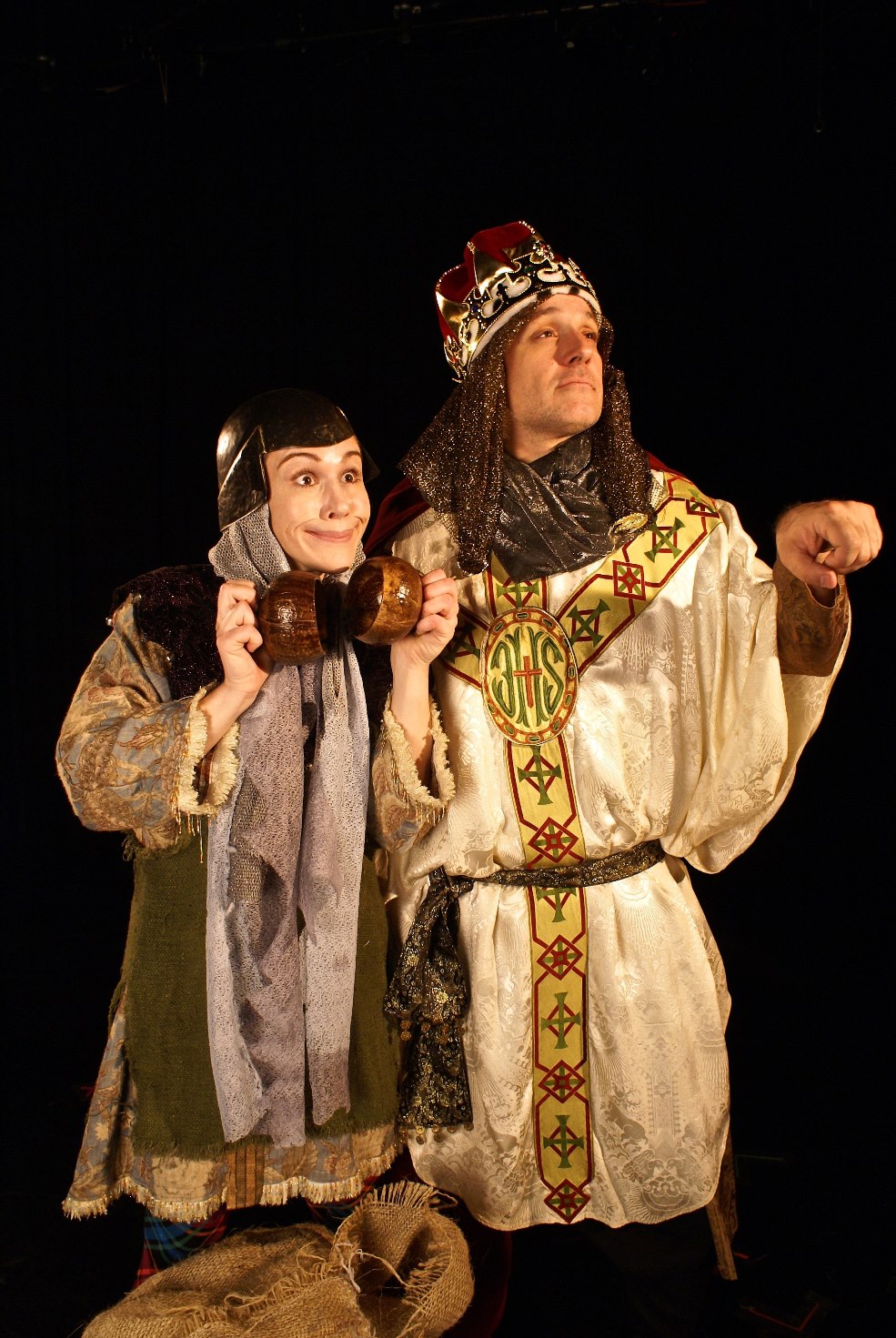
Tom Cardinal (right) as King Arthur and Amy Lay as his aide, Patsy, in Spamalot (photo courtesy of Shadowbox Live)

By Richard Ades

Shadowbox Live’s “metaperformers” are Monty Python fans. That’s obvious throughout their production of Spamalot, the musical inspired by the 1975 film Monty Python and the Holy Grail.

You can see the love in the working-class British accents and the squeaky voices of the suspiciously mannish women. You can see it in the perfect timing with which the “Knights Who Say Ni” squawk out their signature word.

You can see it in director Stev Guyer’s patient willingness to allow each scene to expand to its maximum level of hilarity.

For the unaware, Monty Python was a BBC-bred comedy troupe that combined brainy humor with rampant silliness and an anarchic disregard for societal norms. Spamalot, with book and lyrics by Python alum Eric Idle, simultaneously spoofs the King Arthur legend and Broadway-style musicals. The latter comes out in numbers such as The Song That Goes Like This, a dead ringer for the kind of show-stopping tune that’s become an Andrew Lloyd Webber hallmark.

At Shadowbox, Idle’s Tony-winning musical allows numerous performers to put their acting and singing strengths to optimal use.

Tom Cardinal is heroic but not foolhardy as Arthur, the mythical king whose search for the Holy Grail sends his ragtag group of knights off on a series of dangerous adventures. Amy Lay is delightfully dutiful as Patsy, his aide, who stands in for his “horse” by clapping together two halves of a coconut. (The presence of this tropical fruit, by the way, foments one of the first daffy exchanges as dubious guards question just what kind of bird would be big enough to carry it to medieval England.)

After spoofing operatic divas in previous Shadowbox theme shows, Stephanie Shull brings the same kind of energy to the Lady of the Lake, a role that also makes the most of her powerhouse voice. Michelle Daniels narrates Arthur’s adventures as the Historian, while Billy DiPetro supplies comical menace as the disapproving father of a son who fancies himself a maiden in distress.

Also along for the virtual ride are JT Walker III as Galahad, David Whitehouse as Lancelot, Jim Andes as Bedevere and Robbie Nance as Robin, as well as a host of others playing the threatening soldiers, trash-talking “Frenchies,” lascivious ladies and sundry monsters the knights encounter during their quest.

Katy Psenicka’s alternately medieval-rough and Broadway-glitzy choreography adds to the fun, as does Matthew Hahn’s musical direction and a band that’s often dominated by Kevin Patrick Sweeny’s keyboard work.

Due to acoustics and accents, a few lyrics and bits of dialogue may be difficult to catch. But that probably won’t be a problem for true Python fans, who know the show by heart anyway.

Speaking of which, if you are such a fan, don’t give in to the temptation to call out punch lines in advance, as at least one audience member did on opening night. Otherwise, an unpleasant French person may unplug his nose in your general direction.

Spamalot will be presented at 2 and 7 p.m. Sundays through Nov. 17 at Shadowbox Live, 503 S. Front St. Running time: 2 hours, 20 minutes (including intermission). Tickets are $30, $20 for students and seniors. 614-416-7625 or shadowboxlive.org.

You might want to brush up on your Kierkegaard first

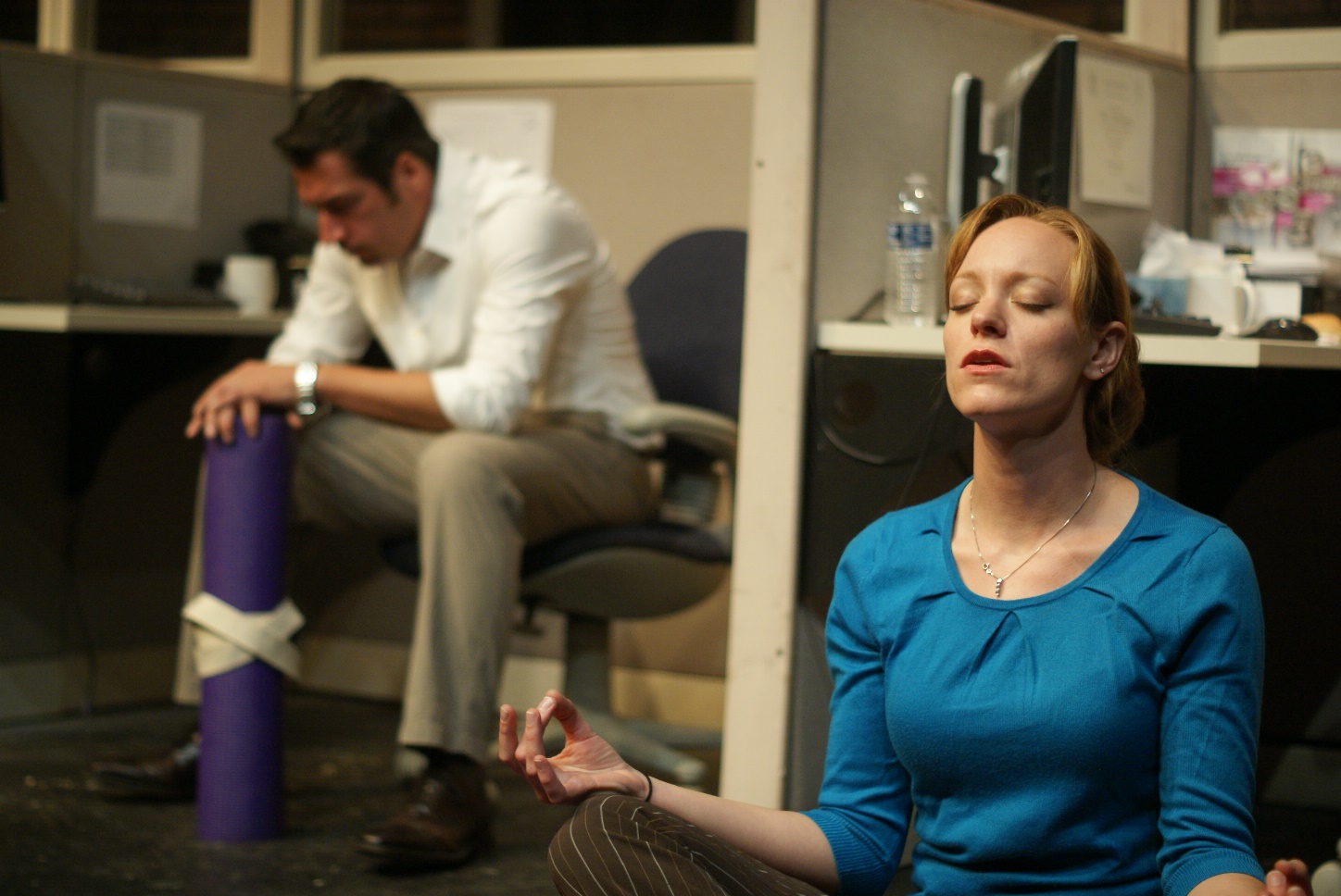
Colin (Erik Sternberger, left) strikes a typically dejected pose while Fran (Katharine Pilcher) practices “existential yoga” in The :nv:s:ble Play (photo by Andy Batt)
Colin (Erik Sternberger, left) strikes a dejected pose while Fran (Katharine Pilcher) practices “existential yoga” in The :nv:s:ble Play (photo by Andy Batt)

By Richard Ades

It’s ironic that Alex Dremann’s The :nv:s:ble Play is about a group of book editors. The two-act, two-hour work offers interesting food for thought, but it would benefit from a little editing.

While philosophy majors may be amused by its subtle existential humor, most folks would find it far more palatable if a few minutes—60, say—were cut from its running time.

Set in a New York publishing house that specializes in existential literature, The :nv:s:ble Play is about employees who are so shy and retiring that they gradually disappear from sight. At the center of the action is Colin (Erik Sternberger), who is trying to finish editing a romance novel when he discovers that neither his co-workers nor the book’s author (an unusually hammy Courtney Deuser) can see or hear him.

Actually, saying Colin is at the center of the action is misleading. It would be more accurate to say he’s in the center of the inaction, as he spends scene after scene hunched over his desk in a state of dejection while his oblivious co-workers go about their lives.

Since those lives consist mainly of gossiping about who’s romancing whom and which employees are destined to be laid off, Dremann seems to be suggesting that people like Colin are doomed to be the unappreciated backbones of their companies while their shallow but flashier colleagues gain all the glory.

There’s also a romantic element to the story, but its point is a bit murky. Colin may be in love with Fran (Katharine Pilcher), the Yale-educated woman in the next cubicle, but he also may not be, as he’s not even sure he believes in the emotion. So why should we care? Because a fellow invisible worker comes up with a theory—presumably after watching Beauty and the Beast—that one way to break the spell of invisibility is to make another person fall in love with you.

This sets Colin on a quest to get Fran to fall for him, which means he first must get her to notice him. His bumbling efforts result in several frustratingly slow scenes, including one cribbed from the 1989 rom com Say Anything.

One bright spot in all this is that MadLab’s cast, like most recent MadLab casts, is uniformly good. Director Andy Batt pulls generally well-crafted performances out of his actors.

Besides Sternberger and Pilcher, the leading players include Chad Hewitt as the sleazily ambitious Tim, Shana Kramer as the pregnant Carmen and Megan Corbin as their scary supervisor, Nancy. Most lovable of all is Michelle Batt as Ramona, a self-described asexual arborist who, like Colin, has become invisible to her co-workers.

Rounding out the cast are Joe Liles as Lawrence, an IT guy who has become invisible even to Colin and Ramona, and Deuser as Cass, an aging editor who is unseen because her desk is on the far side of the room.

Speaking of the room, Brendan Michna’s set design is a series of cubicles that will remind many office workers of their place of employment. It certainly reminded me of my former office, except that I don’t remember my days there being quite so uneventful.

The :nv:s:ble Play will be presented at 8 p.m. Fridays and Saturdays through Sept. 14 at MadLab Theatre and Gallery, 227 N. Third St. Running time: 2 hours (including intermission). Tickets are $12, $10 for students and seniors, $8 for members. 614-221-5418 or madlab.net.

On his way to writing ‘Rent’…

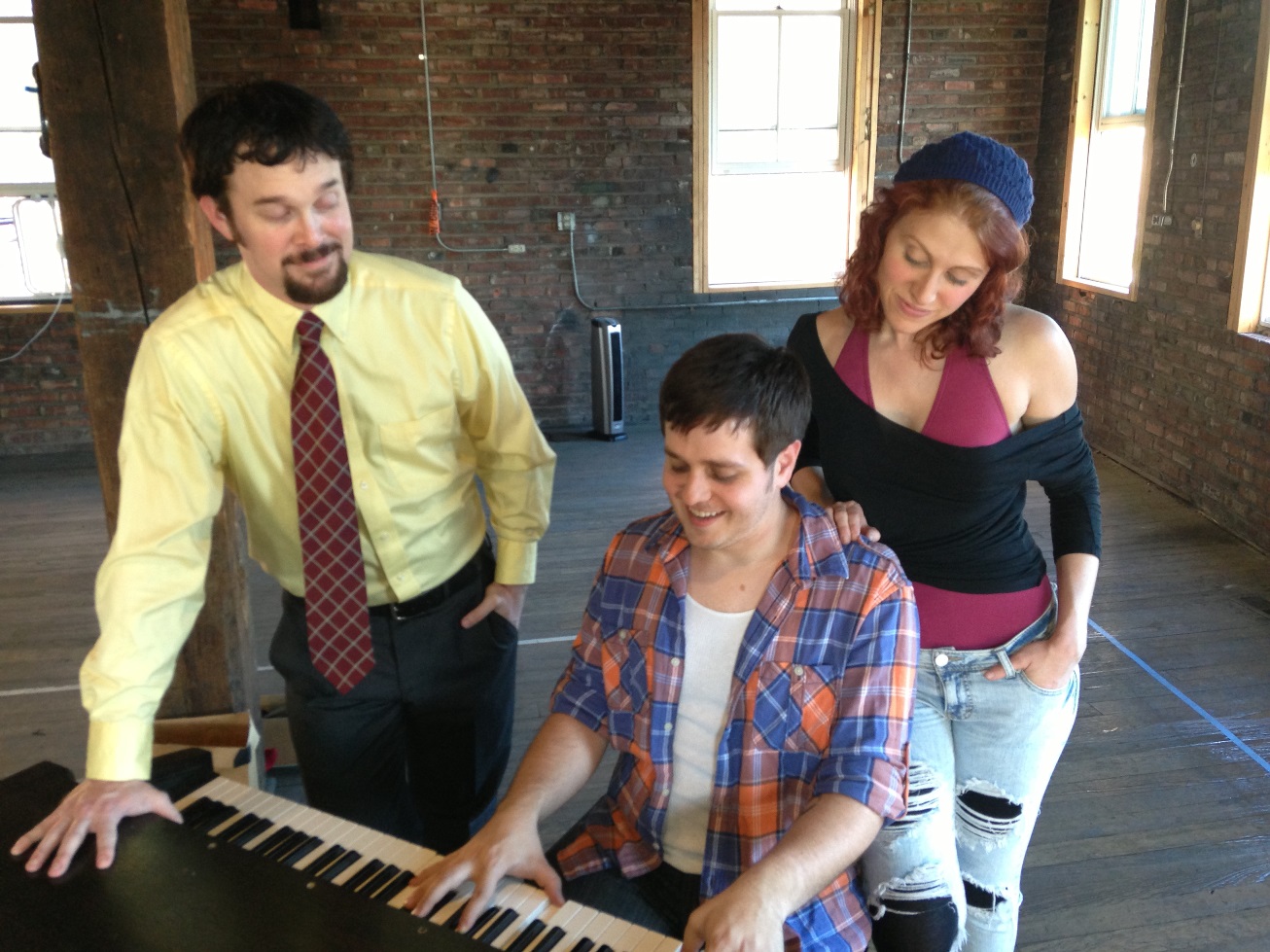
Appearing in tick, tick…Boom! are (from left) Christopher Storer as Michael, Jonathan Collura as Jon and Kaitlin Descutner as Susan (photo by Zach Hartley)

By Richard Ades

If you’re a fan of Rent or of rock-based musical theater in general, you’ll want to see tick, tick…Boom! The 1990 work is Jonathan Larson’s semi-autobiographical take on his struggle to establish himself as a composer and lyricist.

If you’re not a fan of either Rent or rock-based musical theater, the show is less of a must-see, but it remains tuneful and pleasant enough to be worthwhile.

Of course, the $64,000 question with any locally produced musical is: Does the cast have enough vocal chops to carry it off? Because, let’s face it, that’s not something you can take for granted.

Happily, though, the answer is a resounding yes. Director Zach Hartley has found three performers who sing like pitch-perfect larks. They also have acting chops, though that’s less of a consideration in a show whose appeal is more historical than dramatic.

Jonathan Collura is personable as Jon, a New York composer who’s sweating his way toward both his 30th birthday and a workshop performance of his latest musical. Kaitlin Descutner is equally appealing as his dancer/girlfriend, Susan, who supplies comfort and support when she’s not kvetching about her desire to live in a less-urban environment.

It would nice if Christopher Storer provided a more grounded portrayal of Michael, Jon’s Bimmer-driving roommate. That might make a last-minute revelation about the character seem less gratuitous. But Storer excels—as does Descutner—in colorful secondary roles.

As for the songs, they range from the lightweight Green Dress to the clever Sunday, a trio that reflects Jon’s (and Larson’s) reverence for Stephen Sondheim. Also Sondheim-like is the flashy Come to Your Senses, which gives Descutner a chance to show off her vocal power.

For the most part, the tunes come in flavors of rock, which Larson helped to introduce to musical theater. Whatever their genre, an onstage band led by musical director Hillary Billups provides stalwart support.

Truthfully, as a piece of theater, tick, tick…Boom! is less than overwhelming. But as a piece of theatrical history, it’s a gem.

Evolution Theatre Company will present tick, tick…Boom! through Aug. 17 at the Columbus Performing Arts Center, 549 Franklin Ave. Show times are 8 p.m. Thursday-Saturday. Running time: 95 minutes. Tickets are $20-$25, $15 for students and seniors. 614-223-1124, 1-800-838-3006 or evolutiontheatre.org.