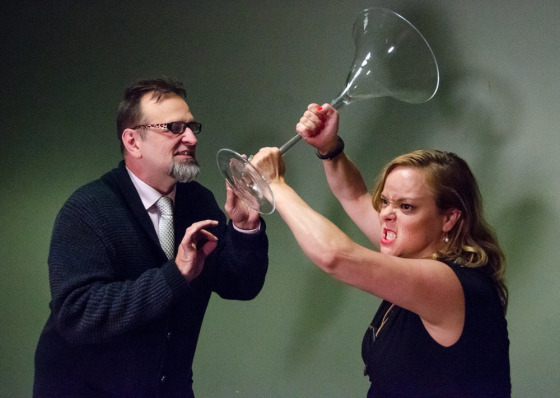
Waltzing through a tender tale of longing and infidelity

One of the beautiful stage pictures offered by Short North Stage’s production of A Little Night Music (photo by Ray Zupp)

By Richard Ades

To succeed, a musical production needs basic ingredients such as strong singing, a good band, pretty scenery, etc. If a show has all of these things, it’s probably worth seeing.

But it can be so much more if the director has a feel for the material’s subtleties (assuming there are any) and knows how to communicate them to the cast and crew. Then the musical becomes a transcendent experience.

At Short North Stage, I’ve seen two such productions, both written by Stephen Sondheim: 2013’s Sunday in the Park With George and, now, A Little Night Music. In the current show, a bittersweet reverie on love and regret, director Michael Licata and his cast bring out every knowing chuckle and every tender, aching moment.

Adapted by Hugh Wheeler from the Ingmar Bergman film Smiles of a Summer Night, the 1973 Tony winner centers on two Swedish households at the turn of the last century.

In one, middle-aged lawyer Fredrik Egerman (Mark A. Harmon) lives with young wife Anne (Jennifer Barnaba) and his son from a previous marriage, seminary student Henrik (JJ Parkey). In the other, Madame Armfeldt (Linda Dorff) cares for granddaughter Fredrika (Maria Delanno) while the girl’s mother, actress Desiree (Marya Spring), is off touring with her latest play.

From the start, it’s apparent that the Egerman household is emotionally unstable. Fredrik loves his girlish wife but is frustrated by her reluctance to take part in marital relations. When Desiree’s touring show arrives in town, he can’t resist going to see the woman with whom he had an affair some 14 years earlier.

This leads to a night of passion that arouses the suspicions of Desiree’s current lover, the pinheaded Count Carl-Magnus Malcolm (Nick Lingnofski). Being a first-class male chauvinist, he then complains about his mistress’s indiscretion to his long-suffering wife, Charlotte (Kate Lingnofski).

All the desires, suspicions and resentments that were fomented in Act 1 come to a delicious head in Act 2, when everyone converges at Madame Armfeldt’s estate for a country outing.

It’s hard to find fault with the large cast, except to note that Barnaba’s Anne sometimes fades into the woodwork and that her pretty soprano voice was occasionally overwhelmed by the band on opening night. Really, though, there are no weak links.

Spring exudes worldly confidence as Desiree, which makes her vulnerable rendition of the show’s most memorable tune, Send in the Clowns, all the more devastating. As former lover Fredrik, Harmon offers a deftly sketched portrait of a decent man tottering on a tightrope between obligation and desire.

Parkey, a familiar visitor on the Short North stage, gives one of his best performances yet as Henrik, a young man pulled in opposite directions by his religious ideals and his unspoken love for his 18-year-old stepmother. Another career-topping performance is given by Dorff as Madame Armfeldt, whether she’s tackling Sondheim’s tricky melodies or waxing philosophical about roads not taken.

Several hearty laughs are earned by Nick Lingnofski as the preening, adulterous count, while Kate Lingnofski communicates all of the conflicting emotions felt by his wronged but loving wife, Charlotte. In another important supporting role, Eli Brickey gives a saucy but warmhearted portrayal as Petra, Anne’s maid and confidante, and delivers a rousing rendition of The Miller’s Son, a Celtic-flavored statement of female self-sufficiency.

Meanwhile, young Maria Delanno shows remarkable poise as the wise-beyond-her-years Fredrika—to the extent that she didn’t even flinch when a piano bench collapsed under her on opening night.

Adding to the production’s texture are the varied voices who serve as a sort of musical Greek chorus, as well as the backstage musicians who perform under Lloyd Butler’s direction. Interestingly, nearly all of the songs are written in waltz time, which makes it fitting that the most prominent dance numbers (choreographed by Dionysia Williams) are actual waltzes.

Like the troupe’s 2013 staging of Sunday in the Park With George, the current show is a visual treat thanks to Ray Zupp’s gauze-strewn scenery, Adam Zeek’s ethereal lighting and a colorful array of costumes supervised by Stephanie Keller. But perhaps the most important of the backstage talents is sound designer Michael Mason, who succeeds in making nearly every syllable come through clearly—not an easy feat in the Garden Theater’s cavernous main auditorium.

With A Little Night Music, Short North Stage proves once again that it understands Sondheim. The show is tender, wise, witty and—for devoted fans of the composer/lyricist—completely unmissable.

Short North Stage will present A Little Night Music through Nov. 1 at the Garden Theater, 1187 N. High St., Columbus. Show times are 8 p.m. Thursday-Saturday, 3 p.m. Sunday. Running time: 3 hours (including intermission). Tickets are $25-$40. 614-725-4042 or shortnorthstage.org.

You say kabuki, I say ka-pokey…

Julie Klein, Nikki Fagin, Stacie Boord and Billy DePetro (from left) in The Tenshu (Shadowbox Live photo)

By Richard Ades

No one ventures outside its comfort zone more than Shadowbox Live.

The troupe could play it safe by sticking to its usual formula of skits and rock tunes, but it continually pushes beyond that SNL-like envelope by putting on ambitious, original shows. In recent years, those shows have largely been huge successes.

With The Tenshu, the kabuki-inspired tale that opened last week, Shadowbox pushes the envelope more than ever. Not only has it consulted with an international collaborator for the first time, but it’s completely redesigned its space—to the extent that its other current productions had to be placed on hold for the show’s three-week run.

What a shame that all of this effort has added up to a decidedly mixed success.

Visually, the show is striking, thanks to Britton Mauk’s Japanese-style scenery, Linda Mullin’s ornate costumes, David Mack’s macabre makeup and Aaron Pelzek’s lighting, along with puppets designed by Beth Kattelman and others.

Musically, the show is a bit less satisfying, though the original score is an interesting attempt to combine traditional Japanese sounds with rock beats.

But it’s in the drama department that the show really lags, suggesting that there’s a reason kabuki has never caught on in America. Adapted from a play written by Izumi Kyoka and translated from the Japanese by Hiromi Sakamoto, it lacks the unifying plot that Western viewers expect from a theatrical work.

Instead, it’s united by a single character and her mysterious home. All of the events occur in and around an ancient castle whose fifth floor is inhabited by a ghostly noblewoman named Tomihime (Stacie Boord) and her entourage.

Act 1 deals with Tomihime’s preparations for a visit from her friend Kamehime (Leah Haviland), as well as her use of supernatural powers to repel a band of samurai warriors led by the evil Lord Harima (Jimmy Mak). There are moments of enchantment and beauty, but much of the time is spent simply telling stories or exchanging gifts and pleasantries.

Act 2 finally gets to the meat of the tale: Tomihime’s potentially romantic encounter with a disgraced samurai named Zusho (JT Walker III). Unfortunately, the encounter proceeds so slowly that viewers’ patience may be put to the test.

Throughout, director Stev Guyer has the actors speak in a deliberate, declamatory manner. It’s probably meant to mimic the style of kabuki acting, but the approach makes it even harder for Western viewers to maintain interest in the slow-paced tale.

Shadowbox head writer Mak tries to make up for the script’s talkiness by adding action scenes reminiscent of Japanese samurai flicks or anime cartoons. Among them are two intricately choreographed swordfights and an attack by a huge, flying creature with glowing eyes.

Dancing also plays a role, courtesy of Katie Psenicka’s choreography. The most memorable dance represents a battle between a falcon (Nick Wilson) and a crane (Amy Lay).

The dance numbers are graceful, while the action sequences are thrilling. There just aren’t enough of them to make up for the show’s long stretches of lifeless dialogue.

The talent is all top-notch, both onstage and off-, but it’s not enough to sell the exotic story. Maybe what’s needed are subtitles—not to translate what happens but to explain why we’re supposed to find it compelling.

The Tenshu continues through Oct. 25 at Shadowbox Live, 503 S. Front St. Show times are 7:30 p.m. Wednesday-Thursday, 1 and 7:30 p.m. Friday, 2:30 and 7:30 p.m. Saturday, 2 and 7 p.m. Sunday. Running time: 2 hours, 20 minutes (including intermission). Tickets are $20-$40, $10 for ages 12 and under. An abridged version will be presented at 1 p.m. Friday (doors at noon). Running time: 45 minutes. Tickets are $10, $5 students/seniors/military. 614-416-7625 or shadowboxlive.org.

Shoemaker sets out to save cross-dressers’ soles

The touring cast of Kinky Boots, presented by Broadway in Columbus and CAPA (photo by Matthew Murphy)

By Richard Ades

I have to admit I went into Kinky Boots with a small chip on my shoulder.

In 2013, Matilda the Musical was expected to win a slew of Tony Awards, including for best musical. Instead, despite having opened to mixed reviews, Kinky Boots danced away with the top prize.

Full disclosure: I love Matilda the Musical. Seeing it was my favorite Broadway experience since Memphis. After Kinky Boots beat out the magical lass for the top prize and others, including Cyndi Lauper’s win for best score, I decided it had better be damn good.

Anyway, that was my mindset going into the Ohio Theatre on Tuesday night, which helps to explain why it took me a while to warm up to the show. Eventually, though, I came around.

Adapted by Harvey Fierstein from a 2005 movie, Kinky Boots is the story of Charlie (Steven Booth), a young Englishman who’s preparing to move to London with his fiancée, Nicola (Charissa Hogeland). In the process, he’s leaving behind the family business, a Northampton shoe factory run by his father (Tom Souhrada).

No sooner does Charlie get to London, however, than he learns his father has died. As if that weren’t enough bad news, he then realizes the company is going broke because it can’t compete in a market flooded with cheap, foreign-made shoes.

Enter Lola (Kyle Taylor Parker), a drag performer whose chief problem seems to be her inability to find high-heeled boots strong enough to support her male frame. Thanks to a suggestion from factory worker Lauren (Lindsay Nicole Chambers), Charlie realizes the only way to save the business—along with the jobs of the people he grew up with—is to find a niche need and fill it. His solution: Start making sturdy, yet stylish, footwear for the discriminating cross-dresser.

I said I eventually came around on Kinky Boots, but that doesn’t mean I love everything about it. You don’t have to be an expert on Morse code to recognize that Fierstein is telegraphing plot points well in advance, including the fate of Charlie’s relationship with the sour-tempered Nicola. And things get even more transparent in the second act, when Fierstein manufactures conflicts by having Charlie act in totally unconvincing ways.

The show’s salvation is Lauper’s genre-hopping score, which earns its Tony. A couple of the songs strike me as derivative, but they’re generally enjoyable and catchy.

Of course, any production rises or falls on the strength of its cast, and this touring show’s cast acts, sings and dances delightfully under the guidance of director/choreographer Jerry Mitchell. At the top of the bill, Booth is relatable as Charlie, while Parker is nothing short of amazing as the sassy, yet soulful, Lola.

Some early critics complained that the show loses steam in the second act, but I actually like it better because it gives Lola a chance to grow into something beyond a flashy stereotype. Yes, Lola’s production numbers with her lascivious “Angels” are fun, but Parker’s best moment comes when Lola slows down for the Act 2 lament Hold Me in Your Heart. It’s a true show stopper.

Visually, the show is equally impressive, thanks to Gregg Barnes’s costumes, Kenneth Posner’s lighting and David Rockwell’s glorious scenery.

The one place the touring show could stand improvement is in the area of the sound. On opening night, whole lines of dialogue and lyrics were indecipherable. The English accents were partially to blame, but poor mixing seemed to be the main culprit. Hopefully, that problem will be fixed as the week goes on.

Did Kinky Books deserve to steal the top Tony away from Matilda? Not in my book. But it does give musical-loving theatergoers a colorful, toe-tapping good time.

Broadway in Columbus and CAPA will present Kinky Boots Oct. 6-11 at the Ohio Theatre, 39 E. State St., Columbus. Show times are 7:30 p.m. through Thursday, 8 p.m. Friday, 2 and 8 p.m. Saturday, 1 and 6:30 p.m. Sunday. Running time: 2 hours, 30 minutes (including intermission). Tickets are $33-$118. 614-469-0939, 1-800-745-3000 or ticketmaster.com.

Maybe the goat ate his moral compass

(Martin) Tim Browning and Stevie (Sonda Staley) find themselves in a romantic triangle with a barnyard animal in The Goat or, Who Is Sylvia? (photo by Matt Slaybaugh)

By Richard Ades

What’s a guy to do?

Martin Gray loves his wife and has been faithful to her throughout their marriage. Then, during a visit to the countryside, he meets and instantly falls for a beautiful, sweet-natured female—a female who just happens to be a goat.

D’oh! Or rather: Doe!

In The Goat or, Who Is Sylvia?, esteemed playwright Edward Albee charges headfirst into the prickly topic of bestiality, and he doesn’t exactly handle it with kid gloves. Instead, he uses Martin’s predicament to question traditional concepts of love and morality.

Yes, Albee holds Martin up to some degree of satirical ridicule, but not because a barnyard creature has turned the architect into a bleating-heart liberal on the topic of interspecies romance. No, it’s Martin’s personality that makes him the butt of Albee’s jokes.

Martin (Tim Browning)—like wife Stevie (Sonda Staley) and, to a lesser extent, son Billy (Jesse Massaro)—is depicted as a superficial intellectual. He’s so enraptured by his own cleverness that he periodically interrupts even the fiercest argument to compliment a particularly apt comment or to question a grammatical choice.

Another early source of humor is Martin’s self-admitted forgetfulness. Apparently distracted by his secret affair with a four-legged lover, he simply can’t hold onto the threads of conversations with either his wife or his best friend, Ross (Todd Covert).

Is The Goat a comedy? That seems to be Albee’s goal at first, but later it hops the fence into the realm of tragedy as Martin’s new love places him on the horns of a marital dilemma.

At any rate, it’s not a gut-busting comedy, seldom generating more than the occasional chuckle in Red Herring’s current production. The main problem is that Albee tries to milk Martin’s forgetfulness for so many laughs that few materialize.

Then again, neither is it a great tragedy, unless you relate to Martin’s quandary—and unless you find the ending far more shocking than I did. Though I’m far from prescient, I saw it trotting my way from a mile off.

Working under Michael Herring’s direction, the actors generally play their characters naturalistically, though sometimes with a tinge of satirical exaggeration. Personally, I found Staley and Massaro the most convincing, but that’s partly because their characters are the most relatable for those of us who haven’t gone looking for love in the nearest stall. Stevie and Billy greet the news of Martin’s bucolic canoodling with understandable fury and disbelief.

As for Browning, he plays Martin as a man so obsessed by his bearded lover that he’s basically sleepwalking through life. That’s an appropriate interpretation, but I still don’t get the character. It might help if Albee had allowed Martin to go into more detail about the moment he first fell in love with a creature whose greatest joy comes from licking the glue off tin cans.

But he doesn’t, because Albee is more interested in fomenting an audience reaction than he is in an actual interspecies relationship. Before the play is over, he’s brought up such equally scandalous topics as incest and sexual attraction toward an infant.

Most provocatively of all, he has Martin attack his son’s homosexuality, as if that were somehow analogous to his own love for Sylvia. No, huh-uh. There’s no analogy between the two, despite what fear-mongering opponents of gay marriage might tell you. Consenting adults can do whatever they want, but farm animals can never be said to have free will.

Herring’s set design of the Grays’ home is modern and avant-garde, which seems fitting. On opening night, however, individual pieces had problems: a pedestal nearly falling over, a chair partially coming apart, two vases falling off shelves seemingly of their own volition. Though these appeared to be accidents, I couldn’t help wondering whether Herring meant for at least some of them to happen as symbols of the Gray family’s precarious equilibrium.

Another production oddity: Though the play was designed to be performed in one act, Red Herring adds an intermission about 35 minutes in. It serves no obvious function, as it follows a dramatic development that will come as no surprise to 99 percent of the audience.

Will the Gray family survive Martin’s barnyard dalliance? It seems that Albee wants us to care whether they do, but truthfully, I didn’t. Though parts of it are entertaining, the play as a whole is hard to take seriously.

Yes, it won a Tony (in 2002, for best play), but it’s disappointingly shallow, especially coming from the man who gave us theater’s greatest marital spat of all time: Who’s Afraid of Virginia Woolf?

Other than their author and the titular question marks, the two works could not be more different.

Red Herring Theatre will present The Goat or, Who Is Sylvia? through Oct. 10 in Studio One, Riffe Center, 77 S. High St., Columbus. Show times are 8 p.m. Thursday-Saturday. Running time: 1 hour, 50 minutes (including intermission). Tickets are $20 in advance, pay what you want at the door. 614-723-9116 or redherring.info.

Comedy has Texas-sized helping of humor, heart

Dr. Eve Bolinger (Ruth Sternberg) tries to “de-homosexualize” Earl “Brother Boy” Ingram (Mark Phillips Schwamberger) in Evolution Theatre Company’s production of Sordid Lives (photo by Jerri Shafer)

By Richard Ades

Judging from the size of Friday night’s audience, Sordid Lives looks like one of Evolution Theatre Company’s more popular productions.

It’s not hard to see why. Del Shores’s comedy has become a cult hit since it first appeared in 1996 and subsequently spawned a movie and a short-lived TV series. It may not be a great work of art, but it’s a fun piece of theater.

In Evolution Theatre Company’s production, it benefits from a seasoned group of performers who seem to enjoy sinking their teeth into Shores’s juicy Texas stereotypes.

Pam Welsh-Huggins gets each of the four scenes off to a tuneful start as vocalist/guitarist Bitsy Mae Harling, who sings and strums her way through a handful of mood-setting tunes. Also establishing the proper mood is Shane Cinal’s Texas-centric set design, complete with homey furniture and the skull of a longhorn steer.

The scenes nearly function as separate set pieces except that they’re connected by a recent death: Peggy Ingram, a mother and grandmother, died after tripping over the wooden legs of neighbor G.W. (Ralph Edward Scott). Making her departure not only painful but embarrassing for her family, the accident happened while she and the married G.W. were sharing a motel room.

The scenes also have a thematic connection in the form of repressed sexuality. Peggy’s son, Earl “Brother Boy” Ingram (Mark Phillips Schwamberger), has been institutionalized in an attempt to “cure” him of his gay, cross-dressing ways. And her grandson, New York-based actor Ty (Andrew Trimmer), is struggling to come to terms with the homosexuality that he’s afraid to reveal to his family, especially strait-laced mother Latrelle (Lori Cannon).

The first scene takes place at the home of Peggy’s sister Sissy (Betsy Poling), who is attempting to grieve and quit smoking at the same time. It features the awkward reunion of Peggy’s younger daughter, LaVonda (Danielle Mari), and Noletta (Kathy Sturm), wife of the philanderer whose prosthetic legs were responsible for Peggy’s death.

The second scene is set in the local bar owned by Wardell (David Vargo), who is still ashamed that he and G.W. once gay-bashed Brother Boy, an act that may have led to the latter’s institutionalization. Also present are barflies Juanita (Vicky Welsh Bragg) and Odell Owens (Jeb Bigelow).

What makes these scenes work is that director Beth Kattelman seems to have encouraged the actors to invest in the characters rather than trolling for laughs. This allows the humor to flow naturally from the absurd situations and down-home dialogue.

However, the production doesn’t really hit its peak until after intermission. That’s when we finally meet the much-discussed Brother Boy, along with his therapist, Dr. Eve Bolinger (Ruth Sternberg). Schwamberger is a revelation as the long-institutionalized patient, who gamely puts up with Bolinger’s attempts to “de-homosexualize” him in hopes he’ll finally be allowed to go home. His portrayal is both hilarious and touching.

So, for that matter, is the scene itself. Adding to its effectiveness are Nitz (Curtis) Brown’s dramatic lighting and Sternberg’s crafty portrayal of the ruthless Bolinger.

Not surprisingly, the play ends with Peggy’s funeral and the tying up of the comedy’s various threads.

According to an ETC Facebook post, last Saturday’s performance of Sordid Lives sold out. With raunchy regional humor and an uplifting message, the comedy is likely to continue pulling in crowds. Translation: Order your tickets now.

Evolution Theatre Company will present Sordid Lives through Sept. 26 at the Columbus Performing Arts Center, 549 Franklin Ave., Columbus. Show times are 8 p.m. Thursday-Saturday. Running time: 2 hours, 30 minutes (including intermission). Tickets are $20, $15 students/seniors. 1-800-838-3006 or evolutiontheatre.org.

A clown, a rabbit and a llama walked into a TV studio…

Appearing in MadLab’s production of Clowntime Is Over are (from left) Shana Kramer as Susie the Bunny, Andy Batt as Max and Chad Hewitt as Tidy the Llama (photo by Michelle DiCeglio)

By Richard Ades

Clowntime Is Over has been touted as a typical MadLab play, and that’s an accurate description. Written by Joseph E. Green, it’s the kind of small, dark and weirdly offbeat work we’ve come to expect from the theater on North Third.

But that’s not the only reason MadLab fans will eat it up. The play also gives them the chance to see two familiar actors spread their wings in unfamiliar ways.

Andy Batt (who also directs) has never been averse to trying new things, but he’s seldom stretched himself as far as he does here. As TV clown Max P. Twinkle, he’s sardonic, morose and morbidly philosophical. He also has great comic timing, which helps to keep Green’s play from getting bogged down in existential angst.

The equally familiar Stephen Woosley is normally less chameleonic than Batt, but there’s nothing Woosley-like about Paco, the mouse he plays during a short but spirited appearance. Just as Batt’s Max brings humor to the tale, Woosley’s Paco brings energy, and lots of it.

Adding to the novelty of their performances is Suzanne Camilli’s liberally applied makeup, which ensures that neither Batt nor Woosley looks anything like himself.

Green’s metaphorical story is set in the TV studio where Max normally presents his children’s show. One fateful day, however, he arrives to find his crew is AWOL. Even more strangely, the “bunny” and “llama” who also appear on the show seem to be just that: a bunny and a llama. At any rate, their costumes have no zippers in sight.

Shana Kramer and Chad Hewitt play Susie the Bunny and Tidy the Llama, respectively. Of the two, Kramer’s Susie makes a stronger impression. Hewitt has been great in other shows—most notably as Nick in an early-2015 production of Who’s Afraid of Virginia Woolf?—but his portrayal seemed a bit too understated on opening night.

The four actors—as well as an unseen snake that plays a pivotal role—do their thing on Brendan Michna’s creatively designed set.

So what is Green’s play about? Oh, about 75 minutes. Sorry. I normally would have resisted such an obvious joke, but the show’s brevity happens to be one of its best qualities. It has some funny moments, as well as some biblically inspired ponderings about life and death, but it doesn’t hang together well enough to support a longer running time.

You want my best guess? I think Green meant it as a Christian metaphor, but that doesn’t explain everything.

Of course, one advantage of the show’s brevity is that you’ll have plenty of time to head to a bar or coffee shop afterward and look for your own meaning. And even if you don’t find any, at least you can bask in the memory of witnessing two familiar actors doing very unfamiliar things.

Clowntime Is Over runs through Sept. 5 at MadLab Theatre and Gallery, 227 N. Third St., Columbus. Show times are 8 p.m. Friday-Saturday. Running time: 1 hour, 15 minutes. Tickets are $15, $13 students/seniors, $10 members. 614-221-5418 or madlab.net.

I knew Will Shakespeare, and Mr. Moliere, you’re no Will Shakespeare

Appearing in Actors’ Theatre’s production of The Miser are (from left) Danny Turek as Cleante, Ted Amore as Harpagon and Elizabeth Harelik as Elise (photo by Nick Pershing)

By Richard Ades

Actors’ Theatre has gone through quite an evolution.

Shakespeare in the park has always been the troupe’s bread and butter, but recent years have seen the Bard’s stage time reduced. In his place, Actors’ has tried to attract families with swashbuckling adventures, some of them written especially for Schiller Park. Vintage comedies by other playwrights, such as the current production of Moliere’s The Miser, have also been tried.

It’s been an interesting experiment, and no doubt it’s paid off in some ways. For one, the kids who enjoy plays such as Treasure Island (2010) or Robin Hood (2012) may well return to the park when they’re older to watch more-challenging works.

But where does that leave those of us who already enjoy more-challenging works, especially those written by one William Shakespeare? We’ve had to get by with a single helping of the Bard per summer.

Adding insult to injury, that single helping is sometimes delivered in a high-concept production that overwhelms the original tale. This summer saw an unconvincing attempt to turn Richard III into an American gangster saga. And in 2013, the charming Twelfth Night was raucously updated to the 1980s, complete with pop-culture references to Miami Vice and Ghost Busters.

It’s almost as if Actors’ Theatre has decided it can’t sell Shakespeare without a gimmick.

But Shakespeare still works just fine on its own, as last year’s outstanding production of Hamlet proved. Sure, it had a gimmick of sorts, in the form of the untraditional casting of a teenage girl (Grace Bolander) in the title role. But the real “gimmick” was talent: Under the co-direction of Nick Baldasare and the late John S. Kuhn, every member of the cast found depths of nuanced meaning in each and every line.

That’s not to say there’s no value in giving stage time to other playwrights. It was certainly educational seeing the current production of The Miser. Namely, it taught me that Moliere is no Shakespeare.

To be fair, I might appreciate Moliere’s satire more if I could enjoy it in its original French. In Miles Malleson’s English adaption, unfortunately, it often comes off as heavy-handed and predictable.

Compounding the problem, some of the scenes are delivered in an exaggerated farcical style that underlines the comedy’s heavy-handedness. Especially guilty of this approach are Ted Amore as the stingy Harpagon and Danny Turek as his lovelorn son, though both are otherwise impressive.

Working under Pamela Hill’s brisk direction, most of the cast members are more restrained. They include Andy Falter as the brown-nosing Valere, David Harewood as the devious LaFleche and Michael Neff as the eager-to-please Master Jacques, along with all of the major female players: Elizabeth Harelik as Harpagon’s daughter, MB Griffith as matchmaker Frosine and Lexi Bright as a young woman caught in a romantic bind.

The show also benefits from Trent Bean’s colorful set, Emily Jeu’s imaginative costumes and sparkling clear sound designed by William Bragg and engineered by Catherine Rinella.

Yet, despite all of these strengths, the production is truly funny in only one scene toward the end, when a trio of actors offer deadpan deliveries of monologues accompanied by equally deadpan background music. Otherwise, the show is merely pleasant.

Pleasant entertainment is better than none at all, but I’d rather be challenged, touched and transported, as I am by a good production of Shakespeare. How about it, Actors’ Theatre? Is it time to return the Bard to top billing?

Actors’ Theatre will present The Miser through Sept. 6 at the Schiller Park amphitheater, 1069 Jaeger St., Columbus. Show times are 8 p.m. Thursday-Sunday. Running time: 2 hours, 10 minutes (including intermission). Tickets: Pay what you will. Bring a blanket or lawn chair. 614-444-6888 or theactorstheatre.org.

Are you now or have you ever been a homosexual?

Donnie Lockwood, Brent Alan Burington, Adam Latek, Mark P. Schwamberger and David Vargo (from left) in The Temperamentals (Evolution Theatre Company photo)

By Richard Ades

If you’re like most people, you think America’s gay rights movement began with New York’s 1969 Stonewall rebellion.

Well, it did and it didn’t. The uprising was a prime catalyst, but a few brave souls were already fighting anti-gay discrimination nearly two decades earlier. Their efforts are the subject of Jon Marans’s The Temperamentals.

The play is set in Los Angeles in the early 1950s, a red-baiting era when homosexuals are treated with as much suspicion as communists. And it so happens that the main protagonists, Harry Hay (Brent Alan Burington) and Rudi Gernreich (Adam Greenbaum Latek), are both.

Though outwardly more conservative than Rudi, Harry is the one who seems determined to challenge the status quo.

Taking advantage of costume designer Rudi’s connections, he approaches Hollywood bigwigs such as Vincente Minnelli (David Allen Vargo) and asks them to sign a manifesto he’s drawn up on the rights of “temperamentals” (the euphemistic 1950s term for homosexuals). Not surprisingly, Minnelli and others are afraid to have anything to do with the document.

Eventually, Harry and Rudi do gather a tiny group of like-minded men and found the Mattachine Society, an organization devoted to the cause of equality. However, they accomplish little until Dale (Donnie Lockwood) is arrested on the trumped-up charge of soliciting sex from an undercover cop.

Such ruses are common in these pre-enlightened times, as gay men are so desperate to keep their sexual identity a secret that they willingly pay a hefty fine to make the charge go away. But when Dale says he can’t afford to take that route, Harry suggests a bold alternative: Admit his homosexuality while declaring his innocence. Members of the jury will be so impressed by his brave honesty, Harry reasons, that they’ll have to believe him.

In a perfect world, such a courageous act would inspire more courageous acts, all of which would lead to the kind of acceptance the Mattachine Society was seeking. But our world isn’t perfect, and it was even less so in the 1950s. Thus, The Temperamentals is the story of a movement that proves to be ahead of its time.

Because it remains true to history, with its mix of triumphs and disappointments, the play lacks an overall dramatic arc. But it makes up for it by documenting the huge barriers early gay activists faced. And not all the barriers were external; a big first step was learning how to communicate with each other about their shared heartaches and frustrations.

Director Douglas Whaley helps us understand these struggles by drawing relatable performances out of his cast. Burington anchors the production as the abrasive, impatient Hay, while Latek offers contrast as the more diplomatic Rudi. Besides Lockwood’s Dale, other founding members of the Mattachine Society are Chuck (Vargo) and Bob (Mark Phillips Schwamberger).

In addition to their central roles, all of the actors except for Burington play multiple supporting roles, both men and women. For the most part, they rise to the multitasking occasion.

Like Evolution Theatre Company’s spring production of Yank! The Musical, The Temperamentals is an imperfect but engrossing work that offers insights into gay life in the mid-20th century. That makes it invaluable.

Evolution Theatre Company will present The Temperamentals through July 18 at the Columbus Performing Arts Center, 549 Franklin Ave., Columbus. Show times are 8 p.m. Thursday-Saturday. Running time: 2 hours, 30 minutes (including intermission). Tickets are $20, $15 students/seniors. 1-800-838-3006 or evolutiontheatre.org.

Will Richard III get into a turf battle with Tony Soprano?

Geoff Wilson (center) plays the conniving title character in Actors’ Theatre’s updated production of Richard III (Actors’ Theatre photo)

By Richard Ades

When I heard Actors’ Theatre was going to turn Richard III into a 1950s American crime saga, my first thought was: How are they going to explain the title character’s best-known line: “A horse, a horse, my kingdom for a horse!”

Are they going to pretend that 20th-century mobsters have traded their Cadillacs and Lincolns in for four-legged transportation?

As it turns out, the relocated Shakespearean drama runs into problems long before Richard utters the iconic lament. Thankfully, good acting helps to salvage the production, but not before viewers have spent much of the proceedings scratching their heads.

At first glance, it’s easy to see why director Jennifer Feather Youngblood decided to recast Richard and his followers as mobsters. In his attempt to satisfy his lust for power, he’s as ruthless and violent as any Mafia capo.

Unfortunately for Feather Youngblood and her cast, Shakespeare refuses to cooperate. His script is clearly about someone aspiring to be England’s king, not the head of some crime syndicate. The tale is so immersed in British history and geography that you quickly forget it’s been relocated to 20th-century America. It simply comes across as Shakespeare that’s being performed in relatively modern dress.

To make matters worse, viewers apparently aren’t the only ones who don’t buy the hop across the pond. Most of the cast doesn’t, either. Though a few of the smaller roles are played with Jersey accents, Geoff Wilson’s Richard and most of his cohorts and victims speak in standard Shakespearean English.

Complementing the inconsistent accents is the production’s inconsistent tone. Most of the play’s many murders are handled with appropriate solemnity, but one is as darkly comedic as if it had been directed by Quentin Tarantino.

Most inconsistent—and jarring—of all is the recorded music that accompanies each scene change. It seems to have little to do with what’s happening around it.

For example, after Richard sends a pair of assassins to dispatch his trusting brother Clarence (David Ailing), the air is suddenly filled with the strains of Jerry Lee Lewis’s Great Balls of Fire. If you’re like me, this will leave you with two responses: (1) “Oh, that’s right, this is supposed to be 1950s America” and (2) “Huh?” It’s hard to fathom why the rockabilly hit is being used to introduce an act of outright villainy.

One gets the feeling that Feather Youngblood envisioned an interpretation of Richard III that was much more sardonic—and, obviously, more American—than it ended up being. The result is that it comes across as a production with multiple, clashing personalities.

As I said, good acting helps to make the show entertaining despite its problems, particularly in Act 2. As for Act 1, I should mention that I didn’t see it at its best, as the performance I saw was plagued with annoying sound problems prior to intermission. But the script itself is also a problem early on: Shakespeare bombards us with so many historical characters and intrigues that we struggle to keep them all straight.

By Act 2, thanks to Richard’s murderous machinations, many of these characters have disappeared. This leaves us free to enjoy the rousing arguments and battles of those who remain.

Throughout, Wilson’s Richard is a powerhouse, exuding evil from every pore of his twisted frame. The rest of the cast also is consistently strong, even though it speaks with inconsistent accents.

Three actors are particularly notable as a trio of wronged women: Vicky Welsh Bragg as former Queen Margaret, Beth Josephsen as current Queen Elizabeth and Christina Yoho as Lady Anne. Male characters who stand out from the crowd include Ailing’s Clarence, Alexander Chilton’s Buckingham, Philip J. Hickman’s King Edward IV and Robert Philpott’s heroic Richmond. In a prominent smaller role, Jason Speicher is memorable as the goon-like Ratcliffe.

Maybe it’s because I share his name, but I have to point out that not everyone believes the actual Richard III was as evil as the Bard portrays him. Nevertheless, he makes a great villain. Even though you almost need a degree in English history to understand his world—and even though Actors’ Theatre further complicates matters by pretending he’s an American gangster—it’s fun to watch him connive his way to the throne.

Especially since you know he’ll eventually have that problem with the horse.

Actors’ Theatre of Columbus will present Richard III through Aug. 2 at the Schiller Park amphitheater, 1069 Jaeger St., Columbus. Show times are 8 p.m. Thursday-Sunday. Running time: 2 hours, 35 minutes (including intermission). Tickets: pay what you will (donations accepted at intermission). Bring a blanket or lawn chair. 614-444-6888 or theactorstheatre.org.

[title of review]

Annie Huckaba, Bradley Johnson, Elisabeth Zimmerman and Jonathan Collura (clockwise from front) star in CATCO’s production of [title of show]
By Richard Ades

I arrive at the Riffe Center’s Studio Three and prepare to watch CATCO’s cabaret-style production of [title of show]. The intimate room is a pleasant place to watch theater, but I have my doubts about whether I should be watching this particular piece of theater.

My trepidation stems from what I’ve heard about Jeff Bowen and Hunter Bell’s offbeat musical, which first appeared in 2004, had an off-Broadway run in 2006 and finally turned up on Broadway for about three months in 2008. What I’ve heard is that the show is loaded with inside jokes and references that only gay, theater-obsessed New Yorkers can fully appreciate.

As the show begins, my fears seem justified. Some jokes fly right by me, while others just don’t seem that funny. Several audience members seem equally mystified—indeed, I can see one woman across the room who doesn’t crack a smile for the entire two hours and 10 minutes.

However, a small group of viewers makes up for this by laughing at nearly everything the cast does. Looking around, I realize that most of the laughs are coming from four men sitting in a tight circle. To be sure, many viewers chuckle or at least smile at various jokes, but this quartet supplies the bulk of the audience response.

So what is this show that appeals—intentionally, as it turns out—to such a select audience? It’s basically a musical about putting on a musical. Composer/lyricist Bowen and book writer Bell wanted to enter a show in an upcoming theater festival, and since they didn’t have any ideas, they decided to make the show its own subject.

A bit self-indulgent, don’t you think? Like the theatrical equivalent of a taking a selfie? Yes, and some of the early humor acknowledges that fact by focusing on the creators’ superficiality. In particular, the show’s version of Hunter is loath to begin a new project because he’s too involved in watching TV’s The Bachelor and Project Runway.

If the musical has any depth and universal meaning, it involves the participants’ desire to do something that would finally allow them to make theater the center of their existences. The self-doubt that prevents all of us from taking necessary chances in life is lampooned in one of the better songs, Die, Vampire, Die.

Back to Studio Three: As I watch the musical unfold under Joe Bishara’s direction, I admire both the cast’s singing and the keyboard work of accompanist Quinton Jones. But I also think the actors are portraying their characters with mixed success. That’s especially true of two female friends who join Jeff and Hunter’s project.

Elisabeth Zimmerman—who played one of my favorite characters in CATCO’s wonderful 2013 production of The 25th Annual Putnam County Spelling Bee—is entertaining as Heidi, to the extent that the thinly written role allows her to be. However, Annie Huckaba never quite gels as Susan, instead coming off as a caricature of playful quirkiness.

As for the men, Bradley Johnson is tastefully flamboyant as Hunter, while Jonathan Collura balances him out nicely as the more down-to-earth Jeff. It’s only in the later stages of the play that I begin to think Collura’s Jeff should have shown more passion for their shared project from the beginning. Maybe then the argument that arises late in Act 2 would be more convincing.

Truthfully, though, it’s unfair to blame the actors for anything that happens in Act 2.

The act didn’t even exist when the musical first opened, having been written to explain how the show and its creators changed as it moved to off-Broadway and finally to Broadway itself. Watching the second act in Studio Three, I quickly decide that adding it was a mistake.

And I’m not alone, judging from the audience’s reaction. Even the four biggest laughers are noticeably quiet as Jeff, Hunter, Susan and Heidi argue endlessly about whether they’ll ever get the show to Broadway and whether all of them will still be on board if and when it gets there.

Finally, Hunter suggests it’s time to bring the elongated show to an end, noting, “We can’t keep adding everything that happens to us.” It’s a brilliant insight, though it’s hard not to wish it had occurred to him about half an hour earlier.

Then again, I’m hardly in a position to throw that particular stone. It’s now been days since I saw the show, and I can’t find a way to finish this review, which already has dragged on for way too long.

Should I mention that, while watching the show, I kept thinking Zimmerman was playing Susan because she reminded me so much of the short-lived Seinfeld character of the same name? No, chances are no one else will make the connection, and really, who cares?

I guess I should just finish by addressing the all-important question: Will you enjoy the show? Maybe, maybe not. The creators themselves admit it won’t appeal to everyone, declaring in the finale that they’d rather be “nine people’s favorite thing than 100 people’s ninth-favorite thing.”

It should be obvious by now that [title of show] isn’t my favorite thing, my ninth-favorite thing or even my 90th-favorite thing. But who knows? Maybe it will be your favorite thing—at least until the second act.

CATCO is presenting an open-ended run of [title of show] in Studio Three of the Riffe Center, 77 S. High St. Show times are 8 p.m. Thursday-Sunday and 2 p.m. Sunday. Running time: 2 hours, 10 minutes (including intermission). Tickets are $35, $180 for a reserved table of four; a limited number of $15 student tickets will be available two hours before curtain. 614-469-0939 or catco.org.