How the GOP keeps its White voters faithful—and scared

Republican strategist Steve Bannon talks politics in the documentary White With Fear.

By Richard Ades

When Donald Trump talked about immigrants eating people’s pets during a 2024 presidential debate, he was carrying on a longtime Republican campaign tactic: Win the votes of White Americans by scaring the hell out of them.

According to Andrew Goldberg’s documentary White With Fear, this strategy can be traced back at least as far as the 1968 presidential campaign. Even though the controversial Vietnam War was still raging, we learn, the campaign of Republican Richard Nixon focused mainly on race.

Among the film’s many interviewees is author Rick Perlstein (Nixonland), who explains that the GOP worked to recapture the White House by tapping into many White Americans’ hatred of Blacks. This was done largely through innuendo and dog whistles.

When Nixon pledged to support “law and order” and fight crime, for example, it was understood that he was talking specifically about Black crime. The candidate’s subtext was hard to miss when he made statements such as referring to Black-majority Washington, D.C. as “the crime capital of the world.”

 The fearmongering tactic apparently worked, as Nixon captured the presidency. And it obviously continues to work, the documentary points out, as the GOP has won the majority of White votes in every presidential election ever since.

Not that the targets of GOP fearmongering have always remained the same.

When Al-Qaeda-backed terrorists attacked the World Trade Center on Sept. 11, 2001, brown-skinned Muslim extremists became the new source of fear. Republican Vice President Dick Cheney fed the paranoia with warnings about sneak attacks involving “chemical agents,” and the fledgling Fox News catapulted to prominence by offering its own nonstop appeals to prejudice and mistrust.

Later, the advent of Barack Obama as a national figure allowed the GOP to launch a two-pronged attack that combined White Americans’ fear of Blacks with their fear of Muslims. Obama actually wasn’t Muslim, but the persistent rumor that he was ran hand in hand with the Trump-fed suspicion that he wasn’t even born in this country.

Then 2020 arrived along with the worldwide COVID pandemic, allowing Republicans to target yet another race: Asians. Falling back on his love for nicknames, Trump led the attack by persistently referring to the scourge as the “Chinese virus” or “kung flu.”   

Hillary Clinton is one of many voices from both the left and the right who are interviewed in White With Fear.

Several years earlier, according to White With Fear, the Grand Old Party had actually considered changing its racially divisive ways. This happened after Obama was elected to a second term in 2012, and Republicans realized it might be a good idea to win over some of the non-White Americans who would one day become the majority.

Their solution: Work to pass immigration reform. But when that proved unpopular with their most conservative representatives, Republicans instead went back to their old ways by launching an attack on immigrants.

Strategists such Steve Bannon came up with the tactic, and then-candidate Trump adopted it with a vengeance. Thus was born his endless attack on immigrants as rapists, murderers and drug dealers; as stealers of American jobs; as replacements for American voters; and, most surreally, as eaters of American pets. It all culminated in the expensive and court-defying effort to expel immigrants that has become a cornerstone of Trump’s second term in office.

One of the most interesting aspects of Goldberg’s documentary is that it tackles its provocative topic with the help of experts from both the left and the right.

There are the expected liberal voices such as Hillary Clinton, who has several incisive things to say about her 2016 presidential opponent. But there are also conservative voices, including some former Trump supporters who have since repented, and others—including Bannon himself—who remain among the MAGA faithful.

This diversity of viewpoints gives us not only a critique of the GOP’s race-baiting approach to politics but a behind-the-scenes look at how it came to be.

Rating: 4 stars (out of 5)

White With Fear will be available through VOD outlets beginning June 3.
He photographed folks the mainstream media ignored

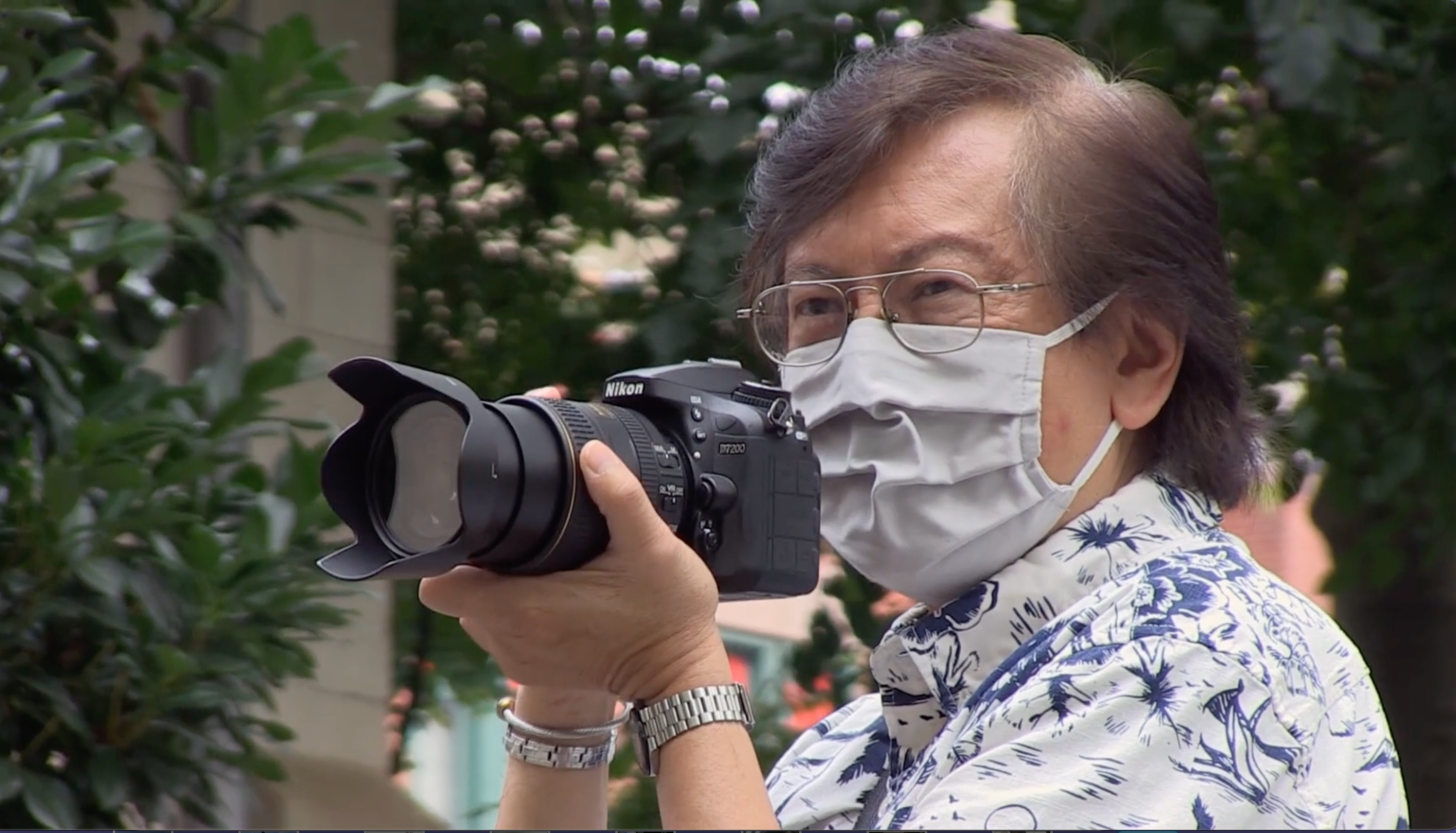
Wearing a mask during the COVID pandemic, Corky Lee gets ready to take his next photo. (Photos courtesy of All Is Well Pictures)

By Richard Ades

As a child, Corky Lee enjoyed comic books about superheroes, which he later credited with giving him a “moral compass.” As a Chinese American, however, he never saw any superheroes who looked like him.

Despite this fact (or maybe because of it), Lee grew up to be a kind of superhero himself—one whose “superpower” was simply taking the kind of pictures no one else was taking. Walking around New York City with a camera bag over his shoulder, he spent five decades chronicling the lives of Asian Americans and Pacific Islanders, people whose struggles and celebrations were often ignored by the mainstream media.

Lee and his lifelong crusade of inclusion are the subject of Photographic Justice: The Corky Lee Story, a documentary being shown on PBS in observance of Asian American and Pacific Islander Month.

Directed by Jennifer Takaki and featuring a combination of contemporary interviews and vintage footage, the film is a low-key but loving portrait of the man who became a fixture in New York’s Asian community. Whenever members of its many varied cultures and nationalities threw a parade, held a party or joined a picket line, Lee could be counted on to be there.

Love of country and love of New York are obvious in this photo Corky Lee took of a 2006 parade celebrating Budha’s birthday.

After decades of such coverage, the documentary tells us, Lee amassed so much knowledge about local AAPI-related events that kids jokingly referred to him as “Corkypedia.”

Besides showing up for Asian holidays such as the lunar new year and Budha’s birthday, Lee also covered national holidays, when he concentrated on providing an Asian American viewpoint. On Veterans Day, for example, he focused his lens on AAPI vets to show that Asians are as much a part of U.S. society as their European American counterparts.

According to the documentary, Lee felt this lesson became especially important when the country was hit with the 9/11 attacks in 2001 and with COVID in 2020. Muslim Americans and Chinese Americans, respectively, were scapegoated for these national and international tragedies, and he did what he could to counteract the resulting prejudice.

Sadly, the latter effort turned out to be his last. After viewing Takaki’s documentary, you’ll realize just how much of a loss that was.

Rating: 4 stars (out of 5)

Photographic Justice: The Corky Lee Story can be seen in select theaters and will air on PBS stations beginning May 13. Its Central Ohio airtime is 4 p.m. Sunday, May 19 on WOSU.

Musical remembers the day air travel came to a halt

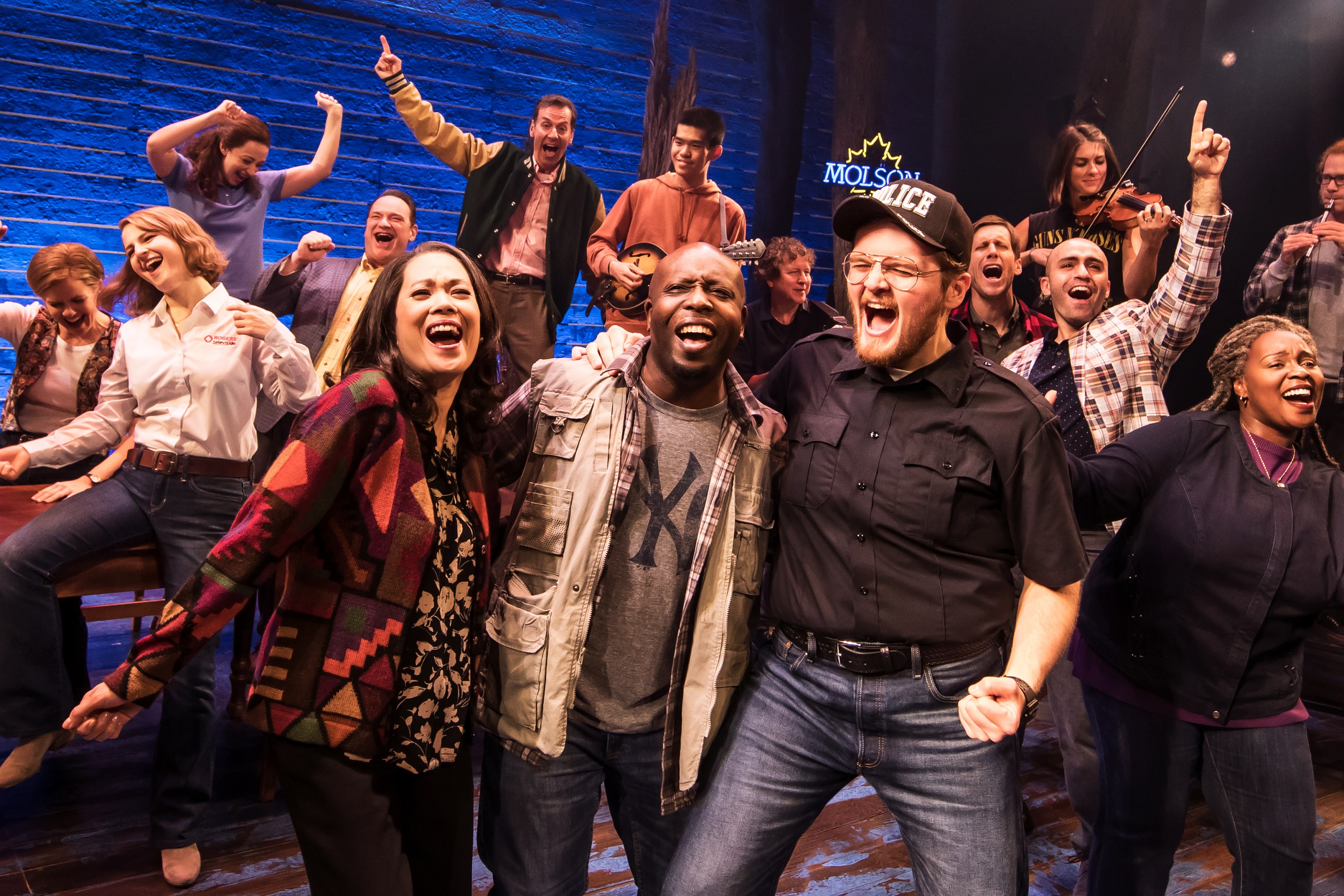
Air passengers grounded by 9/11 discover Canadian hospitality in Come From Away. (Photo by Matthew Murphy)

By Richard Ades

Sometimes you need a reminder that human beings are capable of kindness. Come From Away—a touring production of which is now playing Columbus’s Ohio Theatre—is just such a reminder.

The Irene Sankoff/David Hein musical is a breezy and heartwarming account of what happened in Gander, Newfoundland, following the Sept. 11, 2001, terrorist attacks.

When commercial airlines were ordered to land their planes out of fear that more could be commandeered and turned into flying bombs, the small Canadian community was forced to accept 38 or them. That nearly doubled its population and presented it with the sudden need to feed and house 7,000 strangers, many of whom didn’t even speak English.

As the musical reveals, the Newfoundlanders responded with ingenuity and generosity, providing food, shelter, clothes and other necessities. Even more importantly, they made the waylaid passengers feel safe and welcome in a world that suddenly seemed more dangerous than ever.

Director Christopher Ashley, who won the musical’s sole Tony Award after it opened on Broadway in 2017, stages five days’ worth of events in a fast-paced production that seldom even stops for applause. It’s a marvel of efficiency thanks partly to Beowulf Boritt’s set and Howell Binkley’s lighting, both of which are versatile enough to allow locations and moods to be changed in the blink of an eye.

Adding to the efficiency are 12 busy cast members who portray a multitude of both locals and visitors with the help of costume tweaks and an array of accents. While this is essentially an ensemble piece, several characters and the actors who play them are given a chance to stand out. Among them:

• Janice (Julia Knitel), a newbie TV reporter who’s overwhelmed by what undoubtedly will be the biggest story of her career.

• Nick and Diane (Chamblee Ferguson and Christine Toy Johnson), an Englishman and Texan who turn to each other for friendship and perhaps more.

• Kevin T. and Kevin J. (Jeremy Woodard and Nick Duckart), a gay couple who stress over how open to be about their relationship in this isolated community.

• Hannah (Danielle K. Thomas), a passenger who’s desperate to learn whether her son, a New York firefighter, is safe.

• Bonnie (Sharone Sayegh), director of the area SPCA, who takes it on herself to seek out and care for the cats, dogs and other animals trapped in the cargo areas of the grounded planes.

Members of the band cut loose during one of the musical’s more raucous moments. (Photo by Matthew Murphy)

Note: Bonnie’s real-life counterpart, Bonnie Harris, appeared at a local preview event late last year to help publicize Gander’s connection to Central Ohio. Namely, two of the endangered great apes known as bonobos (referred to in the play as “bonobo chimpanzees”) were among the animals, and one of them was a female destined for the Columbus Zoo. The audience greeted this bit of information with applause on opening night, accidentally covering up the additional announcement that the zoo named her first son “Gander” in honor of the town that had served as her temporary refuge.

Despite the musical’s strengths, it must be said that one point near the beginning seems briefly off. When Gander officials and residents learn of the Sept. 11 attacks, they instantly begin planning how to deal with the diverted flights. Considering what a shocking event 9/11 was for America and the world, didn’t anyone stop long enough to say, “Terrorists did what?” Overall, though, Come From Away does an admirable job of condensing five days’ worth of individual trauma and communal kindness into an inspiring and uplifting 100 minutes.  

And it does it with a collection of tunes that are nicely sung by the actors and energetically accompanied by the offstage band. Though the songs mainly serve the plot and characters and rarely stand out, they become more and more infectious as the evening goes on. Best of all is the Irish-flavored “Finale” that accompanies the final bows and continues long after the actors have left the stage.

In other words, don’t plan on making a quick exit.

Broadway in Columbus and CAPA will present Come From Away through Feb. 13 at the Ohio Theatre, 39 E. State St., Columbus. Showtimes are 7:30 p.m. through Thursday, 8 p.m. Friday, 2 and 8 p.m. Saturday, 1 and 6:30 p.m. Sunday. Running time: 1 hour, 40 minutes (no intermission). Tickets start at $39 and can be purchased at the CBUSArts Ticket Office (39 E. State St.), online at capa.com or by phone at 614-469-0939.