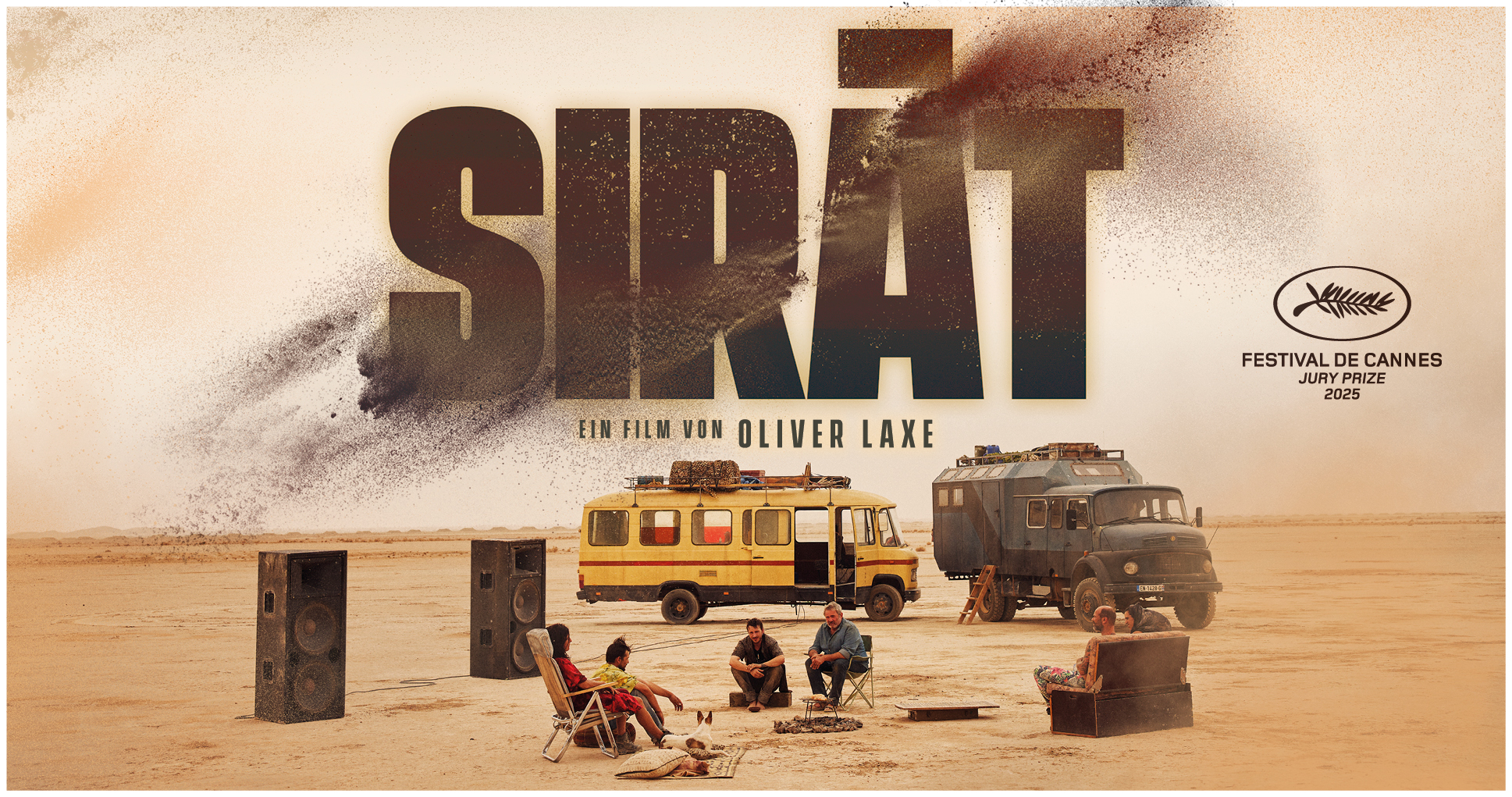
Of the five films up for an international Oscar, Sirat is by far the most unsettling.
I say that without fear of contradiction, even though I have yet to see most of its competitors. Watching Spain’s nominee is simply the kind of nerve-wracking experience that few films can match.
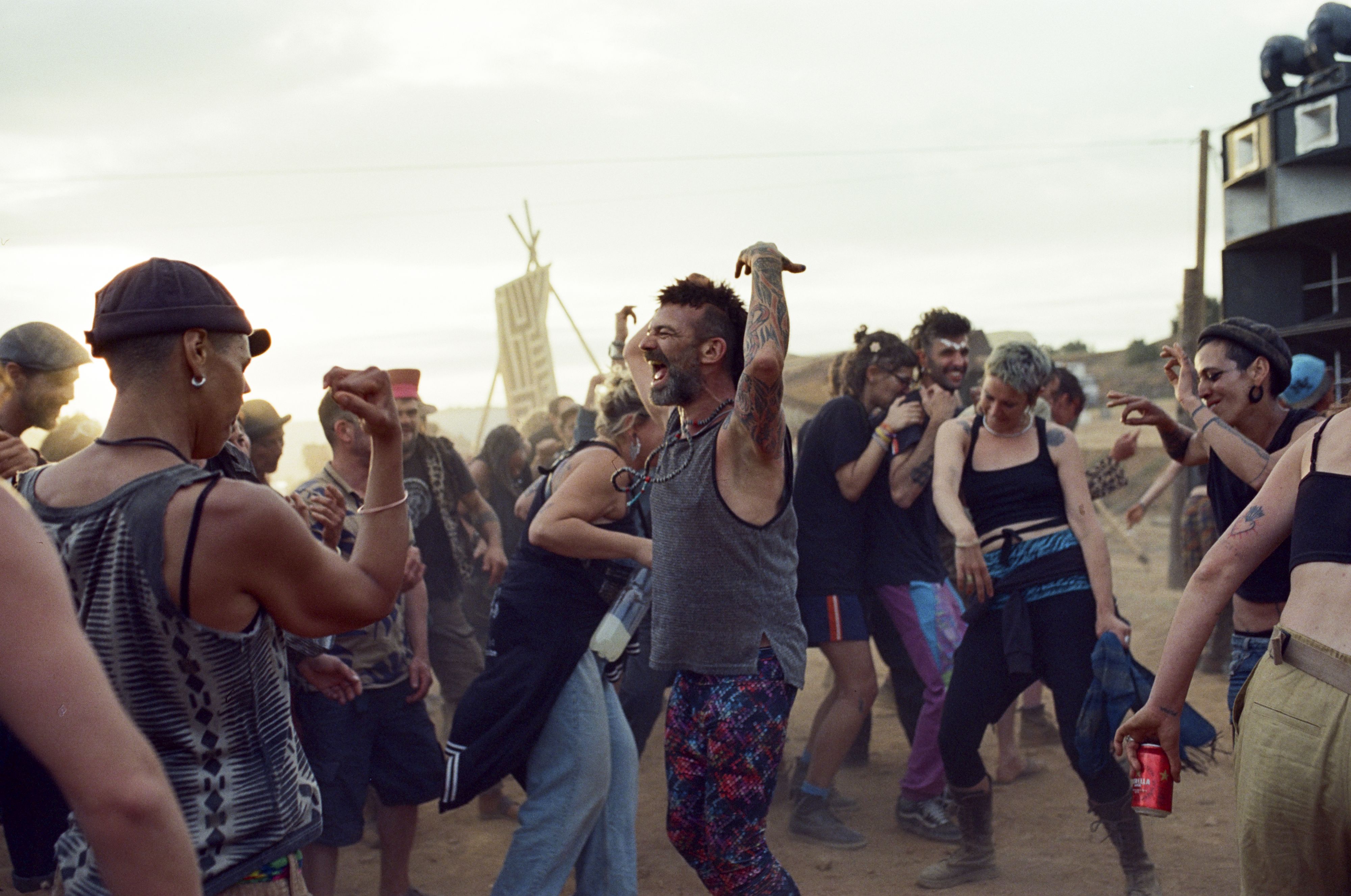
French-born director/co-writer Oliver Laxe begins his tale as a massive rave is getting underway in the middle of the Moroccan desert. After arriving in trucks and other weather-beaten vehicles, hardcore enthusiasts begin dancing ecstatically to bass-heavy beats that echo against rocky canyon walls.
It’s into this scene that a middle-aged Spaniard named Luis (Sergi Lopez) arrives with his young son, Esteban (Bruno Nunez Arjona). Passing out fliers with pictures of his grown daughter, Luis explains that she’s disappeared to join the raver lifestyle, and he thinks she might be here.
As it turns out, no one has seen her, but Luis learns she could be at an upcoming rave happening far to the south in Mauritania. Then comes an unexpected complication followed by a fateful decision.
Ravers do their thing in an early scene from Sirat.
Soldiers arrive and order all Europeans to leave the country due to a developing military conflict. When a few ravers revolt by instead heading south toward their next gathering, Luis decides to follow, thus sending him and his son on a journey into a hellish landscape filled with dangers both natural and manmade.
“Hellish,” by the way, is an appropriate adjective, according to words that flash on the screen at the film’s beginning. Referring to Islamic beliefs concerning the path souls must follow in the afterlife, they explain that the Sirat bridge connects heaven and hell and is “narrower than a strand of hair and sharper than a sword.”
Translation: Salvation is hard to come by.
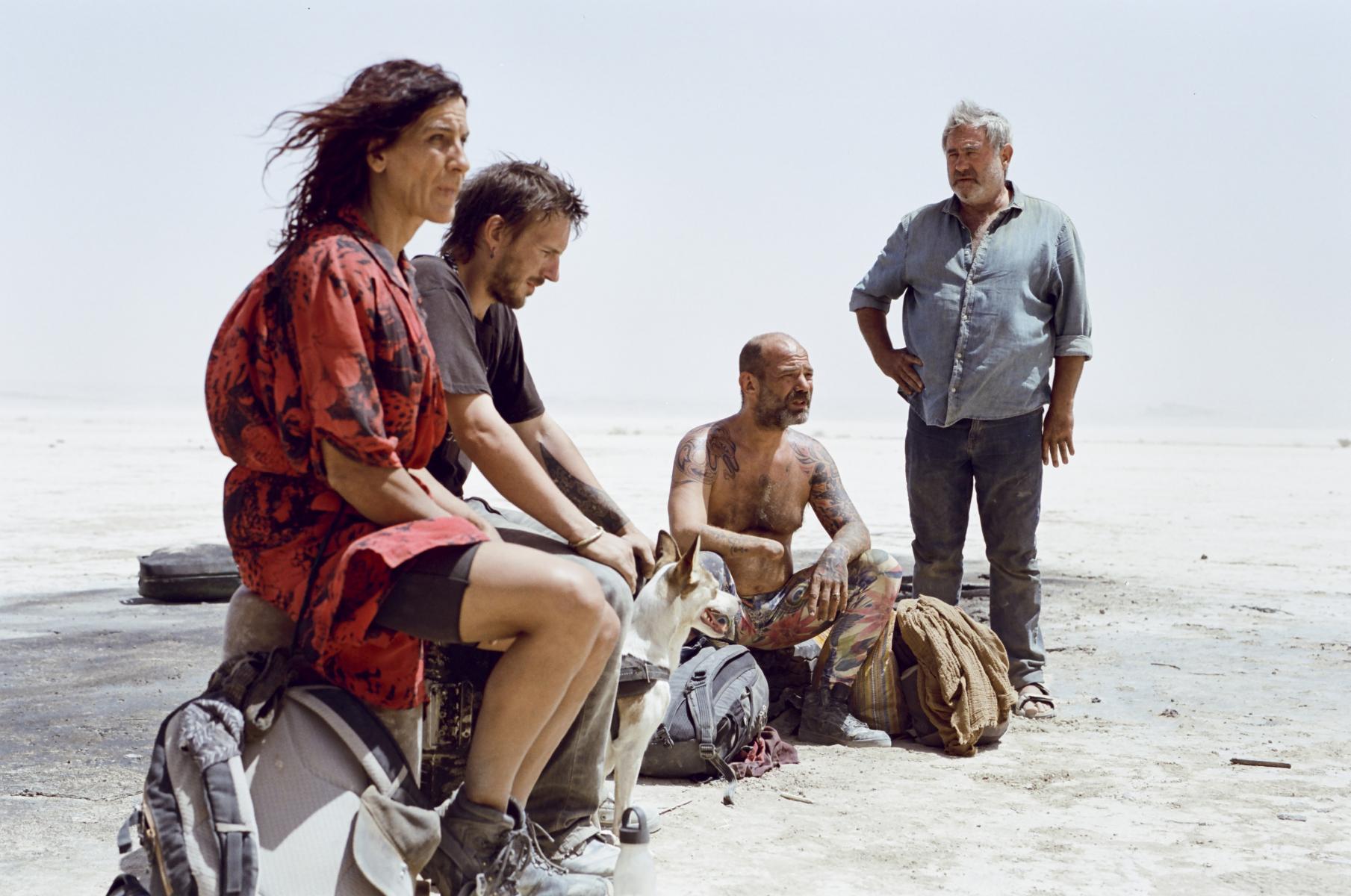
Luis (Sergi Lopez, right) with some of his newfound raver friends
For those of a spiritual bent, this offers one way to view the nightmarish trip Luis, Esteban and their adopted raver friends take as they head across the desert and over treacherous mountain roads—all the while hearing news reports of military actions that threaten to escalate into World War III.
For those of a more political bent, the trip might be seen as the emotional approximation of what it’s like to live in a world that increasingly seems at the mercy of leaders who have no compunction about starting wars and killing innocents to serve their own purposes.
However you interpret the characters’ tribulations, you can’t help but be moved by them thanks to director Laxe and collaborators such as cinematographer Mauro Herce and composer Kangding Ray, as well as a convincing cast consisting largely of gifted amateurs.
Sirat, in other words, is one painful ride.
Rating: 4 stars (out of 5)
Sirat (rated R) can be seen at select theaters, including the Gateway Film Center in Columbus, and is scheduled to expand nationwide beginning March 6.
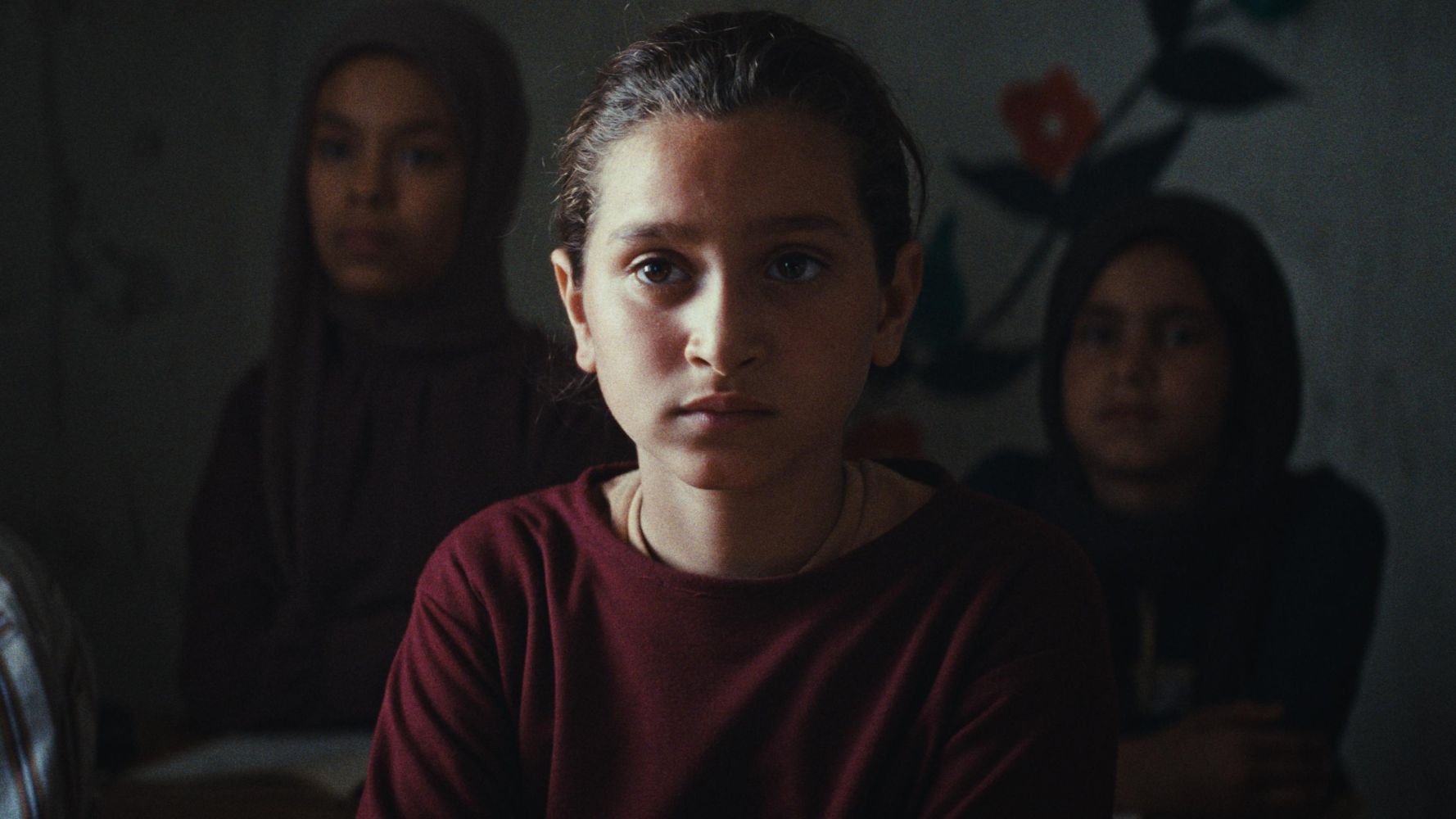
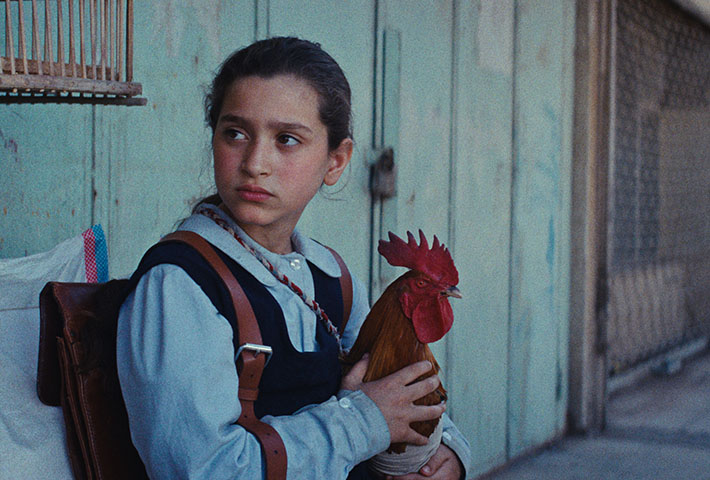
Baneen Ahmad Nayyef plays Lamia, an Iraqi girl who faces a daunting task in The President’s Cake.
By Richard Ades
Five films have received Oscar noms in the international category, including the French-sponsored Iranian drama It Was Just an Accident and the apparent front-runner, Brazil’s The Secret Agent.
Not on the final list is Iraq’s nominee for the honor—though it’s hard to say why, because the film is a gem.
The President’s Cake, written and directed by Hasan Hadi, is the alternately sad, funny and nail-biting story of Lamia, a 9-year-old girl who receives an unwanted honor: Thanks to a classroom lottery, she’s one of many citizens from across the country who are chosen to bake birthday cakes in honor of dictatorial leader Saddam Hussein.
What makes this task so difficult is that the tale is set in 1990, when Iraq’s invasion of Kuwait has made it the target of military attacks and economic sanctions. As a result, day-to-day survival is hard enough, and finding necessary ingredients such as flour and sugar is nearly impossible.
Lamia (Baneen Ahmad Nayyef) seldom goes anywhere without her pet rooster, Hindi.
Portrayed with a combination of pluck and vulnerability by Baneen Ahmad Nayyef, Lamia is already living on the edge—literally, as her home is located in the swampy Mesopotamian Marshes. Apparently parentless, the child shares a tiny home with her diabetic grandmother, Bibi (Waheed Thabet Khreibat), and a rooster named Hindi. Beyond the pet bird, her only friend seems to be Saeed (Sajad Mohamad Qasem), a neighbor with a reputation for getting into trouble.
When Lamia tells Bibi about her cake-making assignment, the grandmother insists that she skip classes the next day so they can take a trip to the city. Lamia assumes the purpose is to find the proper ingredients, but it turns out Bibi has something else in mind. Knowing her health is failing, the elderly woman plans to leave Lamia with a friend who’s better able to take care of her.
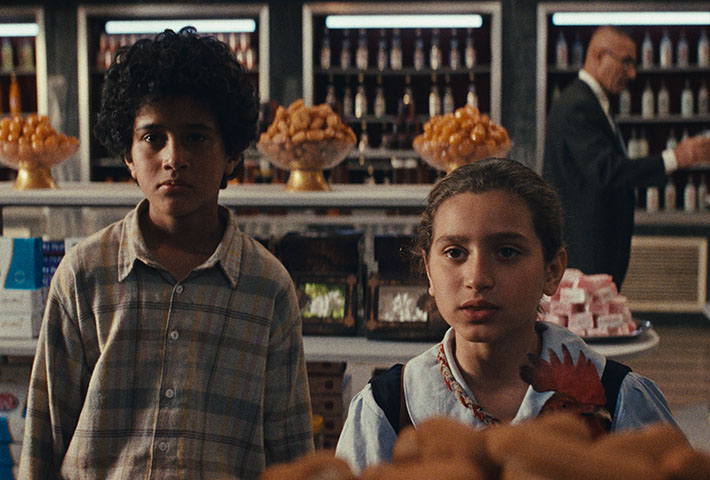
Unfortunately, Lamia mistakes her grandmother’s concern for anger, and she grabs her pet rooster and escapes into the streets of Baghdad. Knowing her friend Saeed had also planned to be in the city that day, she meets up with him and enlists his help as she proceeds to search for the elusive cake ingredients.
The result is a perilous journey that could be described as Dickensian (as in Charles) or Chaplinesque (as in Charlie). Nearly everyone they meet tries to ignore, cheat or even harm them, forcing them to rely on each other and on their own ingenuity. A fine cast, led by the talented youngsters playing Lamia and Saeed, makes it a gripping experience.
Like the aforementioned It Was Just an Accident, Hadi’s debut film portrays a country distorted by authoritarian politics. Hussein’s insistence on total devotion can be seen in the chants of allegiance Lamia and her classmates are forced to repeat every day, and in the countless images of him that can be seen displayed on Baghdad streets.
Lamia (Baneen Ahmad Nayyef, right) searches for cake ingredients with her friend, Saeed (Sajad Mohammad Qasem).
The film also shows how ordinary Iraqis are hurt by the world’s responses to Hussein’s aggression, including military attacks and sanctions that keep necessary food and medicine out of their hands. It’s a reminder that even well-intentioned actions can have unintended consequences, though it somewhat dilutes Hadi’s political message.
Maybe this helps to explain why the film didn’t score an Oscar nom even though it has so much to offer. Besides an absorbing story, its portrayal of a country under the control of a leader who demands constant obedience and adoration is a chilling vision of where the awards’ host country could well be headed.
Rating: 4 stars (out of 5)
The President’s Cake opened Feb. 6 in New York and Los Angeles and will open wide on Feb. 27.
A motion-captured Jonno Davies plays a simian version of British pop star Robbie Williams in Better Man. (Photo courtesy of Paramount Pictures)
By Richard Ades
This is the time of year when critics get a chance to catch up on recent flicks they might have missed, courtesy of studios in search of buzz and, hopefully, award nominations. While I don’t claim to be clairvoyant when it comes to the latter, I can confidently say this: If the Oscars and other competitions gave out prizes for bravery, these three films and their creators would win hands down.
One filmmaker displays creative courage by breaking the mold in a familiar genre, while the others put their liberty and even their lives at risk in order to bring their truths to the screen.
Let’s look at them one by one.
Biopic with a difference
By now, we all know the drill when it comes to film biopics: The would-be celeb claws his or her way to the top, but success comes at a steep cost. Friends are abandoned, spouses are cheated on, and alcohol and/or drugs are abused.
Better Man, based on the life of British pop superstar Robbie Williams, follows that general pattern, but with a difference. The entire story unfolds through the eyes (and narration) of Williams himself, who emerges as someone who desperately wants fame but is convinced he doesn’t deserve it.
And, oh yes: Williams is portrayed by a CGI-generated chimpanzee (a motion-captured Jonno Davies). It sounds weird—and, frankly, it is—but it also makes sense in a brilliant and emotionally satisfying way.
Even as a child, Williams suffers from self-doubt, self-loathing and what he later comes to identify as depression. By making him the lone ape in a world of humans, the film has found a clever way of symbolizing Williams’s fear that he’s an imposter unworthy of the success he seeks.
Directed with theatrical flair by Michael Gracey (The Greatest Showman), Better Man is marked by gee-whiz, over-the-top production numbers and surreal fantasy sequences, in addition to its simian protagonist. But what really sets it apart is its honesty and warmth.
Despite being depicted as an ape, Williams comes off as a recognizably flawed human who earns our sympathy, as well as the heart-on-its-sleeve sendoff the film gives him. Director Gracey’s gamble has paid off with a flick that’s as moving as it is massively entertaining.
Rating: 4½ stars (out of 5)
Better Man (rated R) opened Dec. 25 in select theaters and expands nationwide Jan. 10.
National unrest and a missing gun upset the lives of Iranian student Rezvan (Mahsa Rostami, center), her mother (Soheila Golestani, left) and sister (Setareh Maleki) in The Seed of the Sacred Fig.
Criticizing—and then escaping—Iran
As an attack on Iran’s government and justice system, The Seed of the Sacred Fig is the kind of film that can’t be made in that country. And yet veteran writer/director Mohammad Rasoulof succeeded in making it—in secret—before fleeing to Europe for his own safety.
The thriller concerns Iman (Missagh Zareh), who aspires to be a judge but learns that the path to success will force him to ignore his moral compass. He lands a position that requires him to sentence people to death without being given a chance to consider the evidence.
As it turns out, the position endangers more than just his conscience. Because of the job’s controversial nature, he and his wife, Najmeh (Soheila Golestani), and their family are forced to live in secrecy. Meanwhile, daughters Rezvan and Sana (Mahsa Rostami and Setareh Maleki) become embroiled in the widespread unrest that erupts after a young woman is beaten and killed for not sufficiently covering her head.
Then the gun that Iman keeps for protection turns up missing, and the national turmoil threatens to spread to his household as he searches for the culprit. Interrogations ensue, along with a car chase and a tense finale that may remind some of a certain horror film set in a snowbound hotel.
Considering it was made in secret and by a director who’d already gotten in trouble for earlier works, The Seed of the Sacred Fig should fill viewers with admiration for Rasoulof’s resourcefulness, as well as his courage. The film deserves an Oscar nomination, but it probably won’t get one, because who would nominate it? Certainly not Iran.
Rating: 4½ stars (out of 5)
The Seed of the Sacred Fig (PG-13) can be seen in select theaters and is scheduled to open Jan. 30 at Columbus’s Gateway Film Center.
Palestinian activist Basel Adra (left) joins forces with Israeli journalist Yuval Abraham in the documentary No Other Land.
Palestinian, Israeli expose West Bank abuses
Basel Adra has spent years documenting the Israeli army’s systematic attacks on his West Bank community, Masafer Yatta. In No Other Land, he continues that work along with Israeli journalist Yuval Abraham and fellow writer/directors Hamdan Ballal and Rachel Szor.
The result is an eye-opening expose of the abuses Adra and his Palestinian neighbors have had to endure living in the occupied territory. Houses and other buildings are destroyed on the shortest of notices and flimsiest of excuses, such as that the army needs the land for training exercises. Those who want to rebuild are told to get permits that they know are unobtainable.
Much of the film consists of footage taken with amateur video equipment or cellphones. It shows locals trying in vain to reason with soldiers, government officials and, in some cases, illegal Israeli settlers, all of whom are clearly trying to force them to abandon their rural community.
Other footage, shot by Szor, centers on the growing friendship between the Palestinian Adra and Israeli journalist Abraham, who are allied by their concern over the situation but separated by their approaches to dealing with it. Abraham is frustrated that his muckraking stories have had so little impact, but Adra counsels patience, saying a solution could take years or even decades.
The differing approaches reflect the men’s vastly different backgrounds. While Abraham is relatively new to the situation, Adra has been dealing with it for much of his life. In the face of constant, officially sanctioned abuse, he and his neighbors have no recourse but to greet it with steadfast determination and even flashes of dark humor.
Made under the most difficult of circumstances, No Other Land is a portrait of courage that is, in and of itself, an act of courage.
Rating: 5 stars (out of 5)
No Other Land is available through VOD outlets and can be seen at select theaters beginning Jan. 31.
Seydou (Seydou Sarr, center) and other migrants crowd into a boat that they hope will take them to Italy. (Photos courtesy of Cohen Media Group)
By Richard Ades
In this presidential election year, it’s easy to forget that migrants are not merely a campaign issue. They’re also desperate people who sometimes take unimaginable risks in their search for a better life.
One such person is at the center of Io Capitano (“I Captain”), the Italian nominee for this year’s International Feature Film Oscar. Directed and co-written by Matteo Garrone (2008’s Gomorrah), it’s the story of Seydou (Seydou Sarr), a 16-year-old Senegalese musician who believes he can become a superstar if only he and his cousin Moussa can find their way to Italy.
The youths’ optimism is challenged when a local elder warns them the trip will be risky, and that even if they get to Europe, they’ll find it’s far from a paradise. His words nearly scare Seydou into abandoning the journey, but then Moussa (Moustapha Fall) reminds him of the fame that hopefully awaits them in Europe.
“White people will be asking for your autograph,” the cousin predicts.
So, after seeking guidance from a neighborhood mystic, they set off, only to learn that the elder’s warnings were all too accurate. Soon they’re dealing with bribe-seeking officials, unreliable guides, desert heat and much worse in a journey that begins to resemble Dante’s descent into hell.
African migrants are forced to cross the Sahara Desert on foot in a scene from Io Capitano.
Worst of all, they’re eventually separated, leaving Seydou to continue on his own. Will the teen, who had to be coaxed into taking the trip, be up to the task? Will he even have the chance to go on, or has his luck run out?
Garrone’s film begins as a warmhearted celebration of Senegalese culture before evolving into a terrifying depiction of the hazards that await would-be migrants such as Seydou and Moussa. Whether any of them succeeds, it seems, depends on a mixture of strength, grit and just plain luck.
Leading a uniformly good cast, Sarr turns the kind-hearted Seydou into a likable, root-worthy protagonist. Behind the scenes, cinematographer Paolo Carnera supplies images that are striking whether they depict a Senegalese dance or a forced march through the Sahara Desert.
Io Capitano goes a bit overboard toward the end by allowing its drama to escalate into hectic melodrama. Otherwise, it’s a moving depiction of a search for a better life that morphs into a fight for survival.
Rating: 4 stars (out of 5)
Io Capitano opens in select cities Feb. 23 and expands to other theaters in the following weeks, including Columbus’s Gateway Film Center on March 1.
The widespread assumption is that Germany’s epic All Quiet on the Western Front will nab this year’s International Feature Oscar. For those in the mood for a less warlike viewing experience, however, the other four nominees are well worth considering. They range from a historically based courtroom thriller to somber tales involving, respectively, teenage boys, a pre-teen girl and a down-and-out donkey.
Here, in no particular order, are the other four nominees:
Remi (Gustav De Waele, left) and Leo (Eden Dambrine) are longtime friends in the Belgian film Close.
Growing up, growing apart
Close has an apt title, as the Belgian film is about the unusually tight friendship between two 13-year-old boys.
Leo and Remi (played without artifice by Eden Dambrine and Gustav De Waele) spend most of their days together, hanging out before, during and after school. Often, they even sleep together, sharing a bedroom with the blessing of their parents, especially Remi’s warm-hearted mother.
It’s all innocent and comforting fun until comments from fellow students force them to see their friendship through other people’s eyes. A girl asks if they’re “together,” while boys pummel them with gay epithets. None of this bothers Remi, but Leo responds by suddenly setting boundaries and branching out into activities that don’t involve his lifelong pal. The result is a development that’s heartbreaking, even if not entirely unexpected.
Director and co-writer Lukas Dhont handles all this with sensitivity and naturalistic restraint. It’s only in the aftermath of the aforementioned development that he turns restraint into a fault by delaying and underplaying the inevitable aftershocks. The result is that when they finally do arrive, they’ve lost much of their ability to move us.
Rating: 3 stars (out of 5)
Close (PG-13) is available from VOD outlets and will be screened Feb. 24-26 at Columbus’s Gateway Film Center.
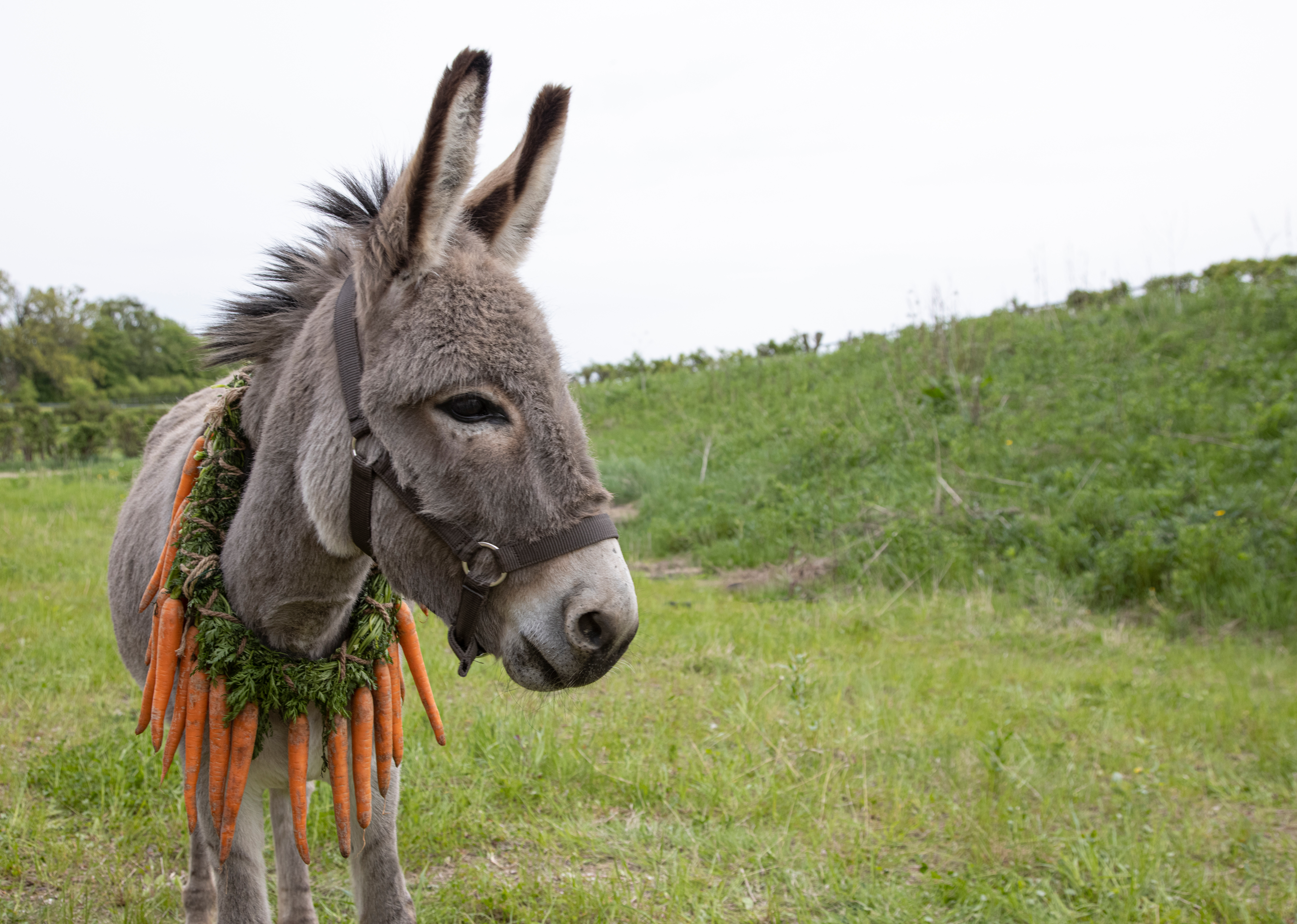
The titular donkey sports a necklace made of carrots in Poland’s EO. (Photo courtesy of Aneta and Filip Gebscy)
Four-legged love story
Polish director Jerzy Skolimowski has made no secret of the fact that EO, his journey through the life of a lowly donkey, was inspired by the 1966 classic Au Hasard Balthazar. The differences couldn’t be starker.
While French director Robert Bresson told his own donkey-centered tale in a typically minimalistic manner, Skolimowski and cinematographer Michael Dymek ply us with images that are often ornate and sometimes surreal. There are strobe effects, infrared effects, POV shots, dreamlike flashbacks and nightmare-like sequences. There’s even a scene involving a mechanical dog that seems to appear out of nowhere.
Story-wise, the two films’ approaches are also different. While Bresson focused on people, the title donkey being merely an unwilling pawn in their difficult lives, Skolimowski turns his leading animal into a full-fledged protagonist.
Essentially, the new film is a love story between EO and Kasandra (Sandra Drzymalska), a woman who takes him under her wing while they’re working together in a traveling circus. After bankruptcy forces the circus to sell off its four-legged performers, the two are separated, but they never forget each other. In particular, EO is haunted by memories of happy moments he shared with Kasandra, which lead him to take actions that don’t always work out in his favor.
Like Bresson’s film, EO lends itself to larger questions about human nature, including our cruelty toward each other and toward the animals in our care. Both works also offer deep levels of allegorical meaning for those into religious, and particularly Christian, symbolism.
So which film is better?
Bresson’s is more perfect in its absolute simplicity, in contrast to which Skolimowski’s cinematic showmanship can be distracting. On the other hand, that showmanship frequently results in strikingly beautiful images. Along with its personable star, that gives EO viewers a lot to love.
Rating: 3½ stars (out of 5)
EO (no MPAA rating) will be available from VOD outlets beginning Feb. 21.
Ricardo Darin (left) and Peter Lanzani star in the fact-based courtroom drama Argentina, 1985.
Dictatorship’s abuse confronted
Argentina, 1985 is based on an actual attempt to bring to justice those who tortured, raped, murdered and “disappeared” thousands of Argentinians during the long reign of a right-wing dictatorship.
Ricardo Darin stars as Julio Cesar Strassera, who’s appointed to prosecute the officials responsible for the former regime’s acts of terror. It’s not a task he accepts gladly, as many of his friends and relatives supported such acts in the name of fighting communism. Among them are most of his colleagues, complicating his ability to form the legal team he needs to take on his monstrous assignment.
Coming to his rescue is Luis Moreno Ocampo (Peter Lanzani), a younger man who’s assigned to serve as Strassera’s deputy. Together, they put together a team consisting largely of idealistic students and instruct them to comb the countryside in search of people who can testify about abuses they suffered at the hands of government-sponsored thugs.
Director/co-writer Santiago Mitre handles this potentially explosive story in a surprisingly low-key manner and even adds touches of humor. That prevents the film from descending into melodrama, particularly when victims of the previous regime finally get the chance to tell their shocking stories in a nationally televised hearing.
One puzzling aspect of the case Strassera presents is that he seemingly makes little effort to connect these repulsive crimes with the suspects. It could be that Mitre simply left out that part of the testimony to underscore the fact that Strasser’s most important task is to convince the divided public that the crimes are worth prosecuting in the first place.
Or, as the prosecutor puts it so powerfully, “Nunca mas.” English translation: “Never again.”
Rating: 4 stars (out of 5)
Argentina, 1985 (rated R) is available through Amazon Prime Video.
Cait (Catherine Clinch, left) is greeted by Eibhlin (Carrie Crowley) after a long journey in Ireland’s The Quiet Girl. (Photo courtesy of EF Neon)
Lonely girl finds temporary reprieve
The Quiet Girl centers on Cait (Catherine Clinch), a 9-year-old who tends to keep to herself. She’s not happy at school, and she’s even less happy in her overcrowded home, where she gets little attention from her overworked mother or her philandering, heavy-drinking father.
Then her mother gets pregnant yet again, and Cait is sent off to live with relatives in another part of rural Ireland until things get back to normal. This turns out to be an unexpected blessing. Her mom’s cousin Eibhlin (Carrie Crowley) welcomes her with the kind of love and warmth she’s never known. And while Eibhlin’s husband, Sean (Andrew Bennett), is stand-offish at first, he puts her to work on their farm and soon begins to show signs of acceptance.
Directed in an appropriately quiet manner by Colm Bairead, who based the Irish-language script on a story by Claire Keegan, this is no maudlin, feel-good flick. We eventually learn that Eibhlin and Sean are hiding a secret whose effect on their lives is painful and intractable. And then there’s the question of Cait’s future: How long will her newfound happiness last if, as planned, she’s forced to return to her family?
Thanks to sensitive direction and fine performances all around, The Quiet Girl reveals its secrets and delivers its answers in a way that will likely leave a lump in your throat. After its Irish cousin, The Banshees of Inisherin, it’s my favorite film of 2022.
Rating: 4½ stars (out of 5)
The Quiet Girl (PG-13) opens in select theaters Feb. 24 and will be screened March 10-12 at Columbus’s Gateway Film Center.
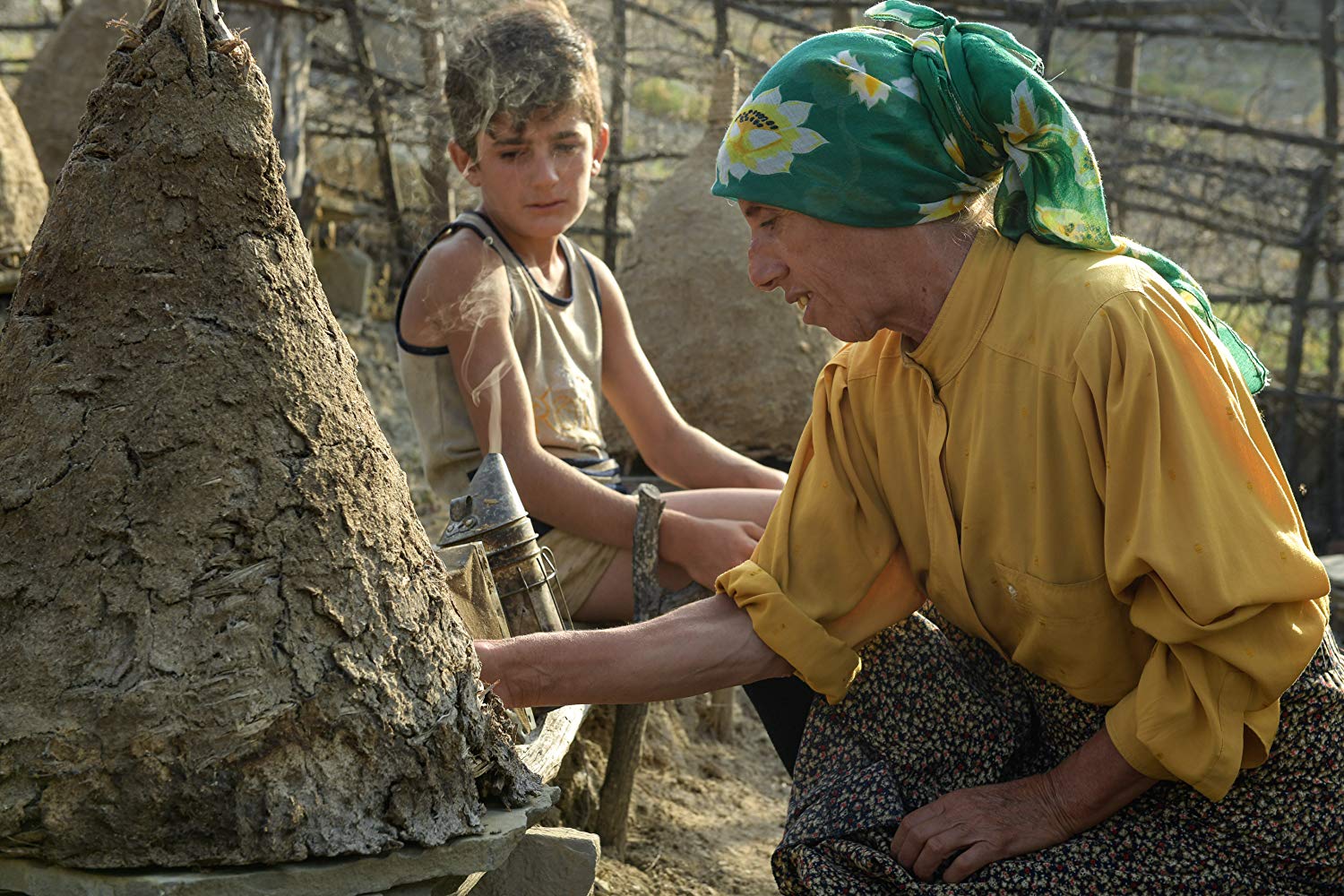
Beekeeper Hatidze Muratova tends to one of her hives while a young neighbor watches in a scene from Honeyland.
By Marilyn Fais and Richard Ades
Note: Guest critic Marilyn Fais helps review Honeyland, a film from North Macedonia that has been nominated for Academy Awards in two categories: Documentary and International Feature. Directed by Tamara Kotevska and Ljubomir Stefanov, the film originally was meant to be a short documentary about the land surrounding a river in the country’s central region. Then the filmmakers met Hatidze Muratova, a 50-something woman eking out a living as a beekeeper, and they ultimately decided to focus their lens on her unusual life.
If you decide to see Honeyland, don’t expect any big moments, but expect to be captivated by many small moments. Taking place in a remote area of North Macedonia, the film follows one woman, Hatidze Muratova, as she goes about her subsistence life as a beekeeper.
She’s in her mid-50s and lives with her ailing mother. They have no neighbors, and it appears they’re the only people around for miles.
Then they get neighbors—a large nomadic family led by Hussein and Ljutve Sam—and the interactions that follow add new complications to Hatidze’s difficult existence. Between her reactions to these newcomers and her brief but poignant talks with her mother, viewers gain new insights into Hatidze’s life and philosophy.
In the process, they also gain insights into the challenges faced by anyone attempting to live in harmony with the natural world. These make this unusual film both intensely personal and sadly universal.
Rating: 4 stars (out of 5)
Honeyland opens Feb. 7 at the Gateway Film Center in Columbus.
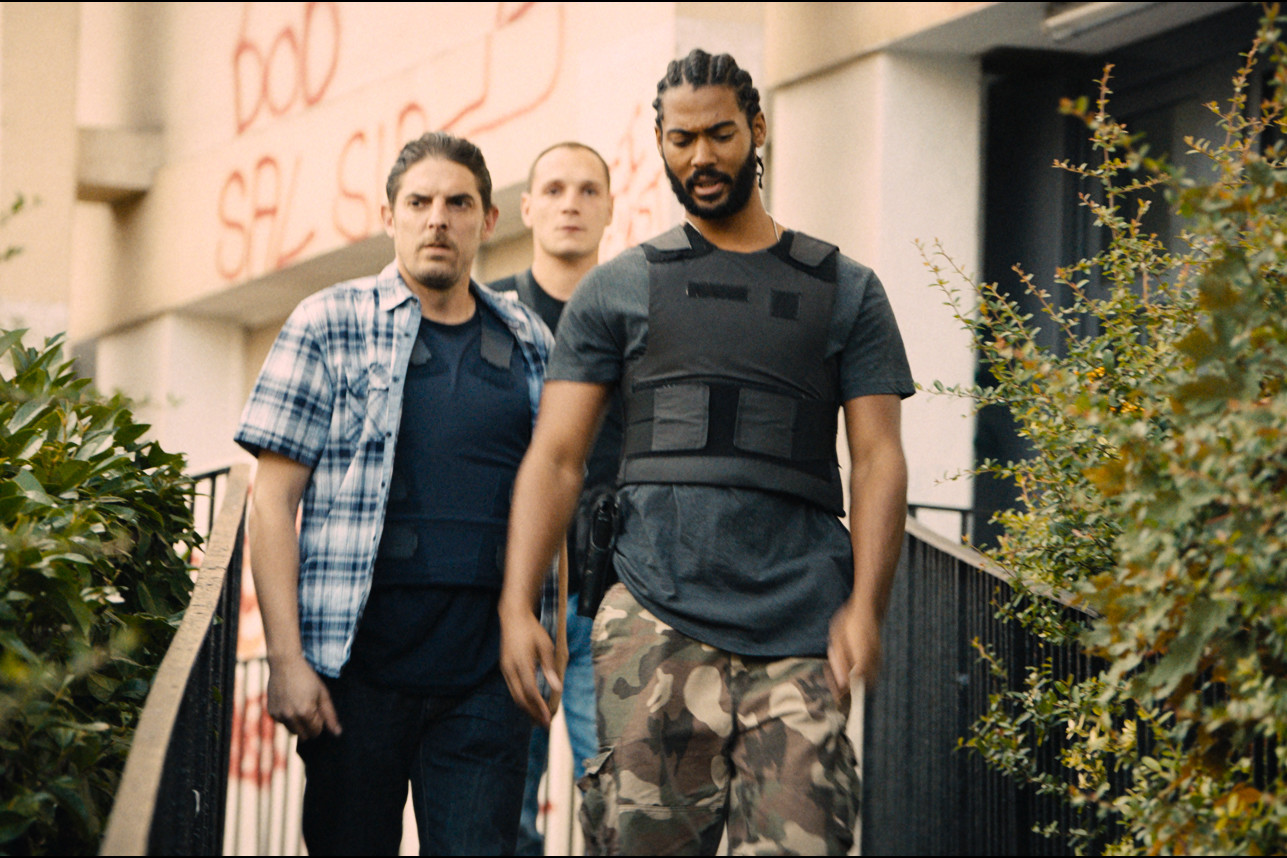
Three plain-clothes cops (Damien Bonnard, Alexis Manenti and Djibril Zonga, from left) patrol a poor Parisian neighborhood in Les Misérables. (SRAB Films/Rectangle Productions/Lyly Films)
By Richard Ades
As Les Misérables opens, a group of dark-skinned youths joyfully celebrate France’s 2018 World Cup championship by taking part in a public event that includes a mass rendition of “La Marseillaise.” Director Ladj Ly’s apparent message: Despite being immigrants or the children of immigrants, the boys consider themselves just as French as those around them.
As Ly’s camera follows them back to their segregated Parisian neighborhood, however, we realize they don’t enjoy the same opportunities as their countrymen. This isn’t Victor Hugo’s Les Misérables—there’s no Jean Valjean, no Javert, no idealistic revolutionaries. But there’s more than enough injustice to light the fuse of revolt, just as it did in Hugo’s tale.
The question is: Will it? Leading up to the answer is a harrowing dive into the lives of modern-day immigrants.
The Malian-born Ly, directing and co-writing his first full-length film, doesn’t create a one-sided portrait of discrimination. Those who take advantage of the local residents include a racist white cop named Chris (Alexis Manenti), but they also include the neighborhood’s black “Mayor” (Steve Tientchev), who uses his power to line his own pockets. There’s also a group of thugs who consort with the police to further their illegal activities.
We’re introduced to the resulting cauldron of resentment through the eyes of newcomer Stephane (Damien Bonnard), a divorced cop who’s moved to Paris to be closer to his young son. He’s assigned to ride along with Chris and his Malian-French partner, Gwada (Djibril Zonga), and soon becomes appalled by the liberties Chris takes with residents—for example, finding excuses to body-search teenage girls.
But before he can decide how to respond, Stephane and the others are thrown into the middle of potentially explosive situation brought on by a seemingly small crime: the theft of a lion cub from a traveling circus. This brings them into contact with two local boys—the trouble-prone Issa (Issa Perica) and the drone-flying Buzz (Al-Hassan Ly)—as well as a devout Muslim restaurateur named Salah (Almamy Kanoute). Thus begins a chain of events that results in unforeseen consequences for all concerned.
Why name this contemporary tale Les Misérables? That’s spelled out when the film ends with a quote from Hugo: “There are no such things as bad plants or bad men. There are only bad cultivators.”
Viewers may quibble about whether Ly has proved the maxim, just as they may differ on whether it should win the “International Feature Film” Oscar for which it’s been nominated. (Probably not, as South Korea’s Parasite seems a worthy shoo-in.) But they’re likely to agree that Ly has created an exciting cautionary tale and an impressive full-length debut.
Rating: 4 stars (out of 5)
Les Misérables (rated R) opens Jan. 24 at the Drexel Theatre and Gateway Film Center.
Rolf Lassgard as the gruff title character in A Man Called Ove
By Richard Ades
Fans of the British TV series Doc Martin know grumpy heroes can be both endearing and entertaining. Now we have a Swedish movie, A Man Called Ove, that aims to prove they can be just as endearing and entertaining in a country that drives on the opposite side of the road.
If the flick doesn’t succeed quite as brilliantly, it’s because director/screenwriter Hannes Holm doesn’t have the series’ knack for tickling us with quirky comedy before surprising us with heart-stopping suspense or heartwarming drama. The film, adapted from Fredrik Backman’s bestselling novel, takes a more direct route to our emotions.
We first meet Ove (Rolf Lassgard) when he’s haggling with a store clerk over the price of a bouquet of flowers. He comes off as an unreasonable, disagreeable curmudgeon. Then, in the next scene, we realize he bought the flowers to take to his late wife’s grave. Oops. I guess we should give the old guy a break.
Another reason for pitying him arrives when his young bosses call him into their office and pretend they’re doing him a favor by laying him off from the company where he’s worked for 43 years. Little wonder that Ove—wifeless, friendless and now jobless—is soon attempting suicide. The only thing that stops him is the arrival of a new family of neighbors led by Parvanah (Bahar Pars), a pregnant Iranian immigrant who immediately begins inserting herself into Ove’s lonely existence.
From this point on, the film revolves on the question of whether the friendly Parvanah will succeed in renewing Ove’s interest in the world and those who share it. Though he continues trying to join his wife in the great beyond, the film gives us little reason for pessimism. For one thing, Parvanah is such a bubbly force of nature that it’s impossible to believe he can resist her for long. For another, numerous episodes reveal that Ove is far less misanthropic than he pretends to be.
One such incident involves another Doc Martin parallel: Just as Martin is bedeviled by a homeless dog that refuses to leave him alone, Ove is bedeviled by a fluffy homeless cat. Yet as soon as the cat is threatened, he comes to its rescue.
Other scenes depict Ove as downright heroic. At times, when he alone steps forward to prevent a tragedy, he appears to be the only heroic person in Sweden.
Through much of the film, incidents from Ove’s current life are interspersed with flashbacks to his childhood and young adulthood. The most charming of these depict how he met Sonja (Ida Engvoll), the outgoing woman who became his wife. The most puzzling involves an encounter with one of the dictatorial officials he refers to as “whiteshirts.”
The flashbacks show the developments that helped to turn Ove into the sad individual he’s become, but in the process they give the film an episodic structure. They also reinforce the flick’s tendency toward heavy-handed melodrama.
Though flawed, A Man Called Ove paints a warm portrait of an aging individual who’s given a well-deserved second chance at life. As a popular example of modern Swedish cinema—it’s the country’s nominee for a Foreign Language Film Oscar—it may come as a pleasant surprise to those more familiar with the dour works of Ingmar Bergman.
As for fans of Doc Martin who are looking for an emergency dose of curmudgeonhood, they’ll probably be less satisfied. Fortunately for them, an eighth (and supposedly last) season is set to air next year.
Rating: 3 stars (out of 5)
A Man Called Ove, rated PG-13, opens Friday (Oct. 21) at the Drexel Theatre, 2254 E. Main St., Bexley.







 Reel Time With Richard Ades