Third time is hardly a charm for Shakespeare’s Falstaff

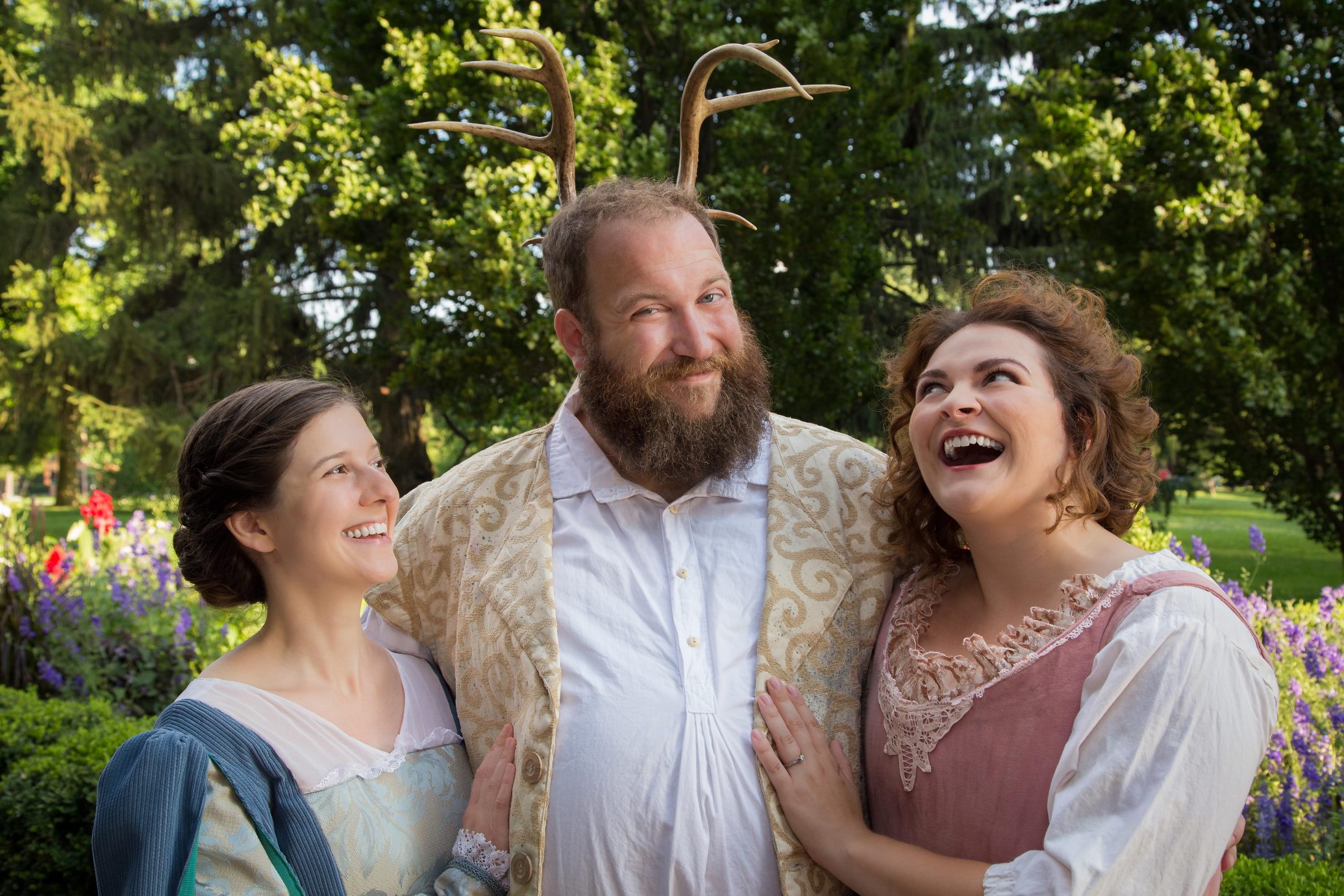
Appearing in The Merry Wives of Windsor are (from left): Elizabeth Harelick as Mistress Ford, Adam Simon as Sir John Falstaff and Michelle Weiser as Mistress Page (photo by Nick Pershing)

By Richard Ades

Fat and vain, cowardly and conniving, Sir John Falstaff is one of Shakespeare’s greatest comic inventions. But you have to catch him in one of the Bard’s Henry IV plays to see him at his best.

In The Merry Wives of Windsor—which some believe was written because Queen Elizabeth I wanted to see more of the entertaining scamp—he’s simply the butt of the joke. The result is a comedy that’s less fun than it would have been if he were as sly and resourceful as he is in Henry IV, Parts 1 and 2.

On the Schiller Park stage, director Beth Kattelman and her cast try their hardest to extract laughs from his misadventures, and sometimes they succeed. More often, though, they merely succeed in raising the volume with shouted lines and over-the-top acting.

The plot starts promisingly enough. While staying at an inn in Windsor, Falstaff (Adam Simon) realizes he can no longer afford his hard-partying lifestyle. He quickly comes up with the idea of improving his finances by romancing Mistresses Ford and Page (Elizabeth Harelick and Michelle Weiser), two local married ladies.

Unfortunately for Falstaff, the ladies are close friends who share everything—including the identical love notes he sent them. Insulted, they agree to concoct a romantic trap in order to teach him a lesson.

What happens next should be a delicious case of comeuppance, and it would be if Falstaff weren’t so darn gullible. Instead, he’s such an easy mark that the wives are able to fool him over and over. What starts out amusingly soon becomes predictable and repetitious. And it doesn’t help matters that the mostly admirable Harelick and Weiser go overboard on the faux melodramatics whenever they’re conning the lascivious knight.

An added complication provides a few chuckles. After Falstaff’s disgruntled former servants tell the wives’ husbands what their ex-boss is up to, the jealous Ford (Micah Logsdon) decides to investigate. Introducing himself as a man named Brook, he tells Falstaff he has long lusted after Mistress Ford but can’t persuade her to abandon her marital vows. He invites Falstaff to compromise her integrity in order to make her more open to his advances.

The early scenes between Falstaff and the disguised Ford are nicely handled by Simon and Logsdon, but the latter eventually gives in to the production’s tendency toward over-emoting.

A romantic subplot involves the Pages’ daughter, Anne (a winsome Cecelia Bellomy), who is being courted by a trio of suitors. Here, some characters stand out thanks to inspired comic performances, including the idiotic Slender (Dayton Willison), the extravagantly French Dr. Caius (Daniel Turek) and Caius’s mischievous servant, Mistress Quickly (Jennifer Feather-Youngblood). Meanwhile, Jesse Massarro shows welcome restraint as third suitor Fenton, as does Nick Baldasare as Anne’s father.

Stefan Langer also fares well as Welsh clergyman Sir Hugh Evans. He doesn’t actually display the incoherent accent that others joke about, but it’s hard to blame him for that. Apparently the Welsh accent was pretty heavy in Shakespeare’s time, but nowadays it’s far more subtle.

Thus, the Welsh jokes fall as flat as pretty much everything else in this heavy-handed comedy.

Actors’ Theatre will present The Merry Wives of Windsor through Aug. 31 at the Schiller Park amphitheater, 1069 Jaeger St. Show times are 8 p.m. Thursday-Sunday. Running time: 2 hours, 30 minutes (including intermission). Admission is “pay what you will.” Bring a blanket or lawn chair. 614-444-6888 or theactorstheatre.org.

Columbus School for Girls grad excels as melancholy Dane

Grace Bollander, a graduating senior at Columbus School for Girls, plays the conflicted title character in Hamlet (photo by Nick Pershing)
Grace Bolander, a graduating senior at Columbus School for Girls, plays the conflicted title character in Hamlet (photo by Nick Pershing)

By Richard Ades

Can an 18-year-old high school student do justice to one of the greatest roles in the English language? When that student is Grace Bolander, yes, indeed.

Actors’ Theatre has pushed the envelope with its season-opening production of Hamlet, giving the title role to an actor who is not only a teenager but a female to boot. If you suspect the casting is simply an attention-getting gimmick, you obviously haven’t seen the show. Once you do, you’ll realize that Bolander was simply the best person for the part.

Over the years, I’ve witnessed various takes on the Danish prince, all attempting to explain a puzzling man who seems eager to avenge his father’s murder, yet keeps finding excuses to delay action. Bolander quickly puts her own stamp on the character, portraying him as tearfully emotional one moment and wickedly humorous the next.

She also ups the tempo at key moments, allowing the familiar words to tumble out in a dazzling torrent. Once or twice, the words come a little too fast, rushing the dialogue, but overall her performance is remarkable.

Despite Bolander’s star-making turn, the best thing about Actors’ Theatre’s production is that every performance is remarkable. Co-directed by Nick Baldasare and John S. Kuhn and set in the late Victorian era, this Hamlet interprets each character with clarity and conviction.

John Heisel is a combination of dull-witted malice and honest remorse as King Claudius, the uncle who allegedly stole his throne by murdering Hamlet’s father. As Gertrude, Hamlet’s mother and Claudius’s new bride, Janetta Davis exhibits both wifely support and—after her distraught son shows signs of mental instability—maternal concern.

Josh Katawick is a rock as Horatio, the one friend Hamlet trusts. John Quickley and Sarah Gehring portray Rosencrantz and Guildenstern as such superficial simps that it’s clear why they’re the friends Hamlet doesn’t trust.

As the aged Polonius, John Feather is humorously doddering and sanctimonious. As Ophelia, his daughter and the object of Hamlet’s affection, Rachel Gaunce projects sweetness and innocent virtue.

More solid work is turned in by John Connor as Laertes, Greg Hoffman as the ghost of Hamlet’s father, Jordan Estose as Osric/Messenger, John Beeler as Marcellus/Lucianus, Andy Falter as the Leading Player and Christina Yoho as the acrobatic Player Queen.

Providing able technical support are designers Trent Bean (set), Emily Jeu (costumes), Jarod Wilson (lighting) and William Bragg (sound). Jason Speicher choreographed the climactic fight scene.

In recent years, Actors’ Theatre has branched out from its traditional focus on Shakespeare in an attempt to broaden its audience. And when it did take on the Bard, it sometimes did so in a way that was designed to amuse non-Shakespeare fans: for example, by mixing puppets with live actors (good idea) or by adding jokey pop-culture references and slapstick (bad idea).

Despite its unconventional casting, the current production provides welcome evidence that Actors’ remains capable of doing Shakespeare straight and putting on a great show in the process.

Actors’ Theatre will present Hamlet through June 22 at the Schiller Park amphitheater, 1069 Jaeger St. Show times are 8 p.m. Thursday-Sunday. Running time: 2 hours, 15 minutes (including intermission). Admission: Pay what you will. Bring a blanket or lawn chair. 614-444-6888 or theactorstheatre.org.
Special event: A memorial for Columbus actor Carl Novak, who died unexpectedly last month, will be held at 2 p.m. Friday (May 30) at the Schiller Park amphitheater.

All Shakespearean updates are not created equal

Susan Wismar (Maria), Andy Falter (Sir Toby), Jesse Massaro (Malvolio) and Adam Poe (Sir Andrew) in a scene from Twelfth Night (photo by Dale Bush)
Appearing in a scene from Twelfth Night are (from left) Susan Wismar (Maria), Andy Falter (Sir Toby), Jesse Massaro (Malvolio) and Adam Poe (Sir Andrew) (photo by Dale Bush)

By Richard Ades

There’s more than one way to update Shakespeare.

One approach, perfected by Josh Whedon’s modern-dress film version of Much Ado About Nothing, is to ignore the time period and concentrate on the story. The effect is to emphasize the timelessness of the characters and their predicaments, even if their language is a particularly flowery form of Elizabethan English.

Another approach is to use the time period and setting to add another layer of meaning to the play—for instance, by relocating Macbeth to a politically unstable part of the world.

Yet a third approach is to use the time period as a way to make the play more accessible to the average theatergoer. That’s the tack Actors’ Theatre has taken with its 1980s version of Twelfth Night.

To tell the truth, I tend to see this approach as a form of surrender. It’s like the thespians have decided it’s too hard to persuade viewers to appreciate Shakespeare for his own sake, so they add a veneer of recognizable references. It’s particularly puzzling when they apply this method to Twelfth Night, which may be the most likable of all the Bard’s comedies.

That said, it must be stated that much works just fine in the production director Mandy Fox has put together on the nifty pastel-colored set Trent Bean has designed for the Schiller Park stage.

Most importantly, Kayla Jackmon is appealing as Viola, the young woman who washes ashore in an unfamiliar land following a shipwreck. We automatically root for her as she responds to her dire situation by disguising herself as a male eunuch and going to work for the love-struck Duke Orsino (Andrew Blasenak).

Also working just fine are the comical figures we meet at the house of the noblewoman Orsino is love-struck for, Olivia (Ashley Frisch). Andy Falter is a Miami Vice-attired hoot as her drunken uncle, Toby Belch, while Adam Poe puts his short stature to humorous use as Olivia’s would-be suitor, Sir Anthony Aguecheek. In addition, Liz Light sings nicely as Olivia’s fool, Feste, and Susan Wismar earns laughs with a Valley Girl interpretation of Olivia’s conniving servant, Maria.

From a comedy standpoint, all this sounds pretty good. But the problem is that director Fox seems to have decided that everything in this updated Twelfth Night has to be played for laughs. Not only does this approach rob the tale of some charming moments, but it forces the actors to find humor in characters that aren’t meant to be funny.

In the first scene, while Viola worries that she lost twin brother Sebastian (Cornelius Hubbard Jr.) in the shipwreck, Ben Sostrom depicts the sea captain who rescued her as a fey stereotype. Needless to say, this undercuts the sadness of the moment.

Viola (Kayla Jackmon, left) unwittingly wins the love of Olivia (Ashley Frisch) while masquerading as a man in Twelfth Night (photo by Dale Bush)

Later, we’re introduced to Orsino and his ongoing attempt to woo Olivia despite her pledge to spend the next seven years mourning her late brother. In most productions, Orsino is depicted as a soulful romantic, making him a fitting target for the adoration the disguised Viola comes to feel for him. Here, though, Orsino comes across as a love-struck buffoon, making Viola’s crush seem shallow and inconsequential.

The worst part of all this is that, having played the comedy’s gentler moments for laughs, the actors are forced to up the ante by playing the more-boisterous moments for even bigger laughs. As the show goes on, some cast members over-emote in a style that seems more appropriate for the vaudeville era than the 1980s.

When Olivia falls for the young “man” Viola is impersonating, Frisch turns her into a caricature of a woman in heat. When Olivia’s dictatorial steward, Malvolio (Jesse Massaro), is fooled into thinking he’s the object of his lady’s desires, he shouts his protestations of love so loudly that you’d think he was courting someone in the next county. Then, just in case the odd audience member is still unaware that something funny is supposed to be going on, Toby and his friends take the stage decked out in Ghost Busters paraphernalia.

All this overwhelms the alternately clever and tenderly romantic tale that is Twelfth Night, which could have absorbed the 1980s pop references but can’t survive all the bombast.

“Prithee read i’ thy right wits,” Olivia pleads at one point as Feste is reading a letter out loud and making a mockery of it in the process. You can’t help wishing the director and her cast had taken her words to heart.

Actors’ Theatre will present Twelfth Night through July 28 at the amphitheater in Schiller Park, 1069 Jaeger St. Show times are 8 p.m. Thursday-Sunday. Running time: 2 hours, 10 minutes (including intermission). Admission is free; bring a blanket or lawn chair. 614-444-6888 or theactorstheatre.org.