Fight for freedom is fueled by revolutionary art

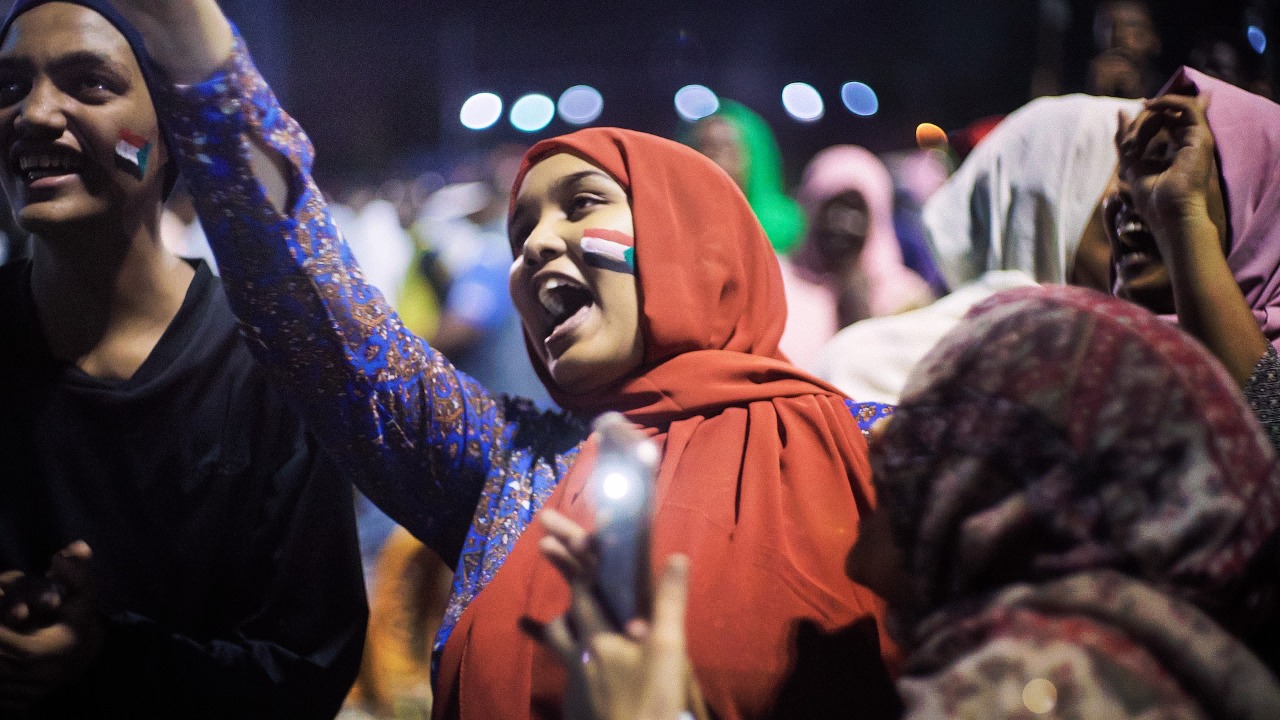
A woman demonstrates against repression in the documentary Sudan, Remember Us.

By Richard Ades

While much of the world is rightfully concerned about what’s going on in Gaza, the northeast African country of Sudan may be the site of even greater misery, if only because its population is far larger. After years of dictatorships, military coups, rebellion and civil war, its people—those who haven’t fled—find life a daily struggle.

The documentary Sudan, Remember Us is a record of the ways young Sudanese rebels tried to head off the current situation by fighting repression and pushing for change. These protesters are remarkable for the courage they display, but also for their creativity, as they often use poetry and other forms of art to make their points.

Written and directed by French-Tunisian filmmaker Hind Meddeb, the doc begins with scenes of military strife in Khartoum in 2023, representing the beginning of the civil war that still engulfs the country. It then flashes back four years to the spring of 2019, when a rebellion has ended the long reign of dictator Omar Al-Bashir.

The victory leaves the rebels, all young and many of them female, filled with optimism and resolve. With signs, murals, chants, songs, poems and sit-ins, they push for the freedoms they were denied under Al-Bashir’s rule.

Unfortunately, Sudan’s window of opportunity for change is short-lived. On the last night of Ramadan, soldiers attack a sit-in demonstration, leaving many of the protesters dead and ushering in a military crackdown.

The main frustration of watching Meddeb’s documentary is that it’s so embedded in Sudan’s struggles that it makes little attempt to explain them to outsiders. We’re seldom told what the political situation is at any particular moment, though the film makes it clear just how the changes affect the gutsy rebels.

After the initial crackdown in 2019, they continue protesting via poetry, songs and other means, but at one point the atmosphere becomes even more ominous. We’re told that the internet has been shut down and that political arrests are now carried out in secret by unidentified men in plain clothes.

This development is guaranteed to send chills down the spines of Americans who’ve noticed the parallels in our own country: the attempts to silence and even defund critical media voices, as well as the expanding army of masked agents who seize people off the streets or at their jobs, often ignoring their rights or legal status.

An important difference is that Sudan doesn’t have America’s history of democracy, though so far it has failed to stop the executive branch’s adoption of an autocratic playbook. On the other hand, Sudan seems to have an unusual affinity for inspirational music, poetry and other art, which buoyed rebels’ spirits and determination when their quest seemed increasingly hopeless.

Any American who was alive back in the 1960s knows that we once had a similar appetite for revolutionary art. Maybe it’s time we got it back.

Rating: 4 stars (out of 5)

Sudan, Remember Us can be seen at select theaters and will open Aug. 15 at the Gateway Film Center in Columbus.

Decades later, ‘The Lion King’ still roars

The Lion King begins with “The Circle of Life,” which celebrates the birth of King Mufasa’s son, Simba. (Photo by Matthew Murphy; photos courtesy of Disney)  

By Richard Ades

It was almost exactly 20 years ago that I first saw the onstage version of The Lion King. After seeing it again last week, I looked up my review of that earlier production and realized it applies equally well to the current touring show.

That says a lot for the quality of the new production and for the timelessness of director Julie Taymor’s vision. The Lion King could have been just another Disney cartoon adapted for the stage, but Taymor employed African-inspired costumes, masks, puppetry and dance moves and turned it into a cultural phenomenon.

For her efforts, in 1998 Taymor became the first woman to win the Tony Award for best direction of a musical. In addition, the original Broadway production won well-deserved Tonys for scenic design (Richard Hudson), costume design (Taymor), lighting design (Donald Holder) and choreography (Garth Fagan) as well as the overall award for best musical.

Though the beautiful music and lyrics by Elton John and Tim Rice (and others) did not win a Tony, they contribute to the show’s groundbreaking character, starting with the fact that some of the key lyrics are in Swahili.

Maybe it’s less surprising that the book by Roger Allers and Irene Mecchi was Tony-less, as the story is simple and predictable: A majestic lion rules wisely over his kingdom until a jealous brother engineers his demise, after which the monarch’s young son must decide whether to fight for justice and his position as the rightful heir.  

It’s a tale as old as time—or at least as old as Hamlet. What makes it compelling is the show’s spirit and style, as delivered by a committed cast of fine actors, singers and dancers.

Cheetahs and giraffes are among the animals creatively portrayed with the help of life-size puppets. (Photo by Joan Marcus)

Major figures in the current touring show are Gerald Ramsey as the noble King Mufasa; Peter Hargrave as his villainous brother, Scar; Nick LaMedica as Mufasa’s hornbill steward, Zazu; Darian Sanders as the grownup version of the prince, Simba; and Khalifa White as Simba’s friend, Nala.

Appearing in alternate performances as the younger versions of the latter two characters are Bryce Christian Thompson and Julian Villela as Simba, and Ritisha Chakraborty and Leela Chopra as Nala.

Finally, special mention must be made of Mukelisiwe Goba as Rafiki, the all-seeing mandrill (or is she a baboon?) who serves as viewers’ guide and narrator. When she gets things started with her full-throated rendition of “The Circle of Life,” we know this iconic show is in good hands.

As it was from the beginning, thanks to Julie Taymor.

P.S. Danya Taymor followed in her aunt’s footsteps Sunday by winning the Tony Award for best direction of a musical (The Outsiders, which also won for best musical). Obviously, talent runs in the family.

CAPA and Broadway in Columbus will present The Lion King through July 7 at the Ohio Theatre, 39 E. State St., Columbus. Showtimes are 7:30 p.m. Tuesdays-Thursdays (except July 4), 8 p.m. Fridays, 2 and 8 p.m. Saturdays, 1 and 6:30 p.m. Sundays, plus 2 p.m. June 20, 7:30 p.m. July 1 and 1 p.m. July 4. Running time: 2 hours, 30 minutes (including intermission). For ticket information, visit columbus.broadway.com. For information on future tour stops, visit lionking.com/tour/.