Catherine Deneuve stars as the title character in The President’s Wife, a fictionalized biopic of French first lady Bernadette Chirac. (Photo courtesy of Cohen Media Group)
By Richard Ades
What’s it like to be the wife of a leader who forces you to live in his shadow and ignores your political advice? The President’s Wife answers that question with its feminism-informed biography of former French first lady Bernadette Chirac.
But don’t expect a sober-minded piece of historical revisionism. The film, directed and co-written by Lea Domenach, refuses to take itself too seriously, and it’s clear from the first scene that we shouldn’t, either.
As Bernadette (the legendary Catherine Deneuve) makes her way to a confessional booth for a heart-to-heart with her priest, the church choir informs us that what we’re about to see is based only loosely on reality. In fact, the singers warn us, it’s a “work of fiction.”
Still, it’s hard not to hope that what follows is least partly true, because it’s a delicious story of self-reinvention and political comeuppance.
We first meet Bernadette in 1995, when her husband, Jacques Chirac (Michel Vuillermoz), is on the verge of winning the presidency. A politician in her own right, Bernadette has worked hard to bring about this long-sought victory, but once the new administration takes office, she’s quickly pushed to the background.
With her dated wardrobe and occasionally loose lips, Bernadette is seen as a liability by both her husband and her younger daughter, Claude (Clara Giraudeau), who works as one of his chief aides. The two even go so far as to assign a communications adviser named Bernard (Denis Podalydes) to help Bernadette hone her image. The idea is to keep the first lady from embarrassing and upstaging the president.
However, the plan soon backfires.
After a series of events provide proof of (1) Bernadette’s political smarts and (2) Jacques’s marital unfaithfulness, Bernard switches his allegiance from the husband to the wife. Together, Bernard and Bernadette begin working to improve her image through such tacks as promoting charities, rubbing elbows with celebrities and, mostly, just being herself.
To put it mildly, their efforts prove fruitful for Bernadette and entertaining for the audience. (Watch for the trained bear!)
Anyone who’s less than fully knowledgeable about French politics might lose a reference here and there, but it’s just a slight inconvenience. Thanks to Domenach’s witty script and playful direction—and thanks to a great cast and especially to Deneuve’s droll and assured performance as Bernadette—The President’s Wife is one history class you won’t want to skip.
Rating: 4 stars (out of 5)
The President’s Wife opened April 18 in major cities and will expand to other markets beginning April 25. It is scheduled to open May 9 at Columbus’s Gateway Film Center.
A motion-captured Jonno Davies plays a simian version of British pop star Robbie Williams in Better Man. (Photo courtesy of Paramount Pictures)
By Richard Ades
This is the time of year when critics get a chance to catch up on recent flicks they might have missed, courtesy of studios in search of buzz and, hopefully, award nominations. While I don’t claim to be clairvoyant when it comes to the latter, I can confidently say this: If the Oscars and other competitions gave out prizes for bravery, these three films and their creators would win hands down.
One filmmaker displays creative courage by breaking the mold in a familiar genre, while the others put their liberty and even their lives at risk in order to bring their truths to the screen.
Let’s look at them one by one.
Biopic with a difference
By now, we all know the drill when it comes to film biopics: The would-be celeb claws his or her way to the top, but success comes at a steep cost. Friends are abandoned, spouses are cheated on, and alcohol and/or drugs are abused.
Better Man, based on the life of British pop superstar Robbie Williams, follows that general pattern, but with a difference. The entire story unfolds through the eyes (and narration) of Williams himself, who emerges as someone who desperately wants fame but is convinced he doesn’t deserve it.
And, oh yes: Williams is portrayed by a CGI-generated chimpanzee (a motion-captured Jonno Davies). It sounds weird—and, frankly, it is—but it also makes sense in a brilliant and emotionally satisfying way.
Even as a child, Williams suffers from self-doubt, self-loathing and what he later comes to identify as depression. By making him the lone ape in a world of humans, the film has found a clever way of symbolizing Williams’s fear that he’s an imposter unworthy of the success he seeks.
Directed with theatrical flair by Michael Gracey (The Greatest Showman), Better Man is marked by gee-whiz, over-the-top production numbers and surreal fantasy sequences, in addition to its simian protagonist. But what really sets it apart is its honesty and warmth.
Despite being depicted as an ape, Williams comes off as a recognizably flawed human who earns our sympathy, as well as the heart-on-its-sleeve sendoff the film gives him. Director Gracey’s gamble has paid off with a flick that’s as moving as it is massively entertaining.
Rating: 4½ stars (out of 5)
Better Man (rated R) opened Dec. 25 in select theaters and expands nationwide Jan. 10.
National unrest and a missing gun upset the lives of Iranian student Rezvan (Mahsa Rostami, center), her mother (Soheila Golestani, left) and sister (Setareh Maleki) in The Seed of the Sacred Fig.
Criticizing—and then escaping—Iran
As an attack on Iran’s government and justice system, The Seed of the Sacred Fig is the kind of film that can’t be made in that country. And yet veteran writer/director Mohammad Rasoulof succeeded in making it—in secret—before fleeing to Europe for his own safety.
The thriller concerns Iman (Missagh Zareh), who aspires to be a judge but learns that the path to success will force him to ignore his moral compass. He lands a position that requires him to sentence people to death without being given a chance to consider the evidence.
As it turns out, the position endangers more than just his conscience. Because of the job’s controversial nature, he and his wife, Najmeh (Soheila Golestani), and their family are forced to live in secrecy. Meanwhile, daughters Rezvan and Sana (Mahsa Rostami and Setareh Maleki) become embroiled in the widespread unrest that erupts after a young woman is beaten and killed for not sufficiently covering her head.
Then the gun that Iman keeps for protection turns up missing, and the national turmoil threatens to spread to his household as he searches for the culprit. Interrogations ensue, along with a car chase and a tense finale that may remind some of a certain horror film set in a snowbound hotel.
Considering it was made in secret and by a director who’d already gotten in trouble for earlier works, The Seed of the Sacred Fig should fill viewers with admiration for Rasoulof’s resourcefulness, as well as his courage. The film deserves an Oscar nomination, but it probably won’t get one, because who would nominate it? Certainly not Iran.
Rating: 4½ stars (out of 5)
The Seed of the Sacred Fig (PG-13) can be seen in select theaters and is scheduled to open Jan. 30 at Columbus’s Gateway Film Center.
Palestinian activist Basel Adra (left) joins forces with Israeli journalist Yuval Abraham in the documentary No Other Land.
Palestinian, Israeli expose West Bank abuses
Basel Adra has spent years documenting the Israeli army’s systematic attacks on his West Bank community, Masafer Yatta. In No Other Land, he continues that work along with Israeli journalist Yuval Abraham and fellow writer/directors Hamdan Ballal and Rachel Szor.
The result is an eye-opening expose of the abuses Adra and his Palestinian neighbors have had to endure living in the occupied territory. Houses and other buildings are destroyed on the shortest of notices and flimsiest of excuses, such as that the army needs the land for training exercises. Those who want to rebuild are told to get permits that they know are unobtainable.
Much of the film consists of footage taken with amateur video equipment or cellphones. It shows locals trying in vain to reason with soldiers, government officials and, in some cases, illegal Israeli settlers, all of whom are clearly trying to force them to abandon their rural community.
Other footage, shot by Szor, centers on the growing friendship between the Palestinian Adra and Israeli journalist Abraham, who are allied by their concern over the situation but separated by their approaches to dealing with it. Abraham is frustrated that his muckraking stories have had so little impact, but Adra counsels patience, saying a solution could take years or even decades.
The differing approaches reflect the men’s vastly different backgrounds. While Abraham is relatively new to the situation, Adra has been dealing with it for much of his life. In the face of constant, officially sanctioned abuse, he and his neighbors have no recourse but to greet it with steadfast determination and even flashes of dark humor.
Made under the most difficult of circumstances, No Other Land is a portrait of courage that is, in and of itself, an act of courage.
Rating: 5 stars (out of 5)
No Other Land is available through VOD outlets and can be seen at select theaters beginning Jan. 31.
Maestro stars Bradley Cooper and Carey Mulligan as conductor/composer Leonard Bernstein and his wife, Felicia Montealegre.
By Richard Ades
While waiting to see Maestro—Bradley Cooper’s take on the life of Leonard Berstein and his wife, Felicia Montealegre—I had a scary thought: What if it turned out to be another Being the Ricardos?
In that 2021 film, writer/director Aaron Sorkin focused so much on the marital woes of Lucille Ball and her husband, Desi Arnaz, that he all but ignored the comedic joy she brought to the world. So I worried: Would Cooper pull a Sorkin by focusing so much on Bernstein’s marital challenges that he’d ignore all the musical joy the composer/conductor created?
The good news is that Cooper, as the biopic’s director and co-writer (with Josh Singer), does leave ample room for Bernstein’s beautiful music. The bad news is that he leaves little room for the joy that should have accompanied the music. Instead, the musical interludes appear like oases amid a chilly atmosphere of marital tension and discord.
Perhaps even worse, even though Leonard is played by Cooper himself and Felicia by the great Carey Mulligan (Promising Young Woman), we only sporadically feel like we understand them as either individuals or marital partners.
A big problem is Cooper’s portrayal of Leonard as a nasal-voiced caricature who seems to be consumed by frantic energy. Mulligan’s Felicia is more restrained, but it’s not really clear why the Costa Rican-born thespian decided to spend her life with this flighty musical genius.
As the movie’s first scene points out, Leonard is attracted to men and eager to act on that attraction. Felicia is apparently aware of this and seems OK with it, but you don’t have to be clairvoyant to suspect it eventually will cause tension in the marriage.
Felicia Montealegre and Leonard Bernstein (Carey Mulligan and Bradley Cooper) enjoy one of their first outings. The couple’s early years are depicted in black and white.
Another reason we have trouble understanding the characters is the self-consciously artsy way in which director Cooper and cinematographer Matthew Libbatique tell their story.
The black-and-white photography of the early scenes, the transitions that allow characters to magically walk through a doorway into another location altogether, the heated conversations that are seen from a fixed viewpoint on the other side of the room: All may be impressive in and of themselves, but they cumulatively have a “look at me” quality that detracts attention from the central characters.
Maybe it would have helped us get to know the two if the film had spent less time on their challenging marriage and more on their respective careers. But we see little of Felicia’s acting or of Leonard’s musical collaborations. Even his best-known work, the great Broadway musical West Side Story, gets only a brief mention as an adaptation of Romeo and Juliet.
The film eventually does allow Leonard and Felicia and their relationship to come warmly alive, but only after a serious health problem threatens to separate them forever. The change is welcome, but it comes very late in the two-plus-hour running time.
As a conductor, Bernstein said his goal was, in effect, to become the composer so that he and the orchestra could do justice to the artist’s work. As a writer, director and actor, Cooper no doubt wanted to do equal justice to Bernstein and Montealegre, but he was too busy showing off to accomplish the task.
Rating: 2½ stars (out of 5)
Maestro (rated R) opens Nov. 22 in select theaters and Dec. 8 at Columbus’s Drexel Theatre and Gateway Film Center. It will be available through Netflix beginning Dec. 20.
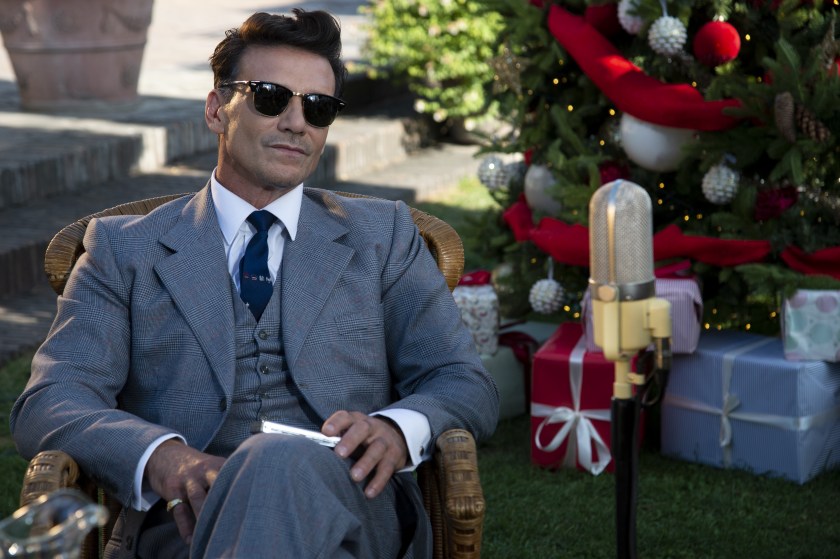
Frank Grillo as Ferruccio Lamborghini, tractor manufacturer-turned-automaker, in Lamborghini: The Man Behind the Legend (Photos courtesy of Lionsgate)
By Richard Ades
Ferruccio Lamborghini’s new biopic could have been called Lamborghini v. Ferrari, as the rivalry between the two Italian supercars is a central theme. It’s fortunate that it wasn’t, as that name would have made it even harder to avoid comparisons with 2019’s far superior Ford v. Ferrari.
Instead, the flick is called Lamborghini:The Man Behind the Legend, thus promising an in-depth study of the entrepreneur who created one of the world’s most exotic automobiles. Sadly, however, it also has trouble living up to that title, as it leaves us with little idea who Lamborghini really was. Written and directed by Bobby Moresco (co-scripter of Crash), it comes across as just another biopic about a man whose ego and ambition dominate his life.
Where did this ambition come from? It’s a mystery, as the young Lamborghini (Romano Reggiani) already has his eye fixed on success when he returns to the family farm after serving in World War II. Rather than settling back into his old life, he tells his father he plans to make his fortune by designing and marketing a superior breed of tractor.
“You’ll throw your life away,” his pragmatic father (Fortunado Cerlino) warns him.
“But what better way to do it than in search of greatness?” the son replies.
That begs the question: Do real-life people really talk about “greatness” in such an abstract way? Maybe not, but they do in this film, adding to the feeling that Moresco has crafted a generic and rather rushed (97-minute) biopic that doesn’t take time to flesh out its protagonist.
Lamborghini (Frank Grill) introduces his namesake sports car to the world.
The presence of a devoted best friend and loving wife (Matteo Leoni and Hannah van der Westhuysen) do help to humanize Lamborghini, but they abruptly disappear from the film soon after it makes a jarring leap several years into the future. There we find that Lamborghini (now played with rigid determination by Frank Grillo) has become a successful tractor manufacturer with a new doting wife (Mira Sorvino).
Eventually, of course, Lamborghini branches out from farm machinery into high-class automobiles. According to the film, it’s all due to a brief encounter he has with the one and only Enzo Ferrari (Gabriel Byrne), during which he brashly offers to help improve the automaker’s celebrated product. Ferrari responds dismissively, which is depicted as the catalyst that propels Lamborghini on a quest to create his own luxury sports car—and to do it in time to debut it at a prominent auto show just months away.
The frantic scenes that follow, with their shop talk of aluminum engine blocks and wet sumps, might interest the kind of auto geek who’s likely to be drawn to a film called Lamborghini: The Man Behind the Legend. But they do little to fill in the blanks of a biopic that promises more than it delivers.
Rating: 2 stars (out of 5)
Lamborghini: The Man Behind the Legend (rated R) opens Nov. 18 at select theaters and VOD outlets.



 Reel Time With Richard Ades