
By Richard Ades
PBS has just launched Black and Jewish America, a four-week miniseries that examines the political and historical ties between African Americans and Jewish Americans.
For those who want to examine the topic further, a new documentary directed by Ilana Trachtman is a good place to start. Ain’t No Back to a Merry-Go-Round tells the fascinating story of a 1960 protest that unexpectedly created cross-cultural ties.
The protest centered on Glen Echo Amusement Park, which once served as a recreation destination for families in the Washington, D.C. area. Offering rides, snacks and a giant pool, it had everything parents needed to keep their kids entertained on hot summer days.
The only problem: You had to be White to enter. Children from local Black neighborhoods could only watch the fun from outside the gates.
The situation eventually prompted students from nearby Howard University to do something about it. However, it took them awhile to get to that point, according to Dion Diamond, one of two Howard alumni interviewed for Trachtman’s film.
During the 1950s, Diamond recalls, most students of the historically Black university were comfortably middle-class and refused to acknowledge that segregation affected them. That didn’t begin to change, he says, until Southern activists launched a sit-in campaign aimed at integrating Woolworth’s lunch counters.
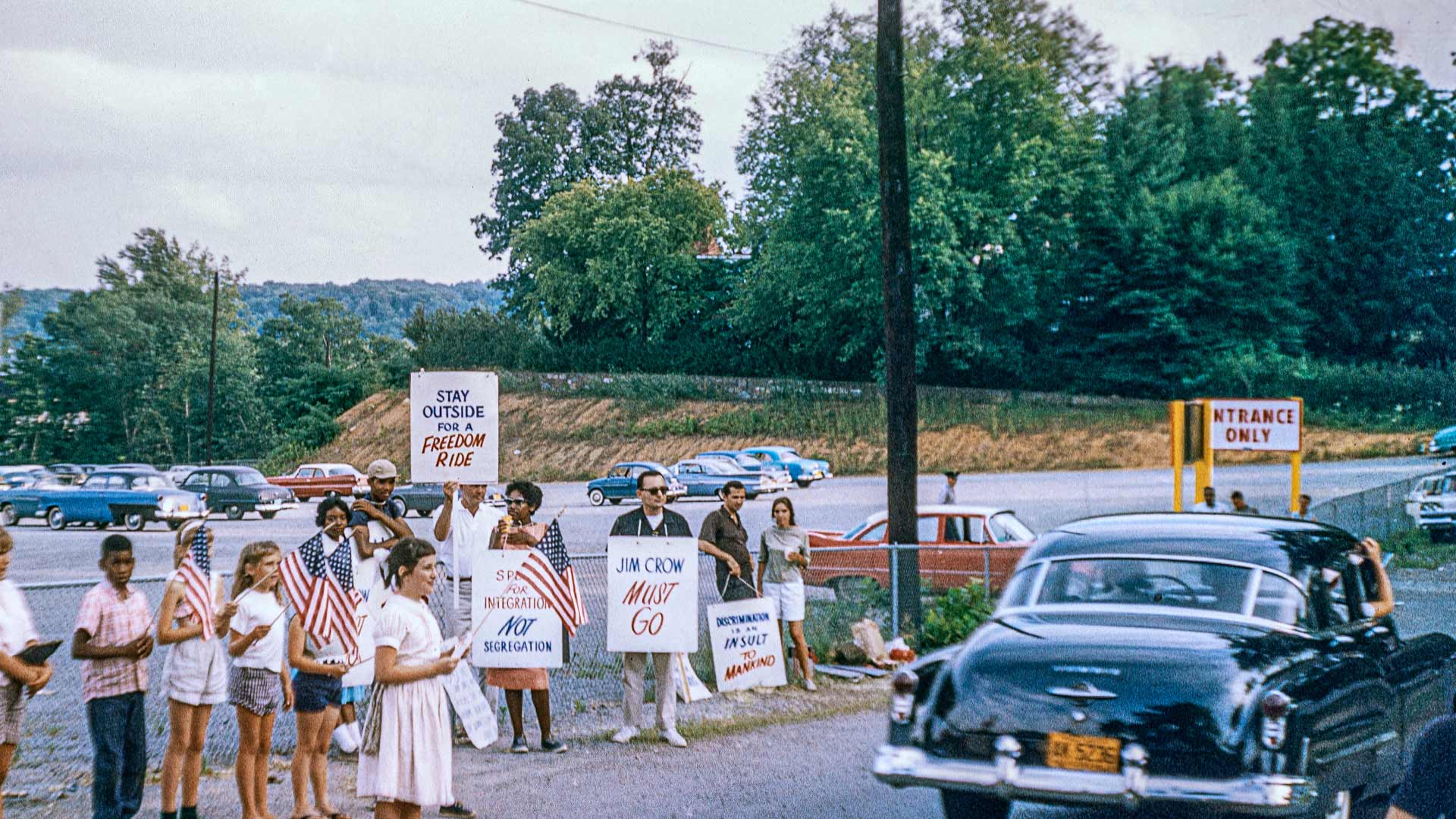
Picketers urge families not to patronize the segregated Glen Echo Amusement Park in a scene from Ain’t No Back to a Merry-Go-Round.
Inspired by the action, Howard students formed their own civil rights organization, the Nonviolent Action Group, or NAG. Then, after the sit-in achieved success by forcing most Woolworth’s stores to integrate, the group began looking for a new issue to tackle.
They soon found one in their own backyard: Glen Echo.
Thus it was that NAG announced its decision to begin picketing the amusement park on June 30, 1960—only to learn that the issue had already been adopted by residents of Bannockburn, a progressive and largely Jewish neighborhood in nearby Bethesda, Maryland.
Through interviews with Diamond, fellow Howard alum Hank Thomas and then-Bannockburn residents Helene Wilson Ageloff and Esther Delaplain, the documentary explains what happened next.
The Howard students at first had mixed feelings about their new allies, and they were uneasy about the fact that their picket lines were predominantly White. But as the summer wore on, a spirit of camaraderie developed among the students, the Bannockburn volunteers and local Black residents who joined the struggle.
This was fortunate because they faced a difficult battle, which the documentary depicts with the help of vintage footage. Not only did the park’s owners refuse to capitulate, but the picketers were bombarded with racist and antisemitic insults—and even threats—from counter-protesters, including some who wore swastikas.
Trachtman’s documentary reports the protest’s eventual outcome, but it doesn’t stop there. It also reveals the action’s long-term effects on its participants, several of whom went on to engage in other civil rights efforts such as the Freedom Rides.
Toward the end of the film, Howard alumnus Thomas is shown telling a group of students one important fact he learned from the protests: that American Jews have been some of African Americans’ most important allies.
That’s a good jumping-off place for tackling PBS’s Black and Jewish America, which examines the long and sometimes difficult relationship between two groups bonded by their familiarity with historic discrimination.
Rating: 4 stars (out of 5)
Ain’t No Back to a Merry-Go-Round can be seen in select theaters and will make its Columbus, Ohio, debut at 2 p.m. Feb. 15 at the Gateway Film Center. For a list of other screenings, visit aintnoback.com/screenings/.
Black and Jewish America: An Interwoven History, hosted by Henry Louis Gates Jr., airs at 9 p.m. Tuesdays on WOSU-TV in Columbus. Check local listings for times in other areas.
 Reel Time With Richard Ades