Staged film adaptation goes heavy on spectacle

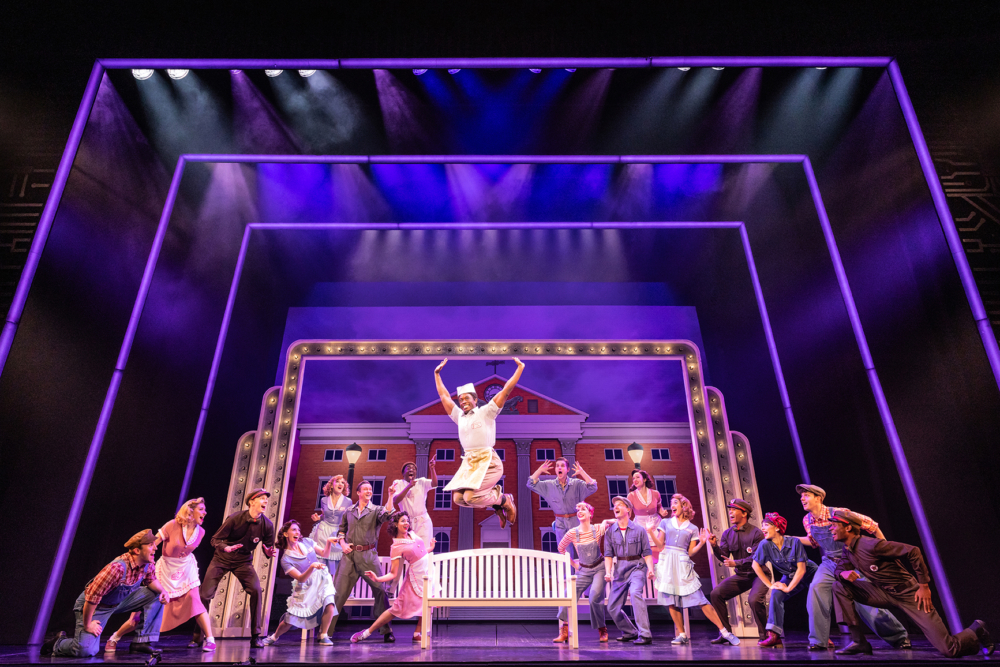
Cast members show off some of the high-flying choreography that won Some Like It Hot one of its four Tony Awards on Broadway.

By Richard Ades

“Well, nobody’s perfect.” It’s ironic that one of the most famous last lines in the history of cinema belongs to a film that’s pretty much perfect.

Billy Wilder’s Some Like It Hot stars Tony Curtis and Jack Lemmon as Depression-era musicians Joe and Jerry, who are being chased by gangsters because they accidentally witnessed a mob execution. Disguising themselves as women, they join an “all-girl band,” where their attempts to fit in are complicated by Joe’s attraction to the lead singer and Jerry’s acquisition of an admirer who refuses to take “no” for an answer.

It’s always risky trying to adapt a work as universally loved and admired as Wilder’s 1959 comedy, so it’s not surprising that the stage version of Some Like It Hot fails to achieve the original’s perfection. What’s disappointing is that it could have been a lot better.

With a book by Matthew Lopez and Amber Ruffin, and songs by Marc Shaiman and Scott Wittman, the musical opened on Broadway in late 2022 and closed just over a year later. Despite the relatively short run, the show garnered a slew of Tony nominations and won four. Besides best actor in a musical, it took home awards for costume design, choreography and orchestrations.

These wins point to some of the show’s strong points, which are also evident in the touring production that opened Tuesday at Columbus’s Ohio Theatre.

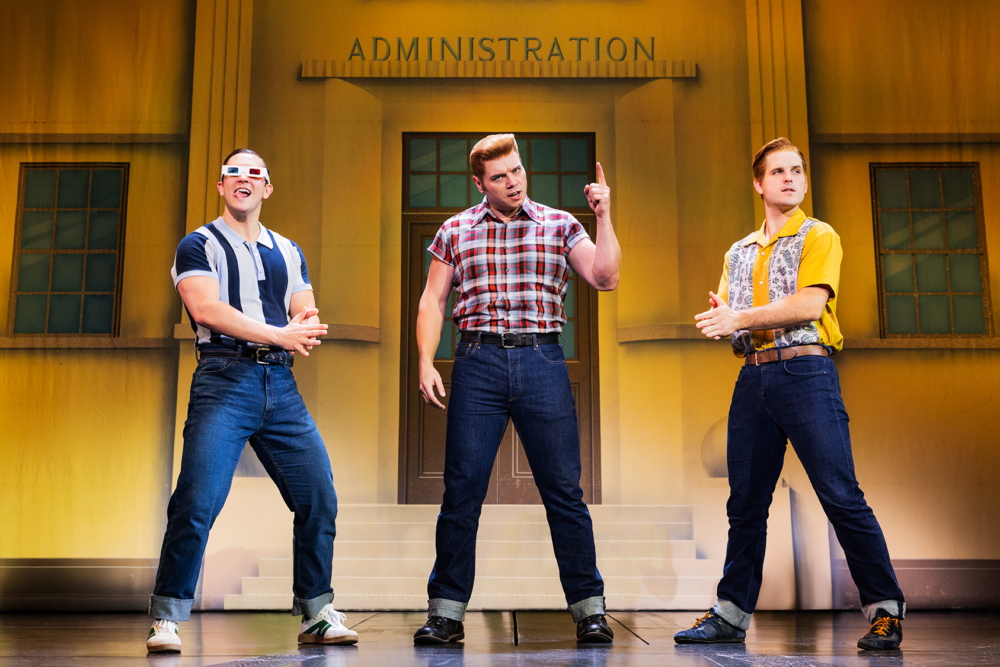
Director/choreographer Casey Nicholaw imbues the many song-and-dance numbers with high kicks and precision tapping, all backed by Charlie Rosen and Bryan Carter’s brassy, jazzy orchestrations. Meanwhile, Gregg Barnes outfits the characters in imaginative period costumes. Combined with Scott Pask’s gorgeous set designs, it all adds up to a colorful spectacle.

In a way, that’s part of the reason the show falls short of the film that inspired it. Far from a spectacle, Wilder’s classic was the comic but heartfelt tale of two men who disguise themselves to stay alive and find their lives altered as a result. Not only do they learn what it’s like to be a woman in a man’s world, but one of them finds that living as a woman is strangely fulfilling.

In the touring show, Matt Loehr and Tavis Kordell star as buddies Joe and Jerry, respectively, who don dresses and disguise themselves as Josephine and Daphne. Both get plenty of opportunities to show off their dancing and singing skills, but they have fewer chances to define their evolving characters. And Jerry, in particular, evolves a lot, becoming increasingly comfortable in the guise of the invented Daphne. (Like the Tony-winning actor who played Jerry on Broadway, Kordell identifies as nonbinary.)

As Sugar, the band’s lead singer, Leandra Ellis-Gaston displays fairly decent pipes but was sometimes overpowered by the band on opening night. In fact, several singers faced the same problem, pointing to the possibility that the sound balance was in need of tweaking. A related problem is that the lyrics were often hard to make out, weakening songs that weren’t that memorable to begin with.

One singer who managed to come through loud and clear on Tuesday was DeQuina Moore, who gives a powerhouse performance as band leader Sweet Sue. Filling out the leading cast members, Edward Juvier is a hoot as Osgood, the millionaire who takes a liking to Daphne.

Of the two acts, the second comes closer to the spirit of the movie, slowing down enough to allow Loehr, Kordell and Ellis-Gaston to flesh out their characters. However, it ends with a seemingly endless slapstick number that involves chases and slamming doors and would have been more at home in a bedroom farce.

Moral: If you’re going to adapt a classic movie for the stage, it helps if you understand just what made the movie great.

Broadway in Columbus will present Some Like It Hot through Nov. 23 at the Ohio Theatre, 39 E. State St., Columbus. Showtimes are 7:30 p.m. through Friday, 2 and 7:30 p.m. Saturday, and 1 and 6:30 p.m. Sunday. Running time: 2 hours, 45 minutes (including intermission). For ticket information, visit columbus.broadway.com. For information on future tour stops, visit somelikeithotmusical.com.

‘MJ’ pays homage to moonwalking superstar

One of many flashy moments from the touring production of MJ: The Musical (Photo by Mathew Murphy of MurphyMade)

By Richard Ades

A good fireworks show begins with a “wow” and ends with a “WOW,” filling the space in between with enough peaks to fuel our anticipation. MJ: The Musical, based on the life of Michael Jackson, follows that formula almost exactly.

The action has barely begun when the title character (an amazing Jamaal Fields-Green) launches into an MTV-worthy rendition of the Jackson classic “Whip It.” Then, nearly 2½ hours later, the show is only minutes from its finale when it delivers the song-and-dance number we’ve all been waiting for: “Thriller.”

And by the way: When I say “delivers,” imagine the word being followed by multiple exclamation points. The number is so over-the-top astounding that it alone would nearly justify the original Broadway production’s Tonys for choreography (Christopher Wheeldon, who also directs), lighting design (Natasha Katz) and sound design (Gareth Owen).

In between these two high points, it must be said, the production falls a bit short of a good fireworks show’s standards. There are impressive peaks here and there, but there are also valleys that slow down the momentum.

Set in 1992 during a rehearsal for Jackson’s upcoming “Dangerous” world tour, the jukebox musical addresses some of the rumors then swirling around the “King of Pop.” These are uncovered with help from nosy documentary maker Rachel (Cecilia Petrush) and her cameraman, Alejandro (Anthony J. Garcia).

Through flashbacks, the show also introduces us to two earlier Jackson incarnations: the Jackson 5’s pipsqueak frontman (alternately played by Josiah Benson and Bane Griffith) and the young adult seeking to launch a solo career (Erik Hamilton).

Also featured in the flashbacks are the rest of the Jackson family, including the mom, Katherine (Anastasia Talley), and dad, Joseph (Devin Bowles). Bowles plays the latter as a domineering bully who pushed his talented children relentlessly and was particularly abusive toward young Michael.

The implication is that Joseph’s behavior was responsible for MJ’s later problems, but the argument is only partially convincing. To some extent, that’s because Jackson had so many problems and eccentricities, some of which didn’t come out until after the musical’s time frame, that it’s hard to pin them all on any single source.

Despite his flaws, the one undeniable thing you can say about Michael Jackson is that he was a showman of the first degree, and MJ is most successful when it concentrates on that fact. Along with singing, dancing was obviously central to his appeal, and his devotion to the craft comes out brilliantly in an Act II fantasy that shows him trading steps with virtuosos who apparently inspired him: Fred Astaire, Bob Fosse and the tapdancing Nicholas Brothers.

Though all of the cast members sing and dance well, it clearly takes a special skillset to portray someone as unique as Michael Jackson. In the original Broadway production, Myles Frost filled the bill and thereby won the show’s fourth and final Tony.

In the current touring production, Fields-Green displays the voice, the moonwalk and all the other flourishes that won the King of Pop his title. (Jordan Markus alternates in the role at some performances.)

Fields-Green’s portrayal, backed up by a stellar band and some of the most awe-inspiring stagecraft you’ll ever see, makes MJ a pulse-quickening trip down memory lane.

MJ: The Musical runs through Sept. 15 at the Ohio Theatre, 39 E. State St., Columbus. Showtimes are 7:30 p.m. through Friday, 2 and 7:30 p.m. Saturday, 1 and 6:30 p.m. Sunday. Running time: 2 hours, 40 minutes (including intermission). For ticket information, visit columbus.broadway.com. For information on future tour stops, visit tour.mjthemusical.com.

Celebrating the birth and rebirth of Tina Turner

Zurin Villanueva holds forth as Tina Turner in the North American Tour of Tina: The Tina Turner Musical. (Photo by Matthew Murphy for MurphyMade)

By Richard Ades

Tina: The Tina Turner Musical opens as the queen of rock psyches herself up for a concert that she hopes will relaunch her career.

The show eventually takes us to that concert, but not before it recaps Turner’s years’ worth of struggles with parents who abandoned her and a husband who abused her. It’s a long and painful journey that’s sometimes touching and other times, well, not. You may even be tempted to leave early, as a few audience members did toward the end of Tuesday’s opening night at the Ohio Theatre.

But don’t. I repeat, DO NOT LEAVE. Because when the show finally takes us to that concert, it may well be the best time you’ve had in ages.

With a book by Katori Hall, Frank Ketelaar and Kees Prins, Tina is a jukebox musical that revisits Turner’s classic hits while covering the highlights and (mostly) the lowlights of her life. After premiering in London in 2018, it opened the following year on Broadway, where it garnered a bevy of Tony nominations but won only for lead performer Adrienne Warren.

That suggests that the musical rises and falls on the strength of the performer who plays Tina, and how could it be otherwise? In the case of the touring production now visiting Columbus, it definitely rises, though not immediately. On Tuesday, Zurin Villanueva at first held forth with a voice that seemed too thin to do the role justice, but she gradually began adding elements of Tina’s iconic tones. By the time she launched into “River Deep—Mountain High,” she was Tina Turner.

Was Villanueva holding back in the beginning to dramatize the title character’s evolution into the powerhouse performer she would become? Likely. At any rate, she just kept getting better and better in a role that left her onstage and belting out tunes through most of the show. (Ari Groover takes over the demanding role in alternate performances.)

Anyone familiar with Tina Turner knows that she got her start (and her stage name) thanks to rock performer Ike Turner, who made her his lead singer and later married her, even though she was already pregnant with another musician’s child. It’s also well known that Ike was a physically abusive control freak. In the touring show, Deon Releford-Lee plays Ike as an all-out cad, though the script does give him a touch of humanity by revealing some of the Mississippi native’s disturbing brushes with Jim Crow racism.

When Tina at long last rebels against Ike’s brutality, it’s one of the show’s most moving moments, especially since it’s followed by the gorgeous “I Don’t Wanna Fight No More.” Tina’s struggles, however, have just begun, as she then spends years trying to reinvent herself as a solo performer.

Complicating her quest, the script suggests, is her understandable fear of submitting to another man’s control following her separation from Ike. This makes her cautious when an Australian music producer named Roger Davies (Dylan S. Wallach) appears out of nowhere and offers to help restart her career.  

Besides the talented folks already mentioned, top cast members include Carla R. Stewart as Tina’s supportive grandmother; Roz White as her mother; Gigi Lewis as her sister; Gerard M. Williams as Raymond, her first love; and Sarah Bockel as her manager, Rhonda. Worthy of special mention are Brianna Cameron and Symphony King, who alternate in the role of Anna-Mae, the girl who grows up to be Tina Turner.

Though the show sometimes drags things out a bit, especially during Act II, director Phyllida Lloyd mostly moves it along at a comfortable pace that escalates into pure exuberance during the spirited musical numbers. A dynamite band under Dani Lee Hutch’s direction accompanies the numbers, while choreographer Anthony Van Laast brings them to life by recreating Tina’s energetic dance moves.

Equally important are the behind-the-scenes technicians who back up the show’s dramatic and musical components with consistently compelling stage pictures, including lighting designer Bruno Poet and set/costume designer Mark Thompson. “Compelling,” by the way, turns into “gloriously over-the-top” once that final concert begins.

One final note: Don’t leave before the curtain call, and don’t leave after the curtain call, either, because that’s only the beginning of an extended “encore” that is the highlight of the entire evening.

Broadway in Columbus and CAPA will present Tina: The Tina Turner Musical through May 12 at the Ohio Theatre, 39 E. State St., Columbus. Showtimes are 7:30 p.m. through Thursday, 8 p.m. Friday, 2 and 8 p.m. Saturday, and 1 and 6:30 p.m. Sunday. Running time: 3 hours (including intermission and encore). For ticket information, visit columbus.broadway.com. For information about upcoming tour stops, visit tinaonbroadway.com/tickets/.

Sondheim tunes still the best part of revised ‘Company’

Britney Coleman as Bobbie in the national tour of Company (Photos by Matthew Murphy for Murphy Made)

By Richard Ades

When I first saw Company at a local university in 2006, I loved the tunes but thought the student cast failed to make the episodic show seem coherent. But now, after seeing a touring production based on the Tony-winning 2021-22 Broadway revival, I suspect it wasn’t entirely their fault.

Maybe this is simply a hard show to pull off.

Once again, I loved the Stephen Sondheim tunes but had trouble caring about the characters singing them, especially Bobbie, the 35-year-old New Yorker around whom the show revolves. Forgoing a traditional plot, Company merely tags along with Bobbie as she visits various engaged and married friends who think she should be getting engaged and married herself.

First of all, we should note that Bobbie (played here by Britney Coleman) is a re-gendered version of Bobby, who was the male protagonist when the show debuted on Broadway in 1970. Much has been said and written about the character’s sex change, which Sondheim himself approved before his death in November 2021. Some claim it makes the show more relatable, while others have called it problematic.

Since I’ve had trouble with the show whether it had a male or a female lead, I can’t say the change was pivotal to my enjoyment. But it may have added unforeseen complications.

For one thing, you can’t make a woman seem too desperate to find a husband in 2024 without dredging up patriarchal stereotypes. Maybe that’s one reason Bobbie doesn’t seem as concerned about being single as Bobby was—which makes the show seem even less dramatically coherent than it was originally. If Bobbie isn’t motivated to question her marital status, then what is she doing except spending time with her various coupled friends?

Various friends help Bobbie (Britney Coleman, center) celebrate her 35th birthday.

The gender change also necessitates tangential tweaks that are sometimes awkward. The biggest one involves the protagonist’s much-divorced friend Joanne, who propositions Bobby in a key scene of the original musical. In this version, Joanne (Judy McLane) invites Bobbie to have an affair, not with her, but with her current husband (Derrick Davis).

Why would Joanne do that, and why would she assume her obviously devoted hubby would even consider being unfaithful? The situation is so odd that it almost overshadows McLane’s stellar rendition of one of the show’s musical highlights, “The Ladies Who Lunch.”

Even though this Company doesn’t work as a whole, individual scenes do entertain thanks to a talented cast working under Marianne Elliot’s direction. One of the best involves two gay friends (another revision from the original show) who are about to get married. Paul (Jhardon DiShon Milton) is eager, but Jamie (Matt Rodin) has a severe case of cold feet, as he explains in the comically rapid-fire “Getting Married Today.”

Several of the other musical highlights involve Coleman’s Bobbie, including Act I’s “Someone Is Waiting” and “Marry Me a Little,” and Act II’s “Side by Side by Side.” Coleman emotes a bit too frantically on the finale, “Being Alive”—perhaps trying to make up for the show’s emotional deficiencies—but her beautiful voice serves the other numbers well.

One musical highlight that doesn’t involve Bobbie is “Another Hundred People,” in which PJ (Tyler Hardwick) sings about the ever-growing population that gives New York its atmosphere of excitement and underlying desperation.

The number also showcases Bunny Christie’s scenic design by using three letters from the musical’s title to create people-sized props that spell out “NYC.” Christie is similarly creative throughout, staging most of the scenes inside various-sized boxes with illuminated edges, as if the action were taking place within living snapshots.

It’s too bad the show doesn’t have much dramatic cohesion to go along with the visual cohesion Christie’s designs provide. It’s also too bad that not all of its updates are completely successful. But at least Company has Sondheim’s music and lyrics, which remain timeless.

Broadway in Columbus and CAPA will present Company through Feb. 18 at the Ohio Theatre, 39 E. State St., Columbus. Running time: 2 hours, 45 minutes (including intermission). Showtimes are 7:30 p.m. through Thursday, 8 p.m. Friday, 2 and 8 p.m. Saturday, and 1 and 6:30 p.m. Sunday. For ticket information, visit columbus.broadway.com or capa.com. For information about future Company tour stops, visit broadway.org.

‘Doubtfire’ actor reprises Tony-nominated star turn

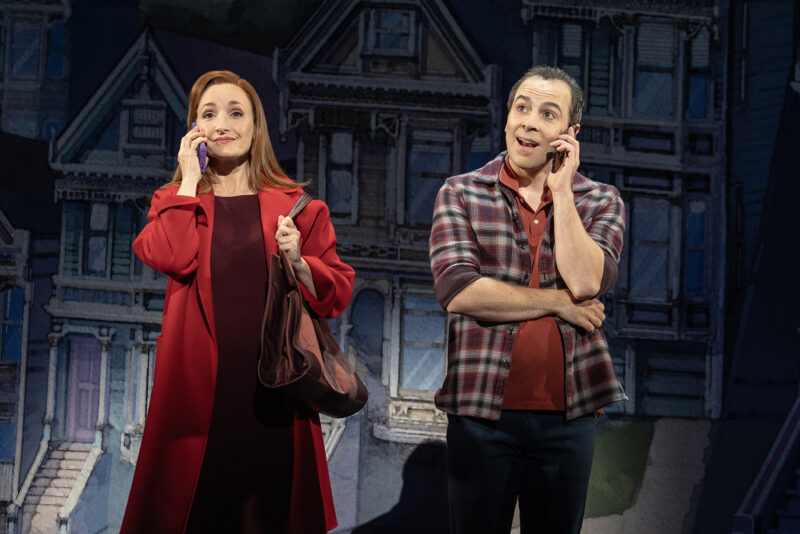
Daniel (Rob McClure) effects a Scottish accent to convince ex-wife Miranda (Maggie Lakis) to hire the fictitious Mrs. Doubtfire as their children’s nanny. (Photos courtesy of Broadway in Columbus)

By Richard Ades

Mrs. Doubtfire’s brief 2021-22 Broadway run was most acclaimed for Rob McClure’s Tony-nominated performance in the starring role. So it’s fortunate that McClure is re-donning the title nanny’s wig, mask and padding for the North American tour.

As unemployed actor Daniel Hillard, McClure trots out a cornucopia of voices and impersonations, all delivered with manic energy almost worthy of the late Robin Williams, who originated the role in the 1993 film.

Fueling the plot is the fact that Daniel is a devoted father but a so-so husband, leading wife Miranda (Maggie Lakis) to seek a divorce. When a judge threatens to award Miranda sole custody of their kids unless Daniel can get his financial act together, the distraught dad concocts a plan to keep on seeing them.

With makeup and hairstyling help from brother Frank (Aaron Kaburick) and his husband, Andre (Nik Alexander), Daniel invents an aging Scotswoman named Mrs. Doubtfire. In this disguise, he lands the job of taking care of his offspring while Miranda is busy launching her own clothing line.

Daniel (Rob McClure) shares dance steps with a group of chefs in one of the show’s production numbers.

Emotion would seem to be built into the story, dealing as it does with Daniel’s attempt to hold onto his family. But the musical’s writers (Kary Kirkpatrick and John O’Farrell) and director (Jerry Zaks) put more of the focus on comedy and spectacle.

The comedy largely revolves around Daniel’s attempts to bamboozle a court liaison (Romelda Teron Benjamin) charged with checking up on him. As for the spectacle, it involves dance numbers that are sometimes shoehorned in on the thinnest of excuses. For example, when Daniel tells Frank and Andre he needs a female alter ego, they conjure up dancing celebrities ranging from Donna Summer to Eleanor Roosevelt and Janet Reno before he can explain what he has in mind.

All of this is fun when it works, as it often does. There are many amusing moments, and the dance numbers are spirited thanks to Lorin Latarro’s choreography and Wayne Kirkpatrick and Kary Kirkpatrick’s tunes.

It’s just that the show would be more satisfying if it provided more feels.

Giselle Gutierrez as Lydia, Daniel and Miranda’s older daughter

One emotional high point comes midway through Act 1 with “What the Hell,” a heartfelt song that expresses how Daniel and Miranda’s divorce is affecting their children. Teenage daughter Lydia (a wonderful Giselle Gutierrez) is angry, while younger siblings Chris and Natalie feel they are somehow to blame for the breakup. (Chris is played at alternate performances by Cody Braverman and Axel Bernard Rimmele, Natalie by Emerson Mae Chan and Kennedy Pitney.)  

By the end, the musical does manage to supply another heartwarming moment or two. Otherwise, the focus is on laughs, leaps and Rob McClure’s amazing capacity for comedic schtick.   

Broadway in Columbus will present Mrs. Doubtfire through Nov. 5 at the Ohio Theatre, 39 E. State St., Columbus. Showtimes are 7:30 p.m. through Thursday, 8 p.m. Friday, 2 and 8 p.m. Saturday, and 1 and 6:30 p.m. Sunday. Running time: 2 hours, 35 minutes (including intermission). For tickets or more information, visit columbus.broadway.com. For information on future tour stops, visit mrsdoubtfirebroadway.com/tour.

Iconic musical’s power emerges despite shadowy challenges

05_LM_TOUR_One-Day-More-Photo-Matthew-Murphy-800x408
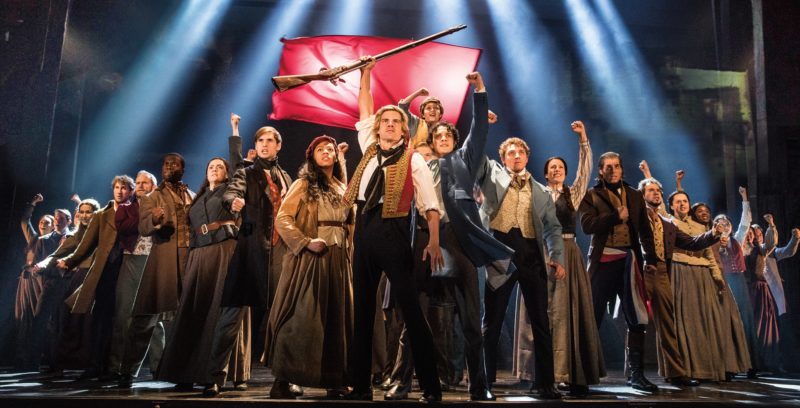
The cast of Les Miserables asks for “One Day More.” (Photo by Matthew Murphy)

By Richard Ades

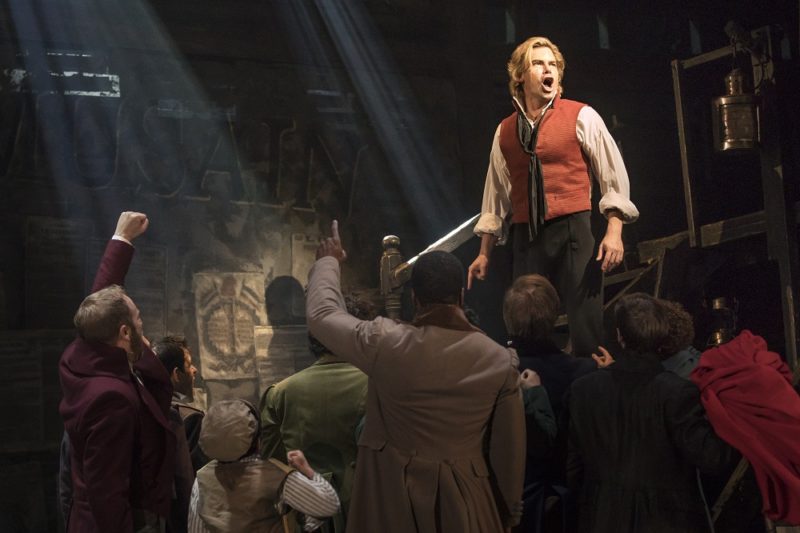
It’s when the latest incarnation of Les Misérables nears the halfway point that it begins hitting its stride. It’s then that we’re introduced to a group of young revolutionaries whose faith in their cause adds new layers of tragedy and nobility to the tale. The production builds from there to a climax that is just as glorious and moving as it was meant to be.

In the early scenes, however, this telling of fugitive Jean Valjean’s struggles has quirks that limit its effectiveness. Based on a 2014 Broadway revival and directed by Laurence Connor and James Powell, the touring production incorporates scenery based on paintings by the tale’s original author, Victor Hugo. But it also employs a lighting design (by Paule Constable) so dark that it’s hard enough to see the actors, let alone the scenery behind them.

This is not so much a problem for those of us who’ve seen the musical multiple times, but it might discourage first-time viewers. Particularly during the fast-paced first act, they could well struggle to keep up as the story races from one dramatic development to the next.

For those who aren’t familiar with the tale, Les Miz takes place in 19th-century France and centers on Jean Valjean, who was imprisoned for 19 years simply because he stole a loaf of bread. Released on parole as the show opens, he struggles against his own bitterness—as well as the suspicion that greets a former convict—until a clergyman’s generosity allows him to reinvent himself. He then pledges himself to a life of helping others, but he’s forever dogged by a police official named Javert who’s determined to bring him to justice for breaking parole.

02_LM_TOUR_0371_Josh-Davis-and-Nick-Cartell-800x533
Nick Cartell (right) as Jean Valjean and Josh Davis as his nemesis, Javert

Drenched in pathos and death, the Alain Boublil/Claude-Michel Schonberg blockbuster is admittedly melodramatic, but it succeeds on the strength of the achingly beautiful songs penned by composer Schonberg and lyricist Herbert Kretzmer. That is, it succeeds when the cast does the songs justice.

What bothers me more than the current production’s dark lighting is that male leads Nick Cartell (Jean Valjean) and Josh Davis (Javert) sometimes make the melodies subservient to the drama—that is, they shout rather than sing the words. It’s an ill-advised technique that means we get only approximations of some of the most gorgeous songs in the musical-theater canon.

Fortunately, both actors have strong moments when they skip the shouting. Cartell displays his fine voice on the falsetto showcase “Bring Him Home” and makes Valjean an increasingly sympathetic figure as the show progresses. As for Davis, he has a limited voice that keeps him from being one of the all-time great Javerts, but he turns the Act I solo “Stars” into a near-showstopper on the force of will alone.

There are parts of the musical that are guaranteed some degree of success no matter how well they’re staged: the plight of single mom Fantine (Mary Kate Moore), say, or the comic antics of those conniving innkeepers, the Thenardiers (Allison Guinn and Jimmy Smagula). It’s when the plot hops several years into the future and introduces new characters such as the aforementioned student revolutionaries that Les Miz sometimes struggles to regain its footing.

Luckily, that’s exactly when the touring production comes into its own.

From this point, the scenery of Matt Kinley begins emerging from the shadows: a silhouetted barricade, a sewer system that appears to arise magically from the stage. The former is the setting for a legitimately horrific battle, complete with the sounds of musket fire and whistling bullets, as the young rebels take a stand against repression.

10_LM_TOUR_1004_ABC-Cafe-and-Matt-Shingledecker-as-Enjolras-800x533
Enjolras (Matt Shingledecker) entreats his fellow malcontents to rebel against the government.

The characters introduced at this time are all brought vividly to life by accomplished actors: Brett Stoelker (filling in for Matt Shingledecker on opening night) as rebel leader Enjolras; Phoenix Best as the Thenardiers’ lovestruck daughter, Eponine; Robbie Crandell and Jasper Davenport alternating in the role of plucky street urchin Gavroche. Among the strongest are Jillian Butler as Valjean’s orphaned ward, Cosette; and Joshua Grosso as Marius, the rebel who falls for her. Their sweet voices and sincere delivery make us believe in love at first sight.

Hope in the power of love despite overwhelming adversity: That’s the final message of Les Misérables, and it still comes through as clearly as ever.

Broadway in Columbus and CAPA will present Les Misérables Nov. 19-24 at the Ohio Theatre, 39 E. State St., Columbus. Showtimes are 7:30 p.m. through Thursday, 8 p.m. Friday, 2 and 8 p.m. Saturday, 1 and 6:30 p.m. Sunday. Running time: 3 hours (including intermission). Tickets are $79-$150+ (regular or verified resale). 614-469-0939 (CAPA), 1-800-745-3000 (Ticketmaster), columbus.broadway.com, capa.com or ticketmaster.com.

Musicalized high school comedy deserves a passing grade

Mean Girls
Cady (Danielle Wade, left) gets to know Regina (Mariah Rose Faith, second from right) and her fellow “Plastics” in the first national tour of Mean Girls. (Photo by Joan Marcus)

By Richard Ades

Tina Fey’s satirical wit comes across in everything she does, whether it’s Saturday Night Live, 30 Rock or the clever 2004 flick she wrote and co-starred in, Mean Girls. It also comes across in the musical version of the flick, now holding forth at the Ohio Theatre.

It comes across eventually, that is. The stage show is encumbered by several songs and dances that seem to be copied from the Broadway playbook, especially in the early scenes. But by the time the darkly comic plot kicks into gear, Fey’s distinctive voice is clearly heard.

Mean Girls is the story of Cady Heron (Danielle Wade), an American teen who was born and raised in Kenya but must move to the U.S. when her mother’s job is relocated. Since Cady has been homeschooled all her life, she feels doubly out of place when she stumbles into her first day at a Chicago high school.

Luckily for her, outcasts Damien and Janis (Eric Huffman and Mary Kate Morrissey) take it on themselves to lead her through the school’s minefield of a social scene. They describe each clique in detail, but they save their sternest caution for the “Plastics,” a trio of divas led by Regina (Mariah Rose Faith), an alpha female whose beauty and viciousness make her a figure of both envy and fear.

Despite their warnings, Cady lets herself be courted by the haughty group, which also includes the needy Gretchen (Megan Masako Haley) and the hilariously dense Karen (Jonalyn Saxer). She soon learns the hard way that Regina is just as evil as she’s been told. She also learns, too late, that the Plastics’ shallow, self-centered lifestyle is dangerously addictive.

What makes Cady such a perfect guide into Fey’s version of high school purgatory is that she’s a tabula rasa. Raised in a land of beast-filled savannahs and star-filled skies, she knows nothing of a society where friends and social media “likes” are touted as signs of popularity. She also knows nothing about boys or the lengths to which girls will go to capture their attention, including downplaying their own intelligence. Most of all, she knows nothing of the cutthroat competition girls sometimes wage with each other out of insecurity and jealousy.

All of this comes across in the musical just as it did on the big screen, though not quite as succinctly. Jeff Richmond’s music, Nell Benjamin’s lyrics and Casey Nicholaw’s choreography sometimes create numbers that seem to be straight out of Broadway Musical 101. The most self-conscious is “Stop,” the tap number that opens Act 2. Though entertainingly performed by Huffman’s Damien and a group of backup dancers, it seems too old-hat to belong in a modern high school.

More up to date, even though it does little to advance the plot, is the hip-hop-inspired “Whose House Is This?” And more creative is the Act 1 number “Where Do You Belong?”—which is fun despite “choreography” that largely consists of pushing tables and chairs around a lunchroom.

Best of all are the numbers that encapsulate the message of Fey’s cautionary tale. Among them are Janis and Cady’s “Apex Predator,” with its James Bond-like blares, and the uplifting finale, “I See Stars.”

Mean Girls has arrived in Columbus remarkably fast: It opened on Broadway only a year and a half ago and began its first national tour just last month. Despite the speed, the show at the Ohio is technologically polished. Director Nicholaw, scenic designer Scott Pask, lighting designer Kenneth Posner and others have joined forces to create a production that changes times and locales both colorfully and instantaneously.

More importantly, the cast is nearly perfect from both an acting and singing standpoint. Huffman is an early standout as Damian, despite playing a character that is little more than a gay stereotype. Among those making an impression in smaller roles are Adante Carter as Cady’s math-class crush and Gaelen Gilliland as her supportive teacher.

As for the leads, Wade makes us believe the huge metamorphoses Cady undergoes in the course of the show, while Faith actually leaves us feeling sorry for Regina after her fortunes change.

Well, just a little. It’s still nice to see at least one “mean girl” get a taste of her own medicine.

Broadway in Columbus and CAPA will present Mean Girls through Oct. 27 at the Ohio Theatre, 39 E. State St., Columbus. Showtimes are 7:30 p.m. through Thursday, 8 p.m. Friday, 2 and 8 p.m. Saturday, 1 and 6:30 p.m. Sunday. Running time: 2 hours, 35 minutes (including intermission). Tickets are $39-$139+. 614-469-0939, 1-800-745-3000, columbus.broadway.com, capa.com or ticketmaster.com.

Personable monarch informs new staging of ‘The King and I’

Photo: Jeremy Daniel
The King of Siam (Jose Llana) and Anna Leonowens (Elena Shaddow) take a spin around the dance floor in The King and I. (Photo by Jeremy Daniel)

By Richard Ades

When theater companies want to bring new life to a familiar work, they often rely on obvious changes. A recent example is Opera Columbus’s production of Gluck’s Orphee et Eurydice, with its surreal scenery, avant-garde instrumentation and virtual chorus. And, of course, there are any number of Shakespearean productions that move the action to a different locale, time period or both.

The Lincoln Center Theater and director Bartlett Sher take a different tack with Rodgers and Hammerstein’s The King and I. The musical is still set in Siam (now Thailand) in the 1860s and still focuses on the evolving relationship between an authoritarian king and a widowed British teacher who’s hired to tutor his many children. But there’s a subtle difference from earlier productions, and certainly from the 1956 movie starring Deborah Kerr and Yul Brenner.

It mainly can be found in the character of the king. As wonderfully played by Jose Llana, he is imperious and comically petulant, yet he’s also vulnerable and even sympathetic. We understand that he’s concerned for his country’s future, not wanting it to become a European protectorate like some of his neighbors. Though he has hired a British governess to teach his children, he comes to rely on her to help him modernize—basically, to Westernize—his country in order to convince Europe that Siam doesn’t need “protecting.”

As governess Anna Leonowens, Elena Shaddow is a charming mixture of politeness and stubborn determination. Though her Victorian upbringing makes it hard for her to accept the king’s polygamy, she does her best to get along with her royal employer. However, she refuses to bend on one matter: the king’s promise, which he seems to have conveniently forgotten, to provide her and her son, Louis (Rhyees Stump), with a home of their own.

The production opens with a gorgeous scene, courtesy of set designer Michael Yeargan and lighting designer Donald Holder: the sunset arrival of the ship that brings Anna and Louis to Bangkok. After that, the scenery is far more restrained, with the outline of the palace walls in the background and long curtains playing a big role in delineating the change from one location to the next. It’s what goes on in front of the scenery that makes this staging so special.

Besides Anna and the king, key characters include Prime Minister Kralahome (Brian Rivera); the king’s head wife, Lady Thiang (Jane Almedilla); and Prince Chulalongkorn (Charlie Oh), his oldest son. Adding a dark subplot is the young and beautiful Tuptim (Q Lim), a “gift” from Burma who is forced to submit to the king’s advances despite being in love with another man, Lun Tha (Kavin Panmeechao).

Fine voices give some of Rodgers and Hammerstein’s most beloved tunes their due, including Anna’s “Hello, Young Lovers” and “Getting to Know You” and Anna and the king’s “Shall We Dance?” Panmeechao’s thin tones are a slight impediment to Lun Tha’s wistful duets with Tuptim, “We Kiss in a Shadow” and “I Have Dreamed.” On the other hand, Almedilla’s matronly voice only adds depth to the show’s most touching number, Lady Thiang’s “Something Wonderful.”

A large orchestra consisting mostly of local musicians (who, for a change, are actually named in the program) performs under Gerald Steichen’s baton. Christopher Gattelli’s adaptation of Jerome Robbins’s original choreography is especially delightful during Act 2’s prolonged ballet, a Siamese take on Uncle Tom’s Cabin.

“Delightful” is a good adjective for the show in general, along with “illuminating” and “amazing.” And, hopefully, “unmissable.”

Broadway in Columbus and CAPA will present The King and I April 24-29 at the Ohio Theatre, 39 E. State St. Columbus. Show times are 7:30 p.m. through Thursday, 8 p.m. Friday, 2 and 8 p.m. Saturday, and 1 and 6:30 p.m. Sunday. Running time: 2 hours, 55 minutes (including intermission). Tickets are $34-$109+. 614-469-0939, 1-800-745-3000, columbus.broadway.com, capa.com or ticketmaster.com. For information on future tour stops, visit thekinganditour.com.

If this doesn’t raise your spirits, the Nazis win

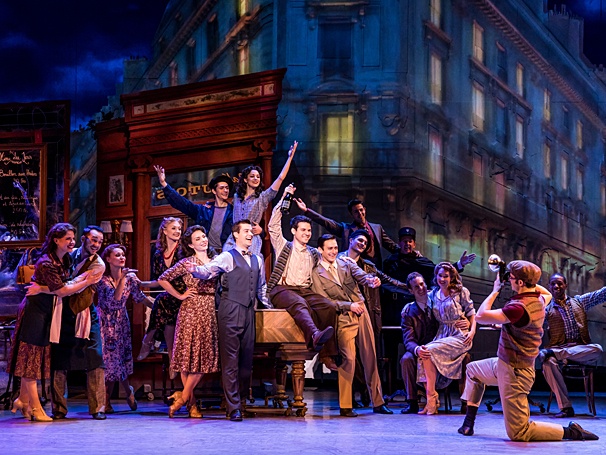
Scene from An American in Paris, presented by Broadway in Columbus (Photos by Matthew Murphy)

By Richard Ades

Love is more important than art, a character proclaims during a key moment from An American in Paris. While that’s undoubtedly true, it’s art that makes the musical so memorable.

Christopher Wheeldon’s direction and choreography combine with Bob Crowley’s set and costumes, Natasha Katz’s lighting and, most of all, George and Ira Gershwin’s ageless jazz tunes to create multiple gifts for the eyes and ears. As for the love story at its center, it mostly amounts to the colorless glue that holds it all together.

Based on the 1951 film about an American (Gene Kelly) who woos a reluctant Frenchwoman (Leslie Caron), the musical took an unconventional path to its 2015 Broadway premiere. It debuted in late 2014 in Paris, where it created a stir despite the language barrier. In addition to its glorious musical numbers, Parisians likely were attracted to its rejiggered plot and setting.

Book writer Craig Lucas moves the tale back to 1945, when the City of Light is struggling to regain its spirit after the dark years of Nazi occupation. Memories of the war affect two central characters in different ways: Jewish American composer Adam Hochberg (Matthew Scott) is so traumatized that he can write only dirges that fit in with his gloomy view of life. In contrast, Frenchman Henri Baurel (Ben Michael) is determined to move beyond his own war experiences by fulfilling his lifelong dream of becoming a song-and-dance man.

Unbeknownst to them, Adam and Henri are united by their mutual love of a ballet dancer named Lise Dassin (Allison Walsh). Nor do they know that Lise has a third admirer in the form of American G.I.-turned-artist Jerry Mulligan (McGee Maddox). Complicating things even further, Jerry attracts the attention of wealthy benefactor Milo Davenport (Kirsten Scott), who clearly expects sexual favors in return for her valuable patronage.

McGee Maddox and Allison Walsh as Jerry and Lise, the characters played by Gene Kelly and Leslie Caron in the original 1951 film version 

Jerry and Lise are the people we’re supposed to care about the most, so it’s disappointing that Maddox and Walsh generate so few romantic sparks. Making up for this in spades, both are lithe dancers and competent singers, as they prove over and over again throughout. (Note: Kyle Robinson fills in as Jerry on Saturday afternoon and Sunday evening, while Deanna Doyle plays Lise during the Sunday matinee.)

More interesting than the two romantic leads are the dramatic arcs undergone by Adam and Henri, particularly during Act 2. In fact, the second act surpasses its predecessor in terms of both drama and spectacle.

Two late-arriving song-and-dance numbers are alone worth the price of admission: “I’ll Build a Stairway to Paradise,” led by Henri and Adam; and “An American in Paris,” a surreally amazing piece featuring Lise, her ballet partner (Kevin A. Cosculluela) and the rest of the company. Both are complemented by set designer Crowley’s most sublime creations and the Gershwins’ most powerful melodies.

Other classic tunes include “I Got Rhythm,” “The Man I Love,” “’S Wonderful” and “They Can’t Take That Away From Me.” All are accompanied in a full-throated style by a massive band conducted by David Andrews Rogers.

After premiering on Broadway in early 2015, An American in Paris won Tonys for its choreography, lighting, orchestration and scenic design. The touring version excels in those same areas, making it an awe-inspiring experience for anyone who ventures to the Ohio Theatre this week.

Broadway in Columbus and CAPA will present An American in Paris through March 11 at the Ohio Theatre, 39 E. State, Columbus. Show times are 7:30 p.m. through Thursday, 8 p.m. Friday, 2 and 8 p.m. Saturday, and 1 and 6:30 p.m. Sunday. Running time: 2 hours, 45 minutes (including intermission). Tickets are $31-$104. 614-469-0939 (CAPA), 1-800-745-3000 (Ticketmaster), columbus.broadway.com, capa.com or ticketmaster.com.

What do ‘Waitress’ and ‘The Band’s Visit’ have in common?

Desi Oakley, Charity Angel Dawson and Lenne Klingaman (from left) in the Broadway in Columbus presentation of Waitress (photo by Joan Marcus)

By Richard Ades

The transition from the screen to the stage is a tricky one. There have been a few triumphs, but the results are more often disappointing.

The latest film adaptation is The Band’s Visit, a musical that recently moved to Broadway after a successful off-Broadway run. Tony Shalhoub (TV’s Monk) and Katrina Lenk lead a uniformly strong cast, and David Cromer’s sensitive direction captures the cross-cultural discomfort that develops when an Egyptian police band unexpectedly shows up in a remote Israeli village. On top of that, David Yazbek’s music and lyrics are delightful.

Despite the musical’s strengths, I left the Ethel Barrymore Theatre feeling less satisfied than I was after seeing the 2007 Israeli movie on which it’s based. The stage production attempts to create dramatic arcs by playing up several elements of the story, especially the flirtation that Lenk’s restaurant owner directs toward Shalhoub’s uptight band director. It does this at the expense of the little interactions that, in the film, mark the Israelis and the Egyptians as fellow travelers on the sad, lonely journey known as life. The stage show is good, but it lacks its predecessor’s understated charm.

Would I have liked the show more if I hadn’t seen the film? Possibly. So maybe it’s good that I didn’t catch another 2007 movie, Waitress, before seeing its musical adaptation this week at the Ohio Theatre. The late Adrienne Shelly’s flick has been faulted for diluting a story of female empowerment with broad humor, and the stage production likely broadens the humor even more.

The heroine is Jenna (the relatable Desi Oakley), a small-town waitress married to a control freak named Earl (the effectively hateful Nick Bailey). Jenna is desperate to escape from her loveless marriage, but her hopes are dashed when she learns she’s pregnant.

Ironically, her pregnancy leads her to Dr. Pomatter (Bryan Fenkart), a gynecologist who instantly falls for both her and the stellar pies she concocts for the restaurant. Taken off guard by the unfamiliar experience of being appreciated for who she is, Jenna begins an affair with the kind, though married, doctor. Meanwhile, she sets her sights on a pie-making contest whose prize money could bankroll a new life for her and her future child.

As long as the focus stays on Jenna and her miserable situation, Waitress serves as a sobering look at the serious issue of spousal abuse. However, book writer Jessie Nelson and director Diane Paulus seem determined to keep the crowds pleased by devoting much of the show’s time and energy to broad comedy populated by familiar stereotypes.

Jenna’s fellow waitresses are Becky (Charity Angel Dawson) and Dawn (Lenne Klingaman). The former is sassy (i.e., she’s black), and the latter is shy and nerdy (i.e., she wears glasses). In subplots that largely overshadow the main plot, Becky launches into an affair of her own, while Dawn attempts to end her social isolation by running a personal ad. This attracts the attention of Ogie, an oddball exuberantly played by Jeremy Morse with overtones of Paul Lynde and Henry Gibson, the poet from TV’s Laugh-In. Ogie’s comic solo number, Never Ever Getting Rid of Me, becomes the closest thing the musical has to a show stopper.

Roaming even further from Jenna’s homefront predicament, the proceedings nearly turn into a sex farce when all three waitresses and their respective beaus simultaneously engage in onstage canoodling. Diner manager Cal (Ryan G. Dunkin) and elderly owner Joe (Larry Marshall) also contribute to the show’s sexual preoccupation, though the latter does so only by sharing his erotic memories.

The mood finally turns sober again just in time for Jenna’s biggest and saddest solo, She Used to Be Mine, sung with the kind of strong and committed voice Oakley brings to all of her songs. In fact, composer/lyricist Sara Bareilles’s tunes are well served by the entire cast and by conductor/pianist Jenny Cartney and her onstage band. But none of this makes up for the fact that the pop/country melodies are mostly forgettable and the lyrics seldom rise to the level of deep poetry.

Despite its inconsistencies and weaknesses, Waitress remains on Broadway after a year and a half, suggesting that it satisfies patrons’ theatrical taste buds. And it did seem to make many people happy at the Ohio on Tuesday, despite a technical snafu that delayed the show long enough to turn it into a 3½-hour ordeal.

So if the idea of spicing up a serious social issue with broad comedy doesn’t give you acid reflux, you, too, may find Waitress to your liking.

Broadway in Columbus and CAPA will present Waitress through Sunday (Nov. 12) at the Ohio Theatre, 39 E. State St., Columbus. Show times are 7:30 p.m. through Thursday, 8 p.m. Friday, 2 and 8 p.m. Saturday, 1 and 6:30 p.m. Sunday. Running time: 2 hours, 45 minutes (including intermission). Tickets are $34-$115. 614-469-0939, 1-800-745-3000, columbus.broadway.com, capa.com or ticketmaster.com.