What do ‘Waitress’ and ‘The Band’s Visit’ have in common?

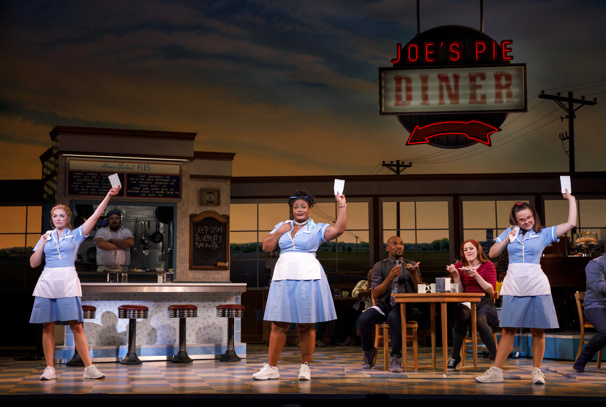
Desi Oakley, Charity Angel Dawson and Lenne Klingaman (from left) in the Broadway in Columbus presentation of Waitress (photo by Joan Marcus)

By Richard Ades

The transition from the screen to the stage is a tricky one. There have been a few triumphs, but the results are more often disappointing.

The latest film adaptation is The Band’s Visit, a musical that recently moved to Broadway after a successful off-Broadway run. Tony Shalhoub (TV’s Monk) and Katrina Lenk lead a uniformly strong cast, and David Cromer’s sensitive direction captures the cross-cultural discomfort that develops when an Egyptian police band unexpectedly shows up in a remote Israeli village. On top of that, David Yazbek’s music and lyrics are delightful.

Despite the musical’s strengths, I left the Ethel Barrymore Theatre feeling less satisfied than I was after seeing the 2007 Israeli movie on which it’s based. The stage production attempts to create dramatic arcs by playing up several elements of the story, especially the flirtation that Lenk’s restaurant owner directs toward Shalhoub’s uptight band director. It does this at the expense of the little interactions that, in the film, mark the Israelis and the Egyptians as fellow travelers on the sad, lonely journey known as life. The stage show is good, but it lacks its predecessor’s understated charm.

Would I have liked the show more if I hadn’t seen the film? Possibly. So maybe it’s good that I didn’t catch another 2007 movie, Waitress, before seeing its musical adaptation this week at the Ohio Theatre. The late Adrienne Shelly’s flick has been faulted for diluting a story of female empowerment with broad humor, and the stage production likely broadens the humor even more.

The heroine is Jenna (the relatable Desi Oakley), a small-town waitress married to a control freak named Earl (the effectively hateful Nick Bailey). Jenna is desperate to escape from her loveless marriage, but her hopes are dashed when she learns she’s pregnant.

Ironically, her pregnancy leads her to Dr. Pomatter (Bryan Fenkart), a gynecologist who instantly falls for both her and the stellar pies she concocts for the restaurant. Taken off guard by the unfamiliar experience of being appreciated for who she is, Jenna begins an affair with the kind, though married, doctor. Meanwhile, she sets her sights on a pie-making contest whose prize money could bankroll a new life for her and her future child.

As long as the focus stays on Jenna and her miserable situation, Waitress serves as a sobering look at the serious issue of spousal abuse. However, book writer Jessie Nelson and director Diane Paulus seem determined to keep the crowds pleased by devoting much of the show’s time and energy to broad comedy populated by familiar stereotypes.

Jenna’s fellow waitresses are Becky (Charity Angel Dawson) and Dawn (Lenne Klingaman). The former is sassy (i.e., she’s black), and the latter is shy and nerdy (i.e., she wears glasses). In subplots that largely overshadow the main plot, Becky launches into an affair of her own, while Dawn attempts to end her social isolation by running a personal ad. This attracts the attention of Ogie, an oddball exuberantly played by Jeremy Morse with overtones of Paul Lynde and Henry Gibson, the poet from TV’s Laugh-In. Ogie’s comic solo number, Never Ever Getting Rid of Me, becomes the closest thing the musical has to a show stopper.

Roaming even further from Jenna’s homefront predicament, the proceedings nearly turn into a sex farce when all three waitresses and their respective beaus simultaneously engage in onstage canoodling. Diner manager Cal (Ryan G. Dunkin) and elderly owner Joe (Larry Marshall) also contribute to the show’s sexual preoccupation, though the latter does so only by sharing his erotic memories.

The mood finally turns sober again just in time for Jenna’s biggest and saddest solo, She Used to Be Mine, sung with the kind of strong and committed voice Oakley brings to all of her songs. In fact, composer/lyricist Sara Bareilles’s tunes are well served by the entire cast and by conductor/pianist Jenny Cartney and her onstage band. But none of this makes up for the fact that the pop/country melodies are mostly forgettable and the lyrics seldom rise to the level of deep poetry.

Despite its inconsistencies and weaknesses, Waitress remains on Broadway after a year and a half, suggesting that it satisfies patrons’ theatrical taste buds. And it did seem to make many people happy at the Ohio on Tuesday, despite a technical snafu that delayed the show long enough to turn it into a 3½-hour ordeal.

So if the idea of spicing up a serious social issue with broad comedy doesn’t give you acid reflux, you, too, may find Waitress to your liking.

Broadway in Columbus and CAPA will present Waitress through Sunday (Nov. 12) at the Ohio Theatre, 39 E. State St., Columbus. Show times are 7:30 p.m. through Thursday, 8 p.m. Friday, 2 and 8 p.m. Saturday, 1 and 6:30 p.m. Sunday. Running time: 2 hours, 45 minutes (including intermission). Tickets are $34-$115. 614-469-0939, 1-800-745-3000, columbus.broadway.com, capa.com or ticketmaster.com.

Carole King musical is a tapestry of nostalgic sights and sounds

Julia Knitel as Carole King in the Broadway in Columbus/CAPA presentation of Beautiful: The Carole King Musical (Photos by Joan Marcus)

By Richard Ades

Pop memories mix with Broadway pizzazz in Beautiful: The Carole King Musical.

The titular singer-songwriter won multiple Grammys in 1971 with Tapestry, an album that voiced the joys, fears and regrets of an entire generation. Beautiful, a jukebox musical written by Douglas McGrath, explains how King became the person who created the iconic work.

The journey begins when King (winningly played by Julia Knitel) is a precocious 16-year-old who’s determined to forge a career writing pop songs. Despite multiple rejections, she persuades her mom (Alaina Mills) to let her try one more time by taking her latest tune to a recording studio on Times Square.

There she meets two men who will play crucial roles in her career: record producer Don Kirshner (James Clow), who is won over by her pop lament It Might as Well Rain Until September; and Gerry Goffin (Liam Tobin), a lyricist who quickly becomes her partner in music and in life.

In most jukebox musicals, the plot exists only to tie together a slew of popular songs. In Beautiful, the plot exists to explain how those songs came to be. Because King’s tunes have so much emotional resonance for those who grew up with them, the story has built-in appeal. We want to know what turned this nerdy, self-effacing teen into the older but wiser, sadder but stronger talent who poured her aching heart out in Tapestry.

In the touring show, that appeal helps to make up for a central relationship that seems iffy from the start because Tobin’s Goffin comes across as someone who is as self-absorbed as he is brilliant. King may think he’s worth the effort, but viewers are apt to be less convinced.

Gathered around the piano (from left): Curt Bouril as Don Kirshner, Liam Tobin as Gerry Goffin, Julia Knitel as Carole King, Ben Fankhauser as Barry Mann and Erika Olson as Cynthia Weil

Oddly, it’s easier to root for another songwriting couple who become friendly competitors to King and Goffin. Lyricist Cynthia Weil (Erika Olson) is sassy and sarcastic, while composer Barry Mann (Ben Fankhauser) is a lovable hypochondriac. The two create both laughs and romantic sparks whenever they’re onstage.

Under Marc Bruni’s direction, the show flows smoothly and efficiently from one scene or song to the next. Derek McLane’s scenery, Peter Kaczorowski’s lighting and Alejo Vietti’s costumes combine to create stage pictures that are both glitzy and elegant. The production numbers are particularly gorgeous and benefit from Josh Prince’s choreography, which often parodies moves favored by early groups such as the Shirelles and the Drifters (both of which make guest “appearances”).

My personal favorite among the production numbers: the Drifters’ rendition of On Broadway, one of the Weil-Mann hits. But there are many other musical moments, both big and intimate, that will tempt viewers to sing along. (But don’t, please—you’ll get your chance during the curtain call.)

My only musical complaint is that Knitel sometimes strays from the well-known King melodies, as if trying to make them her own. Since she’s playing King, she really ought to stick to the original notes. Overall, though, she vocalizes beautifully, often capturing the singer’s timbre without doing an outright impersonation. The rest of the cast sings equally well and is expertly backed up by conductor Susan Draus and her band.

Beautiful may not hit as many emotional moments as it could, but it lives up to its name both visually and aurally while delivering a nutritious serving of nostalgia.

Broadway in Columbus and CAPA will present Beautiful: The Carole King Musical through Sunday (June 11) at the Ohio Theatre, 39 E. State St., Columbus. Show times are 7:30 p.m. through Thursday, 8 p.m. Friday, 2 and 8 p.m. Saturday, and 1 and 6:30 p.m. Sunday. Running time: 2 hours, 30 minutes (including intermission). Tickets are $39-$246. 614-469-0939, 1-800-745-3000, broadway.columbus.com, capa.com or ticketmaster.com.

Musical mermaid yearns for love in Disney do-over

Diana Huey as Ariel in the touring production of The Little Mermaid, presented by Broadway in Columbus and CAPA (Photo by Mark & Tracy Photography)
Diana Huey as Ariel in the touring production of The Little Mermaid, presented by Broadway in Columbus and CAPA (Photos by Mark & Tracy Photography)

By Richard Ades

In mythic lore, mermaids were seductive creatures whose haunting voices lured sailors to their deaths. In modern times, The Little Mermaid lured Disney to one of its rare stumbles: a 2008 Broadway musical that failed to reclaim the magic of the company’s 1989 animated flick. The production garnered so-so reviews and sank a year and a half later.

Now, in a salvage operation consisting of a complete overhaul, Disney has relaunched the tale in a touring show that corrects most of the original production’s faults. It’s still no Beauty and the Beast or The Lion King, but it’s a likable show that should keep parents and their young princes and princesses entertained.

Directed by Glenn Casale, the show uses cables and Kenneth Foy’s modest but attractive scenery to re-create the title character’s underwater world. The cables allow Ariel (Diana Huey) and others to “swim” through the domain ruled by her father, King Triton (Steve Blanchard). In scenes set at the surface or edge of the ocean, they allow her feathered friend Scuttle (Jamie Torcellini) to “fly.”

Though much has changed in the way the tale is told, the basic plot remains the same: Ariel is a teenage mermaid who has long been fascinated by humans despite her father’s claim that they’re barbarians who murdered her mother. Her fascination blossoms into a full-blown crush when she spies the seagoing Prince Eric (Matthew Kacergis) and subsequently saves his life when he falls overboard in a sudden storm.

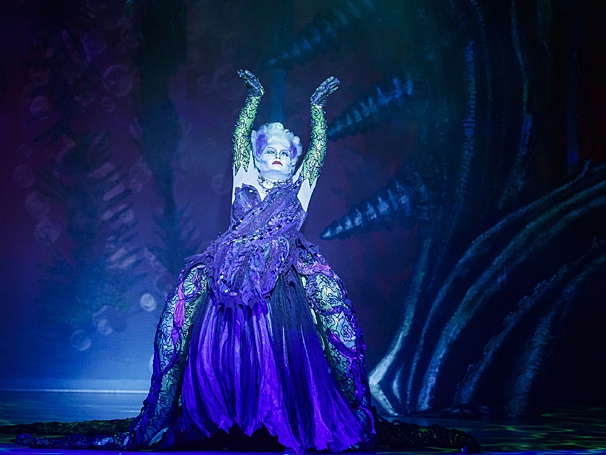
Determined to meet the handsome Eric (who was unconscious when she pulled him from the sea), she makes a Faustian bargain with her evil aunt, Ursula (Jennifer Allen): Ariel will become human, but she will forfeit her soul unless she can persuade the prince to kiss her within three days. In addition, she will immediately lose her voice. That’s unfortunate for her, because Eric has fallen in love with the singing voice he heard before the storm and is determined to find and marry its owner.

Jennifer Allen as the villainous Ursula

Though The Little Mermaid lacks the emotional depth of the best Disney musicals, it partially makes up for it by throwing in a boatload of humor. Scuttle’s misuse of the English language is a bit forced, but Allen’s tentacled and self-amused Ursula is good for chuckles. Funnier still is a scene in which a French chef (Dane Stokinger) prepares a meal by smashing deceased sea creatures with various kitchen utensils.

As Ariel, Huey is most successful at portraying the humorous side of puppy (guppy?) love, especially after the mermaid transforms into a human. In the sea, she’s often overshadowed by the more colorful characters around her, but on land, she’s amusingly awkward as Ariel struggles to deal with an unfamiliar body and emotions. (It’s probably unnecessary to point out that the former mermaid’s struggles symbolically parallel what the average girl goes through during her teen years.)

Despite the emphasis on comedy, The Little Mermaid’s biggest strengths are the tunes penned by composer Alan Menken and lyricists Howard Ashman and Glenn Slater. Sebastian (Melvin Abston), a crab who becomes Ariel’s protector, makes the most of two popular holdovers from the movie: Under the Sea and Kiss the Girl. Huey’s lovely voice soars on Ariel solos such as Part of Your World, while Kacergis displays the production’s strongest pipes on Eric’s numbers Her Voice and One Step Closer.

One element of the plot could use further honing: The inevitable happy ending comes about thanks to a sudden development that left both me and my date scratching our heads. Otherwise, The Little Mermaid—both the title character and the revised telling of her story—offers an inspiring lesson on the value of perseverance.

Broadway in Columbus and CAPA will present Disney’s The Little Mermaid through Sunday (Feb. 5) at the Ohio Theatre, 39 E. State St., Columbus. Show times are 7:30 p.m. through Thursday, 8 p.m. Friday, 2 and 8 p.m. Saturday, and 1 and 6:30 p.m. Sunday. Running time: 2 hours, 30 minutes (including intermission). Tickets are $29-$94. 614-469-0939, 1-800-745-3000, broadway.columbus.com, capa.com or ticketmaster.com.

Shoemaker sets out to save cross-dressers’ soles

The touring cast of Kinky Boots, presented by Broadway in Columbus and CAPA (photo by Matthew Murphy)

By Richard Ades

I have to admit I went into Kinky Boots with a small chip on my shoulder.

In 2013, Matilda the Musical was expected to win a slew of Tony Awards, including for best musical. Instead, despite having opened to mixed reviews, Kinky Boots danced away with the top prize.

Full disclosure: I love Matilda the Musical. Seeing it was my favorite Broadway experience since Memphis. After Kinky Boots beat out the magical lass for the top prize and others, including Cyndi Lauper’s win for best score, I decided it had better be damn good.

Anyway, that was my mindset going into the Ohio Theatre on Tuesday night, which helps to explain why it took me a while to warm up to the show. Eventually, though, I came around.

Adapted by Harvey Fierstein from a 2005 movie, Kinky Boots is the story of Charlie (Steven Booth), a young Englishman who’s preparing to move to London with his fiancée, Nicola (Charissa Hogeland). In the process, he’s leaving behind the family business, a Northampton shoe factory run by his father (Tom Souhrada).

No sooner does Charlie get to London, however, than he learns his father has died. As if that weren’t enough bad news, he then realizes the company is going broke because it can’t compete in a market flooded with cheap, foreign-made shoes.

Enter Lola (Kyle Taylor Parker), a drag performer whose chief problem seems to be her inability to find high-heeled boots strong enough to support her male frame. Thanks to a suggestion from factory worker Lauren (Lindsay Nicole Chambers), Charlie realizes the only way to save the business—along with the jobs of the people he grew up with—is to find a niche need and fill it. His solution: Start making sturdy, yet stylish, footwear for the discriminating cross-dresser.

I said I eventually came around on Kinky Boots, but that doesn’t mean I love everything about it. You don’t have to be an expert on Morse code to recognize that Fierstein is telegraphing plot points well in advance, including the fate of Charlie’s relationship with the sour-tempered Nicola. And things get even more transparent in the second act, when Fierstein manufactures conflicts by having Charlie act in totally unconvincing ways.

The show’s salvation is Lauper’s genre-hopping score, which earns its Tony. A couple of the songs strike me as derivative, but they’re generally enjoyable and catchy.

Of course, any production rises or falls on the strength of its cast, and this touring show’s cast acts, sings and dances delightfully under the guidance of director/choreographer Jerry Mitchell. At the top of the bill, Booth is relatable as Charlie, while Parker is nothing short of amazing as the sassy, yet soulful, Lola.

Some early critics complained that the show loses steam in the second act, but I actually like it better because it gives Lola a chance to grow into something beyond a flashy stereotype. Yes, Lola’s production numbers with her lascivious “Angels” are fun, but Parker’s best moment comes when Lola slows down for the Act 2 lament Hold Me in Your Heart. It’s a true show stopper.

Visually, the show is equally impressive, thanks to Gregg Barnes’s costumes, Kenneth Posner’s lighting and David Rockwell’s glorious scenery.

The one place the touring show could stand improvement is in the area of the sound. On opening night, whole lines of dialogue and lyrics were indecipherable. The English accents were partially to blame, but poor mixing seemed to be the main culprit. Hopefully, that problem will be fixed as the week goes on.

Did Kinky Books deserve to steal the top Tony away from Matilda? Not in my book. But it does give musical-loving theatergoers a colorful, toe-tapping good time.

Broadway in Columbus and CAPA will present Kinky Boots Oct. 6-11 at the Ohio Theatre, 39 E. State St., Columbus. Show times are 7:30 p.m. through Thursday, 8 p.m. Friday, 2 and 8 p.m. Saturday, 1 and 6:30 p.m. Sunday. Running time: 2 hours, 30 minutes (including intermission). Tickets are $33-$118. 614-469-0939, 1-800-745-3000 or ticketmaster.com.

[title of review]

Annie Huckaba, Bradley Johnson, Elisabeth Zimmerman and Jonathan Collura (clockwise from front) star in CATCO’s production of [title of show]
By Richard Ades

I arrive at the Riffe Center’s Studio Three and prepare to watch CATCO’s cabaret-style production of [title of show]. The intimate room is a pleasant place to watch theater, but I have my doubts about whether I should be watching this particular piece of theater.

My trepidation stems from what I’ve heard about Jeff Bowen and Hunter Bell’s offbeat musical, which first appeared in 2004, had an off-Broadway run in 2006 and finally turned up on Broadway for about three months in 2008. What I’ve heard is that the show is loaded with inside jokes and references that only gay, theater-obsessed New Yorkers can fully appreciate.

As the show begins, my fears seem justified. Some jokes fly right by me, while others just don’t seem that funny. Several audience members seem equally mystified—indeed, I can see one woman across the room who doesn’t crack a smile for the entire two hours and 10 minutes.

However, a small group of viewers makes up for this by laughing at nearly everything the cast does. Looking around, I realize that most of the laughs are coming from four men sitting in a tight circle. To be sure, many viewers chuckle or at least smile at various jokes, but this quartet supplies the bulk of the audience response.

So what is this show that appeals—intentionally, as it turns out—to such a select audience? It’s basically a musical about putting on a musical. Composer/lyricist Bowen and book writer Bell wanted to enter a show in an upcoming theater festival, and since they didn’t have any ideas, they decided to make the show its own subject.

A bit self-indulgent, don’t you think? Like the theatrical equivalent of a taking a selfie? Yes, and some of the early humor acknowledges that fact by focusing on the creators’ superficiality. In particular, the show’s version of Hunter is loath to begin a new project because he’s too involved in watching TV’s The Bachelor and Project Runway.

If the musical has any depth and universal meaning, it involves the participants’ desire to do something that would finally allow them to make theater the center of their existences. The self-doubt that prevents all of us from taking necessary chances in life is lampooned in one of the better songs, Die, Vampire, Die.

Back to Studio Three: As I watch the musical unfold under Joe Bishara’s direction, I admire both the cast’s singing and the keyboard work of accompanist Quinton Jones. But I also think the actors are portraying their characters with mixed success. That’s especially true of two female friends who join Jeff and Hunter’s project.

Elisabeth Zimmerman—who played one of my favorite characters in CATCO’s wonderful 2013 production of The 25th Annual Putnam County Spelling Bee—is entertaining as Heidi, to the extent that the thinly written role allows her to be. However, Annie Huckaba never quite gels as Susan, instead coming off as a caricature of playful quirkiness.

As for the men, Bradley Johnson is tastefully flamboyant as Hunter, while Jonathan Collura balances him out nicely as the more down-to-earth Jeff. It’s only in the later stages of the play that I begin to think Collura’s Jeff should have shown more passion for their shared project from the beginning. Maybe then the argument that arises late in Act 2 would be more convincing.

Truthfully, though, it’s unfair to blame the actors for anything that happens in Act 2.

The act didn’t even exist when the musical first opened, having been written to explain how the show and its creators changed as it moved to off-Broadway and finally to Broadway itself. Watching the second act in Studio Three, I quickly decide that adding it was a mistake.

And I’m not alone, judging from the audience’s reaction. Even the four biggest laughers are noticeably quiet as Jeff, Hunter, Susan and Heidi argue endlessly about whether they’ll ever get the show to Broadway and whether all of them will still be on board if and when it gets there.

Finally, Hunter suggests it’s time to bring the elongated show to an end, noting, “We can’t keep adding everything that happens to us.” It’s a brilliant insight, though it’s hard not to wish it had occurred to him about half an hour earlier.

Then again, I’m hardly in a position to throw that particular stone. It’s now been days since I saw the show, and I can’t find a way to finish this review, which already has dragged on for way too long.

Should I mention that, while watching the show, I kept thinking Zimmerman was playing Susan because she reminded me so much of the short-lived Seinfeld character of the same name? No, chances are no one else will make the connection, and really, who cares?

I guess I should just finish by addressing the all-important question: Will you enjoy the show? Maybe, maybe not. The creators themselves admit it won’t appeal to everyone, declaring in the finale that they’d rather be “nine people’s favorite thing than 100 people’s ninth-favorite thing.”

It should be obvious by now that [title of show] isn’t my favorite thing, my ninth-favorite thing or even my 90th-favorite thing. But who knows? Maybe it will be your favorite thing—at least until the second act.

CATCO is presenting an open-ended run of [title of show] in Studio Three of the Riffe Center, 77 S. High St. Show times are 8 p.m. Thursday-Sunday and 2 p.m. Sunday. Running time: 2 hours, 10 minutes (including intermission). Tickets are $35, $180 for a reserved table of four; a limited number of $15 student tickets will be available two hours before curtain. 614-469-0939 or catco.org.

Depression-era musical is far from depressing

Emma Stratton (center, lower deck) shows off her dance moves with other members of the company of Anything Goes (photo by Jeremy Daniel)

By Richard Ades

Watching Anything Goes is like taking a trans-Atlantic voyage while simultaneously time-traveling back to the 1930s.

The seagoing musical has been tweaked since it opened on Broadway in 1934, but the basic show remains intact. As a result, you feel like you’re enjoying the same kind of entertainment that helped to take our ancestors’ minds off the Great Depression.

What does the show tell us about our forebears? That they laughed at silly and sometimes naughty humor. And, mostly, that they had great taste in music.

The musical’s main claim to immortality is its collection of classic Cole Porter tunes such as You’re the Top and the title song, among many others. In the current touring show, all are wonderfully delivered by the cast and a brassy, jazz-savvy band conducted by Robbie Cowan.

Complementing the songs are some truly awesome dance numbers choreographed by director Kathleen Marshall. For tap-dancing fans, the highlight is the Act 1 capper set to the title tune. For those with a taste for something a little more provocative, Act 2’s Blow, Gabriel, Blow is equally fun.

The story centers on a young stockbroker named Billy Crocker (Brian Krinsky) and his attempt to woo engaged-to-be-married heiress Hope Harcourt (Rachelle Rose Clark). However, the show’s real star is neither Krinsky nor Clark.

Instead, it’s Emma Stratton, who plays nightclub performer Reno Sweeney. In the first scene, Reno declares her affection for Billy (I Get a Kick Out of You), only to learn that he’s fallen for Hope. A trooper if there ever was one, Reno then joins Billy’s campaign to win Hope away from her stuffy British fiancé, Lord Evelyn Oakleigh (Richard Lindenfelzer).

Reno is such an engaging character that you may root for Billy to choose her over the mousey Hope, even though you realize it’s a long shot. Meanwhile, you get to enjoy Stratton showing off her pipes and her equally impressive dance prowess in a bevy of tunes and production numbers.

Several other notable characters also figure in the plot. They include Billy’s alcoholic boss, Elisha Whitney (Michael R. Douglass); small-time gangster Moonface Martin (Dennis Setteducati); and Moonface’s free-loving girlfriend, Erma (Mychal Phillips). All have tuneful and reasonably funny moments.

Strangely, though, the funniest moment of all comes from an unlikely source. Lindenfelzer’s Lord Evelyn spends much of his time trying to master American slang, which produces chuckles at best, but the real comic gem is his attempt to locate The Gypsy in Me in an Act 2 dance duet with Reno.

The set, originally designed by Derek McLane and coordinated by James Kronzer, is clever depiction of ocean-liner interiors and exteriors.

Anything Goes is best known for its amazing collection of Porter tunes. Besides those already mentioned, the familiar solos and duets include Easy to Love (Billy), It’s De-Lovely (Billy and Hope) and Friendship (Moonface and Reno).

But thanks to the efforts of director/choreographer Marshall and her talented cast, crew and band, the show is much more than a few excerpts from the American Songbook. It’s a silly, sexy and footloose return trip to 1930s Broadway.

Broadway in Columbus and CAPA will present Anything Goes through Sunday (Feb. 8) at the Ohio Theatre, 39 E. State St. Show times are 7:30 p.m. through Thursday, 8 p.m. Friday, 2 and 8 p.m. Saturday, and 1 and 6:30 p.m. Sunday. Running time: 2 hours, 40 minutes (including intermission). Tickets are $28-$98. 614-469-0939, 1-800-745-3000 or ticketmaster.com.

Newspaper vendors go on strike in fleet-footed musical

Stephanie Styles and Dan DeLuca play Katherine and Jack in the touring production of Newsies (photo by Deen van Meer)

By Richard Ades

It was kind of odd watching Newsies Tuesday night at the Ohio Theatre.

The history-based Disney musical is basically a salute to the power of unions. As a result, it was hard to see it without remembering that a blatantly anti-union law had been passed about four years ago right across the street at the Statehouse—or that the governor who signed the law was re-inaugurated on Monday night.

All of that might have made it hard to enjoy the musical except that the anti-union law was overwhelmingly repealed thanks to a 2011 referendum. Yes, the little guys do occasionally win out in real life, as they do in Disney musicals.

Based on a 1992 movie, which was based on the Newsboys Strike of 1899, Newsies is about what happens when New York City newspapers put the screws to the young lads who eke out a living by selling their products on the street.

Joseph Pulitzer (Steve Blanchard), owner of the New York World, is the first to raise the wholesale price his “newsies” must pay, thinking that’s the easiest way to offset recent losses. He doesn’t count on the tenacity of Jack Kelly (Dan DeLuca), the paper pushers’ unofficial leader.

Jack persuades Manhattan-based newsies to go on strike, then begins seeking support from their counterparts in other New York boroughs. Backing him up are his best friend, Crutchie (Zachary Sayle), along with newcomer Davey (Jacob Kemp) and his little brother, Les (played at alternate performances by Vincent Crocella and Anthony Rosenthal).

Fighting the newspapers is a nearly impossible task, but unexpected help comes in the form of Katherine (Stephanie Styles), a society reporter who wants to write about the labor struggle to prove she’s ready to graduate to hard news.

Newsies gained several Tony nominations after opening on Broadway in 2012, but it won only for its musical score and choreography. The touring version makes it clear that these remain the show’s prime strengths.

With music by Alan Menken and lyrics by Jack Feldman, the score has several enjoyable numbers. They include The World Will Know, a defiant anthem that captures the spirit (if not the power) of Les Miz’s Do You Hear the People Sing?, and Watch What Happens, an amusing expression of Katherine’s determination in the face of self-doubt.

True, a few of the other numbers are either less memorable or less relevant, coming off as mere filler. But a worse problem on opening night was a sound system that often failed to elevate the generally fine voices above the large band conducted by James Dodgson. It sometimes was hard to pick out the lyrics, particularly in the group numbers.

Working under Jeff Calhoun’s direction, DeLuca makes Jack such a caricature of New York swagger that he’s not as compelling a hero as he might be. (Also, he seemed to suffer from subpar amplification at Tuesday’s performance.) But Styles turns Katherine into a lovable heroine, while Blanchard’s Pulitzer is such an effectively loathsome villain that you can almost imagine him twirling his mustache.

The real stars, though, are choreographer Christopher Gattelli and his spinning, leaping and somersaulting dancers. Several numbers fill Tobin Ost’s set with amazing moments of motion.

The dancing makes this musical history lesson as impressive as it is inspiring.

Broadway in Columbus and CAPA will present Newsies through Sunday (Jan. 18) at the Ohio Theatre, 39 E. State St. Show times are 7:30 p.m. through Thursday, 8 p.m. Friday, 2 and 8 p.m. Saturday, and 1 and 6:30 p.m. Sunday. Tickets are $28-$98. 614-469-0939, 1-800-745-3000 or ticketmaster.com.

Struggling to grow up in the Reagan era

Newsies demonstrates that 1890s young adults could accomplish quite a lot when they put their minds to it. Kenneth Lonergan’s This Is Our Youth, in contrast, shows that 1980s young adults could accomplish next to nothing, especially when their minds were clouded by drugs and immaturity.

It’s a savvy, clever portrait of an era and an age group that is entertaining until it gets bogged down in talkiness and redundancy, as it does during the second act.

In Warehouse Theatre Company’s production, the three actors give fully committed performances under Kristofer Green’s direction: John Connor as the self-absorbed Dennis, Jesse Massaro as the self-doubting Warren and Erin Mellon as the emotionally cautious Jessica.

Will Warren find a way to recover the $15,000 he stole from his hated father? And will he ever connect with Jessica, the oblivious object of his romantic obsession?

Such questions hold the viewers’ interest for a while, but Lonergan eventually overplays his dramatic cards. It’s a shame, because the actors do everything they can to keep us involved.

It’s a valiant effort, to say the least.

Warehouse Theatre Company will present This Is Our Youth at 8 p.m. Thursday-Saturday (Jan. 15-17) at MadLab Theatre and Gallery, 227 N. Third St. Running time: 2 hours, 20 minutes (including intermission). Tickets are $22, $15 student rush. 614-371-5940 or warehousetheatre.org.

Keeler-like lass sets out to conquer Broadway

Ruby (Haley Jones, on floor) shows off her flexibility in Dames at Sea, which also stars (from left) Ian Taylor, Erin Ulman, Jordan Donica, Courtney Dahl and Sam Parker (photo by Andrew Beers)

By Richard Ades

Otterbein is presenting its summer series on the stage of Cowan Hall. That is, both the audience and the actors share the stage, making for an intimate experience.

At first, it seems like an odd setup for Dames at Sea, a takeoff on 1930s movie musicals. You may find yourself wondering why they didn’t use the entire auditorium, as they do with their spring musical productions.

But it turns out the cozy surroundings work just fine for this George Haimsohn/Robin Miller/Jim Wise comedy, which is far more modest in size than the movies it spoofs. Originally opening off-Broadway in 1966, it features only seven major roles—and two of them are played by the same actor.

In Otterbein’s production, Haley Jones stars as Ruby, who’s determined to make her mark on Broadway even though she’s fresh off the bus from Utah. She’s clearly modeled after the kind of talented lass Ruby Keeler played on Depression-era movie screens, and Jones imbues her with the same kind of fresh-faced innocence and spunk. Almost as appealing is Sam Parker’s portrayal of Dick, the sailor who falls in love with Ruby after learning they both hail from the same small town.

The same town? Gee, what are the chances of that? Well, pretty good in this show, which takes none-too-subtle jabs at the amazing coincidences and strokes of luck that propelled Keeler’s heroines to instant fame and romance.

Also playing important roles are Jordan Donica as flop-prone director Hennesey, Erin Ulman as spoiled diva Mona Kent, Courtney Dahl as sarcastic hoofer Joan and Ian Taylor as Joan’s sailor-boyfriend, Lucky. In Act 2, Donica does double duty as the Captain, whose battleship is commandeered by Hennesey and his cast after their theater becomes unavailable.

Supporting roles are played by Anthony Cason, Emily Vanni, Jeff Gise and—upstaging all the rest—Tux. This pooch, who plays Mona’s lapdog, is the biggest, calmest Pomeranian you’ve ever seen.

In a show this campy, it’s a good idea not to camp up the performances, which amounts to overkill. Working under Doreen Dunn’s spirited direction, most of the cast members manage to avoid this most of the time. The biggest exception is Ulman, who makes Mona a caricature of diva-hood.

On the other hand, Ulman sings and tap-dances well, as she proves in the first musical number, Wall Street. Other cast members also get ample opportunities to show off their fine pipes and moves, with strong help from Molly Sullivan’s choreography and Dennis Davenport and Lori Kay Harvey’s keyboard accompaniment. Fittingly, no one gets more opportunities than Jones, who is especially impressive on her two ballads, The Sailor of My Dreams and Raining in My Heart.

Rob Johnson’s scenery is nearly nonexistent in Act 1, set on a largely bare stage, but the Captain’s Navy ship is amusingly depicted in Act 2.

Plot-wise, Dames at Sea is little more than a string of self-consciously absurd developments. Music-wise, it’s marked by tunes that are pleasant but mostly unmemorable. It’s a slight pleasure, but a pleasure nonetheless.

Otterbein Summer Theatre will present Dames at Sea at 8 p.m. Wednesday-Saturday (July 23-26), plus 2 p.m. Friday, in Cowan Hall, 30 S. Grove St., Westerville. Running time: 2 hours, 5 minutes (including intermission). Tickets are $25. 614-823-1109 or www.otterbein.edu/drama.

‘Jersey Boys’ fails to recapture stage show’s magic

Playing the Four Seasons in a scene from Jersey Boys are (from left): John Lloyd Young (Frankie Valli), Erich Bergen (Bob Guadio), Vincent Piazza (Tommy DeVito) and Michael Lomenda (Nick Massi) (Warner Bros. Entertainment Inc.)

By Richard Ades

Chicago was a great movie. So were Cabaret, West Side Story and The Sound of Music.

But for every stage musical that made a successful transition to the multiplex, you can probably think of four or five that didn’t. So it’s not really surprising that the movie version of Jersey Boys isn’t half as much fun as its live predecessor.

Director Clint Eastwood made some good choices and some bad choices when he went about adapting Marshall Brickman and Rick Elice’s biographical tribute to the Four Seasons. One of the good choices was casting people who’d already proved themselves in the stage version, rather than following the usual practice of hiring film stars. That guaranteed that the actors playing the 1960s rock group could actually sing (unlike, say, Russell Crowe in the big-screen version of Les Miz).

One of Eastwood’s questionable choices was hiring Brickman and Elice to adapt their own hit musical. You’d think that would be a plus, as it would encourage the movie to stay true to the original, but staying true to the original isn’t necessarily a good thing.

Not to belabor the obvious, but a movie and a stage musical are two entirely different animals. On the stage, we can put up with dramatic developments being delivered in a kind of shorthand, as their main purpose is to propel us toward the next tune. In a movie, we generally need more realism.

We don’t get that in Eastwood’s Jersey Boys. Not only do many of the characters come off as Italian-American stereotypes, but the dramatic developments often hit us without warning, depriving them of their potential power. That’s especially true of lead singer Frankie Valli (John Lloyd Young), who’s faced with one emotional setback after another involving the women in his life—none of whom we’ve really gotten to know.

Compounding the problem, Young gives a rather unemotional performance in the role he originated on Broadway, though he makes up for it every time he launches into his dead-on impersonation of Valli’s falsetto warbling.

The actors playing the other members of the group—Vincent Piazza as unscrupulous control freak Tommy DiVito, Erich Bergen as songwriter Bob Guadio and Michael Lomenda as bass-voiced Nick Massi—are all fine. Even so, the movie seldom gives us a feel for what drives them other than their egos. And economic necessity: In an early voice-over, Tommy says the only ways to escape from their blue-collar New Jersey neighborhood are the Army, the mob and fame.

Speaking of the mob, it’s well represented by Christopher Walken as “Gyp” DeCarlo, a paternal gangster with a soft spot for the group’s music.

The film does manage to open the story up a bit in the first act, as when Frankie is roped into an attempt to rob a jewelry store. The heist goes humorously wrong when the would-be crooks attempt to load a huge safe into the trunk of an old Studebaker, with disastrous results.

Mostly, though, Eastwood sticks to the stage musical’s arc, which allows the members of the group to take turns narrating the Four Seasons’ rise from obscurity to Top 40 success, even as the quartet is wracked by jealousies and financial problems.

Like the original, the movie is at its best when it re-creates the band’s big hits, like Sherry, Walk Like a Man and, best of all, the Valli solo Can’t Take My Eyes Off You. Unfortunately, there aren’t nearly enough moments when the musicians are allowed to set aside their problems and just rock out.

As if to make up for this dearth, the closing credits are projected over a Bollywood-style song-and-dance number involving the whole cast, belatedly capturing the kind of energy that made the stage production a Broadway hit.

Rating: 3 stars (out of 5)

‘Mormon’ musical isn’t just a raunchy satire

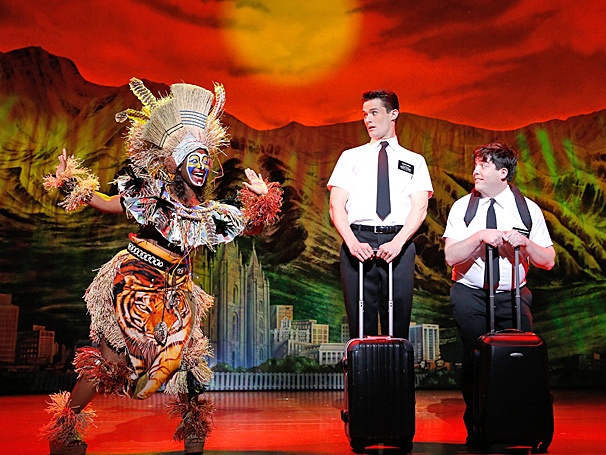
Elder Price (Mark Evans, left) and Elder Cunningham (Christopher John O’Neill) are given a rousing sendoff as they prepare to take the Mormon message to Uganda (Broadway.com photo)

By Richard Ades

The Book of Mormon has finally arrived in Columbus, and I’ve now had the chance to form a second opinion on the show I saw nearly a year ago on Broadway.

That opinion: I like it even better the second time.

Admittedly, the first act was a bit of a letdown when I attended the show Wednesday at the Ohio Theatre, partly because it had lost the element of surprise. But the second act delivered even more of a payoff, both comically and emotionally.

Emotionally? Yes. This hit musical by Avenue Q’s Robert Lopez and South Park creators Trey Parker and Matt Stone does have some inspiring and heartfelt moments in between all the F-bombs and sexual references.

You’ve probably heard that The Book of Mormon takes a satirical look at the titular faith, including its odd belief that Jesus visited what is now upper-state New York during the brief time between his crucifixion and his resurrection. Yes, it has religious zingers aplenty, and they’re both sly and hilarious. At its core, though, this is the story of a friendship between two young missionaries.

Elder Kevin Price (Mark Evans) is the fair-haired child of his missionary class, so flawless that people assume “Heavenly Father” will grant him any wish he desires. And what Kevin desires is to be assigned to spread the Mormon message in Disney-fied Orlando, which he considers the most perfect place on earth.

Elder Arnold Cunningham (Christopher John O’Neill) is Kevin’s opposite, a roly-poly ne’er-do-well with a propensity for stretching the truth. Kevin is chagrined to learn that he and Arnold have been assigned to spend their two-year mission together, and he’s even more chagrined to learn that they’ll be spending it in northern Uganda.

His chagrin turns to terror when he learns that the local people are oppressed not only by poverty, AIDS and superstition, but by a warlord who threatens to “circumcise” (i.e., genitally mutilate) all the women. After the colorfully named General Butt Fucking Naked (Corey Jones) proves his ruthlessness by shooting a detractor in the face, Kevin decides his best option is to request a transfer out of this godforsaken land.

The Book of Mormon’s success depends most heavily on Arnold, an irresponsible scamp who ultimately is forced to Man Up, as he sings in the rousing number that caps off Act 1. In the touring production at the Ohio, O’Neill hits every note just right whether he’s singing or speaking. Over the show’s 2½ hours, he builds a portrayal of a lovably needy but surprisingly resourceful man-child.

Evans also hits every note just right as Kevin, revealing a sweet voice and an innate decency hiding just beneath the character’s self-important surface. He even projects a modicum of vulnerability after a guilty conscience lands Kevin in the middle of a Spooky Mormon Hell Dream. The gaudy musical number surrounds him with threatening demons, a dismissive Jesus and even dancing Starbucks cups. (Mormons, of course, are forbidden from drinking either alcohol or caffeine.)

The show’s third important character is Nabulungi (Alexandra Ncube), a young village woman who responds to the Mormon message because it offers her hope in a hopeless world. Ncube projects charming naiveté and a beautiful singing voice, particularly in her wistful solo Sal Tlay Ka Siti.

Parker co-directs the large and energetic cast with choreographer Casey Nicholaw, who fills the production numbers with clever, spirited dance steps. Justin Mendoza conducts the orchestra, which puts forth a full and satisfying sound despite relying heavily on keyboards. Scott Pask’s scenery, augmented by Brian MacDevitt’s lighting, efficiently moves the action from continent to continent and century to century as needed.

Though The Book of Mormon delights in ridiculing the most eccentric beliefs of the Church of Jesus Christ of Latter-day Saints, it can’t really be described as anti-religious. It accepts and even celebrates religion’s ability to offer hope to people who need it.

The show may not inspire to re-evaluate your beliefs the next time men in white shirts and dark ties ring your doorbell, but you probably won’t slam your door in their faces, either.

Broadway in Columbus and CAPA will present The Book of Mormon through May 25 at the Ohio Theatre, 39 E. State St. Show times are 7:30 p.m. Tuesday-Thursday, 8 p.m. Friday, 2 and 8 p.m. Saturday, and 1 and 6:30 p.m. Sunday. Running time: 2 hours, 30 minutes (including intermission). Tickets are $43-$145. 614-469-0939, 1-800-745-3000 or ticketmaster.com.