Deneuve as a first lady out to reinvent herself

Catherine Deneuve stars as the title character in The President’s Wife, a fictionalized biopic of French first lady Bernadette Chirac. (Photo courtesy of Cohen Media Group)

By Richard Ades

What’s it like to be the wife of a leader who forces you to live in his shadow and ignores your political advice? The President’s Wife answers that question with its feminism-informed biography of former French first lady Bernadette Chirac.

But don’t expect a sober-minded piece of historical revisionism. The film, directed and co-written by Lea Domenach, refuses to take itself too seriously, and it’s clear from the first scene that we shouldn’t, either.

As Bernadette (the legendary Catherine Deneuve) makes her way to a confessional booth for a heart-to-heart with her priest, the church choir informs us that what we’re about to see is based only loosely on reality. In fact, the singers warn us, it’s a “work of fiction.” 

Still, it’s hard not to hope that what follows is least partly true, because it’s a delicious story of self-reinvention and political comeuppance.

We first meet Bernadette in 1995, when her husband, Jacques Chirac (Michel Vuillermoz), is on the verge of winning the presidency. A politician in her own right, Bernadette has worked hard to bring about this long-sought victory, but once the new administration takes office, she’s quickly pushed to the background.

With her dated wardrobe and occasionally loose lips, Bernadette is seen as a liability by both her husband and her younger daughter, Claude (Clara Giraudeau), who works as one of his chief aides. The two even go so far as to assign a communications adviser named Bernard (Denis Podalydes) to help Bernadette hone her image. The idea is to keep the first lady from embarrassing and upstaging the president.

However, the plan soon backfires.

After a series of events provide proof of (1) Bernadette’s political smarts and (2) Jacques’s marital unfaithfulness, Bernard switches his allegiance from the husband to the wife. Together, Bernard and Bernadette begin working to improve her image through such tacks as promoting charities, rubbing elbows with celebrities and, mostly, just being herself.

To put it mildly, their efforts prove fruitful for Bernadette and entertaining for the audience. (Watch for the trained bear!)

Anyone who’s less than fully knowledgeable about French politics might lose a reference here and there, but it’s just a slight inconvenience. Thanks to Domenach’s witty script and playful direction—and thanks to a great cast and especially to Deneuve’s droll and assured performance as Bernadette—The President’s Wife is one history class you won’t want to skip.

Rating: 4 stars (out of 5)

The President’s Wife opened April 18 in major cities and will expand to other markets beginning April 25. It is scheduled to open May 9 at Columbus’s Gateway Film Center.

Can a lonely mom co-exist with her daughter’s ex?

Susan (Michaela Watkins, left) reluctantly takes in her daughter’s ex-boyfriend, Gage (Charlie Gillespie), in Suze.

By Richard Ades

Are you looking for a way to show your love for our neighbors to the north? Do you want to make it up to them for our president’s threats to either absorb them or tax them into oblivion?

Well, now you can, thanks to the new Canadian flick Suze. Written and directed by filmmaking spouses Dane Clark and Linsey Stewart, it’s an offbeat comedy with a Yukon-sized heart.

Title character Susan (Michaela Watkins) is a mid-level manager and mom who left her husband after finding him sharing bodily fluids with another woman. Fast forward five years, and she now has two new problems: the unwelcome arrival of perimenopause and the impending departure of her college-bound daughter, Brooke (Sara Waisglass).

Oh, and one more: Susan can’t stand Brooke’s himbo-esque boyfriend, Gage (Charlie Gillespie), because he’s not bound for college, has no prospects and therefore seems unworthy of her beloved offspring. As a result, Susan urges Brooke to drop him as soon as possible.

A few weeks go by, during which Susan has trouble concentrating at work because she’s frantic to get news from her absent and stubbornly uncommunicative daughter. Then, she finally gets news, but it’s from a surprising source—Gage’s father, Rick (Aaron Ashmore), who tells her his son injured himself jumping off a water tower because Brooke sent him a “Dear John” text.

Rick clearly blames Susan’s daughter for what happened and figures that entitles him to a big ask: Can Susan watch his distraught and possibly suicidal son for a few weeks while his work takes him out of town? Motivated by either guilt or just common decency, Susan reluctantly agrees and opens her home to the volatile teen who still pines for her daughter.

So what happens next? After putting a lonely, middle-aged woman and a hunky, lovesick youth under the same roof, there’s an obvious way this story could have gone. Fortunately for us, Clark and Stewart take a more interesting tack by focusing on the fact that these two vulnerable people have one thing in common: They both love and miss the same person. 

That’s not to say Suze never takes the obvious road. Waisglass’s Brooke and Ashmore’s Rick come across rather heavy-handedly as a spoiled brat and distant dad, respectively. And some scenes seem a little familiar, including one that could have been copied from a recent Jennifer Lawrence comedy (though it probably wasn’t).

But as long as the spotlight remains on the two central characters, none of that matters. Gillespie is often hilarious and always lovable as the outgoing Gage, while Watkins holds onto our sympathy even when Susan’s maternalistic needs lead her into cringe-worthy excesses.

Thanks to a sensitive script and these two wonderful leads, Suze is a treat. It might not take you where you expect to go, but once you get there, you’ll be glad you made the trip.

Rating: 4 stars (out of 5)

Suze (no MPA rating) opens Feb. 7 in theaters and on demand.

Former Mr. Maisel again makes jerkiness palatable

Andy Singer (Michael Zegen, right) is forced to spend a hectic day with his daughter, Anna (Kasey Bella Suarez), in Notice to Quit.

By Richard Ades

As the cheating husband who drove his wife to a life of comedy in The Marvelous Mrs. Maisel, Michael Zegen proved he can play a cad without losing the audience’s sympathy. By the end of the series, in fact, we were rooting for him almost as much as we were for his joke-telling ex.

In the comedy-drama Notice to Quit, as actor-turned-real estate agent Andy Singer, Zegen again relies on his natural likability. So, it seems, does first-time writer/director Simon Hacker.

Perhaps more than he should.

To be blunt, Hacker gives us almost no reason to cheer for Andy, an ethics-challenged New Yorker who’s down on his luck. To name just one of his vices, he regularly makes extra bucks by stealing appliances out of vacant properties and selling them to a ragtag gang of thugs.

Then, just as Andy is being evicted from his apartment because he’s behind on the rent, 10-year-old daughter Anna (a relatable Kasey Bella Suarez) shows up and wants to spend the day with him. She’s mad because her mom (Andy’s ex) is moving to Florida, and she doesn’t want to go.  

So how does Andy react to the presence of the daughter he hasn’t seen in months? Not well. In fact, he doesn’t want to be bothered and unsuccessfully tries to palm her off on his retired father (Robert Klein).

To some extent, it’s understandable that Andy can’t deal with Anna on this day, as he’s desperate to scrape together enough bucks to avoid ending up on the street. Mainly, though, his lack of filial devotion just makes it that much harder to care about him.

That is, it makes it harder for us to care about him. For her part, Anna seems to love her dad and enjoys this rare opportunity to spend time with him. Why? Did they have a close relationship in the past, when her parents were still together?

Hacker’s script never explains, any more than it clarifies just why we’re supposed to see Andy as anything other than a self-centered scumbag. And yet we are, because it quickly becomes obvious that the film has something warm and fuzzy in its long-range sights.

When that something arrives, it lands with all the impact of a wet noodle, both because it was telegraphed well in advance and because it wasn’t earned. It’s clear that Hacker wants us to care about what happens, but it’s equally clear that he doesn’t know how to make us care.

Well, with one exception: He lucked out by casting Zegen as Andy, who retains at least a portion of our sympathy even though he doesn’t deserve it, and Suarez as Anna, the daughter who loves him for no apparent reason. The chemistry these two create is the flick’s main selling point.

Rating: 3 stars (out of 5)

Notice to Quit (PG-13) opens Sept. 27 in theaters nationwide.

Stranded alcoholic goes to war with beavers

A hidden Jean Kayak (Ryland Brickson Cole Tews, foreground) watches the industrious title characters at work in Hundreds of Beavers. (Photos courtesy of hundredsofbeavers.com)

By Richard Ades

What do you get when you take a drunk applejack salesman and strand him in a wintry wilderness filled with beavers?

If the beavers were real, you’d get a very strange nature documentary. But since they’re actually people dressed in animal costumes, you instead get Hundreds of Beavers, a comedy so bizarre that it’s probably on its way to achieving cult status.

Shot in black and white and with title cards rather than spoken dialogue, Beavers borrows some of its look and feel from the silent era. More often, though, it comes off as a (mostly) live-action version of early 20th-century cartoons, which sometimes had plots and visuals so surreal that you had to wonder just what the animaters were drinking and/or smoking.

You might end up wondering the same about director Mike Cheslik and his star, Ryland Brickson Cole Tews, who collaborated with him on the script. But however they got their inspiration, they brought it to life with skill, imagination and a taste for macabre humor.

Angry beavers battle Jean Kayak, who’s wearing a hat made from one of their deceased comrades.  

Tews plays Jean Kayak, who runs the Acme Applejack farm and seems determined to drink up the profits. Then a fiery explosion turns the farm into cinders and apparently leaves Kayak in a deep slumber. When he awakens months or years later, he finds himself alone in a world covered in deep snow.

At first, Kayak spends all of his time trying to stave off hunger by hunting giant rabbits (played, of course, by people in rabbit costumes). His efforts grow more and more elaborate, but like Wile E. Coyote in the old Road Runner cartoons, he always comes up empty. (The comparison is inescapable, as Kayak’s Acme Applejack farm is no doubt an homage to the Acme Co. from which Wile E. purchased his bird-trapping supplies.)

Things finally begin turning around for Kayak after he meets several new people, including a fur trader (Wes Tank) and a merchant (Doug Mancheski). The former helps him learn the trapping skills he needs to gain an advantage over the animals he’s been hunting, while the latter motivates him by offering rewards for their carcasses.

The biggest reward is the hand of the merchant’s furrier daughter (Olivia Graves) in marriage, but the price is steep: namely, “hundreds of beavers.”

The furrier (Olivia Graves) goes to work on a beaver carcass.

Director Cheslik turns the resulting battle royale between Kayak and the beavers into an inventive and sometimes comically gruesome treat with help from collaborators such as cinematographer Quinn Hester, composer Chris Ryan and special effects coordinator Brandon Kirkham.

Most viewers will be happy to accept all the clever mayhem at face value, but those looking for a deeper meaning may find it thanks to a final character: an Indian fur trader (Luis Rico) who befriends Kayak and sometimes helps him out.

The presence of a Native American, along with an early scene that’s reminiscent of the first Thanksgiving, may serve to remind us that Europeans’ “discovery” of the New World had a profound effect on its environment. Could it be that Kayak is meant to represent the early hunters and trappers who decimated animal populations to line their own pockets?

But if there is such a message, don’t worry. The flick never takes itself seriously enough to turn into an ecological lecture. Cheslik and his cohorts are having way too much fun for that.  

Rating: 4 stars (out of 5)

Hundreds of Beavers can be seen in select theaters (including Central Ohio’s Drexel Theatre beginning April 5). It will be available online beginning April 15 via Prime Video and Apple TV, and beginning April 19 as an SVOD exclusive on Fandor.

‘Doubtfire’ actor reprises Tony-nominated star turn

Daniel (Rob McClure) effects a Scottish accent to convince ex-wife Miranda (Maggie Lakis) to hire the fictitious Mrs. Doubtfire as their children’s nanny. (Photos courtesy of Broadway in Columbus)

By Richard Ades

Mrs. Doubtfire’s brief 2021-22 Broadway run was most acclaimed for Rob McClure’s Tony-nominated performance in the starring role. So it’s fortunate that McClure is re-donning the title nanny’s wig, mask and padding for the North American tour.

As unemployed actor Daniel Hillard, McClure trots out a cornucopia of voices and impersonations, all delivered with manic energy almost worthy of the late Robin Williams, who originated the role in the 1993 film.

Fueling the plot is the fact that Daniel is a devoted father but a so-so husband, leading wife Miranda (Maggie Lakis) to seek a divorce. When a judge threatens to award Miranda sole custody of their kids unless Daniel can get his financial act together, the distraught dad concocts a plan to keep on seeing them.

With makeup and hairstyling help from brother Frank (Aaron Kaburick) and his husband, Andre (Nik Alexander), Daniel invents an aging Scotswoman named Mrs. Doubtfire. In this disguise, he lands the job of taking care of his offspring while Miranda is busy launching her own clothing line.

Daniel (Rob McClure) shares dance steps with a group of chefs in one of the show’s production numbers.

Emotion would seem to be built into the story, dealing as it does with Daniel’s attempt to hold onto his family. But the musical’s writers (Kary Kirkpatrick and John O’Farrell) and director (Jerry Zaks) put more of the focus on comedy and spectacle.

The comedy largely revolves around Daniel’s attempts to bamboozle a court liaison (Romelda Teron Benjamin) charged with checking up on him. As for the spectacle, it involves dance numbers that are sometimes shoehorned in on the thinnest of excuses. For example, when Daniel tells Frank and Andre he needs a female alter ego, they conjure up dancing celebrities ranging from Donna Summer to Eleanor Roosevelt and Janet Reno before he can explain what he has in mind.

All of this is fun when it works, as it often does. There are many amusing moments, and the dance numbers are spirited thanks to Lorin Latarro’s choreography and Wayne Kirkpatrick and Kary Kirkpatrick’s tunes.

It’s just that the show would be more satisfying if it provided more feels.

Giselle Gutierrez as Lydia, Daniel and Miranda’s older daughter

One emotional high point comes midway through Act 1 with “What the Hell,” a heartfelt song that expresses how Daniel and Miranda’s divorce is affecting their children. Teenage daughter Lydia (a wonderful Giselle Gutierrez) is angry, while younger siblings Chris and Natalie feel they are somehow to blame for the breakup. (Chris is played at alternate performances by Cody Braverman and Axel Bernard Rimmele, Natalie by Emerson Mae Chan and Kennedy Pitney.)  

By the end, the musical does manage to supply another heartwarming moment or two. Otherwise, the focus is on laughs, leaps and Rob McClure’s amazing capacity for comedic schtick.   

Broadway in Columbus will present Mrs. Doubtfire through Nov. 5 at the Ohio Theatre, 39 E. State St., Columbus. Showtimes are 7:30 p.m. through Thursday, 8 p.m. Friday, 2 and 8 p.m. Saturday, and 1 and 6:30 p.m. Sunday. Running time: 2 hours, 35 minutes (including intermission). For tickets or more information, visit columbus.broadway.com. For information on future tour stops, visit mrsdoubtfirebroadway.com/tour.

Overheard honesty threatens marital bliss

Beth (Julia Louis-Dreyfus) tries to drown her sorrows in You Hurt My Feelings. (Photos by Jeong Park)

By Richard Ades

When a couple exchanges wedding vows, they promise to love and cherish each other, among other things. What they generally don’t promise is to be honest with each other.

Whether or not that’s a good thing is a topic writer-director Nicole Holofcener takes up in her entertaining and chuckle-worthy new film, You Hurt My Feelings.

Long-married New Yorkers Beth and Don (Julia Louis-Dreyfus and Tobias Menzies) love and support each other to a fault—the fault being that they occasionally express that support by telling little white lies.

When Don gives Beth earrings as an anniversary present, she greets them with such forced enthusiasm that it’s obvious she doesn’t like them. And when Beth reciprocates by giving Don a V-neck sweater, his disappointment is equally clear because his first comment is, “Oh, a V-neck.” (As all fans of Louis-Dreyfus’s former series, Seinfeld, know, saying the name of a gift after you open it is a sure sign you didn’t want it.)

All this is no big deal, right? When you’re in a relationship, telling the occasional little white lie can help you avoid hurt feelings or unnecessary friction.

But then Beth catches Don in a lie that doesn’t seem so little: She overhears him admitting to his brother-in-law that, even though he’s told Beth he loves the novel she’s been working on for the past two years, he actually hates it.

Beth is hurt and humiliated, telling sister and fellow eavesdropper Sarah (Michaela Watkins), “I can’t look him in the face ever again.” Sarah tries to soften the blow by admitting she tells actor-husband Mark (Arian Moayed) that he’s more talented than he actually is, but it seems the damage is done.

This unfortunate incident comes to dominate the flick, as well as supplying its title, but it’s actually just one of several examples of the fragile egos and self-doubts that afflict all the major characters.

Aspiring novelist Beth worries she won’t be able to duplicate the success of her previous work, a memoir about growing up with an abusive father. (Not that the memoir was as successful as it might have been if her father hadn’t been just verbally abusive, she muses ruefully.)

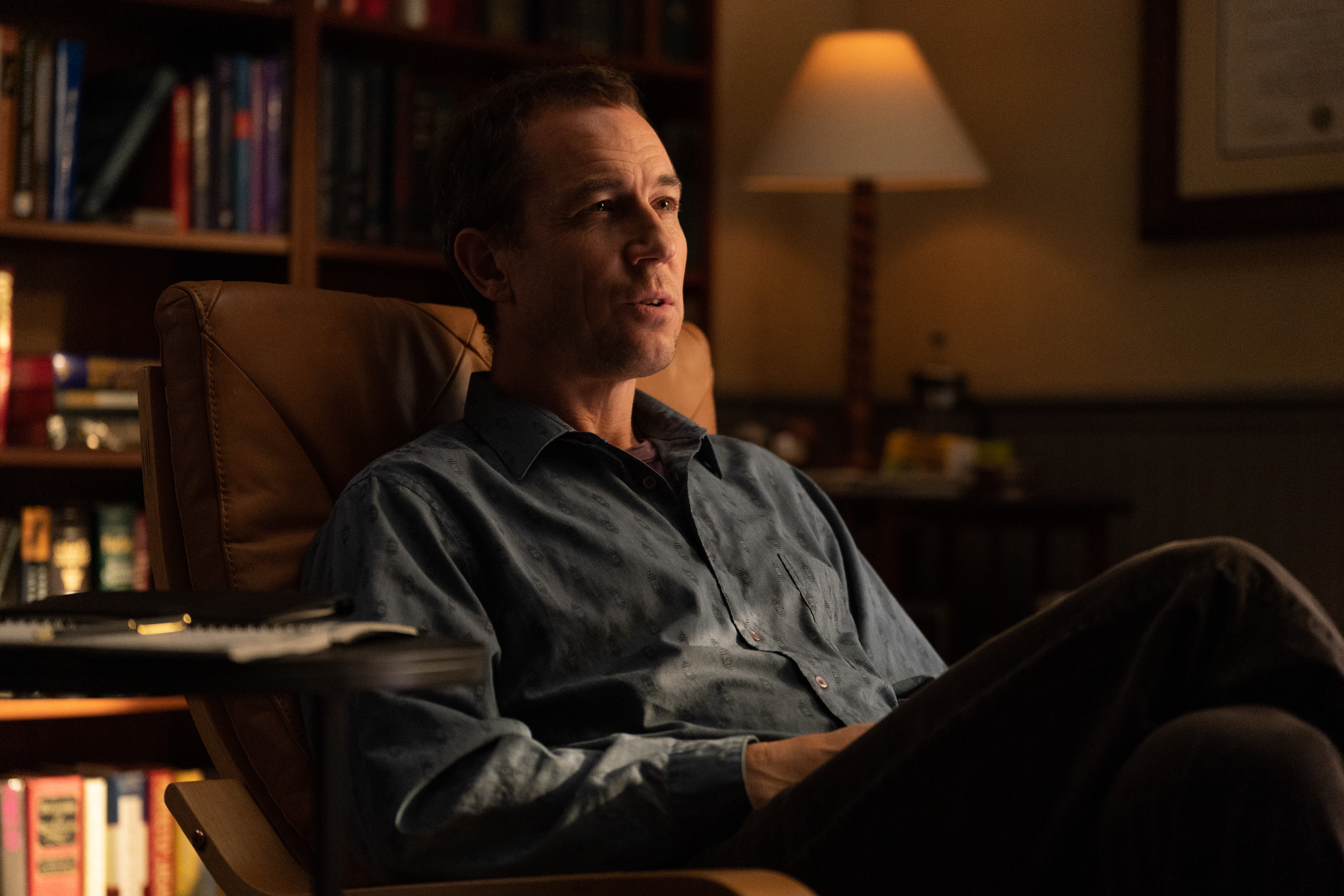
Therapist Don (Tobias Menzies) has trouble keeping his clients’ backstories straight.

Don, a therapist who seems to be chronically tired, has trouble keeping his clients straight, and he worries that he’s not helping them get any better. Sarah, an interior designer, has similar fears about pleasing her clients, while Mark suspects he’s really not such a great actor.

Finally, there’s Beth and Don’s 23-year-old son, Eliot (Owen Teague), who’s working on a play that he fears is no good, while dating a woman who he worries will break up with him.

My one quibble with the way all this trauma is acted out is that Louis-Dreyfus falls back on her old Elaine Benes mannerisms at one or two inopportune moments. Otherwise, everyone’s great, including the several supporting actors who play Mark’s eccentric and generally dissatisfied clients.

With its New York setting, sardonic wit and neurotic characters, You Hurt My Feelings may strike some as a lighter, gentler version of early Woody Allen. But Holofcener is really doing her own thing with this portrait of everyday worries and squabbles, giving viewers a breezily pleasant hour and a half in the process.

Rating; 4 stars (out of 5)

You Hurt My Feelings (rated R) opens May 26 in select theaters.

‘Marvelous’ series’ finale lives up to its name

Rachel Brosnahan as the titular aspiring comedian in The Marvelous Mrs. Maisel

By Richard Ades

The Marvelous Mrs. Maisel is coming to an end, and it’s doing it as stylishly as ever.

The tale of a divorced Jewish housewife who seeks success as a standup comedian will be wrapped up over the course of nine episodes during the series’ fifth and final season.

Will Miriam “Midge” Maisel (Rachel Brosnahan) achieve her goal by breaking through the comedic glass ceiling of mid-20th century America? It’s not giving too much away to say she will, as that’s revealed in an early-season flash-forward. What’s not revealed right away is just how she’ll hit the big time, and how her success will affect her family and friends.

It comes out in the second episode that at some point she’ll part ways with the mannishly attired Susie Myerson (Alex Borstein), who became the fledgling comedian’s first cheerleader and, soon after, her devoted manager. How do they break up, and will they ever reconcile? Viewers will have to wait and see.

Her relationship with ex-husband Joel (Michael Zegen), whose infidelity ended their marriage in the first season, also continues to evolve. And it does so in surprising ways, as seen in another flash-forward or two.

In fact, series creator and writer Amy Sherman-Palladino does a good deal of time-traveling from the show’s principal era of the late 1950s and early ’60s. Thus, we get to peek into the futures of several characters, including Midge’s parents (Marin Hinkle and Tony Shalhoub). We even get to see grownup versions of her children, Esther and Ethan, though they played relatively minor roles during most of the series.

Through it all, Maisel continues to impress with its amazing production values, one episode opening with a dance number worthy of Broadway. The show is also frequently funny, with, as usual, much of the humor coming from its supporting characters rather than its titular comedian. And by “supporting characters,” I primarily mean Borstein’s always-hilarious Susie, followed by Shalhoub’s rendition of Midge’s curmudgeonly and neurotic dad.

(For those who want to see if Borstein is as funny in her own skin as she is in Susie’s, a new Prime comedy special allows her to tell jokes, sing and even make a few political and philosophical points. Viewers may conclude that she isn’t quite as funny in her own skin, but they’re likely to be impressed by her versatility. As indelible a character as Susie is, she’s clearly not Borstein.)

All in all, season five is one of the series’ best, maybe even as good as season one. Fans of the show’s scrappy heroine should go away happy.

Rating: 4 stars (out of 5)

Episodes 1-3 of the final season of The Marvelous Mrs. Maisel can be seen on Amazon Prime Video beginning April 14. One subsequent episode will be released each Friday through May 26. Alex Borstein: Corsets & Clown Suits will air on Prime Video beginning April 18.

Determination trumps inexperience in fun fairway tale

Maurice Flitcroft (Mark Rylance) is a golf novice when he lands a chance to play in the 1976 British Open.

By Richard Ades

Maurice (Mark Rylance) seems unphased when he learns he’s finished dead last in the qualifying round at the British Open. After all, he explains cheerfully, it’s the first round of golf he’s ever played.

The Phantom of the Open, which tells the story of a rank amateur’s participation in the prestigious golf tournament, would seem far-fetched if it weren’t based on fact. In 1976, a working-class Brit named Maurice Flitcroft really did stumble into the tournament, where he played so abominably that officials realized he never should have been allowed on the fairway.  

How did he get there in the first place? And why?

Actor Rylance, working under Craig Roberts’s direction, depicts Maurice as a naive shipyard worker who fails to recognize his own limitations. After learning his job might not last forever, he happens upon a news story about the Open’s 1975 winner and the hefty purse he took home. Thinking this is a sign that golf will be his new career, Maurice decides to enter the 1976 tournament despite the fact that he’s never even picked up a club.

Simon Farnaby’s script, based on a book by Scott Murray, tells the seemingly tall tale in a homey, funny and good-natured way. Flashbacks explain that Maurice married single mom Jean (Sally Hawkins) and provided the fatherly support that helped her son Michael (Jake Davies) grow up to be a successful professional. He also supported the couple’s twin sons James and Gene (Jonah and Christian Lees) in their decidedly less-practical quest to become world-class disco dancers.

Indeed, “support” could be the family’s watchword, which is why no one questions Maurice’s decision to enter a major golf tournament despite his lack of experience. Eventually, though, the more worldly Michael pushes back against his stepdad’s pie-in-the-sky ideas, leading to a father-son argument that threatens their happy home.

Committed performances by Rylance, Hawkins and others help to sell characters defined not only by their decency but by absurd levels of optimism and naivete. Along with Roberts’s savvy direction, they also help to sell a script that sometime slices into predictable territory in service of its upbeat sentimentality.  

Once the hazards are crossed and the scorecards are added up, the flick emerges as an irresistible tribute to a real-life Brit who became a hero simply by refusing to take “no” for an answer.

Rating: 4 stars (out of 5)

The Phantom of the Open (PG-13) opens June 24 in select theaters.

A kinder, funnier look at TV’s first power couple

Lucille Ball and Desi Arnaz, stars of the hit TV sitcom I Love Lucy, in a photo taken around 1953

By Richard Ades

Last year, Aaron Sorkin dramatized the lives of Lucille Ball and Desi Arnaz in Being the Ricardos. Now Amy Poehler is revisiting the television icons in the documentary Lucy and Desi.

The first thing you should know about the new flick is that it’s nothing like Being the Ricardos. While Sorkin’s tale is awash in interpersonal conflict, marital strife and political controversy, director Poehler takes a gentler approach that creates an affectionate yet clear-eyed portrait of the famous couple.

Being a comic herself, Poehler also recognizes something that apparently escaped Sorkin: If you’re doing a film about famously funny people, you really should include a few good laughs. In fact, Lucy and Desi has many laugh-out-loud moments, thanks largely to excerpts from Ball and Arnaz’s groundbreaking 1950s sitcom, I Love Lucy.

The doc begins by looking back on the pair’s early lives with the help of archival footage and interviews with people who knew them, including their daughter, Lucie Arnaz Luckinbill. We learn that both Ball and Arnaz faced financial struggles in their younger years.

Arnaz was born into wealth, but his Cuban family lost everything and was forced to flee following the island’s 1933 revolution. When he arrived in the U.S., the film points out, he was not an immigrant but a refugee.

Ball was raised by a loving grandfather who fell on hard times due to an unjust lawsuit. The family’s dire situation led her to leave home in her mid-teens and head for New York, where she struggled to break into show business until a lucky break sent her to Hollywood.

The doc covers some of the same territory as Sorkin’s drama, though it’s able to fill in more details because it doesn’t rely so much on breathless flashbacks.

This 1940 photo shows Desi Arnaz carrying his bride, Lucille Ball, over the threshold of his Roxy Theatre dressing room in New York. The couple had eloped and gotten married in Greenwich, Conn.

How did Ball and Arnaz meet? How did they become the first couple of television comedy? How did they branch out from TV stars into big-time producers? And, finally, what drove them apart at the height of their success? These questions and others are addressed, which should delight anyone who’s ever enjoyed I Love Lucy or any of the many other shows the pair helped to create.

In the process, the doc is decidedly more discreet and even-handed than Sorkin’s dramatized account, which spends much of its time trying to figure out whether Arnaz was faithful to his talented wife. Director Poehler, writer Mark Monroe and their interviewees are clearly less interested in casting blame than they are in understanding Ball and Arnaz and paying homage to the devotion they felt toward each other even after their divorce.

As Arnaz wrote in a tribute that was read when Ball was honored by the Kennedy Center only five days after his death, “I Love Lucy was never just the title.”

Rating: 4½ stars (out of 5)

Lucy and Desi (PG) is available beginning March 4 on Prime Video.

Texas tale asks whether there’s life after porn

Mikey (Simon Rex, right) has big plans for Strawberry (Suzanna Son) in Red Rocket. (A24 photo)

By Richard Ades

When Mikey Saber (Simon Rex) saunters into his Texas hometown at the beginning of Red Rocket, he passes a billboard advertising Donald Trump’s “Make America Great Again” campaign. This sets the time period as 2016, and it may also provide a clue that we’re about to see the tale of a master manipulator.

Here’s another clue about what’s ahead: Red Rocket is the latest film of Sean Baker (The Florida Project, Tangerine), which means it’s likely about folks scraping by in a hardscrabble and precisely detailed pocket of modern-day America.

Both clues are accurate, but they only partially prepare viewers for what’s ahead: a sex- and nudity-filled journey that will sometimes make them chuckle and other times leave them squirming in dread or discomfort.

At its center is Mikey, an ex-porn star who, when we first meet him, has $22 in his pocket and a face that shows signs of a recent beating. Upon returning to his oilfield-lined hometown for the first time in years, Mikey goes straight to the house of his estranged wife, Lexi (Bree Elrod), and mother-in-law, Lil (Brenda Deiss).

Far from being glad to see him, however, they greet Mikey with a mixture of hostility and suspicion that clearly is based on past experience. They agree to let him stay only after he agrees to contribute to the rent.

This, of course, means Mikey has to find a job, but that’s not so easy when your “resume” consists of X-rated videos. He eventually gives up on landing legit employment and wheedles a chance to sell weed for a friend of Lil named Leondria (Judy Hill). In no time, he’s raking in the big bucks.

Then, just as he seems to be getting his life in order and even reconciling with Lexi, he catches sight of a redheaded teenager named Strawberry (Suzanna Son) behind the counter of the local doughnut shop. He immediately sets out to win her over, but just what he wants to win her over to may send shivers down the average viewer’s spine.

The script, by director Baker and Chris Bergoch, never quite goes where you expect or, perhaps, want it to go, and the unsettled ending may leave some unsatisfied. The film also goes on a little longer than necessary. Still, its many quirky characters and indelible moments more than make up for such annoyances.

Rex skillfully anchors the tale as the glib and ruthless Mikey, and every member of the cast is equally effective, including Elrod as the tough yet vulnerable Lexi and Son as Strawberry, who’s not quite as innocent as she first seems. Other strong impressions are made by Ethan Darbone as Lonnie, a gullible neighbor who becomes Mikey’s biggest fan; and Brittney Rodriguez as June, Leondria’s sarcastic daughter.

Of the flick’s many indelible moments, one that particularly sticks out comes when Strawberry gives Mikey an impromptu rendition of NSYNC’s “Bye Bye Bye,” which is nicely performed by Son. Anyone else would have recognized this as a clear A Star Is Born moment, but Mikey is so limited in his outlook and experience that it fails to alter the questionable future he has in store for the teen.  

The moment is illuminating, disturbing and heartbreaking. Add “darkly funny,” and you have a pretty good description of the film as a whole.  

Rating: 4 stars (out of 5)

Red Rocket (rated R) can be seen at theaters nationwide, including (as of Dec. 24) Columbus’s Gateway Film Center.