Two of the bravest movies I’ve seen in the past couple of years have taken aim at Iranian authoritarianism. In 2024, there was The Seed of the Sacred Fig, followed this year by the judo-centric Tatami.
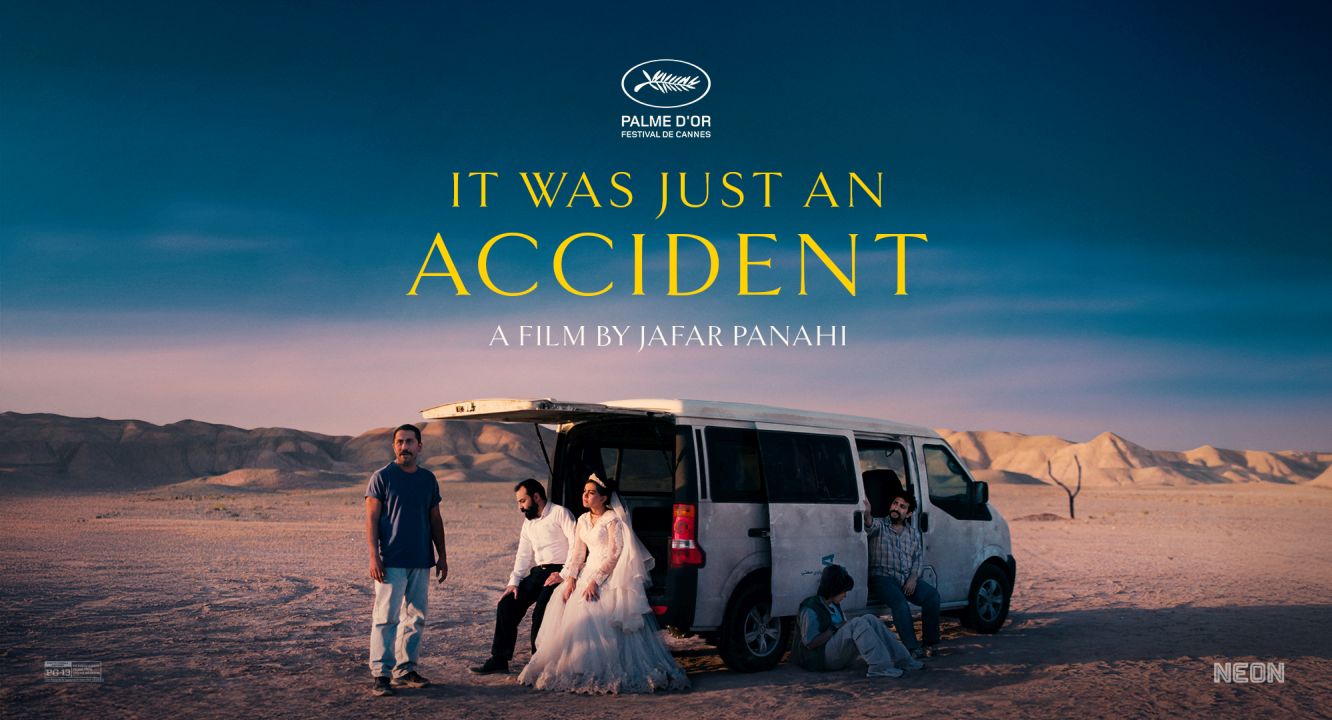
Now, add a third flick that raises a middle finger to Iran’s Islamic dictatorship: It Was Just an Accident, a ballsy effort written and directed by Jafar Panahi. The low-budget thriller deftly creates tension leavened with flashes of humor, all the while wading through moral quagmires and asking questions that defy easy answers.
The tale begins on a dark highway, where we meet a family man (Ebrahim Azizi) who’s driving home with his wife and young daughter when his car breaks down in front of a garage that’s closed for the night.
Luckily for him, the mechanic agrees to take a look at his vehicle anyway. Unluckily for him, the mechanic’s assistant thinks he recognizes this stranded motorist.
Vahid (Vahid Mobaserri) once spent years in prison after being charged with political “crimes” against the state. While there, he was interrogated and tortured by a guard whose face he never saw, but who was recognizable by the squeaking sounds made by his artificial leg.
Vahid thinks he hears the same sounds when this stranger enters his garage.
What follows is a quest for justice—or vengeance, depending on your point of view. Eventually finding a way to capture the motorist, Vahid prepares to bury him alive, only to be attacked by doubt when the stranger claims it’s a case of mistaken identity.
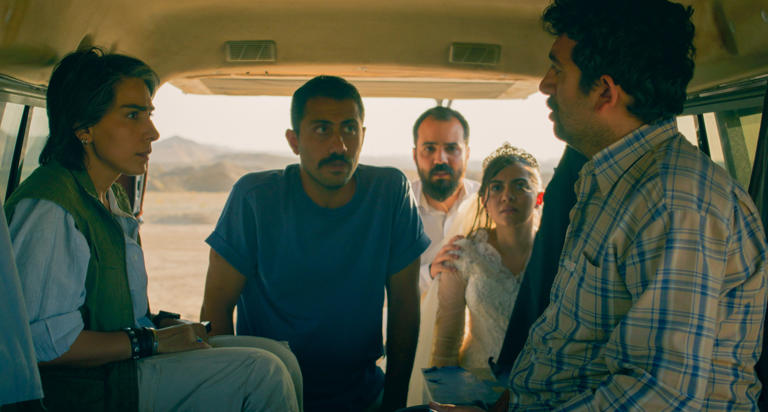
Discussing the fate of their prisoner, whom they suspect of being a sadistic former prison guard, are (from left) Shiva (Miriam Afshari), Hamid (Mohamad Ali Elyasmehr), Ali (Majid Panahi), Golrokh (Hadis Pakbaten) and Vahid (Vahid Mobaserri). (Photo courtesy of Neon)
Vahid then begins rounding up fellow victims of the guard variously known as “Eghbal the Pegleg” or “the Gimp” in hopes someone can make a positive identification. It’s a motley crew, ranging from a photographer (Miriam Afshari) and her tempestuous ex (Mohamad Ali Elyasmehr) to a bride (Hadis Pakbaten) who’s already decked out in her wedding gown.
Driving around in Vahid’s decrepit van, they vent about their prison experiences and argue about whether the drugged man in the back is really their former tormenter—and, if so, what to do with him. Should they make him pay with his life, or would that simply lower them to the government’s level?
These are heavy considerations, and yet writer/director Panahi manages to add bits of humor that often stem from cultural quirks. For example, it seems that not even kidnappers are immune from paying the tips, gifts and bribes that apparently are a part of Iranian daily life.
Beautifully acted by a committed cast, and beautifully photographed by cinematographer Amin Jafari, It Was Just an Accident is mesmerizing from its beginning to its cathartic and intriguingly nebulous ending. The fact that Panahi made this subversive film without the government’s permission—and thus, in secret—just makes his achievement all the more astounding.
Rating: 4½ stars (out of 5)
It Was Just an Accident (no MPA rating) opens theatrically Oct. 15 in New York City and expands to other markets Oct. 24 and 31.
Basem (Saleh Bakri, right) offers comfort to distraught student Adam (Muhammad Abed Elrahman) in The Teacher. (Photos courtesy of MPI Media Group)
By Richard Ades
The Teacher takes on one of the most divisive issues in the world today: the struggle between Israel and the Palestinians. And it does it in a way that is thoughtful, provocative and dramatic.
The title character is Basem El-Saleh (Saleh Bakri), who teaches in a poor community in the West Bank. Anyone who’s seen the Oscar-winning documentary No Other Land—or the final episodes of the Netflix series Mo—won’t be surprised to learn that Basem’s students have more to worry about than passing tests.
Two of them, brothers Yacoub and Adam (Mahmoud Bakri and Muhammad Abed Elrahman), return from school one day just in time to see their home torn down by Israeli forces. “It was just their turn,” Basem explains to British social worker Lisa (Imogen Poots), noting that most houses in the village have been marked for demolition.
Adding to the residents’ worries are the Israeli settlers whose red-roofed homes can be seen multiplying in the distance. Though the settlers have moved to the occupied territory illegally, the residents know the government is likely to take the newcomers’ side if any dispute arises.
And soon a dispute does arise, with tragic consequences. When a group of settlers sets fire to Palestinian-owned olive trees, Yacoub tries to intervene and is killed for his trouble. Community members vow to seek justice, but they know it may be beyond their reach.
Adam (Muhammad Abed Elrahman, left) shares a couch with his teacher (Saleh Bakri) after watching his home be demolished by Israeli troops.
Making her feature-length film debut, British-Palestinian writer-director Farah Nabulsi doesn’t shy away from showing the hardships West Bank residents face under Israeli occupation. Nor is she afraid to take the story into controversial areas.
A subplot that eventually melds with the main storyline involves an Israeli soldier being held hostage by a resistance group that hopes to exchange him for Palestinian prisoners. The soldier’s American parents (Stanley Townsend and Andrea Irvine) pressure the government to approve the exchange, but Israeli officials seem more interested in finding and punishing his kidnappers.
Leading the cast, Bakri is slightly hampered by director Nabulsi’s tendency to exploit his movie-star good looks (i.e., he takes off his shirt a lot). Still, he’s stalwartly effective as the teacher who tries to give his students the help that, as flashbacks reveal, he was unable to give his own son.
As Lisa, Basem’s colleague and possible love interest, Poots projects courage, sincerity and a useful amount of wiliness. As young Adam, who becomes increasingly distraught following his brother’s death, Elrahman provides some of the tale’s most unsettling moments.
Gilles Porte’s cinematography and composer Alex Baranowski’s score perfectly complement the film’s perilous setting and changing moods.
Though some may quibble that its ending is overly tidy, The Teacher is a brave and nuanced attempt to reveal the humanity lurking beneath one of the world’s most intractable political standoffs.
Rating: 4 stars (out of 5)
The Teacher opens April 11 in New York City and expands to other markets beginning April 18. It is scheduled to open April 25 at the Gateway Film Center in Columbus.
The recently widowed Rose Goldberg (Francoise Fabian) heads to her next adventure in Rose. (Photos courtesy of Cohen Media Group)
By Richard Ades
After watching the widowed title character enjoy a surprising romantic adventure in Rose, a fellow viewer was confused. Did this really happen, she asked, or did Rose merely fantasize it?
The answer is that the adventure really happened, but it happened in a film that almost qualifies as a fantasy itself. Director/co-writer Aurelie Saada consistently sees her 78-year-old heroine’s life through what can only be called rose-colored glasses, resulting in a flick that tries a bit too hard to be upbeat and inspirational.
Originally released in 2021, the French drama previously made the rounds of American Jewish film festivals, including one in my own area. It’s now being given a wider release in U.S. theaters, perhaps as a lead-in to Valentine’s Day.
At its center is Rose Goldberg (Francoise Fabian), who’s spent the last 50 years as a devoted wife and mother. A homebody with no outside career of her own, she’s led a rather isolated existence.
As a result, she retreats into herself when her beloved husband suddenly succumbs to a medical condition that’s been hidden from her. Despite her grown children’s entreaties, she reacts to his unexpected death by refusing to leave her apartment or even bathe.
A breakthrough finally comes when daughter Sara (Aure Atika) convinces Rose to accompany her to a dinner party. Most of the guests are her daughter’s age, but the last to arrive is a lively senior named Marceline (Michele Moretti) who quickly makes herself the center of attention.
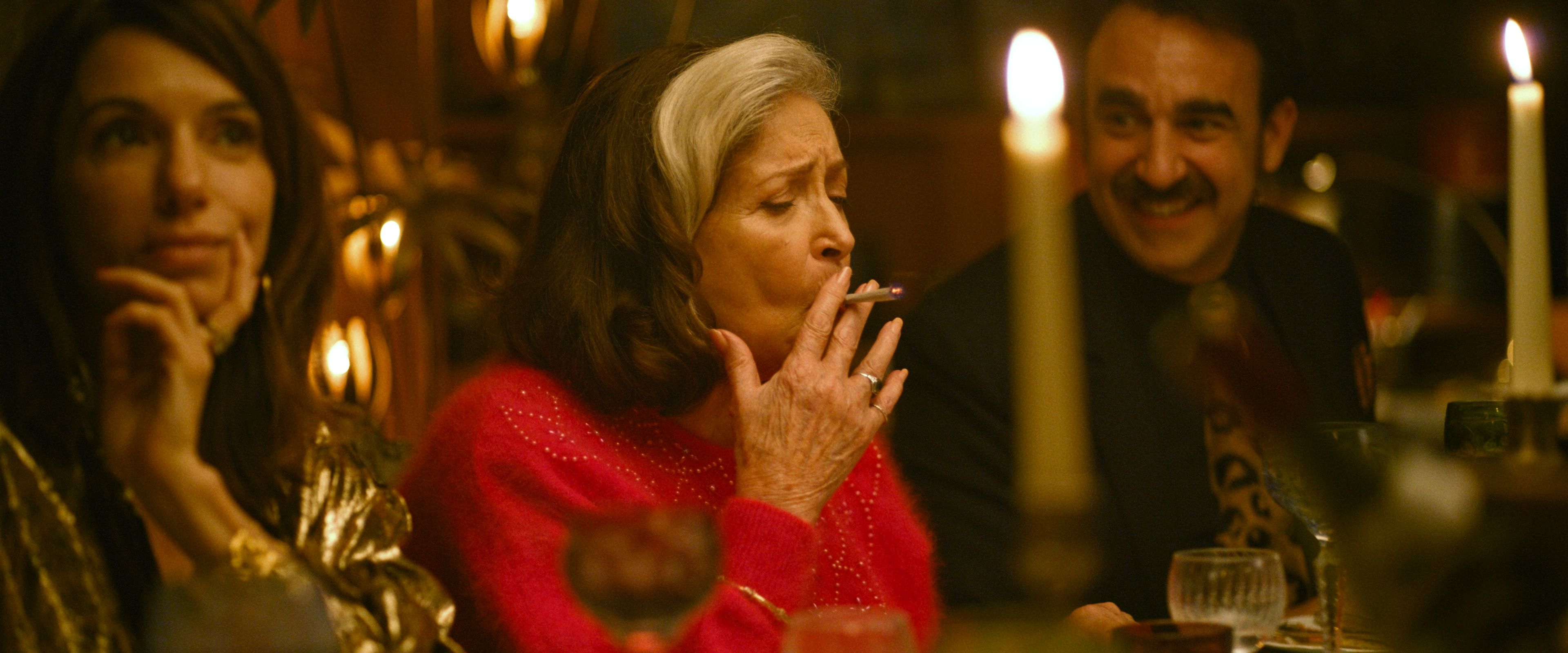
Rose (Francoise Fabian) samples a little pot while attending a dinner party with her daughter, Sara (Aure Atika, left).
Seeing this aging free spirit seems to have an immediate effect on Rose, who is inspired to cast aside her own inhibitions. Before the party is over, the former teetotaler is indulging in alcohol and even taking a few hits off a communal joint.
Still more changes follow the event, including the aforementioned romantic adventure. Rose apparently has decided to enjoy life to the fullest, even though it’s a life that previously was completely foreign to her.
In contrast, Rose’s three children all appear to be stuck in their own lives. Sara is hung up on her long-estranged husband; married son Pierre (Gregory Montel) carries a torch for a former flame; and single son Leon (Damien Chapelle) is still living with his mother, in addition to being in trouble with the law.
The contrast between the unhappy children and their suddenly joyous mother would be touching if the former’s situations and the latter’s transformation had been fleshed out more.
Though the tale could be stronger dramatically speaking, it benefits from a fine cast and especially from Fabian’s luminous portrayal of the evolving Rose. It also benefits from Martin de Chabaneix’s warm cinematography and director Saada’s lively musical score, which reflects the title character’s Jewish heritage and Tunisian roots.
It all adds up to a film whose joy would be contagious if it were just a bit more convincing.
Rating: 3 stars (out of 5)
Rose (no MPA rating) opens Jan. 24 in New York and Los Angeles and expands to other markets in subsequent weeks, including Columbus’s Gateway Film Center on Feb. 14.
A motion-captured Jonno Davies plays a simian version of British pop star Robbie Williams in Better Man. (Photo courtesy of Paramount Pictures)
By Richard Ades
This is the time of year when critics get a chance to catch up on recent flicks they might have missed, courtesy of studios in search of buzz and, hopefully, award nominations. While I don’t claim to be clairvoyant when it comes to the latter, I can confidently say this: If the Oscars and other competitions gave out prizes for bravery, these three films and their creators would win hands down.
One filmmaker displays creative courage by breaking the mold in a familiar genre, while the others put their liberty and even their lives at risk in order to bring their truths to the screen.
Let’s look at them one by one.
Biopic with a difference
By now, we all know the drill when it comes to film biopics: The would-be celeb claws his or her way to the top, but success comes at a steep cost. Friends are abandoned, spouses are cheated on, and alcohol and/or drugs are abused.
Better Man, based on the life of British pop superstar Robbie Williams, follows that general pattern, but with a difference. The entire story unfolds through the eyes (and narration) of Williams himself, who emerges as someone who desperately wants fame but is convinced he doesn’t deserve it.
And, oh yes: Williams is portrayed by a CGI-generated chimpanzee (a motion-captured Jonno Davies). It sounds weird—and, frankly, it is—but it also makes sense in a brilliant and emotionally satisfying way.
Even as a child, Williams suffers from self-doubt, self-loathing and what he later comes to identify as depression. By making him the lone ape in a world of humans, the film has found a clever way of symbolizing Williams’s fear that he’s an imposter unworthy of the success he seeks.
Directed with theatrical flair by Michael Gracey (The Greatest Showman), Better Man is marked by gee-whiz, over-the-top production numbers and surreal fantasy sequences, in addition to its simian protagonist. But what really sets it apart is its honesty and warmth.
Despite being depicted as an ape, Williams comes off as a recognizably flawed human who earns our sympathy, as well as the heart-on-its-sleeve sendoff the film gives him. Director Gracey’s gamble has paid off with a flick that’s as moving as it is massively entertaining.
Rating: 4½ stars (out of 5)
Better Man (rated R) opened Dec. 25 in select theaters and expands nationwide Jan. 10.
National unrest and a missing gun upset the lives of Iranian student Rezvan (Mahsa Rostami, center), her mother (Soheila Golestani, left) and sister (Setareh Maleki) in The Seed of the Sacred Fig.
Criticizing—and then escaping—Iran
As an attack on Iran’s government and justice system, The Seed of the Sacred Fig is the kind of film that can’t be made in that country. And yet veteran writer/director Mohammad Rasoulof succeeded in making it—in secret—before fleeing to Europe for his own safety.
The thriller concerns Iman (Missagh Zareh), who aspires to be a judge but learns that the path to success will force him to ignore his moral compass. He lands a position that requires him to sentence people to death without being given a chance to consider the evidence.
As it turns out, the position endangers more than just his conscience. Because of the job’s controversial nature, he and his wife, Najmeh (Soheila Golestani), and their family are forced to live in secrecy. Meanwhile, daughters Rezvan and Sana (Mahsa Rostami and Setareh Maleki) become embroiled in the widespread unrest that erupts after a young woman is beaten and killed for not sufficiently covering her head.
Then the gun that Iman keeps for protection turns up missing, and the national turmoil threatens to spread to his household as he searches for the culprit. Interrogations ensue, along with a car chase and a tense finale that may remind some of a certain horror film set in a snowbound hotel.
Considering it was made in secret and by a director who’d already gotten in trouble for earlier works, The Seed of the Sacred Fig should fill viewers with admiration for Rasoulof’s resourcefulness, as well as his courage. The film deserves an Oscar nomination, but it probably won’t get one, because who would nominate it? Certainly not Iran.
Rating: 4½ stars (out of 5)
The Seed of the Sacred Fig (PG-13) can be seen in select theaters and is scheduled to open Jan. 30 at Columbus’s Gateway Film Center.
Palestinian activist Basel Adra (left) joins forces with Israeli journalist Yuval Abraham in the documentary No Other Land.
Palestinian, Israeli expose West Bank abuses
Basel Adra has spent years documenting the Israeli army’s systematic attacks on his West Bank community, Masafer Yatta. In No Other Land, he continues that work along with Israeli journalist Yuval Abraham and fellow writer/directors Hamdan Ballal and Rachel Szor.
The result is an eye-opening expose of the abuses Adra and his Palestinian neighbors have had to endure living in the occupied territory. Houses and other buildings are destroyed on the shortest of notices and flimsiest of excuses, such as that the army needs the land for training exercises. Those who want to rebuild are told to get permits that they know are unobtainable.
Much of the film consists of footage taken with amateur video equipment or cellphones. It shows locals trying in vain to reason with soldiers, government officials and, in some cases, illegal Israeli settlers, all of whom are clearly trying to force them to abandon their rural community.
Other footage, shot by Szor, centers on the growing friendship between the Palestinian Adra and Israeli journalist Abraham, who are allied by their concern over the situation but separated by their approaches to dealing with it. Abraham is frustrated that his muckraking stories have had so little impact, but Adra counsels patience, saying a solution could take years or even decades.
The differing approaches reflect the men’s vastly different backgrounds. While Abraham is relatively new to the situation, Adra has been dealing with it for much of his life. In the face of constant, officially sanctioned abuse, he and his neighbors have no recourse but to greet it with steadfast determination and even flashes of dark humor.
Made under the most difficult of circumstances, No Other Land is a portrait of courage that is, in and of itself, an act of courage.
Rating: 5 stars (out of 5)
No Other Land is available through VOD outlets and can be seen at select theaters beginning Jan. 31.
Sam (Lily Collias) explores the Adirondacks with her father and his best friend. (Photos courtesy of Metrograph Pictures)
By Richard Ades
When you’re hiking through nature, you miss a lot if you’re not paying attention. The same holds true when you’re viewing Good One, the story of a teenage girl’s hike through the Adirondacks with her dad and his best friend.
Seen mostly through the eyes of 17-year-old Sam (Lily Collias), the flick is full of telling moments, but few of them hit you over the head. Instead, writer/director India Donaldson expects you to watch and listen for clues about what Sam is going through.
Fortunately, Collias’s face registers the girl’s most fleeting thoughts, and cinematographer Wilson Cameron’s lens is right there to capture them.
Taking place over three days, the film follows along as Sam goes on what seems to be a family tradition: an extended hike with her dad, Chris (James Le Gros). They were supposed to be accompanied by both Chris’s friend Matt (Danny McCarthy) and his teenage son, but the son bails out following a last-minute family argument.
This leaves Sam alone with two divorced, middle-aged men whose egos and life experiences sometimes make them difficult traveling companions.
They not only trade insults with each other, but they force her into a second-class status by, for example, relegating her to the back seat in the car or the floor in their shared hotel room. They also rely on her to take the lead on such stereotypically female tasks as cooking and cleaning.
Sam’s hiking companions are her father, Chris (James Le Gros, right), and his friend Matt (Danny McCarthy).
Sexual roles and outright sexism are understated themes here, but they’re not the only ones. An uncomfortable incident far into the journey forces Sam to question whether she can count on her father to be in her corner, or even to recognize what her corner is. It’s a sad, life-changing moment that filmmaker Donaldson delivers with her usual restraint.
Though the film is only 90 minutes long, its leisurely tempo might test some viewers’ patience. On the other hand, the pace allows us to enjoy the pristine Adirondak scenery, which is complemented by composer Celia Hollander’s evocative score.
More importantly, it allows us to appreciate Le Gros and McCarthy’s portrayals of two flawed but vulnerably human men, along with Collias’s portrayal of a young woman who is still on the cusp of adulthood and yet more mature than either of them.
Rating: 4 stars (out of 5)
Good One (rated R) can be seen in select markets and expands to theaters nationwide on Aug. 23.
Bunny King (Essie Davis) holds aloft the tool of her trade.
By Richard Ades
The title of the New Zealand film The Justice of Bunny King may be its most optimistic element.
Its homeless heroine is waging an uphill battle to regain custody of the two children who were taken from her due to her criminal record. And though she’s sly and resourceful, she’s pitted against an entrenched bureaucracy that refuses to see the reality of her situation.
“Justice” appears to be an impossible goal. Yet the more unreachable it seems, the harder Bunny works to attain it, because that’s who she is.
Essie Davis (The Babadook) plays Bunny as someone who throws herself wholeheartedly into whatever she tries. In the beginning, we see her walking up and down lines of traffic with a squeegee and a broad smile as she cleans windshields in exchange for whatever coins drivers toss her. Later, she retires to the home where she cooks and babysits for her sister (Toni Potter) in return for a place to sleep.
All this she does cheerfully, but there’s a hole in her psyche the size of her physically challenged daughter (Amelie Barnes) and teenage son (Angus Stevens). She’s determined to regain custody but knows that will happen only if she can find a suitable home, something that’s likely beyond her income level.
Then, just as a solution appears to be at hand, she stumbles into the terrifying realization that her teenage niece Tonyah (Jojo Rabbit’s Thomasin McKenzie) is being abused by her sister’s partner (Errol Shand). She tries to fix the situation but only succeeds in making her own life harder. And, thanks to combination of bad luck and bad choices, things just keep getting worse.
Bunny and Tonyah (Essie Davis and Thomasin McKenzie)
Directed by Gaysorn Thavat from a story she co-conceived with Gregory David King and screenwriter Sophie Henderson, this could be seen as a cautionary tale of the steep odds faced by those on the lower rungs of society’s ladder. First of all, though, it’s a character study of a woman whose instincts sometimes get her in trouble but whose courage and determination are beyond reproach.
Davis’s all-in portrayal keeps us engaged whether Bunny’s antics are amusing us or tying our stomachs in knots. McKenzie and the rest of the cast offer strong support, as does Ginny Loane’s naturalistic cinematography.
The Justice of Bunny King doesn’t go where you expect—or want—it to go, but Davis makes the trip memorable.
Rating: 4 stars (out of 5)
The Justice of Bunny King opened Sept. 23 in select theaters and will be available on demand beginning Sept. 30.
Mikey (Simon Rex, right) has big plans for Strawberry (Suzanna Son) in Red Rocket. (A24 photo)
By Richard Ades
When Mikey Saber (Simon Rex) saunters into his Texas hometown at the beginning of Red Rocket, he passes a billboard advertising Donald Trump’s “Make America Great Again” campaign. This sets the time period as 2016, and it may also provide a clue that we’re about to see the tale of a master manipulator.
Here’s another clue about what’s ahead: Red Rocket is the latest film of Sean Baker (The Florida Project, Tangerine), which means it’s likely about folks scraping by in a hardscrabble and precisely detailed pocket of modern-day America.
Both clues are accurate, but they only partially prepare viewers for what’s ahead: a sex- and nudity-filled journey that will sometimes make them chuckle and other times leave them squirming in dread or discomfort.
At its center is Mikey, an ex-porn star who, when we first meet him, has $22 in his pocket and a face that shows signs of a recent beating. Upon returning to his oilfield-lined hometown for the first time in years, Mikey goes straight to the house of his estranged wife, Lexi (Bree Elrod), and mother-in-law, Lil (Brenda Deiss).
Far from being glad to see him, however, they greet Mikey with a mixture of hostility and suspicion that clearly is based on past experience. They agree to let him stay only after he agrees to contribute to the rent.
This, of course, means Mikey has to find a job, but that’s not so easy when your “resume” consists of X-rated videos. He eventually gives up on landing legit employment and wheedles a chance to sell weed for a friend of Lil named Leondria (Judy Hill). In no time, he’s raking in the big bucks.
Then, just as he seems to be getting his life in order and even reconciling with Lexi, he catches sight of a redheaded teenager named Strawberry (Suzanna Son) behind the counter of the local doughnut shop. He immediately sets out to win her over, but just what he wants to win her over to may send shivers down the average viewer’s spine.
The script, by director Baker and Chris Bergoch, never quite goes where you expect or, perhaps, want it to go, and the unsettled ending may leave some unsatisfied. The film also goes on a little longer than necessary. Still, its many quirky characters and indelible moments more than make up for such annoyances.
Rex skillfully anchors the tale as the glib and ruthless Mikey, and every member of the cast is equally effective, including Elrod as the tough yet vulnerable Lexi and Son as Strawberry, who’s not quite as innocent as she first seems. Other strong impressions are made by Ethan Darbone as Lonnie, a gullible neighbor who becomes Mikey’s biggest fan; and Brittney Rodriguez as June, Leondria’s sarcastic daughter.
Of the flick’s many indelible moments, one that particularly sticks out comes when Strawberry gives Mikey an impromptu rendition of NSYNC’s “Bye Bye Bye,” which is nicely performed by Son. Anyone else would have recognized this as a clear A Star Is Born moment, but Mikey is so limited in his outlook and experience that it fails to alter the questionable future he has in store for the teen.
The moment is illuminating, disturbing and heartbreaking. Add “darkly funny,” and you have a pretty good description of the film as a whole.
Rating: 4 stars (out of 5)
Red Rocket (rated R) can be seen at theaters nationwide, including (as of Dec. 24) Columbus’s Gateway Film Center.
Jess (Jasmine Batchelor) agrees to give married friends Aaron (Sullivan Jones, left) and Josh (Chris Perfetti) a baby in The Surrogate.
By Richard Ades
The Surrogate is about a woman who is merely, as she puts it, a “vessel” for her best friend’s baby. When her pregnancy develops a complication, however, she finds herself becoming much more.
Writer/director Jeremy Hersh’s drama stars Jasmine Batchelor (The Good Fight) as the complicated New Yorker named Jess. Just why Jess does the things she does is not always easy to understand, but it helps if you pay close attention to the flick’s early moments.
In the first scene, Jess tries to sell would-be fiancé Nate (Brandon Micheal Hall) on a just-friends relationship, telling him she can’t commit because she has no idea what she’ll be doing in a year. She might even join the Peace Corps, she says.
Later, she’s seen trying to find donors to help expand the services of the nonprofit where she works as a web designer. She reluctantly stops only when her boss instructs her to stick to the agency’s core mission.
Jess, it seems, is a relentless do-gooder. Maybe that’s why we don’t see her being truly happy until she finds herself pregnant with the baby she’s agreed to have on behalf of best friend Josh (Chris Perfetti) and his husband, Aaron (Sullivan Jones). This leaves her so delirious that she’s puzzled when another pregnant woman says she can’t imagine giving up her own baby. To Jess, it seems the most natural thing in the world.
Then things take a startling turn when a prenatal test reveals the baby likely will have Down syndrome. For a while, Jess remains upbeat, cheerfully inviting Josh and Aaron to read up on the condition and to meet the parents of Down children. What she almost willfully fails to notice is that her two friends are going along with her only out of awkward politeness. Only later does she realize that the baby’s prognosis has changed everything.
Hersh’s movie is partly a character study of everyone involved in this gut-wrenching situation, but especially of Jess, who behaves in ways that are both admirable and unadmirable, predictable and unpredictable. Batchelor’s all-in portrayal helps us sympathize with her, whether or not we agree with her actions.
As it goes on, though, the film begins morphing into a debate on a question with no easy answers, in the process bringing up issues of race, class and sexuality. Before it’s over, various characters play the black card, the gay card, even the Jewish card. The effect is that they sometimes seem more like symbols than actual personalities.
This—plus an ending that is abrupt and almost capricious—make this a film that fails to move us quite as much as it enlightens us.
Rating: 3½ stars (out of 5)
The Surrogate (no MPAA rating) is available from VOD outlets beginning June 12.







 Reel Time With Richard Ades