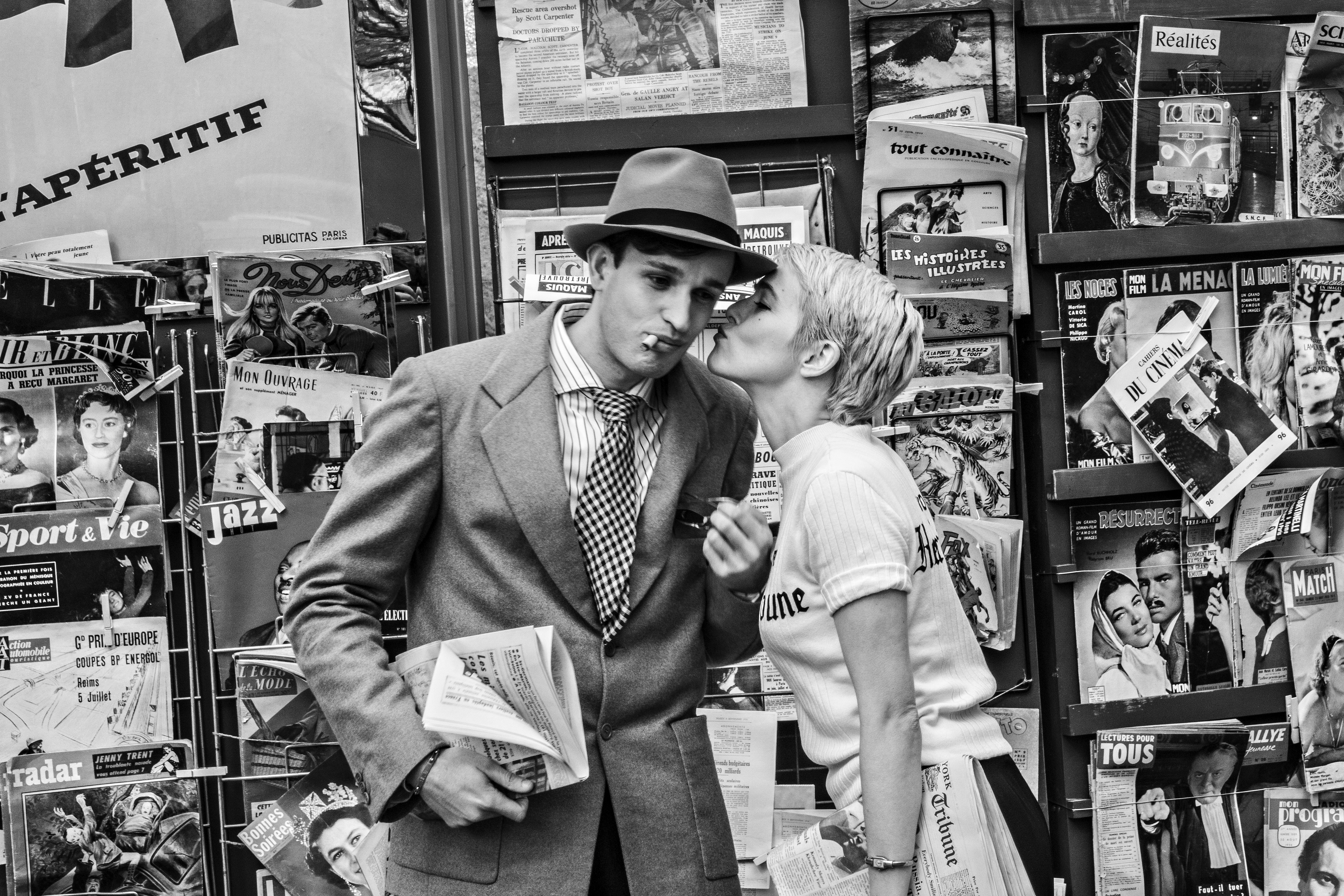
Reimagining the making of a classic

Jean-Paul Belmondo and Jean Seberg (Aubry Dullin and Zoey Deutch) act out a scene from Breathless in Nouvelle Vague, a dramatization of the making of the 1960 film. (Photos by Jean-Louis Fernandez/courtesy of Netflix)

By Richard Ades

Nouvelle Vague may be the most affectionate love letter to moviemaking since Francois Truffaut’s Day for Night (1973).

Directed by Richard Linklater, the new film reimagines the making of Breathless, the 1960 classic that established critic-turned-director Jean-Luc Godard as a star of the influential movement known as the French New Wave.

If you’re a devoted cinephile, it’s likely you’re already salivating. And make no mistake: Linklater made this film with you in mind.

Not only is it shot in the style of Breathless, with a handheld camera and black-and-white photography, but it announces the name of each historic participant—from the director and stars to the lowliest of crew members—as soon as he or she appears on the screen. Linklater assumes you’ll want to know.

But what if you’re not a cinephile? In that case, chances are you’ll be a bit less enthralled, but the flick still has much to offer thanks to a charming cast and a witty script that both reveres and pokes fun at Godard and his eccentric approach to moviemaking.

We first meet Godard (Guillaume Marbeck) as a critic who wears shades even in darkened theaters and who complains that he hasn’t fulfilled his dream of making his first movie by the age of 25. Urged on by fellow critics, and encouraged by their belief that the only authentic way to make cinema is on the cheap, he takes on a film based on a real-life criminal who’s charged with killing a cop.

Jean-Luc Godard (Guillaume Marbeck, left) takes a break with his leading man, Jean-Paul Belmondo (Aubry Dullin).

Godard quickly hires the then-unknown Jean-Paul Belmondo (Aubry Dullin) to play the protagonist, but he has more trouble casting the crook’s American girlfriend. Aiming high because he thinks it will boost the film’s box office potential, he begins a campaign to land rising star Jean Seberg (Zoey Deutch).

Seberg is reluctant but eventually agrees because the film treatment was co-authored by Truffaut (Adrien Rouyard), another critic-turned-director who’s already made a name for himself. Once shooting starts, however, she begins to think she made a mistake.

For one thing, Godard has no script, preferring to rely on last-minute inspiration. For another, he’s not afraid to suspend shooting if that inspiration doesn’t show up on time.

Jean-Paul Belmondo (Aubry Dullin) takes to the street for a climactic scene while cinematographer Raoul Coutard (Matthieu Penchinat) and director Jean-Luc Godard (Guillaume Marbeck) follow in an open-top Citroen.

After Godard threatens the production’s bare-bones budget by repeatedly sending his cast and crew home early, not only Seberg but producer Georges de Beauregard (Bruno Dreyfurst) becomes worried. Beauregard repeatedly lowers the boom, but Godard refuses to change his unconventional ways.

There’s no suspense over the outcome, of course. We know going in that Breathless will become a groundbreaking success and Godard will go on to enjoy a decades-long career. The only question is just how he will accomplish this unlikely feat.

With a sense of history leavened by a sense of humor, Linklater answers that question in a way that should leave cinephiles fascinated and everyone else pleasantly entertained. 

Rating: 4½ stars (out of 5)

Nouvelle Vague (rated R) can be seen at select theaters and is available on Netflix beginning Nov. 14.

The forgotten man who championed unforgettable flicks

By Richard Ades

For people who became film aficionados during the 1960s and ’70s, Searching for Mr. Rugoff is a revelation. Such folks doubtless were intrigued by international filmmakers such as Costa-Gavras, Francois Truffaut, Lina Wertmuller and others, and the documentary reveals that their work might never have made it across the Atlantic if it weren’t for a New York theater owner and distributor named Donald Rugoff.

Full disclosure: I’m one of the many folks who owe my love of films to Rugoff.

Without him, I might never have held my breath over Costa-Gavras’s political thriller Z or laughed at the French spy spoof The Tall Blond Man With One Black Shoe. I also might never have experienced the brilliant but polarizing films of Wertmuller or the head-scratching puzzle that was The Man Who Fell to Earth. Rugoff and his distribution company, Cinema 5, brought these and other notable flicks to the attention of American filmgoers, yet few people remember him.

Director and one-time Cinema 5 employee Ira Deutchman seeks to remedy that situation by talking to people who worked with Rugoff or otherwise knew him. The portrait he paints is of an eccentric man who wasn’t always easy to be around but who seemed to have an innate talent for finding and promoting important cinema.

After inheriting a theater chain following his father’s premature death, Rugoff began opening elegant Upper East Side theaters—“temples of the art,” one commentator calls them—that made going to the movies an indispensable cultural event. People looked forward to major premieres so much that they didn’t even mind standing in the inevitable line to get in. In fact, they savored it as just another part of the ritual.

Rugoff also became a distributor and began championing a host of notable filmmakers, some of whom are interviewed by Deutchman. Costa-Gavras talks about the role Rugoff played not only in bringing his masterful Z to America but in helping it to win two Academy Awards and three additional nominations, including for Best Picture. Wertmuller likewise talks about her experiences with the impresario, who may have helped her to garner the first Oscar nomination ever received by a woman director (for 1975’s Seven Beauties).

We learn that Rugoff had both box office triumphs, such as 1975’s Monty Python and the Holy Grail, and flops, such as Truffaut’s The Soft Skin (1964). But whether the films were hits or misses, he always promoted them with ad campaigns that were groundbreaking and innovative. They were also sometimes controversial, as when he falsely labeled 1977’s Jabberwocky a Monty Python film because its director and star were members of the British comedy troupe.  

Rugoff’s success eventually faded, though the documentary can only suggest possible reasons. Was it health problems that impaired his judgment, or possibly a second wife who pushed her own questionable taste in films? Or maybe it was a change in the cinematic climate, along with the rise of competitors inspired by his example. Chances are it was a combination of causes.

At any rate, Rugoff ultimately was forced to exit the business. In 1986, he left New York and moved to a small town on Martha’s Vineyard, where he converted a former church into a movie theater before dying three years later. But even there, Deutchman learns, he’s been largely forgotten.

Someone who played such a crucial role in our country’s cinematic scene really deserves to be honored and remembered. With the release of Searching for Mr. Rugoff, maybe he will be.

Rating: 4 stars (out of 5)

Searching for Mr. Rugoff opened Aug. 13 at select theaters and through VOD outlets.