Reimagining the making of a classic

Jean-Paul Belmondo and Jean Seberg (Aubry Dullin and Zoey Deutch) act out a scene from Breathless in Nouvelle Vague, a dramatization of the making of the 1960 film. (Photos by Jean-Louis Fernandez/courtesy of Netflix)

By Richard Ades

Nouvelle Vague may be the most affectionate love letter to moviemaking since Francois Truffaut’s Day for Night (1973).

Directed by Richard Linklater, the new film reimagines the making of Breathless, the 1960 classic that established critic-turned-director Jean-Luc Godard as a star of the influential movement known as the French New Wave.

If you’re a devoted cinephile, it’s likely you’re already salivating. And make no mistake: Linklater made this film with you in mind.

Not only is it shot in the style of Breathless, with a handheld camera and black-and-white photography, but it announces the name of each historic participant—from the director and stars to the lowliest of crew members—as soon as he or she appears on the screen. Linklater assumes you’ll want to know.

But what if you’re not a cinephile? In that case, chances are you’ll be a bit less enthralled, but the flick still has much to offer thanks to a charming cast and a witty script that both reveres and pokes fun at Godard and his eccentric approach to moviemaking.

We first meet Godard (Guillaume Marbeck) as a critic who wears shades even in darkened theaters and who complains that he hasn’t fulfilled his dream of making his first movie by the age of 25. Urged on by fellow critics, and encouraged by their belief that the only authentic way to make cinema is on the cheap, he takes on a film based on a real-life criminal who’s charged with killing a cop.

Jean-Luc Godard (Guillaume Marbeck, left) takes a break with his leading man, Jean-Paul Belmondo (Aubry Dullin).

Godard quickly hires the then-unknown Jean-Paul Belmondo (Aubry Dullin) to play the protagonist, but he has more trouble casting the crook’s American girlfriend. Aiming high because he thinks it will boost the film’s box office potential, he begins a campaign to land rising star Jean Seberg (Zoey Deutch).

Seberg is reluctant but eventually agrees because the film treatment was co-authored by Truffaut (Adrien Rouyard), another critic-turned-director who’s already made a name for himself. Once shooting starts, however, she begins to think she made a mistake.

For one thing, Godard has no script, preferring to rely on last-minute inspiration. For another, he’s not afraid to suspend shooting if that inspiration doesn’t show up on time.

Jean-Paul Belmondo (Aubry Dullin) takes to the street for a climactic scene while cinematographer Raoul Coutard (Matthieu Penchinat) and director Jean-Luc Godard (Guillaume Marbeck) follow in an open-top Citroen.

After Godard threatens the production’s bare-bones budget by repeatedly sending his cast and crew home early, not only Seberg but producer Georges de Beauregard (Bruno Dreyfurst) becomes worried. Beauregard repeatedly lowers the boom, but Godard refuses to change his unconventional ways.

There’s no suspense over the outcome, of course. We know going in that Breathless will become a groundbreaking success and Godard will go on to enjoy a decades-long career. The only question is just how he will accomplish this unlikely feat.

With a sense of history leavened by a sense of humor, Linklater answers that question in a way that should leave cinephiles fascinated and everyone else pleasantly entertained. 

Rating: 4½ stars (out of 5)

Nouvelle Vague (rated R) can be seen at select theaters and is available on Netflix beginning Nov. 14.

Deneuve as a first lady out to reinvent herself

Catherine Deneuve stars as the title character in The President’s Wife, a fictionalized biopic of French first lady Bernadette Chirac. (Photo courtesy of Cohen Media Group)

By Richard Ades

What’s it like to be the wife of a leader who forces you to live in his shadow and ignores your political advice? The President’s Wife answers that question with its feminism-informed biography of former French first lady Bernadette Chirac.

But don’t expect a sober-minded piece of historical revisionism. The film, directed and co-written by Lea Domenach, refuses to take itself too seriously, and it’s clear from the first scene that we shouldn’t, either.

As Bernadette (the legendary Catherine Deneuve) makes her way to a confessional booth for a heart-to-heart with her priest, the church choir informs us that what we’re about to see is based only loosely on reality. In fact, the singers warn us, it’s a “work of fiction.” 

Still, it’s hard not to hope that what follows is least partly true, because it’s a delicious story of self-reinvention and political comeuppance.

We first meet Bernadette in 1995, when her husband, Jacques Chirac (Michel Vuillermoz), is on the verge of winning the presidency. A politician in her own right, Bernadette has worked hard to bring about this long-sought victory, but once the new administration takes office, she’s quickly pushed to the background.

With her dated wardrobe and occasionally loose lips, Bernadette is seen as a liability by both her husband and her younger daughter, Claude (Clara Giraudeau), who works as one of his chief aides. The two even go so far as to assign a communications adviser named Bernard (Denis Podalydes) to help Bernadette hone her image. The idea is to keep the first lady from embarrassing and upstaging the president.

However, the plan soon backfires.

After a series of events provide proof of (1) Bernadette’s political smarts and (2) Jacques’s marital unfaithfulness, Bernard switches his allegiance from the husband to the wife. Together, Bernard and Bernadette begin working to improve her image through such tacks as promoting charities, rubbing elbows with celebrities and, mostly, just being herself.

To put it mildly, their efforts prove fruitful for Bernadette and entertaining for the audience. (Watch for the trained bear!)

Anyone who’s less than fully knowledgeable about French politics might lose a reference here and there, but it’s just a slight inconvenience. Thanks to Domenach’s witty script and playful direction—and thanks to a great cast and especially to Deneuve’s droll and assured performance as Bernadette—The President’s Wife is one history class you won’t want to skip.

Rating: 4 stars (out of 5)

The President’s Wife opened April 18 in major cities and will expand to other markets beginning April 25. It is scheduled to open May 9 at Columbus’s Gateway Film Center.

French widow adapts to her new life

The recently widowed Rose Goldberg (Francoise Fabian) heads to her next adventure in Rose. (Photos courtesy of Cohen Media Group)

By Richard Ades

After watching the widowed title character enjoy a surprising romantic adventure in Rose, a fellow viewer was confused. Did this really happen, she asked, or did Rose merely fantasize it?

The answer is that the adventure really happened, but it happened in a film that almost qualifies as a fantasy itself. Director/co-writer Aurelie Saada consistently sees her 78-year-old heroine’s life through what can only be called rose-colored glasses, resulting in a flick that tries a bit too hard to be upbeat and inspirational.

Originally released in 2021, the French drama previously made the rounds of American Jewish film festivals, including one in my own area. It’s now being given a wider release in U.S. theaters, perhaps as a lead-in to Valentine’s Day.

At its center is Rose Goldberg (Francoise Fabian), who’s spent the last 50 years as a devoted wife and mother. A homebody with no outside career of her own, she’s led a rather isolated existence.

As a result, she retreats into herself when her beloved husband suddenly succumbs to a medical condition that’s been hidden from her. Despite her grown children’s entreaties, she reacts to his unexpected death by refusing to leave her apartment or even bathe.

A breakthrough finally comes when daughter Sara (Aure Atika) convinces Rose to accompany her to a dinner party. Most of the guests are her daughter’s age, but the last to arrive is a lively senior named Marceline (Michele Moretti) who quickly makes herself the center of attention.

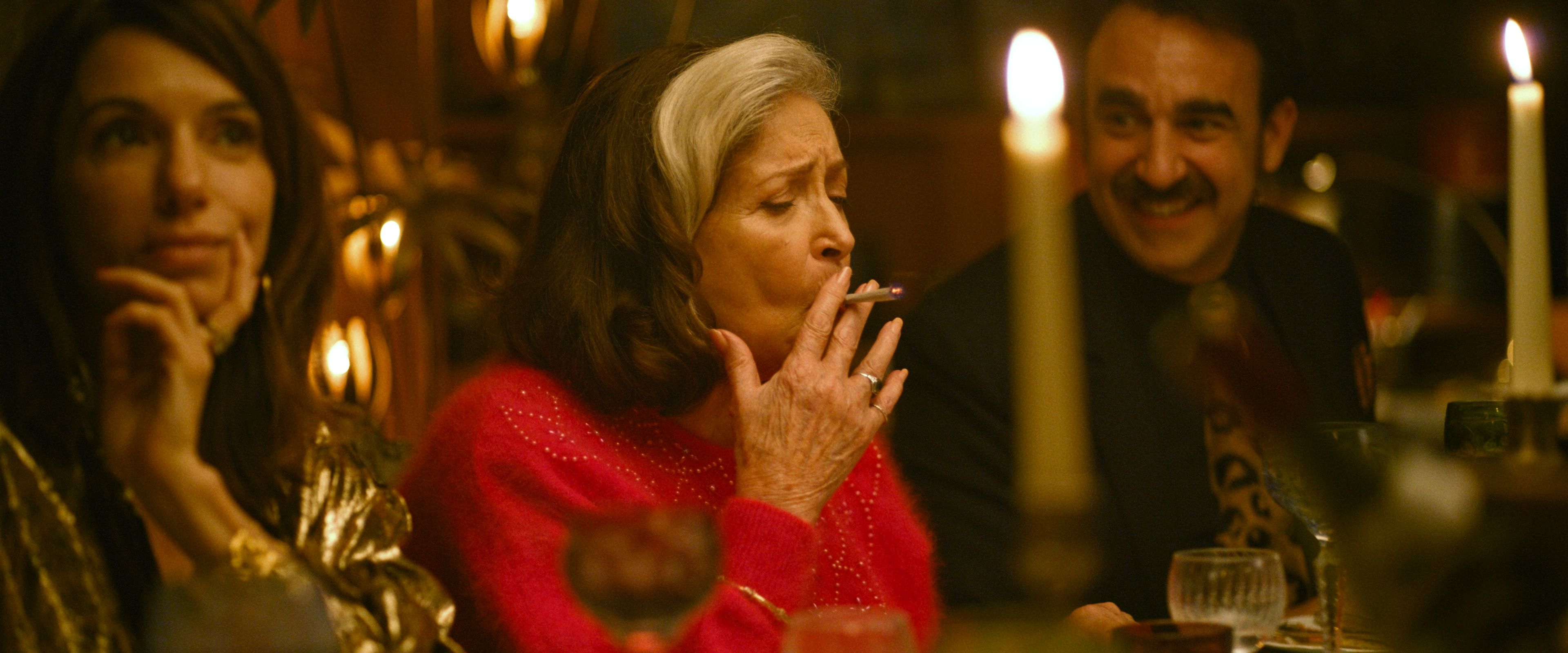
Rose (Francoise Fabian) samples a little pot while attending a dinner party with her daughter, Sara (Aure Atika, left).

Seeing this aging free spirit seems to have an immediate effect on Rose, who is inspired to cast aside her own inhibitions. Before the party is over, the former teetotaler is indulging in alcohol and even taking a few hits off a communal joint.

Still more changes follow the event, including the aforementioned romantic adventure. Rose apparently has decided to enjoy life to the fullest, even though it’s a life that previously was completely foreign to her. 

In contrast, Rose’s three children all appear to be stuck in their own lives. Sara is hung up on her long-estranged husband; married son Pierre (Gregory Montel) carries a torch for a former flame; and single son Leon (Damien Chapelle) is still living with his mother, in addition to being in trouble with the law.

The contrast between the unhappy children and their suddenly joyous mother would be touching if the former’s situations and the latter’s transformation had been fleshed out more.

Though the tale could be stronger dramatically speaking, it benefits from a fine cast and especially from Fabian’s luminous portrayal of the evolving Rose. It also benefits from Martin de Chabaneix’s warm cinematography and director Saada’s lively musical score, which reflects the title character’s Jewish heritage and Tunisian roots.

It all adds up to a film whose joy would be contagious if it were just a bit more convincing.

Rating: 3 stars (out of 5)

Rose (no MPA rating) opens Jan. 24 in New York and Los Angeles and expands to other markets in subsequent weeks, including Columbus’s Gateway Film Center on Feb. 14.

My mom, the cinematic legend

The Truth
Movie star Fabienne (Catherine Deneuve, center) is visited by daughter Lumir (Juliette Binoche) and son-in-law Hank (Ethan Hawke) in The Truth.

By Richard Ades

The Truth is a startling change of pace for Japanese writer/director Hirokazu Koreeda (2018’s Shoplifters), being a French film with two very French leading ladies. In a different sense, though, it’s not startling at all.

Though the plot hinges on the prickly relationship between aging movie star Fabienne Dangeville (Catherine Deneuve) and her screenwriter/daughter, Lumir (Juliette Binoche), the implicit subject is the world of movies. And moviemakers love to make movies about moviemaking, as Quentin Tarantino did just last year with Once Upon a Time…in Hollywood.

The Truth takes its title from Fabienne’s new memoir, whose upcoming debut has prompted a visit from New York-based Lumir and her actor/husband, Hank (Ethan Hawke), and young daughter, Charlotte (Clementine Grenier). But the book hardly lives up to its name, Lumir finds, as it describes a warm mother-daughter relationship that never actually existed. Asked about this, Fabienne huffily replies that, being an actor, she feels no obligation to be shackled by reality.

We soon learn that Fabienne actually feels little obligation to anything but her craft. She routinely ignores or insults those around her, including her past and current lovers (played by Christian Crahay, Alain Libolt and Roger Van Hool). Frankly, she’s a monster, as she proved long ago during an incident that still haunts Lumir and may even haunt Fabienne herself.

Even so, most people let Fabienne get away with such behavior because she’s a living legend. And so do we, the viewers, if only because she’s played by a beloved living legend.

The-Truth-2-1
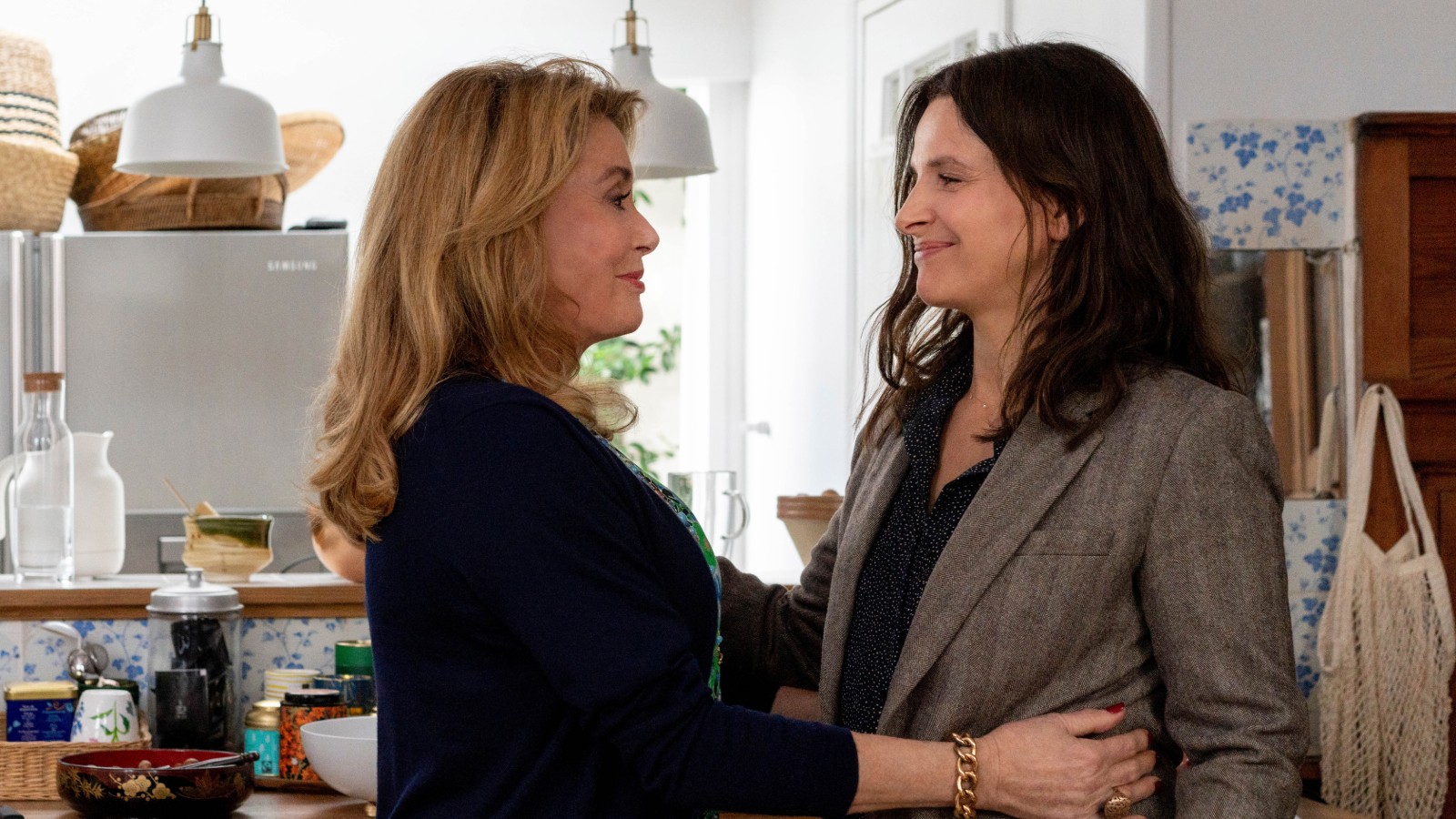
Fabienne (Catherine Deneuve) and Lumir (Juliette Binoche) share a rare moment of mother-daughter ease.

As Fabienne, Deneuve is as cool and self-possessed as ever, though not quite as enigmatic as she was in some of her classic roles. The script isn’t subtle about the fact that she behaves the way she does because nothing matters to her except acting.

That makes it hard to get involved in the mother-daughter relationship that’s at the center of the film. It’s clear that Lumir wishes Fabienne had been as warm a mother to her as she is to her own daughter. But it’s also clear that, for Fabienne, duty to her daughter and others will always be outranked by her duty to cinema.

One gets the feeling that, for writer/director Koreeda, that’s as it should be. Maybe that’s why, despite being a handsome work with a great cast, The Truth is likely to appeal more to hardcore cinephiles than to the general public.

Rating: 3 stars (out of 5)

The Truth (PG) is available from VOD outlets beginning July 3.