Indiana Jones has nothing on Ohio-based glacier explorer

Lonnie Thompson and his colleagues go to great trouble to extract ice cores like this from remote glaciers to learn the secrets they store about the earth’s past.

By Richard Ades

One admirer compares research scientist Lonnie Thompson to Indiana Jones. Another compares him to Clark Kent, the deceptively average-looking individual who is, in reality, Superman.

Both comparisons are apt, as we learn from Canary, a documentary directed by Danny O’Malley and Alex Rivest. The film details Thompson’s decades-long effort to uncover the history stored in glaciers found in some of the world’s highest and least-accessible locations. It also explains how the Ohio State professor became a major voice in the fight against climate change.

Even before the opening credits appear, we’re shown an incident in a war-torn area of Indonesia that encapsulates Thompson’s bravery and commitment to the environment.

After demanding to meet with him, members of a local tribe ask why he and his team are drilling into a mountaintop glacier that they consider the head of their god. Is he trying to steal the deity’s memory? Thompson tells them that’s exactly what he’s doing, because the glacier that stores the “memory” is in danger of melting away.

Serving as the film’s narrator along with other experts such as his wife, Ellen Mosley-Thompson—a glaciologist in her own right—Thompson explains that glaciers are like the canary in the coal mine. In the olden days, caged canaries were taken into mines to serve as early warning systems. If the air got too thin to keep the tiny birds alive, miners knew they had to leave quickly or suffer the same fate.

Thompson’s point is that glaciers have served the same function. By melting and shrinking, sometimes with shocking speed, they’ve offered some of the earliest evidence that the climate is changing and we’d better do something about it or suffer the consequences.

The analogy comes naturally to Thompson, as he was born and raised in a poor area of West Virginia that’s dominated by the coal industry. Ironically, considering the role fossil fuels have played in climate change, he originally enrolled at OSU to study coal geology. However, he eagerly switched fields when he was offered a job studying glaciers.
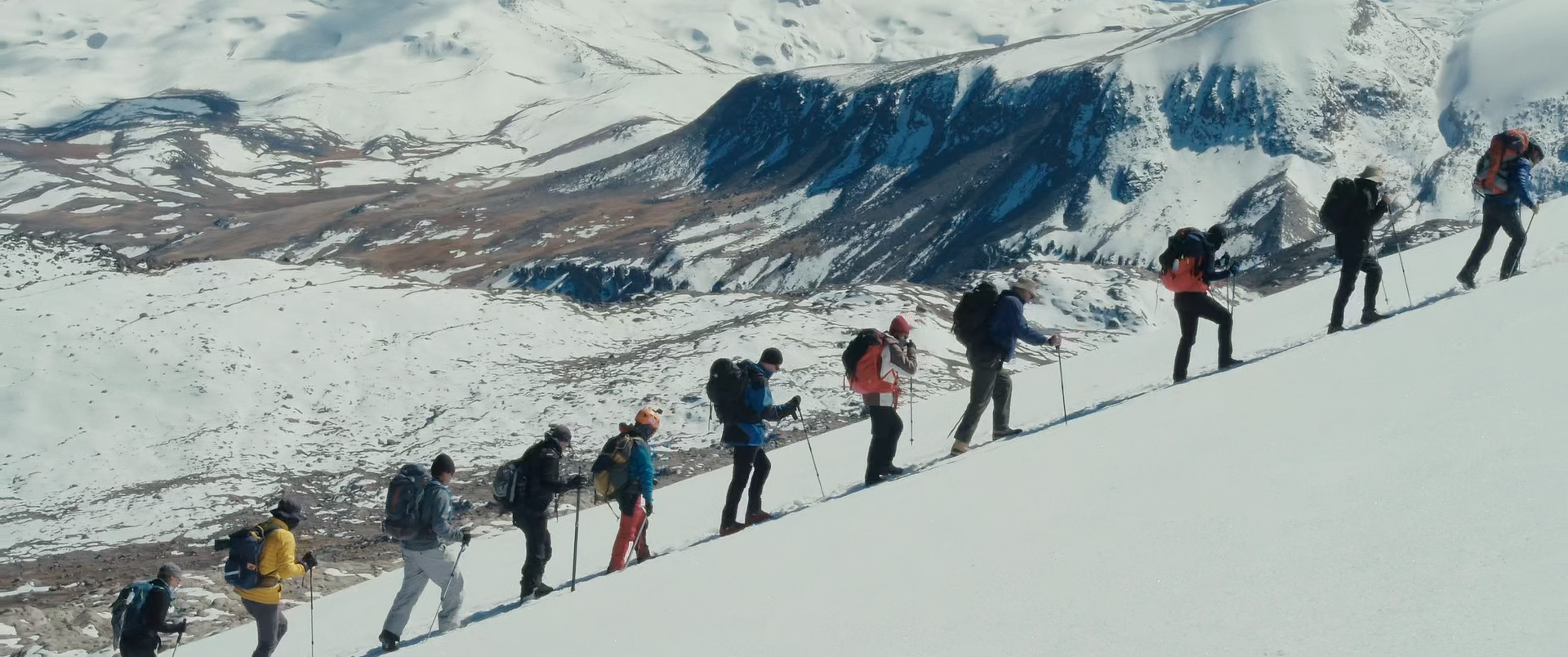
Thompson and his team climb to reach the next glacier.

With a combination of archival footage and contemporary interviews, the documentary explores Thompson’s career, which started with a years-long effort to access a mountaintop glacier located in a remote area of Peru. Though at first he was motivated solely by scientific curiosity, his discovery that glaciers around the world were shrinking eventually turned him into what he is today: a prominent cautionary voice in the fight against climate change.

Dramatic photography by cinematographer Devin Whetstone, accompanied by Paul Doucette and Jeff Russo’s equally dramatic score, set an appropriate tone for a film about a man engaged in a struggle for humanity’s survival. They help to make up for co-director O’Malley’s script, which sometimes fails to fill in salient details. Just what, for example, do Thompson and his colleagues do with the ice cores they work so hard to extract from glaciers? And what do these samples of ancient ice tell them about our planet?

But the film fills in just enough details when it reports on the rise of climate-change denial, a movement that caused politicians as diverse as Newt Gingrich, Sarah Palin and Mitt Romney to change from science supporters into science questioners. An eye-opening depiction of their transformation underscores the uphill battle Thompson and other activists face as they work to save humanity from its own excesses.   

Rating: 3½ stars (out of 5)

Canary opens Sept. 15 in select theaters in New York and Los Angeles, as well as the Gateway Film Center in Columbus. Subsequent one-night screenings are planned Sept. 20 in multiple markets. For details, visit canary.oscilliscope.net.

Luck and learning turned diver into environmental hero

Jacques Cousteau wears his trademark red cap aboard the Calypso during the 1970s. (Photo courtesy of the Cousteau Society)

By Richard Ades

Becoming Cousteau, Liz Garbus’s biographical documentary about the late Jacques Cousteau, is aptly named.

Though Cousteau was one of the first luminaries to sound the alarm about mankind’s ongoing destruction of the environment—particularly the watery environment that covers most of our planet—he was not born with this level of enlightenment. He was not even that interested in the ocean, Garbus reveals, as he entered the French naval academy at the age of 20 only for the chance to become an aviator. But then fate sent his life in a new direction.

After being involved in a traffic accident that nearly killed him, we learn, Cousteau was forced to give up his previous plans and turn to the ocean for refuge. With a couple of companions, he began “free diving” (i.e., without auxiliary aids) as a way to recover his muscle strength. Even after Germany invaded France during World War II, his devotion to the sea kept growing, to the extent that he was soon planning to build a career around his new love.  

At first, Cousteau hoped to earn money by conducting salvage operations on sunken ships and downed planes with the aid of diving equipment that he was working to perfect. Then, in 1951, he acquired the converted mine sweeper known as the Calypso and began his new life as an ocean-going explorer.

It was during these early years at sea, Garbus tells us, that Cousteau committed acts he later came to regret after becoming more environmentally sensitive. In order to catalog local fish populations, for example, he and his crew dynamited off-shore waters without regard for the damage it would cause to fragile habitats. Perhaps worst of all, they bankrolled their exploits by helping a British drilling company locate underwater oil deposits in the Persian Gulf.

Fortunately, Cousteau eventually found a safer meal ticket in the form of his long-running TV series The Underwater World of Jacques Cousteau. The series helped to pay for Cousteau’s worldwide explorations and, at the same time, gave him a bully pulpit to express his growing concerns about the damage being done to the sea by industrialized society and its waste products.

The documentary depicts all of this with the help of the miles and miles of film Cousteau shot throughout his career. At the same time, it doesn’t neglect his family life—such as it was.

Sons Jean-Michel and Philippe often were sent away to boarding school while Cousteau and his wife, Simone, roamed the seas on the Calypso. Even so, both sons took an interest in their father’s work, particularly the adventure-craving Philippe. As a result, Cousteau assumed he would one day be able to allow the younger generation to take it over, and he was devastated when tragedy disrupted his plans.

Producer-director Garbus has won awards and nominations in both documentary and scripted categories. With this National Geographic Documentary Films production, she succeeds in turning a 20th century icon into a human being who took a long, watery path to becoming an environmental prophet. It’s a compelling journey.

Rating: 4 stars (out of 5)

Becoming Cousteau (PG-13) can be seen at select theaters, including Central Ohio’s Marcus Crosswoods Cinema 17 and AMC Dine-In Easton Town Center 30.

‘Godzilla’ over-plotted and under-lit

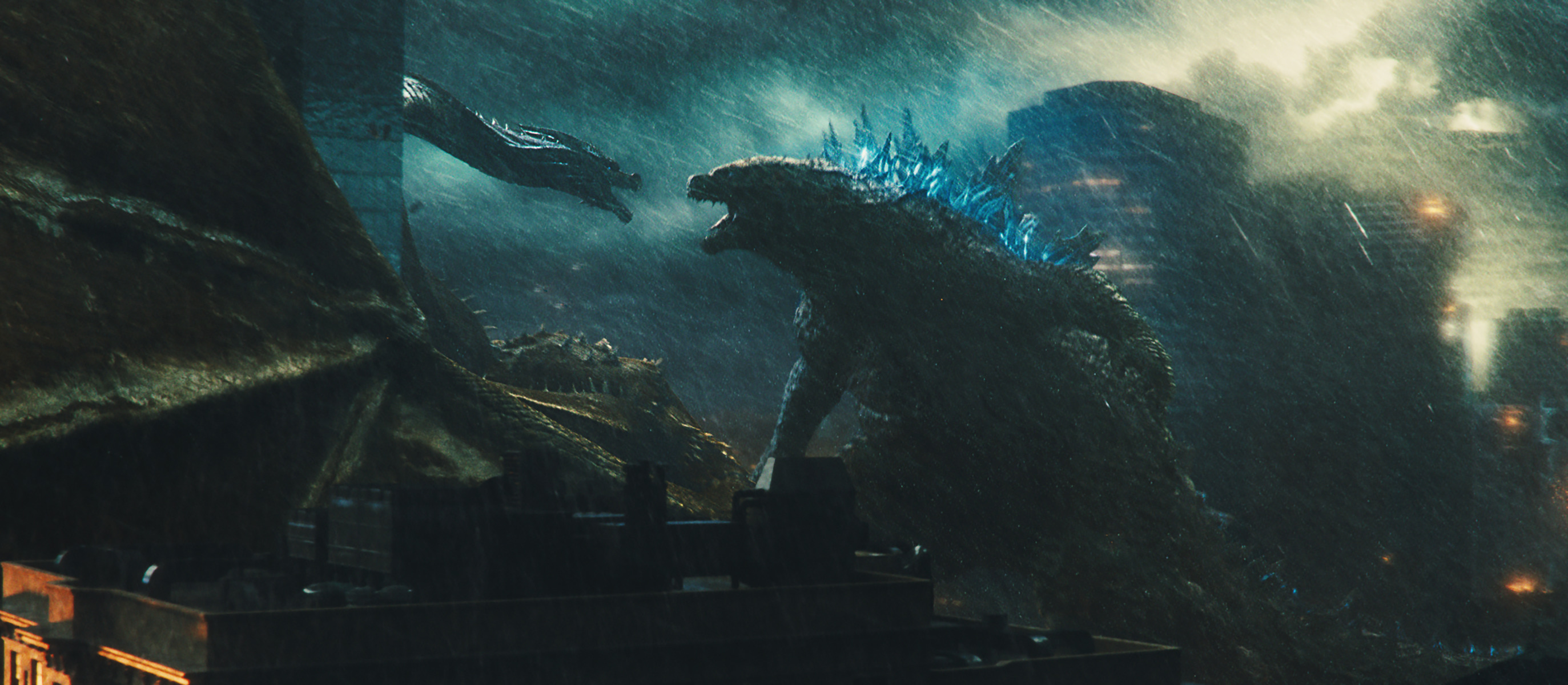
Godzilla and Ghidorah
Godzilla (right) faces off against the alien “titan” Ghidorah in Godzilla: King of the Monsters. (Photos courtesy of Warner Bros. Entertainment and Legendary Pictures Productions)

By Richard Ades

It was back in 1954 that Japan gave us Godzilla, the story of an ancient monster reawakened by tests of the hydrogen bomb. The original movie (though toned down for its U.S. release) was a grimly compelling morality tale. Like Frankenstein, it warned of the horrors that can be unleashed by scientists bent on advancement at all costs.

Over the years, the classic has spawned numerous sequels and reboots. Many of the earliest were campy affairs in which an actor in a Godzilla costume trampled miniature facsimiles of Tokyo while fighting new monsters such as Mothra and Rodan. More impressive was the 2014 U.S. remake, which used the latest cinematic technology to recapture the awe and wonder—if not the moral authority—of the original.

Now we have Godzilla: King of the Monsters, which could be the Godzilla movie to end all Godzilla movies. Not because it’s so great, unfortunately, but because it’s so boring.

Thanks to the haphazard direction of Michael Dougherty and the light-challenged cinematography of Lawrence Sher, the movie’s frequent battle scenes are dark, frenetic spectacles in which we struggle to discern who is being attacked by whom. And thanks to the drab, needlessly convoluted script by Dougherty and his co-writers, we struggle to care one way or the other.

Building on the mythology of 2014’s Godzilla, the flick centers on Monarch, an international organization devoted to controlling Godzilla and other monstrous “titans” by keeping them in a state of hibernation. That puts the group at odds with members of the U.S. government and military who believe the only good titan is a dead titan.

Sharing this belief is scientist Mark Russell (Kyle Chandler), who lost a son to a previous Godzilla attack and went into an alcohol-fueled tailspin that alienated him from his wife, Emma (Vera Farmiga), and daughter, Madison (Millie Bobby Brown). Further dividing the family is Emma’s devotion to studying, rather than destroying, the monsters. In fact, we first meet her in a Monarch “outpost” where none other than Mothra is about to emerge from a gigantic cocoon.

GODZILLA: KING OF MONSTERS
Dr. Emma Russell (Vera Farmiga) and daughter Madison (Millie Bobby Brown) face one of many tense situations in Godzilla: King of the Monsters.

Now here’s where the plot gets really strange. After Emma brings the monster under control with a nifty device called the Orca, the outpost is attacked by eco-terrorist Alan Jonah (Charles Dance). Jonah and his troops proceed to kill everyone present except for Emma and Madison, who are taken hostage.

Or are they? It turns out that Emma is actually in cahoots with Jonah—sort of. While he’s out to collect titan DNA for presumably commercial gain, Emma is determined to release Godzilla and the other monsters in order to save the world from its greatest adversary: mankind. She theorizes that we’ll eventually learn to live in harmony with these ancient beasts, who will help us return Earth to its preindustrial purity.

Let’s pause at this point to consider how far this morality tale has strayed from its 1954 roots. Rather than being our punishment for introducing deadly new weapons to the planet, Godzilla and friends are now seen as allies in the fight against global warming. Of course, millions of innocent people would be trampled and otherwise destroyed once these “allies” are unleashed, but we have no time to consider that ethical complication because the script introduces yet another twist.

Unlike Godzilla and the other titans, it turns out that the mightiest of the monsters, the three-headed Ghidorah, is actually a space alien and will only push Earth further from its original ecological balance. Curses! Not only that, but Godzilla has been weakened or killed in battle and is unable to save us from this invasive species. Double curses!

Given all the busy plotting about monsters and ways to deal with them, it’s hard to care about Mark, Emma and Madison, let alone the many peripheral characters around them. In fact, I found myself worrying more about the actors themselves, including established talents such as Sally Hawkins and Bradley Whitford, who are stuck in unrewarding, one-note roles. Fairing not much better is the Japanese-born Ken Watanabe, whose character, the Godzilla-loving Dr. Serizawa, spouts so much Eastern-style philosophy that he jokes about getting it from a fortune cookie.

The dialogue hits its lowest mark whenever the monsters show up and the humans respond with profound statements such as “Jesus,” “God,” or “Oh, shit!” As for us viewers, we’re likely to be aiming a few choice words of our own at the technicians who lit the monsters so dimly that we can barely make them out.

Rating: 2 stars (out of 5)

Godzilla: King of the Monsters (PG-13) opens May 31 at theaters nationwide.