Preserving film history one frame at a time

By Richard Ades

The worst job I ever had was working in a motion picture lab in the late 1970s. Not only did I spent much of my time trapped in a dark room with very pungent chemicals, but I sometimes had the difficult task of copying old, shrunken films that had to be coaxed through our machinery.  

Too bad I couldn’t have seen Film: The Living Record of Our Memory back then. It would have allowed me to feel some pride in the small role I was playing in the massive (and massively difficult) effort to preserve our cinematic history.

Spanish director Ines Toharia Teran’s documentary is about the worldwide quest to save films that otherwise would be lost due to chemical degradation, disasters and other causes.

It’s a quest that began in spite of the early film studios, we’re told, as they thought of movies as commercial products rather than works of art or historical documents that needed to be preserved. In fact, flicks that had already made the theatrical rounds were often destroyed to recover the silver in the film stock, thus helping to pay for future productions.

An additional preservation complication: Early film stock was composed of nitrate, which was dangerously inflammable. If it ever caught on fire, not even water could extinguish the flames.

The documentary tells us that the result of this danger and neglect is that 80 percent of all silent films are likely gone forever, along with half of all the “talkies” ever made.

Film is not a tragedy, however, but an account of the heroes who have devoted themselves to protecting film history. Numerous preservationists and other cinematic experts from around the world talk about the challenges they face—such as trying to reconstruct a formerly “lost” film by splicing together the least-degraded frames from various recovered prints.

Why go to all this trouble? Because otherwise we’ll lose pieces of art that help to define our cultural history. And sometimes we’ll lose pieces of actual history, as in the case of home movies and other nonfiction films that depict scenes from the Holocaust and other world tragedies.

At nearly two wide-ranging hours, Film will be of most interest to those who care about cinema’s past, present and future.

Does it bother you that Alfred Hitchcock’s 1926 film The Mountain Eagle may never be seen again? Is it important to you that people be able to watch the early works of India’s Satyajit Ray, or the many independent films that depict Africa’s anti-colonial struggles?

Do you want such influential flicks as Charles Burnett’s Killer of Sheep and Cuban director Tomas Gutierrez Alea’s Memories of Underdevelopment to be available to future cinema lovers?

If so, the documentary will be two hours well spent.

Rating: 3½ stars (out of 5)

Film: The Living Record of Our Memory opened May 5 at the Gateway Film Center in Columbus, with additional screenings planned May 8-9 in Los Angeles, May 11-14 in St. Louis, May 20 in San Francisco and May 21 in Cleveland. The film will be available through VOD outlets beginning May 16.
Hockey musical is gone, but spoofy sand-and-surf tale remains

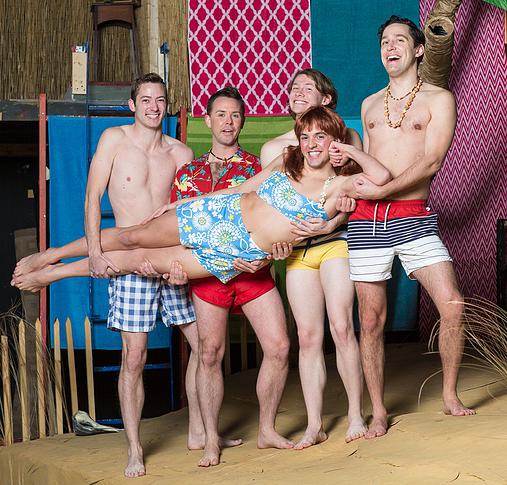
Chicklet (Nick Hardin) gets a lift from friends (from left) Provoloney (Andrew Trimmer), Star Cat (Jason Crase), YoYo (Luke Stewart) and Kanaka (Dan Montour) in Psycho Beach Party, one of two plays opening this week at Short North Stage (photo by Jason Allen, Second Glimpse Photography)
Chicklet (Nick Hardin) gets a lift from friends (from left) Provoloney (Andrew Trimmer), Star Cat (Jason Crase), YoYo (Luke Stewart) and Kanaka (Dan Montour) in Psycho Beach Party (photo by Jason Allen, Second Glimpse Photography)

By Richard Ades

It was one busy week at the Garden Theater.

Last Wednesday, Short North Stage opened its first original work, The Great One. Timed to complement the National Hockey League’s All-Star Game in Columbus, the musical focused on a traumatic moment in western Canadian history: the Edmonton Oilers’ 1988 trade of star player Wayne Gretzky to the Los Angeles Kings.

With direction by Scott Hunt, who also co-wrote the book and lyrics, it boasted a committed cast of five and some surprisingly pretty tunes by composer James Higgins. In just about an hour, it neatly summarized the profound impact a local team’s ups and downs can have on members of its community. (That’s something you don’t have to be Canadian to understand, eh?)

Unfortunately, the show’s run was as short and sweet as its running time. Its last performance ended before Sunday’s All-Star Game.

However, last week’s other Garden Theater production will continue through this weekend. A new troupe called Columbus Immersive Theater is reviving Charles Busch’s Psycho Beach Party in the venue’s main auditorium.

That’s a big room, but director/choreographer Edward Carignan is living up to the “Immersive” moniker by cramming the audience onto the stage with the players. That makes this tale of a troubled teenage girl named Chicklet a pleasantly intimate experience.

I first saw Busch’s campy comedy nearly a quarter-century ago at the old Reality Theatre. It was pretty entertaining, even though the troupe took the unorthodox tack of having Chicklet played by an actual woman.

In Immersive’s production, thankfully, tradition reigns. A cross-dressing Nick Hardin makes such a hilarious Chicklet that you can’t help wondering why anyone would want to do it the other way. Just as funny is Doug Joseph as her protective and borderline-abusive mom, Mrs. Forrest.

Set in Malibu Beach in 1962, Psycho Beach Party spoofs both Hitchcock-style psychodramas and old sand-and-surf epics like Beach Blanket Bingo. As in the latter, everyone is G-rated innocent—on the surface. Underneath, sexual tension rears its head, sometimes even between a couple of suspiciously compatible guy friends.

Most misleading of all is Chicklet, a going-on-16 girl who spends her time hanging out with bookish friend Berdine (Vera Ryan Cremeans) and begging the local beach bums to teach her how to surf. She seems harmless, but if you make her mad, a dominatrix-like alter ego named Ann Bowman suddenly appears. And that’s only one of Chicklet’s multiple personalities, all played to a comic “T” by Hardin.

Other cast members include Dan Montour as surfing ace Kanaka, Kaitin Descutner as popular mean girl Marvel Ann, Bria Schultz as movie star Bettina Barnes, Jason Carl Crase as Star Cat, Luke Stewart as YoYo and Andrew Trimmer as Provoloney. All give likable but restrained performances, basically acting as “straight men” to Hardin and Joseph.

The result is that the show isn’t really at its funniest unless Chicklet and/or Mrs. Forrest are center stage. But when they are, it’s a spoofy blast out of the past.

Immersive Theater Company will present Psycho Beach Party through Feb. 1 at the Garden Theater, 1187 N. High St. Show times are 8 p.m. Friday-Saturday and 4:30 p.m. Sunday. Running time: 1 hours, 45 minutes (including intermission). Tickets are $20. Contact: beachpartycolumbus.com or shortnorthstage.org.