West Bank tale doesn’t pull its punches

Basem (Saleh Bakri, right) offers comfort to distraught student Adam (Muhammad Abed Elrahman) in The Teacher. (Photos courtesy of MPI Media Group)

By Richard Ades

The Teacher takes on one of the most divisive issues in the world today: the struggle between Israel and the Palestinians. And it does it in a way that is thoughtful, provocative and dramatic.

The title character is Basem El-Saleh (Saleh Bakri), who teaches in a poor community in the West Bank. Anyone who’s seen the Oscar-winning documentary No Other Land—or the final episodes of the Netflix series Mo—won’t be surprised to learn that Basem’s students have more to worry about than passing tests.

Two of them, brothers Yacoub and Adam (Mahmoud Bakri and Muhammad Abed Elrahman), return from school one day just in time to see their home torn down by Israeli forces. “It was just their turn,” Basem explains to British social worker Lisa (Imogen Poots), noting that most houses in the village have been marked for demolition.

Adding to the residents’ worries are the Israeli settlers whose red-roofed homes can be seen multiplying in the distance. Though the settlers have moved to the occupied territory illegally, the residents know the government is likely to take the newcomers’ side if any dispute arises. 

And soon a dispute does arise, with tragic consequences. When a group of settlers sets fire to Palestinian-owned olive trees, Yacoub tries to intervene and is killed for his trouble. Community members vow to seek justice, but they know it may be beyond their reach.

Adam (Muhammad Abed Elrahman, left) shares a couch with his teacher (Saleh Bakri) after watching his home be demolished by Israeli troops.

Making her feature-length film debut, British-Palestinian writer-director Farah Nabulsi doesn’t shy away from showing the hardships West Bank residents face under Israeli occupation. Nor is she afraid to take the story into controversial areas.

A subplot that eventually melds with the main storyline involves an Israeli soldier being held hostage by a resistance group that hopes to exchange him for Palestinian prisoners. The soldier’s American parents (Stanley Townsend and Andrea Irvine) pressure the government to approve the exchange, but Israeli officials seem more interested in finding and punishing his kidnappers.

Leading the cast, Bakri is slightly hampered by director Nabulsi’s tendency to exploit his movie-star good looks (i.e., he takes off his shirt a lot). Still, he’s stalwartly effective as the teacher who tries to give his students the help that, as flashbacks reveal, he was unable to give his own son.

As Lisa, Basem’s colleague and possible love interest, Poots projects courage, sincerity and a useful amount of wiliness. As young Adam, who becomes increasingly distraught following his brother’s death, Elrahman provides some of the tale’s most unsettling moments.

Gilles Porte’s cinematography and composer Alex Baranowski’s score perfectly complement the film’s perilous setting and changing moods.

Though some may quibble that its ending is overly tidy, The Teacher is a brave and nuanced attempt to reveal the humanity lurking beneath one of the world’s most intractable political standoffs.

Rating: 4 stars (out of 5)

The Teacher opens April 11 in New York City and expands to other markets beginning April 18. It is scheduled to open April 25 at the Gateway Film Center in Columbus.
Milquetoast turns manly in dark spoof of machismo

Art of Self Defense
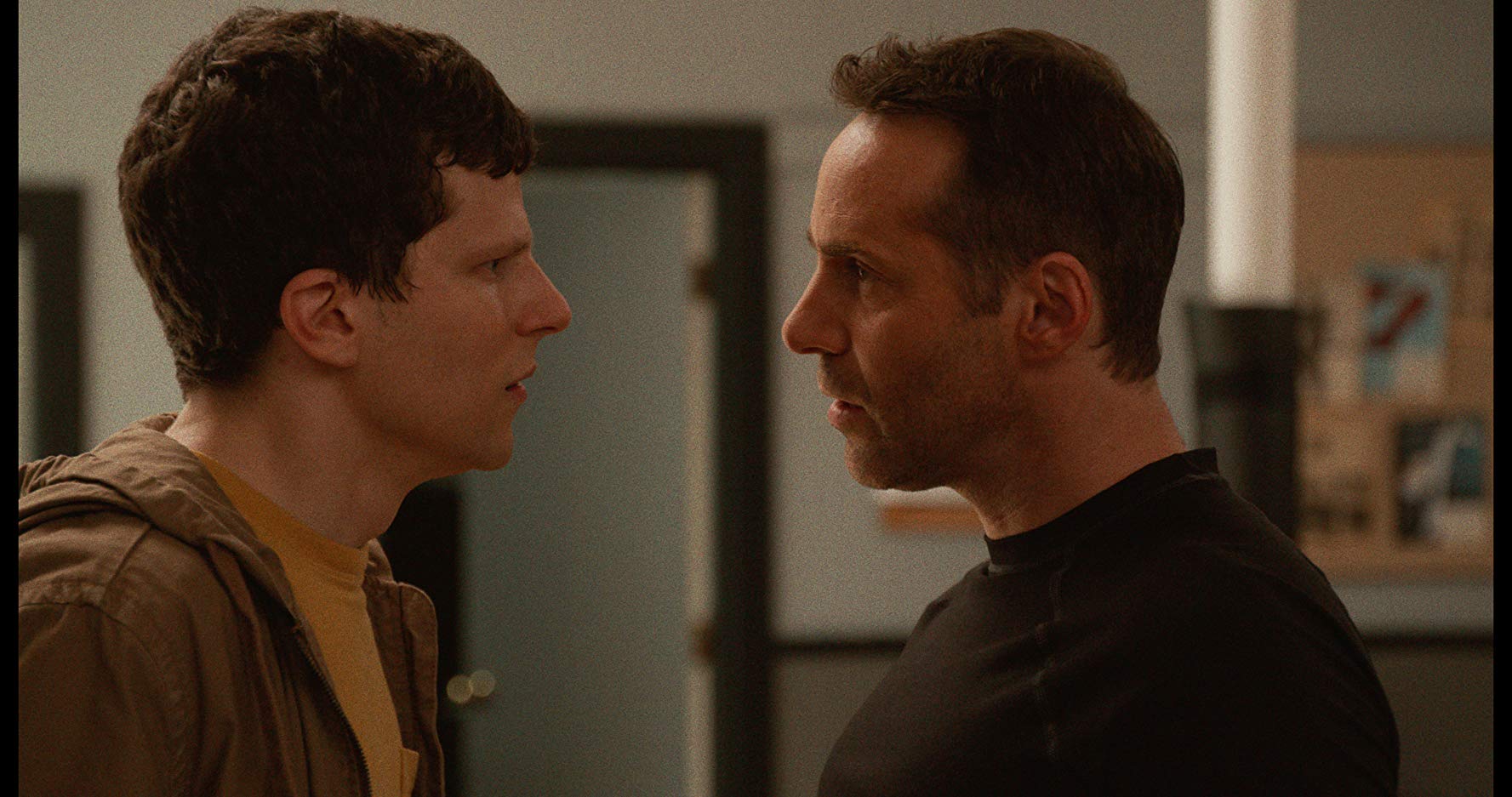
Karate instructor Sensei (Alessandro Nivola, right) is determined to turn Casey (Jesse Eisenberg) into a real man. (Photos courtesy of Bleecker Street)

By Richard Ades

Minutes into The Art of Self-Defense, a vicious mugging sends 35-year-old Casey (Jesse Eisenberg) to a gun shop in search of protection. Ultimately, though, he ends up in a karate studio, where he becomes a devotee of a secretive instructor known only as Sensei (Alessandro Nivola).

It’s a decision that at first transforms and later endangers his life.

Though Casey’s goal is to learn how to defend himself, it turns out that Sensei teaches more than kicks and punches. He’s determined to turn Casey into a man—his definition of a man, that is, which includes the most extreme attributes of machismo.

And maybe that’s what Casey wants, too. “Other men intimidate me,” he tells Sensei, admitting what we’ve already witnessed in his interactions with assorted obnoxious males. So when Sensei eventually invites him to join the dojo’s exclusive “night class,” promising that it will help him become what he fears, Casey jumps at the chance.

Sure enough, he soon becomes someone who instills terror in others, but in the process he starts down a dangerous path that has no easy exit.

Written and directed by Riley Stearns (2014’s Faults), The Art of Self-Defense could just as easily be called The Pitfalls of Toxic Masculinity. Its true subject is that much-derided syndrome, which has been blamed for offenses ranging from sexual harassment to mass shootings and has been attributed to male entitlement, among other causes.

Here, Stearns doesn’t delve deeply into the disorder’s whys, other than having one of Casey’s fellow students suggest that men’s aggression is caused by testosterone. Instead, the flick concentrates on depicting machismo in its most absurd and destructive form.

In his quest to help Casey man up, Sensei tells him to start listening to heavy metal music and to give up his plans to visit France, a country best known for raising the white flag. In its place, he recommends idolizing more “masculine” lands such as Russia or Germany and is pleased to learn that Casey’s dog is German, even though it’s only a lowly dachshund.

Art of Self Defense Anna
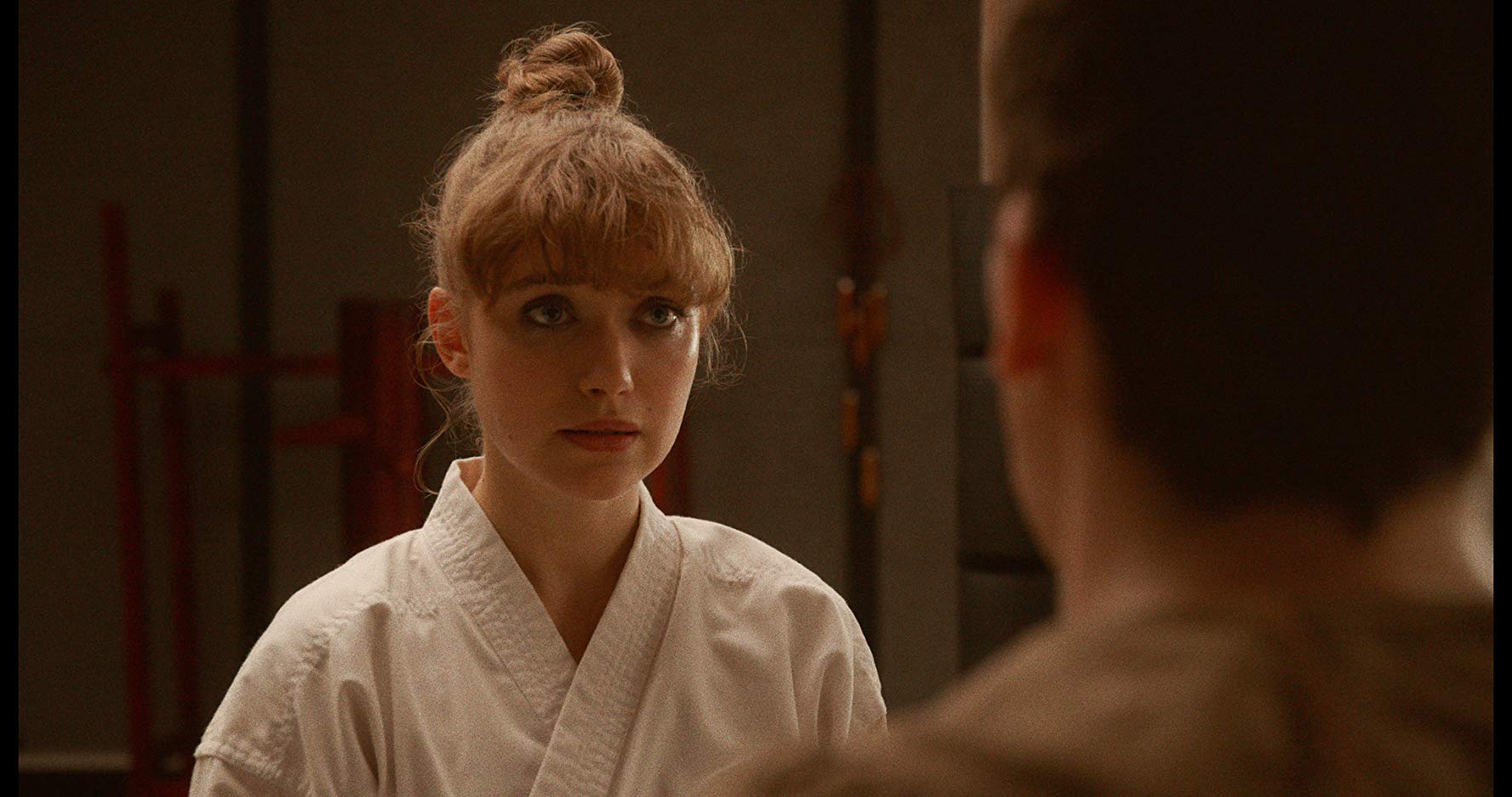
Anna (Imogen Poots) is consigned to second-class citizenhood in Sensei’s male-centered dojo.

As for women, Sensei’s male-centric worldview reduces them to second-class citizens since, after all, they’re not men. Accordingly, he continually downgrades the only woman in the dojo, Anna (Imogen Poots), despite the fact that she’s one of his fiercest and most skilled followers. And Anna herself seems to accept his judgment to some extent, even while she chafes at being denied the black belt she clearly deserves.

The Art of Self-Defense is being promoted as both a dark comedy and a drama. Of the two, it’s probably closer to the former, as long as you realize it’s more “dark” than “comedy.”

Nivola’s deadpan portrayal of the militantly manly Sensei may garner a chuckle or two, but the film’s spiral into danger and violence stops it from turning into a laugh fest. As for the dramatic elements, they’re undercut by Casey’s unrealistic transformation from a fearful milquetoast to an unprovoked throat-puncher, as well as by certain developments that are more predictable than they should be.

It’s probably most interesting to see Stearns’s flick as a comment on toxic masculinity, though Anna’s presence complicates the subject. After all, for the most part she is just as aggressive and dangerous as the men around her. It’s not until the final act that we learn there is one step on Sensei’s perverse journey that she refuses to take.

In the film’s dire view of humanity, that represents a slim hope for salvation.

Rating: 3 stars (out of 5)

The Art of Self-Defense (rated R) opened July 18 at Columbus’s Gateway Film Center, AMC Lennox Town Center 24 and AMC Dine-In Easton Town Center 30.