Two of the bravest movies I’ve seen in the past couple of years have taken aim at Iranian authoritarianism. In 2024, there was The Seed of the Sacred Fig, followed this year by the judo-centric Tatami.
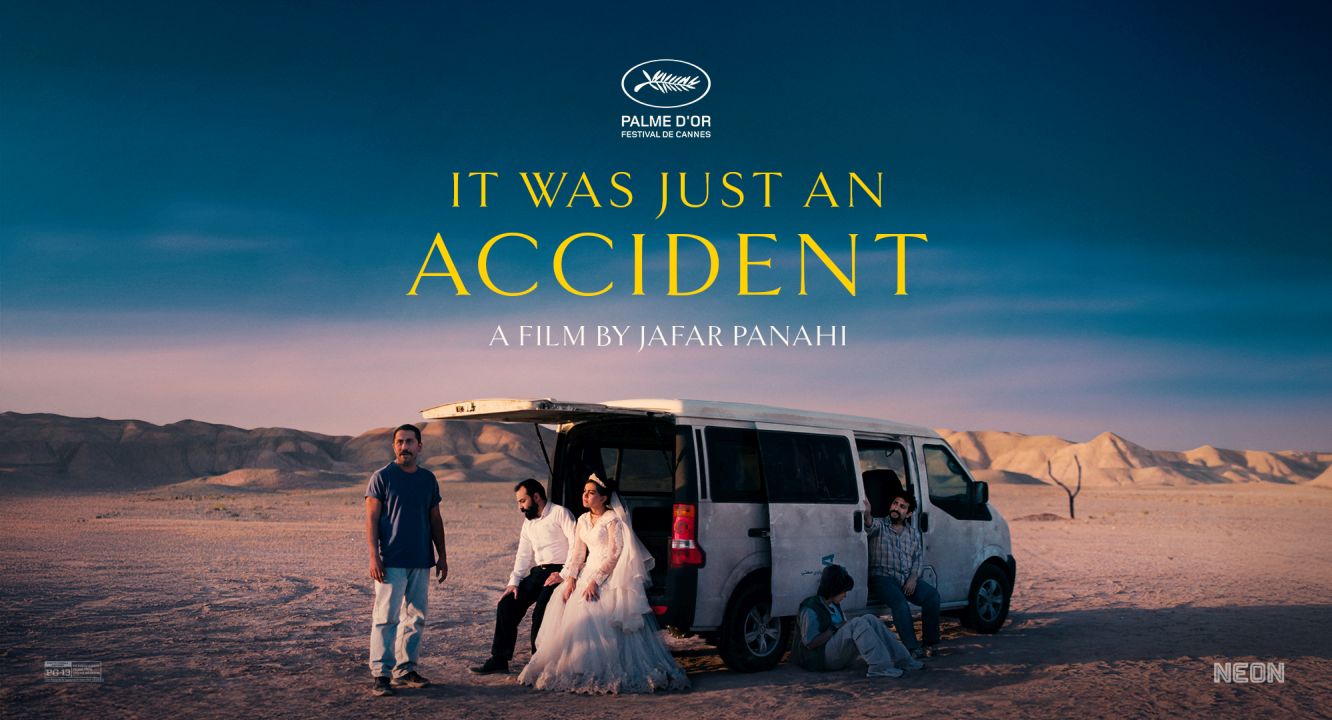
Now, add a third flick that raises a middle finger to Iran’s Islamic dictatorship: It Was Just an Accident, a ballsy effort written and directed by Jafar Panahi. The low-budget thriller deftly creates tension leavened with flashes of humor, all the while wading through moral quagmires and asking questions that defy easy answers.
The tale begins on a dark highway, where we meet a family man (Ebrahim Azizi) who’s driving home with his wife and young daughter when his car breaks down in front of a garage that’s closed for the night.
Luckily for him, the mechanic agrees to take a look at his vehicle anyway. Unluckily for him, the mechanic’s assistant thinks he recognizes this stranded motorist.
Vahid (Vahid Mobaserri) once spent years in prison after being charged with political “crimes” against the state. While there, he was interrogated and tortured by a guard whose face he never saw, but who was recognizable by the squeaking sounds made by his artificial leg.
Vahid thinks he hears the same sounds when this stranger enters his garage.
What follows is a quest for justice—or vengeance, depending on your point of view. Eventually finding a way to capture the motorist, Vahid prepares to bury him alive, only to be attacked by doubt when the stranger claims it’s a case of mistaken identity.
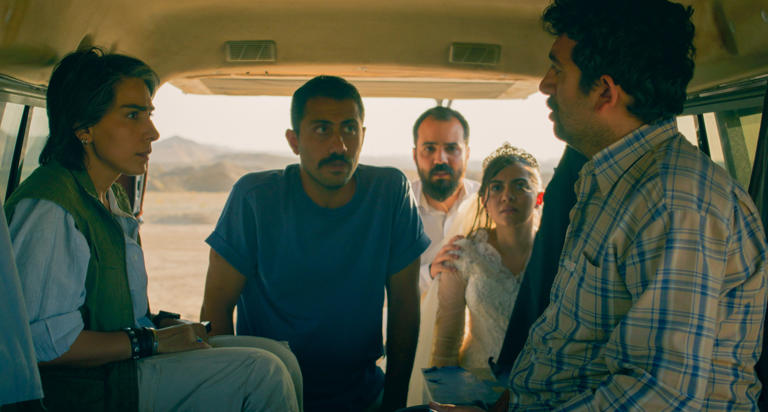
Discussing the fate of their prisoner, whom they suspect of being a sadistic former prison guard, are (from left) Shiva (Miriam Afshari), Hamid (Mohamad Ali Elyasmehr), Ali (Majid Panahi), Golrokh (Hadis Pakbaten) and Vahid (Vahid Mobaserri). (Photo courtesy of Neon)
Vahid then begins rounding up fellow victims of the guard variously known as “Eghbal the Pegleg” or “the Gimp” in hopes someone can make a positive identification. It’s a motley crew, ranging from a photographer (Miriam Afshari) and her tempestuous ex (Mohamad Ali Elyasmehr) to a bride (Hadis Pakbaten) who’s already decked out in her wedding gown.
Driving around in Vahid’s decrepit van, they vent about their prison experiences and argue about whether the drugged man in the back is really their former tormenter—and, if so, what to do with him. Should they make him pay with his life, or would that simply lower them to the government’s level?
These are heavy considerations, and yet writer/director Panahi manages to add bits of humor that often stem from cultural quirks. For example, it seems that not even kidnappers are immune from paying the tips, gifts and bribes that apparently are a part of Iranian daily life.
Beautifully acted by a committed cast, and beautifully photographed by cinematographer Amin Jafari, It Was Just an Accident is mesmerizing from its beginning to its cathartic and intriguingly nebulous ending. The fact that Panahi made this subversive film without the government’s permission—and thus, in secret—just makes his achievement all the more astounding.
Rating: 4½ stars (out of 5)
It Was Just an Accident (no MPA rating) opens theatrically Oct. 15 in New York City and expands to other markets Oct. 24 and 31.
Iranian martial artist Leila Hosseini (Adrienne Mandi) contemplates her next move after her government orders her to withdraw from an international judo competition.
By Richard Ades
One of my favorite movies of 2024 was The Seed of the Sacred Fig, about a family torn apart by Iran’s theocratic dictatorship. In the same year, one of my favorite guilty pleasures was Cobra Kai, the Karate Kid-inspired TV series that was wrapping up its six-season run.
So maybe it’s no surprise that one of my favorite films of 2025 is Tatami, which combines a jab at Iranian authoritarianism with youthful martial arts.
Before you let your imagination run wild, no, this is not the tale of two dojos that trade chops and kicks while arguing over Islamic principles. Instead, it centers on Leila Hosseini, an Iranian athlete who travels to Tbilisi, Georgia to take part in an international judo competition.
Portrayed with fierce determination by Adrienne Mandi, Leila psyches herself up for what she knows will be a grueling test of her skill and stamina. In one long day, a series of bouts will pit her against some of the world’s toughest competitors.
Providing advice and pep talks from the sidelines is her coach, Maryam Ghanbari (sensitively played by Zar Amir Ebrahimi). Between matches, Leila receives additional support via phone calls from her cheerleading husband, Nader (Ash Goldeh), who’s watching the proceedings on TV along with their young son and a houseful of relatives.
Leila (Adrienne Mandi, right) and her coach, Maryam Ghanbari (Zar Amir Ebrahimi), find themselves in an unexpected dilemma.
Then something happens that in most societies would be unthinkable. Coach Maryam receives orders from government officials that Leila must throw a match, fake an injury or simply withdraw from the competition. The reason: Leila’s early successes make it likely that she’ll end up vying for the championship with the top competitor from Iran’s mortal enemy, Israel.
The order reportedly comes from the “Supreme Leader” himself, the ayatollah, which means disobeying would spell big trouble for Leila, her coach and even her family. Realizing the danger, Maryam urges Leila to do as she’s told, even though it means giving up her lifelong dream.
Stubbornly, though, Leila refuses. Her decision immediately ostracizes her from her coach and teammates, leaving her on her own as she returns to the mat over and over to encounter increasingly tough competitors. All the while, the governmental threats continue.
Leila (Adrienne Mandi, in white) meets her latest competitor while competing for an international title.
Co-directed by Israeli filmmaker Guy Nattiv and Ebrahimi, the Iranian-born actor who plays Maryam, Tatami effectively combines sports action with political intrigue to create a tense viewing experience. Todd Martin’s stark black-and-white cinematography gives the film the look of a vintage documentary, lending it an air of veracity.
Indeed, the script by Nattiv and Elham Erfani is said to be inspired by actual athletes’ experiences. That doesn’t mean it all rings true, as one key development seems as contrived as it is predictable.
Even so, committed performances by Mandi, Ebrahimi and the rest of the cast keep viewers attentive and concerned, while composer Dascha Dauenhauer’s music underscores each scene’s emotions without ever overplaying its hand.
Coming out in the midst of the current confrontation among Iran, Israel and the U.S., Tatami’s timing is near perfect—just like the film itself.
Rating: 4½ stars (out of 5)
Tatami (no MPA rating) can be viewed in select theaters and is scheduled to open May 27 at the Gateway Film Center in Columbus.
A motion-captured Jonno Davies plays a simian version of British pop star Robbie Williams in Better Man. (Photo courtesy of Paramount Pictures)
By Richard Ades
This is the time of year when critics get a chance to catch up on recent flicks they might have missed, courtesy of studios in search of buzz and, hopefully, award nominations. While I don’t claim to be clairvoyant when it comes to the latter, I can confidently say this: If the Oscars and other competitions gave out prizes for bravery, these three films and their creators would win hands down.
One filmmaker displays creative courage by breaking the mold in a familiar genre, while the others put their liberty and even their lives at risk in order to bring their truths to the screen.
Let’s look at them one by one.
Biopic with a difference
By now, we all know the drill when it comes to film biopics: The would-be celeb claws his or her way to the top, but success comes at a steep cost. Friends are abandoned, spouses are cheated on, and alcohol and/or drugs are abused.
Better Man, based on the life of British pop superstar Robbie Williams, follows that general pattern, but with a difference. The entire story unfolds through the eyes (and narration) of Williams himself, who emerges as someone who desperately wants fame but is convinced he doesn’t deserve it.
And, oh yes: Williams is portrayed by a CGI-generated chimpanzee (a motion-captured Jonno Davies). It sounds weird—and, frankly, it is—but it also makes sense in a brilliant and emotionally satisfying way.
Even as a child, Williams suffers from self-doubt, self-loathing and what he later comes to identify as depression. By making him the lone ape in a world of humans, the film has found a clever way of symbolizing Williams’s fear that he’s an imposter unworthy of the success he seeks.
Directed with theatrical flair by Michael Gracey (The Greatest Showman), Better Man is marked by gee-whiz, over-the-top production numbers and surreal fantasy sequences, in addition to its simian protagonist. But what really sets it apart is its honesty and warmth.
Despite being depicted as an ape, Williams comes off as a recognizably flawed human who earns our sympathy, as well as the heart-on-its-sleeve sendoff the film gives him. Director Gracey’s gamble has paid off with a flick that’s as moving as it is massively entertaining.
Rating: 4½ stars (out of 5)
Better Man (rated R) opened Dec. 25 in select theaters and expands nationwide Jan. 10.
National unrest and a missing gun upset the lives of Iranian student Rezvan (Mahsa Rostami, center), her mother (Soheila Golestani, left) and sister (Setareh Maleki) in The Seed of the Sacred Fig.
Criticizing—and then escaping—Iran
As an attack on Iran’s government and justice system, The Seed of the Sacred Fig is the kind of film that can’t be made in that country. And yet veteran writer/director Mohammad Rasoulof succeeded in making it—in secret—before fleeing to Europe for his own safety.
The thriller concerns Iman (Missagh Zareh), who aspires to be a judge but learns that the path to success will force him to ignore his moral compass. He lands a position that requires him to sentence people to death without being given a chance to consider the evidence.
As it turns out, the position endangers more than just his conscience. Because of the job’s controversial nature, he and his wife, Najmeh (Soheila Golestani), and their family are forced to live in secrecy. Meanwhile, daughters Rezvan and Sana (Mahsa Rostami and Setareh Maleki) become embroiled in the widespread unrest that erupts after a young woman is beaten and killed for not sufficiently covering her head.
Then the gun that Iman keeps for protection turns up missing, and the national turmoil threatens to spread to his household as he searches for the culprit. Interrogations ensue, along with a car chase and a tense finale that may remind some of a certain horror film set in a snowbound hotel.
Considering it was made in secret and by a director who’d already gotten in trouble for earlier works, The Seed of the Sacred Fig should fill viewers with admiration for Rasoulof’s resourcefulness, as well as his courage. The film deserves an Oscar nomination, but it probably won’t get one, because who would nominate it? Certainly not Iran.
Rating: 4½ stars (out of 5)
The Seed of the Sacred Fig (PG-13) can be seen in select theaters and is scheduled to open Jan. 30 at Columbus’s Gateway Film Center.
Palestinian activist Basel Adra (left) joins forces with Israeli journalist Yuval Abraham in the documentary No Other Land.
Palestinian, Israeli expose West Bank abuses
Basel Adra has spent years documenting the Israeli army’s systematic attacks on his West Bank community, Masafer Yatta. In No Other Land, he continues that work along with Israeli journalist Yuval Abraham and fellow writer/directors Hamdan Ballal and Rachel Szor.
The result is an eye-opening expose of the abuses Adra and his Palestinian neighbors have had to endure living in the occupied territory. Houses and other buildings are destroyed on the shortest of notices and flimsiest of excuses, such as that the army needs the land for training exercises. Those who want to rebuild are told to get permits that they know are unobtainable.
Much of the film consists of footage taken with amateur video equipment or cellphones. It shows locals trying in vain to reason with soldiers, government officials and, in some cases, illegal Israeli settlers, all of whom are clearly trying to force them to abandon their rural community.
Other footage, shot by Szor, centers on the growing friendship between the Palestinian Adra and Israeli journalist Abraham, who are allied by their concern over the situation but separated by their approaches to dealing with it. Abraham is frustrated that his muckraking stories have had so little impact, but Adra counsels patience, saying a solution could take years or even decades.
The differing approaches reflect the men’s vastly different backgrounds. While Abraham is relatively new to the situation, Adra has been dealing with it for much of his life. In the face of constant, officially sanctioned abuse, he and his neighbors have no recourse but to greet it with steadfast determination and even flashes of dark humor.
Made under the most difficult of circumstances, No Other Land is a portrait of courage that is, in and of itself, an act of courage.
Rating: 5 stars (out of 5)
No Other Land is available through VOD outlets and can be seen at select theaters beginning Jan. 31.
The title character (Zar Amir Ebrahimi, left) and her daughter, Mona (Selena Zahednia), in Shayda
By Richard Ades
Shayda is the story of an Iranian woman who flees a bad marriage by hiding out in a shelter for abused women.
The title character is played by Zar Amir Ebrahimi, who expressively conveys Shayda’s fears as she faces cultural and legal forces that limit her options despite the fact that she and her husband are temporarily living in Australia. Perhaps her greatest fear is that even if she wins a divorce, she could end up losing custody of her daughter.
The story is inspired by the real-life experiences of writer-director Noora Niasari, whose mother went through a similar ordeal. That explains why Shayda’s fears ring true, including her paranoia that husband Hossein will somehow discover the shelter’s secret location.
That also might explain why the character who affects us the most is Shayda’s daughter, Mona, who basically represents Niasari herself. But it certainly helps that Mona is played by a talented young actor named Selena Zahednia, whose face and voice register every emotion the girl is experiencing.
When Shayda and Mona first arrive at the shelter, the daughter is peevish and complains about missing the foods and relatives they’ve left behind in Iran. She even seems to miss her father, though she’s witnessed at least some of his brutish behavior toward her mother.
Then Hossein wins a court order granting him unsupervised visitations with his daughter, and Mona begins undergoing a subtle transformation. At first won over by her dad’s hugs and gifts, she becomes increasingly alarmed by his questions about Shayda’s comings and goings. And she feels uneasy when he asks her to keep confidences from her mother.
As Hossein, Osamah Sami gives an unnerving portrayal of a man whose fatherly feelings may be subservient to his anger toward his wife and his patriarchal sense of entitlement.
It’s easy to conclude that Hossein is shaped by his Muslim beliefs and that the movie is an attack on the culture that spawned them. But the flick’s main target is actually wider, as the shelter where Shayda finds refuge also houses women of other nationalities, including the UK. In other words, abuse of women is depicted as a universal problem.
Speaking of universality, the film’s main weakness is that it defines Shayda as an abused wife and devoted mother, but it fails to fill in the details that would help us understand her as an individual.
What is her background? Why is she in Australia? What are her career goals? The answers to such questions are eventually given (or at least hinted at), but in the meantime she simply comes across as a scared woman who’s desperate to change her life.
It’s one more reason why Mona stands out as the film’s most relatable character.



 Reel Time With Richard Ades