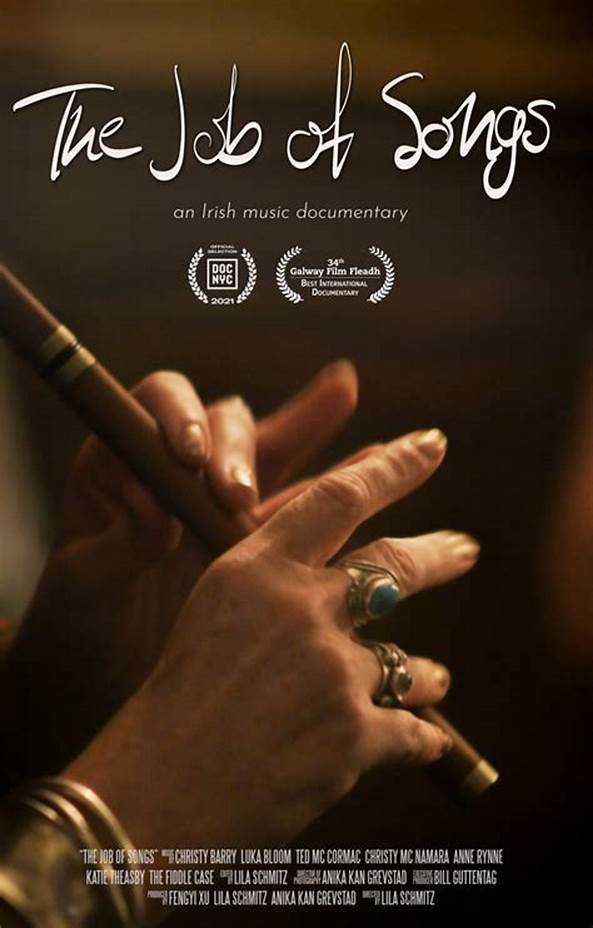
It’s a pity I couldn’t have seen The Job of Songs before taking a trip to Ireland a few years back.
My partner and I were eager to hear authentic Irish music in authentic Irish pubs, but we had little idea where to look. We didn’t know that close to the popular tourist destination known as the Cliffs of Moher is a village steeped in Irish musical traditions.
The tune-filled documentary—directed, edited and co-written by Lila Schmitz—introduces us to Doolin, located in County Clare on the west coast of Ireland. A musician who performs under the stage name Luka Bloom says he moved to the town decades ago after discovering that its entire population was into music just as much as he was.
Apparently, Doolin’s musical fame has spread across the pond and beyond. Local radio deejay Eoln O’Neil is shown spinning Irish tunes on a show that attracts listeners from around the world.
The town is also popular with tourists, who have begun dropping by for a quick fix of music on their way to or from the Cliffs of Moher. It’s a trend that some locals look down on, one complaining that the visitors ought to stick around long enough to meet some actual Irish people.
Speaking of which, the film introduces to several Doolin residents of all ages who devote their lives to playing music. The oldest is Ted McCormic, who has only one leg but doesn’t let either his disability or his 80-plus years stop him from sharing his still-strong voice at local jams.
Other featured musicians include Anne Rynne, who begin playing and writing songs in her 60s after receiving a guitar from her brother, Bloom.
Radio host O’Neil points out the inescapable fact that beautiful but mournful airs make up much of the traditional Irish repertoire. “It’s in our DNA,” he says.
Unfortunately, the sad tunes are more than simply a musical taste, as depression, alcoholism and even suicide are described as widespread problems in the area.
Red-haired Katy Theasby talks about her own struggles with depression and overindulgence, but she says music was her salvation. After obtaining a new tin whistle, she says, she found that for the first time she was able to play without drinking.
Whether for their mental health, personal fulfillment or other reasons, all of the Doolin musicians clearly feel that playing is as necessary as breathing. According to one, listening to music is also important for non-musicians, explaining that the “job of songs” is to allow these folks to feel even though they don’t have songs of their own.
In much the same way, the job of Schmitz’s documentary is to allow viewers to “visit” the musical mecca known as Doolin even though they’ve never actually been there.
Rating: 4 stars (out of 5)
The Job of Songs (no MPAA rating) is available from various digital platforms. For information, visit thejobofsongs.com.
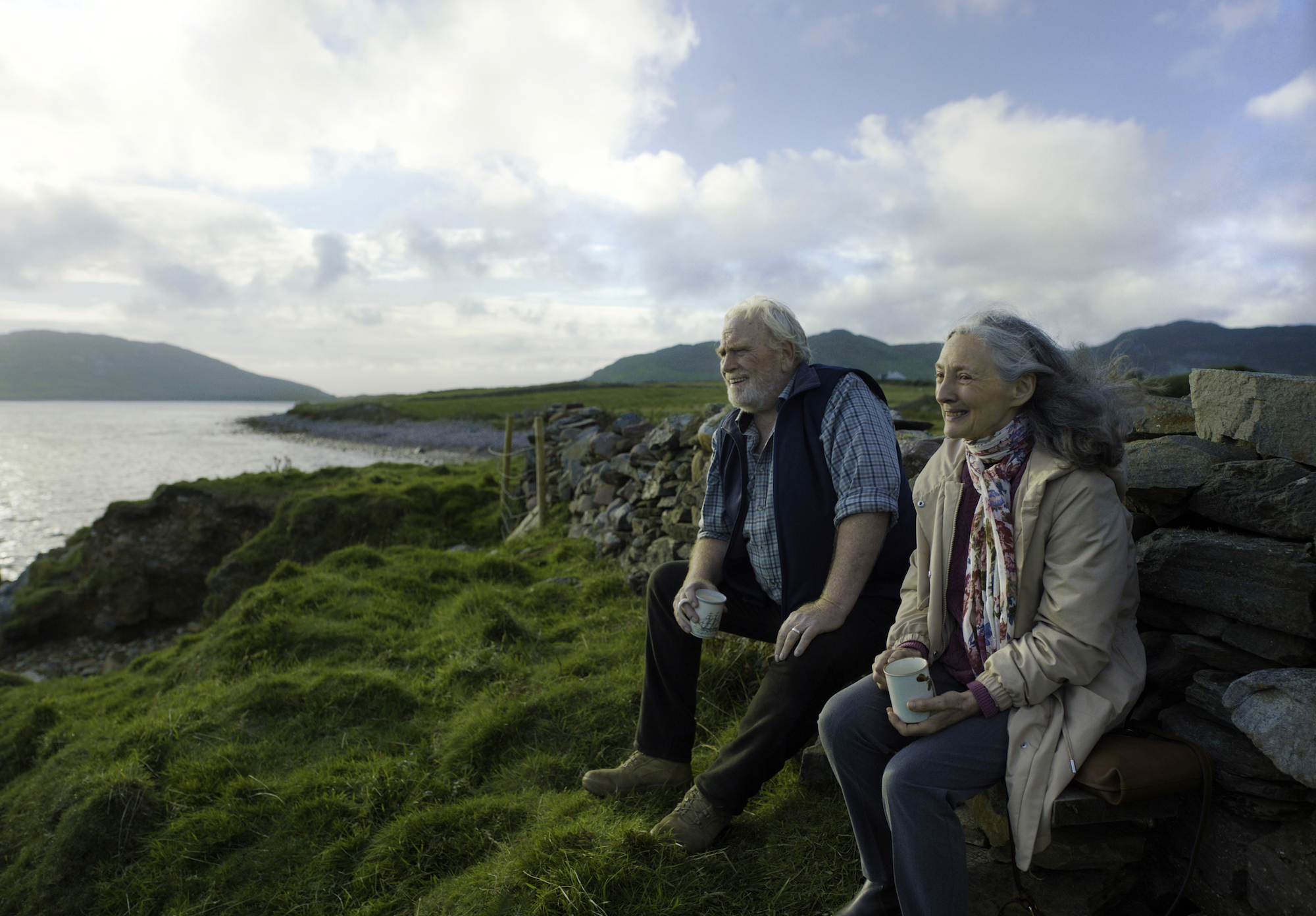
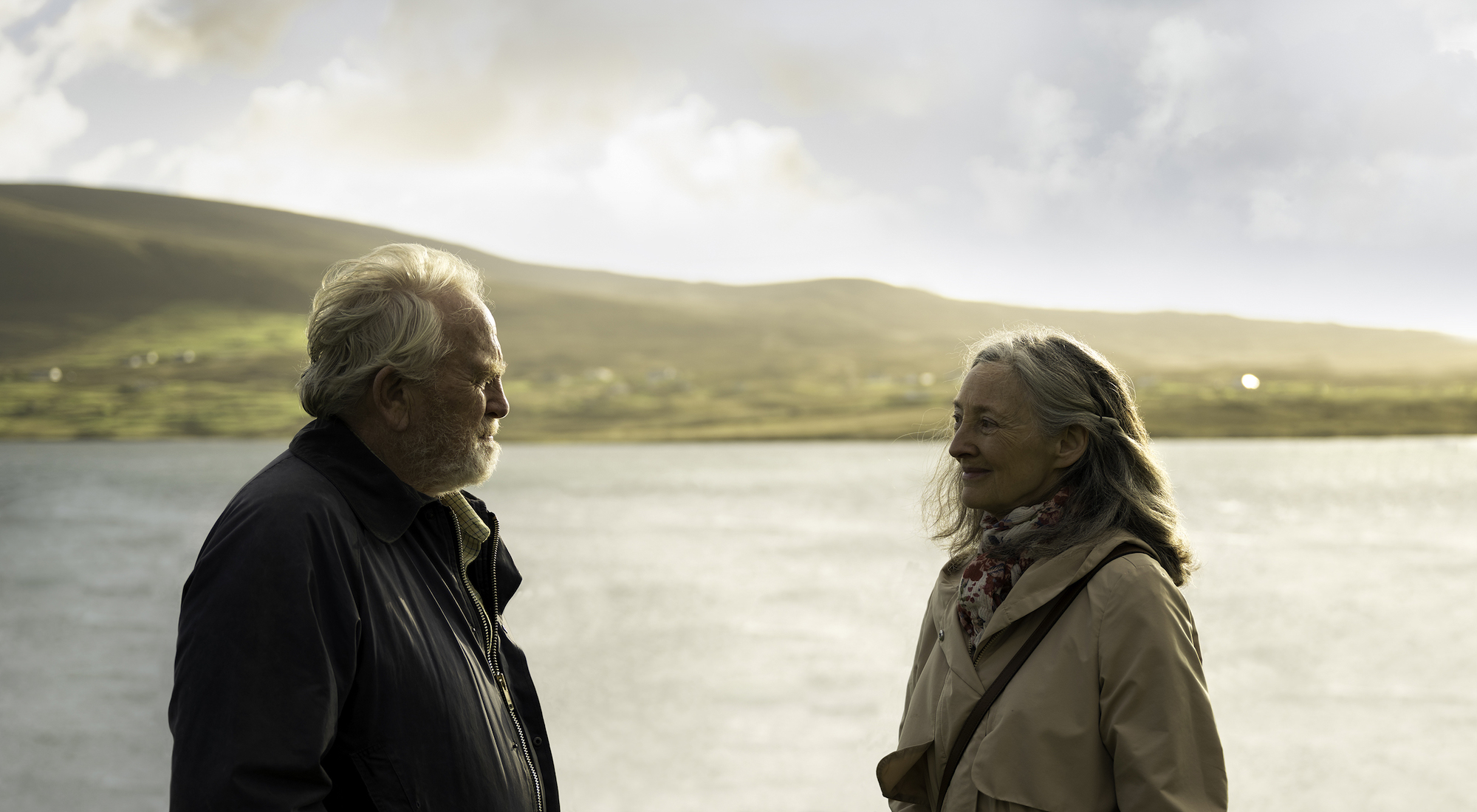
Howard (James Cosmo) enjoys the seaside scenery with housekeeper Annie (Brid Brennan) in My Sailor, My Love. (Photos courtesy of Music Box Films)
Senior citizens need love, too, as ABC hopes to prove with its upcoming debut of The Golden Bachelor. The same holds true across the pond, as Finnish director Klaus Haro demonstrates with his Ireland-set tale My Sailor, My Love.
The TV series, of course, is an extension of The Bachelor and The Bachelorette, “reality” shows that specialize in steamy encounters and dramatic histrionics. Don’t expect much of the former in Haro’s tale, but there are plenty of the latter. The only difference is, they don’t emanate from rejected suitors but from a daughter who’s unhappy about her father’s sudden interest in romance.
The daughter is Grace (Catherine Walker), a healthcare worker who spends most of her waking hours worrying about her aging dad, a retired sea captain named Howard (James Cosmos). When we first meet her, the situation has not only made her miserable, but it’s left her husband feeling so neglected that her marriage may be in jeopardy.
Realizing she can’t carry the burden of caring for Howard by herself, Grace hires a kindhearted widow named Annie (Brid Brennan) to serve as his parttime housekeeper. Howard, who’s accustomed to living on his own in his seaside home, soon sends Annie away, but a haphazard discovery convinces him he made a mistake. He then gathers a bouquet of flowers, starts up the car that’s been gathering dust in his garage and seeks her out.
Cue the heartfelt apology, courtesy of screenwriters Jimmy Karlsson and Kirsi Vikman. Also cue the gushing music, courtesy of composer Michelino Bisceglia. Set it all against gorgeous images of the Irish coastline, courtesy of cinematographer Robert Nordstrom.
In other words, love ensues, even though one wouldn’t expect a gruff hermit like Howard to jump into it so eagerly. But he does, resulting in a December-December romance that would be touching if it didn’t feel a bit contrived.
Then, just when we think the film is setting Howard and Annie up for happiness, Grace drops by with a sour attitude that looks a lot like jealousy. Rather than being grateful to Annie for making her father happy and taking care of his needs, she seems to resent her presence. Meanwhile, Howard displays a coldness toward his daughter that’s just as surprising, given the sacrifices she’s long made on his behalf.
What’s going on? Clues are doled out stingily over the course of the film, but an “aha” moment never arrives. The result is that despite assured performances by the major players, we don’t quite understand Grace and Howard’s motivations, and even Annie sometimes acts in a puzzling way.
With its combination of senior romance and family dysfunction, My Sailor, My Love is a tricky balancing act. Haro and company make a valiant effort, creating a handsome and sometimes appealing film in the process, but they don’t quite pull it off.
Rating: 3 stars (out of 5)
My Sailor, My Love (no MPAA rating) opens Sept. 22 in select theaters and will be available through VOD outlets beginning Oct. 24.
Tana (Lily Gladstone) takes a cross-country trip in her late grandmother’s Cadillac in The Unknown Country. (Photo courtesy of Music Box Films)
By Richard Ades
Opening this weekend are two indie films that have more in common than you might think.
The Unknown Country, a drama by first-time director Morrisa Maltz, is about a cross-country trip taken by a grieving Native American woman. North Circular, an Irish documentary written and directed by Luke McManus, is described as “a musical trip through Dublin’s inner city.”
What unites the flicks is their willingness to digress in the presence of strong personalities. In each case, this is a mixed blessing.
The Unknown Country ostensibly focuses on Tana (Lily Gladstone), who takes time to travel to a family wedding in South Dakota even though she just lost her beloved grandmother. She then drives her granny’s Cadillac to Texas in a trek that ends at a landmark once visited by the dearly departed.
Co-written by director Maltz and cast members Gladstone and Lainey Bearkiller Shangreaux, the film is primarily about Tana’s attempt to come to terms with her loss. However, Tana herself ends up being overshadowed by a series of strong peripheral characters she meets along the road. Among others, there’s a waitress who lives for her cats, a bride and groom who feel they were destined to be together, and an elderly woman who comes to life on the dance floor.
Most of these characters are real people simply playing themselves, making the flick an adventurous blend of fiction and fact. Each of them is interesting, as are several sights Tana sees along the way, including a Native American wedding, a small-town winter festival and a brightly lit Dallas dance club.
The only problem is that we don’t get to know protagonist Tana as well as the people she meets, making the film a bit less than the sum of its very worthwhile parts.
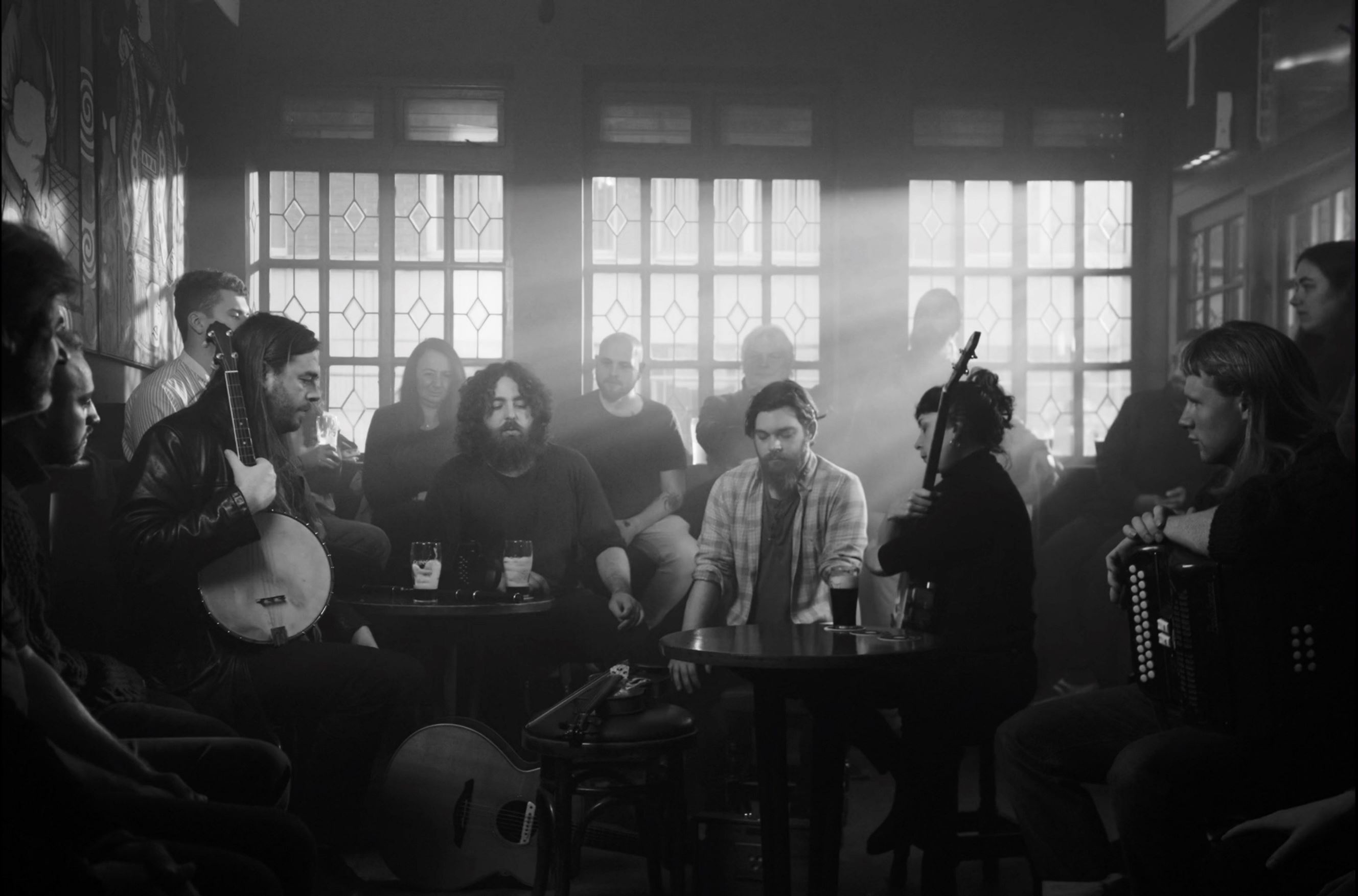
Holding forth at Dublin’s Cobblestone Pub in a scene from North Circular are (from left): folk singers John Francis Flynn, Eoghan Ó Ceannabháin, Killian O’Donnell and Lisa O’Neill. (Photo courtesy of Lightdox)
In a similar way, North Circular spends much of its time introducing us to people who live near the titular roadway, which winds around some of the poorer sections of Dublin. One of the first is an army veteran who plays the bagpipes for military ceremonies and complains that the younger generation shows little interest in learning the traditional instrument. Yes, it’s a shame, but his story comes across as unnecessary digression.
Fortunately, most of the other interviewees can speak more directly to the film’s subject, which is the neighborhood’s struggles with poverty and encroaching gentrification. And several of them do more than speak—they sing about their losses and grievances, often delivering a cappella laments to a silent audience. The sum total is a memorable trip to a side of Ireland’s capital that is never experienced by the average tourist.
Besides their plethora of minor characters, the two films have one other thing in common: striking cinematography. Andrew Jajek’s images in The Unknown Country are engrossing whether they’re showing quiet human interactions or majestic landscapes such as South Dakota’s Badlands and Texas’s Big Bend National Park. And North Circular’s black-and-white images combine with its somber folk tunes to create what at times amounts to cinematic poetry.
Rating for each film: 3½ stars (out of 5)
The Unknown Country opens July 28 at the Quad Cinema in New York City and the Nuart in Los Angeles, and will open at additional theaters across the country in the following weeks. North Circular opens July 28 at DCTV’s Firehouse Cinema in New York City.
The widespread assumption is that Germany’s epic All Quiet on the Western Front will nab this year’s International Feature Oscar. For those in the mood for a less warlike viewing experience, however, the other four nominees are well worth considering. They range from a historically based courtroom thriller to somber tales involving, respectively, teenage boys, a pre-teen girl and a down-and-out donkey.
Here, in no particular order, are the other four nominees:
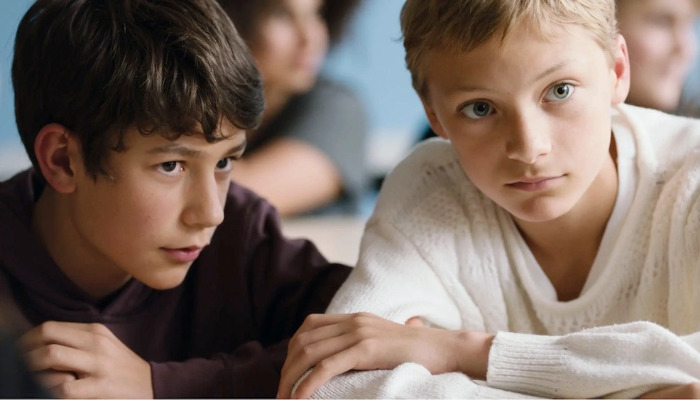
Remi (Gustav De Waele, left) and Leo (Eden Dambrine) are longtime friends in the Belgian film Close.
Growing up, growing apart
Close has an apt title, as the Belgian film is about the unusually tight friendship between two 13-year-old boys.
Leo and Remi (played without artifice by Eden Dambrine and Gustav De Waele) spend most of their days together, hanging out before, during and after school. Often, they even sleep together, sharing a bedroom with the blessing of their parents, especially Remi’s warm-hearted mother.
It’s all innocent and comforting fun until comments from fellow students force them to see their friendship through other people’s eyes. A girl asks if they’re “together,” while boys pummel them with gay epithets. None of this bothers Remi, but Leo responds by suddenly setting boundaries and branching out into activities that don’t involve his lifelong pal. The result is a development that’s heartbreaking, even if not entirely unexpected.
Director and co-writer Lukas Dhont handles all this with sensitivity and naturalistic restraint. It’s only in the aftermath of the aforementioned development that he turns restraint into a fault by delaying and underplaying the inevitable aftershocks. The result is that when they finally do arrive, they’ve lost much of their ability to move us.
Rating: 3 stars (out of 5)
Close (PG-13) is available from VOD outlets and will be screened Feb. 24-26 at Columbus’s Gateway Film Center.
The titular donkey sports a necklace made of carrots in Poland’s EO. (Photo courtesy of Aneta and Filip Gebscy)
Four-legged love story
Polish director Jerzy Skolimowski has made no secret of the fact that EO, his journey through the life of a lowly donkey, was inspired by the 1966 classic Au Hasard Balthazar. The differences couldn’t be starker.
While French director Robert Bresson told his own donkey-centered tale in a typically minimalistic manner, Skolimowski and cinematographer Michael Dymek ply us with images that are often ornate and sometimes surreal. There are strobe effects, infrared effects, POV shots, dreamlike flashbacks and nightmare-like sequences. There’s even a scene involving a mechanical dog that seems to appear out of nowhere.
Story-wise, the two films’ approaches are also different. While Bresson focused on people, the title donkey being merely an unwilling pawn in their difficult lives, Skolimowski turns his leading animal into a full-fledged protagonist.
Essentially, the new film is a love story between EO and Kasandra (Sandra Drzymalska), a woman who takes him under her wing while they’re working together in a traveling circus. After bankruptcy forces the circus to sell off its four-legged performers, the two are separated, but they never forget each other. In particular, EO is haunted by memories of happy moments he shared with Kasandra, which lead him to take actions that don’t always work out in his favor.
Like Bresson’s film, EO lends itself to larger questions about human nature, including our cruelty toward each other and toward the animals in our care. Both works also offer deep levels of allegorical meaning for those into religious, and particularly Christian, symbolism.
So which film is better?
Bresson’s is more perfect in its absolute simplicity, in contrast to which Skolimowski’s cinematic showmanship can be distracting. On the other hand, that showmanship frequently results in strikingly beautiful images. Along with its personable star, that gives EO viewers a lot to love.
Rating: 3½ stars (out of 5)
EO (no MPAA rating) will be available from VOD outlets beginning Feb. 21.
Ricardo Darin (left) and Peter Lanzani star in the fact-based courtroom drama Argentina, 1985.
Dictatorship’s abuse confronted
Argentina, 1985 is based on an actual attempt to bring to justice those who tortured, raped, murdered and “disappeared” thousands of Argentinians during the long reign of a right-wing dictatorship.
Ricardo Darin stars as Julio Cesar Strassera, who’s appointed to prosecute the officials responsible for the former regime’s acts of terror. It’s not a task he accepts gladly, as many of his friends and relatives supported such acts in the name of fighting communism. Among them are most of his colleagues, complicating his ability to form the legal team he needs to take on his monstrous assignment.
Coming to his rescue is Luis Moreno Ocampo (Peter Lanzani), a younger man who’s assigned to serve as Strassera’s deputy. Together, they put together a team consisting largely of idealistic students and instruct them to comb the countryside in search of people who can testify about abuses they suffered at the hands of government-sponsored thugs.
Director/co-writer Santiago Mitre handles this potentially explosive story in a surprisingly low-key manner and even adds touches of humor. That prevents the film from descending into melodrama, particularly when victims of the previous regime finally get the chance to tell their shocking stories in a nationally televised hearing.
One puzzling aspect of the case Strassera presents is that he seemingly makes little effort to connect these repulsive crimes with the suspects. It could be that Mitre simply left out that part of the testimony to underscore the fact that Strasser’s most important task is to convince the divided public that the crimes are worth prosecuting in the first place.
Or, as the prosecutor puts it so powerfully, “Nunca mas.” English translation: “Never again.”
Rating: 4 stars (out of 5)
Argentina, 1985 (rated R) is available through Amazon Prime Video.
Cait (Catherine Clinch, left) is greeted by Eibhlin (Carrie Crowley) after a long journey in Ireland’s The Quiet Girl. (Photo courtesy of EF Neon)
Lonely girl finds temporary reprieve
The Quiet Girl centers on Cait (Catherine Clinch), a 9-year-old who tends to keep to herself. She’s not happy at school, and she’s even less happy in her overcrowded home, where she gets little attention from her overworked mother or her philandering, heavy-drinking father.
Then her mother gets pregnant yet again, and Cait is sent off to live with relatives in another part of rural Ireland until things get back to normal. This turns out to be an unexpected blessing. Her mom’s cousin Eibhlin (Carrie Crowley) welcomes her with the kind of love and warmth she’s never known. And while Eibhlin’s husband, Sean (Andrew Bennett), is stand-offish at first, he puts her to work on their farm and soon begins to show signs of acceptance.
Directed in an appropriately quiet manner by Colm Bairead, who based the Irish-language script on a story by Claire Keegan, this is no maudlin, feel-good flick. We eventually learn that Eibhlin and Sean are hiding a secret whose effect on their lives is painful and intractable. And then there’s the question of Cait’s future: How long will her newfound happiness last if, as planned, she’s forced to return to her family?
Thanks to sensitive direction and fine performances all around, The Quiet Girl reveals its secrets and delivers its answers in a way that will likely leave a lump in your throat. After its Irish cousin, The Banshees of Inisherin, it’s my favorite film of 2022.
Rating: 4½ stars (out of 5)
The Quiet Girl (PG-13) opens in select theaters Feb. 24 and will be screened March 10-12 at Columbus’s Gateway Film Center.
A magical horse is helping Tantrum Theater continue its tradition of ending the summer with a work that complements the annual Dublin Irish Festival.
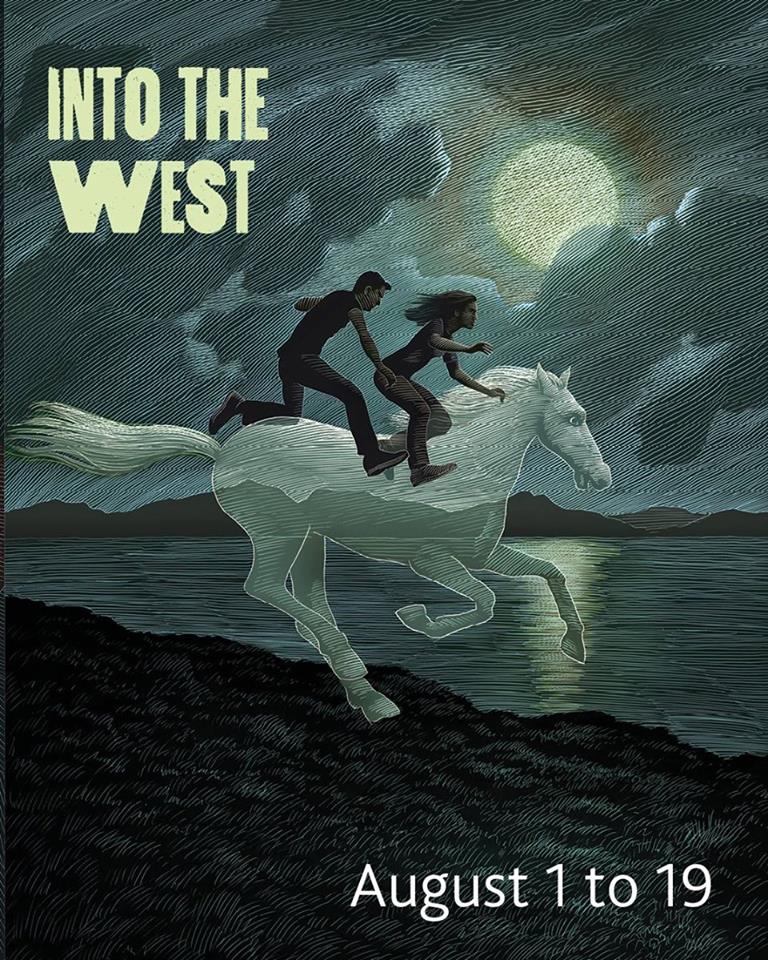
In 2016 (the troupe’s debut season), the selection was a beautifully staged production of Brian Friel’s Dancing at Lughnasa. This year, it’s Into the West, adapted by Greg Banks from a 1992 film about two Irish youths who go on a dangerous journey with a mysterious white steed.
Though not quite as sophisticated or rewarding as Lughnasa, it was an apt choice for any families who made it over to the Abbey Theater from last weekend’s festival. In both subject matter and length, it’s eminently kid-friendly.
Director Jen Wineman and her cast of three spin the lively tale with crucial help from onstage musician and sound designer Robertson Witmer. Each actor plays a leading role in addition to multiple supporting roles.
Turna Mete and Blake Segal portray Ally and Finn, Dublin youths who still grieve for the mother they lost years earlier. Greg Jackson plays their father, whose own reaction to his wife’s death has been to dilute his sorrow with booze. First, though, Jackson plays the grandfather who encounters a white horse and decides to leave it with his grandkids.
Ally and Finn are determined to keep the horse even though they live in a high-rise apartment building. Once their father sobers up enough to realize he has a new four-legged roommate, he naturally demands that they get rid of it. He relents after realizing the horse seems to help Ally’s asthma, but by then the animal has caught the eye of a police official who is determined to make a profit by putting it up for auction.
Desperate, the siblings steal the horse and take off on a cross-country journey with the law on their trail. What they don’t know is that the horse is a supernatural being who will ultimately lead them back into the sea from whence it came.
Into the West’s mixture of loss and Irish mythology may remind some of Song of the Sea, a wondrous 2014 animated film that also centers on motherless siblings. The play can’t match the film’s immersive power, but it’s entertaining, often humorous, and concludes on a note that will leave few viewers with dry eyes.
Mete and Jackson are particularly affecting as the fragile Ally and her repentant father, but Segal also is solid as the stalwart Finn. Deb O’s scenic design complements the production’s minimalist nature by depicting the tale’s multiple settings with the help of a few wooden pallets and barrels and yards of wrinkled, translucent plastic.
Dublin’s Irish Festival may be over, but Into the West gives families a good reason to return to the suburb with the Irish name.
Tantrum Theater will present Into the West through Aug. 19 in the Abbey Theater, Dublin Recreation Center, 5600 Post Road, Dublin. Show times are 7:30 p.m. Tuesday-Sunday (except Aug. 13), 2 p.m. Saturday-Sunday. Running time: 1 hour, 15 minutes. Tickets are $28, $26 seniors (65-plus), $10 students with a valid ID. 614-793-5700 or tantrumtheater.org.





 Reel Time With Richard Ades