West Bank tale doesn’t pull its punches

Basem (Saleh Bakri, right) offers comfort to distraught student Adam (Muhammad Abed Elrahman) in The Teacher. (Photos courtesy of MPI Media Group)

By Richard Ades

The Teacher takes on one of the most divisive issues in the world today: the struggle between Israel and the Palestinians. And it does it in a way that is thoughtful, provocative and dramatic.

The title character is Basem El-Saleh (Saleh Bakri), who teaches in a poor community in the West Bank. Anyone who’s seen the Oscar-winning documentary No Other Land—or the final episodes of the Netflix series Mo—won’t be surprised to learn that Basem’s students have more to worry about than passing tests.

Two of them, brothers Yacoub and Adam (Mahmoud Bakri and Muhammad Abed Elrahman), return from school one day just in time to see their home torn down by Israeli forces. “It was just their turn,” Basem explains to British social worker Lisa (Imogen Poots), noting that most houses in the village have been marked for demolition.

Adding to the residents’ worries are the Israeli settlers whose red-roofed homes can be seen multiplying in the distance. Though the settlers have moved to the occupied territory illegally, the residents know the government is likely to take the newcomers’ side if any dispute arises. 

And soon a dispute does arise, with tragic consequences. When a group of settlers sets fire to Palestinian-owned olive trees, Yacoub tries to intervene and is killed for his trouble. Community members vow to seek justice, but they know it may be beyond their reach.

Adam (Muhammad Abed Elrahman, left) shares a couch with his teacher (Saleh Bakri) after watching his home be demolished by Israeli troops.

Making her feature-length film debut, British-Palestinian writer-director Farah Nabulsi doesn’t shy away from showing the hardships West Bank residents face under Israeli occupation. Nor is she afraid to take the story into controversial areas.

A subplot that eventually melds with the main storyline involves an Israeli soldier being held hostage by a resistance group that hopes to exchange him for Palestinian prisoners. The soldier’s American parents (Stanley Townsend and Andrea Irvine) pressure the government to approve the exchange, but Israeli officials seem more interested in finding and punishing his kidnappers.

Leading the cast, Bakri is slightly hampered by director Nabulsi’s tendency to exploit his movie-star good looks (i.e., he takes off his shirt a lot). Still, he’s stalwartly effective as the teacher who tries to give his students the help that, as flashbacks reveal, he was unable to give his own son.

As Lisa, Basem’s colleague and possible love interest, Poots projects courage, sincerity and a useful amount of wiliness. As young Adam, who becomes increasingly distraught following his brother’s death, Elrahman provides some of the tale’s most unsettling moments.

Gilles Porte’s cinematography and composer Alex Baranowski’s score perfectly complement the film’s perilous setting and changing moods.

Though some may quibble that its ending is overly tidy, The Teacher is a brave and nuanced attempt to reveal the humanity lurking beneath one of the world’s most intractable political standoffs.

Rating: 4 stars (out of 5)

The Teacher opens April 11 in New York City and expands to other markets beginning April 18. It is scheduled to open April 25 at the Gateway Film Center in Columbus.

Risks, bravery pay off in trio of 2024 masterworks

A motion-captured Jonno Davies plays a simian version of British pop star Robbie Williams in Better Man. (Photo courtesy of Paramount Pictures)

By Richard Ades

This is the time of year when critics get a chance to catch up on recent flicks they might have missed, courtesy of studios in search of buzz and, hopefully, award nominations. While I don’t claim to be clairvoyant when it comes to the latter, I can confidently say this: If the Oscars and other competitions gave out prizes for bravery, these three films and their creators would win hands down.

One filmmaker displays creative courage by breaking the mold in a familiar genre, while the others put their liberty and even their lives at risk in order to bring their truths to the screen.

Let’s look at them one by one.

Biopic with a difference

By now, we all know the drill when it comes to film biopics: The would-be celeb claws his or her way to the top, but success comes at a steep cost. Friends are abandoned, spouses are cheated on, and alcohol and/or drugs are abused.

Better Man, based on the life of British pop superstar Robbie Williams, follows that general pattern, but with a difference. The entire story unfolds through the eyes (and narration) of Williams himself, who emerges as someone who desperately wants fame but is convinced he doesn’t deserve it.

And, oh yes: Williams is portrayed by a CGI-generated chimpanzee (a motion-captured Jonno Davies). It sounds weird—and, frankly, it is—but it also makes sense in a brilliant and emotionally satisfying way.

Even as a child, Williams suffers from self-doubt, self-loathing and what he later comes to identify as depression. By making him the lone ape in a world of humans, the film has found a clever way of symbolizing Williams’s fear that he’s an imposter unworthy of the success he seeks.

Directed with theatrical flair by Michael Gracey (The Greatest Showman), Better Man is marked by gee-whiz, over-the-top production numbers and surreal fantasy sequences, in addition to its simian protagonist. But what really sets it apart is its honesty and warmth.

Despite being depicted as an ape, Williams comes off as a recognizably flawed human who earns our sympathy, as well as the heart-on-its-sleeve sendoff the film gives him. Director Gracey’s gamble has paid off with a flick that’s as moving as it is massively entertaining.

Rating: 4½ stars (out of 5)

Better Man (rated R) opened Dec. 25 in select theaters and expands nationwide Jan. 10.

National unrest and a missing gun upset the lives of Iranian student Rezvan (Mahsa Rostami, center), her mother (Soheila Golestani, left) and sister (Setareh Maleki) in The Seed of the Sacred Fig.

Criticizing—and then escaping—Iran

As an attack on Iran’s government and justice system, The Seed of the Sacred Fig is the kind of film that can’t be made in that country. And yet veteran writer/director Mohammad Rasoulof succeeded in making it—in secret—before fleeing to Europe for his own safety.  

The thriller concerns Iman (Missagh Zareh), who aspires to be a judge but learns that the path to success will force him to ignore his moral compass. He lands a position that requires him to sentence people to death without being given a chance to consider the evidence.

As it turns out, the position endangers more than just his conscience. Because of the job’s controversial nature, he and his wife, Najmeh (Soheila Golestani), and their family are forced to live in secrecy. Meanwhile, daughters Rezvan and Sana (Mahsa Rostami and Setareh Maleki) become embroiled in the widespread unrest that erupts after a young woman is beaten and killed for not sufficiently covering her head.

Then the gun that Iman keeps for protection turns up missing, and the national turmoil threatens to spread to his household as he searches for the culprit. Interrogations ensue, along with a car chase and a tense finale that may remind some of a certain horror film set in a snowbound hotel. 

Considering it was made in secret and by a director who’d already gotten in trouble for earlier works, The Seed of the Sacred Fig should fill viewers with admiration for Rasoulof’s resourcefulness, as well as his courage. The film deserves an Oscar nomination, but it probably won’t get one, because who would nominate it? Certainly not Iran.

Rating: 4½ stars (out of 5)

The Seed of the Sacred Fig (PG-13) can be seen in select theaters and is scheduled to open Jan. 30 at Columbus’s Gateway Film Center.

Palestinian activist Basel Adra (left) joins forces with Israeli journalist Yuval Abraham in the documentary No Other Land.

Palestinian, Israeli expose West Bank abuses

Basel Adra has spent years documenting the Israeli army’s systematic attacks on his West Bank community, Masafer Yatta. In No Other Land, he continues that work along with Israeli journalist Yuval Abraham and fellow writer/directors Hamdan Ballal and Rachel Szor.

The result is an eye-opening expose of the abuses Adra and his Palestinian neighbors have had to endure living in the occupied territory. Houses and other buildings are destroyed on the shortest of notices and flimsiest of excuses, such as that the army needs the land for training exercises. Those who want to rebuild are told to get permits that they know are unobtainable.

Much of the film consists of footage taken with amateur video equipment or cellphones. It shows locals trying in vain to reason with soldiers, government officials and, in some cases, illegal Israeli settlers, all of whom are clearly trying to force them to abandon their rural community.

Other footage, shot by Szor, centers on the growing friendship between the Palestinian Adra and Israeli journalist Abraham, who are allied by their concern over the situation but separated by their approaches to dealing with it. Abraham is frustrated that his muckraking stories have had so little impact, but Adra counsels patience, saying a solution could take years or even decades.

The differing approaches reflect the men’s vastly different backgrounds. While Abraham is relatively new to the situation, Adra has been dealing with it for much of his life. In the face of constant, officially sanctioned abuse, he and his neighbors have no recourse but to greet it with steadfast determination and even flashes of dark humor.

Made under the most difficult of circumstances, No Other Land is a portrait of courage that is, in and of itself, an act of courage.

Rating: 5 stars (out of 5)

No Other Land is available through VOD outlets and can be seen at select theaters beginning Jan. 31.

Aging fisherman looks for love, finds god

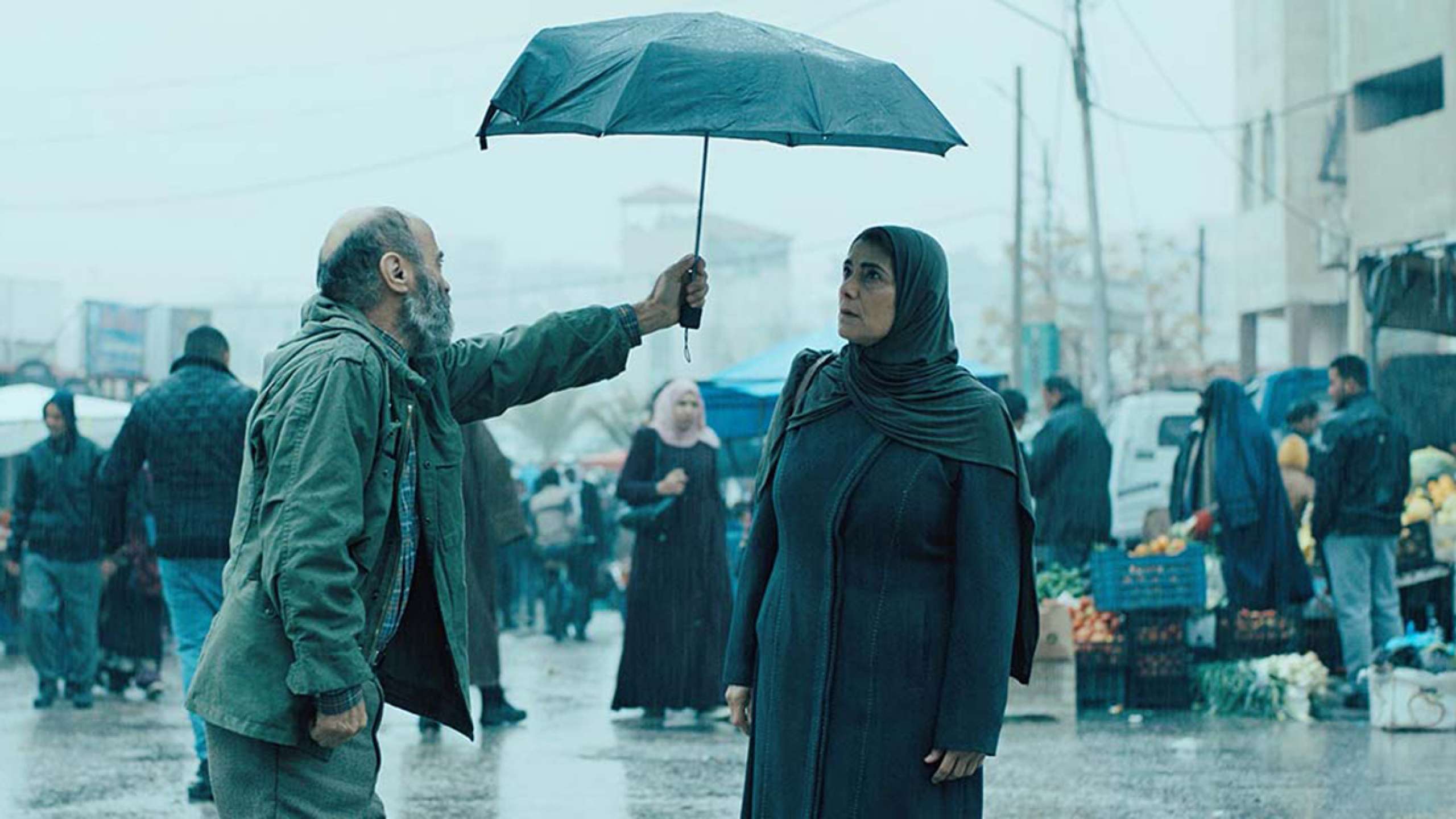
Issa (Salim Daw) offers Siham (Hiam Abbass) his umbrella in a rainy scene from Gaza Mon Amour.

By Richard Ades

A 60-year-old fisherman in the Gaza Strip decides it’s finally time to get married. Then he pulls up his net and finds a statue of the Greek god Apollo. That’s the setup for Gaza Mon Amour.

Is there some connection between the man’s marital decision and his maritime discovery? If there is, writer-director-brothers Tarzan and Arab Nasser don’t spell it out, any more than they explain why the film’s title apparently pays homage to Alain Resnais’s 1959 French New Wave classic, Hiroshima Mon Amour.

The statue and the title are just two more quirky elements in a tale that combines romance with political commentary in such a droll, understated way that even its darker moments are leavened with a sly sense of humor.

Issa (Salim Daw, aka Salim Dau) fishes by night and runs a shop selling fish and other items during the day. Though he’s never been married and apparently hasn’t even expressed interest in matrimony since he was a teenager, he surprises sister Manal (Manal Awad) one day by announcing his desire to wed.

Despite Issa’s strict order that she not get involved, Manal takes the news as her cue to begin rounding up eligible women. And when she learns he already has his eye on widowed shop clerk Siham (Hiam Abbass), Manal argues that she’s not an appropriate choice for a devout Muslim because she has a divorced daughter (Maisa Abd Elhadi). Ignoring her, Issa sticks to his quest, but his own shyness proves to be a high hurdle.

Siham (Hiam Abbass, left) waits for a bus while Issa (Salim Daw) tries to find a way to break the ice.

Meanwhile, both Issa and Siham deal with the daily stresses and challenges that are part of life in the tiny Gaza Strip. Among them are poverty, power outages and occasional Israeli airstrikes, as well as local officials who wield their authority like petty dictators.

It’s all too much for a young friend of Issa’s, who has planned an illegal and potentially dangerous escape to Europe. Issa, though, is determined to stick it out, even after his mysterious discovery from the deep lands him in trouble with the gendarmes.

The Nasser brothers depict life in Gaza with a critical and satirical eye, especially when it comes to the strip’s authority figures. A police official throws his weight around in an arbitrary and self-serving way, and at one point the military proudly displays a new rocket in a scene hilariously loaded with phallic symbolism.

As for the looming relationship at the center of the tale, it’s portrayed with such charm by Daw’s determined but awkward Issa and Abbass’s secretly amused Siham that viewers won’t mind the glacial pace at which it develops. Anyway, despite its cheeky title, the film isn’t really about romance as much as it’s about standing up to society’s limitations and finding the space to live and enjoy one’s life.

Rating: 4½ stars (out of 5)

Gaza Mon Amour opens Nov. 5 at select theaters and through VOD outlets.