Roommate comedy launches assault on fourth wall

Featured in The Playdaters are (from left) MaryBeth Griffith as Stephanie, Audrey Rush as Erma, Josh Kessler as Erwin and Chad Hewitt as Spencer (photo by Andy Batt)

By Richard Ades

Remember the big restaurant scene from When Harry Met Sally? I thought of it after attending Thursday’s preview performance of The Playdaters.

Specifically, I thought of the comment a stranger makes to her waiter after witnessing Sally’s simulated orgasm: “I’ll have what she’s having.” In my case, the line would have been “I’ll have what they’re having.”

It wasn’t so strange that the MadLab viewers laughed early and often. That’s not unusual for a first-night audience, often made up of friends of the cast who are eager to be supportive.

What set these folks apart was that they started laughing before the play even began. When the pre-curtain soundtrack included a naughty Garfunkel and Oates song about hand jobs, they burst into prolonged hysterics. They then remained in stitches for much of the play’s hour-long running time, and I suspect most of them stayed to laugh all over again when MadLab presented a second performance with a juggled cast.

Written by Neil Haven, The Playdaters is about a pair of roommates who dare each other to set up dates with strangers, then misbehave in bizarre ways when they meet. The roommates generally are portrayed by men, but MadLab is trying an interesting experiment by offering two versions: On Fridays, men play the lead roles while women play their dates; on Saturdays, the genders are switched.

At Thursday’s preview, both versions were staged in succession. Since the female version was presented first (as determined by a coin toss), that’s the one I saw.

OK, the gender switch is a cute idea, but what about the play itself? Is it as hilarious as those first-nighters thought it was? Well, not in its entirety, but director Jim Azelvandre and his cast do deliver lots of funny moments.

In the women-led version, most of them belong to Erma, who’s played by Audrey Rush with the kind of roly-poly physicality that will remind many of Melissa McCarthy. Foul-mouthed and mischievous, Erma throws herself into such first-date shenanigans as pretending to be German or drinking half a bottle of whiskey on the sly.

As Stephanie, Erma’s relatively conservative roommate, MaryBeth Griffith is far more subdued. That’s natural, but Griffith probably could land a few more laughs of her own if she played up the character’s strait-laced tendencies.

As for the men, Chad Hewitt gives a similarly low-key performance as Stephanie’s near-perfect date, but Josh Kessler finds droll humor in the men (and one woman) who are unlucky enough to end up on prank dates with Erma.

It should be noted that The Playdaters is not simply the tale of two fun-loving gagsters. Haven also throws a couple of complications into the mix.

The first concerns the relationship between the roommates, which seems to be in flux. Erma loves it and wants it to stay the same forever, and she reacts with jealousy when it becomes clear that Stephanie wants to progress from gag dates to the real thing. If you see the show’s male version, you’ll probably be reminded of movie bromances such as Superbad or 22 Jump Street.

The second complication—and the one that makes things a bit too messy for my taste—involves the characters’ tendency to break through the “fourth wall.” Erma and Stephanie constantly stop the action in order to explain things to the audience or to bicker about how the plot is proceeding. Toward the end, Erma goes so far as to accuse Stephanie of getting herself caught up in a typical romantic comedy.

Maybe Haven felt his play needed something to distinguish itself from the average rom-com, bromance or bramance. Maybe that’s why he added all the fourth-wall busting and winking self-awareness.

If you’re like me and have a low tolerance for this kind of gimmicky, you’ll wish he hadn’t imposed it on what is otherwise an agreeable comedy. But if you’re like that preview audience, you won’t mind at all.

The Playdaters continues through Sept. 13 at MadLab Theatre and Gallery, 227 N. Third St. Show times are 8 p.m. Friday-Saturday. Running time: 1 hour. Tickets are $12, $10 for students and seniors, $8 for members. 614-221-5418 or madlab.net.

 

A look back at ‘2013: The Musical’

Japheal Bondurant as competitor William Barfee in CATCO's production of The 25th Annual Putnam County Spelling Bee (Red Generation Photography)
Japheal Bondurant as competitor William Barfee in CATCO’s production of The 25th Annual Putnam County Spelling Bee (Red Generation Photography)

By Richard Ades

2013 may be remembered as The Year of the Musical in Central Ohio. Or, more likely, as The First Year of the Musical.

In the more than two decades I’ve been reviewing local theater, musicals have always represented a small percentage of the shows I saw each year. But that’s likely to change.

A prime reason is that CATCO dropped its long aversion to the genre when Steven Anderson took over as producing director in 2010. Another reason is the ascendance of Short North Stage, a 2-year-old troupe that specializes in Sondheim’s art form.

Add to that the musicals staged by Otterbein University Theatre and the growing number staged by Shadowbox Live, including its recent collaborations with Opera Columbus. Then figure in the musicals bravely tackled by troupes that normally stick to standard fare.

The end result is a year that was teeming with musicals. And not just musicals: great musicals.

There were so many worthwhile musicals, in fact, that I’ve been forced to abandon the format I always followed at The Other Paper, which divided the nominees into categories such as Best Drama or Best Comedy. Limiting myself to one Best Musical would have forced me to ignore many of the year’s best shows. Instead, I’ve settled for naming the year’s Top 10 shows.

A couple of caveats: First, no one has time to see everything, so I’m sure I missed some award-worthy gems. And second, this is a subjective list based not only on what was done well but on what I found particularly interesting and memorable.

With that said, congratulations to the winners, and thanks to everyone who made this an exceptional year for theater in Central Ohio.

Top 10 Shows of 2013:

The 25th Annual Putnam County Spelling Bee, CATCO. Though the Top 10 list is mostly arranged haphazardly, this was my favorite show of the year. Director Steven Anderson found both the heart and the laughs in this familiar musical, with help from a consistently wonderful cast led by Japheal Bondurant, Elisabeth Zimmerman and Ralph E. Scott.

Sunday in the Park With George, Short North Stage. The Garden Theater-based troupe sometimes imports its directors from New York, and it paid off handsomely here. Sarna Lapine (niece of James Lapine, who wrote the book and directed the Broadway premiere) gave us a Sondheim revival that was both pitch-perfect and picture-perfect. As a bonus, sound designer Leon Rothenberg found a way to tame the theater’s echo-y acoustics, which bodes well for future productions.

Passing Strange, Short North Stage. Green Day fans undoubtedly enjoyed the punk-rock anger of American Idiot, which came through town in March. But those of a thoughtful bent were more likely to enjoy this satirical take on youthful angst, which was beautifully realized by director Mark Clayton Southers and his committed cast.

Duck Variations, A Portable Theatre. The best news was that the fledgling troupe is the new home of Geoffrey Nelson, former artistic director of CATCO. The second-best news was that its premiere show paired Nelson with fellow CATCO alum Jonathan Putnam. These two sly and seasoned pros made the David Mamet comedy one of the year’s funniest shows.

Assassins, Red Herring Productions. Michael Herring’s solo springtime performance of Krapp’s Last Tape launched the rebirth of his long-dormant troupe. But nothing could have prepared us for Red Herring’s next show, a polished production of Sondheim’s most controversial musical. John Dranschak directed an A-list cast led by Ian Short and Nick Lingnofski.

Mercy Killers, On the Verge Productions. 2013’s crop of touring musicals supplied a fair amount of flashy entertainment, but none of them were as impressive or thought-provoking as this one-man touring show. Writer/actor Michael Milligan told a tragic tale that movingly dramatized the shortcomings of the U.S. health-care system.

The Whipping Man, Gallery Players/New Players Theater. If you thought there was no way to come up with a new take on the Civil War, this show proved you wrong. Matthew Lopez’s postwar drama reunited two former slaves with the wounded son of their Jewish master. The fascinating, if imperfect, tale was exquisitely directed by Tim Browning.

The Air Loom, MadLab. Local actor Jim Azelvandre has tried his hand at writing in the past, but this surreal tale is his best work to date. Azelvandre also supplied the canny direction, which ensured that the ingenious storyline and eccentric characters remained entertaining throughout.

Henry IV, Part One, New Players Theater. Besides staging The Taming of the Shrew on its outdoor stage, New Players was brave enough to tackle one of Shakespeare’s seldom-seen historical dramas. Bard-literate director Robert Behrens made 15th-century Britain come to life with the help of a lively cast led by David Tull as the hard-partying Prince Hal and John Tener as the irrepressible Falstaff.

Burlesque Behind the Curtain, Shadowbox Live. Shadowbox’s production of Spamalot was a blast, too, but Behind the Curtain deserves credit for improving on last year’s Burlesque de Voyage. Writer Jimmy Mak, director Stev Guyer and the talented players created a show that was sometimes very sexy and other times very, very funny.

Mark, we hardly knew ye

By Richard Ades

Available Light has always pushed boundaries. Shows that incorporate multimedia, song, dance, movement and improvisation are all par for the course.

All that’s well and good. What’s not so well and good is the troupe’s occasional tendency to confuse plays with lectures, sermons or, worst of all, consciousness-raising sessions. That’s the wrong turn Available Light takes with its latest self-written work, Glue.

It starts out with the appearance of four people who introduce themselves as longtime friends of Mark, a man who recently died. They inform us that they put this show together in response to their loss.

“It’s about friendship,” we’re told.

In an attempt to bond with the audience, they then have specific viewers read statements about friendship that apparently were passed out in advance. Each of these—including the comment that our best friends sometimes have four legs—is met with uniform smiles of support from the people onstage.

“Maybe by the end of the show, we’ll all be best buddies,” one declares brightly.

If all of this smiling supportiveness is meant to be taken with a cynical grain of salt, it’s not apparent in the production director Matt Slaybaugh has put together with actors Acacia Leigh Duncan, Jordan Fehr, Elena M. Perantoni and Michelle G. Schroeder. Instead, all four characters seem to be unvaryingly nice.

They’re too nice, in fact, to tell us anything less than positive about their lost friend. As a result, we never really get to know Mark, any more than we would get to know a real-life stranger whom we “met” only through to his eulogy.

We learn that Anna (Duncan) and Rebecca (Perantoni) dated Mark at various times; that Brian (Fehr) created comic books with him; and that Julie (Schroeder) was once his roommate. Schroeder’s description of Julie’s close but oddly chaste friendship with Mark does strike an emotional chord, but otherwise he remains only a slightly clingy but wonderfully empathetic person.

The problem is not only that Anna, Rebecca, Brian and Julie are too nice to say anything negative about Mark—sometimes they’re too busy sharing general aphorisms about friendship to talk about him at all: “To connect, you’ve got to make yourself vulnerable.” “Love is an act of will.” And so on.

A little of this goes a long way.

Watching Glue is sort of like scrolling through Facebook for 90 minutes, except that this is a version of Facebook without the jokes, topical comments or political harangues. Instead, you get only the friends who ply you with sentimental advice while other friends tell them how wonderful they are for sharing it.

Another difference: You can’t log off.

As in its most-creative shows, Available Light concocts Glue out of a variety of ingredients, including projected images, recorded voices, music and movement. If you’re into adventurous theater and performance art, this is a plus.

But unless you also have a high tolerance for being lectured to, Glue’s 90 minutes will go by very, very slowly.

Available Light Theatre will present Glue through Nov. 23 at MadLab Theatre & Gallery, 227 N. Third St. Show times are 8 p.m. Thursday-Saturday. Running time: 90 minutes. Tickets are $20 in advance, “pay what you want” at the door. 614-558-7408 or avltheatre.com.

You might want to brush up on your Kierkegaard first

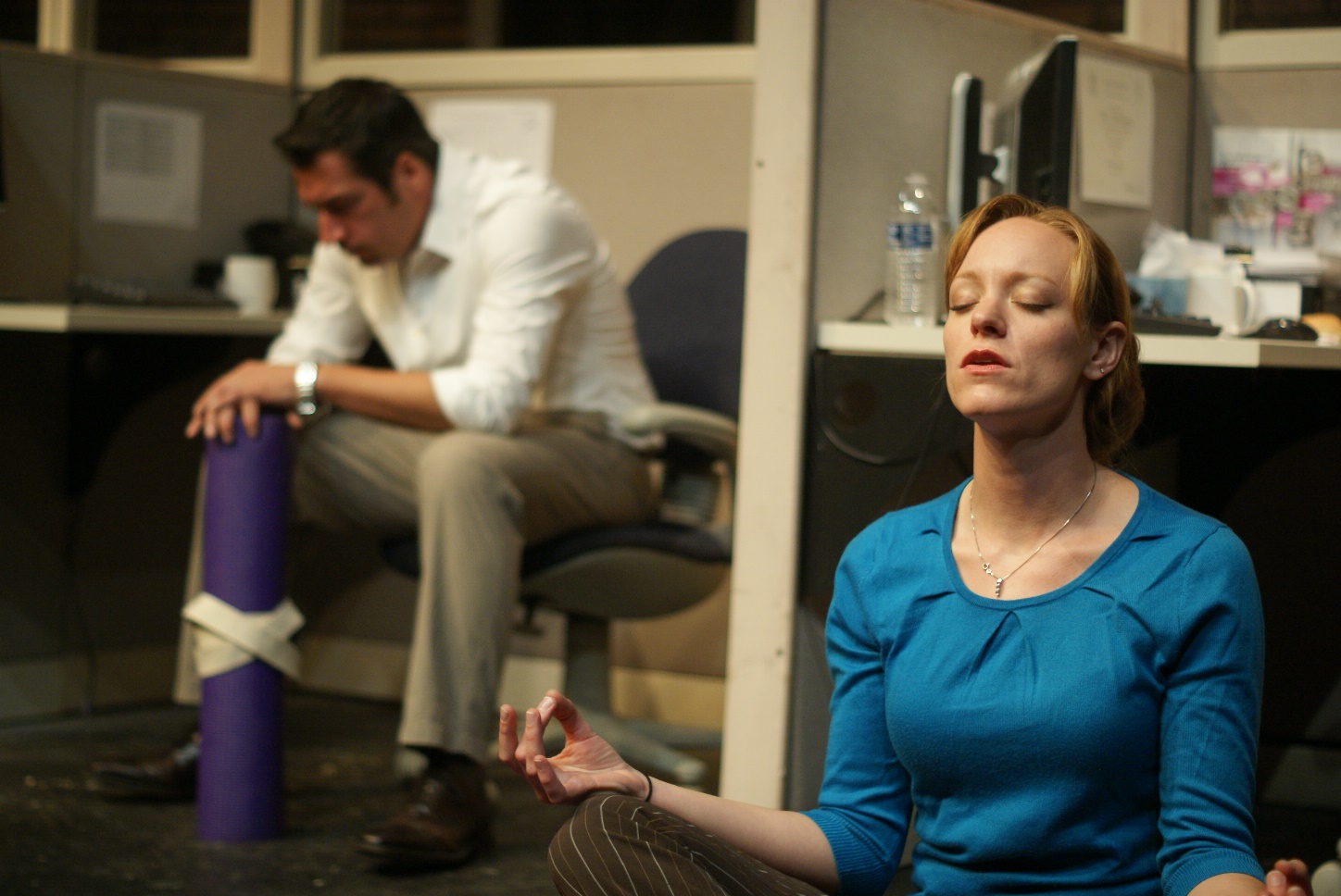
Colin (Erik Sternberger, left) strikes a typically dejected pose while Fran (Katharine Pilcher) practices “existential yoga” in The :nv:s:ble Play (photo by Andy Batt)
Colin (Erik Sternberger, left) strikes a dejected pose while Fran (Katharine Pilcher) practices “existential yoga” in The :nv:s:ble Play (photo by Andy Batt)

By Richard Ades

It’s ironic that Alex Dremann’s The :nv:s:ble Play is about a group of book editors. The two-act, two-hour work offers interesting food for thought, but it would benefit from a little editing.

While philosophy majors may be amused by its subtle existential humor, most folks would find it far more palatable if a few minutes—60, say—were cut from its running time.

Set in a New York publishing house that specializes in existential literature, The :nv:s:ble Play is about employees who are so shy and retiring that they gradually disappear from sight. At the center of the action is Colin (Erik Sternberger), who is trying to finish editing a romance novel when he discovers that neither his co-workers nor the book’s author (an unusually hammy Courtney Deuser) can see or hear him.

Actually, saying Colin is at the center of the action is misleading. It would be more accurate to say he’s in the center of the inaction, as he spends scene after scene hunched over his desk in a state of dejection while his oblivious co-workers go about their lives.

Since those lives consist mainly of gossiping about who’s romancing whom and which employees are destined to be laid off, Dremann seems to be suggesting that people like Colin are doomed to be the unappreciated backbones of their companies while their shallow but flashier colleagues gain all the glory.

There’s also a romantic element to the story, but its point is a bit murky. Colin may be in love with Fran (Katharine Pilcher), the Yale-educated woman in the next cubicle, but he also may not be, as he’s not even sure he believes in the emotion. So why should we care? Because a fellow invisible worker comes up with a theory—presumably after watching Beauty and the Beast—that one way to break the spell of invisibility is to make another person fall in love with you.

This sets Colin on a quest to get Fran to fall for him, which means he first must get her to notice him. His bumbling efforts result in several frustratingly slow scenes, including one cribbed from the 1989 rom com Say Anything.

One bright spot in all this is that MadLab’s cast, like most recent MadLab casts, is uniformly good. Director Andy Batt pulls generally well-crafted performances out of his actors.

Besides Sternberger and Pilcher, the leading players include Chad Hewitt as the sleazily ambitious Tim, Shana Kramer as the pregnant Carmen and Megan Corbin as their scary supervisor, Nancy. Most lovable of all is Michelle Batt as Ramona, a self-described asexual arborist who, like Colin, has become invisible to her co-workers.

Rounding out the cast are Joe Liles as Lawrence, an IT guy who has become invisible even to Colin and Ramona, and Deuser as Cass, an aging editor who is unseen because her desk is on the far side of the room.

Speaking of the room, Brendan Michna’s set design is a series of cubicles that will remind many office workers of their place of employment. It certainly reminded me of my former office, except that I don’t remember my days there being quite so uneventful.

The :nv:s:ble Play will be presented at 8 p.m. Fridays and Saturdays through Sept. 14 at MadLab Theatre and Gallery, 227 N. Third St. Running time: 2 hours (including intermission). Tickets are $12, $10 for students and seniors, $8 for members. 614-221-5418 or madlab.net.
Young playwrights aim high

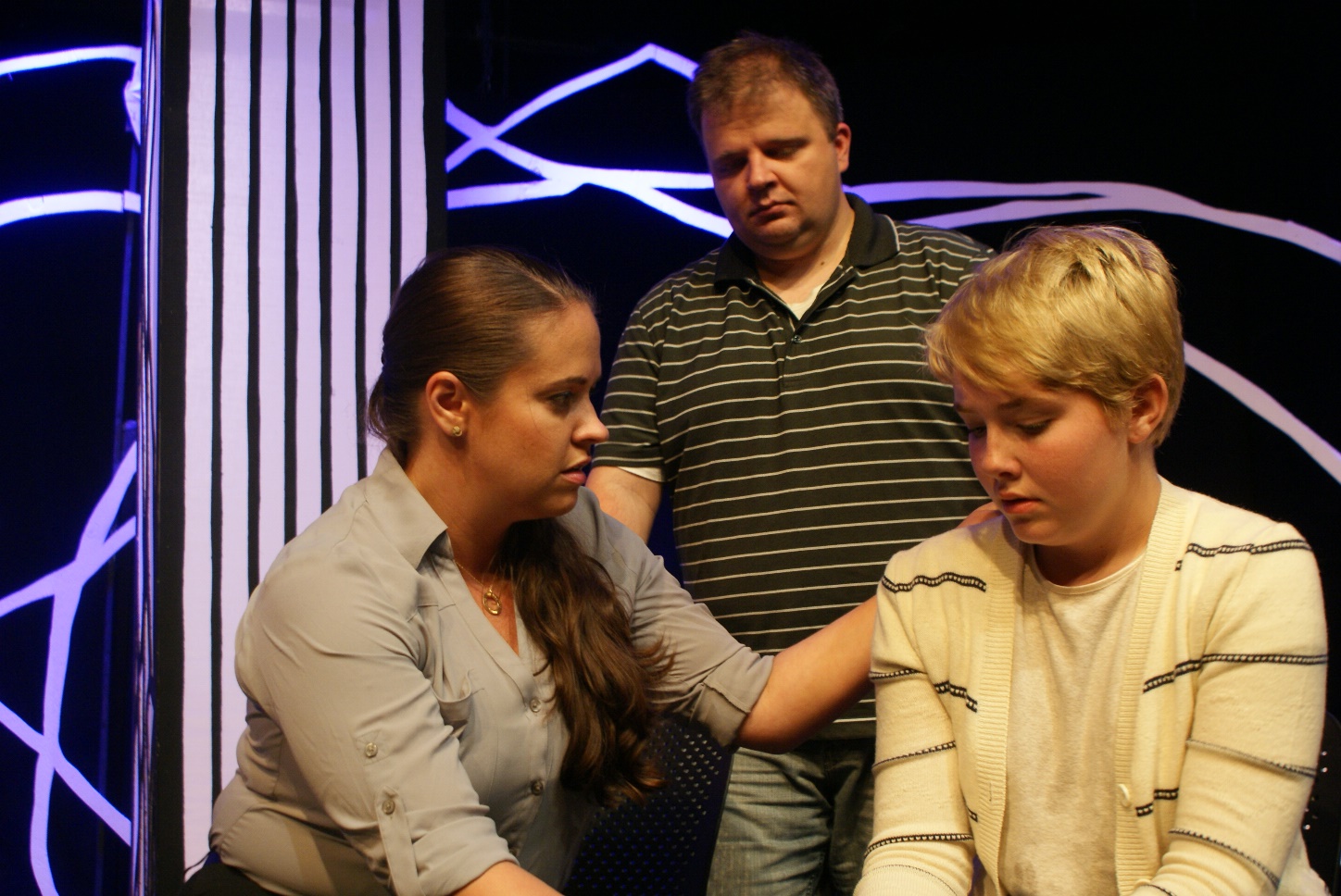
The spirit of George (Sean Reid) watches as his wife (Mary-Aileen St. Cyr, left) and daughter (Lexy Weixel) deal with his loss in Neither Here Nor There (photo by Michelle Batt)

By Richard Ades

When MadLab launched its Young Writers Short Play Festival last year, I was pleasantly surprised to find the high school playwrights taking on mature topics and storylines. Though they spent their days in the classroom, they demonstrated that their imaginations were fully capable of roaming the world at large.

This year—in the first of the festival’s two collections, at any rate—the writers seem to have graduated from mature topics to “big” topics. Friday night’s plays deal with, in order, death, religion, nuclear war and gay identity. Kudos to the kids for their social consciousness.

But, of course, good intentions don’t guarantee good results. No matter how big its topic is, a play rises and falls on such details as characters, situations and dialogue, not to mention the strength of the acting and directing.

Due to all of these factors, the first play of the evening does nothing but rise. Emily Cipriani’s Neither Here Nor There takes on a potentially manipulative and hackneyed situation and creates an inventive combination of laughs and tears.

Working under Becky Horseman’s sensitive direction, Sean Reid stars as George, a man who suddenly finds himself in a hospital room looking down at an unconscious accident victim. Thanks to the appearance of a doughnut-downing Grim Reaper (Peter Graybeal), he learns that the victim is a brain-dead version of himself. Being an invisible spirit, George is then forced to watch helplessly as his wife (Mary-Aileen St. Cyr) and daughter (Lexy Weixel) attempt to deal with a loss that is all the more difficult because it’s not yet final.

Actor Weixel, by the way, is also a featured playwright in the festival (her Dead End being included in the Saturday collection). In the first of her two Friday appearances, her unfussy portrayal of the daughter is one of the production’s many strengths.

None of the Friday collection’s remaining plays are as fully realized as Neither Here Nor There, but all are worth seeing—if for no other reason than because they offer a rare glimpse into the minds of thoughtful high-schoolers. The other works:

Priestly, by Kinsey Cantrell, dramatizes the clash between an up-and-coming filmmaker (Stephen Woosley) and his religion-fixated mother (Randi Morgan). The play benefits from funny lines, but Cantrell and Morgan are less successful in their attempts to humanize the largely stereotypical mom. On opening night, the production’s timing was also a bit sluggish.

In Love and War, by Amelia Koontz, throws a teenage girl and boy (Weixel and Joe Liles) together on the brink of nuclear annihilation. The resulting romance-in-the-face-of-destruction is reminiscent (probably unconsciously so) of the 2012 flick Seeking a Friend for the End of the World, but Koontz’s tale is less cloying than that oddball rom-com.

The playwright and director Woosley and his two actors actually do a good job of portraying the lonely teens’ attempts to understand and support each other. However, as in the movie, the characters’ interactions can’t help being overshadowed by the end-of-days setting.

Closing Closet Doors, by Hannah Russell, centers on Lydia (Brigid Ogden), a young lesbian who has come out to her family and now has to suffer the embarrassing consequences. It’s a brave effort, but the work has so many characters offering so few revelations that it almost seems like an outline for a play rather than the play itself.

Despite its spareness, Closing Closet Doors did win loads of laughs on opening night. That’s partly because the script gives director Woosley and his cast abundant opportunities to throw in comic business.

Truthfully, it also didn’t hurt that friends of the playwright and cast had turned out for the show and were eager to show their support. But just think of that: high-schoolers being celebrated, not for shooting baskets or making touchdowns, but for creating theater.

One more reason to cheer the Young Writers Short Play Festival.

The Young Writers Short Play Festival continues through Aug. 10 at MadLab Theatre and Gallery, 227 N. Third St. Show times are 8 p.m. Friday (featuring plays by Emily Cipriani, Kinsey Cantrell, Amelia Koontz and Hannah Russell) and 8 p.m. Saturday (featuring plays by Em Hammett, Anna Mulhall, Sarah Fornshell, Lexy Weixel and Abigail Goodhart). Tickets are $12, $10 for students and seniors, $8 for members. 614-221-5418 or madlab.net.
Obscure production has impeccable timing

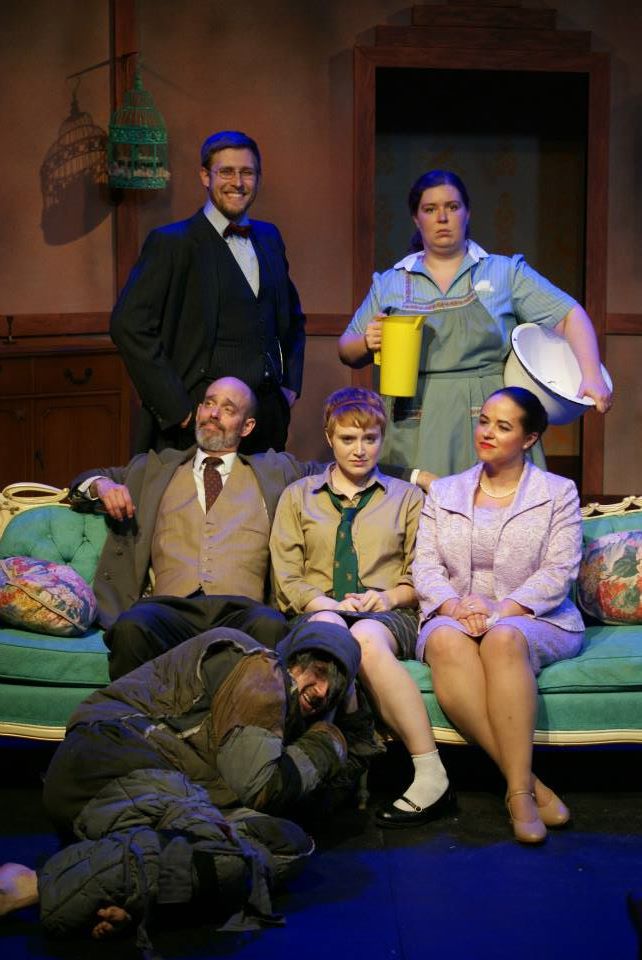
Appearing in The Empire Builders are (from left): standing—Travis Horseman (Neighbor), Audrey Rush (Mug, the maid); seated—Jim Azelvandre (Father), Mary Beth Griffith (Zenobia), Mary-Aileen St. Cyr (Mother); on floor—Stefan Langer (the Schurz) (photo courtesy of MadLab/Shepherd Productions)
Appearing in The Empire Builders are (from left): standing—Travis Horseman (Neighbor), Audrey Rush (Mug, the maid); seated—Jim Azelvandre (Father), Mary Beth Griffith (Zenobia), Mary-Aileen St. Cyr (Mother); on floor—Stefan Langer (the Schmurz) (photo by Michelle Batt)

By Richard Ades

MadLab and Shepherd Productions’ staging of The Empire Builders serendipitously arrives on the heels of an event that raised similar issues: Namely, how much should one be willing to give up in the name of safety, and how does one distinguish between justifiable concern and rampant paranoia?

Well, actually, there were two such events, if you count the revelations of government spying on private phone and Internet usage. But I was speaking mainly of something more local: The Night of the Derecho.

On Wednesday (June 12), Central Ohio TV stations devoted the entire evening to endless reports of tornado warnings, tornado watches and, most frighteningly, of a straight-line storm approaching from the west. We learned that weather patterns over northern Indiana were conspiring to create a threat even more dangerous than the folks E. Gordon Gee referred to as “those damn Catholics” at Notre Dame.

Perhaps sensing that viewers were having trouble worrying about all this while the skies over Columbus remained calm and clear, weathercasters trotted out maps showing developing tornados up north and that treacherous storm system out west. And lightning! Lots and lots of lightning!

And the worst was yet to come, they warned, as the derecho was due to hit Columbus sometime after 1 a.m. The folks at Channel 6 went so far as to advise us to take refuge in our basements in case the fierce winds sent trees crashing into our homes.

I remained skeptical, but I couldn’t dismiss the warnings entirely, especially since a mature ash tree stood right outside my bedroom window. Though I didn’t hide in the basement, neither did I escape into dreamland. Instead, I lay awake and watchful until the storm arrived, right on time, left a few drops of rain and departed. The total damage: an overturned mat on the back porch. Except in parts of Hilliard and Canal Winchester, it seemed, the derecho was a nonevent.

It’s in the aftermath of this harrowing experience—and of the NSA/Verizon revelations—that The Empire Builders arrived at MadLab last week. It was pretty neat timing, considering that French playwright Boris Vian’s 1957 work is about a family that goes to great lengths to protect itself from a vague threat.

Each time they hear a mysterious and ominous noise, Father (Jim Azelvandre) and Mother (Mary-Aileen St. Cyr) drag their daughter (Mary Beth Griffith) and maid (Audrey Rush) upstairs one flight. And each time they move, they end up in a smaller apartment than the one they had before, though only daughter Zenobia seems to realize this. She points out, in vain, that they started out with six rooms and now have only two.

She also points out that it wasn’t until they’d moved the first time that their living space was shared by a silent beast known as the Schmurz (Stefan Langer). But again, the parents are oblivious. They refuse to even acknowledge the creature’s existence, though they periodically pause to attack it with their hands, feet, belt or whatever else is handy.

This is obviously an extremely odd work, and it only gets odder as it goes along—odder and harder to interpret. But many viewers will see that as a challenge.

Inspired by recent events, they may compare the Schmurz to the NSA, or maybe to the terrorist threats that spur it on. They may compare the family’s increasingly smaller apartments to our loss of privacy, or perhaps to our loss of regular TV programming on Wednesday night.

And what does the mysterious noise represent? Edward Snowden? Chris Bradley?

The play’s obscure theme is actually less of a problem than the fact that it’s about as repetitious as Wednesday’s weather reports. For example, it’s fun to watch Father and Mother beat the tar out of the Schmurz two or three times, but by the sixth or seventh time, the slapstick routine has grown stale.

It definitely helps that director Andy Batt has gathered a good cast, which includes Travis Horseman as the Neighbor and the estimable Azelvandre as the Father, who becomes the prime protagonist. But there’s only so much the actors can do to maintain interest in characters who don’t develop or behave in a rational manner.

Griffith has an advantage over the others, playing someone who actually appears to have a working brain, and she makes the most of it with an appealing performance. Weirdly, though, the only character who evolves in the course of the play is the Schmurz, who grows increasingly menacing. Langer does a commendable job of giving the specter a personality without saying a word.

Behind the scenes, Anthony Pellecchia’s lighting, Dave Wallingford’s sound design and Deb Dyer’s bizarre set combine to give the show an eerie personality.

The Empire Builders is a gutsy choice for Shepherd’s third annual production, being relatively unknown compared to Shakespeare’s Titus Andronicus (2011) or Samuel Beckett’s Waiting for Godot (2012). Having recently carped about another local troupe’s unadventurous programming, I can’t fault Shepherd for taking a risk.

But it’s also good to remember that when a vintage play has sunk into obscurity, there’s often a reason.

MadLab and Shepherd Productions will present The Empire Builders through June 22 at MadLab Theatre and Gallery, 227 N. Third St. Show times are 8 p.m. Thursday-Saturday. Running time: 2 hours (including intermission). Tickets are $15, $12 for students and seniors, $10 for members. 614-221-5418 or madlab.net.
This ‘Roulette’ isn’t that much of a gamble

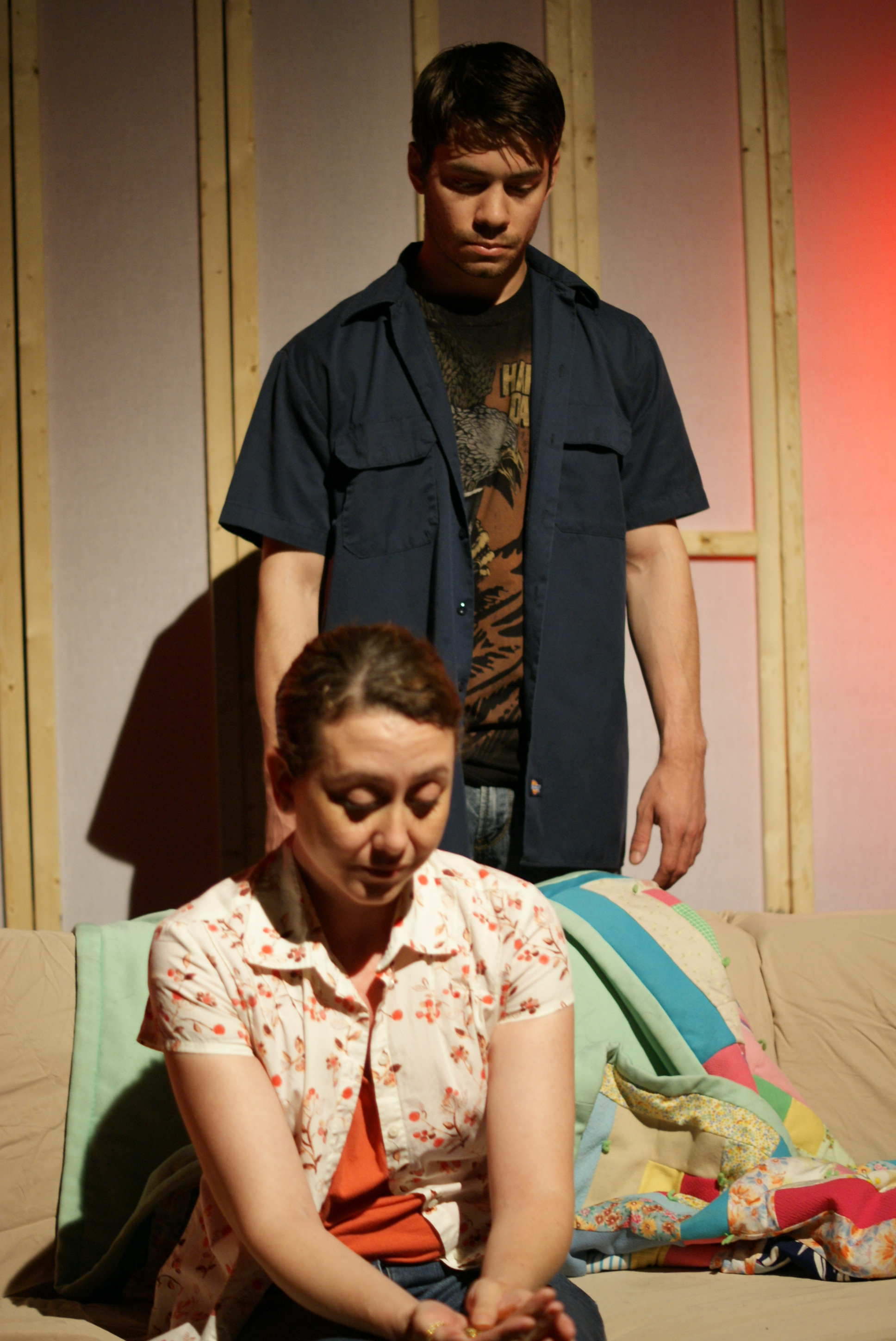
Melissa Bair as an accident victim and Chad Hewitt as her mysterious benefactor in Holy Hell, part of Theatre Roulette’s Ladies Night (photo by Andy Batt)

By Richard Ades

A couple more shows like this, and MadLab may have to ditch the name “Theatre Roulette.”

The annual festival’s moniker is a joking reference to its hit-or-miss nature, since it consists of three collections of mostly unknown short plays. But when MadLab fills one of those collections with works by an interesting writer like Barbara Lindsay, success is pretty much guaranteed.

That’s the case with Ladies Night, which launched the 2013 festival last week and alternates with two more-typical Roulette shows. Each of the featured Lindsay playlets is at least worth the time it takes to watch it. Some are even worth the additional time it takes to process the complex questions and emotions they raise.

The most thoughtful piece is the first, Holy Hell, featuring Melissa Bair as a woman who was involved in a tragic accident and Chad Hewitt as a man who mysteriously shows up to help her move on with her life. What the woman doesn’t know is that the man is motivated by guilt, not charity, as he believes he’s the cause of her woes.

As the woman, Bair proves once again that she’s incapable of registering a false emotion. Though Hewitt’s performance is more surface-bound, this series of alternating monologues resonates as a portrayal of the secret pains and motivations we sometimes bring to our relationships.

Not all of the plays are this serious. Some are outright comedies, but even they mix in elements of psychological truth that are sometimes tinged with sadness. With few exceptions, director Michelle Batt helps each piece realize its full potential by pulling finely honed performances out of her actors.

The funniest piece is Spinsters, starring Natasha Ward as the self-doubting Terry and Audrey Rush as the relatively confident Laura, a friend who urges her not to bail on their double date. Rush is especially hilarious, but both exhibit spot-on comic timing in this take on women’s insecurities.

The female psyche also engenders laughs in Cosmic Goofs, mostly thanks to Jennifer Barlup’s witty portrayal of a woman who ties herself in knots over the sudden reappearance of an irresistible but unreliable ex (a smirking Hewitt). The play wanders into less-rewarding territory after a second woman (Erin Prosser) appears, but until then it’s a hoot.

If Cosmic Goofs goes on too long, On the Line seems surprisingly short, but maybe it’s just as well. Brendan Michna is fine as Joe, who’s forced to man a suicide line by himself on Valentine’s Day, but the character’s unprofessionalism strains credibility. Adding to the piece’s problems, Becky Horseman underacts to a debilitating extent as a caller who seeks his help.

Another type of performance problem rears its head in Fighting Mr. Right, about a woman (Brigid Ogden) who tells her date (Travis Horseman) she won’t sleep with him until they’ve had at least three fights. It’s a clever idea—her explanation is that she wants to know whether he’s going to flee at the first sign of trouble—but Ogden talked so low and so fast on opening night that it was hard to catch her lines.

The evening’s most puzzling piece is Spirit That Won’t Let Me Go, starring a wonderful Courtney Douser as a romance-minded woman having dinner with her boyfriend (Travis Horseman). The puzzle revolves around the “spirit” (Bair), an unseen being who seems to have an unsettling effect on the man. Who is she? If you aren’t too distracted by the question, it’s a bittersweet study of the baggage we all bring to relationships.

The night ends with The Psycho Bitch and the Throbbing Blue Veiner, directed by Amanda Bauer (rather than Batt) and starring Prosser and Erik Sternberger as a couple in the awkward final moments of their first date. Shana Kramer and Michna portray their respective thought processes, which reveal that the two don’t understand each other as well as they think.

Though it’s raunchy, and though it sounds like the kind of “Men Are From Mars, Women Are From Venus” humor we’ve seen in the past, playwright Lindsay isn’t satisfied with just making us laugh. The pair’s misunderstandings may also leave you feeling just a bit sad. Like much of what precedes it, the play affects the viewer on more than one level.

Theatre Roulette”? If trips to the Hollywood Casino paid off this consistently, it would quickly go out of business.

Ladies Night will be repeated at 8 p.m. May 17 and 25 at MadLab Theatre and Gallery, 227 N. Third St. Running time: 90 minutes. Other Theatre Roulette collections are Local Brew, 8 p.m. May 18 and 23 and 2 p.m. May 25; and Mixed Drinks, 8 p.m. May 16 and 24 and 4 p.m. May 25. Tickets are $12, $10 for students and seniors, $8 for members. 614-221-5418 or madlab.net.
Death turns friends into DIY morticians

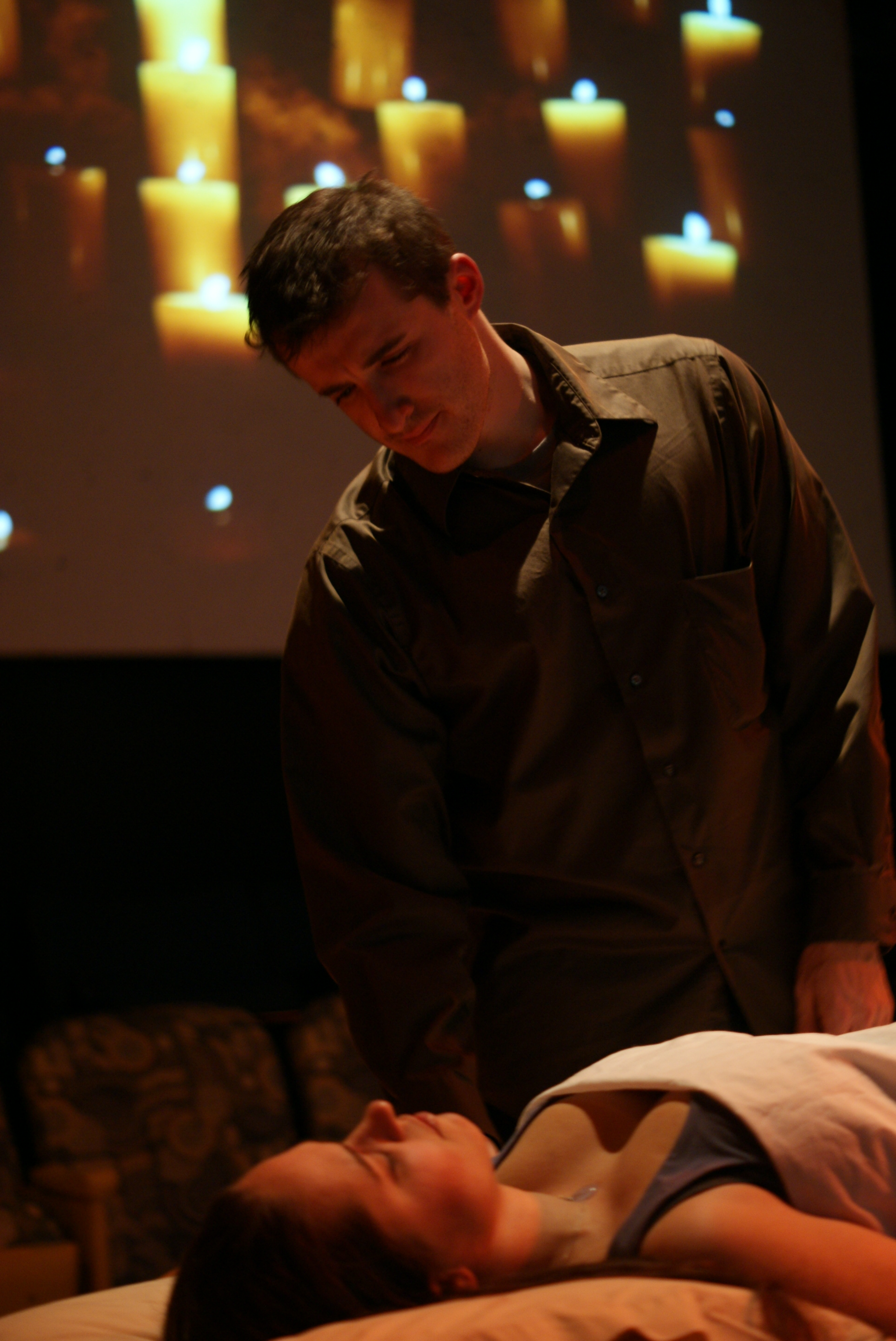
Sam (Michael Galusick) has to prepare deceased girlfriend Erin (Mary-Aileen St. Cyr) for burial in She’s Dead (photo by Andy Batt)

By Richard Ades

There are people in the world who enjoy Happy Endings. I know this because I used to work with such a person, who otherwise seemed fairly normal.

If you also like the ABC sitcom but feel it could use more (a) cussing, (b) pot smoking and (c) death, you might enjoy MadLab’s world-premiere production of She’s Dead.

Like Happy Endings, Joe Giordano’s extended one-act is about a group of friends who spend a lot of time dealing with each other’s problems. Unlike the TV show, She’s Dead particularly focuses on one problem that has no solution: Erin (Mary-Aileen St. Cyr), girlfriend of Sam (Michael Galusick), is dying.

Complicating the situation, Erin insists that her friends skip the funeral home and prepare her body for burial on their own. She also wants them to skip the cemetery, which means they have to find a place to bury her remains, hopefully without running afoul of the law in the process.

Did I mention that there’s cussing going on? Yes, there are F-bombs aplenty, but they’re really more like F-cluster bombs. (Warning: Here comes one.) When Sam is feeling justifiably sorry for himself, for instance, he holds forth with something like: “My fucking life is so fucking fucked! Fuck!”

And did I mention there’s pot smoking going on? There is. In fact, one gets the feeling that the friends are more stoned, more often, than they’re letting on. That would help to explain some of their behavior.

In a key scene set after Erin’s death, Sam attempts to follow her pre-issued instructions by stuffing cotton balls in her vagina, only to be greeted with a stream of urine. The mishap sends the entire group into a laughing jag, a reaction that’s hard to understand considering Sam has just lost his life partner and the rest have lost a dear friend.

If they’re all exceptionally high, the reaction might be slightly understandable. Even so, the scene comes off more like an old Cheech and Chong routine than like real life.

That’s the problem with She’s Dead: tone. It occasionally provides some good laughs (one thing, for me, that sets it apart from Happy Endings), but they too often come at the expense of the playwright’s attempts to insert a little heart into the proceedings.

Director Nikki Smith tries mightily to incorporate both the laughs and the heart, even stopping occasionally for a few seconds of mood music when it’s time to switch gears, but the spastically uneven script thwarts her. She does coax good performances out of the cast, however.

St. Cyr is especially impressive, making Erin an unexpectedly bubbly presence in the scenes set before her death. She’s also a believable corpse in the scenes set after her death (which alternate with the former in a flashback/flash-forward fashion).

As Sam, Galusick does a good job of carrying much of the play’s emotional baggage.

Playing Sam and Erin’s friends are Maria Ritchey as Addie; Brendan Michna as her perpetually confused husband, Brian; and Jay Hobson as their gay friend, Max—I mean, Mack. A tearful Randi Morgan also shows up occasionally as Erin’s mother.

Inserting a dollop of satire, Aran Carr and Erik Sternberger play Rose and Jack, respectively, in a bizarre revision of the movie Titanic that Sam is writing in an attempt to deal with his grief. Unfortunately, Giordano undermines that satire near the end, then tries to un-undermine it, offering further proof that She’s Dead is due for some revision before it returns to the stage.

She’s Dead will be presented at 8 p.m. Fridays and Saturdays through March 23 at MadLab Theatre & Gallery, 227 N. Third St. Running time: 1 hour, 40 minutes. Tickets are $12, $10 for students and seniors, $8 for members. 614-221-5418 or madlab.net.