Can a lonely mom co-exist with her daughter’s ex?

Susan (Michaela Watkins, left) reluctantly takes in her daughter’s ex-boyfriend, Gage (Charlie Gillespie), in Suze.

By Richard Ades

Are you looking for a way to show your love for our neighbors to the north? Do you want to make it up to them for our president’s threats to either absorb them or tax them into oblivion?

Well, now you can, thanks to the new Canadian flick Suze. Written and directed by filmmaking spouses Dane Clark and Linsey Stewart, it’s an offbeat comedy with a Yukon-sized heart.

Title character Susan (Michaela Watkins) is a mid-level manager and mom who left her husband after finding him sharing bodily fluids with another woman. Fast forward five years, and she now has two new problems: the unwelcome arrival of perimenopause and the impending departure of her college-bound daughter, Brooke (Sara Waisglass).

Oh, and one more: Susan can’t stand Brooke’s himbo-esque boyfriend, Gage (Charlie Gillespie), because he’s not bound for college, has no prospects and therefore seems unworthy of her beloved offspring. As a result, Susan urges Brooke to drop him as soon as possible.

A few weeks go by, during which Susan has trouble concentrating at work because she’s frantic to get news from her absent and stubbornly uncommunicative daughter. Then, she finally gets news, but it’s from a surprising source—Gage’s father, Rick (Aaron Ashmore), who tells her his son injured himself jumping off a water tower because Brooke sent him a “Dear John” text.

Rick clearly blames Susan’s daughter for what happened and figures that entitles him to a big ask: Can Susan watch his distraught and possibly suicidal son for a few weeks while his work takes him out of town? Motivated by either guilt or just common decency, Susan reluctantly agrees and opens her home to the volatile teen who still pines for her daughter.

So what happens next? After putting a lonely, middle-aged woman and a hunky, lovesick youth under the same roof, there’s an obvious way this story could have gone. Fortunately for us, Clark and Stewart take a more interesting tack by focusing on the fact that these two vulnerable people have one thing in common: They both love and miss the same person. 

That’s not to say Suze never takes the obvious road. Waisglass’s Brooke and Ashmore’s Rick come across rather heavy-handedly as a spoiled brat and distant dad, respectively. And some scenes seem a little familiar, including one that could have been copied from a recent Jennifer Lawrence comedy (though it probably wasn’t).

But as long as the spotlight remains on the two central characters, none of that matters. Gillespie is often hilarious and always lovable as the outgoing Gage, while Watkins holds onto our sympathy even when Susan’s maternalistic needs lead her into cringe-worthy excesses.

Thanks to a sensitive script and these two wonderful leads, Suze is a treat. It might not take you where you expect to go, but once you get there, you’ll be glad you made the trip.

Rating: 4 stars (out of 5)

Suze (no MPA rating) opens Feb. 7 in theaters and on demand.

Overheard honesty threatens marital bliss

Beth (Julia Louis-Dreyfus) tries to drown her sorrows in You Hurt My Feelings. (Photos by Jeong Park)

By Richard Ades

When a couple exchanges wedding vows, they promise to love and cherish each other, among other things. What they generally don’t promise is to be honest with each other.

Whether or not that’s a good thing is a topic writer-director Nicole Holofcener takes up in her entertaining and chuckle-worthy new film, You Hurt My Feelings.

Long-married New Yorkers Beth and Don (Julia Louis-Dreyfus and Tobias Menzies) love and support each other to a fault—the fault being that they occasionally express that support by telling little white lies.

When Don gives Beth earrings as an anniversary present, she greets them with such forced enthusiasm that it’s obvious she doesn’t like them. And when Beth reciprocates by giving Don a V-neck sweater, his disappointment is equally clear because his first comment is, “Oh, a V-neck.” (As all fans of Louis-Dreyfus’s former series, Seinfeld, know, saying the name of a gift after you open it is a sure sign you didn’t want it.)

All this is no big deal, right? When you’re in a relationship, telling the occasional little white lie can help you avoid hurt feelings or unnecessary friction.

But then Beth catches Don in a lie that doesn’t seem so little: She overhears him admitting to his brother-in-law that, even though he’s told Beth he loves the novel she’s been working on for the past two years, he actually hates it.

Beth is hurt and humiliated, telling sister and fellow eavesdropper Sarah (Michaela Watkins), “I can’t look him in the face ever again.” Sarah tries to soften the blow by admitting she tells actor-husband Mark (Arian Moayed) that he’s more talented than he actually is, but it seems the damage is done.

This unfortunate incident comes to dominate the flick, as well as supplying its title, but it’s actually just one of several examples of the fragile egos and self-doubts that afflict all the major characters.

Aspiring novelist Beth worries she won’t be able to duplicate the success of her previous work, a memoir about growing up with an abusive father. (Not that the memoir was as successful as it might have been if her father hadn’t been just verbally abusive, she muses ruefully.)

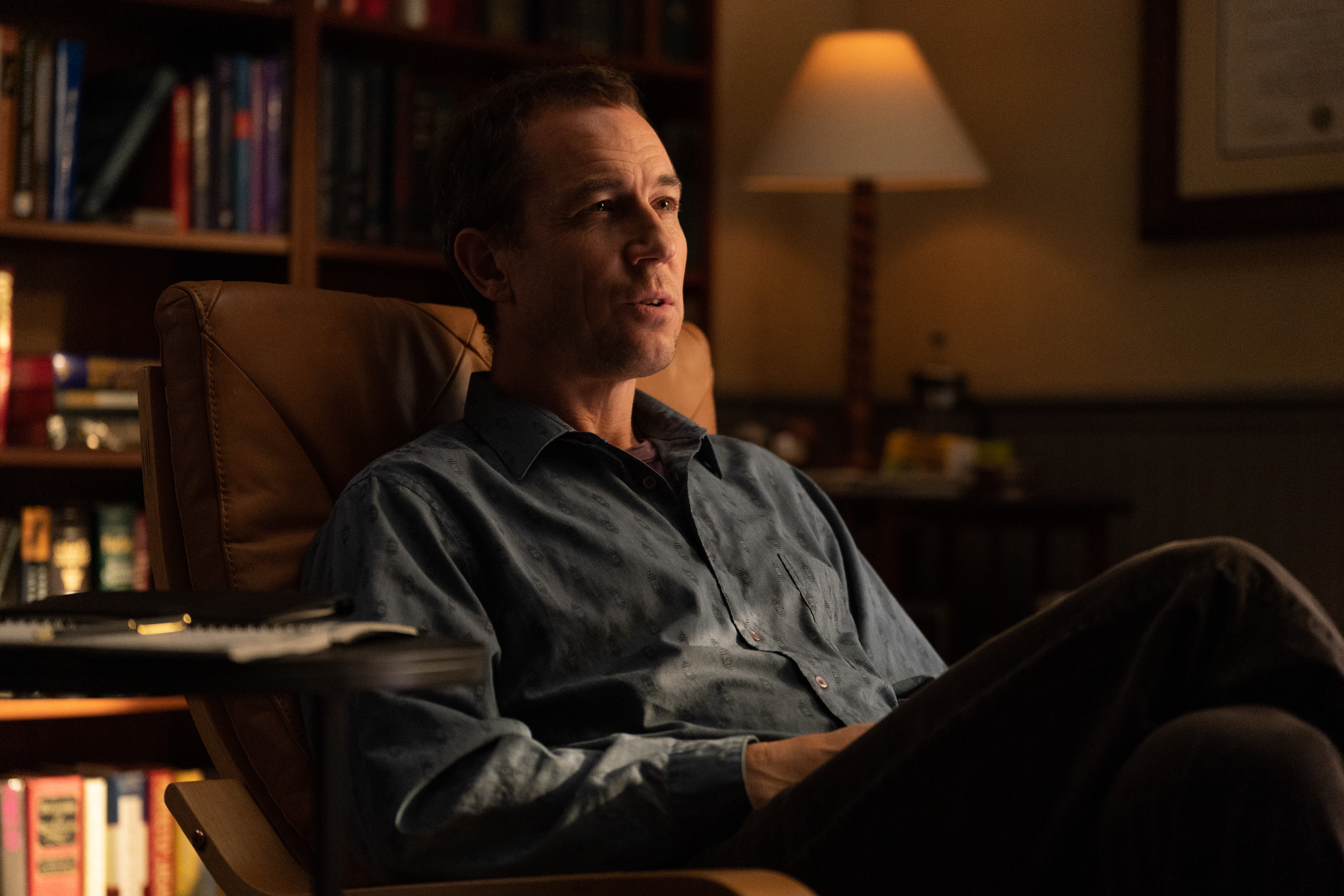
Therapist Don (Tobias Menzies) has trouble keeping his clients’ backstories straight.

Don, a therapist who seems to be chronically tired, has trouble keeping his clients straight, and he worries that he’s not helping them get any better. Sarah, an interior designer, has similar fears about pleasing her clients, while Mark suspects he’s really not such a great actor.

Finally, there’s Beth and Don’s 23-year-old son, Eliot (Owen Teague), who’s working on a play that he fears is no good, while dating a woman who he worries will break up with him.

My one quibble with the way all this trauma is acted out is that Louis-Dreyfus falls back on her old Elaine Benes mannerisms at one or two inopportune moments. Otherwise, everyone’s great, including the several supporting actors who play Mark’s eccentric and generally dissatisfied clients.

With its New York setting, sardonic wit and neurotic characters, You Hurt My Feelings may strike some as a lighter, gentler version of early Woody Allen. But Holofcener is really doing her own thing with this portrait of everyday worries and squabbles, giving viewers a breezily pleasant hour and a half in the process.

Rating; 4 stars (out of 5)

You Hurt My Feelings (rated R) opens May 26 in select theaters.