Staged film adaptation goes heavy on spectacle

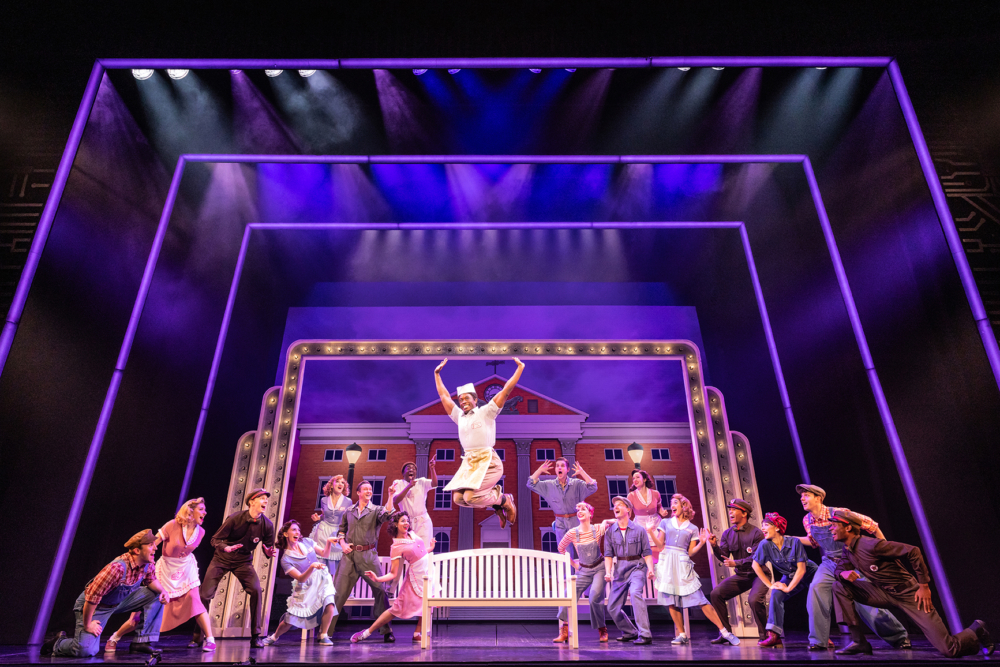
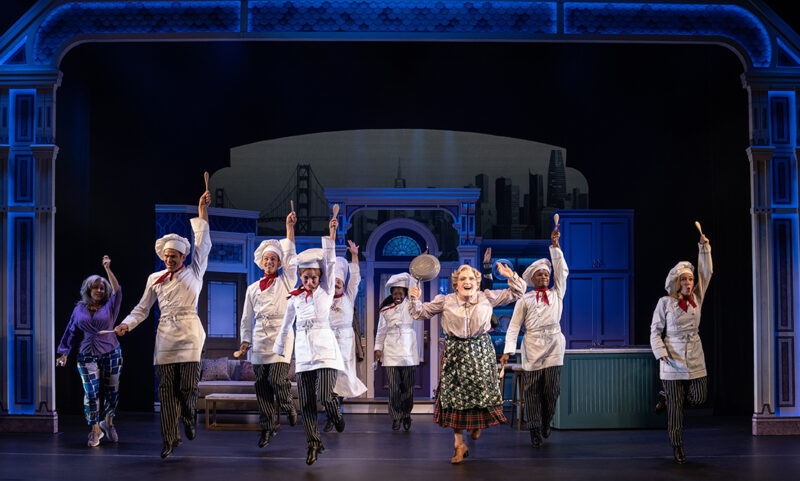
Cast members show off some of the high-flying choreography that won Some Like It Hot one of its four Tony Awards on Broadway.

By Richard Ades

“Well, nobody’s perfect.” It’s ironic that one of the most famous last lines in the history of cinema belongs to a film that’s pretty much perfect.

Billy Wilder’s Some Like It Hot stars Tony Curtis and Jack Lemmon as Depression-era musicians Joe and Jerry, who are being chased by gangsters because they accidentally witnessed a mob execution. Disguising themselves as women, they join an “all-girl band,” where their attempts to fit in are complicated by Joe’s attraction to the lead singer and Jerry’s acquisition of an admirer who refuses to take “no” for an answer.

It’s always risky trying to adapt a work as universally loved and admired as Wilder’s 1959 comedy, so it’s not surprising that the stage version of Some Like It Hot fails to achieve the original’s perfection. What’s disappointing is that it could have been a lot better.

With a book by Matthew Lopez and Amber Ruffin, and songs by Marc Shaiman and Scott Wittman, the musical opened on Broadway in late 2022 and closed just over a year later. Despite the relatively short run, the show garnered a slew of Tony nominations and won four. Besides best actor in a musical, it took home awards for costume design, choreography and orchestrations.

These wins point to some of the show’s strong points, which are also evident in the touring production that opened Tuesday at Columbus’s Ohio Theatre.

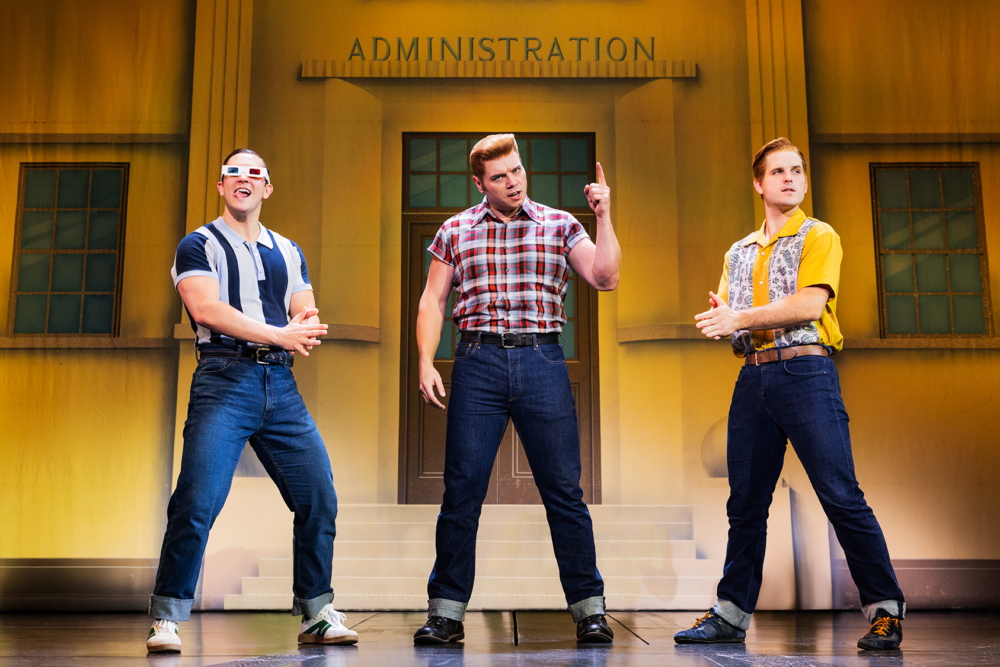
Director/choreographer Casey Nicholaw imbues the many song-and-dance numbers with high kicks and precision tapping, all backed by Charlie Rosen and Bryan Carter’s brassy, jazzy orchestrations. Meanwhile, Gregg Barnes outfits the characters in imaginative period costumes. Combined with Scott Pask’s gorgeous set designs, it all adds up to a colorful spectacle.

In a way, that’s part of the reason the show falls short of the film that inspired it. Far from a spectacle, Wilder’s classic was the comic but heartfelt tale of two men who disguise themselves to stay alive and find their lives altered as a result. Not only do they learn what it’s like to be a woman in a man’s world, but one of them finds that living as a woman is strangely fulfilling.

In the touring show, Matt Loehr and Tavis Kordell star as buddies Joe and Jerry, respectively, who don dresses and disguise themselves as Josephine and Daphne. Both get plenty of opportunities to show off their dancing and singing skills, but they have fewer chances to define their evolving characters. And Jerry, in particular, evolves a lot, becoming increasingly comfortable in the guise of the invented Daphne. (Like the Tony-winning actor who played Jerry on Broadway, Kordell identifies as nonbinary.)

As Sugar, the band’s lead singer, Leandra Ellis-Gaston displays fairly decent pipes but was sometimes overpowered by the band on opening night. In fact, several singers faced the same problem, pointing to the possibility that the sound balance was in need of tweaking. A related problem is that the lyrics were often hard to make out, weakening songs that weren’t that memorable to begin with.

One singer who managed to come through loud and clear on Tuesday was DeQuina Moore, who gives a powerhouse performance as band leader Sweet Sue. Filling out the leading cast members, Edward Juvier is a hoot as Osgood, the millionaire who takes a liking to Daphne.

Of the two acts, the second comes closer to the spirit of the movie, slowing down enough to allow Loehr, Kordell and Ellis-Gaston to flesh out their characters. However, it ends with a seemingly endless slapstick number that involves chases and slamming doors and would have been more at home in a bedroom farce.

Moral: If you’re going to adapt a classic movie for the stage, it helps if you understand just what made the movie great.

Broadway in Columbus will present Some Like It Hot through Nov. 23 at the Ohio Theatre, 39 E. State St., Columbus. Showtimes are 7:30 p.m. through Friday, 2 and 7:30 p.m. Saturday, and 1 and 6:30 p.m. Sunday. Running time: 2 hours, 45 minutes (including intermission). For ticket information, visit columbus.broadway.com. For information on future tour stops, visit somelikeithotmusical.com.

Risks, bravery pay off in trio of 2024 masterworks

A motion-captured Jonno Davies plays a simian version of British pop star Robbie Williams in Better Man. (Photo courtesy of Paramount Pictures)

By Richard Ades

This is the time of year when critics get a chance to catch up on recent flicks they might have missed, courtesy of studios in search of buzz and, hopefully, award nominations. While I don’t claim to be clairvoyant when it comes to the latter, I can confidently say this: If the Oscars and other competitions gave out prizes for bravery, these three films and their creators would win hands down.

One filmmaker displays creative courage by breaking the mold in a familiar genre, while the others put their liberty and even their lives at risk in order to bring their truths to the screen.

Let’s look at them one by one.

Biopic with a difference

By now, we all know the drill when it comes to film biopics: The would-be celeb claws his or her way to the top, but success comes at a steep cost. Friends are abandoned, spouses are cheated on, and alcohol and/or drugs are abused.

Better Man, based on the life of British pop superstar Robbie Williams, follows that general pattern, but with a difference. The entire story unfolds through the eyes (and narration) of Williams himself, who emerges as someone who desperately wants fame but is convinced he doesn’t deserve it.

And, oh yes: Williams is portrayed by a CGI-generated chimpanzee (a motion-captured Jonno Davies). It sounds weird—and, frankly, it is—but it also makes sense in a brilliant and emotionally satisfying way.

Even as a child, Williams suffers from self-doubt, self-loathing and what he later comes to identify as depression. By making him the lone ape in a world of humans, the film has found a clever way of symbolizing Williams’s fear that he’s an imposter unworthy of the success he seeks.

Directed with theatrical flair by Michael Gracey (The Greatest Showman), Better Man is marked by gee-whiz, over-the-top production numbers and surreal fantasy sequences, in addition to its simian protagonist. But what really sets it apart is its honesty and warmth.

Despite being depicted as an ape, Williams comes off as a recognizably flawed human who earns our sympathy, as well as the heart-on-its-sleeve sendoff the film gives him. Director Gracey’s gamble has paid off with a flick that’s as moving as it is massively entertaining.

Rating: 4½ stars (out of 5)

Better Man (rated R) opened Dec. 25 in select theaters and expands nationwide Jan. 10.

National unrest and a missing gun upset the lives of Iranian student Rezvan (Mahsa Rostami, center), her mother (Soheila Golestani, left) and sister (Setareh Maleki) in The Seed of the Sacred Fig.

Criticizing—and then escaping—Iran

As an attack on Iran’s government and justice system, The Seed of the Sacred Fig is the kind of film that can’t be made in that country. And yet veteran writer/director Mohammad Rasoulof succeeded in making it—in secret—before fleeing to Europe for his own safety.  

The thriller concerns Iman (Missagh Zareh), who aspires to be a judge but learns that the path to success will force him to ignore his moral compass. He lands a position that requires him to sentence people to death without being given a chance to consider the evidence.

As it turns out, the position endangers more than just his conscience. Because of the job’s controversial nature, he and his wife, Najmeh (Soheila Golestani), and their family are forced to live in secrecy. Meanwhile, daughters Rezvan and Sana (Mahsa Rostami and Setareh Maleki) become embroiled in the widespread unrest that erupts after a young woman is beaten and killed for not sufficiently covering her head.

Then the gun that Iman keeps for protection turns up missing, and the national turmoil threatens to spread to his household as he searches for the culprit. Interrogations ensue, along with a car chase and a tense finale that may remind some of a certain horror film set in a snowbound hotel. 

Considering it was made in secret and by a director who’d already gotten in trouble for earlier works, The Seed of the Sacred Fig should fill viewers with admiration for Rasoulof’s resourcefulness, as well as his courage. The film deserves an Oscar nomination, but it probably won’t get one, because who would nominate it? Certainly not Iran.

Rating: 4½ stars (out of 5)

The Seed of the Sacred Fig (PG-13) can be seen in select theaters and is scheduled to open Jan. 30 at Columbus’s Gateway Film Center.

Palestinian activist Basel Adra (left) joins forces with Israeli journalist Yuval Abraham in the documentary No Other Land.

Palestinian, Israeli expose West Bank abuses

Basel Adra has spent years documenting the Israeli army’s systematic attacks on his West Bank community, Masafer Yatta. In No Other Land, he continues that work along with Israeli journalist Yuval Abraham and fellow writer/directors Hamdan Ballal and Rachel Szor.

The result is an eye-opening expose of the abuses Adra and his Palestinian neighbors have had to endure living in the occupied territory. Houses and other buildings are destroyed on the shortest of notices and flimsiest of excuses, such as that the army needs the land for training exercises. Those who want to rebuild are told to get permits that they know are unobtainable.

Much of the film consists of footage taken with amateur video equipment or cellphones. It shows locals trying in vain to reason with soldiers, government officials and, in some cases, illegal Israeli settlers, all of whom are clearly trying to force them to abandon their rural community.

Other footage, shot by Szor, centers on the growing friendship between the Palestinian Adra and Israeli journalist Abraham, who are allied by their concern over the situation but separated by their approaches to dealing with it. Abraham is frustrated that his muckraking stories have had so little impact, but Adra counsels patience, saying a solution could take years or even decades.

The differing approaches reflect the men’s vastly different backgrounds. While Abraham is relatively new to the situation, Adra has been dealing with it for much of his life. In the face of constant, officially sanctioned abuse, he and his neighbors have no recourse but to greet it with steadfast determination and even flashes of dark humor.

Made under the most difficult of circumstances, No Other Land is a portrait of courage that is, in and of itself, an act of courage.

Rating: 5 stars (out of 5)

No Other Land is available through VOD outlets and can be seen at select theaters beginning Jan. 31.

‘MJ’ pays homage to moonwalking superstar

One of many flashy moments from the touring production of MJ: The Musical (Photo by Mathew Murphy of MurphyMade)

By Richard Ades

A good fireworks show begins with a “wow” and ends with a “WOW,” filling the space in between with enough peaks to fuel our anticipation. MJ: The Musical, based on the life of Michael Jackson, follows that formula almost exactly.

The action has barely begun when the title character (an amazing Jamaal Fields-Green) launches into an MTV-worthy rendition of the Jackson classic “Whip It.” Then, nearly 2½ hours later, the show is only minutes from its finale when it delivers the song-and-dance number we’ve all been waiting for: “Thriller.”

And by the way: When I say “delivers,” imagine the word being followed by multiple exclamation points. The number is so over-the-top astounding that it alone would nearly justify the original Broadway production’s Tonys for choreography (Christopher Wheeldon, who also directs), lighting design (Natasha Katz) and sound design (Gareth Owen).

In between these two high points, it must be said, the production falls a bit short of a good fireworks show’s standards. There are impressive peaks here and there, but there are also valleys that slow down the momentum.

Set in 1992 during a rehearsal for Jackson’s upcoming “Dangerous” world tour, the jukebox musical addresses some of the rumors then swirling around the “King of Pop.” These are uncovered with help from nosy documentary maker Rachel (Cecilia Petrush) and her cameraman, Alejandro (Anthony J. Garcia).

Through flashbacks, the show also introduces us to two earlier Jackson incarnations: the Jackson 5’s pipsqueak frontman (alternately played by Josiah Benson and Bane Griffith) and the young adult seeking to launch a solo career (Erik Hamilton).

Also featured in the flashbacks are the rest of the Jackson family, including the mom, Katherine (Anastasia Talley), and dad, Joseph (Devin Bowles). Bowles plays the latter as a domineering bully who pushed his talented children relentlessly and was particularly abusive toward young Michael.

The implication is that Joseph’s behavior was responsible for MJ’s later problems, but the argument is only partially convincing. To some extent, that’s because Jackson had so many problems and eccentricities, some of which didn’t come out until after the musical’s time frame, that it’s hard to pin them all on any single source.

Despite his flaws, the one undeniable thing you can say about Michael Jackson is that he was a showman of the first degree, and MJ is most successful when it concentrates on that fact. Along with singing, dancing was obviously central to his appeal, and his devotion to the craft comes out brilliantly in an Act II fantasy that shows him trading steps with virtuosos who apparently inspired him: Fred Astaire, Bob Fosse and the tapdancing Nicholas Brothers.

Though all of the cast members sing and dance well, it clearly takes a special skillset to portray someone as unique as Michael Jackson. In the original Broadway production, Myles Frost filled the bill and thereby won the show’s fourth and final Tony.

In the current touring production, Fields-Green displays the voice, the moonwalk and all the other flourishes that won the King of Pop his title. (Jordan Markus alternates in the role at some performances.)

Fields-Green’s portrayal, backed up by a stellar band and some of the most awe-inspiring stagecraft you’ll ever see, makes MJ a pulse-quickening trip down memory lane.

MJ: The Musical runs through Sept. 15 at the Ohio Theatre, 39 E. State St., Columbus. Showtimes are 7:30 p.m. through Friday, 2 and 7:30 p.m. Saturday, 1 and 6:30 p.m. Sunday. Running time: 2 hours, 40 minutes (including intermission). For ticket information, visit columbus.broadway.com. For information on future tour stops, visit tour.mjthemusical.com.

Decades later, ‘The Lion King’ still roars

The Lion King begins with “The Circle of Life,” which celebrates the birth of King Mufasa’s son, Simba. (Photo by Matthew Murphy; photos courtesy of Disney)  

By Richard Ades

It was almost exactly 20 years ago that I first saw the onstage version of The Lion King. After seeing it again last week, I looked up my review of that earlier production and realized it applies equally well to the current touring show.

That says a lot for the quality of the new production and for the timelessness of director Julie Taymor’s vision. The Lion King could have been just another Disney cartoon adapted for the stage, but Taymor employed African-inspired costumes, masks, puppetry and dance moves and turned it into a cultural phenomenon.

For her efforts, in 1998 Taymor became the first woman to win the Tony Award for best direction of a musical. In addition, the original Broadway production won well-deserved Tonys for scenic design (Richard Hudson), costume design (Taymor), lighting design (Donald Holder) and choreography (Garth Fagan) as well as the overall award for best musical.

Though the beautiful music and lyrics by Elton John and Tim Rice (and others) did not win a Tony, they contribute to the show’s groundbreaking character, starting with the fact that some of the key lyrics are in Swahili.

Maybe it’s less surprising that the book by Roger Allers and Irene Mecchi was Tony-less, as the story is simple and predictable: A majestic lion rules wisely over his kingdom until a jealous brother engineers his demise, after which the monarch’s young son must decide whether to fight for justice and his position as the rightful heir.  

It’s a tale as old as time—or at least as old as Hamlet. What makes it compelling is the show’s spirit and style, as delivered by a committed cast of fine actors, singers and dancers.

Cheetahs and giraffes are among the animals creatively portrayed with the help of life-size puppets. (Photo by Joan Marcus)

Major figures in the current touring show are Gerald Ramsey as the noble King Mufasa; Peter Hargrave as his villainous brother, Scar; Nick LaMedica as Mufasa’s hornbill steward, Zazu; Darian Sanders as the grownup version of the prince, Simba; and Khalifa White as Simba’s friend, Nala.

Appearing in alternate performances as the younger versions of the latter two characters are Bryce Christian Thompson and Julian Villela as Simba, and Ritisha Chakraborty and Leela Chopra as Nala.

Finally, special mention must be made of Mukelisiwe Goba as Rafiki, the all-seeing mandrill (or is she a baboon?) who serves as viewers’ guide and narrator. When she gets things started with her full-throated rendition of “The Circle of Life,” we know this iconic show is in good hands.

As it was from the beginning, thanks to Julie Taymor.

P.S. Danya Taymor followed in her aunt’s footsteps Sunday by winning the Tony Award for best direction of a musical (The Outsiders, which also won for best musical). Obviously, talent runs in the family.

CAPA and Broadway in Columbus will present The Lion King through July 7 at the Ohio Theatre, 39 E. State St., Columbus. Showtimes are 7:30 p.m. Tuesdays-Thursdays (except July 4), 8 p.m. Fridays, 2 and 8 p.m. Saturdays, 1 and 6:30 p.m. Sundays, plus 2 p.m. June 20, 7:30 p.m. July 1 and 1 p.m. July 4. Running time: 2 hours, 30 minutes (including intermission). For ticket information, visit columbus.broadway.com. For information on future tour stops, visit lionking.com/tour/.

Sondheim tunes still the best part of revised ‘Company’

Britney Coleman as Bobbie in the national tour of Company (Photos by Matthew Murphy for Murphy Made)

By Richard Ades

When I first saw Company at a local university in 2006, I loved the tunes but thought the student cast failed to make the episodic show seem coherent. But now, after seeing a touring production based on the Tony-winning 2021-22 Broadway revival, I suspect it wasn’t entirely their fault.

Maybe this is simply a hard show to pull off.

Once again, I loved the Stephen Sondheim tunes but had trouble caring about the characters singing them, especially Bobbie, the 35-year-old New Yorker around whom the show revolves. Forgoing a traditional plot, Company merely tags along with Bobbie as she visits various engaged and married friends who think she should be getting engaged and married herself.

First of all, we should note that Bobbie (played here by Britney Coleman) is a re-gendered version of Bobby, who was the male protagonist when the show debuted on Broadway in 1970. Much has been said and written about the character’s sex change, which Sondheim himself approved before his death in November 2021. Some claim it makes the show more relatable, while others have called it problematic.

Since I’ve had trouble with the show whether it had a male or a female lead, I can’t say the change was pivotal to my enjoyment. But it may have added unforeseen complications.

For one thing, you can’t make a woman seem too desperate to find a husband in 2024 without dredging up patriarchal stereotypes. Maybe that’s one reason Bobbie doesn’t seem as concerned about being single as Bobby was—which makes the show seem even less dramatically coherent than it was originally. If Bobbie isn’t motivated to question her marital status, then what is she doing except spending time with her various coupled friends?

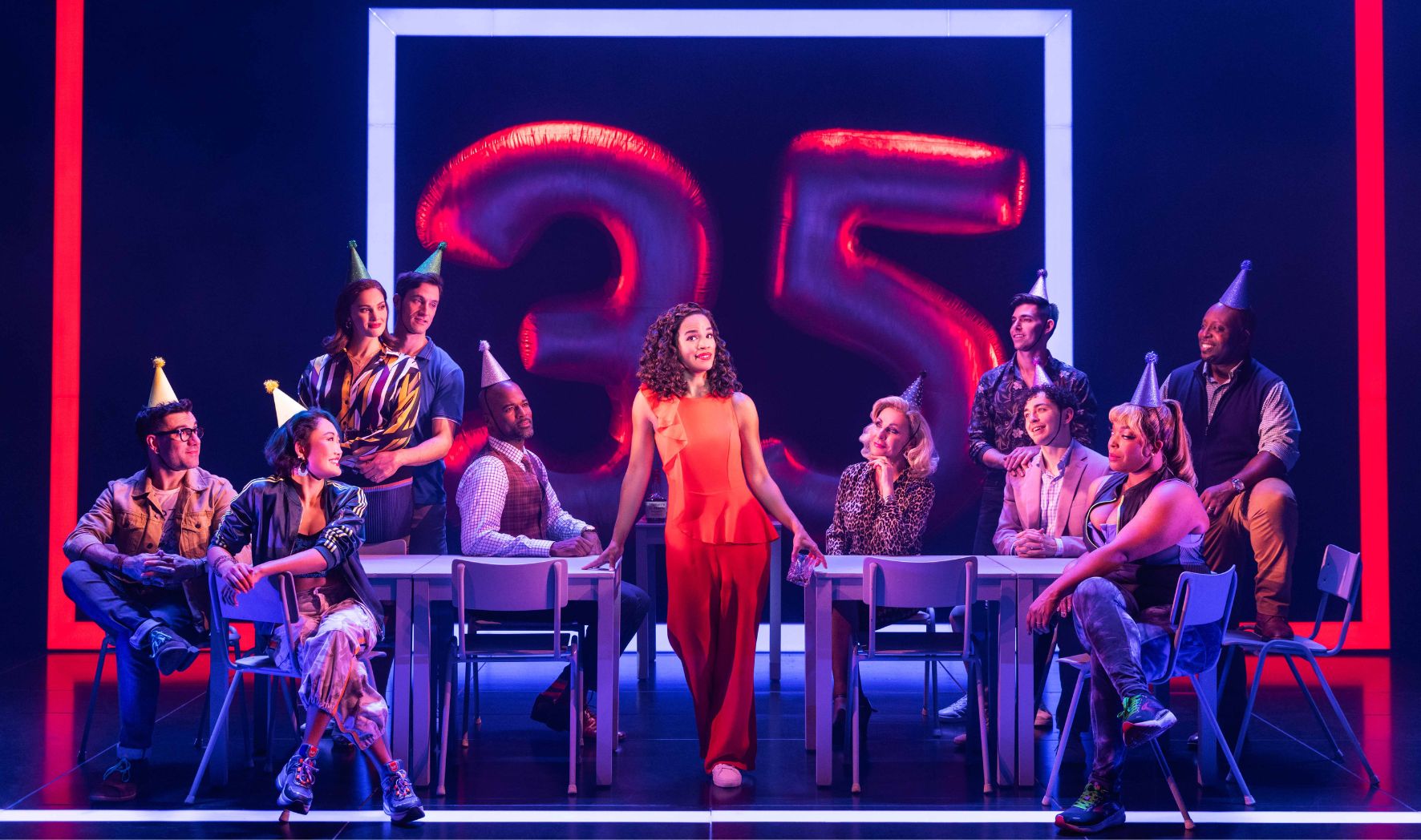
Various friends help Bobbie (Britney Coleman, center) celebrate her 35th birthday.

The gender change also necessitates tangential tweaks that are sometimes awkward. The biggest one involves the protagonist’s much-divorced friend Joanne, who propositions Bobby in a key scene of the original musical. In this version, Joanne (Judy McLane) invites Bobbie to have an affair, not with her, but with her current husband (Derrick Davis).

Why would Joanne do that, and why would she assume her obviously devoted hubby would even consider being unfaithful? The situation is so odd that it almost overshadows McLane’s stellar rendition of one of the show’s musical highlights, “The Ladies Who Lunch.”

Even though this Company doesn’t work as a whole, individual scenes do entertain thanks to a talented cast working under Marianne Elliot’s direction. One of the best involves two gay friends (another revision from the original show) who are about to get married. Paul (Jhardon DiShon Milton) is eager, but Jamie (Matt Rodin) has a severe case of cold feet, as he explains in the comically rapid-fire “Getting Married Today.”

Several of the other musical highlights involve Coleman’s Bobbie, including Act I’s “Someone Is Waiting” and “Marry Me a Little,” and Act II’s “Side by Side by Side.” Coleman emotes a bit too frantically on the finale, “Being Alive”—perhaps trying to make up for the show’s emotional deficiencies—but her beautiful voice serves the other numbers well.

One musical highlight that doesn’t involve Bobbie is “Another Hundred People,” in which PJ (Tyler Hardwick) sings about the ever-growing population that gives New York its atmosphere of excitement and underlying desperation.

The number also showcases Bunny Christie’s scenic design by using three letters from the musical’s title to create people-sized props that spell out “NYC.” Christie is similarly creative throughout, staging most of the scenes inside various-sized boxes with illuminated edges, as if the action were taking place within living snapshots.

It’s too bad the show doesn’t have much dramatic cohesion to go along with the visual cohesion Christie’s designs provide. It’s also too bad that not all of its updates are completely successful. But at least Company has Sondheim’s music and lyrics, which remain timeless.

Broadway in Columbus and CAPA will present Company through Feb. 18 at the Ohio Theatre, 39 E. State St., Columbus. Running time: 2 hours, 45 minutes (including intermission). Showtimes are 7:30 p.m. through Thursday, 8 p.m. Friday, 2 and 8 p.m. Saturday, and 1 and 6:30 p.m. Sunday. For ticket information, visit columbus.broadway.com or capa.com. For information about future Company tour stops, visit broadway.org.

‘Doubtfire’ actor reprises Tony-nominated star turn

Daniel (Rob McClure) effects a Scottish accent to convince ex-wife Miranda (Maggie Lakis) to hire the fictitious Mrs. Doubtfire as their children’s nanny. (Photos courtesy of Broadway in Columbus)

By Richard Ades

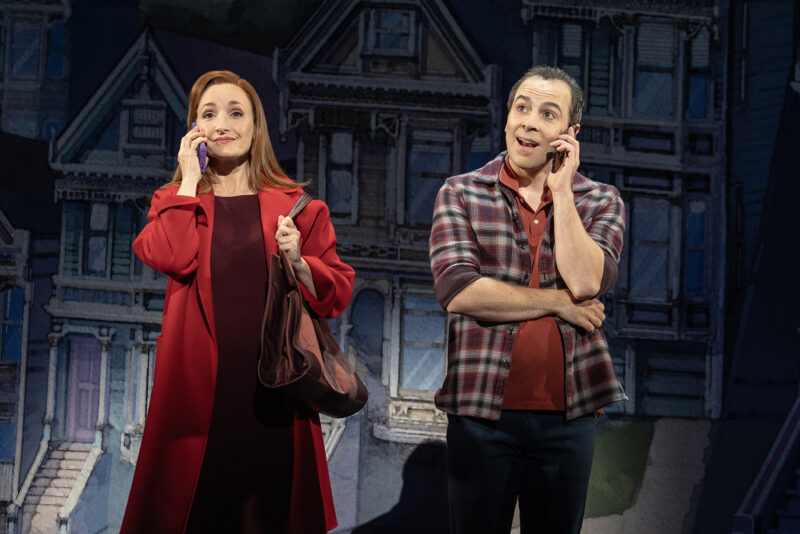
Mrs. Doubtfire’s brief 2021-22 Broadway run was most acclaimed for Rob McClure’s Tony-nominated performance in the starring role. So it’s fortunate that McClure is re-donning the title nanny’s wig, mask and padding for the North American tour.

As unemployed actor Daniel Hillard, McClure trots out a cornucopia of voices and impersonations, all delivered with manic energy almost worthy of the late Robin Williams, who originated the role in the 1993 film.

Fueling the plot is the fact that Daniel is a devoted father but a so-so husband, leading wife Miranda (Maggie Lakis) to seek a divorce. When a judge threatens to award Miranda sole custody of their kids unless Daniel can get his financial act together, the distraught dad concocts a plan to keep on seeing them.

With makeup and hairstyling help from brother Frank (Aaron Kaburick) and his husband, Andre (Nik Alexander), Daniel invents an aging Scotswoman named Mrs. Doubtfire. In this disguise, he lands the job of taking care of his offspring while Miranda is busy launching her own clothing line.

Daniel (Rob McClure) shares dance steps with a group of chefs in one of the show’s production numbers.

Emotion would seem to be built into the story, dealing as it does with Daniel’s attempt to hold onto his family. But the musical’s writers (Kary Kirkpatrick and John O’Farrell) and director (Jerry Zaks) put more of the focus on comedy and spectacle.

The comedy largely revolves around Daniel’s attempts to bamboozle a court liaison (Romelda Teron Benjamin) charged with checking up on him. As for the spectacle, it involves dance numbers that are sometimes shoehorned in on the thinnest of excuses. For example, when Daniel tells Frank and Andre he needs a female alter ego, they conjure up dancing celebrities ranging from Donna Summer to Eleanor Roosevelt and Janet Reno before he can explain what he has in mind.

All of this is fun when it works, as it often does. There are many amusing moments, and the dance numbers are spirited thanks to Lorin Latarro’s choreography and Wayne Kirkpatrick and Kary Kirkpatrick’s tunes.

It’s just that the show would be more satisfying if it provided more feels.

Giselle Gutierrez as Lydia, Daniel and Miranda’s older daughter

One emotional high point comes midway through Act 1 with “What the Hell,” a heartfelt song that expresses how Daniel and Miranda’s divorce is affecting their children. Teenage daughter Lydia (a wonderful Giselle Gutierrez) is angry, while younger siblings Chris and Natalie feel they are somehow to blame for the breakup. (Chris is played at alternate performances by Cody Braverman and Axel Bernard Rimmele, Natalie by Emerson Mae Chan and Kennedy Pitney.)  

By the end, the musical does manage to supply another heartwarming moment or two. Otherwise, the focus is on laughs, leaps and Rob McClure’s amazing capacity for comedic schtick.   

Broadway in Columbus will present Mrs. Doubtfire through Nov. 5 at the Ohio Theatre, 39 E. State St., Columbus. Showtimes are 7:30 p.m. through Thursday, 8 p.m. Friday, 2 and 8 p.m. Saturday, and 1 and 6:30 p.m. Sunday. Running time: 2 hours, 35 minutes (including intermission). For tickets or more information, visit columbus.broadway.com. For information on future tour stops, visit mrsdoubtfirebroadway.com/tour.

Staged ‘Frozen’ is icily beautiful and warmly poignant

Carolyn Bowman plays Elsa, a princess with a dangerous magical gift, in the North American tour of Frozen. (Photo by Deen van Meer)

By Richard Ades

Disney’s 2013 flick Frozen was met by universal acclaim and won the Oscars for best animated film and best song. The stage adaptation, which opened on Broadway to mixed reviews in 2018, was nominated for three Tonys but won none.

Apparently, the stage musical is not as perfect as its cinematic forebear. But after seeing the touring version Thursday at the Ohio Theatre, it’s obvious that it remains pretty entertaining.

Not that it couldn’t be better. To pad out the running time, book writer Jennifer Lee added extra scenes that often seem superfluous, while composer/lyricists Kristen Anderson-Lopez and Robert Lopez added extra songs that aren’t as catchy as the original eight.

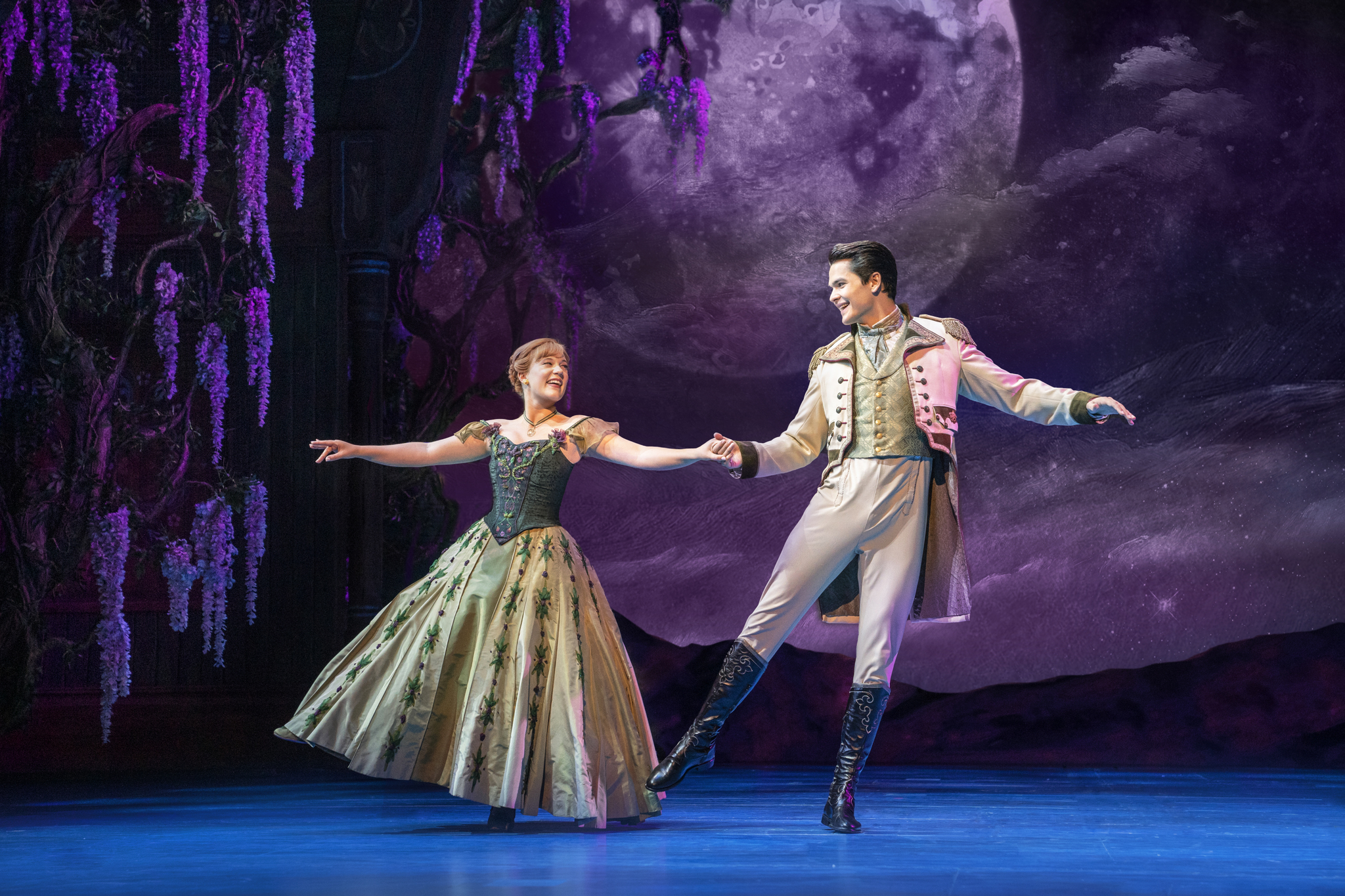
That the show delivers as much entertainment as it does despite the filler is due to the sterling work of director Michael Grandage and his talented cast, as well as the beautiful stage vistas created by scenic/costume designer Christopher Oram and lighting designer Natasha Katz.

Anna (Lauren Nicole Chapman) and Hans (Will Savarese) dance the night away. (Photo by Matthew Murphy)

Like the film, the stage show revolves around the troubled relationship between royal sisters Elsa and Anna, whom we first meet as adolescents. The older Elsa is cursed with the magical ability to inadvertently freeze anyone or anything around her. After a careless act nearly kills her younger sister, Elsa’s parents force her to isolate herself from the world, and particularly from Anna.

On Thursday night, Norah Ann Nunes and Erin Choi played the rambunctious Anna and tortured Elsa, respectively, and indelibly established the personalities they would retain as young women. (Avelyn Choi and Sydney Denise Russell take over the roles at alternate performances.)

The action then fast-forwards several years to find queen-to-be Elsa (Caroline Bowman) still avoiding public contact and nervous about getting through her impending coronation without freeze-drying the guests. Meanwhile, Anna (Lauren Nicole Chapman) is stir-crazy and more than a little man-crazy and looks forward to meeting possible beaus at the coronation ball.  

As Anna, Chapman sometimes lays on the comic schtick a little heavy, but both she and Bowman have abundant acting and singing chops. They use them to flesh out the sisters’ estranged relationship, which suffers a seemingly mortal blow after Elsa accidentally plunges the kingdom into eternal winter and flees into self-imposed exile.

Anna (Lauren Nicole Chapman) and Kristoff (Dominic Dorset) struggle to cross an icy bridge. (Photo by Matthew Murphy)

Other major cast members include Will Savarese as Hans, a prince who meets Anna at the coronation and immediately wins her heart; Dominic Dorset as Kristoff, an ice merchant who comes to Anna’s aid after she wanders into a snowstorm in search of her sister; and Jeremy Davis as Olaf, a snowman brought to life by Elsa’s magic.

Olaf is one of the show’s two most ingenious creations, being a puppet that Davis supports and manipulates in full view of the audience. The other is Sven, Kristoff’s four-legged companion, whose expressive movements and postures are delivered by the limber Dan Plehal in a reindeer costume. (Collin Baja plays the role at alternate performances.)

While the relationship between Anna and Elsa provides the show’s dramatic heart, it’s Kristoff, Olaf and Sven who provide most of its humor.

Snowman Olaf (Jeremy Davis) meets Sven (alternately played by Collin Baja and Dan Plehal), who seems to be eyeing the carrot that serves as his nose. (Photo by Matthew Murphy)

As in the film, the musical highpoints are the hummable “Do You Want to Build a Snowman,” “For the First Time in Forever” and especially “Let It Go.” The latter showstopping earworm is beautifully delivered by Bowman’s Elsa and is accompanied by a feat of stage magic that defies explanation.

As for the musical low point, that would have to be “Hygge,” a goofy song-and-dance number that wasn’t in the original film. It’s one of several moments that make you wonder why Broadway’s Frozen couldn’t have skipped all the filler and been staged as a poignant one-act.

Still, a two-act Frozen is better than none at all. Onstage or on film, Disney’s tale of sisterly love is a treat.

Broadway in Columbus will present Frozen through Aug. 6 at the Ohio Theatre, 39 E. State St., Columbus. Showtimes are 7:30 p.m. Tuesday-Thursday, 8 p.m. Friday, 2 and 8 p.m. Saturday, and 1 and 6:30 p.m. Sunday. Running time: 2 hours, 15 minutes (including intermission). Tickets are available at BroadwayInColumbus.com, by calling CAPA at 614-469-0939 or at the Ohio Theatre’s CBUSArts Ticket Center. For information on future tour dates, visit frozenthemusical.com.

Motown hits supercharge Temptations history lesson

A scene from the touring production of Ain’t Too Proud: The Life and Times of the Temptations (Photos courtesy of Broadway in Columbus)

By Richard Ades

As you wait for Ain’t Too Proud to begin, the “marquees” projected onto the curtain establish the subject, place and mood. They advertise a “dance and show” featuring the Temptations at Detroit’s iconic Fox Theatre. And there are two additional words: “SOLD OUT.”

All of this is depicted in shades of gray, setting the tone for what is essentially a history lesson about the Temptations’ hard-fought quest to become the most successful R&B group of all time. But though that history is marked by struggle, conflict and loss, it’s accompanied by the some of the toe-tapping-est, spirit-lifting-est music that ever came out of Motown.

In other words, expect to have one of the best times you’ve ever had in a theater.

The musical’s book by Dominique Morisseau is based on a history of the Temptations written by founding member Otis Williams. Some have complained that this results in a one-sided look at the group, in contrast to the more even-handed Four Seasons musical Jersey Boys.

There’s some truth to this. Williams (masterfully played in the touring show by Michael Andreaus) serves as the history’s narrator and routinely depicts himself as the voice of reason who tries to keep the group on an even keel despite other members’ missteps, failings and ego trips. Even so, the general thrust of the show is not to cast blame but to explain how hard it is to achieve musical success, particularly when one starts out poor and Black.

The Temptations began making their mark during the 1960s, when civil rights struggles and an increasingly unpopular war were making front-page headlines. The musical touches on these issues and on the dilemma they raised for the group’s members, who were torn over whether they could address what was going on in their music without jeopardizing their “crossover” popularity with White audiences.

An interesting piece of trivia revealed by the show: The protest song “War (What is it good for?)” was meant to be recorded by the Temptations, but Motown execs decided it was too political. The result was that Edwin Starr got the recording deal and ended up with a hit.

Fortunately, the “Temps” got the chance to record plenty of other classic ballads and danceable anthems, and the best are peppered throughout the show. Thanks to Des McAnuff’s impeccable direction, Sergio Trujillo’s choreography and a cast that can handle both the tunes and the steps with aplomb, the result is like being in Detroit’s Fox Theatre on the aforementioned night and watching musical history come gloriously alive.

Along with Andreaus, central cast members include E. Clayton Cornelious as Paul Williams, Harrell Holmes Jr. as Melvin Franklin, Jalen Harris as Eddie Kendricks, and Elijah Ahmad Lewis as the mercurial, showboating David Ruffin. Numerous others display equal levels of talent in lesser roles.

Robert Brill’s scenic design and Howell Binkley’s lighting design are eloquently restrained, refusing to upstage the singers and dancers. A good-sized band led by Jonathan “Smitti” Smith and featuring several local musicians provides the accompaniment—and gets the chance to show what it can do on its own after the curtain call.

The moral: Don’t leave early.

Broadway in Columbus and CAPA will present Ain’t Too Proud: The Life and Times of the Temptations through April 18 at the Ohio Theatre, 39 E. State St., Columbus. Showtimes are 7:30 p.m. through Thursday, 8 p.m. Friday, 2 and 8 p.m. Saturday, and 1 and 6:30 p.m. Sunday. Running time: 2½ hours including intermission. Tickets are $40-$135+. Columbus.broadway.com. For upcoming tour dates, visit ainttooproudmusical.com.

Fickle king’s wives share their stories

The queens belt out a song in a typically high-energy moment from the North American Six Aragon Tour. (Photos by Joan Marcus)

By Richard Ades

No doubt about it. Columbus was ready for Six. That’s clear not only from the touring production’s sold-out status, but from the whoops and cheers that greeted Tuesday night’s opening. It was reminiscent of the wildly enthusiastic response Rent encountered when that musical phenomenon made its local premiere decades ago.

For those not yet familiar with Six, the concert-style musical centers on the six wives of England’s King Henry VIII, women whose various fates are summarized by the words “divorced, beheaded, died, divorced, beheaded, survived.” So, much like Lin-Manuel Miranda’s megahit Hamilton, Six is a musical take on history.

That, however, is where the resemblance ends.

While Hamilton uses its rapped and sung songs to explain and humanize an American “founding father,” Six creators Toby Marlow and Lucy Moss turn the 16th century tale of Henry and his wives into a celebration of what was once called “girl power.” It’s all presented in the form of a pop concert accompanied by a spunky onstage band and glitzed up with sparkly costumes and flashy lighting (designed, respectively, by Gabriella Slade and Tim Deiling).

From the start, the six “queens” set the vibe by strutting, striking poses and inviting the audience to “Make some noise, Columbus!” They then introduce the premise: The women will compete against each other to see who had the saddest life, with the winner being elevated to leader of their vocal sextet.

 Proceeding in chronological order, each character then summarizes her fate in a song while the others accompany her with backup harmonies and dance steps choreographed by Carrie-Anne Ingrouille. First up is original wife Catherine of Aragon (Khaila Wilcoxon), followed by Anne Boleyn (normally played by Storm Lever but ably portrayed by Cassie Silva on opening night). Rounding out the six are Jane Seymour (Jasmine Forsberg), Anna of Cleves (Olivia Donalson), Katherine Howard (Didi Romero) and Catherine Parr (Gabriela Carrillo).

Jasmine Forsberg plays Henry VIII’s third wife, Jane Seymour.

All of the songs are performed with verve and skill, but the big showstopper is Jane Seymour’s romantic lament “Heart of Stone,” partly because it offers a change of pace from the normally fast-moving production, and mostly because it’s gorgeously sung by Forsberg.

So which queen deserves the prize? That’s a red herring, actually, as the musical eventually admits its real purpose is not to pit the women against each other but to honor them as individuals. Of course, this profession of feminine solidarity comes only after the women have spent most of the show’s 80 minutes pelting each other with catty putdowns that account for much of its humor.

A bigger problem with the musical’s feminist theme is that these women, whose historical counterparts often dealt with complicated religious and political issues, are largely reduced to shallow, one-dimensional characters. A prime example is Anne Boleyn, an educated and accomplished individual who was involved in England’s break with the Catholic Church and who ultimately was executed on the pretext that she’d had affairs, though it was more likely because she’d failed to give Henry a male heir. Here, she’s portrayed as a party girl who cheerfully admits to the alleged dalliances, saying, “I’m just trying to have some fun.”

Such concerns are unlikely to keep anyone from becoming a Six fan. The show still boasts enough catchy tunes, colorful sights and relentless energy to keep viewers entertained. As a reflection of history, though, it’s like a fancy dessert: pretty and tasty, but not very filling. If you want a main course, see Hamilton.

Broadway in Columbus will present Six through Sunday, Jan. 29 at the Ohio Theatre, 39 E. State St., Columbus. Showtimes are 7:30 p.m. through Thursday, 8 p.m. Friday, 2 and 8 p.m. Saturday, and 1 and 6:30 p.m. Sunday. Running time: 1 hour, 20 minutes (no intermission). Tickets are mostly sold out. For information visit CBUSarts.com or call 614-469-0939. For information on future tour stops, visit sixonbroadway.com/north-american-tours.

Otherworldly trip through a futuristic Africa

Cheryl Isheja as a transformed Neptune in Neptune Frost (Photos courtesy of Kino Lorber)

By Richard Ades

Neptune Frost may be the most mesmerizing film of recent years. It’s also one of the most beautiful. And, frustratingly, one of the most puzzling.

Set in a futuristic version of Rwanda, the sci-fi musical introduces us to Neptune (Elvis Nagabo), who cryptically announces through a narrator, “I was born in my 23rd year.” Then, while we’re still pondering that bit of information, the film switches its attention to Matalusa (Bertrand “Kaya Free” Ninteretse), who works in the local coltan mine. (Coltan is a mineral used in high-tech products, a fact whose significance soon becomes clear.)

After each of their lives is waylaid by an act of violence, Neptune and Matalusa separately take to the road and begin wandering through a countryside damaged by war and oppressed by authoritarianism. Eventually, they cross paths in an enclave of technologically minded rebels, but not before Neptune undergoes a transformation that leaves the masculine-looking individual looking decidedly more feminine (and played by a different actor, Cheryl Isheja).

The script by Saul Williams, who also composed the beautiful score, is obscure and sometimes blatantly symbolic. Characters with names such as “Memory” and “Psychology” discuss mysterious topics such as “binary crime theory” and make statements along the lines of “The motherboard is bleeding.” Furthermore, the standard greeting is “Unanimous goldmine,” and the standard answer to the everyday question “How are you?” is “Shining!”

All of this creates an eccentric world that might have been a chore for viewers to navigate if co-directors Williams and Anisia Uzeyman hadn’t filled the screen with hauntingly surreal and dreamlike images—and if composer Williams hadn’t punctuated the action with music that ranges from infectious rhythmic chants to ethereal ballads. Imaginative makeup, costumes and sets add to the otherworldly atmosphere.

Despite the ambiguities, it eventually becomes clear that the film has two overarching themes: It opposes the colonial-type exploitation that continues to plague Africa now that natural resources such as coltan have made it indispensable to modern technology. And it supports the freedom of every individual—including unconventional individuals such as the intersexual Neptune—to live the life they were meant to lead.

These themes add up to a moral structure that helps to ground the flick despite the fact that it doesn’t fit into any recognizable pattern.

As intriguing as it is, Neptune Frost is almost the definition of a film that’s not for everyone. For some, its refusal to explain itself makes it a frustrating challenge. But for those who are content to lose themselves in its unfamiliar world of images and sounds, it’s a fascinating journey.

Rating: 4 stars (out of 5)

Neptune Frost opens June 3 in New York and expands to other selected theaters June 10.