Musical moments outshine remake’s tragic love story

A STAR IS BORN
Ally (Lady Gaga) and Jackson (Bradley Cooper) share a stage for the first time in A Star Is Born. (Warner Bros. Entertainment Inc. and Metro-Goldwyn-Mayer Pictures Inc.)

By Richard Ades

A Star Is Born has been made and remade so often, it must hit a chord with the American psyche. Either that, or it’s such a perfect star vehicle that Hollywood just can’t let it gather dust for long.

Whether it’s set in the movie industry (like the 1937 and 1954 versions) or the music industry (like the 1976 and current 2018 iterations), the tale centers on a couple who fall in love while her career is rising and his is drowning in a pool of alcohol. The result is a potent mix of drama, romance, histrionics and (in most versions) music, giving both of its stars a chance to shine.

Certainly Bradley Cooper and Lady Gaga shine brightly in the current remake, which Cooper also co-wrote, produced and directed. The beginning is a particular joy.

The first scene throws us into the middle of a country-rock concert in which singer-songwriter Jackson Maine (Cooper) holds forth to the adoration of his fans. Afterward, in desperate need of a drink, he instructs his driver to drop him off at what turns out to be a drag bar. It’s there he first hears and marvels at the vocal talents of Ally (Gaga), the only woman in the night’s lineup.

Having recently broken up with an insensitive boyfriend, Ally is at first reluctant when Jackson introduces himself and insists on getting to know both her and her music. But, encouraged by a co-worker (Anthony Ramos) and her supportive father (Andrew Dice Clay)—who thinks the attentions of a rock star would help get her own singing career off the ground—she eventually gives in. She accepts Jackson’s invitation to an out-of-town gig, where he unexpectedly prods her into joining him in a rendition of one of her own songs. The resulting duet is one of the most powerful musical moments in recent cinematic history.

So far, so good. Cooper is likably humble as Jackson, while Gaga offers an appealing portrayal of the self-doubting Ally and puts her powerful singing voice on full display without ever succumbing to melodramatic overkill. As a director, Cooper also proves to be competent, allowing not only him and Gaga but co-stars like Sam Elliott and Dave Chappelle a chance to make their mark.

It’s only after the story begins down its preordained path toward tragedy that it loses some of its potency. Possible reasons:

1) A major part of the story is Jackson’s decline from popularity, but the singer seems to put on a good show no matter how drugged or boozed up he is. Why, exactly, are his fans turning against him?

2) Jackson urges Ally to remain true to herself rather than letting fame change her. Yet when she allows her agent, Rez (Rafi Gavron), to turn her into a glitzy singer of shallow anthems, he says nothing. It thus becomes unclear whether their growing relationship problems are due to Jackson’s jealousy over her success or his disappointment over how she achieved it. (The situation also raises the question of whether the movie downplays the issue of Ally’s selling out to avoid biting the hand of the industry that feeds Lady Gaga in real life.)

The upshot of these weaknesses is that the tale’s tragic ending seems less organic and inevitable than it should. It’s certainly less organic and inevitable than it was in 1954’s blockbuster remake, which also benefited from Judy Garland’s best-ever performance as a rising movie star and James Mason’s depiction of the fading matinee idol who becomes her mentor.

As a tale of blossoming romance, the latest version of A Star Is Born strikes gold. As a musical, it strikes platinum. It’s only when the flick reaches for tragedy that it fails to find the mother lode.

Rating: 3½ stars (out of 5)

A Star Is Born (rated R) opens Oct. 5 in theaters nationwide.
Personable monarch informs new staging of ‘The King and I’

Photo: Jeremy Daniel
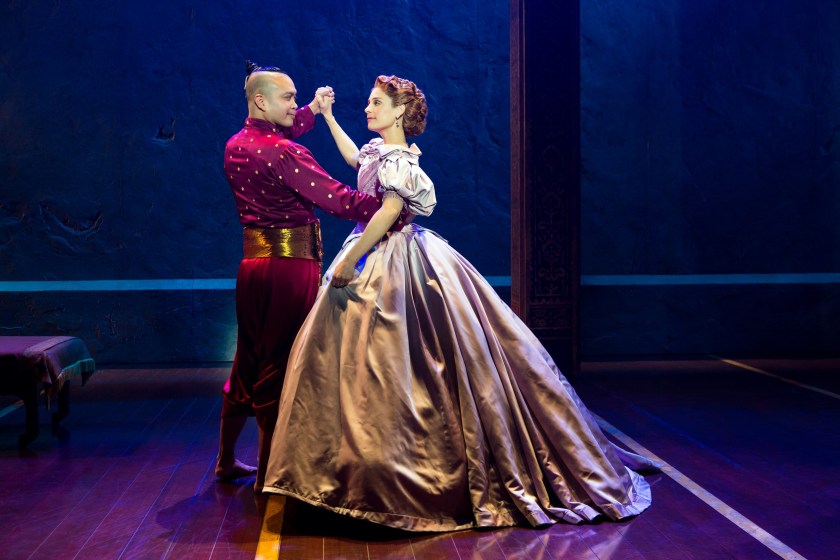
The King of Siam (Jose Llana) and Anna Leonowens (Elena Shaddow) take a spin around the dance floor in The King and I. (Photo by Jeremy Daniel)

By Richard Ades

When theater companies want to bring new life to a familiar work, they often rely on obvious changes. A recent example is Opera Columbus’s production of Gluck’s Orphee et Eurydice, with its surreal scenery, avant-garde instrumentation and virtual chorus. And, of course, there are any number of Shakespearean productions that move the action to a different locale, time period or both.

The Lincoln Center Theater and director Bartlett Sher take a different tack with Rodgers and Hammerstein’s The King and I. The musical is still set in Siam (now Thailand) in the 1860s and still focuses on the evolving relationship between an authoritarian king and a widowed British teacher who’s hired to tutor his many children. But there’s a subtle difference from earlier productions, and certainly from the 1956 movie starring Deborah Kerr and Yul Brenner.

It mainly can be found in the character of the king. As wonderfully played by Jose Llana, he is imperious and comically petulant, yet he’s also vulnerable and even sympathetic. We understand that he’s concerned for his country’s future, not wanting it to become a European protectorate like some of his neighbors. Though he has hired a British governess to teach his children, he comes to rely on her to help him modernize—basically, to Westernize—his country in order to convince Europe that Siam doesn’t need “protecting.”

As governess Anna Leonowens, Elena Shaddow is a charming mixture of politeness and stubborn determination. Though her Victorian upbringing makes it hard for her to accept the king’s polygamy, she does her best to get along with her royal employer. However, she refuses to bend on one matter: the king’s promise, which he seems to have conveniently forgotten, to provide her and her son, Louis (Rhyees Stump), with a home of their own.

The production opens with a gorgeous scene, courtesy of set designer Michael Yeargan and lighting designer Donald Holder: the sunset arrival of the ship that brings Anna and Louis to Bangkok. After that, the scenery is far more restrained, with the outline of the palace walls in the background and long curtains playing a big role in delineating the change from one location to the next. It’s what goes on in front of the scenery that makes this staging so special.

Besides Anna and the king, key characters include Prime Minister Kralahome (Brian Rivera); the king’s head wife, Lady Thiang (Jane Almedilla); and Prince Chulalongkorn (Charlie Oh), his oldest son. Adding a dark subplot is the young and beautiful Tuptim (Q Lim), a “gift” from Burma who is forced to submit to the king’s advances despite being in love with another man, Lun Tha (Kavin Panmeechao).

Fine voices give some of Rodgers and Hammerstein’s most beloved tunes their due, including Anna’s “Hello, Young Lovers” and “Getting to Know You” and Anna and the king’s “Shall We Dance?” Panmeechao’s thin tones are a slight impediment to Lun Tha’s wistful duets with Tuptim, “We Kiss in a Shadow” and “I Have Dreamed.” On the other hand, Almedilla’s matronly voice only adds depth to the show’s most touching number, Lady Thiang’s “Something Wonderful.”

A large orchestra consisting mostly of local musicians (who, for a change, are actually named in the program) performs under Gerald Steichen’s baton. Christopher Gattelli’s adaptation of Jerome Robbins’s original choreography is especially delightful during Act 2’s prolonged ballet, a Siamese take on Uncle Tom’s Cabin.

“Delightful” is a good adjective for the show in general, along with “illuminating” and “amazing.” And, hopefully, “unmissable.”

Broadway in Columbus and CAPA will present The King and I April 24-29 at the Ohio Theatre, 39 E. State St. Columbus. Show times are 7:30 p.m. through Thursday, 8 p.m. Friday, 2 and 8 p.m. Saturday, and 1 and 6:30 p.m. Sunday. Running time: 2 hours, 55 minutes (including intermission). Tickets are $34-$109+. 614-469-0939, 1-800-745-3000, columbus.broadway.com, capa.com or ticketmaster.com. For information on future tour stops, visit thekinganditour.com.

If this doesn’t raise your spirits, the Nazis win

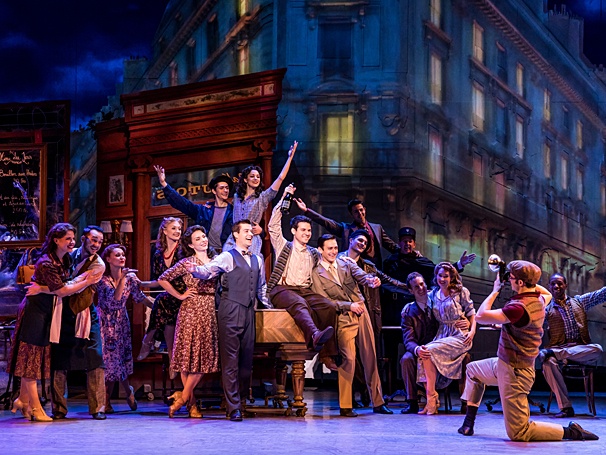
Scene from An American in Paris, presented by Broadway in Columbus (Photos by Matthew Murphy)

By Richard Ades

Love is more important than art, a character proclaims during a key moment from An American in Paris. While that’s undoubtedly true, it’s art that makes the musical so memorable.

Christopher Wheeldon’s direction and choreography combine with Bob Crowley’s set and costumes, Natasha Katz’s lighting and, most of all, George and Ira Gershwin’s ageless jazz tunes to create multiple gifts for the eyes and ears. As for the love story at its center, it mostly amounts to the colorless glue that holds it all together.

Based on the 1951 film about an American (Gene Kelly) who woos a reluctant Frenchwoman (Leslie Caron), the musical took an unconventional path to its 2015 Broadway premiere. It debuted in late 2014 in Paris, where it created a stir despite the language barrier. In addition to its glorious musical numbers, Parisians likely were attracted to its rejiggered plot and setting.

Book writer Craig Lucas moves the tale back to 1945, when the City of Light is struggling to regain its spirit after the dark years of Nazi occupation. Memories of the war affect two central characters in different ways: Jewish American composer Adam Hochberg (Matthew Scott) is so traumatized that he can write only dirges that fit in with his gloomy view of life. In contrast, Frenchman Henri Baurel (Ben Michael) is determined to move beyond his own war experiences by fulfilling his lifelong dream of becoming a song-and-dance man.

Unbeknownst to them, Adam and Henri are united by their mutual love of a ballet dancer named Lise Dassin (Allison Walsh). Nor do they know that Lise has a third admirer in the form of American G.I.-turned-artist Jerry Mulligan (McGee Maddox). Complicating things even further, Jerry attracts the attention of wealthy benefactor Milo Davenport (Kirsten Scott), who clearly expects sexual favors in return for her valuable patronage.

McGee Maddox and Allison Walsh as Jerry and Lise, the characters played by Gene Kelly and Leslie Caron in the original 1951 film version 

Jerry and Lise are the people we’re supposed to care about the most, so it’s disappointing that Maddox and Walsh generate so few romantic sparks. Making up for this in spades, both are lithe dancers and competent singers, as they prove over and over again throughout. (Note: Kyle Robinson fills in as Jerry on Saturday afternoon and Sunday evening, while Deanna Doyle plays Lise during the Sunday matinee.)

More interesting than the two romantic leads are the dramatic arcs undergone by Adam and Henri, particularly during Act 2. In fact, the second act surpasses its predecessor in terms of both drama and spectacle.

Two late-arriving song-and-dance numbers are alone worth the price of admission: “I’ll Build a Stairway to Paradise,” led by Henri and Adam; and “An American in Paris,” a surreally amazing piece featuring Lise, her ballet partner (Kevin A. Cosculluela) and the rest of the company. Both are complemented by set designer Crowley’s most sublime creations and the Gershwins’ most powerful melodies.

Other classic tunes include “I Got Rhythm,” “The Man I Love,” “’S Wonderful” and “They Can’t Take That Away From Me.” All are accompanied in a full-throated style by a massive band conducted by David Andrews Rogers.

After premiering on Broadway in early 2015, An American in Paris won Tonys for its choreography, lighting, orchestration and scenic design. The touring version excels in those same areas, making it an awe-inspiring experience for anyone who ventures to the Ohio Theatre this week.

Broadway in Columbus and CAPA will present An American in Paris through March 11 at the Ohio Theatre, 39 E. State, Columbus. Show times are 7:30 p.m. through Thursday, 8 p.m. Friday, 2 and 8 p.m. Saturday, and 1 and 6:30 p.m. Sunday. Running time: 2 hours, 45 minutes (including intermission). Tickets are $31-$104. 614-469-0939 (CAPA), 1-800-745-3000 (Ticketmaster), columbus.broadway.com, capa.com or ticketmaster.com.

What do ‘Waitress’ and ‘The Band’s Visit’ have in common?

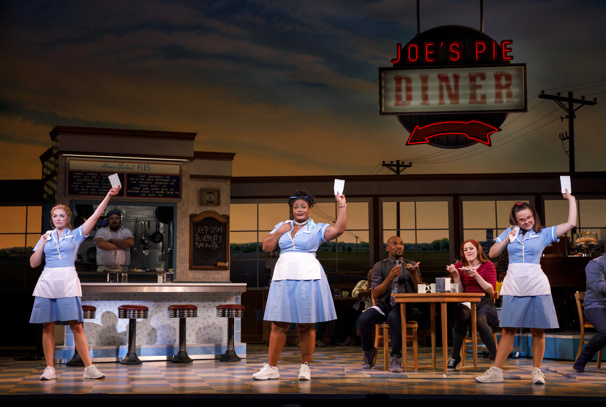
Desi Oakley, Charity Angel Dawson and Lenne Klingaman (from left) in the Broadway in Columbus presentation of Waitress (photo by Joan Marcus)

By Richard Ades

The transition from the screen to the stage is a tricky one. There have been a few triumphs, but the results are more often disappointing.

The latest film adaptation is The Band’s Visit, a musical that recently moved to Broadway after a successful off-Broadway run. Tony Shalhoub (TV’s Monk) and Katrina Lenk lead a uniformly strong cast, and David Cromer’s sensitive direction captures the cross-cultural discomfort that develops when an Egyptian police band unexpectedly shows up in a remote Israeli village. On top of that, David Yazbek’s music and lyrics are delightful.

Despite the musical’s strengths, I left the Ethel Barrymore Theatre feeling less satisfied than I was after seeing the 2007 Israeli movie on which it’s based. The stage production attempts to create dramatic arcs by playing up several elements of the story, especially the flirtation that Lenk’s restaurant owner directs toward Shalhoub’s uptight band director. It does this at the expense of the little interactions that, in the film, mark the Israelis and the Egyptians as fellow travelers on the sad, lonely journey known as life. The stage show is good, but it lacks its predecessor’s understated charm.

Would I have liked the show more if I hadn’t seen the film? Possibly. So maybe it’s good that I didn’t catch another 2007 movie, Waitress, before seeing its musical adaptation this week at the Ohio Theatre. The late Adrienne Shelly’s flick has been faulted for diluting a story of female empowerment with broad humor, and the stage production likely broadens the humor even more.

The heroine is Jenna (the relatable Desi Oakley), a small-town waitress married to a control freak named Earl (the effectively hateful Nick Bailey). Jenna is desperate to escape from her loveless marriage, but her hopes are dashed when she learns she’s pregnant.

Ironically, her pregnancy leads her to Dr. Pomatter (Bryan Fenkart), a gynecologist who instantly falls for both her and the stellar pies she concocts for the restaurant. Taken off guard by the unfamiliar experience of being appreciated for who she is, Jenna begins an affair with the kind, though married, doctor. Meanwhile, she sets her sights on a pie-making contest whose prize money could bankroll a new life for her and her future child.

As long as the focus stays on Jenna and her miserable situation, Waitress serves as a sobering look at the serious issue of spousal abuse. However, book writer Jessie Nelson and director Diane Paulus seem determined to keep the crowds pleased by devoting much of the show’s time and energy to broad comedy populated by familiar stereotypes.

Jenna’s fellow waitresses are Becky (Charity Angel Dawson) and Dawn (Lenne Klingaman). The former is sassy (i.e., she’s black), and the latter is shy and nerdy (i.e., she wears glasses). In subplots that largely overshadow the main plot, Becky launches into an affair of her own, while Dawn attempts to end her social isolation by running a personal ad. This attracts the attention of Ogie, an oddball exuberantly played by Jeremy Morse with overtones of Paul Lynde and Henry Gibson, the poet from TV’s Laugh-In. Ogie’s comic solo number, Never Ever Getting Rid of Me, becomes the closest thing the musical has to a show stopper.

Roaming even further from Jenna’s homefront predicament, the proceedings nearly turn into a sex farce when all three waitresses and their respective beaus simultaneously engage in onstage canoodling. Diner manager Cal (Ryan G. Dunkin) and elderly owner Joe (Larry Marshall) also contribute to the show’s sexual preoccupation, though the latter does so only by sharing his erotic memories.

The mood finally turns sober again just in time for Jenna’s biggest and saddest solo, She Used to Be Mine, sung with the kind of strong and committed voice Oakley brings to all of her songs. In fact, composer/lyricist Sara Bareilles’s tunes are well served by the entire cast and by conductor/pianist Jenny Cartney and her onstage band. But none of this makes up for the fact that the pop/country melodies are mostly forgettable and the lyrics seldom rise to the level of deep poetry.

Despite its inconsistencies and weaknesses, Waitress remains on Broadway after a year and a half, suggesting that it satisfies patrons’ theatrical taste buds. And it did seem to make many people happy at the Ohio on Tuesday, despite a technical snafu that delayed the show long enough to turn it into a 3½-hour ordeal.

So if the idea of spicing up a serious social issue with broad comedy doesn’t give you acid reflux, you, too, may find Waitress to your liking.

Broadway in Columbus and CAPA will present Waitress through Sunday (Nov. 12) at the Ohio Theatre, 39 E. State St., Columbus. Show times are 7:30 p.m. through Thursday, 8 p.m. Friday, 2 and 8 p.m. Saturday, 1 and 6:30 p.m. Sunday. Running time: 2 hours, 45 minutes (including intermission). Tickets are $34-$115. 614-469-0939, 1-800-745-3000, columbus.broadway.com, capa.com or ticketmaster.com.

Visual and vocal pizazz make ‘Bodyguard’ a nostalgic treat

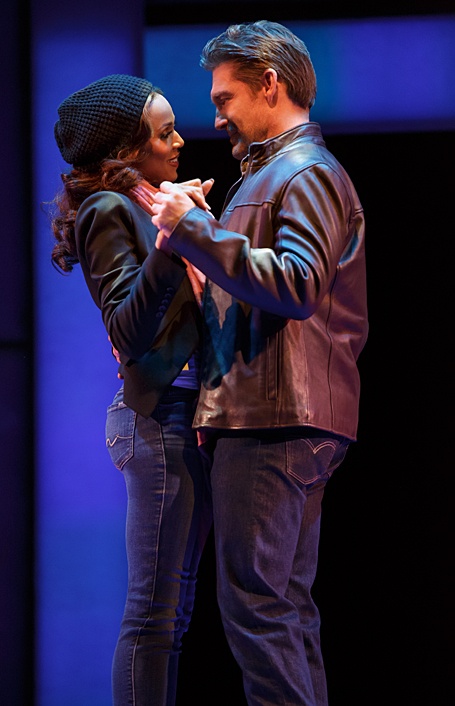
Deborah Cox as Rachel Marron in The Bodyguard (Photos by Joan Marcus)

By Richard Ades

I thought I’d seen flashy theatrical shows in the past, but I now realize I was mistaken. When it comes to flashiness, The Bodyguard is in a class by itself.

A stage remake of the 1992 flick starring Kevin Costner and Whitney Houston, the musical literally starts off with a bang—that is, a gunshot. After stunning viewers into rapt attention, director Thea Sharrock then holds their attention with flashy production numbers (choreographed by Karen Bruce), flashy sets and costumes (designed by Tim Hatley), flashy lighting (designed by Mark Henderson) and, most importantly of all, flashy singing. The latter is mostly provided by Deborah Cox, who does an expert job of filling in for the late and lamented Houston.

Mind you, I don’t mean to give the impression that The Bodyguard is nothing but flash. What makes the romantic thriller palatable and even enjoyable is that Sharrock knows the value of restraint. The thrills are meted out in a judicious manner that makes them all the more exciting when they arrive. That goes for the dramatic thrills, sometimes accompanied by a pleasantly startling jolt, but it particularly goes for the musical thrills.

One of the most entertaining scenes takes place in a karaoke club where disguised pop star Rachel Marron (Cox) has been persuaded to sing one of her own hit songs. After coyly understating the verse, setting off an “Is it her or isn’t it her?” chatter among a trio of college-age fans, she charges into the chorus with all the vocal power at her command. The fans squeal in delight, as does much of the audience.

Much later, Cox’s Rachel pulls off a similar trick with the Houston hit we all came to hear, I Will Always Love You. She underplays the first few verses, making us fear we’ll have to go back to the movie to hear it sung right. Then, to everyone’s delight, both Cox and director Sharrock pull out all the stops.

But I’m getting ahead of myself. There’s a love story to get through before we arrive at that spectacular moment. It’s not a very interesting love story, but the leads’ likable and unassuming performances make it diverting enough to tide us over between songs.

Rachel (Deborah Cox) and bodyguard Frank Farmer (Judson Mills) decide to give romance a try.

When Rachel’s life is threatened by a deranged stalker (Jorge Paniagua), her handlers hire bodyguard Frank Farmer (Judson Mills) to keep her safe. The two initially rub each other the wrong way, mostly because Rachel chafes against the cautious restrictions Frank tries to institute. But eventually they fall for each other and start, you know, rubbing each other the right way—until Frank realizes that their affair is compromising his ability to do his job.

Besides Rachel and Frank, the only relatable characters are Rachel’s sister, Nikki (Jasmin Richardson), and son, Fletcher (Douglas Baldeo). As Fletcher, Baldeo (replaced by Kevelin B. Jones III at alternate performances) is simply adorable. As the jealous Nikki, an aspiring singer who’s had to live her life in her famous sibling’s shadow, Richardson showcases her wide vocal range and dramatic style on the gorgeous solo Saving All My Love. (Note: Richardson will play Rachel at the Saturday matinee and Sunday evening performances.)

Supporting characters include Rachel’s press agent, Sy (Jonathan Hadley), and manager, Bill (Charles Gray), but other than Sy’s pushiness, neither is given much of a personality.

First performed in London’s West End in 2012 and featuring a book by Alexander Dinelaris, the musical simplifies the 1992 movie’s plot. No doubt, this was done to make it easier to stage, but the main motivation was probably to leave more room for the Whitney Houston songs that were the flick’s most timeless attributes.

With a star who approximates Houston’s vocal power and a production flashy enough to make up for its dramatic shortcomings, The Bodyguard should please fans of the movie and just about everyone else.

Broadway in Columbus and CAPA will present The Bodyguard through Sunday (Feb. 19) at the Ohio Theatre, 39 E. State St., Columbus. Show times are 7:30 p.m. through Thursday, 8 p.m. Friday, 2 and 8 p.m. Saturday, and 1 and 6:30 p.m. Sunday. Running time: 2 hours, 20 minutes (including intermission). Tickets are $34-$99. 614-469-0939, 1-800-745-3000, columbus.broadway.com, capa.com or ticketmaster.com.

Musical mermaid yearns for love in Disney do-over

Diana Huey as Ariel in the touring production of The Little Mermaid, presented by Broadway in Columbus and CAPA (Photo by Mark & Tracy Photography)
Diana Huey as Ariel in the touring production of The Little Mermaid, presented by Broadway in Columbus and CAPA (Photos by Mark & Tracy Photography)

By Richard Ades

In mythic lore, mermaids were seductive creatures whose haunting voices lured sailors to their deaths. In modern times, The Little Mermaid lured Disney to one of its rare stumbles: a 2008 Broadway musical that failed to reclaim the magic of the company’s 1989 animated flick. The production garnered so-so reviews and sank a year and a half later.

Now, in a salvage operation consisting of a complete overhaul, Disney has relaunched the tale in a touring show that corrects most of the original production’s faults. It’s still no Beauty and the Beast or The Lion King, but it’s a likable show that should keep parents and their young princes and princesses entertained.

Directed by Glenn Casale, the show uses cables and Kenneth Foy’s modest but attractive scenery to re-create the title character’s underwater world. The cables allow Ariel (Diana Huey) and others to “swim” through the domain ruled by her father, King Triton (Steve Blanchard). In scenes set at the surface or edge of the ocean, they allow her feathered friend Scuttle (Jamie Torcellini) to “fly.”

Though much has changed in the way the tale is told, the basic plot remains the same: Ariel is a teenage mermaid who has long been fascinated by humans despite her father’s claim that they’re barbarians who murdered her mother. Her fascination blossoms into a full-blown crush when she spies the seagoing Prince Eric (Matthew Kacergis) and subsequently saves his life when he falls overboard in a sudden storm.

Determined to meet the handsome Eric (who was unconscious when she pulled him from the sea), she makes a Faustian bargain with her evil aunt, Ursula (Jennifer Allen): Ariel will become human, but she will forfeit her soul unless she can persuade the prince to kiss her within three days. In addition, she will immediately lose her voice. That’s unfortunate for her, because Eric has fallen in love with the singing voice he heard before the storm and is determined to find and marry its owner.

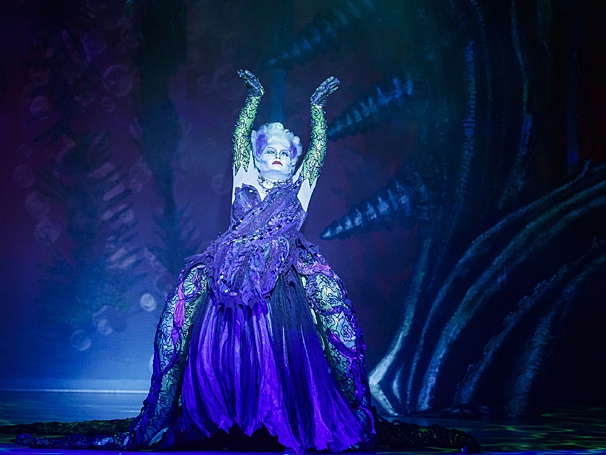
Jennifer Allen as the villainous Ursula

Though The Little Mermaid lacks the emotional depth of the best Disney musicals, it partially makes up for it by throwing in a boatload of humor. Scuttle’s misuse of the English language is a bit forced, but Allen’s tentacled and self-amused Ursula is good for chuckles. Funnier still is a scene in which a French chef (Dane Stokinger) prepares a meal by smashing deceased sea creatures with various kitchen utensils.

As Ariel, Huey is most successful at portraying the humorous side of puppy (guppy?) love, especially after the mermaid transforms into a human. In the sea, she’s often overshadowed by the more colorful characters around her, but on land, she’s amusingly awkward as Ariel struggles to deal with an unfamiliar body and emotions. (It’s probably unnecessary to point out that the former mermaid’s struggles symbolically parallel what the average girl goes through during her teen years.)

Despite the emphasis on comedy, The Little Mermaid’s biggest strengths are the tunes penned by composer Alan Menken and lyricists Howard Ashman and Glenn Slater. Sebastian (Melvin Abston), a crab who becomes Ariel’s protector, makes the most of two popular holdovers from the movie: Under the Sea and Kiss the Girl. Huey’s lovely voice soars on Ariel solos such as Part of Your World, while Kacergis displays the production’s strongest pipes on Eric’s numbers Her Voice and One Step Closer.

One element of the plot could use further honing: The inevitable happy ending comes about thanks to a sudden development that left both me and my date scratching our heads. Otherwise, The Little Mermaid—both the title character and the revised telling of her story—offers an inspiring lesson on the value of perseverance.

Broadway in Columbus and CAPA will present Disney’s The Little Mermaid through Sunday (Feb. 5) at the Ohio Theatre, 39 E. State St., Columbus. Show times are 7:30 p.m. through Thursday, 8 p.m. Friday, 2 and 8 p.m. Saturday, and 1 and 6:30 p.m. Sunday. Running time: 2 hours, 30 minutes (including intermission). Tickets are $29-$94. 614-469-0939, 1-800-745-3000, broadway.columbus.com, capa.com or ticketmaster.com.

Terrified prisoner seeks help from cinematic heroine

kiss-of-the-spider-woman-molina-and-valentin-argue

Molina (Scott Hunt, left) has an uneasy relationship with cellmate Valentin (Joe Joseph), a leftist revolutionary, in Short North Stage’s production of Kiss of the Spider Woman (photo by Jason Allen)

By Richard Ades

Molina prefers fantasy to reality. Small wonder: As a gay man living in a South American dictatorship in the 1970s, he’s too shy and scared to act on his romantic desires.

One of his fantasies involves his fevered friendship with Gabriel, a straight man who can’t give him the love he craves. Mostly, though, his fantasies revolve around Aurora, a movie star who embodies the feminine grace and beauty he tries to re-create in his job as a department-store window dresser.

Then Molina is thrown into prison on the trumped-up charge of making advances on an underage male. It soon becomes evident he’s being pressured by the warden to glean information out of Valentin, the leftist revolutionary who shares his cell. After avoiding reality all his life, Molina suddenly finds himself in a horrifying dilemma that not even fantasies of his beloved Aurora can block out.

Kiss of the Spider Woman is based on a novel by Manuel Puig that previously inspired a 1983 stage play and a 1985 movie starring William Hurt and Raul Julia. The stage musical—with book by Terrence McNally, music by John Kander and lyrics by Fred Ebb—opened on Broadway in 1993 and won that year’s Tony for best musical.

After seeing the film, the play and the musical, I still find the film the most moving interpretation of the story. But Short North Stage’s production of the musical, directed by Michael Licata (who also helmed 2015’s wonderful A Little Night Music), is impressive on several levels.

Scott Hunt gives a relatable portrayal of the in-over-his-head Molina and backs it up with a beautiful singing voice. Joe Joseph is macho but vulnerable as Valentin and also displays strong pipes, especially in an Act 1 lament about Marta, the woman he loves.

As Aurora, the movie star who dominates Molina’s fantasies, Eli Brickey often is required to sing while swinging (upside down, even) from a suspended sash. Though she aces this dizzying task, at other times her breathy voice seems stretched by the role’s vocal demands. She also projects less glamour than one would expect from such a fantasy figure, though she has no trouble projecting a satirical take on glamour, as she does during a Betty Boop-style number in Act 2.

Movie queen Aurora (Eli Brickey) performs with dancers (from left) Edgar Lopez, James Schoppe, Kevin Ferguson and Patrick Carmichael. (photo by Jason Allen)

Key supporting roles are nicely handled by Todd Covert as the manipulative warden; Alex Armesto and Amari Ingram as the abusive prison guards; James Schoppe as Molina’s friend, Gabriel; Danielle Grays as the sexy but unreliable Marta; and Linda Kinnison Roth as Molina’s loving mother.

Visually, the production boasts a weathered-looking two-story set designed by Jason Bolen. Though not lit as dramatically as it might be by Adam Zeek, it allows the action to skip effortlessly between terrifying reality and the musical fantasy sequences that represent the inner workings of Molina’s troubled mind.

Speaking of those fantasy sequences, they benefit from Edward Carignan’s playful and sometimes kitschy choreography and are ably accompanied by musical director Philip Brown Dupont and his mighty backstage band.

As a final bonus, every word of dialogue and lyrics comes through clearly, not the easiest feat in the Garden Theater’s acoustically challenging auditorium.

Add all this to the fact that this is the area premiere of Kander and Ebb’s award-winning work, and the show becomes a top priority for fans of musical theater.

Short North Stage will present Kiss of the Spider Woman through Nov. 20 at the Garden Theater, 1187 N. High St., Columbus. Show times are 8 p.m. Thursday-Saturday and 3 p.m. Sunday. Running time: 2 hours, 45 minutes (including intermission). Tickets are $25-$42. 614-725-4042 or shortnorthstage.org.

Tending a plant that won’t take ‘no’ for an answer

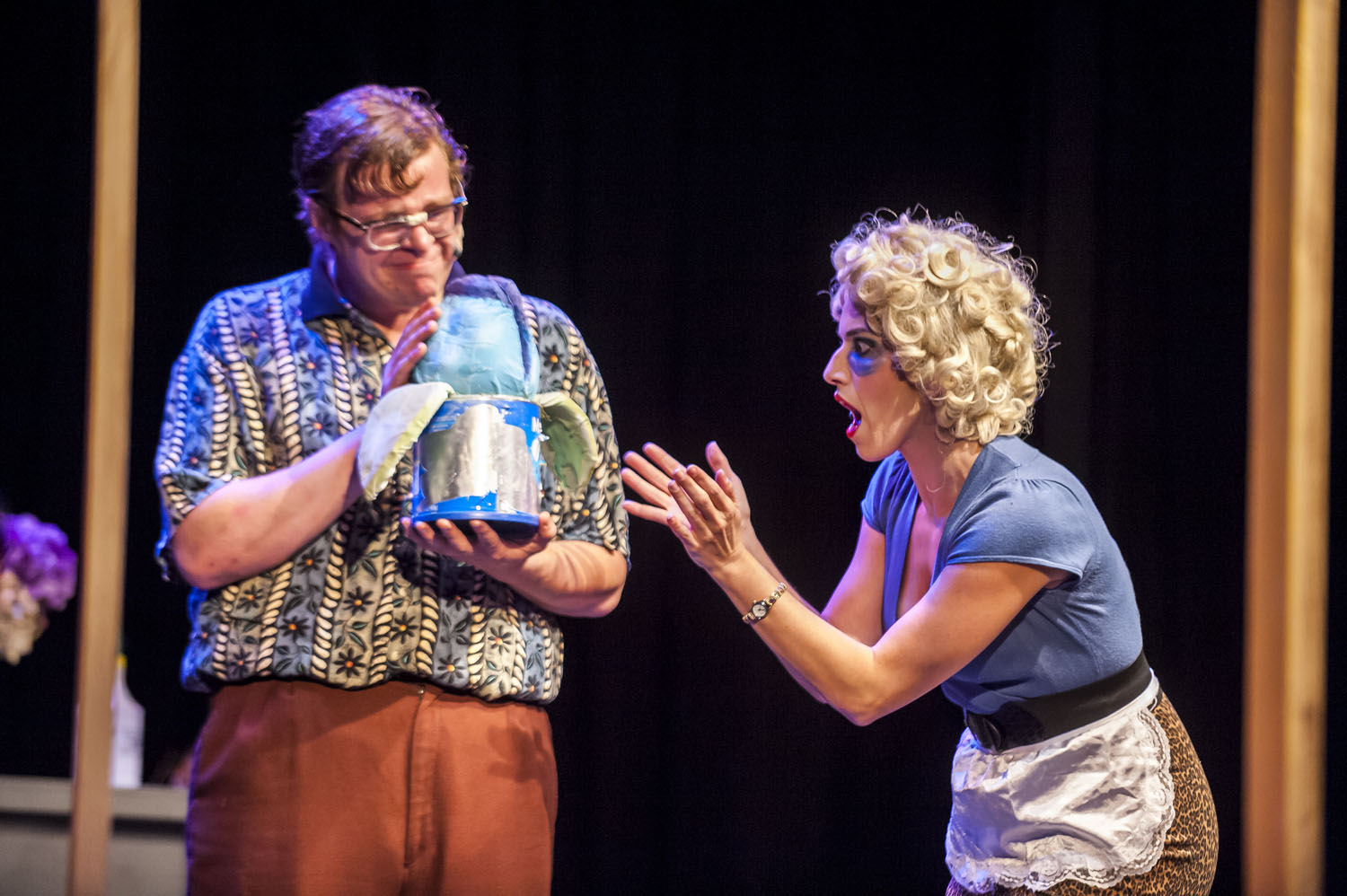
Seymour (Lukas Tomasacci) hopes his newly discovered plant will help him win over his beloved Audrey (Edelyn Parker). (Shadowbox Live photo)

By Richard Ades

Skid Row isn’t the best location for a flower shop. That’s the conclusion store owner Mr. Mushnik (Tom Cardinal) reaches following a sales-less day in Little Shop of Horrors.

Luckily, store clerk Seymour (Lukas Tomasacci) discovers a mysterious plant that soon has customers flocking to their door. Well, maybe “luckily” isn’t the right word, since Seymour quickly learns that the plant thrives only when it gets a steady supply of its favorite food: human blood.

Based on a low-budget 1960 film, the stage musical opened off-off-Broadway in 1982 but was soon transplanted to Broadway, where it bloomed into a five-year hit. Its success is mostly due to the sparking collection of rock, pop and blues songs written by lyricist Howard Ashman and composer Alan Menken, the team behind Disney’s The Little Mermaid and Beauty and the Beast.

Though obviously darker than those family-friendly flicks, the musical shares a seed of humanity and a sense of fun that prevent it from becoming too macabre.

At Shadowbox, it’s hardly surprising that director Stev Guyer and his cast have no trouble with the musical numbers. The vocals are both strong and expressive, never allowing the characters’ personalities to get lost in the melodic underbrush. Accompanying them is a four-piece band that has a feel for the music, which often sounds like a holdover from rock’s innocent early years.

Between songs, the production mostly hits the right dramatic and comic notes.

Tomasacci wins our sympathy as Seymour, an orphan who was taken in by Mr. Mushnik as a child. As a result of his gratefulness and low self-esteem, Seymour feels unworthy of demanding better treatment from the employer who underpays and overworks him. And he feels even less worthy of the woman he secretly worships, fellow clerk Audrey (Edelyn Parker).

For her part, Audrey has even lower self-esteem, to the extent that she puts up with constant abuse from her sadistic dentist/boyfriend, Orin (Jamie Barrow). Parker plays Audrey as a stereotypical bimbo but with an undercurrent of longing that becomes palpable in the wistful ballad Somewhere That’s Green. Unfortunately, Parker adds a veneer of stagy melodrama by striking poses straight out of the silent-film era. It’s a puzzling choice that undercuts an otherwise sympathetic portrayal.

As Orin, the nitrous oxide-addicted dentist who’s never happy unless he’s making Audrey or his patients miserable, Barrow is like a less-scary version of Dennis Hopper’s maniac in Blue Velvet. He’s amusing, but a bit more menace would make him a better villain.

Then again, when it comes to menace and villainy, it would be hard to beat the bloodthirsty plant that Seymour names Audrey II. Depicted by puppets of ever-increasing sizes, it’s voiced by Billy DePetro in raucous tones that suggest an evil radio deejay.

Helping to establish the neighborhood’s rundown character are a mostly silent wino (Brandon Anderson) and three spunky “urchins” (Noelle Grandison, Nikki Fagin and Ashley Pearce). The latter serve as a streetwise Greek chorus, commenting from the sidelines and occasionally breaking into song.

Watching a scene in which Seymour contemplates committing murder to feed the insatiable Audrey II, some may be reminded of a similar scene from Sondheim’s Sweeney Todd, which a couple of local troupes revived in the spring. Though otherwise completely different, both musicals sport bloody plots driven by love: love lost in Sweeney Todd and love desired in Little Shop of Horrors.

That fertile bit of humanity, along with the hummable tunes, keeps Ashman and Menken’s cult hit from withering away on its farcical vine.

Little Shop of Horrors will be presented through Nov. 27 at Shadowbox Live, 503 S. Front St., Columbus. Show times are 2 and 7 p.m. select Sundays (no shows Nov. 6 or 20), plus 2 p.m. Dec. 3, 10 and 17. Running time: 2 hours, 5 minutes (including intermission). Tickets are $25, $20 students/seniors. 614-416-7625 or shadowboxlive.org.

Missionaries have close encounter of the Merman kind

By Richard Ades

The Book of Merman is to The Book of Mormon what a Pekingese is to a bulldog: It’s smaller, fluffier and far less funny.

To be fair, The Book of Merman isn’t entirely fluffy, as it does have a message about being true to oneself. But you’ll see that coming so far in advance that it doesn’t have much impact.

Written by Leo Schwartz, the musical starts out with a clever premise. It’s about a pair of Mormon missionaries who come face to face with a woman who claims to be someone she clearly isn’t. Or is she?

We first meet Elders Shumway and Braithwaite (Nick Hardin and T. Johnpaul Adams) as they’re bickering their way from one suburban doorbell to the next while trying to avoid their territorial rivals, the Jehovah’s Witnesses. The bickering stems from the fact that Braithwaite is far more into their two-year mission than Shumway, who seems so averse to all things Mormon that he can’t even stand Salt Lake City.

Then they end up at the door of a woman who calls herself Ethel Merman (Gina Handy). Shumway, a fan of Broadway in general and Merman in particular, is overcome with joy. He immediately believes she’s who she says she is, even though the real Ethel Merman reportedly died in 1984. In no time, he’s chatting with her about his own dreams of becoming a Broadway composer and star.

For his part, Braithwaite doesn’t even know who Merman was—or is. He just wants to give this odd woman the word of Mormon so they can get on with their mission.

Working under Bryan Adam’s direction and Bryan Babcock’s musical direction, all three cast members give likable and tuneful performances.

Hardin is particularly convincing as the stage-struck Shumway, while Adams, by a slight margin, exhibits the most commanding voice. As Merman, Handy isn’t always as big and brassy as she could be, especially when she’s speaking. But when she really lays into a song, her Merman impersonation is nearly impeccable.

The songs themselves are sometimes takeoffs on Broadway tunes that became Merman standards. For example, Most People fills in for Some People from Gypsy, while You’re the Best replaces You’re the Top from Anything Goes. These are OK, but they suffer from comparison to the hits that inspired them.

Some of the Schwartz’s original songs are more entertaining, especially the Act 2 tribute Because of You, beautifully sung by Adams. Babcock’s spirited piano provides the musical accompaniment.

In between the songs, and even during one of them (Son of a Motherless Goat), the humor often pokes fun at the Mormons’ squeaky-clean ways, such as their refusal to curse. These jokes quickly suffer from diminishing returns.

More impressive than the script is the set on which it’s performed. Director Adam’s scenic design, showing Merman’s living room, is far more detailed than anything we’re used to seeing in the Columbus Performing Arts Center’s cozy Van Fleet Theatre.

With a handsome set, an endearing cast and a timeless moral, The Book of Merman adds up to a harmless diversion. If you want more than that, you’ll have to hold out for The Book of Mormon.

Evolution Theatre Company will present The Book of Merman through July 30 at the Columbus Performing Arts Center, 549 Franklin Ave., Columbus. Show times are 8 p.m. Wednesday-Saturday (no show July 27). Running time: 1 hour, 35 minutes (including intermission). Tickets are $25, $20 seniors, $15 students. 1-800-838-3006 or evolutiontheatre.org.

Staged ‘Dirty Dancing’ best seen through nostalgia-tinted glasses

Baby (Rachel Boone) and Johnny (Christopher) share a few steps in the national tour of Dirty Dancing, presented by Broadway in Columbus (photo by Matthew Murphy)
Baby (Rachel Boone) and Johnny (Christopher Tierney) practice their moves in the national tour of Dirty Dancing, presented by Broadway in Columbus (photo by Matthew Murphy)

By Richard Ades

If you’re a fan of Dirty Dancing, you may not have the time of your life watching the stage show, but it’ll probably do until the next time you catch the 1987 flick.

Adapted by original screenwriter Eleanor Bergstein, the theatrical version tries to recapture the magic of the Jennifer Grey-Patrick Swayze romance but starts out with several strikes against it.

The first strike, of course, is that it features neither Jennifer Grey nor the late Patrick Swayze. In their place, the current touring show has Rachel Boone as Frances “Baby” Houseman, who’s vacationing with her family at a Catskills resort in 1963; and Christopher Tierney as Johnny Castle, the working-class dance instructor who attracts her attention.

Boone earns our sympathy and sometimes our laughs as the high-minded Baby, but Tierney’s Johnny is rather stiff except when he’s strutting his stuff on the dance floor. The two generate so little chemistry that when Baby finally announces her feelings for Johnny, it comes as a surprise even though we know that’s what the whole show is about.

It’s not entirely the actors’ fault. The second strike against the show is its episodic structure, especially in the hectic first act. Scenes fly by so fast that there’s no time for any emotional depth to develop.

Strike three is the quirky nature of the show, which can’t be called a real musical because it denies its stars the chance to express themselves in song. Most of the vocal numbers are delivered by minor characters such as Elizabeth (Adrienne Walker) and Billy Kostecki (Doug Carpenter). Both sing beautifully, but in the process they effectively put both Johnny and Baby in the corner.

All of this would have been enough to strike out the average show, but it hasn’t seemed to hurt Dirty Dancing, which has become a worldwide hit. The only explanation is that the show effectively, if imperfectly, rekindles viewers’ affection for the film.

The vintage pop tunes are back, along with several more that couldn’t be obtained for the film. They include Do You Love Me?, If You Were the Only Girl and the beloved finale, (I’ve Had) The Time of My Life. All are accompanied by a boisterous and brassy onstage (but usually hidden) band led by Alan J. Plado.

Also back are the early 1960s idealism and conflicts, including references to the Peace Corps and the civil rights struggle. It’s in this unstable atmosphere that Baby steps forward to help Penny (Jenny Winton), a friend of Johnny who has been impregnated by her well-to-do boyfriend. That sets up a misunderstanding that drives a wedge between Baby and her previously doting father (Mark Elliot Wilson).

Best of all, the dancing is back, courtesy of Michelle Lynch’s high-kicking and high-lifting choreography.

James Powell’s direction makes the most of the flashier moments, particularly when special effects are used to “show” Baby and Johnny practicing their dance moves in the middle of a forest, a field and even a lake. Stephen Brimson Lewis’s set designs and Jon Driscoll’s video and projection designs are the real stars here.

The supporting cast is all strong, with some of the funniest moments provided by Alex Scolari as Baby’s bratty and vocally challenged sister, Lisa.

The stage version of Dirty Dancing is hardly a classic, but it does have the advantage of reviving viewers’ memories of a classic. For many, that will be enough.

Broadway in Columbus and CAPA will present Dirty Dancing through May 22 at the Ohio Theatre, 39 E. State St., Columbus. Show times are 7:30 p.m. through Thursday, 8 p.m. Friday, 2 and 8 p.m. Saturday, and 1 and 6:30 p.m. Sunday. Running time: 2 hours, 25 minutes (including intermission). Tickets are $58-$153. 614-469-0939, 1-800-745-3000, broadway.columbus.com, capa.com or ticketmaster.com.