Sweet music, jarring language and a timeless morality tale

Big River

By Richard Ades

Standing Room Only nearly lived up to its name Friday, as its evening performance of Big River filled most of the seats in CPAC’s Van Fleet Theatre. Hopefully, that means there’s a market for the ambitious programming the troupe has been tackling of late.

Or maybe it simply means people have an undying love for the tale whose source material is often considered the Great American Novel: Mark Twain’s The Adventures of Huckleberry Finn. Adapted by William Hauptman (book) and Roger Miller (music and lyrics), the Tony-winning musical again sends its scruffy title character and a runaway slave named Jim down the Mississippi on their respective quests for adventure and freedom.

One of the gutsiest things about SRO’s production is also the reason parents might want to prepare their youngest children for the experience. Like Twain’s novel, but unlike an expurgated version I saw many years ago, it allows characters to spout the most racist term in the American vocabulary. The word can sound jarring to modern ears, but it’s probably necessary. That’s because the story depends on a frank portrait of 19th century attitudes to underscore its central lesson.

Huck begins the tale as a rebellious lad who nonetheless accepts the morality of his pre-Civil War era when it comes to the subjugation of black Americans. Indeed, he’s so convinced slavery is a holy institution that he worries he’ll go to hell if he helps Jim escape. Both the novel and the musical are most moving when they show the boy reassessing his position after getting to know Jim as a human being.

Miller’s songs are sometimes stirring but mostly laid-back and pleasant, especially when accompanied by SRO’s old-timey quintet. Performing under music director Chipper Snow, it’s dominated by Ted Reich’s wistful harmonica and Jordan Shear’s lively fiddle.

As for the vocals, there are a few pitchy moments, but most cast members are up to the challenge. That’s especially true of the two male leads. Caleb Baker (as Huck) and Brandon Buchanan (as Jim) harmonize beautifully on duets such as Muddy Water and Worlds Apart.

Acting-wise, their styles are a bit less harmonious. Though Buchanan’s Jim reflects the tension and fears of a man determined to float his way to freedom, Baker’s Huck is unrelentingly calm. He seems unruffled whether he’s fighting off a knife attack or trying to avoid being tarred and feathered by angry townsfolk.

Baker’s physical appearance—he’s taller and huskier than most of the “adults” around him—also undercuts his portrayal of the youth. But that would be less of a problem if he acted more like a frightened teen rather than a laconic good ol’ boy.

Several of the supporting players make indelible impressions under Dee Shepherd’s easy-going direction.

John Feather is dignified and decent as Judge Thatcher, then abandons both dignity and decency to play the self-described King, a con artist who hitches a ride on Huck and Jim’s raft. Greg Zunkewicz is equally conniving as the King’s companion, the Duke, but he sometimes needed to project more at the performance I attended.

Funniest of all is Thor Collard as Huck’s drunken Pap, especially when he’s railing musically against the Gov’ment. Sweetest of all is Ashton Brammer as Mary Jane, who wins Huck’s heart when she becomes the victim of a scheme hatched by the King and the Duke.

As Huck’s friend Tom Sawyer, Anthony Guerrini gets across the lad’s addiction to romantic adventures. It’s not his fault that Tom becomes a distraction late in the story. His 11th-hour reappearance is the only instance in which Twain’s Great American Novel becomes a little less than great.

Even more than SRO’s recently staged Sweeney Todd, Big River is presented in a bare-bones manner. Designed by Angela Barch, some of the costumes are only vaguely 1840-ish, while the “scenery” consists mainly of a footlocker and a large box.

But none of that matters when the production is at its best, doling out sweet music along with a morality tale that retains its power 131 years after it first pricked the conscience of America.

Standing Room Only Theatre will present Big River through May 7 at the Columbus Performing Arts Center, 549 Franklin Ave., Columbus. Show times are 8 p.m. Friday and 2 and 8 p.m. Saturday. Running time: 2 hours, 50 minutes (including intermission). Tickets are $21, $18 seniors (55-plus), $16 members, $12 students. 614-258-9495 or srotheatre.org.

Singing and dancing overshadow emotion in latest ‘Fiddler’

Appearing in Otterbein University Theatre’s production of Fiddler on the Roof are (front) Lauren Kent (Tzeitel), (rear, from left) Aubree Tally (Golde), Natalie Szczerba (Hodel), John Stefano (Tevye) and Abigail Isom (Chava) (photo by Evan Moore-Coll)

By Richard Ades

Otterbein University Theatre apparently is giving Fiddler on the Roof to John Stefano as a going-away present. The professor, who’s retiring after 24 years in the theater and dance department, had long dreamed of playing the iconic dairyman, Tevye.

It’s a wonderful gesture on Otterbein’s part, but it wouldn’t have been surprising if the result had been a production that fell far short of the Tony-winning musical’s potential. After all, you can’t build a show this massive around a single actor.

Thankfully, Otterbein’s theater program is sufficiently rich in talent that its production has several stirring moments.

One of them comes shortly after Tevye introduces us to his Russian hometown, a Jewish community that, in the pre-revolutionary political climate of 1905, is finding life increasingly precarious. Gathering together with their families for the Friday night meal, Tevye and other villagers sing the beautiful Sabbath Prayer.

It’s a heartfelt scene that underscores the message of Tradition, the anthem that opens the show: These humble folks cling to their beliefs and rituals to give meaning to lives mired in poverty, pain and struggle.

Also stirring is the wedding scene in which Tevye and wife Golde (Aubree Talley) marry off the first of their five daughters. Its highlight comes when four dancers perform difficult moves while carefully balancing bottles on their flat-topped hats. Bravo!

In general, director Lenny Leibowitz’s production is at its best in large numbers involving singing and dancing. Otterbein has enough fine vocalists and dancers to carry off Jerry Bock and Sheldon Harnick’s glorious anthems and Stella Hiatt Kane’s acrobatic choreography, and rousing accompaniment is supplied by the ample-sized orchestra performing under Lori Kay Harvey’s baton.

Many of the individual actors also sing beautifully, including Lauren Kent, Natalie Szczerba and Abigail Isom as Tevye’s daughters Tzeitel, Hodel and Chava. Their early trio, Matchmaker, is an engaging exploration of their mixed feelings toward the ancient tradition of arranged marriage.

As for Stefano, he’s not the strongest vocalist who ever hauled around Tevye’s milk cart, but neither is he the weakest. Yes, his voice sometimes falters, but it does so in a way that makes the character all the more endearing.

Stefano also shines during the humorous moments in which Tevye complains to God about his sad lot in life—or to the audience about his loving but fear-inducing wife, Golde. The actor’s comic timing is spot-on.

It’s in the more dramatic moments that the Otterbein production sometimes lacks finesse and timing. One example is the aforementioned wedding scene, which peters out long before it’s interrupted by an attack that foreshadows new problems for the local Jewish community.

Another example: Connor Cook is appealing as Motel, the shy tailor who’s afraid to ask Tevye for the hand of his oldest daughter, but the moment in which he finally works up the nerve is rushed through before it has a chance to sink in.

Other problems can be traced to overacting (Dana Cullinane as the over-the-top Matchmaker) or underacting (Andre Spathelf-Sanders, who barely registers as Chava’s non-Jewish suitor). And though Tally strikes the right balance between scariness and warmth as Golde, neither she nor her makeup artist make a serious attempt to disguise the age difference between her and the actor who plays her husband. As a result, it’s hard to believe Golde and Tevye’s marriage really has endured for 25 years.

The production has many strengths beyond those I’ve already mentioned. They include supporting players Connor Allston as Perchik, the radical student who woos Hodel, and Jack Labrecque as Lazar Wolf, the lonely butcher who sets his sights on Tzeitel. Rob Johnson’s nonrealistic scenery and T.J. Gerckens’s lighting also are striking.

Overall, though, this staging of the musical tragicomedy is more effective as a musical and a comedy than it is as a tragedy. Most productions of Fiddler on the Roof are three-hankie affairs, but one should be enough this time around.

Otterbein University Theatre will present Fiddler on the Roof through April 16 at Cowan Hall, 30 S. Grove St., Westerville. Show times are 8 p.m. Thursday-Saturday. Running time: 2 hours, 55 minutes (including intermission). Tickets are $25. 614-823-1109 or www.otterbein.edu/drama.

Show offers stripped-down, bloodied-up Sondheim

Susan Bunsold Wilson and Bill Hafner in Standing Room Only's production of Sweeney Todd (photo by Dale Bush)
Susan Bunsold Wilson and Bill Hafner in Standing Room Only’s production of Sweeney Todd (photo by Dale Bush)

By Richard Ades

If Columbus barbers have noticed a drop in business recently, it could be because the local theater scene is offering not one, but two productions of the bloodthirsty musical Sweeney Todd: The Demon Barber of Fleet Street.

Those whose taste tends toward the grandiose might want to check out the Ohio State version being presented this weekend at Mershon Auditorium. Those who favor more intimate productions might prefer the Standing Room Only production whose two-week run ends Sunday.

I’ve seen the latter, and I can recommend it with one caveat: The unamplified lyrics are sometimes hard to pick out over the accompaniment. That annoyance aside, the production does right by this darkest of musicals, which features a book by Hugh Wheeler and music and lyrics by Stephen Sondheim.

In fact, it does brilliantly by the musical, thanks to a well-chosen cast and Patrick McGregor II’s ingenious direction.

This is a “black box” production twice over. Not only is the scenery limited to a black backdrop and little more, but the main prop is a black, coffin-shaped box that is continually being moved and upended to serve a multitude of functions. This minimalistic approach might be distracting if McGregor’s cast weren’t so mesmerizing.

Following his starring role in Gallery Players’ 2015 production of Les Miserables, Bill Hafner again excels playing a 19th century man who’s suffered years of unjust imprisonment. But don’t expect to find much in common between the two portrayals.

Unlike the noble Jean Valjean, Sweeney Todd has vengeance on his mind—vengeance against the judge who sent him away in order to pursue his wife. The former barber’s fury intensifies when he returns to London only to learn that his wife is dead and his daughter has been adopted by that same judge. As portrayed by Hafner, Todd is so overcome by grief and anger that he stumbles around in a state of near catatonia.

In effective contrast, Susan Bunsold Wilson radiates manic energy as Mrs. Lovett, the widowed baker who ultimately becomes Todd’s partner in crime. As amoral as she is personable, Mrs. Lovett quickly finds a way to benefit when the deranged barber’s “shaves” start turning into homicides. It’s no coincidence that her meat pies soon become the talk of the neighborhood.

Both Hafner and Wilson display strong voices on numbers such as their duets By the Sea and the darkly humorous A Little Priest, in which Todd and Mrs. Lovett discuss the optimum ingredients for a tasty pie.

As the dastardly Judge Turpin, Todd Lemmon offers an understated version of villainy that disguises itself under a cloak of piety. Turpin and Hafner join their voices to great effect on Pretty Women, a beautiful song that incongruously arises during a moment of impending murder. A more blatant depiction of evil is offered by Colton Weiss as Turpin’s henchman, the nasal-voiced Beadle.

The musical’s second-most beautiful song, Not While I’m Around, is given a dramatic delivery by Layne Roate as the limping, dimwitted Tobias Ragg. Appearing in other important secondary roles are Ethan White as goodhearted seaman Anthony Hope; Taryn Huffman as Todd’s grown daughter, Johanna; and Laura Crone as a beggar woman and a rival barber.

An impressively large orchestra provides the accompaniment, though music director Josh Cutting ably replaced it with his keyboard at the matinee I attended. Curtis Brown’s lighting not only establishes mood but is used to shift viewers’ focus from one side of the room to the other during quick scene changes.

Filled with dark themes and bloody violence, Sweeney Todd is unsuitable for young children. But SRO’s inventive production makes it a treat for those who appreciate Sondheim’s lovely tunes and graceful lyrics even when they’re sung in the midst of a murder spree.

Standing Room Only Theatre will present Sweeney Todd through Sunday (April 10) at the Columbus Performing Arts Center, 549 Franklin Ave., Columbus. Remaining show times are 8 p.m. Saturday and 2 p.m. Sunday. Running time: 2 hours, 45 minutes (including intermission). Tickets are $12-$21 Saturday, $12-$16 Sunday. 614-258-9495 or srotheatre.org.

The Ohio State School of Music, Opera and Lyric Theatre will present Sweeney Todd through Sunday (April 10) at Mershon Auditorium, 1879 N. High St., Columbus. Remaining show times are 7:30 p.m. Saturday and 3 p.m. Sunday. Tickets are $20, $10 for senior citizens, students, children and OSU faculty, staff and alumni association members. Show isn’t suitable for ages 12 and under. 614-292-3535 or music.osu.edu.

Gamblers take a chance on romance in Loesser musical

Playing gamblers in Guys & Dolls are (from left): Bradley Davis Barbin, Kent Stuckey (Benny Southstreet), Todd Covert (Nathan Detroit), Derryck Menard and Ryan Kopycinski (Nicely Nicely) (photo by Jared Saltman)
Admiring a wad of cash in Guys & Dolls are (from left): Bradley Davis Barbin, Kent Stuckey, Todd Covert, Derryck Menard and Ryan Kopycinski (photo by Jared Saltman)

By Richard Ades

Guys & Dolls opened on Broadway in 1950 and subsequently won the Tony for best musical. I can only see that as a sign of how much society’s tastes have changed over the intervening decades.

Composer/lyricist Frank Loesser’s songs include the classic Luck Be a Lady and the infectious Sit Down, You’re Rocking the Boat. But they also include several unmemorable tunes and Sue Me, which combines a tender melody with the puzzling lyrics “So sue me, sue me, what can you do me?” Say what?

In short, Guys & Dolls is a mixed bag. And at 66 years of age, it’s a very dusty mixed bag. Adapted by Jo Swerling and Abe Burrows from short stories by Damon Runyon, it’s set in a quaintly old-fashioned version of New York’s underworld (dubbed “Runyonland”) where all the women are “dolls” and all the men are gamblers with hearts of gold.

Faced with the thankless task of resuscitating this chestnut for Gallery Players, director Mark Mann starts off by filling the four leading roles with likable and talented performers:
• Todd Covert as Nathan Detroit, a perpetually struggling gambler
• Amy Silver Judd as Miss Adelaide, a night club singer and Nathan’s longtime fiancée
• Kristin Yarger as Sarah Brown, head of a Salvation Army-like mission that tries to reform local “sinners”
• Christopher Storer as Sky Masterson, a traveling gambler and confirmed bachelor

The two women offer particularly distinct portrayals, Judd’s Adelaide coming off as a good-natured floozy while Yarger’s Sarah is sincere and grounded. Of the two men, Covert’s Nathan is slightly nicer, but both he and Storer’s Sky strike us as basically decent sorts.

As I said, all four of the leads are likable—maybe to a fault. If their characters had a bit more edge to them, their romantic intrigues might seem less blandly sweet.

Making up for the lack of dramatic tension, all four performers sing well and often beautifully under Bryan Babcock’s musical direction. An eight-piece band provides the big-sounding and mostly tuneful accompaniment.

Nathan Detroit (Todd Covert) and his longtime fiancee Miss Adelaide (Amy Silver Judd) in the Gallery Players production of Guys & Dolls (photo by Jared Saltman)
Nathan Detroit (Todd Covert) has an uncomfortable moment with his longtime fiancee, Miss Adelaide (Amy Silver Judd) in the Gallery Players production of Guys & Dolls (photo by Jared Saltman)

The plot centers on the illegal craps game Nathan is trying to set up for local and visiting gamblers. Short on the cash he needs to rent a space, he tricks Sky into betting he can lure the high-minded Sarah to accompany him to Havana. Sky leaps to the challenge by visiting Sarah’s mission and pretending he needs her help to repent from his evil ways.

Peripherally involved in the goings-on are Denae Sullivan as one of Sarah’s fellow missionaries; Ryan Kopycinski and Kent D. Stuckey as Nathan’s colleagues Nicely and Benny; Brad Barbin as police Lt. Brannigan; and Rick Cohen as Big Jule, a gat-packing gangster from Chicago.

Benny and various other gamblers are distinguished mainly by their colorful and era-appropriate suits, which were designed by Debbie Hamrick. The only one who gets a chance to stand out is Kopycinski’s Nicely, who helms the show’s most entertaining musical number, Sit Down, You’re Rocking the Boat.

Danielle Mann’s choreography is generally low-key except for a few acrobatic moves performed during the opening strains of Luck Be a Lady. Jon Baggs’s spare scenery is efficiently designed, keeping scene changes short.

Unfortunately, some of the scenes themselves tended to drag on opening night. A little tightening would help to keep things moving in between songs.

I’ve used terms such as “nice” and “likable” to describe the characters, and those are good descriptions of the production as a whole. If you’re in a mellow mood, that might be enough. But considering the show demands nearly three hours of your time, you may find yourself wishing for something more.

Gallery Players will present Guys & Dolls through March 13 at the Jewish Community Center, 1125 College Ave., Columbus. Show times are 7:30 p.m. Thursday, 8 p.m. Saturday and 2:30 p.m. Sunday. Running time: 2 hours, 50 minutes (including intermission). Tickets are $25 ($20 for JCC member), $23 for ages 60-plus ($18 for JCC members), $15 for students/children. 614-231-2731 or www.jccgalleryplayers.org.

Motown musical is like sunshine on a cloudy day

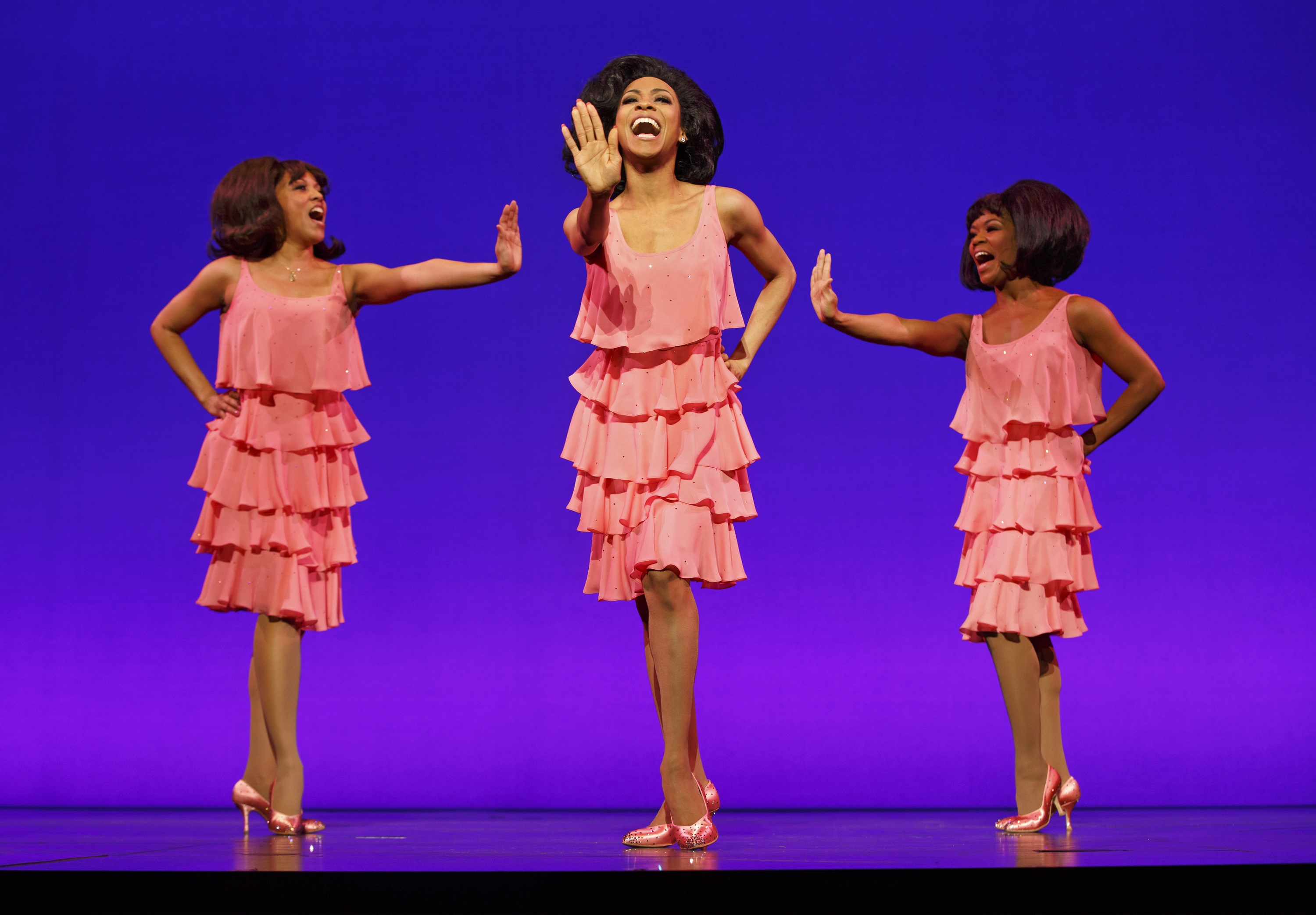
Playing the Supremes in Motown the Musical are (from left): Krisha Marcano (Florence Ballard), Allison Semmes (Diana Ross) and Trisha Jeffrey (Mary Wilson) (photo by Joan Marcus)

By Richard Ades

The curtain rises to reveal facsimiles of old Motown groups singing snippets of their hits. From the beginning, it’s clear that Motown the Musical is all about the music.

It’s only after we’ve been treated to several smartly choreographed numbers that the show introduces to the man around whom it revolves: Berry Gordy Jr. (Chester Gregory), who founded Motown and now is threatening to boycott a 1983 celebration of the record label’s 25th anniversary. Why? Because he holds a grudge against the many artists who abandoned it over the years.

Based on Gordy’s 1994 autobiography, the musical then backs up and begins recounting his long career.

First seen as a young boy growing up in Detroit, Gordy quickly develops into a brash young man who pushes his way into the music business by writing hits for singer Jackie Wilson (Rashad Naylor). But he soon becomes fed up with seeing his songs relegated to the B-sides of lesser efforts, so Gordy founds his own label.

This, however, introduces a whole new problem. Mainstream radio stations refuse to play black music—then known as “race music”—despite Gordy’s assurances that his soul/pop tunes appeal to everyone. His claim is borne out by a Southern concert that attracts a multiracial audience, which police officers struggle to keep segregated into “white” and “colored” sections of the auditorium.

Of the two acts, Act 1 is more interesting due to scenes like this that reflect the tenor of the times. It ends in the 1960s, a decade marked by hopeful activism and soul-rending violence: the Vietnam War, the assassination of a president and a King, and Detroit’s 1967 riot. On a more personal level, it also covers Gordy’s blossoming relationship with Diana Ross (Allison Semmes), lead singer of the Supremes.

Act 2 covers Motown’s move to Los Angeles and Gordy’s determination to turn Ross into a solo artist and a movie star. Inevitably, though, it becomes the story of Gordy and Motown’s gradual decline, which makes it much like every other musical biography.

Along the way, we get a few tidbits of information about Gordy’s relationships with Motown’s various stars. While these are sometimes interesting, the details are sketchy and sometimes are left out entirely—as when Gordy and an aggrieved musical group take each other to court. In such cases, it’s hard to forget that we’re hearing only Gordy’s side of the story.

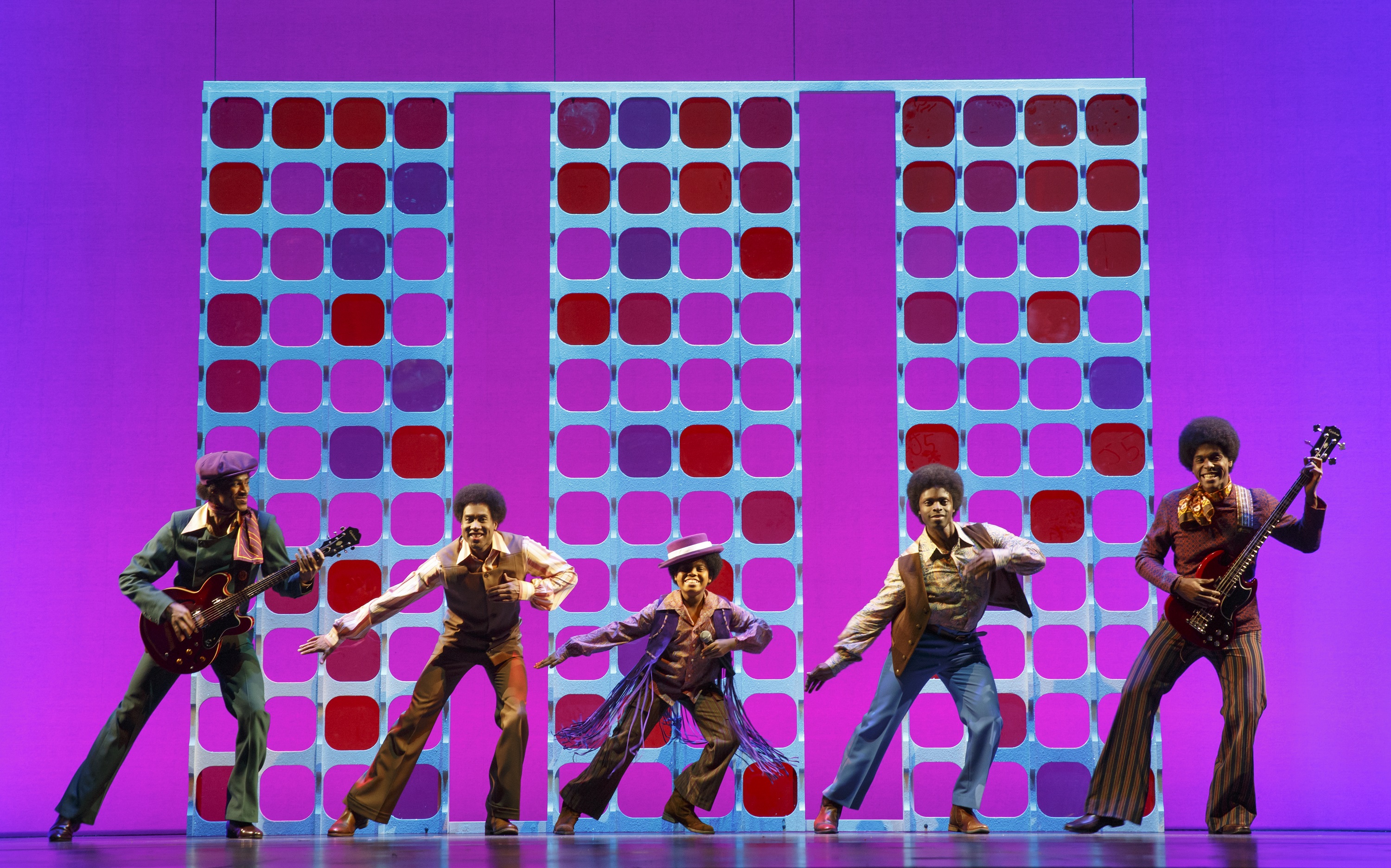
A young version of the Jackson 5 makes an appearance in Motown the Musical (photo by Joan Marcus)

But whatever the show lacks in narrative depth, it makes up for by allowing us to bask in one Motown hit after another. ABC, Ain’t No Mountain High Enough, Dancing in the Street: The nostalgic moments just keep on coming.

In the touring show, directed by Charles Randolph-Wright and accompanied by Darryl Archibald’s funky band, the songs are delivered with power and grace.

Semmes is great as Ross, seeming to gather strength as the night goes on. Though Gordy is known for promoting music rather than singing it, actor Gregory also comports himself well when he raises his voice in song. Semmes and Gregory’s duet You’re All I Need to Get By is one of the show’s sweetest numbers.

Also prominent are Jesse Nager as Smokey Robinson and the fleet-footed J.J. Batteast (alternating with Leon Outlaw Jr.) as a young Michael Jackson. On opening night, Nik Walker filled in for Jarran Muse as Marvin Gaye and displayed one of the most impressive voices of all.

David Korins’s scenery is spare, relying on Natasha Katz’s lighting to set the scene and mood. Esosa’s costume designs are period-appropriate and properly flashy.

Motown may not be a great musical, but it’s a musical with great music. Whether or not you’re old enough to remember the titular record label’s heyday, you’re sure to have fun.

Broadway in Columbus and CAPA will present Motown the Musical through Feb. 28 at the Ohio Theatre, 39 E. State St., Columbus. Show times are 7:30 p.m. through Thursday, 8 p.m. Friday, 2 and 8 p.m. Saturday, and 1 and 6:30 p.m. Sunday. Running time: 2 hours, 45 minutes (including intermission). Tickets are $33-$113. 614-469-0939, 1-800-745-3000 or ticketmaster.com.

Mythical ogre stalks kids in musical yuletide tale

A scene from Short North Stage's production of Krampus, a Yuletide Tale (photo courtesy of Short North Stage)
Krampus (JJ Parkey, center) terrorizes Flora (Emma Lou Andrews) and Bruno (William Gorgas) while St. Nicholas (Edward Carignan) watches on (photo courtesy of Short North Stage)

By Richard Ades

Christmas, at its essence, is a holiday devoted to hope and redemption.

Thus, it’s not surprising that redemption is at the heart of the granddaddy of all holiday yarns, Charles Dickens’s A Christmas Carol. And it’s also at the heart of Krampus: A Yuletide Tale, a musical that’s wrapping up its world-premiere run this weekend at Short North Stage’s Garden Theater.

Another similarity to A Christmas Carol: The road to redemption is a scary one indeed, probably too scary for small children. But for adults and mature youngsters, Krampus is a bracingly original journey.

With music by Nils-Petter Ankarblom (who also leads the three-piece band), and book and lyrics by Ankarblom and Carrie Gilchrist (who also directs), Krampus feels like an instant classic. The songs are beautiful and varied, and the story is thought-provoking and involving.

The title character (JJ Parkey) is a demon-like figure from Austro-Bavarian folklore who is said to kidnap and punish naughty children during the Christmas season. In this story, he sets his sights on siblings Flora (Emma Lou Andrews) and Bruno (William Gorgas), the offspring of penniless widow Anna Schlecht (Stephanie Prince).

Flora and Bruno aren’t really bad kids—they simply make a bad decision in order to help Anna avoid being evicted by their money-grubbing landlord, Herr Ulrich (Luke Stewart). But this momentary lapse is enough to remove them from the good graces of St. Nicholas (Edward Carignan), the forerunner of our modern Santa Claus.

Contributing to the tale’s charm is the intimate way it’s presented. Viewers sit on the stage of the Garden’s big auditorium, placing them a handful of feet away from Carignan’s storybook-like set. The imaginative costumes (also designed by Carignan) and the dramatic lighting add to the magical atmosphere.

The only production’s only technical shortcoming is that the band occasionally overpowers the vocals. This is mostly a matter of sound mixing, but Prince adds to the problem by singing some of her lines at a nearly inaudible level.

In the two showiest roles, Parkey and Carignan are spectacularly successful. Parkey makes a fearsome but somehow vulnerable Krampus, while Carignan is a surprisingly officious St. Nicholas. (Those of a spiritual bent may read religious significance into the implication that the mythic figures are but two sides of the same coin.) Both actors sing beautifully, but Carignan’s rich voice is put to particularly good use on St. Nick’s introductory solo, On This Night of December Fifth.

Among the human characters, Andrews’s Flora is the most engaging, but all of the cast members display heart and commitment.

Any new work can benefit from a tweak or two, and Krampus could stand to whittle down some of its sappier elements. Otherwise, this new work is just about perfect.

As I said, an instant classic.

Short North Stage will present Krampus, a Yuletide Tale through Dec. 20 at the Garden Theater, 1187 N. High St., Columbus. Show times are 8 p.m. Thursday-Saturday and 3 p.m. Sunday. Running time: 1 hour, 15 minutes. Tickets are $25, $15 for children. 614-725-4042 or shortnorthstage.org.

Welcome to the world where gay is the new straight

ZannaBy Richard Ades

Sean Felder seems a bit miscast as Steve, the football star in Zanna, Don’t! He sings and acts just fine, but the gridiron doesn’t usually attract guys with such a slight build.

Then again, there’s nothing usual about the world portrayed in Tim Acito’s “musical fairy tale.” It’s set at Heartsville High School, where being gay is the norm and being hetero is so unheard of that the head of the drama club is scandalized when a member suggests doing a musical about straight people.

Just as unconventional is the students’ attitude toward extracurricular activities. Though Steve is such a talented jock that he wins a game by actually passing the ball to himself, the school’s biggest celebrity is chess champion Mike (Ricky Locci). But the real key to popularity, as new student Steve recognizes, is joining the drama club.

Obviously, this is the school many a gay student has dreamed of attending. As written and scored by Acito (with help from Alexander Dinelaris), Zanna, Don’t! brings the dream to fizzy, tuneful life.

In Evolution Theatre’s production, director Brent Ries captures the piece’s mood with the help of Shane Cinal’s imaginative set, Danielle Mann’s playful choreography, music director Tim Sarsany’s well-heeled band and, most importantly, a lovable cast.

In the center of it all is William Macke as the title character, a wand-carrying, spell-casting student whose only desire is to hook up everyone with his or her same-sex soulmate. Indeed, Zanna devotes so much time to others’ happiness that he neglects his own. His sole friend is Cindy, an exotic bird portrayed by puppeteer Mike Writtenberry.

Even when trouble rears its head, Zanna does his best to keep romance alive. After Roberta (Tahrea Maynard) learns that girlfriend Karla (Alex Lanier) has been unfaithful, Zanna immediately points her toward Kate (Jordan Shafer). In general, everything is sweetness and light until a girl and boy come to the reluctant realization that they’re attracted to each other. The resulting controversy threatens the school’s loving atmosphere, forcing Zanna to respond with a spell that has unforeseen consequences.

Also in the cast are Laura Crone as the bossy Candi, Brian C. Gray as the put-upon Arvin and T. Johnpaul Adams as radio deejay Tank.

Everyone does a good or better-than-good job on the show’s songs, which represent vintage pop-rock and other lighthearted genres. Though the actors don’t appear to be miked, most put out enough volume to be heard over the carefully modulated band. That’s not to say the show wouldn’t benefit from more amplification, which would add to the fun quotient, but it functions just fine without it.

Despite its satirical, upside-down view of reality, Zanna, Don’t! mostly serves up frothy fantasy. As a theatrical work, it’s about as slight as the build of Heartsville High’s star football player, but its tunefulness and charm make it a modestly pleasant diversion.

Evolution Theatre Company will present Zanna, Don’t! through Nov. 21 at the Columbus Performing Arts Center, 549 Franklin Ave., Columbus. Show times are 8 p.m. Thursday-Saturday. Running time: 2 hours, 5 minutes (including intermission). Tickets are $25, $20 students/seniors, $30 for “generosity seating” (second or third row center). 1-800-838-3006 or evolutiontheatre.org.

Waltzing through a tender tale of longing and infidelity

One of the beautiful stage pictures offered by Short North Stage’s production of A Little Night Music (photo by Ray Zupp)

By Richard Ades

To succeed, a musical production needs basic ingredients such as strong singing, a good band, pretty scenery, etc. If a show has all of these things, it’s probably worth seeing.

But it can be so much more if the director has a feel for the material’s subtleties (assuming there are any) and knows how to communicate them to the cast and crew. Then the musical becomes a transcendent experience.

At Short North Stage, I’ve seen two such productions, both written by Stephen Sondheim: 2013’s Sunday in the Park With George and, now, A Little Night Music. In the current show, a bittersweet reverie on love and regret, director Michael Licata and his cast bring out every knowing chuckle and every tender, aching moment.

Adapted by Hugh Wheeler from the Ingmar Bergman film Smiles of a Summer Night, the 1973 Tony winner centers on two Swedish households at the turn of the last century.

In one, middle-aged lawyer Fredrik Egerman (Mark A. Harmon) lives with young wife Anne (Jennifer Barnaba) and his son from a previous marriage, seminary student Henrik (JJ Parkey). In the other, Madame Armfeldt (Linda Dorff) cares for granddaughter Fredrika (Maria Delanno) while the girl’s mother, actress Desiree (Marya Spring), is off touring with her latest play.

From the start, it’s apparent that the Egerman household is emotionally unstable. Fredrik loves his girlish wife but is frustrated by her reluctance to take part in marital relations. When Desiree’s touring show arrives in town, he can’t resist going to see the woman with whom he had an affair some 14 years earlier.

This leads to a night of passion that arouses the suspicions of Desiree’s current lover, the pinheaded Count Carl-Magnus Malcolm (Nick Lingnofski). Being a first-class male chauvinist, he then complains about his mistress’s indiscretion to his long-suffering wife, Charlotte (Kate Lingnofski).

All the desires, suspicions and resentments that were fomented in Act 1 come to a delicious head in Act 2, when everyone converges at Madame Armfeldt’s estate for a country outing.

It’s hard to find fault with the large cast, except to note that Barnaba’s Anne sometimes fades into the woodwork and that her pretty soprano voice was occasionally overwhelmed by the band on opening night. Really, though, there are no weak links.

Spring exudes worldly confidence as Desiree, which makes her vulnerable rendition of the show’s most memorable tune, Send in the Clowns, all the more devastating. As former lover Fredrik, Harmon offers a deftly sketched portrait of a decent man tottering on a tightrope between obligation and desire.

Parkey, a familiar visitor on the Short North stage, gives one of his best performances yet as Henrik, a young man pulled in opposite directions by his religious ideals and his unspoken love for his 18-year-old stepmother. Another career-topping performance is given by Dorff as Madame Armfeldt, whether she’s tackling Sondheim’s tricky melodies or waxing philosophical about roads not taken.

Several hearty laughs are earned by Nick Lingnofski as the preening, adulterous count, while Kate Lingnofski communicates all of the conflicting emotions felt by his wronged but loving wife, Charlotte. In another important supporting role, Eli Brickey gives a saucy but warmhearted portrayal as Petra, Anne’s maid and confidante, and delivers a rousing rendition of The Miller’s Son, a Celtic-flavored statement of female self-sufficiency.

Meanwhile, young Maria Delanno shows remarkable poise as the wise-beyond-her-years Fredrika—to the extent that she didn’t even flinch when a piano bench collapsed under her on opening night.

Adding to the production’s texture are the varied voices who serve as a sort of musical Greek chorus, as well as the backstage musicians who perform under Lloyd Butler’s direction. Interestingly, nearly all of the songs are written in waltz time, which makes it fitting that the most prominent dance numbers (choreographed by Dionysia Williams) are actual waltzes.

Like the troupe’s 2013 staging of Sunday in the Park With George, the current show is a visual treat thanks to Ray Zupp’s gauze-strewn scenery, Adam Zeek’s ethereal lighting and a colorful array of costumes supervised by Stephanie Keller. But perhaps the most important of the backstage talents is sound designer Michael Mason, who succeeds in making nearly every syllable come through clearly—not an easy feat in the Garden Theater’s cavernous main auditorium.

With A Little Night Music, Short North Stage proves once again that it understands Sondheim. The show is tender, wise, witty and—for devoted fans of the composer/lyricist—completely unmissable.

Short North Stage will present A Little Night Music through Nov. 1 at the Garden Theater, 1187 N. High St., Columbus. Show times are 8 p.m. Thursday-Saturday, 3 p.m. Sunday. Running time: 3 hours (including intermission). Tickets are $25-$40. 614-725-4042 or shortnorthstage.org.

Shoemaker sets out to save cross-dressers’ soles

The touring cast of Kinky Boots, presented by Broadway in Columbus and CAPA (photo by Matthew Murphy)

By Richard Ades

I have to admit I went into Kinky Boots with a small chip on my shoulder.

In 2013, Matilda the Musical was expected to win a slew of Tony Awards, including for best musical. Instead, despite having opened to mixed reviews, Kinky Boots danced away with the top prize.

Full disclosure: I love Matilda the Musical. Seeing it was my favorite Broadway experience since Memphis. After Kinky Boots beat out the magical lass for the top prize and others, including Cyndi Lauper’s win for best score, I decided it had better be damn good.

Anyway, that was my mindset going into the Ohio Theatre on Tuesday night, which helps to explain why it took me a while to warm up to the show. Eventually, though, I came around.

Adapted by Harvey Fierstein from a 2005 movie, Kinky Boots is the story of Charlie (Steven Booth), a young Englishman who’s preparing to move to London with his fiancée, Nicola (Charissa Hogeland). In the process, he’s leaving behind the family business, a Northampton shoe factory run by his father (Tom Souhrada).

No sooner does Charlie get to London, however, than he learns his father has died. As if that weren’t enough bad news, he then realizes the company is going broke because it can’t compete in a market flooded with cheap, foreign-made shoes.

Enter Lola (Kyle Taylor Parker), a drag performer whose chief problem seems to be her inability to find high-heeled boots strong enough to support her male frame. Thanks to a suggestion from factory worker Lauren (Lindsay Nicole Chambers), Charlie realizes the only way to save the business—along with the jobs of the people he grew up with—is to find a niche need and fill it. His solution: Start making sturdy, yet stylish, footwear for the discriminating cross-dresser.

I said I eventually came around on Kinky Boots, but that doesn’t mean I love everything about it. You don’t have to be an expert on Morse code to recognize that Fierstein is telegraphing plot points well in advance, including the fate of Charlie’s relationship with the sour-tempered Nicola. And things get even more transparent in the second act, when Fierstein manufactures conflicts by having Charlie act in totally unconvincing ways.

The show’s salvation is Lauper’s genre-hopping score, which earns its Tony. A couple of the songs strike me as derivative, but they’re generally enjoyable and catchy.

Of course, any production rises or falls on the strength of its cast, and this touring show’s cast acts, sings and dances delightfully under the guidance of director/choreographer Jerry Mitchell. At the top of the bill, Booth is relatable as Charlie, while Parker is nothing short of amazing as the sassy, yet soulful, Lola.

Some early critics complained that the show loses steam in the second act, but I actually like it better because it gives Lola a chance to grow into something beyond a flashy stereotype. Yes, Lola’s production numbers with her lascivious “Angels” are fun, but Parker’s best moment comes when Lola slows down for the Act 2 lament Hold Me in Your Heart. It’s a true show stopper.

Visually, the show is equally impressive, thanks to Gregg Barnes’s costumes, Kenneth Posner’s lighting and David Rockwell’s glorious scenery.

The one place the touring show could stand improvement is in the area of the sound. On opening night, whole lines of dialogue and lyrics were indecipherable. The English accents were partially to blame, but poor mixing seemed to be the main culprit. Hopefully, that problem will be fixed as the week goes on.

Did Kinky Books deserve to steal the top Tony away from Matilda? Not in my book. But it does give musical-loving theatergoers a colorful, toe-tapping good time.

Broadway in Columbus and CAPA will present Kinky Boots Oct. 6-11 at the Ohio Theatre, 39 E. State St., Columbus. Show times are 7:30 p.m. through Thursday, 8 p.m. Friday, 2 and 8 p.m. Saturday, 1 and 6:30 p.m. Sunday. Running time: 2 hours, 30 minutes (including intermission). Tickets are $33-$118. 614-469-0939, 1-800-745-3000 or ticketmaster.com.

[title of review]

Annie Huckaba, Bradley Johnson, Elisabeth Zimmerman and Jonathan Collura (clockwise from front) star in CATCO’s production of [title of show]
By Richard Ades

I arrive at the Riffe Center’s Studio Three and prepare to watch CATCO’s cabaret-style production of [title of show]. The intimate room is a pleasant place to watch theater, but I have my doubts about whether I should be watching this particular piece of theater.

My trepidation stems from what I’ve heard about Jeff Bowen and Hunter Bell’s offbeat musical, which first appeared in 2004, had an off-Broadway run in 2006 and finally turned up on Broadway for about three months in 2008. What I’ve heard is that the show is loaded with inside jokes and references that only gay, theater-obsessed New Yorkers can fully appreciate.

As the show begins, my fears seem justified. Some jokes fly right by me, while others just don’t seem that funny. Several audience members seem equally mystified—indeed, I can see one woman across the room who doesn’t crack a smile for the entire two hours and 10 minutes.

However, a small group of viewers makes up for this by laughing at nearly everything the cast does. Looking around, I realize that most of the laughs are coming from four men sitting in a tight circle. To be sure, many viewers chuckle or at least smile at various jokes, but this quartet supplies the bulk of the audience response.

So what is this show that appeals—intentionally, as it turns out—to such a select audience? It’s basically a musical about putting on a musical. Composer/lyricist Bowen and book writer Bell wanted to enter a show in an upcoming theater festival, and since they didn’t have any ideas, they decided to make the show its own subject.

A bit self-indulgent, don’t you think? Like the theatrical equivalent of a taking a selfie? Yes, and some of the early humor acknowledges that fact by focusing on the creators’ superficiality. In particular, the show’s version of Hunter is loath to begin a new project because he’s too involved in watching TV’s The Bachelor and Project Runway.

If the musical has any depth and universal meaning, it involves the participants’ desire to do something that would finally allow them to make theater the center of their existences. The self-doubt that prevents all of us from taking necessary chances in life is lampooned in one of the better songs, Die, Vampire, Die.

Back to Studio Three: As I watch the musical unfold under Joe Bishara’s direction, I admire both the cast’s singing and the keyboard work of accompanist Quinton Jones. But I also think the actors are portraying their characters with mixed success. That’s especially true of two female friends who join Jeff and Hunter’s project.

Elisabeth Zimmerman—who played one of my favorite characters in CATCO’s wonderful 2013 production of The 25th Annual Putnam County Spelling Bee—is entertaining as Heidi, to the extent that the thinly written role allows her to be. However, Annie Huckaba never quite gels as Susan, instead coming off as a caricature of playful quirkiness.

As for the men, Bradley Johnson is tastefully flamboyant as Hunter, while Jonathan Collura balances him out nicely as the more down-to-earth Jeff. It’s only in the later stages of the play that I begin to think Collura’s Jeff should have shown more passion for their shared project from the beginning. Maybe then the argument that arises late in Act 2 would be more convincing.

Truthfully, though, it’s unfair to blame the actors for anything that happens in Act 2.

The act didn’t even exist when the musical first opened, having been written to explain how the show and its creators changed as it moved to off-Broadway and finally to Broadway itself. Watching the second act in Studio Three, I quickly decide that adding it was a mistake.

And I’m not alone, judging from the audience’s reaction. Even the four biggest laughers are noticeably quiet as Jeff, Hunter, Susan and Heidi argue endlessly about whether they’ll ever get the show to Broadway and whether all of them will still be on board if and when it gets there.

Finally, Hunter suggests it’s time to bring the elongated show to an end, noting, “We can’t keep adding everything that happens to us.” It’s a brilliant insight, though it’s hard not to wish it had occurred to him about half an hour earlier.

Then again, I’m hardly in a position to throw that particular stone. It’s now been days since I saw the show, and I can’t find a way to finish this review, which already has dragged on for way too long.

Should I mention that, while watching the show, I kept thinking Zimmerman was playing Susan because she reminded me so much of the short-lived Seinfeld character of the same name? No, chances are no one else will make the connection, and really, who cares?

I guess I should just finish by addressing the all-important question: Will you enjoy the show? Maybe, maybe not. The creators themselves admit it won’t appeal to everyone, declaring in the finale that they’d rather be “nine people’s favorite thing than 100 people’s ninth-favorite thing.”

It should be obvious by now that [title of show] isn’t my favorite thing, my ninth-favorite thing or even my 90th-favorite thing. But who knows? Maybe it will be your favorite thing—at least until the second act.

CATCO is presenting an open-ended run of [title of show] in Studio Three of the Riffe Center, 77 S. High St. Show times are 8 p.m. Thursday-Sunday and 2 p.m. Sunday. Running time: 2 hours, 10 minutes (including intermission). Tickets are $35, $180 for a reserved table of four; a limited number of $15 student tickets will be available two hours before curtain. 614-469-0939 or catco.org.