‘Mormon’ musical isn’t just a raunchy satire

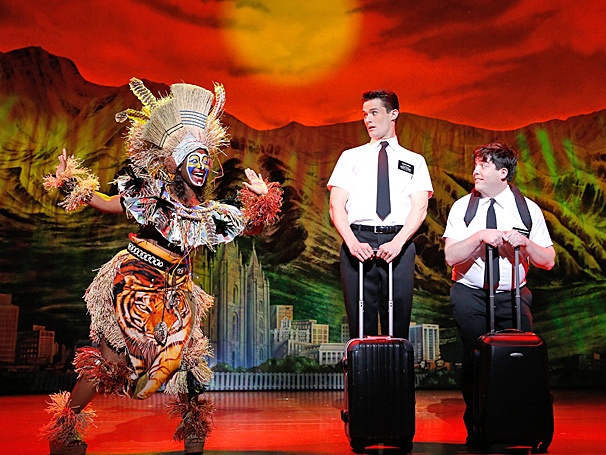
Elder Price (Mark Evans, left) and Elder Cunningham (Christopher John O’Neill) are given a rousing sendoff as they prepare to take the Mormon message to Uganda (Broadway.com photo)

By Richard Ades

The Book of Mormon has finally arrived in Columbus, and I’ve now had the chance to form a second opinion on the show I saw nearly a year ago on Broadway.

That opinion: I like it even better the second time.

Admittedly, the first act was a bit of a letdown when I attended the show Wednesday at the Ohio Theatre, partly because it had lost the element of surprise. But the second act delivered even more of a payoff, both comically and emotionally.

Emotionally? Yes. This hit musical by Avenue Q’s Robert Lopez and South Park creators Trey Parker and Matt Stone does have some inspiring and heartfelt moments in between all the F-bombs and sexual references.

You’ve probably heard that The Book of Mormon takes a satirical look at the titular faith, including its odd belief that Jesus visited what is now upper-state New York during the brief time between his crucifixion and his resurrection. Yes, it has religious zingers aplenty, and they’re both sly and hilarious. At its core, though, this is the story of a friendship between two young missionaries.

Elder Kevin Price (Mark Evans) is the fair-haired child of his missionary class, so flawless that people assume “Heavenly Father” will grant him any wish he desires. And what Kevin desires is to be assigned to spread the Mormon message in Disney-fied Orlando, which he considers the most perfect place on earth.

Elder Arnold Cunningham (Christopher John O’Neill) is Kevin’s opposite, a roly-poly ne’er-do-well with a propensity for stretching the truth. Kevin is chagrined to learn that he and Arnold have been assigned to spend their two-year mission together, and he’s even more chagrined to learn that they’ll be spending it in northern Uganda.

His chagrin turns to terror when he learns that the local people are oppressed not only by poverty, AIDS and superstition, but by a warlord who threatens to “circumcise” (i.e., genitally mutilate) all the women. After the colorfully named General Butt Fucking Naked (Corey Jones) proves his ruthlessness by shooting a detractor in the face, Kevin decides his best option is to request a transfer out of this godforsaken land.

The Book of Mormon’s success depends most heavily on Arnold, an irresponsible scamp who ultimately is forced to Man Up, as he sings in the rousing number that caps off Act 1. In the touring production at the Ohio, O’Neill hits every note just right whether he’s singing or speaking. Over the show’s 2½ hours, he builds a portrayal of a lovably needy but surprisingly resourceful man-child.

Evans also hits every note just right as Kevin, revealing a sweet voice and an innate decency hiding just beneath the character’s self-important surface. He even projects a modicum of vulnerability after a guilty conscience lands Kevin in the middle of a Spooky Mormon Hell Dream. The gaudy musical number surrounds him with threatening demons, a dismissive Jesus and even dancing Starbucks cups. (Mormons, of course, are forbidden from drinking either alcohol or caffeine.)

The show’s third important character is Nabulungi (Alexandra Ncube), a young village woman who responds to the Mormon message because it offers her hope in a hopeless world. Ncube projects charming naiveté and a beautiful singing voice, particularly in her wistful solo Sal Tlay Ka Siti.

Parker co-directs the large and energetic cast with choreographer Casey Nicholaw, who fills the production numbers with clever, spirited dance steps. Justin Mendoza conducts the orchestra, which puts forth a full and satisfying sound despite relying heavily on keyboards. Scott Pask’s scenery, augmented by Brian MacDevitt’s lighting, efficiently moves the action from continent to continent and century to century as needed.

Though The Book of Mormon delights in ridiculing the most eccentric beliefs of the Church of Jesus Christ of Latter-day Saints, it can’t really be described as anti-religious. It accepts and even celebrates religion’s ability to offer hope to people who need it.

The show may not inspire to re-evaluate your beliefs the next time men in white shirts and dark ties ring your doorbell, but you probably won’t slam your door in their faces, either.

Broadway in Columbus and CAPA will present The Book of Mormon through May 25 at the Ohio Theatre, 39 E. State St. Show times are 7:30 p.m. Tuesday-Thursday, 8 p.m. Friday, 2 and 8 p.m. Saturday, and 1 and 6:30 p.m. Sunday. Running time: 2 hours, 30 minutes (including intermission). Tickets are $43-$145. 614-469-0939, 1-800-745-3000 or ticketmaster.com.

Stage version of Addams Family is more lovable than creepy

Stars of The Addams Family include (from left) Amanda Bruton (Grandma), Jennifer Fogarty (Wednesday), Dan Olson (Lurch), Jesse Sharp (Gomez), KeLeen Snowgren (Morticia), Shaun Rice (Uncle Fester) and Jeremy Todd Shinder (Pugsley). Note: Alternate actors play Lurch and Pugsley in the current touring production. (photo by Carol Rosegg)

By Richard Ades

The musical comedy now unfolding at the Palace is called The Addams Family, but it bears only a superficial resemblance to its macabre source material.

Fans of Charles Addams’s New Yorker cartoons or the 1960s TV series will recognize the basic characters. They look much as they did on TV and in subsequent movies, except that daughter Wednesday (Jennifer Fogarty) has grown into a romance-minded young woman. Book authors Marshall Brickman and Rick Elice (Jersey Boys) have even retained touches of the old Addams quirkiness, such as the family’s fondness for torture devices and graveyards.

Beneath these surface aberrations, though, these stage Addamses are surprisingly normal.

The thin plot hinges on Wednesday’s plan to introduce Ohio-bred boyfriend Lucas Beineke (Bryan Welnicki) to the family by inviting him and his parents (Mark Poppleton and Blair Anderson) to dinner. Confiding in her father, Gomez (Jesse Sharp), Wednesday reveals that she and Lucas have already agreed to marry, but she asks Gomez not to tell her mother, Morticia (KeLeen Snowgren). Her fear is that Morticia will try to sabotage the relationship if she learns of the engagement before she’s gotten to know the Beinekes.

Gomez protests that he’s never lied to his wife, but he reluctantly agrees to keep the secret from Morticia until that night’s dinner party. And on that brief bit of deception rests the entire storyline.

Musicals probably have been built on slimmer ideas, though I can’t think of any offhand. But the oddest thing about The Addams Family is how conventional the characters are beneath their gothic exteriors.

Gomez is like any devoted husband and father who’s trying to keep peace in the household. Wednesday is like any embarrassed teenager who thinks her family is weird (except that her family really is weird). Her brother, Pugsley (Connor Barth), may be tortured by his big sister literally rather than figuratively, but he loves her just the same.

Perhaps the most Addams-like of the characters are the herb-gathering Grandma (Amanda Bruton) and grunting butler, Lurch (Ryan Jacob Wood). The least Addams-like is Uncle Fester (Shaun Rice), who has metamorphosed from an anti-social, blunderbuss-brandishing curmudgeon into a romantic who enlists the souls of his dead ancestors in the cause of promoting Wednesday and Lucas’s love.

The result of all the changes made to the original characters—and of the subsequent changes made in response to the show’s mixed success on Broadway in 2010-11—is a warmhearted, rather conventional musical that’s designed to appeal to everyone but hardcore Addams fans.

Its pluses include Andrew Lippa’s songs, which are sometimes pretty (Wednesday and Pugsley’s Pulled) and sometimes catchy (the hummable Full Disclosure). The six-piece band is synthesizer-dominated and sounds it, but the players’ voices range from serviceable to great. Fogarty (Wednesday) and Anderson (Alice) are especially strong.

Working under Jerry Zaks’s direction, the cast is as funny as the material allows it to be. Jonathan Ritter’s choreography is especially enjoyable when it includes both living and non-living participants, as it does in Act 2’s Tango de Amor. The set and costumes (designed by original directors Julian Crouch and Phelim McDermott, with later set tweaks by James Kronzer) are appropriately gothic.

Amid all the singing and dancing, The Addams Family seeks to purvey the message that you have to be true to yourself. Considering the liberties it takes with its creepy characters, some might see that as a bit ironic.

Broadway in Columbus and CAPA will present The Addams Family through April 13 at the Palace Theatre, 34 W. Broad St. Show times are 7:30 p.m. Tuesday-Thursday, 8 p.m. Friday, 2 and 8 p.m. Saturday and 1 and 6:30 p.m. Sunday. Running time: 2 hours, 25 minutes (including intermission). Tickets are $28-$78. 614-469-0939, 1-800-745-3000 or ticketmaster.com.
New York-bound ‘Flashdance’ faces an uphill battle

Steelworker/dancer Alex Owens (Jillian Mueller) re-creates an iconic moment from the original movie in Flashdance: The Musical (photo by Jeremy Daniel)

By Richard Ades

“She’s a maniac, maniac on the floor/And she’s dancing like she never danced before…”

Read those lyrics the wrong way, and the fantasy at the heart of Flashdance becomes apparent. Steelworker-by-day/dancer-by-night Alex longs to be accepted into a prestigious ballet academy, but she has no formal training. So how can she hope to win out against dancers who’ve been hitting the barre since they were kids?

The 1983 movie distracted attention from that glaring question by overwhelming us with montages of toned bodies dancing to a rocking soundtrack. It also captured the tenor of the times by setting Alex’s quest against the backdrop of a dying industry: We could relate to her struggle to redefine herself because so many of us were trying to find a way to survive in a changing economy.

Then, of course, there was cinematic newcomer Jennifer Beals and her portrayal of Alex as a tough Pittsburgh girl who could switch from wistful dreamer to sexual predator at the drop of a leg warmer.

So the movie became a hit, and Alex and her wardrobe became cultural icons. Can the new Tom Hedley/Robert Cary/Robbie Roth stage version repeat the magic?

After seeing the touring show Tuesday night at the Palace, I suspect it has a long way to go.

Director/choreographer Trujillo and his cast reimagine some of the movie’s best moments and add some of their own. Overall, though, it fails to make us care about Alex’s journey.

Part of the problem is the role of Alex, which must be almost impossible to cast. Besides acting and singing, the leading lady must be able to dance well enough to convince us she has a shot at a career in ballet. In the touring production, it’s apparent that Jillian Mueller was cast primarily for her dancing skills. Her moves are fine, but her singing voice lacks power and she has little stage presence.

It’s admirable that the producers didn’t follow the movie’s tack and have Alex’s dance moves performed by a body double (though it appears they do just that in one scene, for no apparent reason). But because they failed to find the rare individual who can act, sing and dance like a maniac, Alex mostly disappears into Klara Zieglerova’s serviceable but generic scenery. As a result, few sparks are generated by the central romance between Alex and her smitten boss, Nick, even though Corey Mach gives the latter a likable personality and sonorous voice.

Filling some of that void, Ginna Claire Mason and David R. Gordon do make us care about the rocky relationship between Alex’s dancer friend Gloria and would-be comedian Jimmy. We particularly care about Gloria, whose naïve search for fame makes her susceptible to the advances of C.C. (Christian Whelan), proprietor of the disreputable dance club down the street. Her crestfallen rendition of Gloria is one of the more effective holdovers from the movie.

Back at the raunchy but relatively wholesome club run by the fatherly Harry (Matthew Henerson), Alex spends her nights sharing the stage with Tess and Kiki, seasoned hoofers well played by Alison Ewing and DeQuina Moore. Moore is especially fiery in the energetically choreographed Manhunt, another movie holdover.

Not all of the show’s songs are inherited from the movie, by the way. Of the new tunes, some are pretty, and some are even catchy, but none matches the toe-tapping power of the originals.

Will Flashdance make it to New York? If it does, it will accomplish a major miracle, as it’s not easy to construct a conventional stage musical out of a movie that was basically an extended music video. The show reportedly has been tweaked quite a bit to get this far, and it likely will need a lot more tweaking to get to Broadway.

Broadway in Columbus and CAPA will present Flashdance: The Musical through Dec. 22 at the Palace Theatre, 34 W. Broad St. Show times are 7:30 p.m. Tuesday-Thursday, 8 p.m. Friday, 2 and 8 p.m. Saturday, and 1 and 6:30 p.m. Sunday. Tickets are $28-$78. 614-469-0939, 1-800-745-3000 or ticketmaster.com.
Tale of New Jersey songsters improves with age

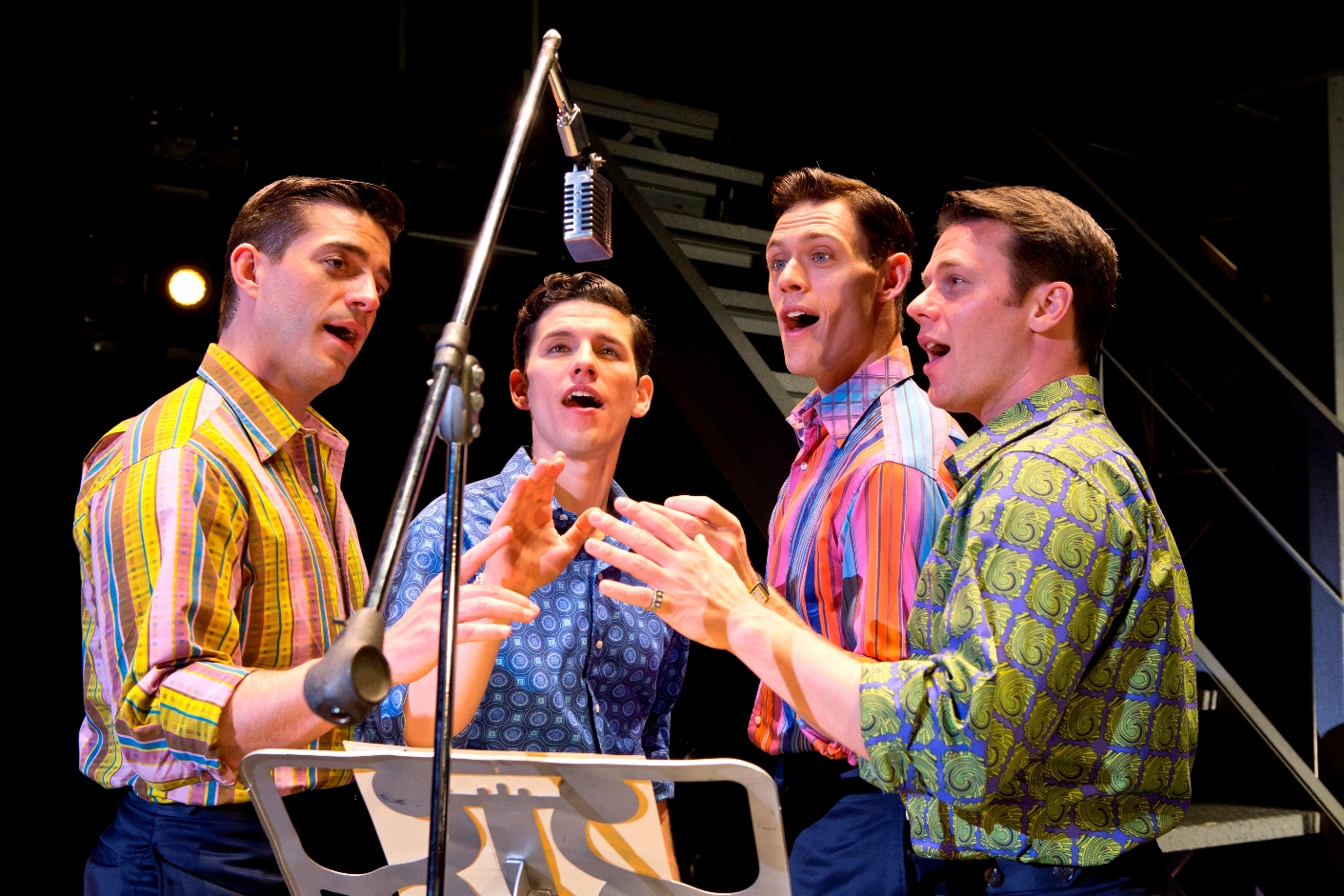
Brandon Andrus, Nick Cosgrove, Jason Kappus and Nicolas Dromard (from left) play the Four Seasons in Jersey Boys (photo by Jeremy Daniel)

By Richard Ades

Why is Jersey Boys so much more fun the second time around?

Part of it may be due to lowered expectations. Prior to the touring show’s Columbus debut in 2011, the press attended a preview during which we were told to expect a spectacle that would put every other musical to shame. We also were informed that male viewers, in particular, would be reduced to manly tears by this trip down the Four Seasons’ Memory Lane.

Well, it didn’t happen. Not to me, at least. The show’s historically correct harmonizing was great, but the dramatic portions left my eyes dry.

Fast forward to earlier this week, when the latest version of the touring show returned to the Ohio Theatre. I went, expecting little, and got a lot. In fact, I had a ball.

But the difference can’t be attributed entirely to my new lack of optimism. I think the production is noticeably better this time around.

That’s particularly true in regards to the key role of lead singer Frankie Valli. Two years ago, the featured actor hit the falsetto notes with aplomb, but he couldn’t carry off some of the tale’s most touching moments. Now, though, Nick Cosgrove does it all without a hitch—singing, acting and even a few athletic dance moves.

Actors playing the rest of the New Jersey-bred quartet are equally fine: Nicolas Dromard as the out-for-himself Tommy DeVito, Jason Kappus as songwriter Bob Gaudio and a comically laconic Brandon Andrus as Nick Massi.

With a book by Marshall Brickman and Rick Elice, this 2006 Tony Award winner relates the history of the Four Seasons by allowing each member of the 1960s rock group to tell his side of the tale in turn. It’s a clever tack and probably a necessary one, given that three of the four original members are still alive and don’t necessarily agree on the details.

A bevy of talented supporting cast members play the many people who wander in and out of the musicians’ lives. Key actors include Barry Anderson as record producer Bob Crewe, Marlana Dunn as Mary Delgado and Thomas Fiscella as sentimental gangster Gyp DeCarlo.

Under Des McAnuff’s direction, the cast and crew work as a unit while the action flows fluidly from one scene to the next, sometimes even in the midst of song. Meanwhile, Klara Zieglerova’s set design and Howell Binkley’s lighting design fill the stage with images that are subtly handsome and perfectly complementary. As a piece of stagecraft, Jersey Boys is a wonder.

But the show’s real highlight is the music—the just-right re-creations of hits such as Big Girls Don’t Cry, Walk Like a Man and Can’t Take My Eyes Off You. And that’s due not only to the actors’ vocal prowess but to conductor Ben Hartman and his onstage band. Special kudos to Mark Papazian, without whose emphatic drumming the night would be far less joyful.

Were my eyes still dry when I left the show this time around? Yes, but I didn’t care. The rest of my face was smiling.

Broadway in Columbus and CAPA will present Jersey Boys through Sept. 29 at the Ohio Theatre, 39 E. State St. Show times are 7:30 p.m. Tuesday-Thursday, 8 p.m. Friday, 2 and 8 p.m. Saturday and 1 and 6:30 p.m. Sunday. Running time: 2 hours, 35 minutes (including intermission). Tickets are $28-$128. 614-469-0939, 1-800-745-3000 or ticketmaster.com.
King Arthur and friends hit the road in ‘Spamalot’

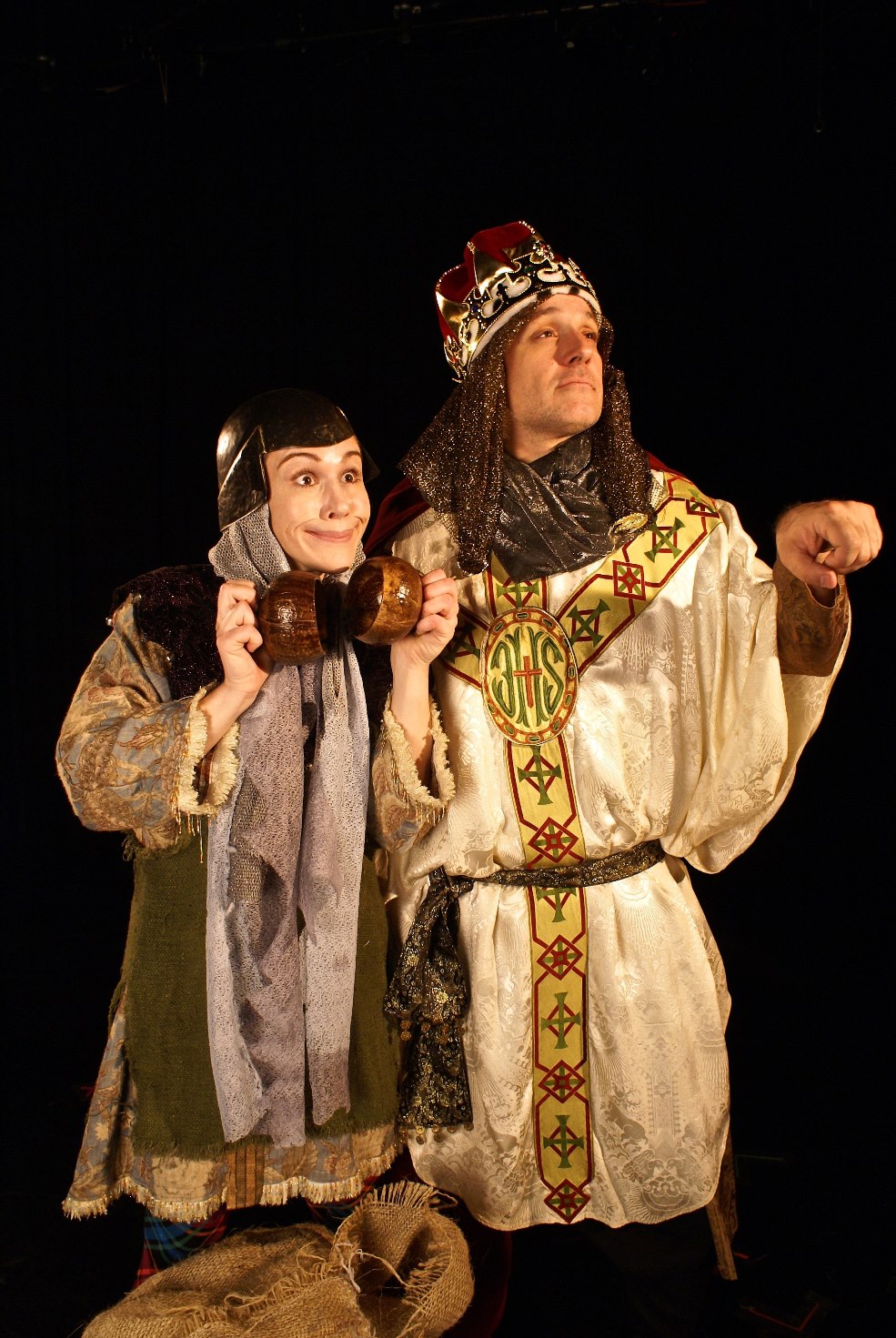
Tom Cardinal (right) as King Arthur and Amy Lay as his aide, Patsy, in Spamalot (photo courtesy of Shadowbox Live)

By Richard Ades

Shadowbox Live’s “metaperformers” are Monty Python fans. That’s obvious throughout their production of Spamalot, the musical inspired by the 1975 film Monty Python and the Holy Grail.

You can see the love in the working-class British accents and the squeaky voices of the suspiciously mannish women. You can see it in the perfect timing with which the “Knights Who Say Ni” squawk out their signature word.

You can see it in director Stev Guyer’s patient willingness to allow each scene to expand to its maximum level of hilarity.

For the unaware, Monty Python was a BBC-bred comedy troupe that combined brainy humor with rampant silliness and an anarchic disregard for societal norms. Spamalot, with book and lyrics by Python alum Eric Idle, simultaneously spoofs the King Arthur legend and Broadway-style musicals. The latter comes out in numbers such as The Song That Goes Like This, a dead ringer for the kind of show-stopping tune that’s become an Andrew Lloyd Webber hallmark.

At Shadowbox, Idle’s Tony-winning musical allows numerous performers to put their acting and singing strengths to optimal use.

Tom Cardinal is heroic but not foolhardy as Arthur, the mythical king whose search for the Holy Grail sends his ragtag group of knights off on a series of dangerous adventures. Amy Lay is delightfully dutiful as Patsy, his aide, who stands in for his “horse” by clapping together two halves of a coconut. (The presence of this tropical fruit, by the way, foments one of the first daffy exchanges as dubious guards question just what kind of bird would be big enough to carry it to medieval England.)

After spoofing operatic divas in previous Shadowbox theme shows, Stephanie Shull brings the same kind of energy to the Lady of the Lake, a role that also makes the most of her powerhouse voice. Michelle Daniels narrates Arthur’s adventures as the Historian, while Billy DiPetro supplies comical menace as the disapproving father of a son who fancies himself a maiden in distress.

Also along for the virtual ride are JT Walker III as Galahad, David Whitehouse as Lancelot, Jim Andes as Bedevere and Robbie Nance as Robin, as well as a host of others playing the threatening soldiers, trash-talking “Frenchies,” lascivious ladies and sundry monsters the knights encounter during their quest.

Katy Psenicka’s alternately medieval-rough and Broadway-glitzy choreography adds to the fun, as does Matthew Hahn’s musical direction and a band that’s often dominated by Kevin Patrick Sweeny’s keyboard work.

Due to acoustics and accents, a few lyrics and bits of dialogue may be difficult to catch. But that probably won’t be a problem for true Python fans, who know the show by heart anyway.

Speaking of which, if you are such a fan, don’t give in to the temptation to call out punch lines in advance, as at least one audience member did on opening night. Otherwise, an unpleasant French person may unplug his nose in your general direction.

Spamalot will be presented at 2 and 7 p.m. Sundays through Nov. 17 at Shadowbox Live, 503 S. Front St. Running time: 2 hours, 20 minutes (including intermission). Tickets are $30, $20 for students and seniors. 614-416-7625 or shadowboxlive.org.

On his way to writing ‘Rent’…

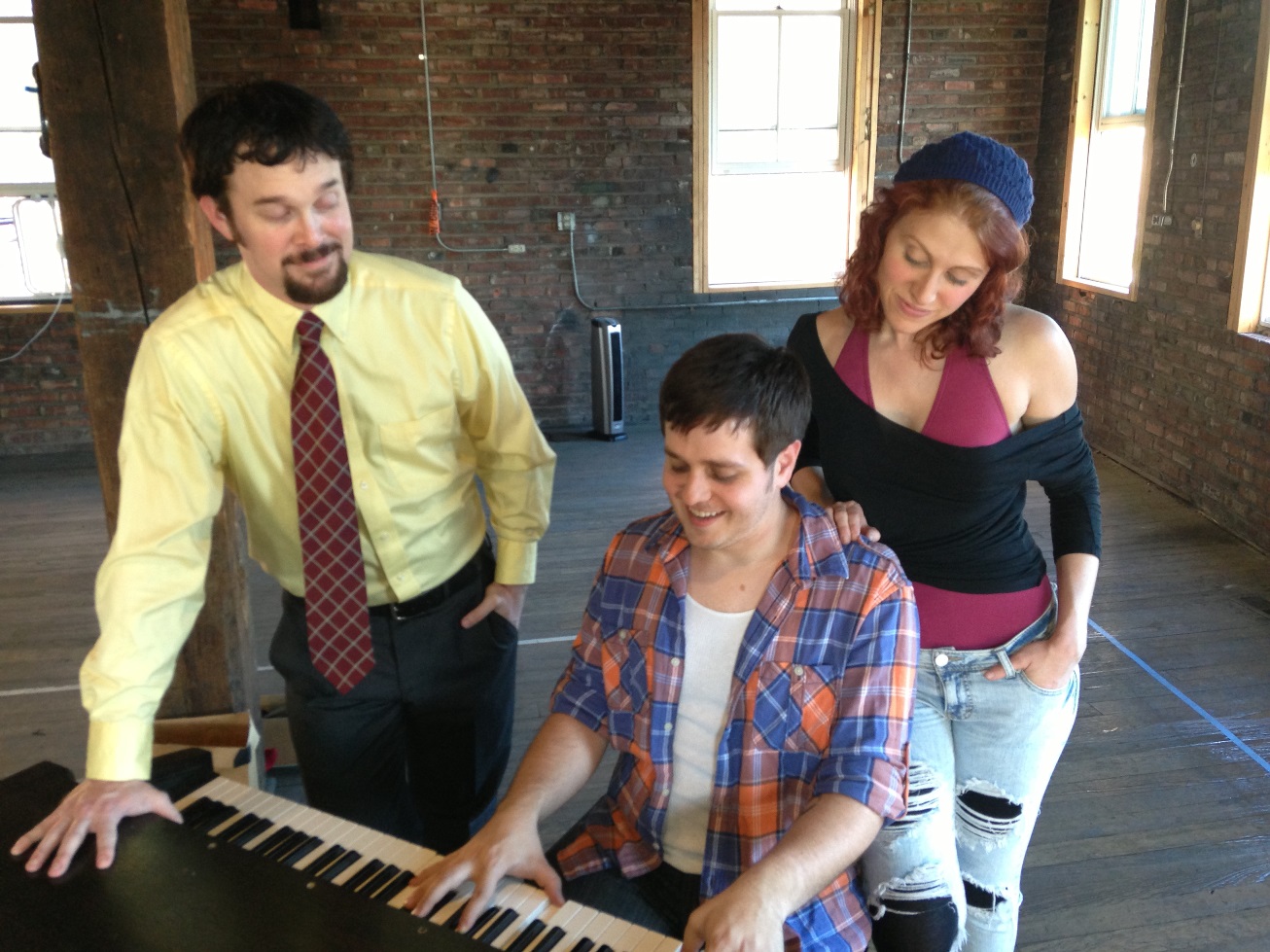
Appearing in tick, tick…Boom! are (from left) Christopher Storer as Michael, Jonathan Collura as Jon and Kaitlin Descutner as Susan (photo by Zach Hartley)

By Richard Ades

If you’re a fan of Rent or of rock-based musical theater in general, you’ll want to see tick, tick…Boom! The 1990 work is Jonathan Larson’s semi-autobiographical take on his struggle to establish himself as a composer and lyricist.

If you’re not a fan of either Rent or rock-based musical theater, the show is less of a must-see, but it remains tuneful and pleasant enough to be worthwhile.

Of course, the $64,000 question with any locally produced musical is: Does the cast have enough vocal chops to carry it off? Because, let’s face it, that’s not something you can take for granted.

Happily, though, the answer is a resounding yes. Director Zach Hartley has found three performers who sing like pitch-perfect larks. They also have acting chops, though that’s less of a consideration in a show whose appeal is more historical than dramatic.

Jonathan Collura is personable as Jon, a New York composer who’s sweating his way toward both his 30th birthday and a workshop performance of his latest musical. Kaitlin Descutner is equally appealing as his dancer/girlfriend, Susan, who supplies comfort and support when she’s not kvetching about her desire to live in a less-urban environment.

It would nice if Christopher Storer provided a more grounded portrayal of Michael, Jon’s Bimmer-driving roommate. That might make a last-minute revelation about the character seem less gratuitous. But Storer excels—as does Descutner—in colorful secondary roles.

As for the songs, they range from the lightweight Green Dress to the clever Sunday, a trio that reflects Jon’s (and Larson’s) reverence for Stephen Sondheim. Also Sondheim-like is the flashy Come to Your Senses, which gives Descutner a chance to show off her vocal power.

For the most part, the tunes come in flavors of rock, which Larson helped to introduce to musical theater. Whatever their genre, an onstage band led by musical director Hillary Billups provides stalwart support.

Truthfully, as a piece of theater, tick, tick…Boom! is less than overwhelming. But as a piece of theatrical history, it’s a gem.

Evolution Theatre Company will present tick, tick…Boom! through Aug. 17 at the Columbus Performing Arts Center, 549 Franklin Ave. Show times are 8 p.m. Thursday-Saturday. Running time: 95 minutes. Tickets are $20-$25, $15 for students and seniors. 614-223-1124, 1-800-838-3006 or evolutiontheatre.org.

Hoping to spell their way to happiness

Japheal Bondurant as competitor William Barfee in The 25th Annual Putnam County Spelling Bee (Red Generation Photography)

By Richard Ades

A confession: I was disappointed when I heard CATCO had booked The 25th Annual Putnam County Spelling Bee for its new season.

That was partly because I’d rather see Columbus’s premier troupe tackle works that aren’t quite so familiar. Mostly, though, it was because I’d seen a touring production come through town several years back and hadn’t fallen in love with it.

But you know what they say about love being better the second time around? Maybe that also applies to this quirky musical. Thanks to CATCO’s personable production, I now love both it and its nerdy characters.

With a book by Rachel Sheinkin and music and lyrics by William Finn (Falsettos), Spelling Bee is like a comedic and tuneful version of the 2002 documentary Spellbound. Like the film, it delves into the personalities of the young contestants in an attempt to explain how they became spelling whizzes and why parlaying their skills into victory is so important to them.

It could be that director Steven Anderson’s long submergence in children’s theater has served him well here, because his production’s greatest strength is its ability to turn each of the competitors into a recognizably and lovably eccentric individual.

Early laughs are won by Leaf Coneybear (Patrick Walters), whose behavior is even odder than his helmeted and caped attire. Also attracting our attention is the Korean-American Marcy Park (Nicolette Montana), who only later reveals why she seems annoyed by the whole event.

The richest portrayals are provided by Japheal Bondurant as the plus-sized William Barfee—whose haughtiness could well be both a reflection of his brilliance and a defense against an often-hostile world—and Elisabeth Zimmerman as the lonely Olive Ostrovsky. Played by Zimmerman with a deer-in-the-headlights expression and a lovely voice, Olive reveals the direness of her situation in the show’s most touching number, The I Love You Song.

Also taking part in the competition are Chip Tolentino (James Sargent), whose struggle to repeat last year’s victory is complicated by his dictatorial libido, and Logainne Schwarzandgrubenierre (Emily Turner), whose gay fathers encourage her to win at any cost.

Four pre-selected audience members play additional competitors and frequently come in for witty and personalized jibes from the spelling bee’s hosts, Rona Lisa Peretti (Krista Lively-Stauffer) and Vice Principal Douglas Panch (Ralph E. Scott). Panch, by the way, has many of the show’s funniest lines—which usually follow the question “Can you use it in a sentence?”—and Scott delivers them with deadpan perfection.

The cherry on the show’s comical sundae is Mitch Mahoney (Geoffrey Martin), a scruffy ex-con who was sentenced to perform community service by acting as the competition’s “comfort counselor.”

Michael S. Brewer’s set design captures the look of a school auditorium right down to the cinder-block walls and the “Putnam Piranhas” wall signs. A band led by Matt Clemens is a spirited presence despite being hidden backstage.

With tuneful tunes, heartfelt performances and more laugh-out-loud moments than you can shake a dictionary at, The 25th Annual Putnam County Spelling Bee is simply irresistible.

CATCO will present The Twentieth Annual Putnam County Spelling Bee through Aug. 18 in Studio One, Riffe Center, 77 S. High St. Show times are 11 a.m. Wednesday, 8 p.m. Thursday-Saturday and 2 p.m. Sunday. Running time: 2 hours, 20 minutes (including intermission). Tickets are $41 for Thursday and Sunday performances, $45 for Fridays and Saturdays, $11.50 for Wednesday matinees. Student tickets are available for $15 two hours before non-sold-out performances. 614-469-0939 or catco.org.

If Miracle-Gro doesn’t work, try blood

Seymour (Preston Pounds) and Audrey II are surrounded by “Urchins” Monica Brown, Marina Pires and Haley Jones (from left) in Little Shop of Horrors (photo by Ed Syguda)

By Richard Ades

One of my favorite musical experiences of all time was Otterbein’s 2011 production of The Drowsy Chaperone, whose many perks included Preston Pounds’s portrayal of the agoraphobic central character.

Now Pounds is back as Seymour, the unfortunate plant-shop employee in Little Shop of Horrors. His presence guarantees that the movie-based musical will have a core of likable vulnerability that keeps it from drowning in silliness.

The presence of director David Hemsley Caldwell, an old hand at Otterbein musicals (including Chaperone), is another harbinger of good things to come. Caldwell keeps things fun and quirky while only occasionally allowing the proceedings to descend into self-conscious campiness.

With a book by Howard Ashman and based on Roger Corman’s 1960 cult flick, Little Shop is set in a Skid Row plant shop that’s seen better times. (Or maybe it hasn’t—it is located on Skid Row.)

After suffering through a particularly slow day, owner Mushnik (an extravagantly accented Kyle Hansen) threatens to fire both Seymour and fellow employee Audrey (a glamorously attired but flighty Madison Tinder). But then Seymour reveals that he’s discovered a strange plant—some kind of flytrap, he thinks—and has named it “Audrey II” in honor of the woman for whom he secretly lusts. Once word of the exotic plant gets out, the customers start flocking in.

Just a slight problem: Seymour learns that Audrey II thrives on one thing and one thing only: human blood. Is he willing to become a murderer in order to keep his new meal ticket alive? Pounds imbues Seymour with just enough humanity to clarify the struggle between his basic decency and his desire for success, which he hopes will finally impress the beautiful Audrey. Audrey, meanwhile, suffers from such low self-esteem that she seems incapable of escaping the abusive clutches of her sadistic boyfriend, Orin (Harry Sanderson).

Obviously, Little Shop of Horrors deals with dark subjects, but the overall atmosphere is as goofy and gleefully malevolent as Audrey II herself (a puppet voiced by John Henry Carter). Helping to set the mood is a slyly sexy trio of “Urchins” (Monica Brown, Haley Jones and Marina Pires) who serve as a sort of Greek chorus.

But what really keeps things lively is the score, a collection of songs by Alan Menken (music) and Ashman (lyrics) that capture the flavor of early rock, blues and folk. Hummable favorites include the Prologue (sung by the Urchins) and Suddenly, Seymour (sung by Seymour and Audrey). Both the solos and the harmonized numbers are nicely handled by the cast and the offstage band led by Dennis Davenport.

Rob Johnson’s clever and realistic set, Andy Baker’s mock-scary lighting and Julia Ferreri’s playful costumes add to the entertainment value of this drolly bloodthirsty musical comedy.

Otterbein Summer Theatre will present Little Shop of Horrors through July 27 at Cowen Hall, 30 S. Grove St., Westerville. Performances are at 8 p.m. Friday-Saturday and 2 p.m. Sunday (July 14 only), plus 8 p.m. July 18 and 2 p.m. July 19. Running time: 1 hour, 55 minutes (including intermission). Tickets are $25. 614-823-1109 or www.otterbein.edu/drama.

Daring to spoof Broadway

By Richard Ades

Appearing in Forbidden Broadway’s Greatest Hits, Vol. 1 are (from left) Dionysia Williams, Joe Bishara (front), Christopher Storer and Dionysia Williams (Red Generation Photography)
Appearing in Forbidden Broadway’s Greatest Hits, Vol. 1 are (from left) Dionysia Williams, Joe Bishara (front), Christopher Storer and Liz Wheeler (Red Generation Photography)

Lighthearted summer musicals have become a staple with CATCO, and the troupe’s patrons seem to approve. They’ve bought so many tickets that both Evil Dead: The Musical (2011) and Avenue Q (2012) were extended and/or revived.

This year’s offering, Forbidden Broadway’s Greatest Hits, Vol. 1, appears to be continuing that tradition. The satirical revue opened just last week, and it’s already been extended by four performances.

It couldn’t have happened to a nicer cast—or one that’s harder-working. Joe Bishara (who also directs), Christopher Storer, Liz Wheeler and Dionysia Williams reveal impressive singing and improvisational skills as they storm their way through an evening filled with take-no-prisoners lyrics and blink-of-an-eye costume changes. Their purpose: to spoof a slew of well-known Broadway shows and stars.

Created and written by Gerard Alessandrini, Forbidden Broadway has been updated numerous times since it opened off-Broadway in 1982. The latest New York version included takeoffs on current Broadway blockbuster The Book of Mormon and on Hugh Jackman, star of last year’s cinematic production of Les Miserables.

Not surprisingly, the Greatest Hits show is less up to date. Some of its satirical targets, in fact, are more than a bit dusty.

Williams does a nifty impersonation of Liza Minnelli in Liza One Note, for example, but when was the last time the star of the silver screen’s Cabaret has grabbed the spotlight? And the show’s version of America, featuring Wheeler as Chita Rivera and Williams as Rita Moreno, really tests the audience’s long-term memory—since it jokes about a presumed rivalry between the performers who played Anita in the Broadway and Hollywood versions, respectively, of West Side Story.

Some of the targeted shows are equally ancient. Cats? Yes, it ran longer than any other Broadway show except The Phantom of the Opera, but the New York production used up the last of its nine lives 13 years ago.

Still, even when the subject matter seems past its prime, the cast members are always admirable. And when their talent combines with one of Alessandrini’s particularly clever conceits, the results are sublime.

Yes, Ethel Merman is long gone, but Wheeler brings her back in all of her full-throated glory in a piece that takes aim at modern singers’ tendency to let the amplification do the heavy lifting. Among the male impersonations, the funniest is Bishara’s take on “male chanteuse” Mandy Patinkin in an Over the Rainbow spoof that’s understatedly named Somewhat Overindulgent.

Of course, satire wouldn’t be satire if it didn’t rub some people the wrong way.

If you worship at the altar of Stephen Sondheim, you may be put off by a segment that rips into the composer/lyricist’s tendency to pack a whole lot of words and ideas into small amounts of time and melody. Even the audience gets into the act on this one, courtesy of a sing-along that eventually accelerates to breakneck speed.

And what will fans of Les Miz think of Forbidden Broadway’s eight-song attack on the mega-musical? Well, they’ll probably be won over multiple times. The best part comes when Jackman’s version of Jean Valjean (Storer) sings the words that probably have been on the mind of every man who’s ever attempted the plaintive Bring Him Home: “It’s too high.”

Adding to the show’s fun is the fact that it’s performed in an intimate cabaret setting on a tiny stage the performers share with music director and accomplished pianist Matt Clemens. The glitzy set, lighting and costumes—designed by Michael S. Brewer, Curtis “Nitz” Brown and Marcia Hain, respectively—are further pluses.

Satire is said to be something that closes on Saturday night, but CATCO’s latest summer musical is proving to be an exception to the rule.

CATCO will present Forbidden Broadway’s Greatest Hits, Vol. 1 through July 14 in Studio Three, Riffe Center, 77 S. High St. Show times are 8 p.m. Thursday-Saturday (no show July 4) and 2 p.m. Sunday. Running time: 1 hour, 30 minutes (including intermission). Tickets are $35. 614-469-0939 or catco.org.

Singing the post-operative blues

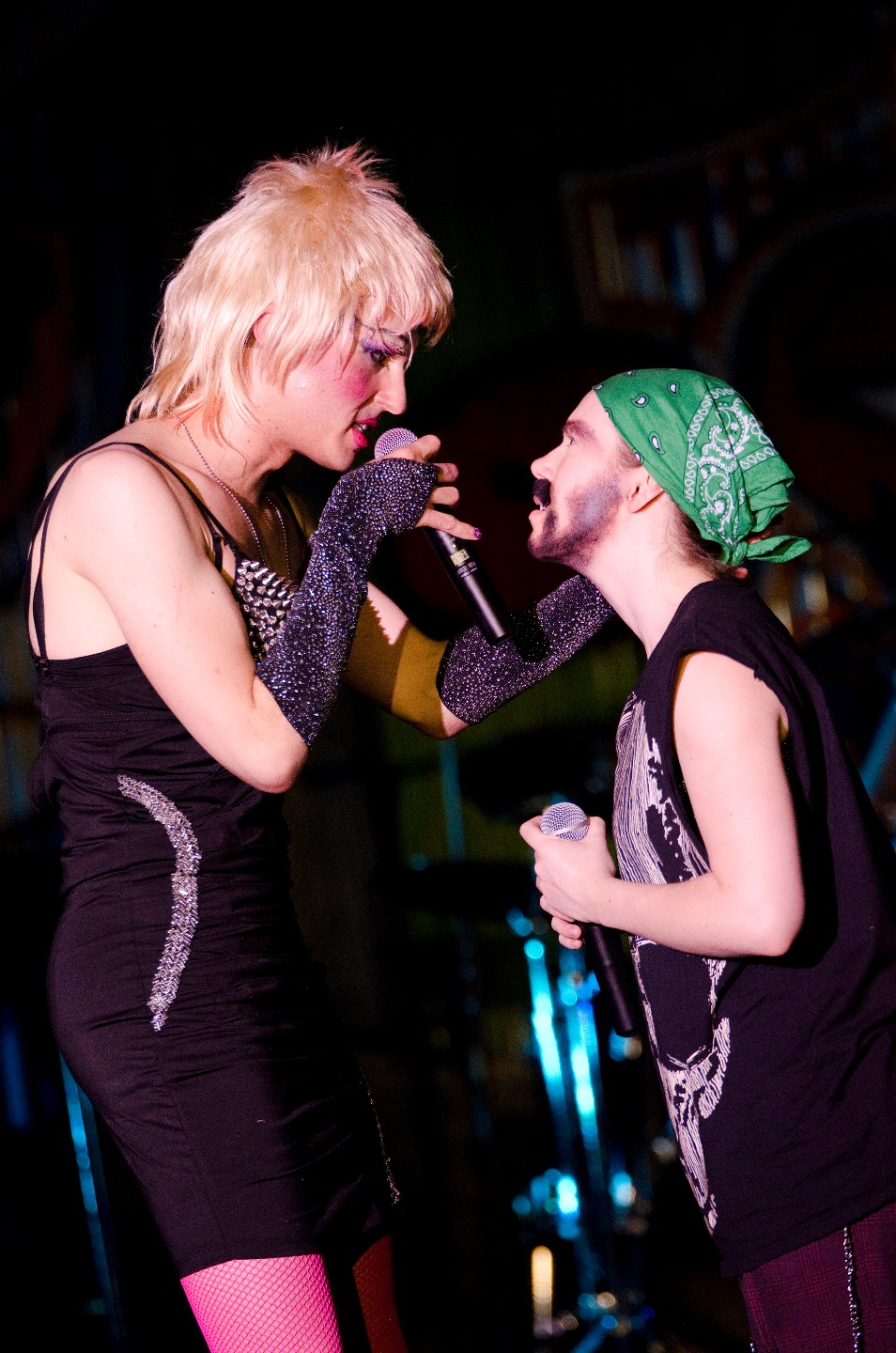
Hedwig (JJ Parkey, left) and Yitzhak (Ruthie Stephens) trade notes in Hedwig and the Angry Inch (photo by Heather Wack)

By Richard Ades

I was a little concerned when I learned JJ Parkey was going to play the title role in Short North Stage’s production of Hedwig and the Angry Inch.

When Parkey played the Emcee in Cabaret at the same venue last year, he depicted the entertainer as pure evil. Since no one is pure anything, that approach made the iconic character less interesting than he might have been.

Still, Parkey seemed talented, and I consoled myself with the thought that actors don’t always have final say over their performances. Sometimes directors dictate a certain approach in order to support their vision of the work. I have personal experience with this because, way back in my college/community-theater days, a director forced me to play a soft-spoken and intuitive character as a loudmouthed jerk in order to support his misguided interpretation of the play.

Maybe that’s what was going on with Cabaret, I thought. Or maybe not. It’s a moot point, really, because Parkey plays the transgendered Hedwig with all the verve and sensitivity that the role demands. It’s a bravura performance.

In case you’re one of the few people who are encountering John Cameron Mitchell’s cult musical for the first time (Short North’s production is my fourth, counting the 2001 movie), it’s about an East German lad who undergoes gender-reassignment surgery in order to marry his way to American citizenship. Unfortunately, the surgery is botched, leaving the former Hansel with a vestige—an “angry inch,” as it were—of his former genitalia where a brand-new vagina was supposed to be.

We actually meet Hedwig, as she’s now known, when she takes the stage along with her rock band, the Angry Inch. In the course of the concert, we hear her sad story, including her unhappy affair with a now-popular musician who’s simultaneously performing up the street. We also meet Yitzhak (a cross-dressing Ruthie Stephens), a sullen band member who clearly has his own rocky history with Hedwig.

Written with both wit and attitude by Mitchell, the melodrama unfolds in the midst of enjoyable ballads and punk-rock tunes by Stephen Trask. Parkey and the golden-throated Stephens do them all justice, as does the onstage band led by P. Tim Valentine.

Director/choreographer Edward Carignan wraps it all up in a production that knows when to let loose and when to stop and smell the rancor. Carignan likewise designed the wigs and gaudy costumes that help to define the title character, as do the clever video images that appear at opportune moments on two backdrop screens.

Technical director Robert Kuhn and lighting designer Amanda Ackers also deserve mention for their contributions to a show that, along with the recent Passing Strange, bolsters Short North Stage’s reputation as a purveyor of first-rate musical entertainment.

Short North Stage will present Hedwig and the Angry Inch through June 22 at the Garden Theater, 1187 N. High St. Show times are 9 p.m. Thursday-Saturday. Running time: 2 hours (including intermission). Tickets are $20. 614-725-4042 or shortnorthstage.org.