NYC-set flick inspired by romantic classic

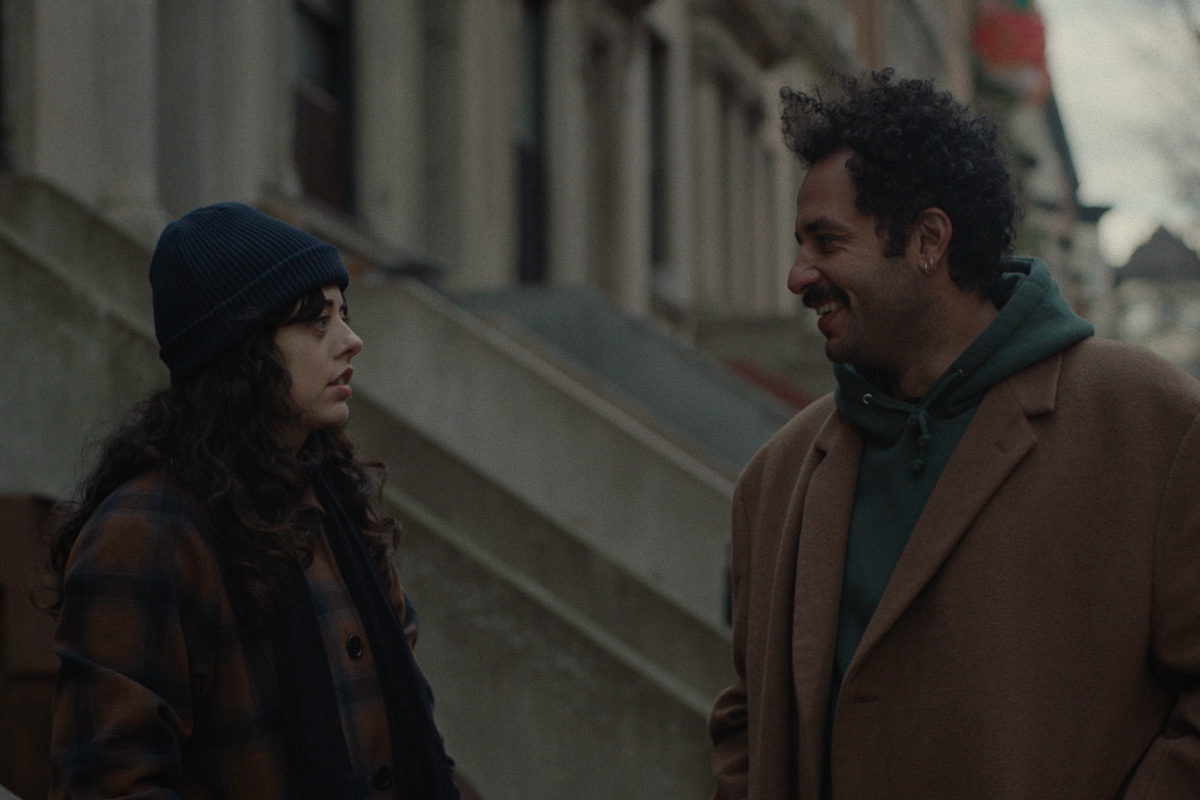
Olivia (Mary Neely, left) and Amir (Kareem Rahma) are strangers who meet at the apartment of a man who owes each of them money. (Photos courtesy of Factory 25)

By Richard Ades

In 1995, director Richard Linklater came out with Before Sunrise, the tale of a man and a woman who meet on a train and decide to spend an eventful night exploring Vienna. Laced with philosophical discussions and flirtatious banter, the achingly romantic film explored possibilities that remained unfulfilled, as the two had commitments that forced them to go their separate ways in the morning.

Before Sunrise was such a success that Linklater reunited the characters in two sequels: Before Sunset (2004) and Before Midnight (2013). The former was even more romantic than its predecessor, but the final film was rather sour-natured, depicting the lovers in a stagnant relationship marked by constant bickering.

I bring all this up because Or Something, a film by first-time director Jeffrey Scotti Schroeder, is obviously inspired by the flick that launched Linklater’s lauded trilogy.

Like Before Sunrise, it brings together two strangers and forces them to spend a day wandering the streets of a big city—in this case, New York. At first, they struggle to get along, but soon they’re sharing opinions on subjects of increasing depth, even including religion and God. Finally, they begin revealing some of their darkest secrets.

The open-ended script is well suited to a low-budget production that reportedly was shot on location in only six days. It also gives the lead actors plenty of room to flesh out their characters—not surprisingly, since it was written by the actors themselves.

Mary Neely plays the tense and closed-off Olivia, whom we first meet when she’s trying to raise cash by selling some of her clothes to a thrift shop. Kareem Rahma plays the more outgoing Amir, who needs money for personal reasons that eventually come out.

The two first meet outside the apartment of a mutual acquaintance, Teddy (Brandon Wardell), who coincidentally owes each of them $1,200. The film is a bit vague on just why he owes them that exact amount, but it makes it clear that Teddy is either unable or unwilling to pay it.

Instead, he tells Olivia and Amir to get the money from someone named Uptown Mike, though he can’t tell them how to contact this mysterious figure other than directing them to a certain corner in Harlem. Thus begins a crosstown trek that will throw the two strangers together for the next several hours.
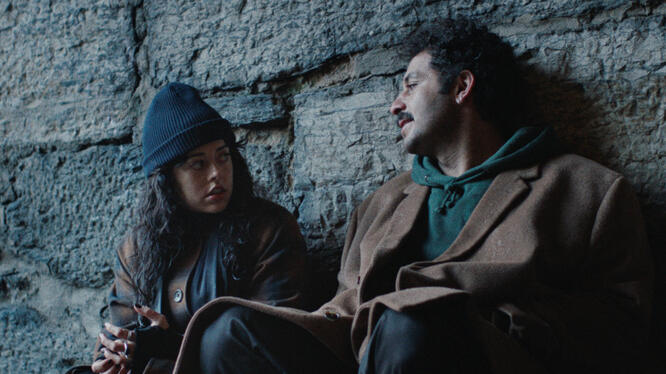
Much of the conversation that follows is entertaining and character-defining, such as the argument that arises when Olivia asserts that men are nice to women only when they want to have sex with them. On the other hand, some of the more cerebral topics arise less organically and less convincingly.

Still, Neely and Rahma play well off each other, keeping viewers vested in their characters’ fledgling relationship right up until the script makes two unfortunate detours.

The first leads Olivia and Amir into a karaoke bar at what seems like an unlikely moment. The second, and far more devastating, detour is a development that apparently is thrown in for shock value. It’s neither what we expected nor—especially for fans of Before Sunrise—what we wanted.

Look at it this way: Richard Linklater took 18 years to throw a sour note into his romantic “Before” saga, but Schroeder did it in only 82 minutes. If the director and his screenwriting stars want to redeem themselves, they need to bring Olivia and Amir back for a sequel.

Rating: 3 stars (out of 5)

Or Something (no MPA rating) opened Aug. 22 at the Quad Cinema in New York City and is scheduled for a special engagement Sept. 14 at Brain Dead Studios in Los Angeles. Additional screenings or VOD outlets have yet to be announced.

Former Mr. Maisel again makes jerkiness palatable

Andy Singer (Michael Zegen, right) is forced to spend a hectic day with his daughter, Anna (Kasey Bella Suarez), in Notice to Quit.

By Richard Ades

As the cheating husband who drove his wife to a life of comedy in The Marvelous Mrs. Maisel, Michael Zegen proved he can play a cad without losing the audience’s sympathy. By the end of the series, in fact, we were rooting for him almost as much as we were for his joke-telling ex.

In the comedy-drama Notice to Quit, as actor-turned-real estate agent Andy Singer, Zegen again relies on his natural likability. So, it seems, does first-time writer/director Simon Hacker.

Perhaps more than he should.

To be blunt, Hacker gives us almost no reason to cheer for Andy, an ethics-challenged New Yorker who’s down on his luck. To name just one of his vices, he regularly makes extra bucks by stealing appliances out of vacant properties and selling them to a ragtag gang of thugs.

Then, just as Andy is being evicted from his apartment because he’s behind on the rent, 10-year-old daughter Anna (a relatable Kasey Bella Suarez) shows up and wants to spend the day with him. She’s mad because her mom (Andy’s ex) is moving to Florida, and she doesn’t want to go.  

So how does Andy react to the presence of the daughter he hasn’t seen in months? Not well. In fact, he doesn’t want to be bothered and unsuccessfully tries to palm her off on his retired father (Robert Klein).

To some extent, it’s understandable that Andy can’t deal with Anna on this day, as he’s desperate to scrape together enough bucks to avoid ending up on the street. Mainly, though, his lack of filial devotion just makes it that much harder to care about him.

That is, it makes it harder for us to care about him. For her part, Anna seems to love her dad and enjoys this rare opportunity to spend time with him. Why? Did they have a close relationship in the past, when her parents were still together?

Hacker’s script never explains, any more than it clarifies just why we’re supposed to see Andy as anything other than a self-centered scumbag. And yet we are, because it quickly becomes obvious that the film has something warm and fuzzy in its long-range sights.

When that something arrives, it lands with all the impact of a wet noodle, both because it was telegraphed well in advance and because it wasn’t earned. It’s clear that Hacker wants us to care about what happens, but it’s equally clear that he doesn’t know how to make us care.

Well, with one exception: He lucked out by casting Zegen as Andy, who retains at least a portion of our sympathy even though he doesn’t deserve it, and Suarez as Anna, the daughter who loves him for no apparent reason. The chemistry these two create is the flick’s main selling point.

Rating: 3 stars (out of 5)

Notice to Quit (PG-13) opens Sept. 27 in theaters nationwide.

Holocaust escapee finds a home in pornography

Chelly Wilson does business out of her apartment in an old snapshot provided by the Wilson family. (Photos courtesy of Kory Miller/Obscured Pictures)

By Richard Ades

There have been many documentaries about Holocaust survivors. Queen of the Deuce is likely the only one about a survivor who went on to make her fortune in the porn industry.

Born into a family of Greek Jews in 1908, Chelly Wilson was quicker than most to recognize the rising threat Nazi Germany posed in the late 1930s. Temporarily leaving her son with her ex-husband and her daughter with a non-Jewish acquaintance, she hastily emigrated to New York, where she was soon making money selling hot dogs.

But Wilson’s real success came years later, when she began acquiring neighborhood movie theaters and devoting them to the increasingly popular genre of pornography. By the time soft porn began giving way to the hard variety, she was honchoing a business that ran a slew of theaters and even made its own features.

Directed and co-written by Valerie Kontakos, Queen of the Deuce tells Wilson’s story through interviews with her grown children and grandchildren, as well as people who worked with her over the years. Though she died in 1994, Wilson even makes an appearance herself thanks to home movies and interviews recorded by her family. In addition, an animated version of Wilson at various ages makes brief appearances to help us understand who she was and how she got that way.

An animated version of Chelly Wilson poses with some of her regular poker buddies in an image provided by Exile Films.

It all adds up to a portrait of an individual whose life was full of contradictions. For example:

⸱ She was a Jew who celebrated Christmas (which was also her birthday).

⸱ She was a lesbian but was married twice, including to a man she met in America.

⸱ She was a mother and grandmother who valued her family but sometimes kept them in the dark about her past.

A final contradiction is that, while many would label her a feminist thanks to her fierce independence, she made her living off a film genre that feminists of her era often considered misogynous.

In general, Wilson comes across as someone who proudly and unapologetically lived her life and was unafraid to thumb her nose at social norms. Director Kontakos does a good job of capturing her personality with major help from collaborators such as editor Rob Ruzic, composer Ken Myhr and lead animator Abhilasha Dewan.

As a bonus, Kontakos also captures the personality of New York in the 1960s and ’70s, before politicians such as Rudy Giuliani began working to reform its sex-, dirt- and crime-ridden image. Back then, the Big Apple might not have been as nice a place to visit as today’s cleaned-up version, but it obviously was the perfect home for a risk-taking entrepreneur named Chelly Wilson.

Rating: 4 stars (out of 5)

Queen of the Deuce previously made the rounds of several festivals, including the 2023 Columbus Jewish Film Festival. The film opens May 24 in select theaters and online through Amazon Prime Video and Apple TV.

He photographed folks the mainstream media ignored

Wearing a mask during the COVID pandemic, Corky Lee gets ready to take his next photo. (Photos courtesy of All Is Well Pictures)

By Richard Ades

As a child, Corky Lee enjoyed comic books about superheroes, which he later credited with giving him a “moral compass.” As a Chinese American, however, he never saw any superheroes who looked like him.

Despite this fact (or maybe because of it), Lee grew up to be a kind of superhero himself—one whose “superpower” was simply taking the kind of pictures no one else was taking. Walking around New York City with a camera bag over his shoulder, he spent five decades chronicling the lives of Asian Americans and Pacific Islanders, people whose struggles and celebrations were often ignored by the mainstream media.

Lee and his lifelong crusade of inclusion are the subject of Photographic Justice: The Corky Lee Story, a documentary being shown on PBS in observance of Asian American and Pacific Islander Month.

Directed by Jennifer Takaki and featuring a combination of contemporary interviews and vintage footage, the film is a low-key but loving portrait of the man who became a fixture in New York’s Asian community. Whenever members of its many varied cultures and nationalities threw a parade, held a party or joined a picket line, Lee could be counted on to be there.

Love of country and love of New York are obvious in this photo Corky Lee took of a 2006 parade celebrating Budha’s birthday.

After decades of such coverage, the documentary tells us, Lee amassed so much knowledge about local AAPI-related events that kids jokingly referred to him as “Corkypedia.”

Besides showing up for Asian holidays such as the lunar new year and Budha’s birthday, Lee also covered national holidays, when he concentrated on providing an Asian American viewpoint. On Veterans Day, for example, he focused his lens on AAPI vets to show that Asians are as much a part of U.S. society as their European American counterparts.

According to the documentary, Lee felt this lesson became especially important when the country was hit with the 9/11 attacks in 2001 and with COVID in 2020. Muslim Americans and Chinese Americans, respectively, were scapegoated for these national and international tragedies, and he did what he could to counteract the resulting prejudice.

Sadly, the latter effort turned out to be his last. After viewing Takaki’s documentary, you’ll realize just how much of a loss that was.

Rating: 4 stars (out of 5)

Photographic Justice: The Corky Lee Story can be seen in select theaters and will air on PBS stations beginning May 13. Its Central Ohio airtime is 4 p.m. Sunday, May 19 on WOSU.

Maria soars, Moreno returns, Spielberg triumphs

Anita (Ariana DeBose), Bernardo (David Alvarez) and a host of others take to the street in a colorful dance number from West Side Story.

By Richard Ades

After a preview screening, critics usually clear the room as soon as the end credits start to roll. But after a recent screening of Steven Spielberg’s West Side Story, several critics (including this one) remained in their seats. Either they were too mesmerized to move or they couldn’t resist the opportunity to hear a few more minutes’ worth of those iconic tunes.

First presented as a stage musical in 1957, West Side Story transposes Shakespeare’s Romeo and Juliet to a New York neighborhood divided between two rival gangs: the Puerto Rican Sharks and the non-Latino Jets. Trouble brews and inevitably leads to tragedy when a former Jet named Tony falls in love with Maria, sister of the head Shark, Bernardo.

With a book by Arthur Laurents, a glorious score by Leonard Bernstein and lyrics by Stephen Sondheim, the musical caught fire and inspired a classic, multiple-Oscar-winning 1961 movie directed by Robert Wise and Jerome Robbins.

Full disclosure: As a fan of the stage play and particularly of the original flick, I approached this new Spielberg remake with a mixture of excitement and trepidation. Would it deviate from the Wise-Robbins version, thus marring perfection? Or, conversely, would it offer a slavish clone, thus raising the question “Why did they bother?”

Maria (Rachel Zegler) catches her first sight of Tony across the dance floor.

The welcome answer is that the new movie, with a script by the great Tony Kushner (Angels in America), stays true to the spirit of the original. When it deviates, it does so in ways that are tasteful and often necessary to bring the story up to date with modern mores even though the action remains in the 1950s.

On the surface, the most obvious change is that Maria and the rest of the Puerto Rican characters are now played by Latino/Latina actors rather than Gringos in tan makeup. In a more subtle innovation, it’s announced from the beginning that the neighborhood shared by both gangs is marked for demolition to make way for ritzier dwellings. The underlying message is that the Sharks and Jets are fighting each other in a battle that ultimately will be decided by forces beyond their control. (Its relevance to modern-day America is hard to miss.)

Still, at its core, this remains the story of the dangerous romance between Maria and Tony. And it’s still told by way of the most beautiful music ever written for a stage musical, and punctuated by deliriously spirited dance steps (adapted by Justin Peck from Robbins’s original choreography).

My only serious disappointment with the new film is that one of the leading actors seems miscast. Ansel Elgort was fine the title character in 2017’s Baby Driver, but he often makes an inexpressive Tony, and he sings with a voice that’s good but not great. In compensation, Rachel Zegler’s Maria has a vulnerable face and the voice of an angel, hitting those high notes with ease. It’s largely thanks to her that their duets, such as “Tonight” and “One Hand, One Heart,” are among the film’s many highlights.

Tony (Ansel Elgort) and Maria (Rachel Zegler) share their first dance.

The supporting cast is uniformly strong, starting with Ariana DeBose as Bernardo’s mind-of-her-own girlfriend, Anita. Though DeBose doesn’t create quite as many waves as Rita Moreno did in her Oscar-winning 1961 performance, she’s a powerful presence and dances up a hurricane in colorful numbers such as “America.” In other key roles, David Alvarez is mercurial but dignified as Shark leader Bernardo, while Mike Faist projects pride mixed with desperation as Jets leader Riff.

Best of all, Moreno herself (who turns 90 on Dec. 11) plays Valentina, a Puerto Rican shopkeeper who has helped Tony get his life back together after a brief stint in prison. In a surprising twist, she’s given the honor of singing “Somewhere,” the wistful lament sung by Tony and Maria in 1961. It turns out to be one of the new film’s most touching moments.  

Though I originally worried about what Spielberg might change, one of my minor quibbles has to do with something he didn’t change: The Jets’ comic number “Gee, Officer Krupke” now seems dated, a blast from the past that’s turned into a dud amid the new film’s heightened sense of reality.

But that and other qualms fade away as the story heads into its final half-hour and the gears begin to turn toward its inescapable outcome. The feelings run as high as ever, and Bernstein’s music is as tender and majestic as always.

Thankfully, West Side Story endures.

Rating: 4½ stars (out of 5)

West Side Story (PG-13) opens Dec. 10 at theaters nationwide.