Landless refugees resort to desperate measures  

Reda (Aram Sabbah, left) and Chatila (Mahmood Bakri) see an escape to Germany as their only hope for a brighter future.

By Richard Ades

To a Land Unknown is a film shaped by its director’s dual allegiances.

As a man of Palestinian descent (though he now lives in Denmark), Mahdi Fleifel is devoted to telling the stories of his people. But as a cinephile, he seems equally devoted to recreating the magic of the American films he watched growing up in the 1980s.

The result is the story of two Palestinian refugees that combines the unvarnished realism of a documentary with the kind of alternately warm and testy relationship you might find in an American “buddy flick.”

The tale’s setting is Athens, Greece, where Chatila and his cousin Reda (Mahmood Bakri and Aram Sabbah, both excellent) are barely scraping by with the help of petty thefts and, in Reda’s case, paid sexual trysts. Their situation is desperate, but they see it as temporary.

If they can save up enough money, they plan to purchase fake passports and make their way to what they see as the greener pastures of Germany. Once there, they hope to open a café with the help of Chatila’s wife and son, who are now living in a refugee camp in Lebanon. 

From the beginning, it’s clear that Chatila is the more ruthless of the two, justifying their illegal activities as the products of dire necessity. Reda is both more soft-hearted and less self-disciplined, struggling to escape the drug addiction that threatens to control him.

Reda and Chatila meet Malik (Mohammad Alsurafa, left), a 13-year-old Palestinian orphan.

The men’s personality differences complicate what is already a difficult quest to escape Athens, but they forge ahead with the help of a 13-year-old Palestinian orphan named Malik (Mohammad Alsurafa) and a lonely Greek woman named Tatiana (Angeliki Papoulia). Later, others are involved as well, though not always by their own choice.

Indeed, the film eventually evolves into a kind of crime caper, though one that bears little resemblance to any caper flick you’ve ever seen. The emphasis is not so much on whether the men’s plot will succeed as it is on just how far they’ll go to achieve their goal.

If there’s one line that sums up To a Land Unknown, it’s one person’s assertion that people who’ve been treated like dogs are apt to attack each other. It helps to explain much of the characters’ behavior, as well as the film’s refusal to condemn them for it.

That thought alone would leave viewers with much to ponder, but then director/co-writer Fleifel adds a development that can only be seen as an homage—an unconscious homage, according to Fleifel—to an Oscar-winning classic from decades past.

Some will disagree, but for me it’s an unwelcome complication, upsetting the film’s delicate balance between stark reality and cinematic tropes. Up until then, however, Fleifel’s full-length debut is an engrossing examination of the lengths desperate people will go to in order to survive.

Rating: 3½ stars (out of 5)

To a Land Unknown (no MPA rating) can be seen in select theaters and is scheduled to open July 18 at Columbus’s Gateway Film Cen

Profiles in struggle: ‘Runner’ and ‘My Darling Vivian’

Runner
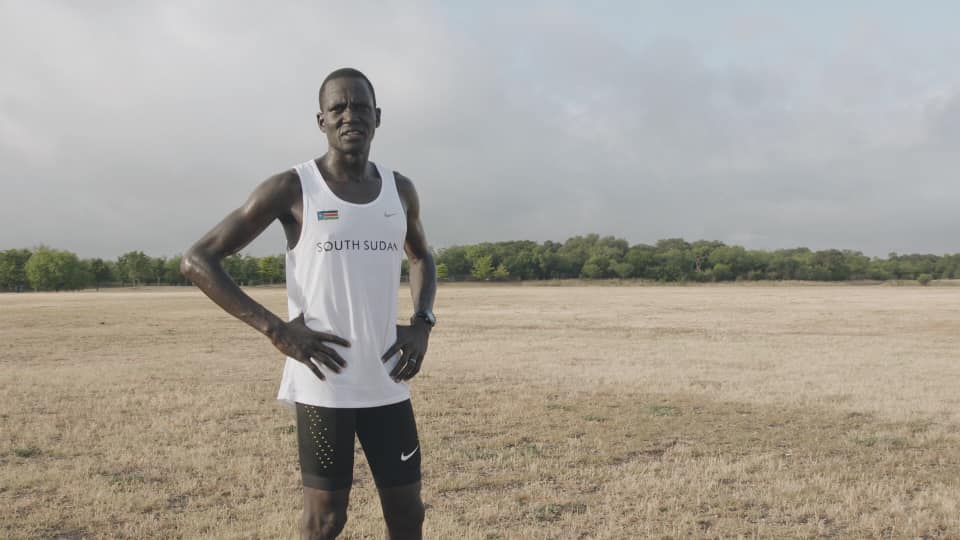
Guor Mading Maker, a refugee who became an Olympic athlete, in Runner

By Richard Ades

Two very different kinds of heroism are on display in documentaries coming out this weekend. One centers on a refugee-turned-Olympic athlete, the other on a celebrity wife and mother-turned-forgotten woman.

First up is Runner, the story of Guor Mading Maker, who was born in Sudan during a decades-long struggle between the Arabic/Muslim northern region and his own African/Christian south.

Director Bill Gallagher uses somber animation to depict Guor’s early years, when his parents reluctantly sent him away for his own safety. But “safety” is a relative term in the midst of a civil war, as he was captured by the enemy and, after escaping, spent four years of his boyhood totally on his own.

Guor’s fortunes finally changed due to a chance encounter with an aunt and uncle, who took him to the U.S. and settled in New Hampshire. There—as the documentary relates via interviews with former high school classmates and coaches—he discovered that running was not merely a survival tool but a sport and even the possible key to a college education and a promising future.

The bulk of the documentary deals with Guor’s Olympic aspirations, which were spread out over several years and were inextricably linked to the political situation in his homeland. He first opted to compete under an international banner, having no desire to run on behalf of the country that destroyed much of his family and nearly killed him. However, when a peace deal opened the possibility that southern Sudan would gain its independence, he had hopes of joining the new country’s first Olympic team.

Most sports fiction eventually leads to a rousing scene of hard-won triumph. Confined by reality, Gallagher’s film can’t do that, but it does deliver stark glimpses of the pain and frustration of competition, mixed with moving depictions of cultural pride and long-delayed reunions. Most of all, it introduces us to a man who has maintained his determination and integrity despite obstacles most of us can’t even imagine.

My Darling Vivian
Vivian Liberto and Johnny Cash during the early, happy years of their marriage

This weekend’s other new documentary, My Darling Vivian, pays homage to the Catholic schoolgirl who became Johnny Cash’s first wife and bore most of his children. Directed by Matt Riddlehoover, it serves as a counterpoint to the 2005 Cash biopic Walk the Line, which some feel was a misrepresentation of who Vivian Liberto really was.

Riddlehoover’s main witnesses are Vivian’s four daughters: singer Rosanne Cash and younger sisters Kathy, Cindy and Tara. Interviewed separately and only occasionally disagreeing on minor details, they present a comprehensive picture of the difficult life their mother led as Cash’s wife, and of the nearly invisible existence she led as his ex-wife. Family photos and archival footage help bring the story to life.

Obviously, the film will appeal most to Cash fans, particularly early scenes that detail how the couple met, fell in love and engaged in a long-distance courtship while Johnny finished his military service. But the account of their difficult marriage, during which Vivian was left to watch over the girls and assorted animals while her husband was away on tour for months at a time, should awaken even non-fans’ empathy. And few will fail to see the injustice of what happened to Vivian after their divorce, when the public forgot her as Johnny and new wife June Carter Cash became the music scene’s new darlings.

The doc makes two things clear: (1) Johnny Cash was an impossible man to live with; and (2) Vivian loved him anyway and always would. It’s also clear that Vivian’s daughters loved her and were eager to undo the damage they felt Walk the Line and time itself had done to her reputation. My Darling Vivian gives them the chance to do just that.

Ratings:
Runner: 4½ stars (out of 5)
My Darling Vivian: 4 stars

My Darling Vivian is available from VOD outlets beginning June 19. For information on how to watch Runner, visit runnerdoc.com.