Reimagining the making of a classic

Jean-Paul Belmondo and Jean Seberg (Aubry Dullin and Zoey Deutch) act out a scene from Breathless in Nouvelle Vague, a dramatization of the making of the 1960 film. (Photos by Jean-Louis Fernandez/courtesy of Netflix)

By Richard Ades

Nouvelle Vague may be the most affectionate love letter to moviemaking since Francois Truffaut’s Day for Night (1973).

Directed by Richard Linklater, the new film reimagines the making of Breathless, the 1960 classic that established critic-turned-director Jean-Luc Godard as a star of the influential movement known as the French New Wave.

If you’re a devoted cinephile, it’s likely you’re already salivating. And make no mistake: Linklater made this film with you in mind.

Not only is it shot in the style of Breathless, with a handheld camera and black-and-white photography, but it announces the name of each historic participant—from the director and stars to the lowliest of crew members—as soon as he or she appears on the screen. Linklater assumes you’ll want to know.

But what if you’re not a cinephile? In that case, chances are you’ll be a bit less enthralled, but the flick still has much to offer thanks to a charming cast and a witty script that both reveres and pokes fun at Godard and his eccentric approach to moviemaking.

We first meet Godard (Guillaume Marbeck) as a critic who wears shades even in darkened theaters and who complains that he hasn’t fulfilled his dream of making his first movie by the age of 25. Urged on by fellow critics, and encouraged by their belief that the only authentic way to make cinema is on the cheap, he takes on a film based on a real-life criminal who’s charged with killing a cop.

Jean-Luc Godard (Guillaume Marbeck, left) takes a break with his leading man, Jean-Paul Belmondo (Aubry Dullin).

Godard quickly hires the then-unknown Jean-Paul Belmondo (Aubry Dullin) to play the protagonist, but he has more trouble casting the crook’s American girlfriend. Aiming high because he thinks it will boost the film’s box office potential, he begins a campaign to land rising star Jean Seberg (Zoey Deutch).

Seberg is reluctant but eventually agrees because the film treatment was co-authored by Truffaut (Adrien Rouyard), another critic-turned-director who’s already made a name for himself. Once shooting starts, however, she begins to think she made a mistake.

For one thing, Godard has no script, preferring to rely on last-minute inspiration. For another, he’s not afraid to suspend shooting if that inspiration doesn’t show up on time.

Jean-Paul Belmondo (Aubry Dullin) takes to the street for a climactic scene while cinematographer Raoul Coutard (Matthieu Penchinat) and director Jean-Luc Godard (Guillaume Marbeck) follow in an open-top Citroen.

After Godard threatens the production’s bare-bones budget by repeatedly sending his cast and crew home early, not only Seberg but producer Georges de Beauregard (Bruno Dreyfurst) becomes worried. Beauregard repeatedly lowers the boom, but Godard refuses to change his unconventional ways.

There’s no suspense over the outcome, of course. We know going in that Breathless will become a groundbreaking success and Godard will go on to enjoy a decades-long career. The only question is just how he will accomplish this unlikely feat.

With a sense of history leavened by a sense of humor, Linklater answers that question in a way that should leave cinephiles fascinated and everyone else pleasantly entertained. 

Rating: 4½ stars (out of 5)

Nouvelle Vague (rated R) can be seen at select theaters and is available on Netflix beginning Nov. 14.
NYC-set flick inspired by romantic classic

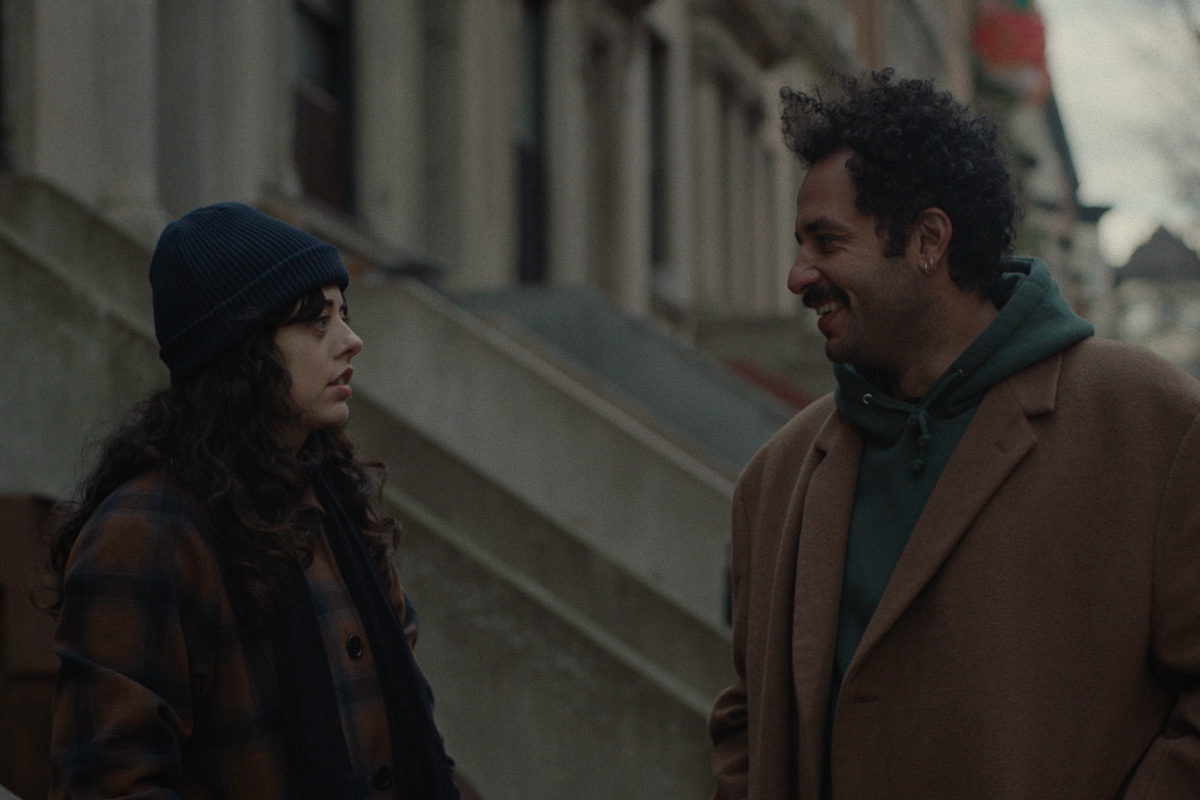
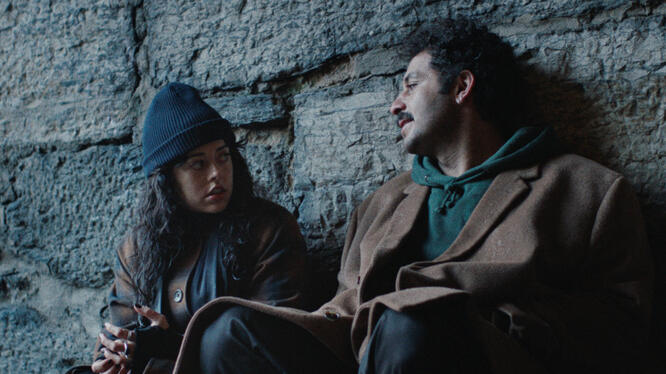
Olivia (Mary Neely, left) and Amir (Kareem Rahma) are strangers who meet at the apartment of a man who owes each of them money. (Photos courtesy of Factory 25)

By Richard Ades

In 1995, director Richard Linklater came out with Before Sunrise, the tale of a man and a woman who meet on a train and decide to spend an eventful night exploring Vienna. Laced with philosophical discussions and flirtatious banter, the achingly romantic film explored possibilities that remained unfulfilled, as the two had commitments that forced them to go their separate ways in the morning.

Before Sunrise was such a success that Linklater reunited the characters in two sequels: Before Sunset (2004) and Before Midnight (2013). The former was even more romantic than its predecessor, but the final film was rather sour-natured, depicting the lovers in a stagnant relationship marked by constant bickering.

I bring all this up because Or Something, a film by first-time director Jeffrey Scotti Schroeder, is obviously inspired by the flick that launched Linklater’s lauded trilogy.

Like Before Sunrise, it brings together two strangers and forces them to spend a day wandering the streets of a big city—in this case, New York. At first, they struggle to get along, but soon they’re sharing opinions on subjects of increasing depth, even including religion and God. Finally, they begin revealing some of their darkest secrets.

The open-ended script is well suited to a low-budget production that reportedly was shot on location in only six days. It also gives the lead actors plenty of room to flesh out their characters—not surprisingly, since it was written by the actors themselves.

Mary Neely plays the tense and closed-off Olivia, whom we first meet when she’s trying to raise cash by selling some of her clothes to a thrift shop. Kareem Rahma plays the more outgoing Amir, who needs money for personal reasons that eventually come out.

The two first meet outside the apartment of a mutual acquaintance, Teddy (Brandon Wardell), who coincidentally owes each of them $1,200. The film is a bit vague on just why he owes them that exact amount, but it makes it clear that Teddy is either unable or unwilling to pay it.

Instead, he tells Olivia and Amir to get the money from someone named Uptown Mike, though he can’t tell them how to contact this mysterious figure other than directing them to a certain corner in Harlem. Thus begins a crosstown trek that will throw the two strangers together for the next several hours.

Much of the conversation that follows is entertaining and character-defining, such as the argument that arises when Olivia asserts that men are nice to women only when they want to have sex with them. On the other hand, some of the more cerebral topics arise less organically and less convincingly.

Still, Neely and Rahma play well off each other, keeping viewers vested in their characters’ fledgling relationship right up until the script makes two unfortunate detours.

The first leads Olivia and Amir into a karaoke bar at what seems like an unlikely moment. The second, and far more devastating, detour is a development that apparently is thrown in for shock value. It’s neither what we expected nor—especially for fans of Before Sunrise—what we wanted.

Look at it this way: Richard Linklater took 18 years to throw a sour note into his romantic “Before” saga, but Schroeder did it in only 82 minutes. If the director and his screenwriting stars want to redeem themselves, they need to bring Olivia and Amir back for a sequel.

Rating: 3 stars (out of 5)

Or Something (no MPA rating) opened Aug. 22 at the Quad Cinema in New York City and is scheduled for a special engagement Sept. 14 at Brain Dead Studios in Los Angeles. Additional screenings or VOD outlets have yet to be announced.

A night for sharing thoughts and burying turtles

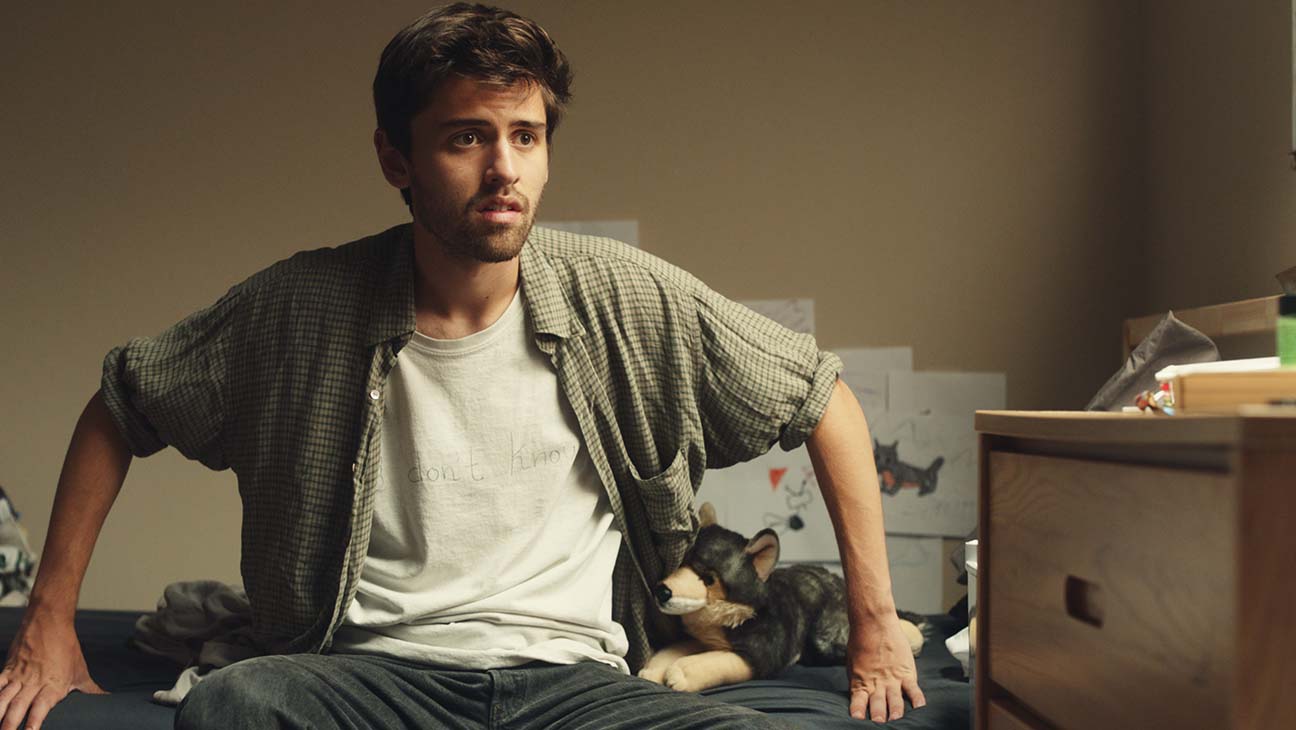
Alex (Cooper Raiff) is having a hard time adjusting to college life in Shithouse.

By Richard Ades

In 1995, director Richard Linklater brought together an American man and a Frenchwoman for an overnight session of talk and romance. The result was the indie film Before Sunrise.

This year, writer/director/star Cooper Raiff has brought together two college students for an overnight session of talk, commiseration and (a little) romance. The result is the indie film Shithouse.

Though the new flick is inferior to its predecessor in ways that go beyond its unappealing title, it still has something to offer. For starters, it’s a heartfelt look at the difficult transition college life represents to people like shy freshman Alex Malmquist (Raiff).

A Texan who’s spent much of his first six months at a California university hiding in his room, Alex finally decides to break out of his shell. When perennially stoned roommate Sam (Logan Miller) tells him about a party at the frat home known as “Shithouse,” Alex is game. Or, at least, he thinks he is. Once there, he panics when a girl tries to get intimate, then flees and calls his mom (Amy Landecker) just to hear her reassuring voice.

The night is salvaged only because, back at the dorm, Sam has a drunken accident that makes their room uninhabitable. Escaping to a common area, Alex meets up with his resident adviser, Maggie (Dylan Gelula), who is having a similarly bad day due to the death of her pet turtle. She invites him back to her room, where a brief attempt at sex gives way to an eventful night of walking, talking and an impromptu funeral for her lost pet.

Maggie (Dylan Gelula) and Alex (Cooper Raiff) share a momentous night.

It’s this part of Shithouse that is most reminiscent of Before Sunrise, and the comparison is not altogether flattering. Raiff’s dialogue is brisk but can’t match the earlier film’s engrossing debates on philosophy and life. Also, though Alex and Maggie are engagingly played by Raiff and Gelula, the script tries a bit too hard to define them.

Alex grew up with loving parents (though his father is now deceased), while Maggie’s father deserted her when he divorced her mother. These facts serve as shorthand explanations for their very different reactions to college life—and, as it turns out, to the night they shared.

After waking up in Maggie’s bed the next morning, Alex is shocked to find that their experience didn’t mean the same thing to her that it did to him. Friction and awkwardness follow, including much that is funny and much that rings painfully true. As a result, both characters undergo important changes, leading to an ending that is inconclusive, yet gives us hope for each of them.

…Except that it’s not the end. Instead, Raiff tacks on a final scene that takes place two and a half years later. Why, it’s hard to say, as it leaves us wondering just what we’ve missed.

Despite this and other missteps (including the name itself), Raiff’s first directorial effort boasts originality, humor and honesty. It may not be worth the two sequels (and counting) that Before Sunrise inspired, but it’s at least worth a look.

Rating: 3½ stars (out of 5)

Shithouse (rated R) opens Oct. 16 at select theaters (including Columbus’s Gateway Film Center) and though VOD outlets.