Waltzing through a tender tale of longing and infidelity

One of the beautiful stage pictures offered by Short North Stage’s production of A Little Night Music (photo by Ray Zupp)

By Richard Ades

To succeed, a musical production needs basic ingredients such as strong singing, a good band, pretty scenery, etc. If a show has all of these things, it’s probably worth seeing.

But it can be so much more if the director has a feel for the material’s subtleties (assuming there are any) and knows how to communicate them to the cast and crew. Then the musical becomes a transcendent experience.

At Short North Stage, I’ve seen two such productions, both written by Stephen Sondheim: 2013’s Sunday in the Park With George and, now, A Little Night Music. In the current show, a bittersweet reverie on love and regret, director Michael Licata and his cast bring out every knowing chuckle and every tender, aching moment.

Adapted by Hugh Wheeler from the Ingmar Bergman film Smiles of a Summer Night, the 1973 Tony winner centers on two Swedish households at the turn of the last century.

In one, middle-aged lawyer Fredrik Egerman (Mark A. Harmon) lives with young wife Anne (Jennifer Barnaba) and his son from a previous marriage, seminary student Henrik (JJ Parkey). In the other, Madame Armfeldt (Linda Dorff) cares for granddaughter Fredrika (Maria Delanno) while the girl’s mother, actress Desiree (Marya Spring), is off touring with her latest play.

From the start, it’s apparent that the Egerman household is emotionally unstable. Fredrik loves his girlish wife but is frustrated by her reluctance to take part in marital relations. When Desiree’s touring show arrives in town, he can’t resist going to see the woman with whom he had an affair some 14 years earlier.

This leads to a night of passion that arouses the suspicions of Desiree’s current lover, the pinheaded Count Carl-Magnus Malcolm (Nick Lingnofski). Being a first-class male chauvinist, he then complains about his mistress’s indiscretion to his long-suffering wife, Charlotte (Kate Lingnofski).

All the desires, suspicions and resentments that were fomented in Act 1 come to a delicious head in Act 2, when everyone converges at Madame Armfeldt’s estate for a country outing.

It’s hard to find fault with the large cast, except to note that Barnaba’s Anne sometimes fades into the woodwork and that her pretty soprano voice was occasionally overwhelmed by the band on opening night. Really, though, there are no weak links.

Spring exudes worldly confidence as Desiree, which makes her vulnerable rendition of the show’s most memorable tune, Send in the Clowns, all the more devastating. As former lover Fredrik, Harmon offers a deftly sketched portrait of a decent man tottering on a tightrope between obligation and desire.

Parkey, a familiar visitor on the Short North stage, gives one of his best performances yet as Henrik, a young man pulled in opposite directions by his religious ideals and his unspoken love for his 18-year-old stepmother. Another career-topping performance is given by Dorff as Madame Armfeldt, whether she’s tackling Sondheim’s tricky melodies or waxing philosophical about roads not taken.

Several hearty laughs are earned by Nick Lingnofski as the preening, adulterous count, while Kate Lingnofski communicates all of the conflicting emotions felt by his wronged but loving wife, Charlotte. In another important supporting role, Eli Brickey gives a saucy but warmhearted portrayal as Petra, Anne’s maid and confidante, and delivers a rousing rendition of The Miller’s Son, a Celtic-flavored statement of female self-sufficiency.

Meanwhile, young Maria Delanno shows remarkable poise as the wise-beyond-her-years Fredrika—to the extent that she didn’t even flinch when a piano bench collapsed under her on opening night.

Adding to the production’s texture are the varied voices who serve as a sort of musical Greek chorus, as well as the backstage musicians who perform under Lloyd Butler’s direction. Interestingly, nearly all of the songs are written in waltz time, which makes it fitting that the most prominent dance numbers (choreographed by Dionysia Williams) are actual waltzes.

Like the troupe’s 2013 staging of Sunday in the Park With George, the current show is a visual treat thanks to Ray Zupp’s gauze-strewn scenery, Adam Zeek’s ethereal lighting and a colorful array of costumes supervised by Stephanie Keller. But perhaps the most important of the backstage talents is sound designer Michael Mason, who succeeds in making nearly every syllable come through clearly—not an easy feat in the Garden Theater’s cavernous main auditorium.

With A Little Night Music, Short North Stage proves once again that it understands Sondheim. The show is tender, wise, witty and—for devoted fans of the composer/lyricist—completely unmissable.

Short North Stage will present A Little Night Music through Nov. 1 at the Garden Theater, 1187 N. High St., Columbus. Show times are 8 p.m. Thursday-Saturday, 3 p.m. Sunday. Running time: 3 hours (including intermission). Tickets are $25-$40. 614-725-4042 or shortnorthstage.org.
Up-and-coming playwright is both depressing and hysterical

Taylor Moss and Susie Gerald in The Bully Composition, one of four Will Eno plays featured in Over the Edge (photo by Allan Burkman)

By Richard Ades

Back in March, Wild Women Writing presented a collection of pieces about people On the Edge. This month, it’s offering plays about people who’ve gone Over the Edge.

What’s the difference? Rick Gore of Short North Stage (which is co-presenting the production) offered an explanation during a post-performance talkback. He pointed out that the characters in the earlier show often pushed their relationships to the brink of separation but then pulled back, whereas in this show, relationships are more likely to be doomed.

Both shows feature one piece by Samuel Beckett and several short works by another playwright. In On the Edge, the second playwright was Britain’s Harold Pinter; in Over the Edge, it’s contemporary American playwright Will Eno.

Given the contrast between the two shows, could it be that Eno has an even bleaker view of life than Pinter? Maybe so, but he sometimes leavens that bleakness with a sly sense of humor.

This comes out most clearly in Ladies and Gentlemen, the Rain, in which a man and a woman (John Hawk and Heather Caldwell) are shown recording videos for a dating website. The recording sessions seem to be going on in separate locations, as there’s no connection between the man and the woman. And judging from the way they describe themselves, neither of them is likely to forge a connection with anyone else, either.

Delivered with droll matter-of-factness by Hawk and Caldwell under Katherine Burkman’s direction, their comments are hilariously banal and random. “I’m good at grocery shopping,” the man says, while the woman admits she’s never understood why breaking the sound barrier has to create so much racket. Both are desperate to share their lives with someone, but neither has any idea how to bring that about. Their situations are at once laughable and pitiable.

The other Eno pieces have a similarly downbeat viewpoint, though it’s delivered more straightforwardly.

In The Bully Composition, two people (Taylor Moss and Susie Gerald) set out to re-create a classic photo of soldiers posing between battles during the Spanish-American War. Treating the audience as their models, they urge viewers to imagine they’re in a time and place where life could take a turn for the worse at any moment. The comparison between war and our everyday reality is hard to miss.

In Behold the Coach, in a Blazer, Uninsured, the title character (David Fawcett) holds a press conference to explain why he failed to lead his team to victory during the past season. “It was a building year,” he starts out, but his defenses eventually crumble—much as his team’s defenses undoubtedly crumbled on the playing field. Before it’s over, he’s revealed way too much about the insecurities that plague every aspect of his life.

The piece has resonance, particularly in a football-obsessed town like Columbus, and is my second-favorite Eno playlet (after Ladies and Gentlemen, the Rain). However, Fawcett could give it even more resonance, along with a few more chuckles, if he threw himself into the part a bit more.

Speaking of Columbus, the show’s one Beckett work is called Ohio Impromptu. Its name notwithstanding, it has nothing to do with the Buckeye State except that it was first performed here.

The play features a white-bearded Richard Green reading from an apparently personal essay while an identically bearded Fawcett listens and occasionally raps on the table when he wants Green to stop or repeat something. Basically, it’s a stylish and macabre rumination on death, much like Beckett’s Rockaby from the March show.

Wrapping up the evening is the most unvarnished expression of Eno’s dark outlook, Oh, the Humanity. It begins with a bickering couple (Gerald and a particularly convincing Green) attempting to drive somewhere in a car, which is represented by two chairs. Strangely, they can’t agree on whether they’re going to a funeral or a christening, but this becomes a moot point when the man realizes that they can’t go anywhere because their “car” is—you guessed it—two chairs.

Adding to the piece’s self-conscious theatricality, a third character (Hawk) introduces himself as “The Beauty of Things.” He mostly just observes the couple’s troubles, but at one point he turns to the audience and tells us he knows we expect him to say something reassuring. The line probably would work better if we hadn’t just seen enough Eno to realize that reassurance is not what the playwright is about.

My first take on Eno is that he’s a serious artist who can be hysterically funny when he’s not being annoyingly pretentious. Clearly, though, he’s worth paying attention to, since he’s an up-and-comer who had plays both on and off-Broadway in 2014. Many thanks to Wild Women Writing for giving Columbus a chance to meet him.

Wild Women Writing and Short North Stage will present Over the Edge With Beckett and Eno through May 10 at the Garden Theater, 1187 N. High St., Columbus. Show times are 8 p.m. Thursday-Saturday and 2 p.m. Sunday. Tickets are $20. 614-725-4042 or shortnorthstage.org.

One-night stands and recalcitrant cabbies

Nick Lingnofski, Geoffrey Nelson, Colleen Dunne and Stephen Woosley (clockwise from top left) appear in The Collection, one of four works featured in On the Edge (photo by Julia Stonerook)

By Richard Ades

Columbus thespian Katherine Burkman is continuing her love affair with Samuel Beckett and Harold Pinter.

Her former group, Women at Play, presented several works by the playwrights when it was active around the turn of the millennium. And now Burkman has made them the focus of a Wild Women Writing show called On the Edge.

Co-presented by Short North Stage, the program consists of an hour-long one-act and two shorter pieces by Pinter, as well as a one-woman play by Beckett. It’s a pleasantly puzzling way to spend an afternoon or evening.

The most rewarding work is the longest, Pinter’s The Collection. The play delves into the power struggle that grows out of an alleged episode of marital infidelity.

James (Stephen Woosley) accuses Bill (Nick Lingnofski) of having a one-night stand with his wife, Stella (Colleen Dunne). Bill denies it ever happened and tries to keep the whole matter from his older lover and benefactor, Harry (Geoffrey Nelson).

Working under Burkman’s direction, the entire cast performs ably. Woosley exudes menace as the accusatory James, while Lingnofski’s Bill responds with oily obfuscation. One of the piece’s joys is seeing Nelson’s Harry finally take charge of the situation after being consigned to the sidelines for much of the running time.

Oddly, the piece is performed with American accents even though the dialogue places the action firmly in the UK. But that’s a distraction only when a character lets loose with a Briticism such as “old chap” or “bollocks.”

Also performed in Americanese, though it’s obviously set in London, is Victoria Station. It’s the comic tale of a taxi dispatcher (David Fawcett) who tries to send a maddeningly obtuse driver (Lingnofski) to the titular railway terminal.

Much of the piece resembles a low-key version of the kind of absurd comic sketches Monty Python specialized in. (Substitute “dead parrot” for “Victoria Station” and you’ll see what I mean.) The contrast between Fawcett’s increasingly frustrated dispatcher and Lingnofski’s uncooperative cabbie is good for several chuckles, but the piece’s darker elements might work better if the latter came off as something more than a blissed-out ignoramus.

Burkman herself takes the stage in Rockaby, the show’s one contribution by Beckett. Much like the playwright’s Krapp’s Last Tape, it consists of the interplay between an elderly character and that character’s recorded voice.

The situation, however, is far simpler. Rather than reviewing her life, the old woman is simply trying to lull herself to sleep (or something more permanent) by listening to a series of repetitive recordings. Working under Ken Pearlman’s direction, Burkman delivers a portrayal effectively tinged with exhaustion and regret.

After all the power plays, frustrations and anguish of the previous works, Pinter’s Night ends the program on an entirely different note. Susie Gerald and Fawcett offer a tender enactment of an older couple’s attempt to agree on the details of their first meeting.

It’s a short and unexpectedly sweet conclusion to an engrossing visit with two of the last century’s most celebrated playwrights.

Wild Women Writing and Short North Stage will present On the Edge through March 15 at the Garden Theater, 1187 N. High St., Columbus. Show times are 8 p.m. Thursday-Saturday and 2 p.m. Sunday. Running time: 1 hour, 50 minutes (including intermission). Tickets are $20. Contact: shortnorthstage.org.

Hollywood agent drops names, spills secrets in one-woman gabfest

Deb Colvin-Tener in Short North Stage’s production of I’ll Eat You Last: A Chat With Sue Mengers (photo by Jerri Shafer)

By Richard Ades

Do you like to dish? Do you love show business? Are you crazy about Bette Midler?

If you answered “yes” to all three questions, you’ll probably enjoy I’ll Eat You Last: A Chat With Sue Mengers.

Midler starred in the one-woman play on Broadway, and Short North Stage’s production never lets you forget it. If Deb Colvin-Tener’s portrayal doesn’t remind you of the Divine Miss M, you must be suffering from either extreme youth or a serious case of amnesia.

Mengers (1932-2011) fled Nazi Germany as a girl and grew up to be a successful Hollywood agent. John Logan’s script reveals how she did it, then imparts juicy bits of gossip about her famed clients and other Tinseltown bigwigs she scuffled with while promoting those clients.

It leaves us with the feeling that Mengers could be an invaluable friend and a formidable adversary.

In one of her most fascinating stories, she talks about her campaign to persuade a reluctant William Friedkin to hire an obscure actor named Gene Hackman to star in The French Connection (1971). She pursued this partly by blocking the director’s driveway with her Bentley, but mostly by delivering a soundly reasoned explanation of just what Hackman would bring to the role.

When you hear who they were thinking of hiring in his place, you realize just how much we all owe her.

Mengers could be described as a force of nature—except that it would have to be an immobile force of nature. “Exercise has not played a big part in my life,” she announces, and she proves it by spending the entire play lounging on her couch. So averse is she to unnecessary exertion that she calls on an audience member for help when she needs something that’s on the other side of her plush, Michael S. Brewer-designed living room.

Directed by Jonathan Putnam, one of Central Ohio’s leading experts on comedy, Colvin-Tener makes the most of curmudgeonly lines like “I just don’t get the appeal of children.” It would have been nice to see a little more Colvin-Tener mixed in with the Midler-inspired gestures and intonations, but Midler fans won’t mind in the least.

Besides being funny, Colvin-Tener communicates the forced bravado that shows not everything is right with Mengers’s world.

We learn early on that she’s been fired by Barbra Streisand, one of her first and favorite clients, and is expecting the personal call that will make it official. Mengers’s career seems to be in trouble, but she’s determined to tough it out with her usual swagger, fueled by whatever courage she can gain from alcohol and marijuana.

With the Academy Awards presentation less than a week away, this is a particularly appropriate time to catch I’ll Eat You Last. After seeing it, you begin to understand the crucial role Mengers and her colleagues played in shaping the industry it celebrates.

Short North Stage will present I’ll Eat You Last: A Chat With Sue Mengers through March 1 in the Green Room of the Garden Theater, 1187 N. High St. Show times are 8 p.m. Thursday-Saturday (no show Feb. 27) and 3 p.m. Sunday. Running time: 95 minutes. Tickets are $25-$30. 614-725-4042 or shortnorthstage.org.
Hockey musical is gone, but spoofy sand-and-surf tale remains

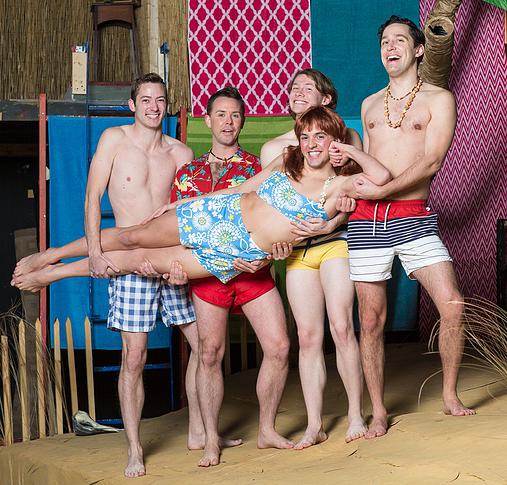
Chicklet (Nick Hardin) gets a lift from friends (from left) Provoloney (Andrew Trimmer), Star Cat (Jason Crase), YoYo (Luke Stewart) and Kanaka (Dan Montour) in Psycho Beach Party, one of two plays opening this week at Short North Stage (photo by Jason Allen, Second Glimpse Photography)
Chicklet (Nick Hardin) gets a lift from friends (from left) Provoloney (Andrew Trimmer), Star Cat (Jason Crase), YoYo (Luke Stewart) and Kanaka (Dan Montour) in Psycho Beach Party (photo by Jason Allen, Second Glimpse Photography)

By Richard Ades

It was one busy week at the Garden Theater.

Last Wednesday, Short North Stage opened its first original work, The Great One. Timed to complement the National Hockey League’s All-Star Game in Columbus, the musical focused on a traumatic moment in western Canadian history: the Edmonton Oilers’ 1988 trade of star player Wayne Gretzky to the Los Angeles Kings.

With direction by Scott Hunt, who also co-wrote the book and lyrics, it boasted a committed cast of five and some surprisingly pretty tunes by composer James Higgins. In just about an hour, it neatly summarized the profound impact a local team’s ups and downs can have on members of its community. (That’s something you don’t have to be Canadian to understand, eh?)

Unfortunately, the show’s run was as short and sweet as its running time. Its last performance ended before Sunday’s All-Star Game.

However, last week’s other Garden Theater production will continue through this weekend. A new troupe called Columbus Immersive Theater is reviving Charles Busch’s Psycho Beach Party in the venue’s main auditorium.

That’s a big room, but director/choreographer Edward Carignan is living up to the “Immersive” moniker by cramming the audience onto the stage with the players. That makes this tale of a troubled teenage girl named Chicklet a pleasantly intimate experience.

I first saw Busch’s campy comedy nearly a quarter-century ago at the old Reality Theatre. It was pretty entertaining, even though the troupe took the unorthodox tack of having Chicklet played by an actual woman.

In Immersive’s production, thankfully, tradition reigns. A cross-dressing Nick Hardin makes such a hilarious Chicklet that you can’t help wondering why anyone would want to do it the other way. Just as funny is Doug Joseph as her protective and borderline-abusive mom, Mrs. Forrest.

Set in Malibu Beach in 1962, Psycho Beach Party spoofs both Hitchcock-style psychodramas and old sand-and-surf epics like Beach Blanket Bingo. As in the latter, everyone is G-rated innocent—on the surface. Underneath, sexual tension rears its head, sometimes even between a couple of suspiciously compatible guy friends.

Most misleading of all is Chicklet, a going-on-16 girl who spends her time hanging out with bookish friend Berdine (Vera Ryan Cremeans) and begging the local beach bums to teach her how to surf. She seems harmless, but if you make her mad, a dominatrix-like alter ego named Ann Bowman suddenly appears. And that’s only one of Chicklet’s multiple personalities, all played to a comic “T” by Hardin.

Other cast members include Dan Montour as surfing ace Kanaka, Kaitin Descutner as popular mean girl Marvel Ann, Bria Schultz as movie star Bettina Barnes, Jason Carl Crase as Star Cat, Luke Stewart as YoYo and Andrew Trimmer as Provoloney. All give likable but restrained performances, basically acting as “straight men” to Hardin and Joseph.

The result is that the show isn’t really at its funniest unless Chicklet and/or Mrs. Forrest are center stage. But when they are, it’s a spoofy blast out of the past.

Immersive Theater Company will present Psycho Beach Party through Feb. 1 at the Garden Theater, 1187 N. High St. Show times are 8 p.m. Friday-Saturday and 4:30 p.m. Sunday. Running time: 1 hours, 45 minutes (including intermission). Tickets are $20. Contact: beachpartycolumbus.com or shortnorthstage.org.

Hollywood has-been seeks comeback in Webber musical

Norma Desmond (Gina Handy) tangoes with Joe Gillis (Chris Shea) in Short North Stage’s production of Sunset Boulevard (photo by Heather Wack)

By Richard Ades

One of Sunset Boulevard’s two most famous lines comes early on. When a struggling writer stumbles into Norma Desmond’s Hollywood mansion and tells her she “used to be big,” the former silent-film star replies: “I’m still big. It’s the movies that got small.”

Movies may or may not be smaller nowadays, but movie-based stage musicals are often extravaganzas. Andrew Lloyd Webber’s adaptation of Billy Wilder’s 1950 film certainly was. In fact, the 1994 Broadway production was so expensive that it ran for more than two years and still managed to lose millions.

Short North Stage’s production isn’t quite that big, but it’s still huge by Columbus standards. Michael Brewer’s two-story set effectively stands in for Norma’s grandiose mansion and other locations, with help from video segments projected on two large screens. Moreover, music director P. Tim Valentine’s offstage band is sizable enough to handle Webber’s soaring score.

If director Scott Hunt’s staging fails to consistently match the power of Wilder’s classic, it’s partly because the nourish film is tricky source material for a stage musical. Just the right touch is needed to carry off its blend of cynicism, desperation and passion.

One problem is that leading lady Gina Handy only occasionally projects the brittle mixture of grandiosity and insecurity that marks Norma Desmond, an ex-celeb who clings to the belief that the world is eager for her return. At Thursday’s preview performance, Handy also was decidedly pitchy on her first big solo (Surrender), though her voice was better on later, quieter numbers.

Jarod Wilson’s bland lighting design is another disappointment. This tale of a woman lost in the caverns of her ego-driven delusions cries out for uber-dramatic lighting effects, and it seldom gets them.

Most of the cast does strike the right chords, beginning with Chris Shea as Joe Gillis, the struggling screenwriter who wanders into Norma’s abode and ends up falling under her dangerous spell. Perhaps Shea could project a bit more world-weariness as Joe, who has become tired of the ass-kissing it takes to prosper in Hollywood, but he has no trouble earning our attention and concern.

As Max, Norma’s mysterious butler, Christopher Moore Griffin is appropriately reserved and sings with the show’s deepest, richest voice. The only drawback is that Max’s lyrics sometimes get buried under a droning German accent, so a little more enunciation would be helpful.

The fourth major character, script editor Betty Schaeffer, is played by Cassie Rae. The perky blonde proved in Short North Stage’s early-2014 production of A Grand Night for Singing that she’s a charismatic performer with an irresistible voice. She proves it again here, to the extent that Betty’s growing affection for Joe becomes one of the show’s strongest threads.

Smaller parts are divided among a group of worthy actors who each play multiple roles. Doug Joseph, for example, portrays “Finance Man #1” in addition to legendary director Cecil B. DeMille.

Of the nearly sung-through musical’s two acts, Act 2 is stronger, as it contains several dramatic payoffs. They include the show’s other famous line, Norma’s surreal announcement that she’s ready for her close-up.

Surprisingly, this is the first time we see clearly just how many years separate Norma from the glamorous, youthful image she carries around in her head. Up until then, she’s appeared to be little older than the writer who’s joined her household.

If only she’d posed for that close-up a couple of hours earlier, the depths of her delusion would have been easier to understand.

Short North Stage will present Sunset Boulevard through Oct. 19 at the Garden Theater, 1187 N. High St. Show times are 8 p.m. Thursday-Saturday and 3 p.m. Sunday. Running time: 2 hours, 35 minutes (including intermission). Tickets are $25-$40. 614-725-4042 or shortnorthstage.org.
Love triangle turns deadly in offbeat rock musical

By Richard Ades

Chances are you’ve never seen a musical quite like Murder Ballad. On the other hand, chances are the show’s characters will seem very familiar.

In the first act, young New Yorkers Sara (Kaitlin Descutner) and Tom (Jason Carl Crase) begin a wild affair that appears to be based solely on physical attraction. (Well, maybe alcohol plays a supporting role.)

When they break up two years later, a drunk and lonely Sara bumps into Michael (Nick Cirillo), who is kind, decent, sensitive and, in general, everything Tom is not. They hook up and begin planning a future together.

It’s not hard to predict what will happen next. We know that Sara is attracted to “bad boys.” We know that Michael doesn’t fit that description. We know that Tom is still around—and easy to find, since he tends bar on the Lower East Side. It’s only a matter of time, it would seem, before Sara and Tom reunite.

About the only thing we don’t know is how Murder Ballad will live up to its name. Who gets murdered, and who does the murdering?

The one character who doesn’t seem familiar in Julia Jordan and Juliana Nash’s rock musical is the Narrator (Corinne Davis). Narrators generally are neutral reporters of the action, and that’s the way this Narrator starts out. As time goes on, however, she seems to be increasingly troubled by what she sees—so troubled that at one point she picks up a bottle from Tom’s bar and begins taking deep swigs between songs.

The emotionally involved Narrator is one thing that sets Murder Ballad apart, despite its familiar plot and characters. The staging is another.

Director/production designer Edward Carignan has transformed Short North Stage’s Green Room by installing a high, rectangular “bar top” in the center, with the audience seated around the periphery. The characters often climb onto this elevated platform or other precarious perches, underlining the dangerousness of their situation. Occasionally, they wander among the viewers, making them feel like they’re in the midst of the action.

Since this is a sung-through musical (no spoken dialogue), the songs are designed to tell the story rather than stand alone. Even so, a few have catchy tunes, and all are powerfully delivered by the cast and the four-piece band led by keyboardist Matthew Ebright. The only disappointment is that the lyrics are sometimes hard to pick out on the louder numbers.

Murder Ballad premiered at Manhattan Theatre Club’s Studio at Stage II in late 2012 and reopened in 2013 at an off-Broadway venue. Though the original production reportedly sold out, the off-Broadway version closed after only two months. After seeing Short North Stage’s revival, it’s not hard to guess why. The offbeat production design is striking, but you can’t help wishing the characters were a bit less generic.

Still, it’s fun to see what caught the attention of New York theatergoers a couple of years back. Bravo to Short North Stage for bringing this still-fresh slice of the Big Apple to Columbus.

Short North Stage will present Murder Ballad through Aug. 16 at the Garden Theater, 1187 N. High St. Show times are 8 p.m. Thursday-Saturday. Running time: 1 hour, 30 minutes (including intermission). Tickets are $30. 614-725-4042 or shortnorthstage.org.
Pinball Wizard, Acid Queen return in pioneering rock opera

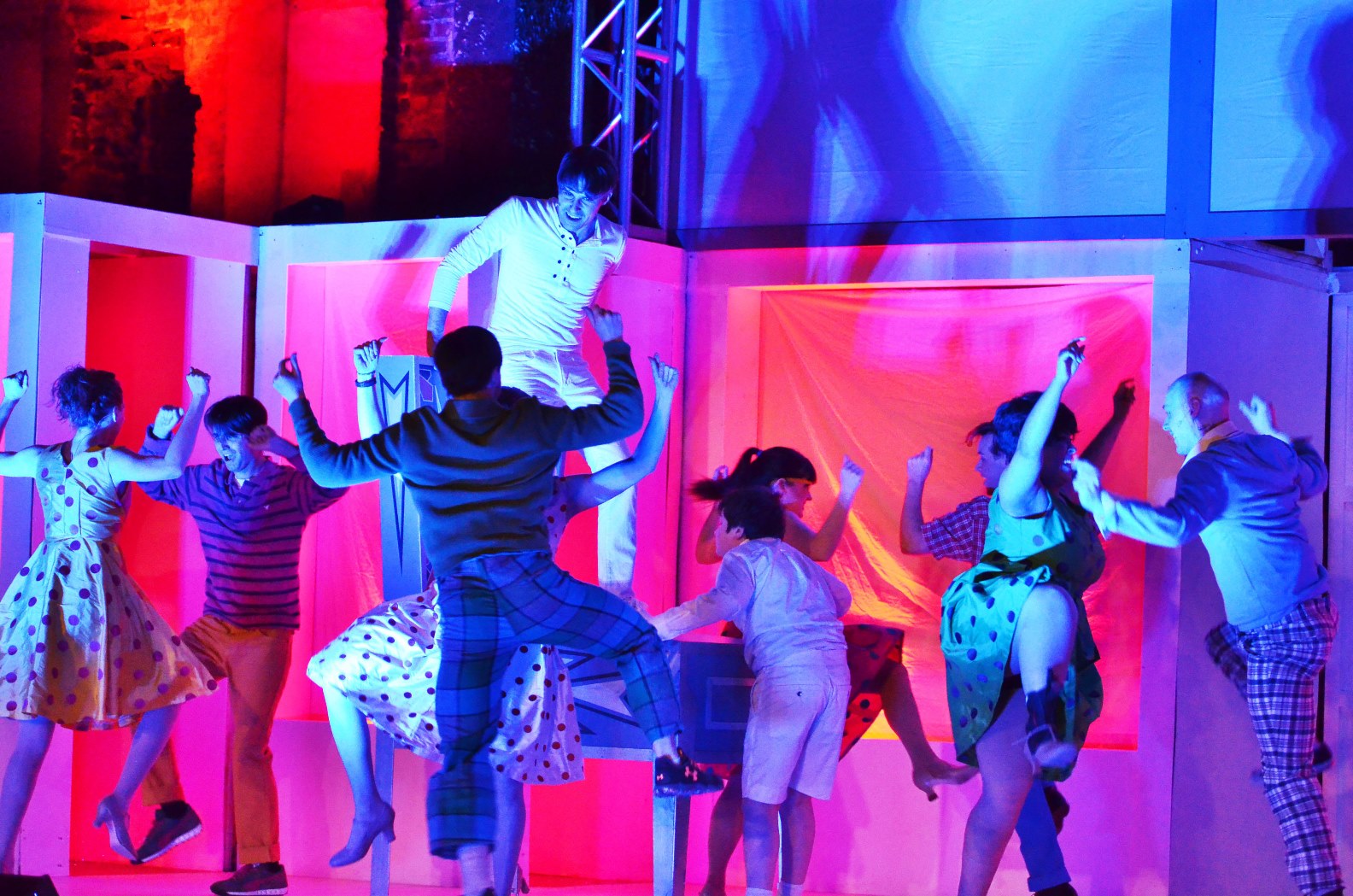
JJ Parkey as pinball wizard Tommy (center) revels in the adulation of his dancing fans while Griffin Giannone, as his 10-year-old self, racks up a score at the pinball machine in The Who’s Tommy (photo by Heather Wack)

By Richard Ades

Check out Short North Stage’s program for The Who’s Tommy, and you’ll see that Edward Carignan is billed as both the director and the choreographer. The jobs aren’t as distinct as you might assume.

There’s dancing, of course, but even when there isn’t, the scenes move along with such speed, precision and complexity that they feel like they’ve been choreographed rather than merely directed. As often happens during Short North Stage musicals, you can’t help sitting up and thinking, “Wow!”

JJ Parkey (formerly seen in the troupe’s Cabaret and Hedwig and the Angry Inch) stars as the adult version of the English title character, who becomes oblivious to the world after witnessing a shocking event at the age of 4: His father (David Bryant Johnson) returns from World War II and finds his wife (Emily Brockway) having an affair. A struggle ensues, and the lover (Jason Carl Crase) is killed.

Over the years, the helpless Tommy endures mistreatment at the hands of his perverted Uncle Ernie (Ryan Stem) and sadistic Cousin Kevin (Josh Houghton). He also is subjected to his parents’ endless attempts to “cure” him with the help of either science or religion. Nothing can break him out of his mental prison.

Then Tommy stumbles across a pinball machine and proves to have so much innate skill at the game—possibly because his disabilities eliminate all distractions—that he becomes a minor celebrity.

Much more happens, including Tommy’s eventual rise from a minor celebrity to a major one, but the musical reaches its high point when our hero discovers his unexpected talent to the tune of the rousing Act 1 capper, Pinball Wizard. Post-intermission developments never attain this level of emotional power.

Musically speaking, however, it’s a different matter. Composer/lyricist/co-book writer Pete Townshend, with help from bandmates John Entwistle and Keith Moon, has filled the album-based musical with songs that not only advance the plot but are memorable in their own right.

At Thursday’s preview, conductor P. Tim Valentine’s backstage band sometimes overwhelmed the singers and rendered lyrics indecipherable. Hopefully, a few tweaks on the soundboard will improve that situation.

In the leading role, Parkey’s vocals are as strong as ever, though some of his Act 2 dialogue comes off as stilted. Two young brothers, Christian and Griffin Giannone, give poised performances as Tommy at ages 4 and 10, respectively.

The rest of the cast is uniformly good, but Kendra Lynn Lucas stands out for making the most of her showy role as the drug-pushing Acid Queen. Another indelible impression is made by Tommy Batchelor (a former Billy Elliot on Broadway), who emerges from the ensemble to give an amazing balletic dance solo during the Act 2 Underture.

Rob Kuhn’s scenic and lighting designs are complementary, as the set is a series of white doors and panels that goes through chameleonic changes whenever the lighting changes hues. Director Carignan’s costume designs are inventive and colorful.

First appearing as a double album in 1969 and as a stage show in 1992, The Who’s Tommy helped to found the genre of the rock musical. In 2014, its audacity and musical sophistication still inspire awe.

Short North Stage will present The Who’s Tommy through April 27 at the Garden Theater, 1187 N. High St. Show times are 8 p.m. Thursday-Saturday and 3 p.m. Sunday. Running time: 2 hours, 35 minutes (including intermission). Tickets are $25-$40. 614-725-4042 or shortnorthstage.org.

Annual theater celebration features awards, speeches, songs

Matt Clemens (seen sharing a scene with Laura Griffith) received a Theatre Roundtable award for his leading role in Short North Stage's production of Sunday in the Park With George (photo by Megan Leigh)
Matt Clemens (seen sharing a scene with Laura Griffith) received a Theatre Roundtable award for his leading role in Short North Stage’s production of Sunday in the Park With George (photo by Megan Leigh)

By Richard Ades

It’s all over but the Facebook posts.

The Central Ohio Theatre Roundtable held its annual awards night Sunday at the Jewish Community Center. As in the past, the fast-paced show punctuated its presentations and speeches with songs from some of the past year’s musical productions.

The treats included Matt Clemens’s emotional rendition of Finishing the Hat from Stephen Sondheim’s Sunday in the Park With George. The number provided proof that Clemens richly deserved the award the Roundtable gave him for his leading role in the Short North Stage production.

One of the night’s most heartwarming moments came when the Central Ohio Theatre Critics Circle—representing local print, on-air and online critics—presented a citation to Short North Stage for that same production. When troupe co-founders Rich Gore and Peter Yockel came onstage to accept the award, Yockel found himself getting a little choked up. That prompted Gore to observe that he hadn’t seen his partner tear up like that since their recent wedding day.

In a conversation prior to the show, the two recalled that they were just one of many same-sex couples who’d headed to New York and queued up to get hitched in a civil ceremony on Halloween. But they stood out from the crowd, they noted, being one of the few pairs who hadn’t turned up in Halloween costumes.

Two troupes received the Roundtable’s Harold Awards for, essentially, persevering: Columbus Children’s Theatre for turning 50 and Shadowbox Live for turning 25 (as measured from the appearance of Stev Guyer and company’s earliest “rock operas”). Accepting his Harold, Guyer explained why he and his cohorts had stuck it out in a profession that kept them working longer-than-average hours for lower-than-average pay.

“It’s a calling,” he said. “It’s what you do.”

Guyer also praised Columbus theatergoers who were willing to take a chance on unknown productions—such as most of those presented by Shadowbox.

For a list of other Theatre Roundtable nominees and winners, visit www.theatre-roundtable.org/trnominations/. For a list of the Central Ohio Theatre Critics Circle’s 20th annual round of citations, which were presented at Sunday’s event, see below:

▪ To CATCO and the Columbus Museum of Art, for educating Central Ohio about the power of art and the creative challenges of artists by jointly scheduling CATCO’s area premiere of Red, John Logan’s 2010 Tony winner for best play about Rothko at a pivotal point in his career, and “Mark Rothko: The Decisive Decade,” the museum’s first major exhibit of works by the abstract master.

▪ To Short North Stage, for raising the standard in locally produced musicals with an ambitious 2013 season that culminated in the long-awaited Central Ohio premiere of Stephen Sondheim and James Lapine’s Sunday in the Park With George, a challenging 1985 Pulitzer Prize winner that was brought to vivid life by blending local talents with such New York experts as sound designer Leon Rothenberg, a 2013 Tony Award winner, and director Sarna Lapine, niece of James Lapine.

▪ A Roy Bowen Lifetime Achievement Award to William Goldsmith for nurturing the talents and imaginations of tens of thousands of children and for writing and directing many popular stage adaptations of classic tales as youth theater director at Players Theatre Columbus in the 1970s and ’80s and, for 25 years since 1989, as artistic director of Columbus Children’s Theatre, a troupe that celebrated its 50th anniversary in 2013.

A look back at ‘2013: The Musical’

Japheal Bondurant as competitor William Barfee in CATCO's production of The 25th Annual Putnam County Spelling Bee (Red Generation Photography)
Japheal Bondurant as competitor William Barfee in CATCO’s production of The 25th Annual Putnam County Spelling Bee (Red Generation Photography)

By Richard Ades

2013 may be remembered as The Year of the Musical in Central Ohio. Or, more likely, as The First Year of the Musical.

In the more than two decades I’ve been reviewing local theater, musicals have always represented a small percentage of the shows I saw each year. But that’s likely to change.

A prime reason is that CATCO dropped its long aversion to the genre when Steven Anderson took over as producing director in 2010. Another reason is the ascendance of Short North Stage, a 2-year-old troupe that specializes in Sondheim’s art form.

Add to that the musicals staged by Otterbein University Theatre and the growing number staged by Shadowbox Live, including its recent collaborations with Opera Columbus. Then figure in the musicals bravely tackled by troupes that normally stick to standard fare.

The end result is a year that was teeming with musicals. And not just musicals: great musicals.

There were so many worthwhile musicals, in fact, that I’ve been forced to abandon the format I always followed at The Other Paper, which divided the nominees into categories such as Best Drama or Best Comedy. Limiting myself to one Best Musical would have forced me to ignore many of the year’s best shows. Instead, I’ve settled for naming the year’s Top 10 shows.

A couple of caveats: First, no one has time to see everything, so I’m sure I missed some award-worthy gems. And second, this is a subjective list based not only on what was done well but on what I found particularly interesting and memorable.

With that said, congratulations to the winners, and thanks to everyone who made this an exceptional year for theater in Central Ohio.

Top 10 Shows of 2013:

The 25th Annual Putnam County Spelling Bee, CATCO. Though the Top 10 list is mostly arranged haphazardly, this was my favorite show of the year. Director Steven Anderson found both the heart and the laughs in this familiar musical, with help from a consistently wonderful cast led by Japheal Bondurant, Elisabeth Zimmerman and Ralph E. Scott.

Sunday in the Park With George, Short North Stage. The Garden Theater-based troupe sometimes imports its directors from New York, and it paid off handsomely here. Sarna Lapine (niece of James Lapine, who wrote the book and directed the Broadway premiere) gave us a Sondheim revival that was both pitch-perfect and picture-perfect. As a bonus, sound designer Leon Rothenberg found a way to tame the theater’s echo-y acoustics, which bodes well for future productions.

Passing Strange, Short North Stage. Green Day fans undoubtedly enjoyed the punk-rock anger of American Idiot, which came through town in March. But those of a thoughtful bent were more likely to enjoy this satirical take on youthful angst, which was beautifully realized by director Mark Clayton Southers and his committed cast.

Duck Variations, A Portable Theatre. The best news was that the fledgling troupe is the new home of Geoffrey Nelson, former artistic director of CATCO. The second-best news was that its premiere show paired Nelson with fellow CATCO alum Jonathan Putnam. These two sly and seasoned pros made the David Mamet comedy one of the year’s funniest shows.

Assassins, Red Herring Productions. Michael Herring’s solo springtime performance of Krapp’s Last Tape launched the rebirth of his long-dormant troupe. But nothing could have prepared us for Red Herring’s next show, a polished production of Sondheim’s most controversial musical. John Dranschak directed an A-list cast led by Ian Short and Nick Lingnofski.

Mercy Killers, On the Verge Productions. 2013’s crop of touring musicals supplied a fair amount of flashy entertainment, but none of them were as impressive or thought-provoking as this one-man touring show. Writer/actor Michael Milligan told a tragic tale that movingly dramatized the shortcomings of the U.S. health-care system.

The Whipping Man, Gallery Players/New Players Theater. If you thought there was no way to come up with a new take on the Civil War, this show proved you wrong. Matthew Lopez’s postwar drama reunited two former slaves with the wounded son of their Jewish master. The fascinating, if imperfect, tale was exquisitely directed by Tim Browning.

The Air Loom, MadLab. Local actor Jim Azelvandre has tried his hand at writing in the past, but this surreal tale is his best work to date. Azelvandre also supplied the canny direction, which ensured that the ingenious storyline and eccentric characters remained entertaining throughout.

Henry IV, Part One, New Players Theater. Besides staging The Taming of the Shrew on its outdoor stage, New Players was brave enough to tackle one of Shakespeare’s seldom-seen historical dramas. Bard-literate director Robert Behrens made 15th-century Britain come to life with the help of a lively cast led by David Tull as the hard-partying Prince Hal and John Tener as the irrepressible Falstaff.

Burlesque Behind the Curtain, Shadowbox Live. Shadowbox’s production of Spamalot was a blast, too, but Behind the Curtain deserves credit for improving on last year’s Burlesque de Voyage. Writer Jimmy Mak, director Stev Guyer and the talented players created a show that was sometimes very sexy and other times very, very funny.