Of the five films up for an international Oscar, Sirat is by far the most unsettling.
I say that without fear of contradiction, even though I have yet to see most of its competitors. Watching Spain’s nominee is simply the kind of nerve-wracking experience that few films can match.
French-born director/co-writer Oliver Laxe begins his tale as a massive rave is getting underway in the middle of the Moroccan desert. After arriving in trucks and other weather-beaten vehicles, hardcore enthusiasts begin dancing ecstatically to bass-heavy beats that echo against rocky canyon walls.
It’s into this scene that a middle-aged Spaniard named Luis (Sergi Lopez) arrives with his young son, Esteban (Bruno Nunez Arjona). Passing out fliers with pictures of his grown daughter, Luis explains that she’s disappeared to join the raver lifestyle, and he thinks she might be here.
As it turns out, no one has seen her, but Luis learns she could be at an upcoming rave happening far to the south in Mauritania. Then comes an unexpected complication followed by a fateful decision.
Ravers do their thing in an early scene from Sirat.
Soldiers arrive and order all Europeans to leave the country due to a developing military conflict. When a few ravers revolt by instead heading south toward their next gathering, Luis decides to follow, thus sending him and his son on a journey into a hellish landscape filled with dangers both natural and manmade.
“Hellish,” by the way, is an appropriate adjective, according to words that flash on the screen at the film’s beginning. Referring to Islamic beliefs concerning the path souls must follow in the afterlife, they explain that the Sirat bridge connects heaven and hell and is “narrower than a strand of hair and sharper than a sword.”
Translation: Salvation is hard to come by.
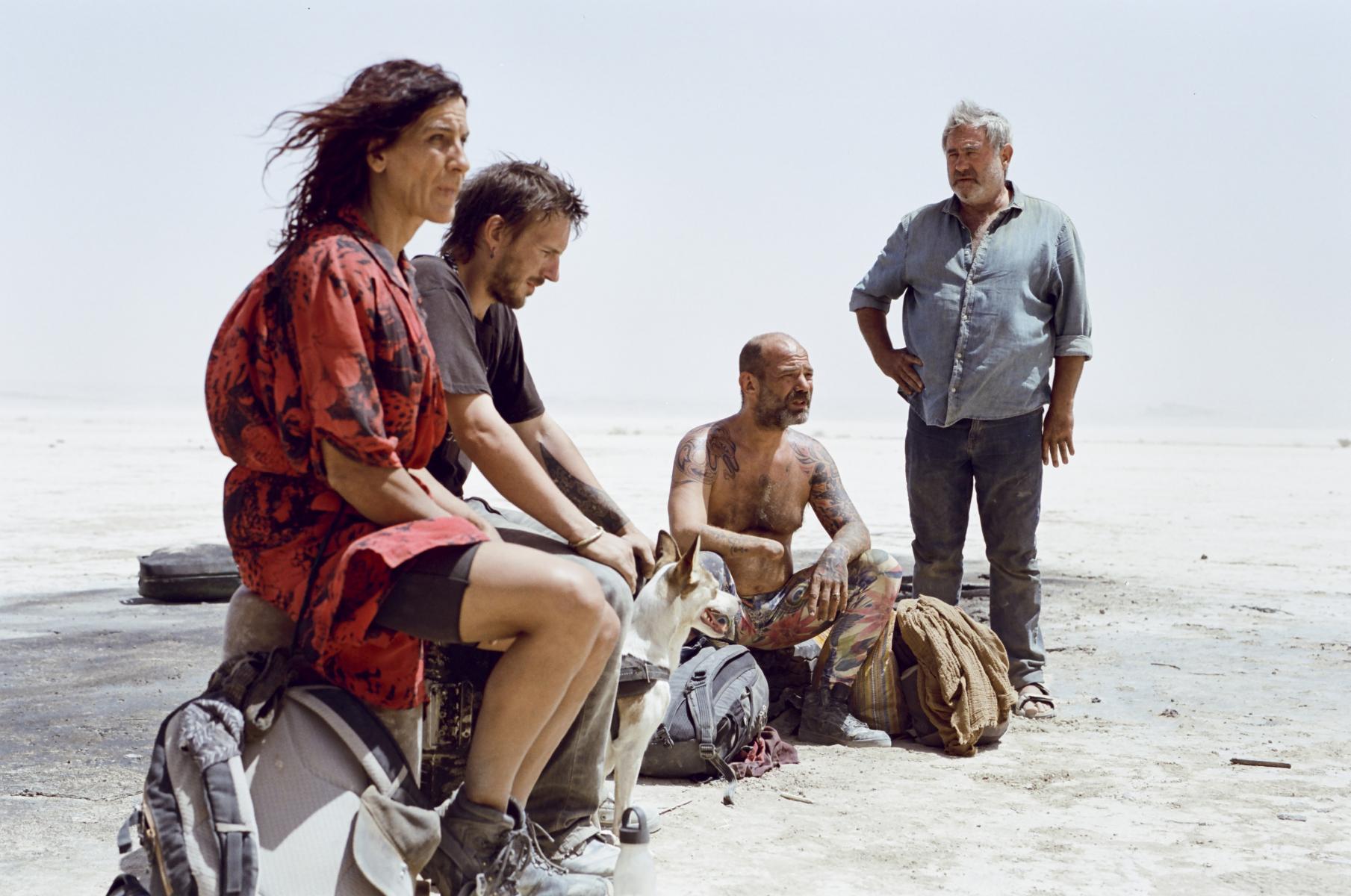
Luis (Sergi Lopez, right) with some of his newfound raver friends
For those of a spiritual bent, this offers one way to view the nightmarish trip Luis, Esteban and their adopted raver friends take as they head across the desert and over treacherous mountain roads—all the while hearing news reports of military actions that threaten to escalate into World War III.
For those of a more political bent, the trip might be seen as the emotional approximation of what it’s like to live in a world that increasingly seems at the mercy of leaders who have no compunction about starting wars and killing innocents to serve their own purposes.
However you interpret the characters’ tribulations, you can’t help but be moved by them thanks to director Laxe and collaborators such as cinematographer Mauro Herce and composer Kangding Ray, as well as a convincing cast consisting largely of gifted amateurs.
Sirat, in other words, is one painful ride.
Rating: 4 stars (out of 5)
Sirat (rated R) can be seen at select theaters, including the Gateway Film Center in Columbus, and is scheduled to expand nationwide beginning March 6.
A motion-captured Jonno Davies plays a simian version of British pop star Robbie Williams in Better Man. (Photo courtesy of Paramount Pictures)
By Richard Ades
This is the time of year when critics get a chance to catch up on recent flicks they might have missed, courtesy of studios in search of buzz and, hopefully, award nominations. While I don’t claim to be clairvoyant when it comes to the latter, I can confidently say this: If the Oscars and other competitions gave out prizes for bravery, these three films and their creators would win hands down.
One filmmaker displays creative courage by breaking the mold in a familiar genre, while the others put their liberty and even their lives at risk in order to bring their truths to the screen.
Let’s look at them one by one.
Biopic with a difference
By now, we all know the drill when it comes to film biopics: The would-be celeb claws his or her way to the top, but success comes at a steep cost. Friends are abandoned, spouses are cheated on, and alcohol and/or drugs are abused.
Better Man, based on the life of British pop superstar Robbie Williams, follows that general pattern, but with a difference. The entire story unfolds through the eyes (and narration) of Williams himself, who emerges as someone who desperately wants fame but is convinced he doesn’t deserve it.
And, oh yes: Williams is portrayed by a CGI-generated chimpanzee (a motion-captured Jonno Davies). It sounds weird—and, frankly, it is—but it also makes sense in a brilliant and emotionally satisfying way.
Even as a child, Williams suffers from self-doubt, self-loathing and what he later comes to identify as depression. By making him the lone ape in a world of humans, the film has found a clever way of symbolizing Williams’s fear that he’s an imposter unworthy of the success he seeks.
Directed with theatrical flair by Michael Gracey (The Greatest Showman), Better Man is marked by gee-whiz, over-the-top production numbers and surreal fantasy sequences, in addition to its simian protagonist. But what really sets it apart is its honesty and warmth.
Despite being depicted as an ape, Williams comes off as a recognizably flawed human who earns our sympathy, as well as the heart-on-its-sleeve sendoff the film gives him. Director Gracey’s gamble has paid off with a flick that’s as moving as it is massively entertaining.
Rating: 4½ stars (out of 5)
Better Man (rated R) opened Dec. 25 in select theaters and expands nationwide Jan. 10.
National unrest and a missing gun upset the lives of Iranian student Rezvan (Mahsa Rostami, center), her mother (Soheila Golestani, left) and sister (Setareh Maleki) in The Seed of the Sacred Fig.
Criticizing—and then escaping—Iran
As an attack on Iran’s government and justice system, The Seed of the Sacred Fig is the kind of film that can’t be made in that country. And yet veteran writer/director Mohammad Rasoulof succeeded in making it—in secret—before fleeing to Europe for his own safety.
The thriller concerns Iman (Missagh Zareh), who aspires to be a judge but learns that the path to success will force him to ignore his moral compass. He lands a position that requires him to sentence people to death without being given a chance to consider the evidence.
As it turns out, the position endangers more than just his conscience. Because of the job’s controversial nature, he and his wife, Najmeh (Soheila Golestani), and their family are forced to live in secrecy. Meanwhile, daughters Rezvan and Sana (Mahsa Rostami and Setareh Maleki) become embroiled in the widespread unrest that erupts after a young woman is beaten and killed for not sufficiently covering her head.
Then the gun that Iman keeps for protection turns up missing, and the national turmoil threatens to spread to his household as he searches for the culprit. Interrogations ensue, along with a car chase and a tense finale that may remind some of a certain horror film set in a snowbound hotel.
Considering it was made in secret and by a director who’d already gotten in trouble for earlier works, The Seed of the Sacred Fig should fill viewers with admiration for Rasoulof’s resourcefulness, as well as his courage. The film deserves an Oscar nomination, but it probably won’t get one, because who would nominate it? Certainly not Iran.
Rating: 4½ stars (out of 5)
The Seed of the Sacred Fig (PG-13) can be seen in select theaters and is scheduled to open Jan. 30 at Columbus’s Gateway Film Center.
Palestinian activist Basel Adra (left) joins forces with Israeli journalist Yuval Abraham in the documentary No Other Land.
Palestinian, Israeli expose West Bank abuses
Basel Adra has spent years documenting the Israeli army’s systematic attacks on his West Bank community, Masafer Yatta. In No Other Land, he continues that work along with Israeli journalist Yuval Abraham and fellow writer/directors Hamdan Ballal and Rachel Szor.
The result is an eye-opening expose of the abuses Adra and his Palestinian neighbors have had to endure living in the occupied territory. Houses and other buildings are destroyed on the shortest of notices and flimsiest of excuses, such as that the army needs the land for training exercises. Those who want to rebuild are told to get permits that they know are unobtainable.
Much of the film consists of footage taken with amateur video equipment or cellphones. It shows locals trying in vain to reason with soldiers, government officials and, in some cases, illegal Israeli settlers, all of whom are clearly trying to force them to abandon their rural community.
Other footage, shot by Szor, centers on the growing friendship between the Palestinian Adra and Israeli journalist Abraham, who are allied by their concern over the situation but separated by their approaches to dealing with it. Abraham is frustrated that his muckraking stories have had so little impact, but Adra counsels patience, saying a solution could take years or even decades.
The differing approaches reflect the men’s vastly different backgrounds. While Abraham is relatively new to the situation, Adra has been dealing with it for much of his life. In the face of constant, officially sanctioned abuse, he and his neighbors have no recourse but to greet it with steadfast determination and even flashes of dark humor.
Made under the most difficult of circumstances, No Other Land is a portrait of courage that is, in and of itself, an act of courage.
Rating: 5 stars (out of 5)
No Other Land is available through VOD outlets and can be seen at select theaters beginning Jan. 31.
One of many flashy moments from the touring production of MJ: The Musical (Photo by Mathew Murphy of MurphyMade)
By Richard Ades
A good fireworks show begins with a “wow” and ends with a “WOW,” filling the space in between with enough peaks to fuel our anticipation. MJ: The Musical, based on the life of Michael Jackson, follows that formula almost exactly.
The action has barely begun when the title character (an amazing Jamaal Fields-Green) launches into an MTV-worthy rendition of the Jackson classic “Whip It.” Then, nearly 2½ hours later, the show is only minutes from its finale when it delivers the song-and-dance number we’ve all been waiting for: “Thriller.”
And by the way: When I say “delivers,” imagine the word being followed by multiple exclamation points. The number is so over-the-top astounding that it alone would nearly justify the original Broadway production’s Tonys for choreography (Christopher Wheeldon, who also directs), lighting design (Natasha Katz) and sound design (Gareth Owen).
In between these two high points, it must be said, the production falls a bit short of a good fireworks show’s standards. There are impressive peaks here and there, but there are also valleys that slow down the momentum.
Set in 1992 during a rehearsal for Jackson’s upcoming “Dangerous” world tour, the jukebox musical addresses some of the rumors then swirling around the “King of Pop.” These are uncovered with help from nosy documentary maker Rachel (Cecilia Petrush) and her cameraman, Alejandro (Anthony J. Garcia).
Through flashbacks, the show also introduces us to two earlier Jackson incarnations: the Jackson 5’s pipsqueak frontman (alternately played by Josiah Benson and Bane Griffith) and the young adult seeking to launch a solo career (Erik Hamilton).
Also featured in the flashbacks are the rest of the Jackson family, including the mom, Katherine (Anastasia Talley), and dad, Joseph (Devin Bowles). Bowles plays the latter as a domineering bully who pushed his talented children relentlessly and was particularly abusive toward young Michael.
The implication is that Joseph’s behavior was responsible for MJ’s later problems, but the argument is only partially convincing. To some extent, that’s because Jackson had so many problems and eccentricities, some of which didn’t come out until after the musical’s time frame, that it’s hard to pin them all on any single source.
Despite his flaws, the one undeniable thing you can say about Michael Jackson is that he was a showman of the first degree, and MJ is most successful when it concentrates on that fact. Along with singing, dancing was obviously central to his appeal, and his devotion to the craft comes out brilliantly in an Act II fantasy that shows him trading steps with virtuosos who apparently inspired him: Fred Astaire, Bob Fosse and the tapdancing Nicholas Brothers.
Though all of the cast members sing and dance well, it clearly takes a special skillset to portray someone as unique as Michael Jackson. In the original Broadway production, Myles Frost filled the bill and thereby won the show’s fourth and final Tony.
In the current touring production, Fields-Green displays the voice, the moonwalk and all the other flourishes that won the King of Pop his title. (Jordan Markus alternates in the role at some performances.)
Fields-Green’s portrayal, backed up by a stellar band and some of the most awe-inspiring stagecraft you’ll ever see, makes MJ a pulse-quickening trip down memory lane.
MJ: The Musical runs through Sept. 15 at the Ohio Theatre, 39 E. State St., Columbus. Showtimes are 7:30 p.m. through Friday, 2 and 7:30 p.m. Saturday, 1 and 6:30 p.m. Sunday. Running time: 2 hours, 40 minutes (including intermission). For ticket information, visit columbus.broadway.com. For information on future tour stops, visit tour.mjthemusical.com.
Dr. Ethan Kochar (Sathya Sridharan) works on the machine he hopes will allow him to isolate parts of his personality.
By Richard Ades
Do you like an intellectual challenge? Then Minor Premise may be the film for you.
Do you like an intellectual challenge with a reward at the end? Then maybe it’s not the film for you—or maybe it is, depending on how you interpret the puzzling finale.
Eric Schultz, adapting and directing a story originally written by Thomas Torrey and Justin Moretto, has created a real brain teaser that has to do with—well, the brain. It centers on Ethan Kochar (Sathya Sridharan), a neuroscientist who’s trying to build on his late father’s work by creating a machine that allows a person to control his or her consciousness.
Ethan hopes the gizmo will help him isolate his intellect from other parts of his personality in order to aid his research. But, of course, something goes wrong, as he could have predicted if only he’d read Robert Louis Stevenson’s cautionary tale about Dr. Jekyll and Mr. Hyde. Ethan succeeds in isolating his intellect, but he also isolates nine other aspects of his personality, which then take turns controlling his body for intervals of six minutes each.
Complicating an already complicated situation, each version of Ethan has no memory of what the others have done, forcing him to rely on security cameras and other aids to figure out what’s going on. Fortunately for him, former girlfriend and fellow neuroscientist Alli Fisher (Paton Ashbrook) soon drops by and offers to help him sort things out.
Dr. Alli Fisher (Paton Ashbrook) helps Ethan chart the personality traits that take turns controlling him, though they haven’t quite figured out No. 8.
As difficult as it is for Ethan to understand his bizarre predicament, it’s nearly as hard for viewers, as Schultz likes to make sudden jumps in time and sometimes throws in flashbacks depicting the scientist’s difficult relationship with his late father (Nikolas Kontomanolis) and others. But once we grasp that each hour of Ethan’s life is now divided into six-minute segments respectively dominated by traits such as anger, libido and creativity, it’s kind of fun to guess how he’ll react to each—and whether he and Alli will find a way to end the relentless cycle.
In an attempt to add humanity to this overtly cerebral tale, Schultz suggests that at least some elements of Ethan’s psyche don’t want to return to normal, since normal is being a recluse whose suspicion and self-centeredness have alienated him from people who’ve tried to help him. This tack would work better if the flick’s frenzied style didn’t make it so hard to know and care about the scientist.
But a bigger problem is an ending that will leave many viewers wondering just what happened and how they’re supposed to feel about it. After sitting through a film that forces us to work so hard, it’s kind of a bummer.
Rating: 3 stars (out of 5)
Minor Premise (no MPAA rating) is available beginning Dec. 4 through theaters, virtual cinemas and VOD outlets.
Allison and Rory O’Hara (Carrie Coon and Jude Law) are living uncomfortably beyond their means. (Photos courtesy of IFC)
By Richard Ades
Several times during The Nest, Rory O’Hara (Jude Law) is seen delivering a morning cup of coffee to his still-sleeping wife, Allison (Carrie Coon). The significance of the recurrent scene changes over time.
At first, it appears to show a thoughtful husband taking part in one of the comfortable rituals that mark a successful relationship. Later, it appears to say more about the wife. Does her tendency to sleep late symbolize her apparent ability to put off dealing with the problems that have long been developing in their marriage?
The first hint of trouble comes when Rory tells Allison they must leave their ritzy American home—which includes ample space for her to ply her trade as an equestrian instructor—and return to his native London. Things just aren’t working out here, he says, and besides, his old company is begging him to return (which, it turns out, is a lie).
Allison briefly complains that they’ve already moved several times for similar reasons, but she ultimately gives in. So, after shipping her favorite horse to the UK, she sets off for London with their two kids, teenage Samantha (Oona Roche) and 10-year-old Benjamin (Charlie Shotwell). There, Allison is surprised to learn that Rory has already leased a farm with a gigantic mansion worthy of landed gentry. This begins ringing belated alarm bells, particularly after she finds that Rory is allowing their bills to go unpaid.
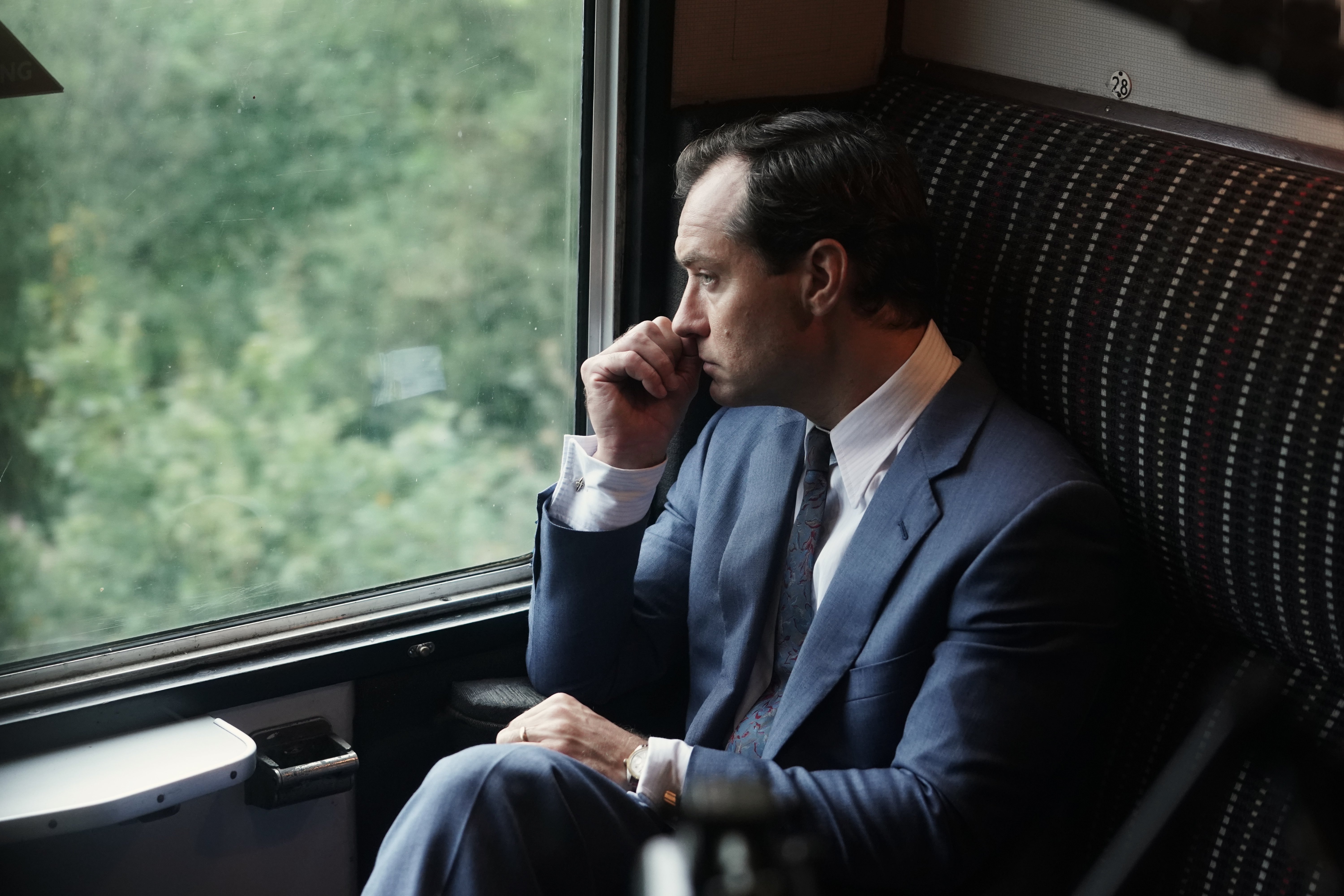
Rory (Jude Law) has a contemplative moment.
Written and directed by Sean Durkin, who’s best known for 2011’s tense Martha Marcy May Marlene, The Nest often comes off as a thriller or even a horror film. Spooky music, baroque interiors and a horse’s terrified screams may even make you wonder whether the family’s new home is haunted. Both Samantha and Benjamin seem to suspect it is, the younger boy being particularly terrified.
Essentially, though, this is the tale of a family unraveling because it’s headed by a man who insists on chasing elusive fantasies of success. To the extent that the film itself succeeds, it’s because all four of the principal players are wonderful, starting with Law as a driven individual incapable of recognizing his own delusions and limitations.
To the extent the film fails, on the other hand, it’s because Durkin works harder at creating an atmosphere than he does at establishing relatable characters. He doesn’t make us care enough about these people, and he then compounds the problem by telling their tale in a leisurely manner.
The film somewhat makes up for its deficiencies with an ending that offers at least partial closure, but viewers should be aware that patience is required along the way.
Rating: 3 stars (out of 5)
The Nest (rated R) is available from VOD outlets beginning Nov. 17.





 Reel Time With Richard Ades