She forged a new way to look at racism

Aunjanue Ellis-Taylor stars as author Isabel Wilkerson in Origin. (Photos by Atsushi Nishijima/courtesy of Neon)

By Richard Ades

Isabel Wilkerson’s 2020 book Caste: The Origins of Our Discontents was praised for its incisive comparison between racial repression in the U.S. and repressive systems in other countries. In particular, it looked at India’s caste system and Nazi Germany’s genocidal antisemitism.

Now writer-director Ava DuVernay has transformed that best-selling book into a semibiographical movie called Origin, which explains the challenges Wilkerson faced as she was formulating her provocative ideas. Besides facing pushback from African Americans and others who questioned her thesis, we learn, she lost several beloved members of her family.

DuVernay, who wrote the script with Wilkerson herself, apparently hopes these personal tragedies will inject enough drama into the film to prevent it from coming off as a mere lecture.

Wilkerson (Aunjanue Ellis-Taylor, right) is comforted by her husband, Brett (Jon Bernthal).

First, the bad news: It still comes off largely as a lecture despite solid acting by Aunjanue Ellis-Taylor (as Wilkerson) and the rest of the cast. But the good news is that the lecture imparts enough details about Wilkerson’s revolutionary thesis to be worthwhile. Those who haven’t read the book will find it enlightening, while those who have read it may see it as a useful recap.

In a nutshell, Wilkerson contends that our country’s history of repression toward Blacks—from slavery and racist laws to the recent murders of innocent African Americans such as Trayvon Martin—has much in common with other societies’ attempts to devalue certain groups and depict their members as less than human.

In India, that group is the Dalits (formerly known as the Untouchables), who often are denied educational opportunities and relegated to the most menial of jobs. In Nazi Germany, of course, that group was the Jews.

Throughout the film, historical incidents are recreated to give the victims and perpetrators of repression a human face. Among others, we meet a Black couple and a White couple who worked undercover to understand racism in the Jim Crow South. We also meet a Gentile man and a Jewish woman who fell in love in Germany during the rise of Naziism.
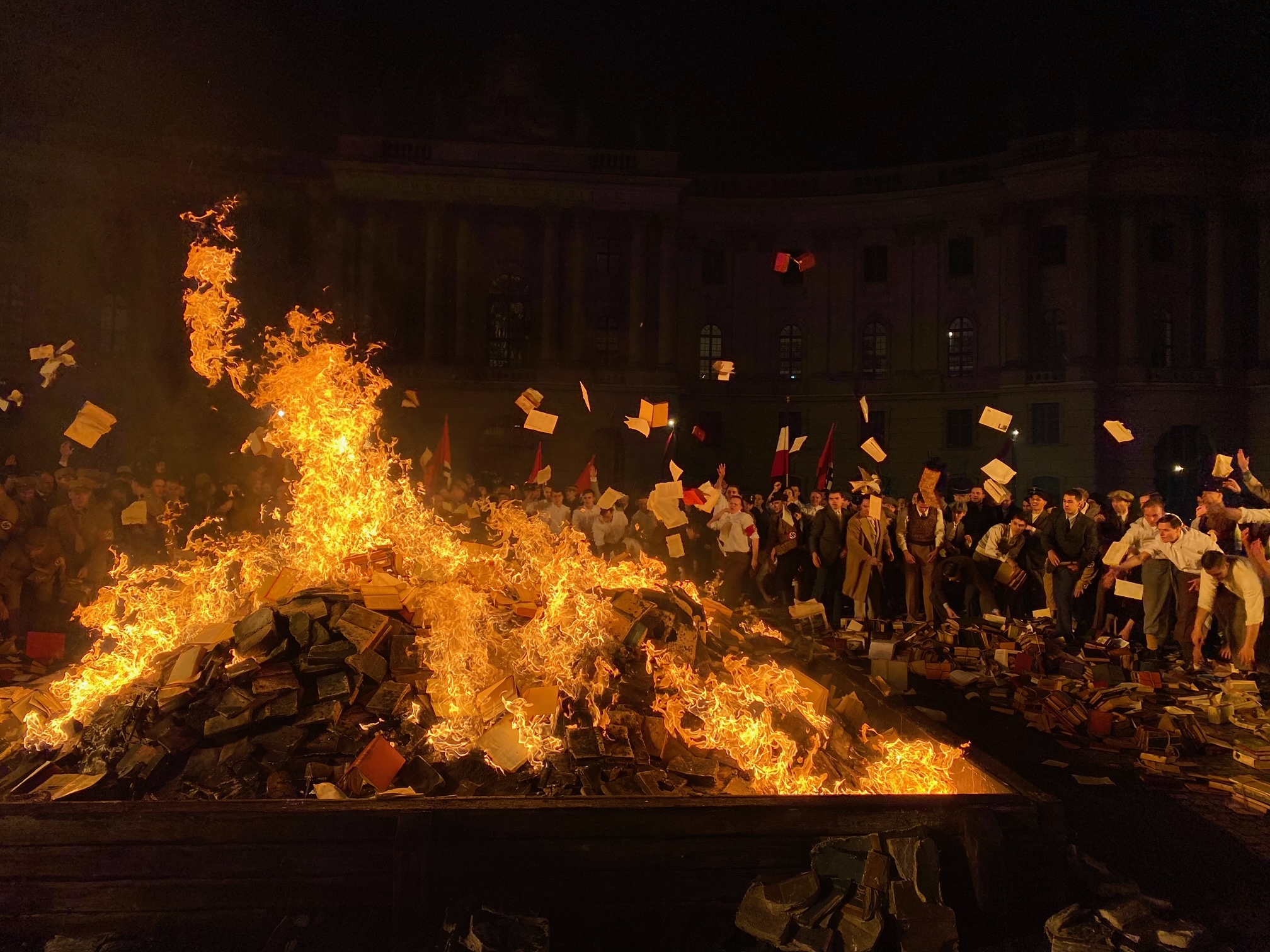
Nazis hold a public book burning in a scene from Origin.

Dramatically, perhaps the most effective of these recreations involves a young Black baseball player who wasn’t allowed to swim when his White teammates dropped by the local pool. Historically, the most shocking scene (for those unfamiliar with Wilkerson’s book) shows Nazi officials patterning Germany’s antisemitic laws after American laws that relegated Blacks to second-class citizenship.

In the more contemporary scenes involving Ellis-Taylor’s Wilkerson, the other major cast members include Jon Bernthal as her husband, Brett; Emily Yancy as her mother, Ruby; and Niecy Nash as her cousin, Marion.   

DuVernay’s 2014 film Selma was a fascinating look at Martin Luther King and the pivotal role he played in the Civil Rights movement. The director’s new film may not be as dramatically effective, but it is every bit as illuminating.

Rating: 3 stars (out of 5)

Origin (PG-13) can be seen in theaters nationwide.

Black writer rebels against tired stereotypes

Thelonius “Monk” Ellison (Jeffrey Wright) resents fellow writers who trade in racial stereotypes. (Photo by Claire Folger/Orion Pictures Inc.)

By Richard Ades

American Fiction’s opening credits are accompanied by funky music reminiscent of ’70s “blaxploitation” cinema. That efficiently sets us up for the flick’s satire of entertainment that trades in Black stereotypes.

If only the satire itself were delivered as efficiently. Instead, director/co-writer Cord Jefferson mixes it in with a series of family and personal tragedies and challenges that delay and dilute its message.

It’s all pleasantly entertaining, thanks largely to a fine cast led by Jeffrey Wright. It’s just not as pointed as it might be.

Wright plays Thelonius “Monk” Ellison, an L.A.-based writer of brainy books that struggle to find an audience. While attending a book festival in Boston, his hometown, Monk is frustrated to find that most of the attention is being grabbed by up-and-coming author Sintara Golden (Issa Rae) and her best-selling tale of inner-city life, We’s Lives in da Ghetto.

Author Sintara Golden (Issa Rae, left) and a fawning interviewer (Nicole Kempskie) discuss Sintara’s acclaimed novel, We’s Lives in da Ghetto. (Photo courtesy of Orion Pictures Inc.)

Sintara’s success, combined with Monk’s failure to find a publisher for his latest ultra-intellectual effort, confirms his view that African American writers can’t sell books unless they fill them with stereotypical representations of Black existence. In other words, they have to be immersed in crime, poverty, anger, drugs and violence.

In an effort to dramatize the absurdity of the situation, Monk dashes off an exaggerated version of such a book and instructs his agent (John Ortiz) to market it under the pen name Stagg R. Leigh. Anyone who’s seen The Producers will probably guess what happens next: Much to Monk’s chagrin, this supposed loser is snapped up by eager publishers who see it as a surefire hit.

This forces Monk to play the part of the fictitious author, who’s supposedly a street-wise escaped felon, while interacting with various bigwigs who not only want to publish the book but to turn it into a Hollywood blockbuster. The result is comedic and satirical gold.

Monk’s brother, Clifford (Sterling K. Brown), makes an unexpected appearance in the family pool. (Photo courtesy of Orion Pictures Inc.

Before we get to that point, however, Monk’s life is hit with several complications, including an unexpected death, a mother (Leslie Uggams) who’s stricken with Alzheimer’s, an estranged brother (Sterling K. Brown) who recently came out as gay and an amorous neighbor (Erika Alexander).

These and other developments are generally handled well, but they do nothing to advance the flick’s frontal attack on an entertainment industry that too often deals in racial stereotypes.

The film reclaims its satirical edge with an unconventional finale that debates just what kind of story it meant to tell. That’s a clever and all-too-appropriate way to wrap things up, since it’s apparent that first-time filmmaker Jefferson, as talented as he is, never quite made up his mind.

Rating: 3½ stars (out of 5)

American Fiction (rated R) opens Dec. 11-12 in theaters nationwide.

Critics name the best of 2023

The 22nd annual Columbus Film Critics Association Awards, honoring the best in film for 2023, were announced on Jan. 4. The winners are listed below.

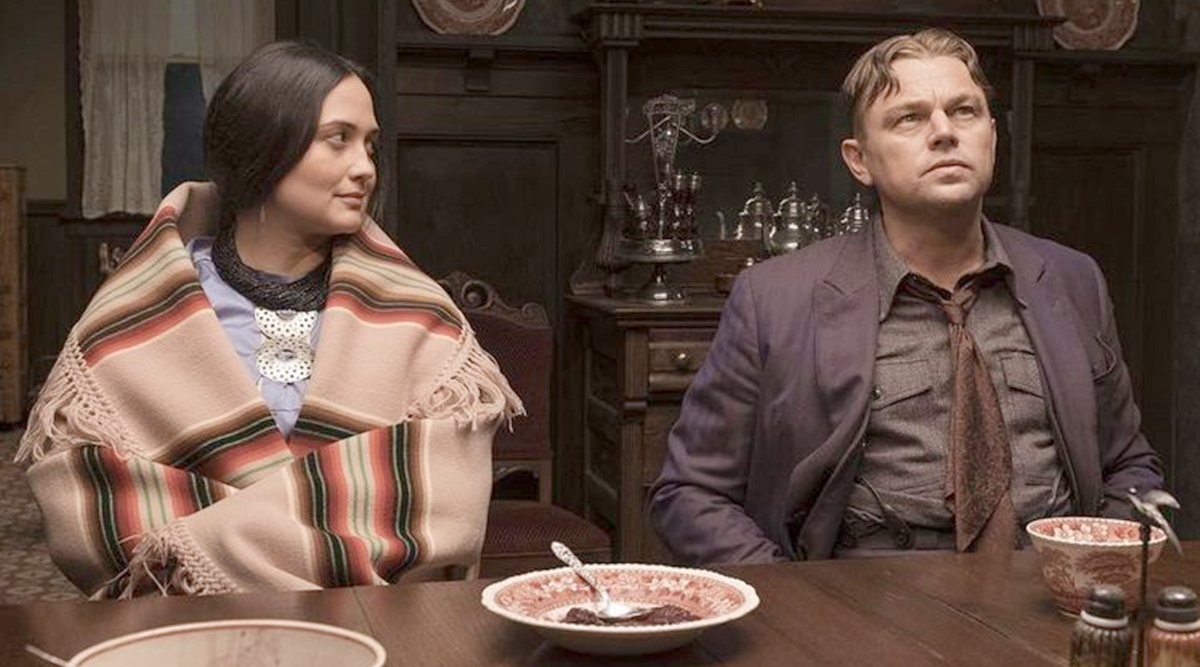
Lily Gladstone (left) and Leonardo DiCaprio in Killers of the Flower Moon, winner of several honors in the Columbus film critics’ annual poll

Best Film

  1. Killers of the Flower Moon
  2. The Holdovers
  3. Poor Things
  4. Past Lives
  5. Oppenheimer
  6. Barbie
  7. American Fiction
  8. The Zone of Interest
  9. Spider-Man: Across the Spider-Verse
  10. The Iron Claw

Best Director

  • Martin Scorsese, Killers of the Flower Moon
  • Runner-up: Greta Gerwig, Barbie

Best Lead Performance

  • Emma Stone, Poor Things
  • Runner-up: Lily Gladstone, Killers of the Flower Moon

Best Supporting Performance

  • Jodie Foster, Nyad
  • Runner-up: Da’Vine Joy Randolph, The Holdovers

Best Ensemble

  • Killers of the Flower Moon
  • Runner-up: Poor Things

Actor of the Year (for an exemplary body of work)

  • Sandra Hüller, Anatomy of a Fall (Anatomie d’une chute) and The Zone of Interest
  • Runner-up: Jeffrey Wright, American FictionAsteroid City and Rustin

Breakthrough Film Artist

  • Lily Gladstone, Killers of the Flower Moon – (for acting)
  • Runner-up: Celine Song, Past Lives – (for directing and screenwriting)

Best Cinematography

  • Robbie Ryan, Poor Things
  • Runner-up: Rodrigo Prieto, Killers of the Flower Moon

Best Film Editing

  • Thelma Schoonmaker, Killers of the Flower Moon
  • Runner-up: Jennifer Lame, Oppenheimer

Best Adapted Screenplay

  • Kelly Fremon Craig, Are You There God? It’s Me, Margaret.
  • Runner-up: Eric Roth and Martin Scorsese, Killers of the Flower Moon

Best Original Screenplay

  • David Hemingson, The Holdovers
  • Runner-up: Justine Triet and Arthur Harari, Anatomy of a Fall (Anatomie d’une chute)

Best Score

  • Robbie Robertson, Killers of the Flower Moon
  • Runner-up: Ludwig Göransson, Oppenheimer

Best Documentary

  • (Tie): Anselm (Anselm – Das Rauschen der Zeit) and Kokomo City
  • Runners-up (tie): 20 Days in Mariupol and Still: A Michael J. Fox Movie

Best Foreign Language Film

  • Afire (Rotter Himmel)
  • Runner-up: Anatomy of a Fall (Anatomie d’une chute)

Best Animated Film

  • Nimona
  • Runner-up: Spider-Man: Across the Spider-Verse

Frank Gabrenya Award for Best Comedy

  • The Holdovers
  • Runner-up: American Fiction

Best Overlooked Film

  • Are You There God? It’s Me, Margaret.
  • Runner-up: Showing Up