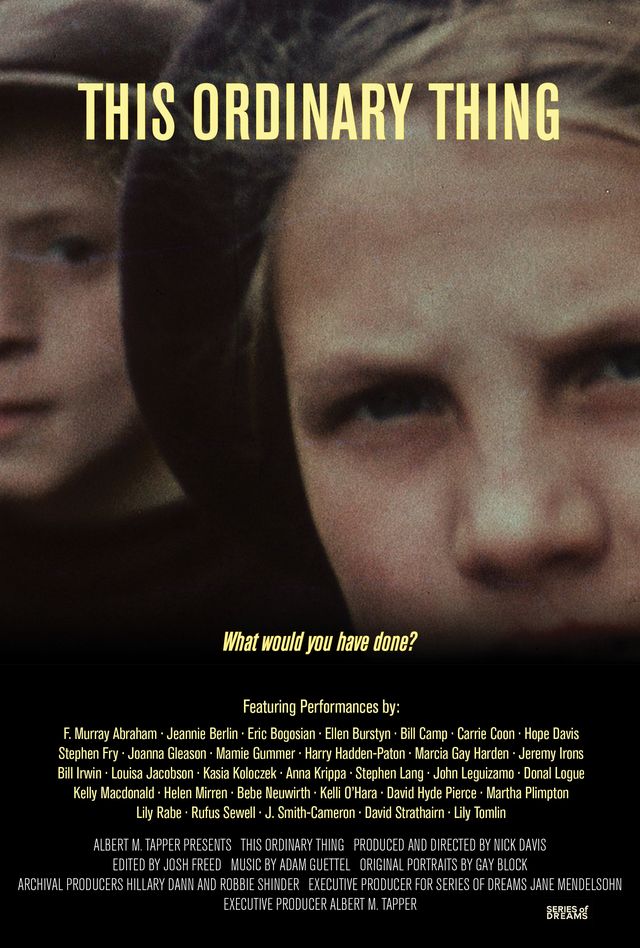
Remembering heroes who defied Hitler to save Jewish lives

By Richard Ades

When Schindler’s List was released in 1993, viewers probably saw its hero as one of a kind. German businessman Oskar Schindler may have stuck his neck out to help Jews survive the Holocaust during World War II, but it was assumed few others were willing to do the same.

That assumption was wrong, according to the new documentary This Ordinary Thing. Written and directed by Nick Davis, the film tells the stories of dozens of people who risked Nazi wrath to come to the aid of their Jewish friends and neighbors.

As we learn, those people were spread across multiple countries that fell under Hitler’s domination, including Germany itself, France, the Netherlands, Poland, Hungary, Ukraine, Belgium and Yugoslavia.

Davis tells these heroes’ stories in more or less their own words, based on accounts of their ordeals that were recorded in the late 1980s. Excerpts from those accounts are delivered off-camera by top-tier actors—F. Murray Abraham, Ellen Burstyn, Jeremy Iron and Helen Mirren, just to name a few—and illustrated by archival scenes of wartime life.

These are startling tales of courage and compassion, involving people who refused to say “no” when asked to hide or otherwise aid fellow countrymen who happened to be Jewish. Doing so was clearly the right thing to do, but it was also the dangerous thing to do. In a few cases, they were found out but managed to avoid imprisonment or worse with the help of bribes involving money, alcohol or even sex.

The fact that these good Samaritans have received so little attention over the years makes This Ordinary Thing even more of a can’t-miss film. However, some viewers might wish Davis had given us the chance to get better acquainted with his subjects.

With a running time of just over an hour and a format that continually skips from person to person and country to country, there is little opportunity for individuals’ personalities to emerge. And it doesn’t help that we don’t hear the actual individuals, but rather actors who are clearly playing roles.  
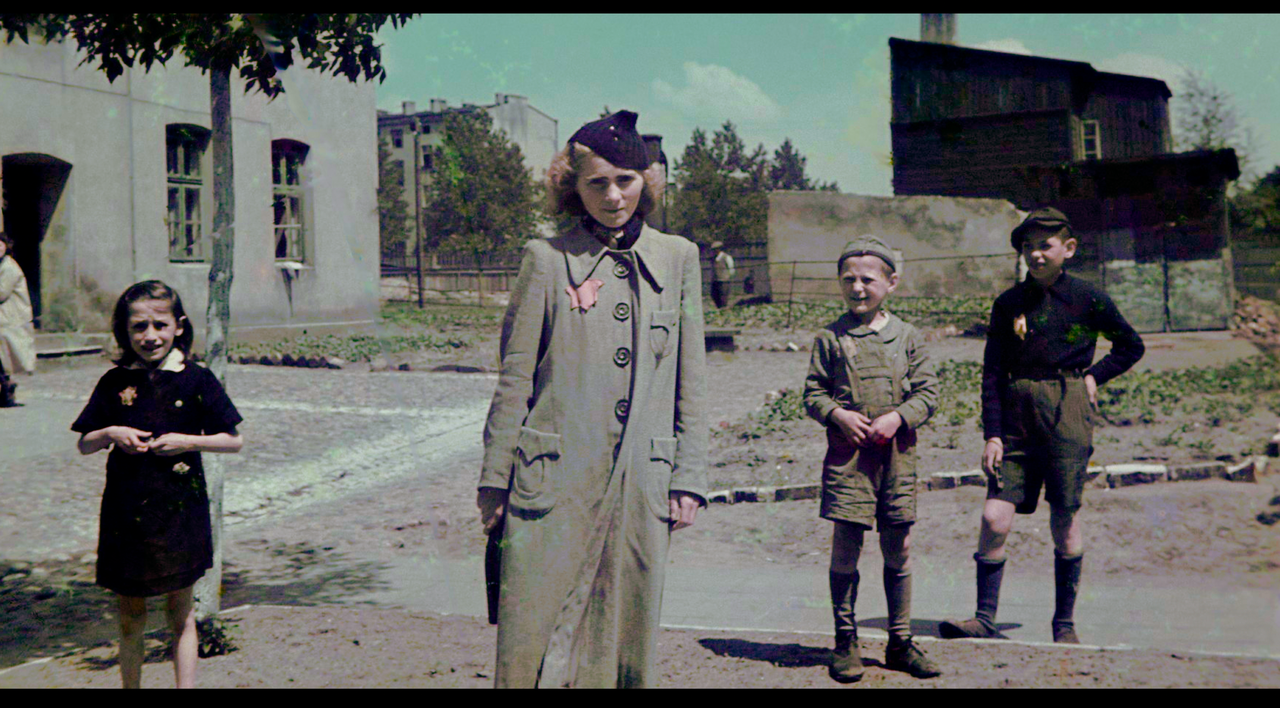
A woman and a trio of children display the stars of David that Nazis forced them to wear to reveal their Jewish identities. (Photo courtesy of Series of Dreams)

Some viewers might also be distracted by the film’s visuals, which combine actual wartime film footage with occasional re-enacted scenes, leading to the question: How much of what we’re seeing is real?

Possibly adding to the confusion, much of the archival footage is in color. Davis has said he went out of his way to find color footage, since we usually see World War II depicted in black-and-white images that make the era seem divorced from our everyday reality.

And, of course, what we’re seeing is not that divorced from our everyday reality. Though the doc doesn’t spell out the connection, it’s hard not to see parallels between Hitler’s occupied Europe and Trump’s America.

Substitute “immigrants” for “Jews,” and “ICE” for the “SS” and “Brownshirts,” and you end up with another society in which members of a minority group are being demonized and rounded up in ways that ignore their civil rights, let alone common decency.

Despite this unavoidable comparison, the film’s predominant message is a positive one: In the face of official threats and societal pressure, a surprising number of non-Jews were willing to risk everything to help save fellow citizens who were being persecuted.

Just how many of these heroes were there? It’s impossible to know, the film states, but as of 2023, the World Holocaust Remembrance Center had honored 28,217 people as “Righteous Among the Nations” for helping to save Jewish lives during World War II.

It’s a number that’s both inspiring—because of the courage and humanity it represents—and depressing—because it’s not higher.

Rating: 4 stars (out of 5)

This Ordinary Thing will be available through major VOD outlets beginning June 12.

She forged a new way to look at racism

Aunjanue Ellis-Taylor stars as author Isabel Wilkerson in Origin. (Photos by Atsushi Nishijima/courtesy of Neon)

By Richard Ades

Isabel Wilkerson’s 2020 book Caste: The Origins of Our Discontents was praised for its incisive comparison between racial repression in the U.S. and repressive systems in other countries. In particular, it looked at India’s caste system and Nazi Germany’s genocidal antisemitism.

Now writer-director Ava DuVernay has transformed that best-selling book into a semibiographical movie called Origin, which explains the challenges Wilkerson faced as she was formulating her provocative ideas. Besides facing pushback from African Americans and others who questioned her thesis, we learn, she lost several beloved members of her family.

DuVernay, who wrote the script with Wilkerson herself, apparently hopes these personal tragedies will inject enough drama into the film to prevent it from coming off as a mere lecture.

Wilkerson (Aunjanue Ellis-Taylor, right) is comforted by her husband, Brett (Jon Bernthal).

First, the bad news: It still comes off largely as a lecture despite solid acting by Aunjanue Ellis-Taylor (as Wilkerson) and the rest of the cast. But the good news is that the lecture imparts enough details about Wilkerson’s revolutionary thesis to be worthwhile. Those who haven’t read the book will find it enlightening, while those who have read it may see it as a useful recap.

In a nutshell, Wilkerson contends that our country’s history of repression toward Blacks—from slavery and racist laws to the recent murders of innocent African Americans such as Trayvon Martin—has much in common with other societies’ attempts to devalue certain groups and depict their members as less than human.

In India, that group is the Dalits (formerly known as the Untouchables), who often are denied educational opportunities and relegated to the most menial of jobs. In Nazi Germany, of course, that group was the Jews.

Throughout the film, historical incidents are recreated to give the victims and perpetrators of repression a human face. Among others, we meet a Black couple and a White couple who worked undercover to understand racism in the Jim Crow South. We also meet a Gentile man and a Jewish woman who fell in love in Germany during the rise of Naziism.

Nazis hold a public book burning in a scene from Origin.

Dramatically, perhaps the most effective of these recreations involves a young Black baseball player who wasn’t allowed to swim when his White teammates dropped by the local pool. Historically, the most shocking scene (for those unfamiliar with Wilkerson’s book) shows Nazi officials patterning Germany’s antisemitic laws after American laws that relegated Blacks to second-class citizenship.

In the more contemporary scenes involving Ellis-Taylor’s Wilkerson, the other major cast members include Jon Bernthal as her husband, Brett; Emily Yancy as her mother, Ruby; and Niecy Nash as her cousin, Marion.   

DuVernay’s 2014 film Selma was a fascinating look at Martin Luther King and the pivotal role he played in the Civil Rights movement. The director’s new film may not be as dramatically effective, but it is every bit as illuminating.

Rating: 3 stars (out of 5)

Origin (PG-13) can be seen in theaters nationwide.

Quirky tale of a boy and his führer

Jojo Rabbit
Jojo (Roman Griffin Davis, right) shares a run with his friend Adolf (Taika Waititi) in Jojo Rabbit. (20th Century Fox Film Corp.)

By Richard Ades

Those who hate war, prejudice and mass murder rightly view Adolf Hitler as one of history’s foremost villains. So it comes as a shock when a seemingly kind-hearted version of the dictator serves as a German boy’s imaginary friend in Jojo Rabbit.

Set in the chaotic final months of World War II, the dark comedy centers on the struggles of Jojo (Roman Griffin Davis), who lives with his mother (Scarlett Johansson) following the disappearance of his soldier/father under mysterious circumstances.

Jojo is a true believer in the Nazi cause and is looking forward to attending a government-run training camp for youths as the story opens. Once there, however, the 10-year-old balks at a demand that he prove his combat readiness by killing a defenseless rabbit. His refusal turns him into an object of ridicule by the instructors and everyone else.

Everyone that is, except the supportive friend that only he can see. Hitler (Taika Waititi) assures Jojo that he did the right thing and says he will be a better soldier than all the others if he learns to emulate rabbits’ survival instincts. “Be the rabbit,” he counsels the boy.

Directed by Waititi (Thor: Ragnarok), who adapted the story from Christine Leunens’s novel, Jojo Rabbit often functions as a satirical reflection on authoritarianism and prejudice. When the imagined Hitler isn’t soothing Jojo’s spirits, he’s parroting the party line on the supposedly horned and subhuman creatures known as Jews. It’s something Jojo and his real-life friend Yorki (Archie Yates) have long heard and mostly accept, even though it doesn’t always jibe with what they’ve witnessed for themselves.

Then Jojo happens to venture into an upstairs room while his mother is out and is horrified to learn she’s been hiding a Jewish teenager named Elsa (Thomasin McKenzie). As a loyal Nazi, he feels obligated to turn her in, but Elsa warns him that doing so will land his mother in trouble with the authorities. Elsa also thwarts his attempt to overpower her by deftly snatching away his party-issued knife. She’s like a “female, Jewish Jesse Owens,” Hitler later comments, sharing the boy’s indecision over how to handle the situation.

The resulting stalemate between Jojo and Elsa gradually becomes the central core of the story, taking it in new and emotionally charged directions thanks to sincere portrayals by actors Davis and McKenzie. Most of the other cast members also give carefully gauged performances, including Sam Rockwell as an eccentric German officer and Rebel Wilson as the gung-ho Fraulein Rahm. The one exception is Johansson, who never quite comes to life as Jojo’s secretive mother.

As for Waititi, he does fine in the on-screen portion of his triple contribution, making the imaginary Hitler humorously boyish without ignoring the danger he represents. As the screenwriter and director, he allows occasional sections of the film to fall flat, but he’s on target more often than not.

Given that its subject is the prime evil of the 20th century, it’s likely that not everyone will be comfortable with this quirky tale. But for those who can get into the spirit, it’s a subversive experience with an unexpectedly effective payoff.

Rating: 4 stars (out of 5)

Jojo Rabbit (PG-13) opens Oct. 31 in Columbus at the Drexel Theatre, Gateway Film Center, AMC Lennox Town Center 24 and Crosswoods Cinema.