By Richard Ades
The past year has been a scary one for Americans who believe in freedom of the press. Faced with an autocratic president who works to stifle his critics with a combination of favors, threats, lawsuits and every other means at his disposal, one media company after another has been willing to compromise its integrity.
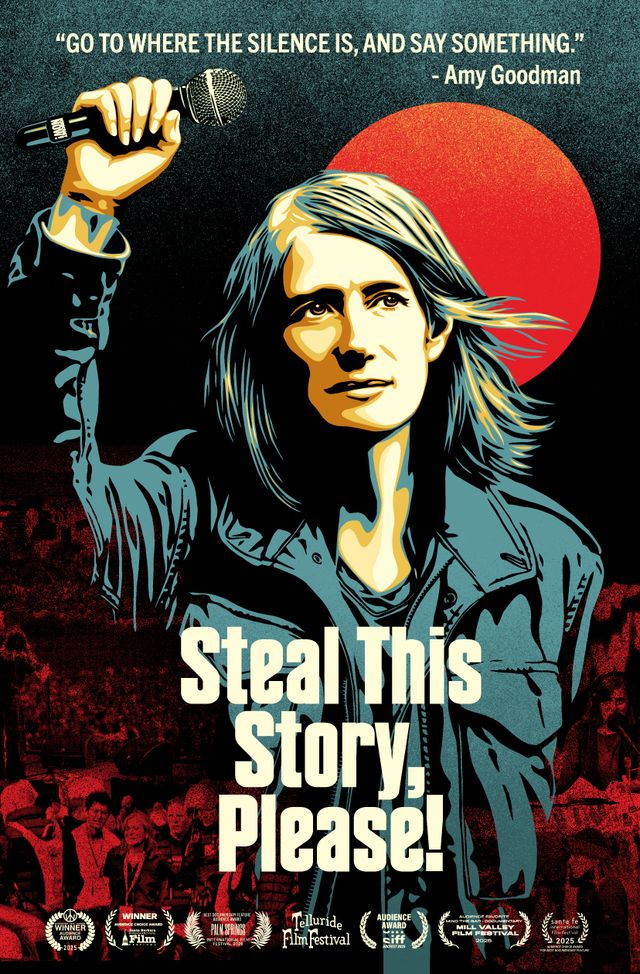
That’s what makes Steal This Story, Please! such an refreshing experience. Co-directed by Tia Lessin and Carl Deal (2008’s Trouble the Water), the documentary introduces us to Amy Goodman, a radio/TV journalist who absolutely refuses to compromise her own integrity.
Indeed, integrity seems to be baked into her character along with courage, stubbornness and—surprisingly for someone who takes her work so seriously—a sense of humor. All of these qualities come out in the doc, as they do in the 30-year-old news program Goodman founded and co-hosts, Democracy Now!
Lessin and Deal’s film, briskly edited by Mona Davis, thrusts Goodman’s gutsy style of reporting in our faces right from the get-go. The first scene shows her waylaying a Trump official and following him through crowded hallways and up and down stairs as he tries to avoid her barrage of tough questions.
It’s only after giving us this glimpse of Goodman in action that the film backtracks long enough to explain how she got into journalism in the first place. As a girl, Goodman recalls, she was involved in putting out a family “newspaper” that regularly fomented arguments with adult relatives such as her grandfather, an Orthodox rabbi.
But what finally pushed her into journalism, she explains with a twinkle in her eye, was her obsession with The Phil Donahue Show. As a young adult, she was so impressed by the popular talk show’s willingness to address controversial topics that she was determined to become involved. She bombarded staff members with inquiries but only succeeded in securing an invitation to attend an episode focusing on people like her: the unemployed.
That, Goodman concludes, made her realize she needed to find a job. So she did, becoming news director of the Pacifica radio station WBAI in New York City, a position that eventually led to the creation of Democracy Now!
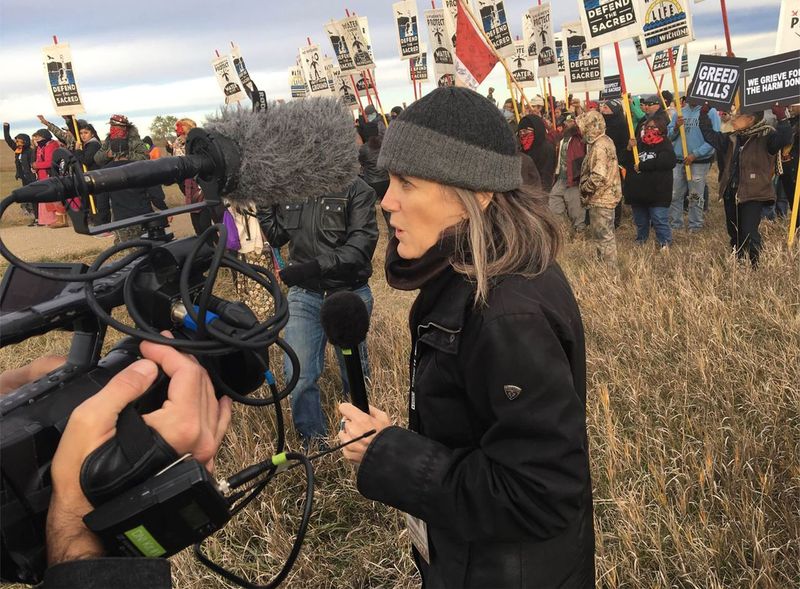
Amy Goodman covers a protest of the Standing Rock oil pipeline in 2016. (Photo courtesy of Reed Brody)
Throughout her career, the documentary reveals, Goodman has been unafraid to tackle tough, controversial stories. At times, those stories placed her in danger of arrest or much worse.
A prime example was her coverage of Indonesia’s long genocidal campaign against East Timor, a military effort carried out with weapons provided by the U.S. Goodman and colleague Allan Naim were reporting on a 1991 demonstration protesting the carnage when Indonesian soldiers attacked, resulting in hundreds of deaths.
Goodman and Naim also were beaten by the soldiers, but their ordeal paid off when their footage of the massacre was picked up by mainstream media. The result was that U.S. viewers got their first look at a tragedy that had been going on for years, helping to inspire an international protest that led to Timorese independence.
For Goodman, the incident underscored the importance of exposing atrocities done in America’s name. For viewers of the documentary, it also helps to explain the flick’s title, Steal This Story, Please! Rather than being upset when other media use her footage, Goodman is thrilled that more people are being exposed to the truths she’s trying to uncover.
After watching the film, it becomes obvious that Goodman’s devotion to reporting the truth, as she sees it, sets her apart from journalists who are satisfied with merely providing “balance”: in other words, reporting both sides of an issue, whether or not each side is equally valid. And it certainly sets her apart from media outlets that increasingly dilute their coverage to curry favor with an authoritarian president who’s willing and able to reward his friends and punish his critics.
For fans of the First Amendment—or for anyone who just wants to meet a devoted, courageous person who might help to restore their faith in humanity—Steal This Story, Please! is a must-see.
Rating: 4½ stars (out of 5)
Steal This Story, Please! is showing in select theaters and is scheduled to expand to additional outlets (including Columbus’s Gateway Film Center on May 15) in the coming weeks. For more information on Democracy Now!, visit democracynow.org.