By Richard Ades
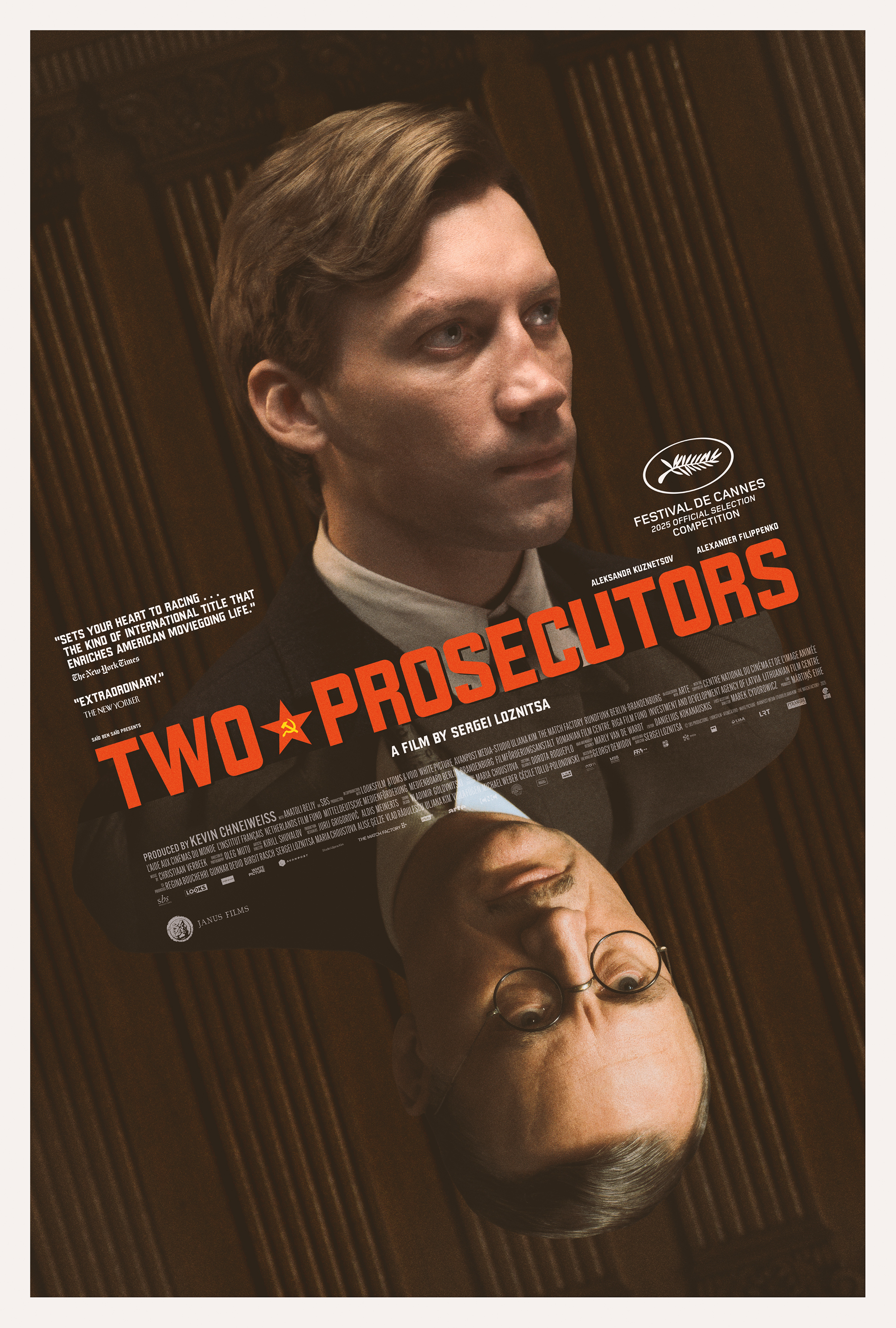
There was a time when Americans could watch political dramas like Two Prosecutors—set during the Stalinist purges of 1930s Russia—without feeling like we’re foreseeing our own future.
Since the film was written and directed by Ukraine’s Sergei Loznitsa (who adapted the story from a novel by Georgy Demidov), the obvious assumption is that it’s meant as a metaphor for Putin’s Russia. But given the prevalence of authoritarianism around the world and in our own backyard, that’s not necessarily the case.
Loznitsa himself has said the film has wider significance. “None of the existing societies, no matter how advanced and democratic, are immune to authoritarianism and dictatorship,” he told an interviewer. “This is why I believe that the great purges of 1930s still need to be studied and reflected upon.”
In the film, those purges are seen through the eyes of a young district prosecutor named Kornyev (Aleksandr Kuznetsov). Only three months into his job, he stumbles onto the realization that justice is being thwarted in the local prison.
And “stumbles” is the correct verb, as the truth would have been trapped inside the prison walls forever if an inmate hadn’t written a note asking for legal help, and if another inmate hadn’t somehow smuggled it out.
So Kornyev arrives at the prison and demands to see the original inmate, only to encounter delays and fabricated reasons why he should come back in the distant future. But he persists and eventually is ushered into the solitary cell of Stepniak (Alexander Filippenko), a political prisoner with a shocking accusation.
Stepniak claims he and hundreds of others have been arrested on false charges and tortured in the hopes that they’ll “confess.” Since local authorities may be implicated, the prisoner says, Kornyev must travel to Moscow and tell Stalin.

A young prosecutor (Aleksandr Kuznetsov) investigates claims of government-sponsored injustice in Two Prosecutors.
As a dedicated lawyer and idealistic Bolshevik, Kornyev then commits himself to a quest that we viewers, with the benefit of historical hindsight, know must fail. To some, that is the film’s fatal dramatic flaw—a flaw exacerbated by the slow pace with which it proceeds toward its inevitable conclusion.
But director Loznitsa isn’t trying to create a potboiler. Rather, he’s focused on recreating a reality in which a monster like Stalin could get away with imprisoning and murdering millions who supported the very political movement that brought him to power.
Actors Kuznetsov, Filippenko and the rest of a uniformly strong cast do their part. (Filippenko, in fact, does his part twice, as he also plays a talkative disabled veteran.)
Just as important are cinematographer Oleg Mutu and production designers Jurij Grigorovič and Aldis Meinerts, who fashion a gray, Kafkaesque world composed of narrow hallways, decrepit staircases and countless locked gates and doors.
Taken together, their efforts manufacture such a convincing world of authoritarian oppression that viewers might well imagine they live there—as, unfortunately, many of us do.
Rating: 4 stars (out of 5)
Two Prosecutors can be seen in select theaters, with openings planned April 3 in Columbus and several other cities. It expands to additional markets in upcoming weeks, including Nashville (April 10), Minneapolis (April 20) and Cleveland (April 23).