
By Richard Ades
When Schindler’s List was released in 1993, viewers probably saw its hero as one of a kind. German businessman Oskar Schindler may have stuck his neck out to help Jews survive the Holocaust during World War II, but it was assumed few others were willing to do the same.
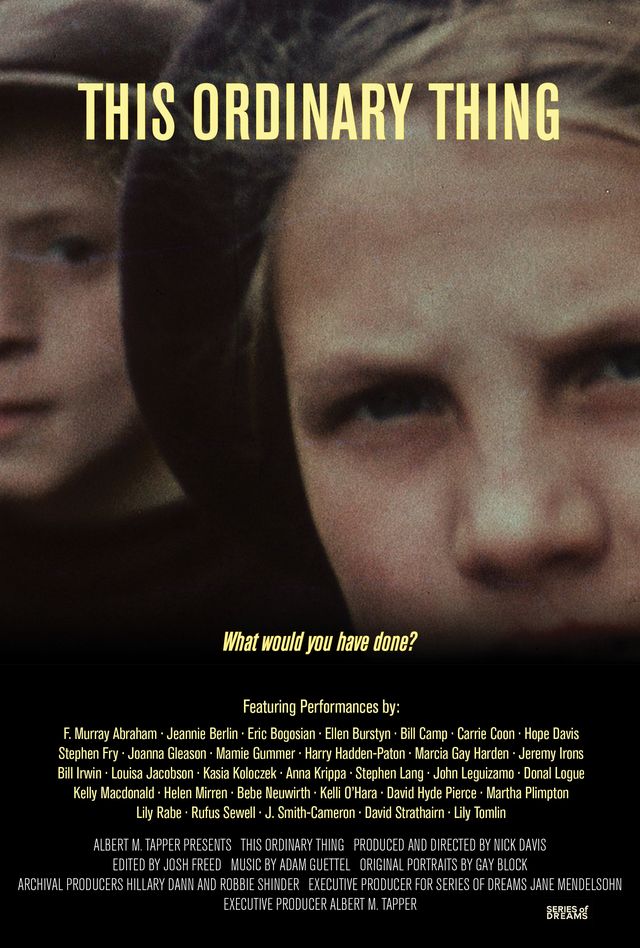
That assumption was wrong, according to the new documentary This Ordinary Thing. Written and directed by Nick Davis, the film tells the stories of dozens of people who risked Nazi wrath to come to the aid of their Jewish friends and neighbors.
As we learn, those people were spread across multiple countries that fell under Hitler’s domination, including Germany itself, France, the Netherlands, Poland, Hungary, Ukraine, Belgium and Yugoslavia.
Davis tells these heroes’ stories in more or less their own words, based on accounts of their ordeals that were recorded in the late 1980s. Excerpts from those accounts are delivered off-camera by top-tier actors—F. Murray Abraham, Ellen Burstyn, Jeremy Iron and Helen Mirren, just to name a few—and illustrated by archival scenes of wartime life.
These are startling tales of courage and compassion, involving people who refused to say “no” when asked to hide or otherwise aid fellow countrymen who happened to be Jewish. Doing so was clearly the right thing to do, but it was also the dangerous thing to do. In a few cases, they were found out but managed to avoid imprisonment or worse with the help of bribes involving money, alcohol or even sex.
The fact that these good Samaritans have received so little attention over the years makes This Ordinary Thing even more of a can’t-miss film. However, some viewers might wish Davis had given us the chance to get better acquainted with his subjects.
With a running time of just over an hour and a format that continually skips from person to person and country to country, there is little opportunity for individuals’ personalities to emerge. And it doesn’t help that we don’t hear the actual individuals, but rather actors who are clearly playing roles.
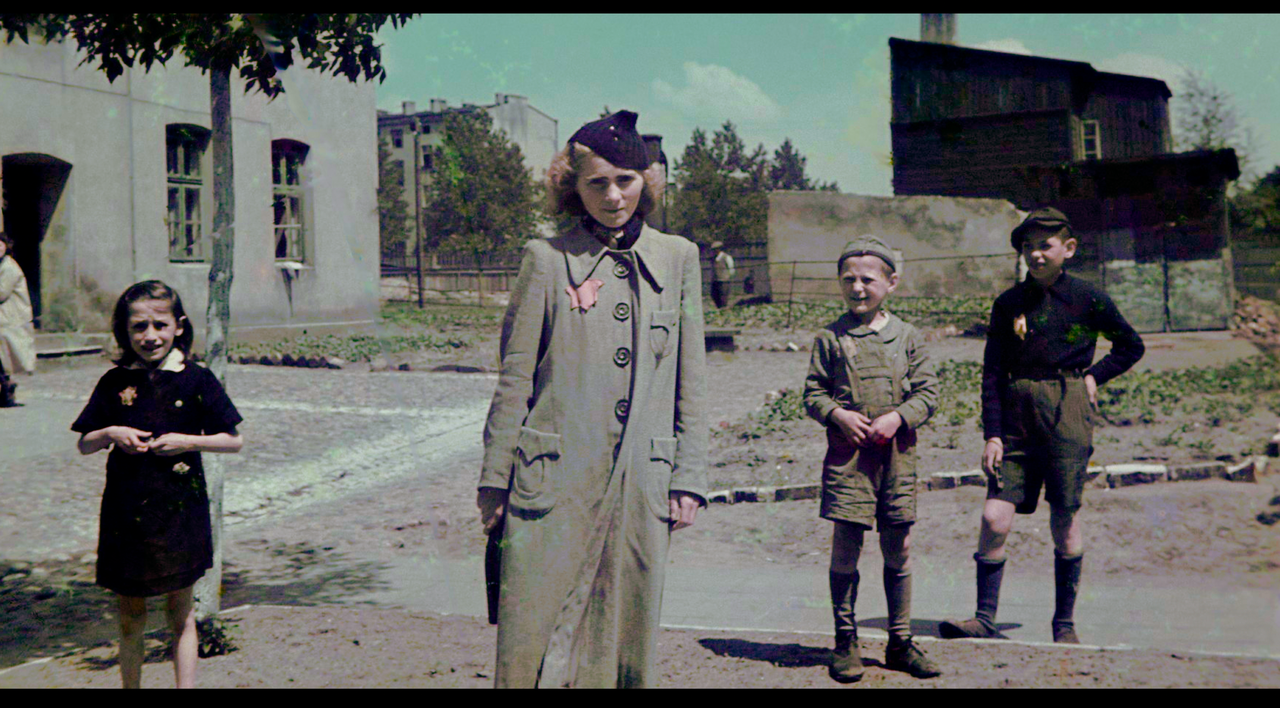
A woman and a trio of children display the stars of David that Nazis forced them to wear to reveal their Jewish identities. (Photo courtesy of Series of Dreams)
Some viewers might also be distracted by the film’s visuals, which combine actual wartime film footage with occasional re-enacted scenes, leading to the question: How much of what we’re seeing is real?
Possibly adding to the confusion, much of the archival footage is in color. Davis has said he went out of his way to find color footage, since we usually see World War II depicted in black-and-white images that make the era seem divorced from our everyday reality.
And, of course, what we’re seeing is not that divorced from our everyday reality. Though the doc doesn’t spell out the connection, it’s hard not to see parallels between Hitler’s occupied Europe and Trump’s America.
Substitute “immigrants” for “Jews,” and “ICE” for the “SS” and “Brownshirts,” and you end up with another society in which members of a minority group are being demonized and rounded up in ways that ignore their civil rights, let alone common decency.
Despite this unavoidable comparison, the film’s predominant message is a positive one: In the face of official threats and societal pressure, a surprising number of non-Jews were willing to risk everything to help save fellow citizens who were being persecuted.
Just how many of these heroes were there? It’s impossible to know, the film states, but as of 2023, the World Holocaust Remembrance Center had honored 28,217 people as “Righteous Among the Nations” for helping to save Jewish lives during World War II.
It’s a number that’s both inspiring—because of the courage and humanity it represents—and depressing—because it’s not higher.
Rating: 4 stars (out of 5)
This Ordinary Thing will be available through major VOD outlets beginning June 12.
 Reel Time With Richard Ades